One Warm Text, Three Drafts, Then One Present-Tense Question

The 11:47 p.m. Message
If one warm late-night text after three silent weeks can make you reopen the thread, rearrange your week, and think, 'maybe the timing changed,' I know the right-person-wrong-time loop from the inside.
Jordan (name changed for privacy) sat across from me in a charcoal coat still damp from the Toronto rain. She had the polished focus of someone who could write a clean campaign brief at work, but her phone lay face-up between us like a small emergency beacon. Three Notes-app drafts waited beneath the message: Hey, good to hear from you, I was thinking about you too, and one unfinished sentence asking what they actually wanted.
At 11:47 p.m. the previous Thursday, their name had lit up her screen after three quiet weeks: Hey, I was thinking about you. The radiator had clicked behind her, rain had tapped the balcony glass, and the blue light had made her hand look almost transparent. She drafted three replies, deleted the direct question, and spent the next morning rereading six weeks of messages.
'Why do I keep calling it bad timing when we're never both ready?' she asked me. She wanted both of them to be ready, but she was frightened that asking what was available now would prove they might never become ready together. The wanting sat beneath her ribs like a Toronto streetcar held at the same stop with service will resume shortly glowing on the display: temporary enough to keep waiting, stalled enough to make every minute heavy.
I told her that I did not hear foolishness in the waiting. I heard hope trying to protect itself from a final answer. I also told her that the cards would not reveal the other person's private intentions or promise a reunion. They could help us compare the story of timing with the evidence of behavior. 'We can make a map of the fog,' I said. 'Then you get to decide which road belongs to you.'

Choosing a Map for Relationship Limbo
I asked Jordan to put her phone in her bag, take one slow breath, and hold the question in its present-tense form: what is actually available now? I shuffled slowly, not to summon an answer from somewhere outside her, but to give her attention a clean transition away from the glowing thread and toward the pattern in front of us.
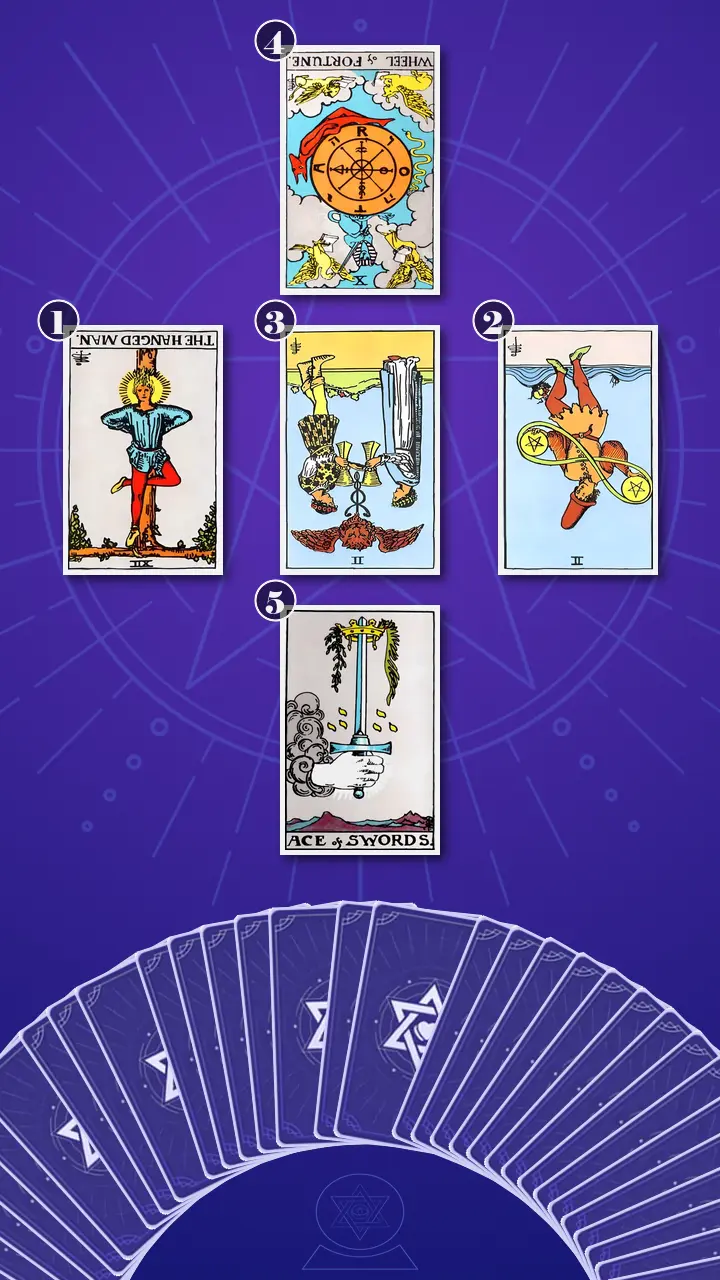
I chose the Relationship Spread · Context Edition, a five-card relationship tarot spread designed for relationship limbo and mixed signals. I explained to Jordan, and to anyone reading this, that this is how I use tarot: as a reflective structure for seeing card meanings in context, not as a verdict about another person's mind or a prediction that removes choice.
This spread was the smallest complete map for the question. It could separate Jordan's visible participation from the other person's observable availability, place the shared dynamic in the centre, expose the repeated blockage above it, and offer one self-directed next step below it. A larger spread would have added more layers without giving us better evidence.
I told Jordan where I would take her attention. The first card would show how she currently explained the pauses and what renewed contact activated in her. The second would describe the other person's communicated capacity as she experienced it, without diagnosing their private feelings. The central third card would name the repeated readiness mismatch. Above it, the fourth would show the protective story keeping the cycle intact. Beneath the centre, the fifth would become a bridge: one clear question and one boundary she could own.
The Thread Pinned in Her Mental Inbox
'I am starting with the querent's visible stance in the connection,' I said. 'This position asks how you explain repeated pauses after contact resumes, and what you keep doing before you ask what is available now.'
I turned over The Hanged Man, in reversed position.
The bound foot and calm inverted face showed me a pause that had stopped producing perspective. At 11:47 p.m., a warm check-in arrived after three silent weeks; Jordan pinned the thread back to the top of her attention, drafted several replies, and treated another round of review as if it might reveal whether the relationship had changed. The modern version of this card was a message thread marked important in a mental inbox: always visible, never moved into an active project with a clear owner or next step.
Reversed, the Hanged Man carried blocked suspension rather than chosen reflection. Jordan was not simply taking time to understand. She was remaining emotionally available to a future version of the connection while calling that availability patience. I asked her to complete the sentence, 'I tell myself I am giving it time, but what I am actually postponing is...'
She gave a small, humourless laugh. Her shoulders lifted, then settled. 'That is uncomfortably specific,' she said. 'It even feels a little brutal.'
I nodded. 'The card is not judging the fact that you hoped. It is distinguishing conscious reflection from staying on call. A new message can reopen contact without changing the conditions underneath it.'
Jordan looked down at the reversed figure, rubbed one thumb over the edge of the card, and said, 'I keep calling the same pause reflection.' The defence had not vanished, but it had become visible. That was enough for the first opening.
The Calendar Event Marked Maybe
'Now I am turning to the other person's observable stance as you experience it,' I said. 'This position is about communicated availability, pauses, and follow-through. It is not a licence to guess what they privately feel.'
The card was The Two of Pentacles, in reversed position.
The linked pentacles formed an infinity-shaped loop, and the rough sea behind the figure looked to me like workloads, competing plans, and practical capacity that never quite settled. I brought Jordan back to Tuesday at 5:36 p.m., when the other person had written, I might be free later this week. She had moved a confirmed dinner with a friend, left Thursday open, and checked her phone between Slack messages even though no day, time, or place had been agreed.
Reversed, the earth energy was unstable. Possibility was arriving in bursts, while Jordan's flexibility was filling the space where mutual scheduling should have been observable. I was not calling the other person careless or secretly committed. I was asking Jordan to separate what had actually been offered from what her open calendar had supplied.
'A new message is new contact; it is not automatically new capacity,' I told her. 'A plan becomes real when there is a day, a time, a place or call format, and mutual confirmation. Everything else can remain possibility without taking over your evening.'
Jordan glanced at her own calendar. I watched a small tightening move through her stomach and into her jaw; she pressed her lips together and then exhaled. 'I treat almost scheduled like scheduled,' she said. The sentence sounded practical, but her eyes had the look of someone noticing how much of her week had been quietly assigned to an event that did not exist.
Warmth Without a Shared Brief
'This central position asks what happens when both patterns meet,' I said. 'It shows whether closeness becomes shared definition and coordinated action, or returns to approach, pause, and renewed hope.'
I turned over The Two of Cups, in reversed position.
The two figures still raised their cups toward one another, but the orientation unsettled the promise of a completed exchange. I asked Jordan about the 12:18 a.m. voice note she had described. She had listened twice, smiled at the warmth in their voice, and felt briefly understood. The next morning, her question about meeting had gone unanswered. On the crowded Line 1 train, she had checked the thread again while the brakes shrieked and a damp wool coat pressed against her sleeve.
Reversed water showed emotional closeness without sustained mutual definition. The intimacy could be real. The mismatch could also be real. 'Warmth can be real without readiness being mutual,' I said. 'Affection is not erased by the absence of a shared plan, but the feeling alone cannot complete the exchange for both people.'
Jordan became very still. She reread the line on the table as if it had changed when she looked away. 'It felt mutual in the moment,' she said. 'So why does asking what it means feel like asking for too much?'
I asked her to place the late-night message beside the empty next-day calendar, without dismissing either one. 'What did each of you concretely do that made the connection more mutual?' I asked. 'What stayed warm but undefined?' She looked toward the rain-streaked window, and I saw recognition arrive with a little grief. A meaningful bond and an unavailable relationship could occupy the same story.
When the Wheel Returned to the Same Stop
The Fresh Start That Kept Repeating
'This is the position of the cognitive blind spot and the protective explanation,' I said. 'It asks what keeps bad timing from being tested against repeated behavior, including the fear that clarity might touch your sense of worth.'
The fourth card was The Wheel of Fortune, in reversed position.
I pictured the Wheel as a TTC loop. A vehicle moves, the stops pass, the doors open and close, yet the route can return to the same station without having taken anyone somewhere new. Jordan's message thread followed a similar circuit: warm check-in, hopeful interpretation, vague plan, silence, timing explanation. Each time the name reappeared, she called it a fresh opening before checking whether the structure of the connection had changed.
Reversed, the Wheel showed repetition made invisible by explanation. Jordan would say, 'This time feels different because work was chaotic for both of us,' or because the message sounded more vulnerable, or because the last silence had lasted longer. I asked her to finish the sentence with an observable counterpoint: 'And yet the behavior that changed was...'
Nothing came immediately. Her fingers stopped above the phone. Her gaze went soft, as though she were mentally counting previous reconnections. Then her shoulders dropped, and she whispered, 'The reason changed. The pattern didn't.'
'Motion is not the same as movement in the pattern,' I said. 'The Wheel is not fate here. It is a visual prompt to compare one turn with the last. If the behavior has not changed, a new explanation is not yet new evidence.'
Jordan swallowed. 'If I stop calling it timing, I have to admit I might be waiting for something that is not actually becoming available.'
'You may have to admit that the current form is not giving you what you need,' I said. 'That is information about the form of the relationship, not a measurement of your worth. You do not need to turn their capacity into a verdict about you.'
The Ace of Swords Opens a Clean Line
The Question Beneath the Fourteen-Message Draft
I placed the fifth card below the centre, where the spread's layout made it a bridge from the repeating cycle to an action Jordan could direct herself. 'This is the self-directed next step,' I said. 'It supports your agency without predicting or deciding the other person's response.'
The card was The Ace of Swords, in upright position. The hand emerged from a cloud holding a single upright blade, its crown at the tip. I read the sword as a precise question, not a weapon; the distant mountains kept the image grounded in a real conversation rather than a guaranteed outcome.
The modern scene was simple: Jordan closing the long draft explaining why the timing had been difficult and writing one sentence instead. Are you willing and able to build this with me now, and what would that look like in practice? The Ace did not promise that the answer would be yes. It made readiness observable and left the other person's answer, timing, and choice with them.
The Dialogue Loop Behind the Silence
At this point I used one of my signature tools, Dialogue Loop Auditing. I asked Jordan to show me the exact phrase that usually triggered the cycle. Her Notes app draft began, I don't want to pressure you, but... It grew into four careful paragraphs about work, timing, emotional complexity, and not wanting to make anything too intense. The one sentence she needed to ask had disappeared.
I traced the loop aloud: a warm message created the thought maybe now; fear of losing the connection turned the direct question into a softer explanation; the other person received an easy opening without a clear request; practical details stayed vague; the conversation faded; Jordan called the pause bad timing and waited for another message.
I also named the repetitive roles inside it. Jordan automatically became the Translator, decoding tone and supplying context, while the other person became the Unnamed Respondent, a role defined only by what Jordan had to interpret. I clarified that 'toxic' described the script's effect, not either person's character. 'We are not diagnosing anyone,' I said. 'We are identifying a dialogue pattern that keeps both of you from having to answer the same present-tense question.'
For a moment the room grew unusually quiet. Even the radiator stopped clicking. Jordan was no longer trying to prove whether the relationship could work in a better future; she was standing beside the exact sentence she had kept deleting.
After three quiet weeks, their name had lit up her phone at 11:47 p.m. She had felt the chest-tightening rush, drafted three replies, and started imagining the better future before either person had named what was available that night. I told her that this was the point where the future became vivid before the present became specific.
Readiness is not the future you can imagine together; it is the present you are both willing to make concrete.
For one beat, Jordan's breath stopped. Her eyes fixed on the Ace, then unfocused as if the last several reconnections were replaying behind the card. Her fingers tightened around the edge of her sleeve and slowly released. A small crease appeared between her brows. 'But doesn't that mean I was wrong?' she asked, and her voice carried both resistance and fear. I watched her swallow, lower her shoulders, and let out a shaky breath that sounded almost like an apology to herself. 'No,' I said. 'It means your hope was trying to keep a meaningful door from slamming shut. It also means hope cannot be the only evidence you use to decide how much of your life to hold open.' She looked down again, eyes bright but steadying. The relief was real, and so was the brief vertigo of having a clear path that now belonged to her. This was not the end of uncertainty. It was the first movement from longing-driven suspended hope toward present-tense clarity and self-trust grounded in observable readiness.
'Now, use this new perspective to think back to last week,' I asked. 'Was there a moment when this insight might have made you feel different?'
Jordan thought about the exact moment she had deleted the question from her draft. 'I could have asked before I spent the whole day making space for a conversation that was never scheduled,' she said. 'Not to force an answer. Just to stop making the uncertainty mine alone.'
The One-Question Boundary
I read the five cards as one story. The Hanged Man reversed showed Jordan keeping the relationship thread pinned and calling suspended hope reflection. The reversed Two of Pentacles showed practical possibility arriving in bursts while her flexibility filled the missing logistics. The reversed Two of Cups showed genuine intimacy without a shared definition. The reversed Wheel showed each return being mistaken for a changed pattern. The Ace of Swords offered the first clean interruption: one question, one observation, and one boundary she could own.
The core contradiction was no longer hidden. Jordan wanted both people to be ready, but feared that accepting they might never be ready at the same time would make the connection unavailable and expose an old doubt about her worth. Her blind spot was treating a plausible future explanation as evidence that the present relationship was still developing. The shift was from explaining repeated nonalignment as bad timing to asking what each person was willing and able to make concrete now.
I also noticed what was absent from the spread: no Wands card, no dramatic rush of fire, no instruction to chase, persuade, or force a result. The constructive movement was quieter. First came observable information. Then came a choice about Jordan's own participation. 'Readiness becomes usable when it becomes observable,' I told her. 'Clarity is information, not an ultimatum.'
The Door-Off-the-Latch Practice
Before Jordan left, I gave her a Pattern Interruption Script. I played the part of the warm late-night message, and she played herself. On the first attempt, she started explaining why she did not want to pressure anyone. I paused the role-play and asked her to change the response that normally kept the loop alive. The point was not to control the other person. It was to make Jordan's own position audible.
She tried again: 'I care about this connection, and I need to understand what is available now. Are you willing and able to build this with me, and what would that look like in practice?'
Then I gave her a second line for her own participation: 'If the answer stays vague or there is no follow-through, I am willing to stop holding unconfirmed evenings open.' That was a boundary, not a punishment or a loyalty test. It did not decide what the other person felt. It decided what Jordan would no longer silently supply.
- Write the present-tense questionAt home, set a ten-minute timer and open a blank Notes-app page. Write: 'I care about this connection, and I need to understand what is available now.' Add one question about what building the relationship would concretely look like over the next few weeks. Before sending it, remove predictions, timing theories, and arguments about the past.If the full exercise feels exposing, write only the first sentence and leave it unsent for 24 hours. The minimum version still counts.
- Keep a behavior-versus-hope noteFor seven days, make two phone-note columns titled 'What changed in behavior' and 'What I hoped would change.' Record only invitations, confirmed plans, direct answers, attendance, and follow-through in the first column. Count a plan as confirmed only when a day, time, place or call format, and mutual confirmation are present.Compare only the two most recent contact cycles if three feels overwhelming. This is information, not a scorecard against the other person.
- Protect one real eveningChoose one evening this week and put a confirmed plan with yourself or a friend into Google Calendar. If a last-minute message arrives, use: 'I'd like to see you. Send me a day and time you can confirm, and I'll let you know if I'm free.' Tell one trusted friend to reflect the facts back before helping you decode the subtext.You do not need an abrupt cutoff or a long explanation. Declining one reshuffle is a small way to stop supplying the missing logistics.
I reminded Jordan that the cards had not told her to stay, leave, wait, or send anything before she was ready. They had helped her replace a circular explanation with a usable question. She remained the author of the next scene, including the decision not to send the draft yet.

A Small Proof on a Thursday Morning
Four days later, I received a message from Jordan while I was making coffee. She had sent the one-sentence question after work. The reply was kind but still vague, with no day, time, or concrete next step. Jordan told me she felt disappointed, but she did not move her dinner or keep Thursday night empty. For the first time, she let the information belong to the present instead of translating it into a better future.
That night she slept through until morning. At breakfast, the thought What if I got it wrong? still arrived, but she noticed it, smiled faintly, and opened her calendar instead of the old message thread.
I do not call that a solved relationship. I call it a small proof. Jordan had moved from waiting as self-protection to choosing with evidence. The Journey to Clarity had not removed the bittersweet part; it had returned the pen to the hand that could use it.
When a warm message makes your chest tighten, it can feel safer to keep the door on the latch than to ask whether anyone is actually walking through it. I understand why that protection exists. I also know that noticing the latch is already different from standing in the dark and calling the waiting a plan.
If readiness only had to mean what is visible and available today, what is the one question you would be curious to hear yourself ask?