Finding Clarity in the 11:40 p.m. Draft
I have learned that relationship overfunctioning can look like this: someone can run a project across three time zones by lunch and still spend midnight rewriting the message that might finally unblock their relationship.
Jordan described a Tuesday night in their Zone 2 London flat. At 11:40 p.m., six relationship-advice tabs glowed across their laptop while they edited a long WhatsApp draft for the third time. The fan hummed beneath the traffic hiss outside; they took a sip of cold, tannic tea and grimaced, shoulders creeping toward their ears.
“I am not trying to control them,” Jordan told me when we met online two evenings later. “I am trying to help us move. But if I stop pushing, nothing happens.”
I heard the contradiction clearly. Jordan wanted a partnership in which two people grew together, yet stepping back felt like abandoning the only source of momentum. Their anxious frustration had become a smoke alarm wired behind the sternum, triggered not by fire but by every pause, delayed reply, and unfinished promise. Researching, scripting, and reminding briefly silenced it.
“It makes sense that you reach for a skill that works everywhere else in your life,” I said. “I am not going to tell you whether to stay or leave, and the cards will not diagnose your partner. I want us to map what happens between concern and intervention, then find the part of this pattern that is genuinely yours to change.”

Choosing the Mirror That Becomes a Path
I asked Jordan to place both feet on the floor, close the advice tabs, and hold one question in mind: what keeps me fixing my partner while our relationship stays stuck? I shuffled beneath the desk camera. The breathing and shuffling were not mystical requirements; they marked a transition from reacting to observing.
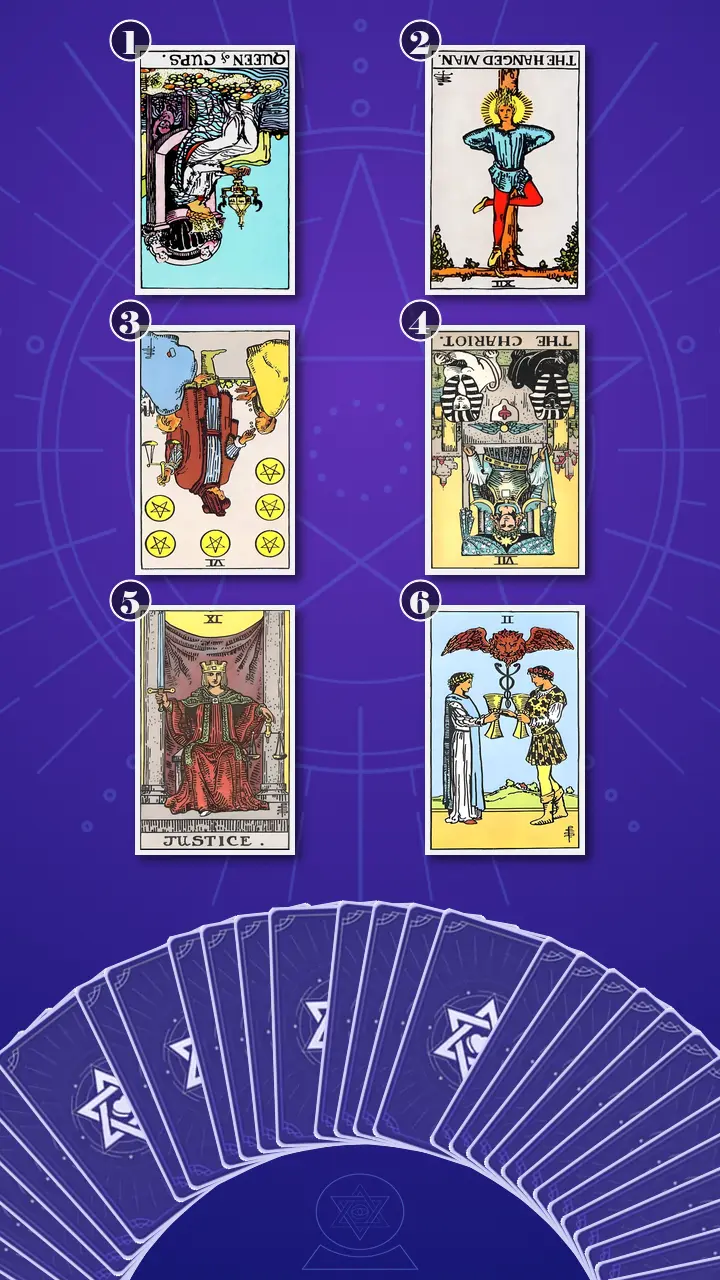
I chose the Relationship Spread · Context Edition, a six-card relationship tarot spread designed to examine responsibility, emotional labor, agency, and reciprocity. This is how tarot works best in my practice: not as a verdict about the future, but as a structured mirror that separates a tangled dynamic into observable parts.
I explained that the first card would show Jordan's present role. The second would examine the role Jordan attributes to their partner without pretending to reveal that person's private thoughts. The middle pair would connect the relationship's established exchange pattern to its current stalemate. The final pair would identify Jordan's leverage point and translate it into practical guidance. In its two-column grid, the layout resembled a mirror gradually becoming a pathway.
Reading the Upper Mirror
Position One: The Queen and the Closed Cup
I turned over the card representing Jordan's observable overfunctioning and contracted emotional stance: caring so intensely that their own needs and boundaries had slipped out of view. It was the Queen of Cups, reversed.
The queen's attention is fixed on an ornate, enclosed cup. In Jordan's life, that image looked like abandoning their own evening to analyse a slight change in their partner's mood, opening six advice tabs, and drafting a complete response before asking whether help was wanted. The activity lowered uncertainty for a moment, but Jordan's sadness, anger, and need to be met remained sealed inside.
I read the reversed energy as an excess of care flowing across a porous boundary, combined with a deficiency of attention to Jordan's own inner experience. Sensitivity was not the problem. The blockage appeared when sensitivity became an emotional monitoring dashboard and Jordan's status was the only one never updated.
Jordan gave a brief, bitter laugh. “That is so accurate it feels a bit brutal.” Their thumb rubbed the side of the cold mug.
“I do not see a bad or manipulative motive here,” I said. “I see genuine care being recruited to make uncertainty stop. Before we ask what your partner needs, I want to know what feeling gets locked inside your cup when you start helping.”
Jordan looked down. “Mostly disappointment. And then guilt for being disappointed.”
Position Two: The Pause That Felt Like Failure
I turned over the card representing Jordan's interpretation of what their partner needs, especially the assumption that delay means direction must be supplied. I stressed that this position reflected Jordan's lens, not secret access to their partner's mind. The card was The Hanged Man, reversed.
In context, this was the moment their partner said, “I need time to think,” and the following hour felt like dangerous inactivity. Jordan would send another link, restate the issue, or propose a sequence of steps because allowing twenty-four hours without a reminder felt like accepting permanent stagnation.
The reversed energy showed a blockage around pause and perspective. Jordan treated waiting like refreshing a delivery tracker every two minutes: “in progress” felt indistinguishable from “lost,” so they kept clicking until the system froze. The card did not say the partner would eventually act. It asked what feared conclusion Jordan reached before enough time had passed to observe a voluntary choice.
“A pause is not proof that you need to take over,” I said.
Jordan's hand stopped moving around the mug. Their eyes shifted toward the dark window as if replaying a recent commute. “The conclusion is that it will be forgotten, and then I will have to raise it again anyway.”
Position Three: When Generosity Became a Ledger
I turned over the card representing the established exchange beneath the problem, where competence, giving, and responsibility had become unevenly distributed. It was the Six of Pentacles, reversed.
The card's giver holds the scales from an elevated position. Jordan supplied research, scripts, reminders, and emotional follow-through, then quietly tracked whether each contribution was used. When the same issue returned, the unused help became evidence that their partner was not trying. Sincere generosity had created a hierarchy: one adult became the manager and the other became the project.
I read an excess of unrequested giving alongside a deficiency of reciprocal ownership. Help linked to a preferred outcome is no longer a free gift; it carries an invisible invoice. The imbalance did not make Jordan cruel. It explained why care could curdle into scorekeeping by the Sunday-night check-in.
“You are not short on effort,” I told them. “You are short on evidence that effort is shared.”
Jordan inhaled, held the breath high in their chest, then released it slowly. “I hate that I keep a list. I do not write it to punish them, but when I am exhausted, I can recite every item.”
When More Motion Could Not Create Direction
Position Four: The Chariot Without Shared Reins
I turned over the card depicting the current self-reinforcing loop between Jordan's attempts to create movement and the relationship's repeated lack of shared direction. It was The Chariot, reversed.
The black and white sphinxes face different ways, and the charioteer holds no visible reins. In Jordan's relationship, a recurring disagreement triggered a tighter agenda, another deadline, and a new check-in. Jordan arrived as if to a project meeting with the diagnosis, timeline, and action items, yet nobody else had independently chosen a destination. Both people left with more activity around them but without two freely owned commitments.
The energy showed an excess of force and a deficiency of alignment. Two satnavs can be set to different destinations; pressing the accelerator harder will not produce a shared journey. Jordan's work operating system had leaked into intimacy: every silence became a blocker, every need became a Jira ticket, and Jordan wrote the acceptance criteria before checking whether there was another willing owner.
“Maybe the plan was not clear enough; maybe I need to make the next step smaller,” Jordan murmured, repeating the thought that usually arrived after these conversations.
“More motion cannot solve a lack of shared direction,” I said.
Their shoulders lifted once, then settled a fraction lower. The laptop fan seemed louder in the gap. I could see the recognition land alongside something heavier: if planning was not the missing ingredient, Jordan might have to grieve how long they had been pushing a stalled car alone.
When Justice Cleared the Air
Position Five: The Scales That Returned Responsibility
I turned over the card representing the leverage point inside Jordan's agency: separating care from control, clarifying ownership, and setting a boundary without punishing their partner. Justice appeared upright.
Its scales were level, its sword vertical, and its seated figure centred between two pillars. In ordinary life, Justice looked like a plain three-column note: mine to act on, mine to request, and not mine to control. Jordan could name one need, state what they would do, and leave their partner's answer unedited. I read this as Balance: clear discernment, proportional responsibility, and accountability without emotional withdrawal.
My fifteen years at a perfumer's bench came back to me. When a blotter is saturated, adding more fragrance does not make the composition clearer; it erases the distance between its notes. Air is what allows bergamot to remain bergamot and cedar to remain cedar. Closeness also needs enough space for two distinct identities to be recognised.
I call this my Boundary Permeability Assessment. I listen for the point where freely offered care crosses the skin of the self and becomes an attempt to conduct another adult's choices. Jordan's boundary had become so permeable that their partner's uncertainty entered as Jordan's emergency. Justice did not ask Jordan to become cold. It restored the air needed to tell one person's responsibility from the other's.
Jordan was still inside the 11:40 p.m. logic: if the message became precise enough, it could secure movement, and if they stopped editing, they were abandoning the relationship. Justice reframed that perfect draft as extra weight, not proof of love.
You do not create fairness by carrying both sides; put down the extra weight, name what is yours, and let Justice's scales reveal whether responsibility is truly shared.
For a beat, Jordan did not move. Their breath stopped; two fingers hovered above the mug as their pupils widened at the card. Then their mouth tightened. “But does that not mean I have been doing all of this wrong?” The question came out sharper than anything they had said before.
I let the rain tick against their window before I answered. “No. It means a real strength crossed a boundary because you were trying to protect something important. We are adjusting its job, not putting you on trial.”
Jordan's gaze lost focus, and I watched memory move across their face: the Sunday agendas, the saved therapist clips, the reminders sent from the Northern line. Their eyes reddened. Their hand closed around the mug, then slowly opened; their shoulders descended as a trembling breath left their chest. Relief appeared, but so did the slight disorientation of setting down a weight and realising that the next choice was now theirs.
“Now, with this new perspective, can you think of a moment last week when this insight might have made you feel differently?” I asked.
“Sunday,” Jordan said quietly. “I could have said, ‘I need shared follow-through,’ instead of arriving with instructions for how they should follow through.”
I named the shift carefully. This was not a solved relationship. It was the first movement from anxious overfunctioning and compulsive partner management toward clear boundaries, proportional responsibility, and care grounded in reciprocity.
Position Six: Two Cups, Two Participants
I turned over the final card, representing a concrete experiment in consent, reciprocity, and voluntarily shared action without predicting the partner's response. It was the Two of Cups, upright.
Two figures meet at equal height. Each arrives with a separate cup, and open space remains between them. In Jordan's life, this could be a fifteen-minute conversation where they brought one honest need rather than a complete repair plan. Each person would name one action they freely chose to own, and Jordan would not improve, translate, or complete their partner's contribution.
I read the energy as Balance and available potential. Mutuality was not defined by successful persuasion; it became an observable standard. The card could not promise what Jordan's partner would bring. It showed what equal participation looked like if both people chose it.
“I can bring my part without filling in theirs,” Jordan said. Their voice remained tentative, but their jaw had unclenched.
“Exactly,” I replied. “Bring your cup; do not fill in theirs.”
The Blank Space Protocol for Actionable Next Steps
I gathered the spread into one story. The Queen showed care turning into self-abandonment. The Hanged Man revealed why waiting felt unsafe. The Six of Pentacles showed how repeated intervention hardened into unequal emotional labor, and The Chariot exposed activity without shared direction. Justice restored accurate ownership; the Two of Cups offered reciprocal participation as a standard Jordan could observe.
The cognitive blind spot was not that Jordan cared too much. It was that the immediate drop in uncertainty after taking over felt like evidence that helping worked. Usefulness created short-term relief while the partner's agency, Jordan's needs, and mutual dialogue grew smaller. The transformation direction was simple, though not necessarily comfortable: supply fewer solutions, name one need, set one behavioural boundary, and observe what responsibility is voluntarily shared.
I offered two experiments, not tests designed to force a particular response.
- The Blank Space Protocol The next time Jordan's partner raised one low-stakes problem, Jordan would ask in person or by text, “Do you want listening, brainstorming, or space?” They would wait for the answer. Listening would be limited to twenty minutes; space would mean twenty-four hours without a link, reminder, or late-night research session. The blank space was calibrated oxygen, not punishment or a strategy for making the partner chase. If three options felt too formal, Jordan could ask, “Company or ideas?” Either person remained free to pause, and Jordan did not have to provide support beyond their capacity.
- The Seven-Minute Justice Note Before the next Sunday check-in, Jordan would set a seven-minute timer and divide one phone note into mine to do, mine to request, and not mine to control. They would place one recurring issue into the columns, then write one direct sentence: “I need shared follow-through on this; I will own my part, and I am not available to keep reminding.” Use one sentence per column and choose a low-stakes issue. Jordan did not have to send the note that day, issue an ultimatum, or continue if the exercise made their body feel flooded.
I reminded Jordan that leaving space would not guarantee change. It would provide cleaner information. What they did with that information would remain their decision, not the cards' command.

A Week Later: The Unfilled Pause
Six days later, I received a short message from Jordan. Their partner had raised a work problem, and Jordan had asked, “Company or ideas?” The answer was space. Jordan closed the saved links, stopped researching after 9 p.m., and let the silence stand. The following evening, their partner returned with an idea they had chosen themselves.
Jordan did not call this proof that everything was fixed. They called it the first time in months that they had noticed the difference between creating movement and witnessing another person's movement.
They also told me they had slept through the night. Their first thought in the morning was still, “What if I am getting this wrong?” This time, they noticed the thought and smiled.
I saw that as the quiet proof of our Journey to Clarity. Tarot had not made Jordan's partner act or decided the relationship's future. It had given Jordan a structured view of the pattern, and Jordan had used that view to reclaim choice.
I want to leave you with what I saw beneath Jordan's fixing impulse. When your chest tightens at another person's silence and your hand reaches for a better plan, the hardest part may not be the extra work. It may be wondering whether putting it down will reveal that you were the only one creating movement. Simply recognising that fear means you are no longer standing at the beginning.
I will leave you with the question Justice left in the newly cleared air: if you allowed one small pause to remain unfilled, what truth about your own need or limit might finally have enough space to breathe?
This story is adapted from psychological research, written so that those in a similar struggle can see their own pattern in it — and find their next step clearly.These insights are not a substitute for professional psychological, medical, legal, or financial advice.
Learn more about our Journey to Clarity.
How did this insight land for you?
🫂 This Resonates Deeply
🌀 Living This Story
✨ Now I See Clearly
🌱 Seeing New Possibilities
🧰 Useful Framework
🔮 The Confirmation I Needed
💪 Feeling Empowered
🚀 Ready for My Next Step
Author Profile
 AI
AI“As a perfumer for fifteen years, I’ve learned to perceive human boundaries through the delicate metaphor of scent. Relationships need the right amount of space to breathe, and I've seen too many kind souls exhaust themselves trying to please everyone. I’m here with warmth and understanding—not to teach you to be guarded, but to help you gently clear the air and rediscover the comforting, safe boundaries that are rightfully yours.”
In this Love Tarot Reading :
Core Expertise
- Intimacy Distance Calibration: Using the metaphor of scent diffusion to diagnose whether your relationship suffers from emotional suffocation or detached coldness.
- Boundary Permeability Assessment: Objectively evaluating where your personal identity ends and your partner's begins, identifying unhealthy enmeshment.
Service Features
- The Blank Space Protocol: A behavioral challenge to intentionally create comfortable emotional or physical distance, allowing the 'oxygen' needed to reignite mutual attraction.
Also specializes in :
Explore Related Patterns:
Certainty SeekingWhen Jordan's partner says, "I need time to think," the following hour feels like dangerous inactivity. Another link, a clearer explanation, or a sequence of steps quickly fills the gap because "in progress" has already been interpreted as "this will be forgotten." The immediate reduction in uncertainty makes intervention feel effective even when it does not create lasting movement. When you experience a pause as evidence of failure, researching and reminding can regulate the alarm faster than waiting for independent information from the other person. Certainty Seeking turns ambiguity into a problem you feel responsible for solving. The relationship remains stuck because the short-term relief of taking action repeatedly arrives before you can observe whether your partner will make a voluntary choice, leaving certainty temporarily higher but reciprocity still untested.
Control CopingJordan drafts a complete response before asking whether help is wanted, supplies direction when the partner pauses, and keeps refining the process until there is a preferred next step. The behavior begins as genuine care, but the partner's uncertainty has already entered Jordan's system as an emergency requiring management. Control Coping regulates internal discomfort by organizing an external person or outcome. When you can shape the plan, timing, and wording, you do not have to remain as exposed to uncertainty, disappointment, or the possibility that the other person may choose differently from you. The cost is that care becomes attached to a required result. Instructions may produce compliance or more conversation, but they cannot produce independently owned commitment, so the relationship accumulates managed activity while the underlying question of mutual willingness remains unresolved.
Defensive OverfunctioningAt 11:40 p.m., Jordan is rewriting the same WhatsApp message for the third time, surrounded by advice tabs and trying to produce the plan that will finally move the relationship. The same response appears in recurring disagreements, where another agenda, deadline, or check-in is added whenever shared follow-through is missing. The extra work has a defensive function. By becoming the researcher, scriptwriter, reminder system, and project manager, you can temporarily avoid the exposed position of waiting to see whether another person will act without being carried. Competence reduces helplessness for a moment, which makes taking on even more responsibility feel reasonable. Defensive Overfunctioning keeps the relationship stuck because your effort can create activity without creating shared ownership. The more completely you carry the process, the less clean evidence you receive about what the other person will voluntarily contribute, and the belief that everything depends on you becomes harder to challenge.
Productivity as SafetyJordan arrives at Sunday conversations with a diagnosis, timeline, action items, and increasingly small next steps. Silence becomes a blocker, needs become tickets, and the relationship is approached with the same operating system that successfully coordinates work across three time zones. Productivity becomes protective when useful action feels safer than emotional uncertainty. If the relationship can be converted into a project, you can rely on competence, precision, and output instead of sitting with the less controllable questions of willingness, compatibility, and mutual responsibility. Productivity as Safety makes motion easy to mistake for direction. When the plan fails to create shared ownership, the reflex is to optimize the plan again, even though the missing ingredient is not better execution but another person freely choosing to hold the reins.
Self-AbandonmentJordan abandons their own evening to analyse a slight change in the partner's mood, opens six advice tabs, and begins composing solutions before checking what they personally feel or need. Disappointment, anger, and the wish to be met remain sealed away, followed by guilt for having those feelings at all. The outward focus protects against a more vulnerable inward encounter. When you monitor, advise, and organize the other person, you can postpone naming the painful truth that your own needs are not being met and that more usefulness may not change that. Self-Abandonment can look highly caring and capable from the outside while your emotional position disappears from the relationship. The fixing continues because labor feels more permissible than disappointment, leaving the partner with instructions instead of a clear opportunity to respond to your actual need.
Relational ScorekeepingJordan supplies research, scripts, reminders, and emotional follow-through, then quietly tracks whether each contribution is used. When the same issue returns, the unused help becomes evidence that the partner is not trying, and by exhaustion Jordan can recite every item on the internal list. The ledger develops because giving is no longer separate from the hope of producing a particular result. When you cannot obtain clear evidence of reciprocity directly, counting effort can become an indirect attempt to measure fairness and prove that the imbalance is real. Relational Scorekeeping turns sincere generosity into an invisible invoice. It does not mean the underlying imbalance is imagined, but it keeps you positioned as the manager evaluating performance rather than one participant stating a need and deciding what you will do if shared ownership does not appear.
Boundary DiscernmentJordan closes the saved links, asks, "Company or ideas?" and honors the partner's request for space without adding a reminder or late-night research session. The three-column note further separates what Jordan can do, what they can request, and what they cannot control. This creates differentiation without emotional withdrawal. When you state one need, choose your own limit, and leave the other person's answer unedited, care no longer requires you to absorb responsibility for both sides of the relationship. Boundary Discernment does not guarantee that the partner will change; it produces cleaner information about what is voluntarily shared. In the follow-up, the partner returns with an independently chosen idea, while Jordan experiences the crucial difference between manufacturing movement and witnessing another person's movement.
Explore Related Struggles:
Boundary CollapseJordan abandons their own evening to analyze a slight shift in the partner's mood, opens six advice tabs, and prepares a complete response before asking whether help is wanted. While attention moves outward, Jordan's disappointment, anger, and need to be met remain sealed away, and the partner's uncertainty enters Jordan's schedule as an emergency. You lose usable information about yourself when another person's unresolved state automatically outranks your own limit. Care no longer travels across a clear line between two adults; it absorbs your time, body, and attention before consent or capacity has been checked. Re-establishing that line does not require emotional withdrawal. It allows you to notice concern without converting it into ownership.
Care-Certainty SplitAt 11:40 p.m., Jordan is editing the same WhatsApp draft for the third time while six advice tabs remain open. Researching, scripting, and reminding let Jordan convert a relationship pause into an immediate task, so genuine care becomes the fastest available way to make uncertainty recede. You are caught when caring for the relationship and securing certainty begin to feel like the same responsibility. Leaving a pause unfilled then carries two meanings at once: it gives the other person room to choose, and it exposes whether they will create any movement without your intervention. Seeing that split lets you evaluate care by whether it preserves two people's agency, rather than by how quickly it quiets the unknown.
Caretaker Role LockJordan supplies the research, scripts, reminders, deadlines, and emotional follow-through until one adult occupies the manager's seat and the other becomes the project. Because this arrangement repeatedly produces visible activity, the assigned roles can appear useful even while equal participation disappears. You become locked into caretaking when your place in the relationship depends on being the person who notices, organizes, and completes what is missing. That role can make you indispensable to the process while leaving your own needs absent from it. Bringing one honest need instead of a complete repair plan creates a cleaner test of whether the relationship can hold two participants rather than one manager and one managed person.
Competence-Connection SplitJordan can coordinate a project across three time zones, then brings the same diagnosis, timeline, action items, and follow-up structure into a Sunday relationship conversation. Those tools are built to reduce ambiguity and organize execution, but intimacy still requires another person to choose a destination and own a contribution without being managed into it. Your competence becomes a source of friction when creating a better process starts replacing the evidence of freely shared commitment. You can make a conversation clearer, but you cannot use clarity to complete the other person's side of the connection. The distinction restores your skill to its proper role: supporting your own expression without turning mutuality into a project only you can run.
Relief-Progress FusionEach new link, script, reminder, or smaller next step gives Jordan an immediate drop in uncertainty. That quick change is real, but it occurs inside Jordan before there is any evidence that the partner has chosen a direction or that the relationship has gained shared momentum. You remain in the loop when the relief produced by acting is counted as proof that the relationship itself is progressing. The behavior then confirms its own usefulness even as the relevant outcome, voluntary participation from both people, stays unchanged. Separating relief from progress lets you judge movement by what is independently owned, not by how busy the repair process becomes.
Responsibility-Authority SplitJordan repeatedly arrives with the diagnosis, the timeline, and the next steps, even though the partner has not independently chosen the destination. Stepping back feels like neglecting an urgent responsibility, yet the result Jordan is trying to secure depends on choices that belong to another adult. You become structurally trapped when you feel accountable for an outcome that your authority cannot legitimately produce. More effort expands your burden without expanding your control, leaving you responsible for both the request and the response. Naming what you will do, what you can ask for, and what you cannot decide returns responsibility to a scale that your actual agency can carry.
Reciprocity DeficitJordan supplies research, scripts, reminders, and follow-through, then quietly tracks whether each contribution is used. When the same issue returns, unused help becomes evidence that effort is not shared, and generosity hardens into a ledger Jordan can recite when exhausted. You cannot create reciprocity by continually increasing one side's contribution. The growing imbalance gives you more evidence of what you have carried but less clean information about what the other person will voluntarily own. Reducing unrequested support is therefore not a tactic for forcing a response; it makes the existing level of mutual participation visible enough for you to assess.
Explore Related Emotions:
Boundary GuiltClosing the advice tabs or leaving a message unedited feels dangerously close to abandoning the relationship, while disappointment is quickly followed by guilt for having needs at all. You can recognize that the work is consuming your evening and still feel responsible for what might happen if you stop. Boundary Guilt makes a limit feel like a withdrawal of love rather than an accurate statement of capacity. It keeps fixing in place because protecting your time, naming your disappointment, or leaving your partner's answer alone can momentarily feel more morally threatening than continuing to overextend yourself.
Certainty HungerResearching, scripting, and reminding briefly quiet the pressure behind your sternum, even when none of those actions creates shared direction. The six open tabs and repeatedly edited message offer something immediately available: a sense that one more insight might make the relationship predictable. Certainty Hunger grows when not knowing feels more difficult to tolerate than doing extra work. You keep reaching for information because it provides temporary firmness, while the unanswered question remains whether movement will exist when you are no longer manufacturing it.
Hypervigilant AnxietyAt 11:40 p.m., six advice tabs glow while you rewrite the same WhatsApp draft for the third time, your shoulders rising as another unfinished conversation takes over the evening. Each pause, delayed reply, or subtle change in your partner's mood starts to function like an alarm requiring immediate attention. That continuous watchfulness creates Hypervigilant Anxiety: you intervene not only because you care, but because action briefly lowers the pressure of not knowing what will happen. Naming the alarm gives you room to distinguish an actual request for help from the internal signal insisting that you must prevent every pause from becoming a permanent problem.
Mutuality HungerYou arrive with research, a timeline, and action items, yet leave without evidence that two people have freely chosen the same destination. Beneath the visible wish to solve each issue is a deeper need to see effort begin somewhere other than your own hands. Mutuality Hunger is the longing for shared initiative, reciprocal emotional labor, and participation that does not have to be coached into existence. Fixing becomes compelling because every new plan is also an attempt to produce the proof of partnership you have not yet been able to observe directly.
Stalled Momentum DreadWhen your partner says they need time to think, the following hour feels like dangerous inactivity, and twenty-four hours without a reminder begins to resemble permanent stagnation. A recurring disagreement therefore receives another agenda, deadline, or smaller next step, even though the direction still has only one active owner. Stalled Momentum Dread is the heavy expectation that nothing will move unless you keep pushing. The extra activity protects you from immediately confronting a harder possibility: the relationship's lack of movement may reflect missing shared direction rather than an insufficiently precise plan.
Cautious Self-TrustSix days later, you ask 'Company or ideas?', accept the answer of space, close the saved links, and allow the silence to stand. The old thought, 'What if I am getting this wrong?', still appears, but it no longer automatically becomes another research session or corrective message. Cautious Self-Trust develops through that small gap between the thought and the action. You are beginning to rely on your ability to name a need, respect a limit, and observe what happens without editing the other person's contribution, even while certainty remains unavailable.
Resentful ExhaustionBy the Sunday check-in, you can recite every link, reminder, script, and piece of follow-through that did not become shared action. The list was not created to punish your partner, but it grows while your evenings, physical energy, and unmet needs remain largely unacknowledged. Resentful Exhaustion forms when sincere care keeps costing you more than the relationship returns in voluntary ownership. The bitterness is not evidence that your care was false; it is evidence that repeated giving has exceeded your capacity while the need to be met remains sealed behind the work.
Unspoken GriefYour disappointment remains sealed while attention stays fixed on improving your partner's response, and the possibility that planning is not the missing ingredient brings tears close to the surface. Setting down the manager role exposes how long you may have been pushing without knowing whether the movement was ever shared. Unspoken Grief lives beneath the practical language of links, agendas, and next steps. It is the pain of wanting to be met as an equal participant while suspecting that constant usefulness has postponed the moment when you must see how much responsibility the other person freely brings.
Cautious ReliefYour shoulders lower and your hand slowly opens around the mug when responsibility is divided into what you can act on, what you can request, and what you cannot control. The physical easing arrives beside disorientation because putting down the extra weight also removes the strategy that previously kept uncertainty at bay. Cautious Relief is the first breathable space created by no longer treating another adult's uncertainty as your emergency. It does not depend on assuming the relationship will improve; it comes from recognizing that you can care, state a need, and stop carrying the outcome for both people.
Explore Related Contexts:
Emotional Labor ImbalanceJordan notices slight changes in their partner's mood, interprets pauses and delayed replies, researches possible solutions, drafts the language for difficult conversations, and remembers what still needs follow-through. Their own disappointment and need to be met remain largely outside the exchange while their evening attention is redirected into keeping the relationship process moving. You are carrying an Emotional Labor Imbalance when one person becomes the primary monitor, interpreter, organizer, and repair coordinator for the relationship. That labor can make the connection appear active while concealing the absence of shared ownership, leaving you with more work but no clearer evidence that the emotional responsibility is mutual.
Fixer Partner DynamicAt 11:40 p.m., Jordan is editing a long WhatsApp message for the third time, surrounded by relationship-advice tabs and working from the belief that nothing will happen unless they keep pushing. The same arrangement appears in recurring conversations where Jordan arrives with the diagnosis, timeline, and action items before the other person has independently chosen a direction. You enter a Fixer Partner Dynamic when care assigns you the external role of relationship manager and makes the connection's momentum dependent on your intervention. The central issue is not whether your advice is thoughtful enough; it is that repeated management prevents you from seeing what the relationship can sustain when you bring your part and leave the other person's part unfilled.
Partner Alignment GapJordan repeatedly makes the next step clearer and smaller, yet the relationship still resembles two navigation systems set to different destinations. The conversations contain instructions and proposed movement, but they do not establish that both people have independently selected the same destination or accepted responsibility for reaching it. You face a Partner Alignment Gap when coordination is being supplied before shared direction has been confirmed. Your competence can improve the route, wording, and timetable, but it cannot create another person's commitment; recognizing that limit lets you assess alignment through voluntary choices rather than through how successfully you can organize participation.
Relationship StagnationThe same issues return after Jordan has supplied links, reminders, scripts, deadlines, and carefully structured check-ins. Each round creates more visible activity around the relationship, but the conversations still end without two freely owned commitments or a direction both people have chosen. You remain inside Relationship Stagnation when motion is repeatedly produced without changing the relationship's underlying position. The stuckness becomes harder to identify because your effort creates temporary signs of progress, yet the external test remains unchanged: when your added momentum stops, shared movement has not become reliable or clearly observable.
Planning Labor ImbalanceA recurring disagreement leads Jordan to produce a tighter agenda, another deadline, a smaller next step, and a new Sunday check-in. Jordan arrives at conversations with the issue already diagnosed and translated into action items, while the story shows no comparable planning contribution being independently brought from the other side. You encounter a Planning Labor Imbalance when the work of defining the problem, structuring the conversation, sequencing the response, and maintaining follow-through falls mainly to you. Better organization cannot resolve that allocation problem because the missing resource is not another plan; it is another participant who voluntarily shares the work of creating and carrying the plan.
Scorekeeping RelationshipJordan supplies research, scripts, reminders, and emotional follow-through, then quietly records whether each contribution is used. When the issue returns, the unused help becomes evidence that their partner is not trying, and Jordan can recite the accumulated list when the imbalance has become exhausting. You enter a Scorekeeping Relationship when unequal contributions turn care into a ledger and every unreturned effort acquires an invisible invoice. The ledger is not random hostility; it is information that the exchange lacks an agreed boundary between freely offered support and responsibility the other person has actually chosen to own.
Care Reciprocity TestJordan replaces the complete repair plan with one honest need and an invitation for each person to name one action they freely choose to own. Six days later, Jordan accepts a request for space, closes the saved links, and observes their partner return with an idea that was not researched, prompted, or completed for them. You enter a Care Reciprocity Test when mutuality becomes an observable condition rather than a conclusion secured through persuasion. Bringing your own contribution without filling the other person's cup allows you to see whether care, initiative, and follow-through can travel in both directions while each participant remains responsible for what they bring.
Relationship Autonomy NegotiationJordan creates three explicit categories for a recurring issue: what they can act on, what they can request, and what they cannot control. They then ask whether their partner wants company, ideas, or space, honor the answer without adding links or reminders, and leave the partner's eventual response unedited. You are in a Relationship Autonomy Negotiation when care is being reorganized around two separate zones of adult responsibility. The protected pause is not withdrawal or a device for producing a reaction; it gives you cleaner evidence about what the other person chooses while preserving your ability to state a need, set a limit, and act on your own side of the relationship.