Parenting a Partner, Then Leaving One Shared Task to Its Owner

The Overfunctioner-Underfunctioner Loop at 10:47 p.m.
I often meet the project coordinator who catches every loose end at work and somehow became the unpaid project manager at home. When one shared deadline stays unchecked, I have seen the overfunctioner-underfunctioner relationship loop begin before either partner has a name for it.
Maya sat across from me in my Toronto studio with her phone warm in her palm. At 10:47 p.m. the night before, she had opened the shared household app and found a maintenance booking still unchecked. The dishwasher had hummed while streetcar brakes scraped outside, and she had typed a reminder, deleted it, added the provider's number and a suggested script, then made the booking herself. The confirmation email had loosened her jaw for a moment; her shoulders had stayed raised.
She worked as a project coordinator, lived with her partner, and had been maintaining most of their shared calendar, recurring reminders, bills, bookings, and administrative lists for two years. She looked at me and said, "I do not want to be in charge of everything, but I hate what happens when nobody is in charge. I asked for a partner, not another project to manage. What keeps me parenting my partner instead of letting us grow?"
I heard the contradiction clearly: she wanted an equal adult partnership, but feared that shared responsibilities, financial stability, and relationship progress would stall if she stopped managing them. Her resentful exhaustion did not look like an abstract mood to me. It looked like carrying both ends of a two-person table while trying to blame the empty side for having no hands on it.
I told her, "I am not here to decide whether your partner is reliable or whether you are controlling. I want to look at the loop that forms between you, the relief that keeps it running, and the choice that might interrupt it. We can let the cards help us make the pattern visible, then you can decide what your next act will be. Let us draw a map through the fog rather than demand a verdict from it."

Choosing a Compass for Finding Clarity
I asked Maya to put both feet on the floor, take one slow breath, and hold the question in a single sentence. Then I shuffled slowly. I treat that small ritual as a psychological transition: it gives the mind a clean edge between replaying the last argument and observing it with enough distance to learn something.
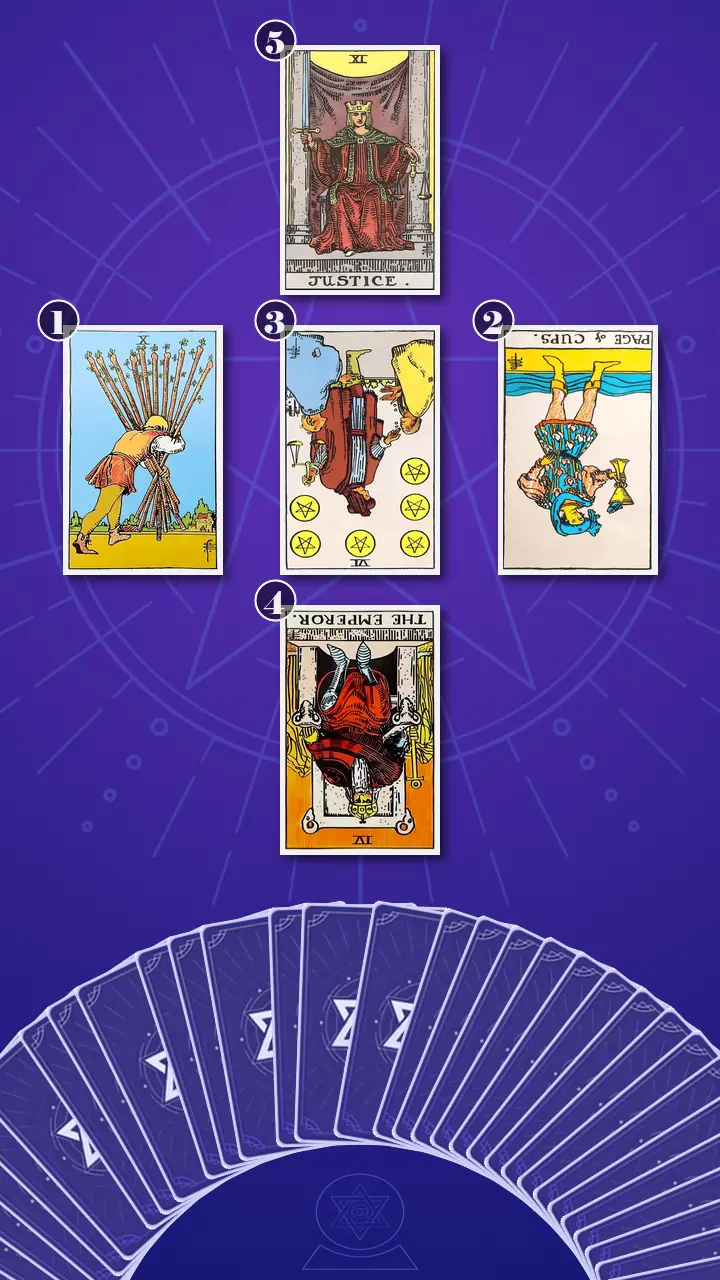
For this reading, I used the five-card Relationship Spread: Context Edition. I explained to Maya, and I want to explain to you, that this is a structured mirror rather than a prediction machine. The question is about an unequal adult role, blurred responsibility boundaries, and the way one person's overfunctioning affects mutual agency, so a compact five-card spread can examine the pattern without pretending to read the partner's private thoughts.
The first position would show Maya's observable overfunctioning: the reminders, corrections, monitoring, and task-taking that placed her in the parental role. The second would examine the working image of her partner that appeared whenever a task was delayed, vague, or approached differently. The center would map the relationship's self-reinforcing exchange. Below it, I would look at the fear that made loosening control feel unsafe. Above it, I would find a constructive direction: explicit ownership, reciprocal accountability, clear boundaries, and room for independent action.
I told her, "The cards can show a pattern in your role and your choices. They cannot tell us what your partner secretly thinks, and they cannot make a decision for either of you. Our job is to turn card meanings into observable questions, then into small, consent-based next steps."
Reading the Map in Real Life
The Weight of the Shared Calendar: Ten of Wands Upright
I turned the first card and said, "This position presents the observable overfunctioning identified in the diagnosis: the reminders, corrections, monitoring, and task-taking through which you occupy the parental role." The card was the Ten of Wands, upright.
In its standard meaning, the Ten of Wands speaks of burden and responsibility carried beyond a sustainable limit. Here, the energy was in excess. Maya's contribution had expanded into total ownership: noticing the task, remembering the deadline, deciding the standard, communicating the request, checking the progress, completing the task, and then absorbing the resentment when the whole sequence felt invisible.
I pointed to the bent figure whose view was blocked by the bundled wands. "This is not saying that your competence is the problem," I said. "It is showing how carrying every part of the system can prevent you from seeing two things at once: what your partner might have done without intervention, and where your own sustainable limit actually is."
I brought her back to 10:47 p.m. The shared app, the warm phone, the dishwasher, the streetcar brakes, the deleted and rewritten reminder: the wands looked like a calendar entry, a contingency plan, a provider's number, a standards checklist, and a backup plan all pressed into one person's arms. I told her it was the opposite-of-Severance experience: her highly competent project-coordinator self never clocked out, so home had become a second workplace carried in her body.
"I should not have to remind them," I said, following the inner monologue she had already described, "but if I do not remind them, what happens?"
Maya gave a short, bitter laugh. "That is accurate in a way I do not love. I want support, but I keep taking total ownership before there is any room to see whether support could arrive." She rubbed the side of her thumb against the phone case, then lowered her shoulders by a fraction. I did not frame care as a defect. I wanted her to recognize the late-night checking routine without turning recognition into shame.
The Fish in the Unexpected Cup: Page of Cups Reversed
I moved to the second card. "This adapted position examines your working image of your partner and the assumptions that trigger intervention. It does not claim to reveal your partner's private thoughts or fixed character." The card was the Page of Cups, reversed.
The Page of Cups usually carries openness to surprise, emotional information, and a message that has not yet been fully understood. Reversed here, that curiosity was blocked. The unexpected fish emerging from the cup became the unfamiliar plan, different sequence, delayed update, or imperfect first attempt that Maya's mind translated too quickly into evidence that supervision was required.
I asked her to picture Saturday at 11:18 a.m. in the condo kitchen. She had heard mugs clinked together and seen her partner load the dishwasher in an order she would not choose. Lemon dish soap hung in the warm air. Before the cycle had even started, she had felt her tongue press against the back of her teeth while a complete list of corrections assembled itself.
"The crucial distinction is simple but not always easy to live," I said. "Different is not the same as unfinished. You can ask, 'What is your plan, and when will you update me?' Then you can allow the answer to exist before supplying the rest of the plan."
I asked her to separate what she could observe from what she was predicting. The observable fact was that the dishes were being loaded differently. The prediction was that the result would be unreliable, that she would have to redo the work, and that waiting would make the eventual fallout more expensive or humiliating.
Maya stared at the card. Her fingers stopped moving, and her eyes went briefly to the kitchen doorway as if she could see the Saturday scene again. "This is not how I would do it, so my brain is already calling it unreliable," she said. I answered, "That reaction is information, not proof. Curiosity does not mean you accept a broken agreement, unsafe conduct, or repeated neglect. It means you do not turn difference into a verdict before the outcome exists."
The Ledger With All the Permissions: Six of Pentacles Reversed
I placed the third card exactly between the first two. "This position maps the self-reinforcing relationship loop in which extra giving creates unequal authority, limited space for agency, and further evidence that you must remain in charge." The card was the Six of Pentacles, reversed.
The Six of Pentacles traditionally speaks of exchange, resources, generosity, and proportion. Reversed, its scales tilted toward unequal giving and conditional help. The energy had become distorted earth: practical care was still happening, but it was entangled with hierarchy. Maya was doing more labor while also retaining the power to decide what counted as correct, timely, sufficient, and worth rescuing.
I asked her to imagine the shared task board she had opened on Sunday evening. Nearly every card had been created, assigned, edited, or checked by her. During an argument, she could list every reminder and rescue as proof that she carried the relationship. At the same time, she could reject her partner's proposed method as inefficient before it had been tested.
"Doing more can leave you with more labor and more authority. Neither is equality," I said.
Maya reread the sentence on my notepad. The room became quiet except for the radiator clicking behind her. Her face grew warm, and she looked down at her hands. "I am carrying more," she said slowly, "so why am I also the one with all the authority?"
I told her that this question did not erase the real imbalance in labor. It made the hidden exchange visible. The overfunctioner-underfunctioner relationship loop survives because intervention brings immediate relief, but it also removes opportunities for independent follow-through. Then the limited evidence of follow-through seems to confirm the original belief that intervention was necessary.
She pressed her lips together, reread the line about labor and authority, and let out a long breath. I could see discomfort, but I could also see a new option entering the room: she did not have to choose between declaring herself the only responsible person and pretending the workload was already fair.
The Stone Throne in the Condo: The Emperor Reversed
I turned the fourth card below the center. "This position reveals the primary challenge and underlying fear: that loosening control will threaten practical stability, relational safety, or forward movement." The card was The Emperor, reversed.
The Emperor brings structure, authority, order, and protection. Reversed, useful structure had hardened into unilateral control. I saw the energy as blocked fire: action no longer moved flexibly toward a shared result; it became armor around the fear that uncertainty would make everything collapse.
I asked Maya to return to 8:05 p.m. after an uncertain appointment booking. She had opened her laptop at the dining table and created a colour-coded household workflow with subtasks, reminders, escalation dates, approval rights, and a final checkpoint that only she could close. The keyboard had clicked sharply in the quiet room. As the structure appeared, the band across her chest had eased.
"If I am not the final checkpoint, our life could become expensive and chaotic," she said. "A missed renewal fee or service charge is not theoretical in Toronto. It lands on the account."
I nodded. "That fear deserves a real conversation about financial boundaries. It does not automatically require you to control every route to every outcome."
I use a diagnostic lens called Toxic Script Identification when a relationship keeps assigning the same destructive roles. I do not use it to label either person permanently. I use it to notice the roles the dynamic produces. In Maya's script, an uncertain task cast her as the Responsible Ruler and her partner as the Assumed Novice. The more she commanded, the less room there was for another adult to demonstrate agency. The less agency became visible, the more necessary her command appeared.
Her jaw tightened. She exhaled sharply and looked at the stone throne in the card as though it had been built in her dining room. "If I loosen my grip and this goes wrong, I will have to live with the fallout," she said. "And then I will blame myself for not preventing it."
I let the silence stay long enough for that sentence to land. Then I said, "This is a control pattern, not a character verdict. A boundary can protect a financial or safety requirement. Supervision scripts another adult's method. We need to separate those two functions so your reasonable standards do not have to become a whole-household operating system."
When Justice Put the Pen Back in Her Hand
The Fair Agreement: Justice Upright
The room seemed to narrow around the fifth card. I placed it above the Six of Pentacles and said, "This adapted position translates the key shift into an adult-to-adult practice of explicit ownership, reciprocal accountability, clear boundaries, and room for independent action." The card was Justice, upright.
Justice is the constructive direction of this reading: fairness, truth, proportion, and accountability through conscious choices. It does not promise that the relationship will become effortless or that both people will contribute in identical ways. It asks whether the agreement is visible, whether the standard applies to both adults, and whether each person can own the effect of their choices.
I showed Maya the level scales and the upright sword. "The scales measure proportion," I said. "The sword gives the agreement clear language. They are separate tools. You do not need to lower every standard, but you do need to make the standard mutual and distinguish the outcome from your preferred method."
As an artist, I have always felt that our lives are films in production. A frame gives a scene shape, but it does not dictate every movement inside it. I thought of that while looking at Justice: structure can hold the scene without turning one person into the director of every breath.
I also ran Maya's familiar conflict through my second diagnostic lens, Dialogue Loop Auditing. The trigger was the unchecked box. The opening phrase was usually, "Just checking." The hidden request beneath it was, "Prove you are reliable in my way, right now." A defensive explanation followed. Maya added more detail. The conversation narrowed. She took the task back, felt temporary relief, and later used the rescue as evidence that she had been left alone again. The loop sounded like communication, but it kept returning to the same dead end.
At 10:47 p.m., you see the maintenance booking still unchecked, type a reminder, soften it, add instructions, then make the booking yourself. Your chest loosens for a minute, even as the thought returns: why am I carrying this again?
You do not have to hold every responsibility to keep the relationship steady; replace supervision with explicit reciprocal agreements, and let Justice's scales measure shared accountability rather than your private effort.
You cannot gather evidence of shared accountability while supervision keeps replacing it. Mutual growth becomes visible when care leaves each adult's ownership intact.
For a few seconds, Maya's face emptied. Her breath paused, and her fingers hovered above the edge of the card. Then her pupils widened as her gaze went unfocused, replaying the maintenance booking, the rewritten reminder, and the confirmation email that had brought relief without bringing rest. Her right hand closed into a fist. "But does this mean I was wrong the whole time?" she asked, with a sudden edge in her voice.
I answered, "No. Your labor may be real, and the fear may be understandable. The question is whether control is the only way you allow yourself to seek reliability."
Something in her expression shifted. Her clenched hand opened one finger at a time. Her shoulders dropped, her eyes became glassy, and a breath left her chest with a small tremor. "I can ask for reliability without appointing myself supervisor," she said. The release was genuine, but it was not weightless. She sat straighter, then looked briefly dizzy, as if clear air required a new balance. I could see relief beside responsibility, and a thin thread of grief for all the energy spent proving she could keep everything steady.
I asked her, "Now, use this new perspective to revisit last week: was there a moment when this insight might have allowed you to feel differently?"
Maya closed her eyes. "The dishwasher," she said. "The result was fine. I was reacting to the route. I could have asked one question and let the answer belong to them."
I told her that this was the first step in the emotional transformation from resentful vigilance and control-based safety to adult-to-adult trust grounded in boundaries and observable accountability. It was not blind trust. It was a decision to create the conditions in which observable accountability could finally become visible.
The One-Task Agreement, Not a New Command Center
When I placed all five cards together, I could see the story they formed. The Ten of Wands showed how Maya's project-coordinator strengths had become total ownership. The reversed Page of Cups showed how overload made unfamiliar methods look like failed outcomes before the deadline arrived. The reversed Six of Pentacles revealed that extra labor and retained authority could exist in the same act of helping. The reversed Emperor showed the fear beneath the system: if Maya stopped being the final checkpoint, shared life might become unsafe or chaotic. Justice offered a different container for care: explicit ownership, a shared outcome, a due time, and owner-led repair.
The blind spot was not simply that Maya did too much. It was that she treated intervention as evidence of care and immediate relief as evidence that intervention had been necessary. By completing both sides of the responsibility, she made it impossible to observe what independent follow-through would look like. The key shift was from preemptively reminding and correcting to agreeing on one shared outcome, assigning clear ownership and timing, and allowing the owner to complete or repair it without mid-course supervision.
I told her, "The goal is not zero care. It is care that leaves ownership intact." Then I introduced my practical intervention, the Pattern Interruption Script. I asked her to rehearse a different role when the familiar trigger appeared. Instead of saying, "Just checking, did you call them?" she could ask, "What is your plan, and when will you update me?" If the due time had not arrived and no safety, legal, health, or mutually accepted financial boundary was at risk, the script ended there. It did not smuggle a checklist into the question.
We also agreed that stepping back would never become a silent test, punishment, or sudden withdrawal of support. If an agreement was missed, the owner would initiate the repair that both adults had already negotiated. If the relationship involved intimidation, coercion, or a situation in which direct negotiation was unsafe, I would not recommend using a micro-agreement as a substitute for context-specific support.
The Four Lines Justice Can Hold
- Choose one recoverable taskI asked Maya to invite her partner to a 12-minute conversation at the kitchen table or on a walk about one low-stakes recurring responsibility, such as a routine booking or household renewal. In one shared Apple Note, Google Keep note, or Notion page, they would write only four headings: owner, agreed outcome, due time, and repair if missed.Start with an inconvenience rather than something dangerous or financially destabilizing. If four lines feel too loose, make a seven-minute private draft first and notice which expectation is hardest to state clearly.
- Ask for the plan, then protect the pauseWhen her partner approached a shared task differently, Maya would ask, "What is your plan, and when will you update me?" Then she would open her Notes app and write two lines: "What I can observe" and "What I am predicting." She would set a 90-second timer, unclench her jaw, lower her shoulders, and put her phone face down if the agreed deadline had not passed.Curiosity does not require accepting disrespect, unsafe conduct, repeated broken agreements, or a missed non-negotiable. It only prevents an unfamiliar method from being treated as proof of failure before the result exists.
- Use owner-led repair and one review timeFor the selected responsibility, both adults would agree in advance on one proportionate repair, such as the owner contacting the provider and sharing a revised confirmation within 24 hours. Maya would write one first-person boundary, such as, "I will not send mid-course reminders; I will raise the incomplete outcome at our agreed review time." A single shared calendar event would replace repeated progress checks.A boundary names what you will do; supervision scripts what they must do. Review the observable result without assigning motive: "The booking was due Friday and is not confirmed." Never turn the review into a covert test.
I reminded Maya that these next steps were not a demand to trust without evidence. They were a small experiment in creating better evidence. She could preserve a real standard, negotiate the result, and leave the route with the person who owned the task. That was actionable advice, not a promise that one conversation would repair an entire relationship.

A Confirmation Email, Not a Miraculous Fix
Four days later, Maya sent me a photo of a four-line shared note. The recurring maintenance task had an owner, an agreed outcome, a Friday due time, and a repair if missed. There was no hidden method checklist underneath it. Her message said, "I almost added instructions. I did not. I made tea instead, and the booking was confirmed by Friday."
She completed the note, slept through the night, and still woke with the old question, "What if I am wrong?" At breakfast, she smiled, left the method blank, and let the uncertainty sit beside her coffee.
I did not treat that message as proof that the relationship was fixed. I treated it as the first small piece of observable follow-through, and as evidence that Maya could experience discomfort without immediately converting it into control. The cards had not taken over her life. They had helped her separate an outcome from a method, a boundary from supervision, and care from the need to manage every movement.
That was her Journey to Clarity: not certainty, not a perfect division of labor, but a quieter kind of ownership. She had begun to move from private management toward shared accountability, and I had handed the pen back to the person whose next act it was.
If you want an equal partner but your jaw only unclenches after you take the task back, I hope you recognize that sensation as a signal of a loop rather than a verdict on your character. The moment you can name where care has become supervision, you are no longer standing exactly where you started.
If care did not have to mean supervision this week, which one small responsibility could you name through Justice's four visible lines: owner, outcome, due time, and repair, and then leave in your partner's hands?