From a TTC Notes Draft to a Ten-Minute Talk About Hidden Hurt

The TTC Draft: Emotional Self-Silencing in Love
“As a Toronto customer success specialist, you can calmly smooth a frustrated client's conversation but type three versions of a message about your own hurt, delete them all, and send 'no worries' after seeing your partner go quiet. That is the beginning of your Low-Maintenance Relationship Pressure.”
Maya sat across from me with her coat still folded over one arm. She had come straight from a customer success shift, carrying the fluorescent buzz of the red-line TTC with her. At 8:47 PM, she had opened her Notes app after a tense exchange, felt the phone warm against her palm, deleted three drafts, and sent her partner a casual meme instead.
“Why do I keep hiding hurt to seem low-maintenance with my partner?” she asked. “I keep saying it’s fine, but I don’t actually feel fine. I don’t want to be the person who makes everything a big conversation.”
I heard the contradiction beneath the question: Maya wanted closeness, yet feared that expressing hurt would make the relationship demanding and threaten the closeness she was trying to protect. Her partner had described them as easy and low-drama, and I could see how that phrase had become a standard she felt responsible for maintaining.
I did not need to call her confused. I saw a Slack status kept green while the person behind it privately ran an emotional incident report: a tight chest, shallow breathing, a clenched jaw, and a heavy stomach before deciding whether one honest sentence was safe to send. She was not hiding the hurt because it was small; she was hiding it because belonging felt conditional.
“I understand why the silence gives you a few minutes of relief,” I said. “But a deleted message can keep the evening calm while keeping the wound private. We are not here to prove that your partner is good or bad, and we are not here to force one perfect conversation. Let’s try to draw a map through the fog so you can hear your own experience clearly and choose your next step.”
As I listened, an old professional note rose in me from years of working across cultures: the surface script for being easy may change, but the shadow bargain is familiar. A person trades direct need for belonging, then wonders why intimacy feels strangely lonely. My Jungian lens helps me notice that hidden bargain without turning it into a verdict.

Choosing a Compass for the Emotional Budget
I invited Maya to take one slow breath and hold the question in mind without trying to make it sound reasonable. I shuffled gradually, using the pause as a psychological transition from reacting to observing, not as a test of supernatural certainty.
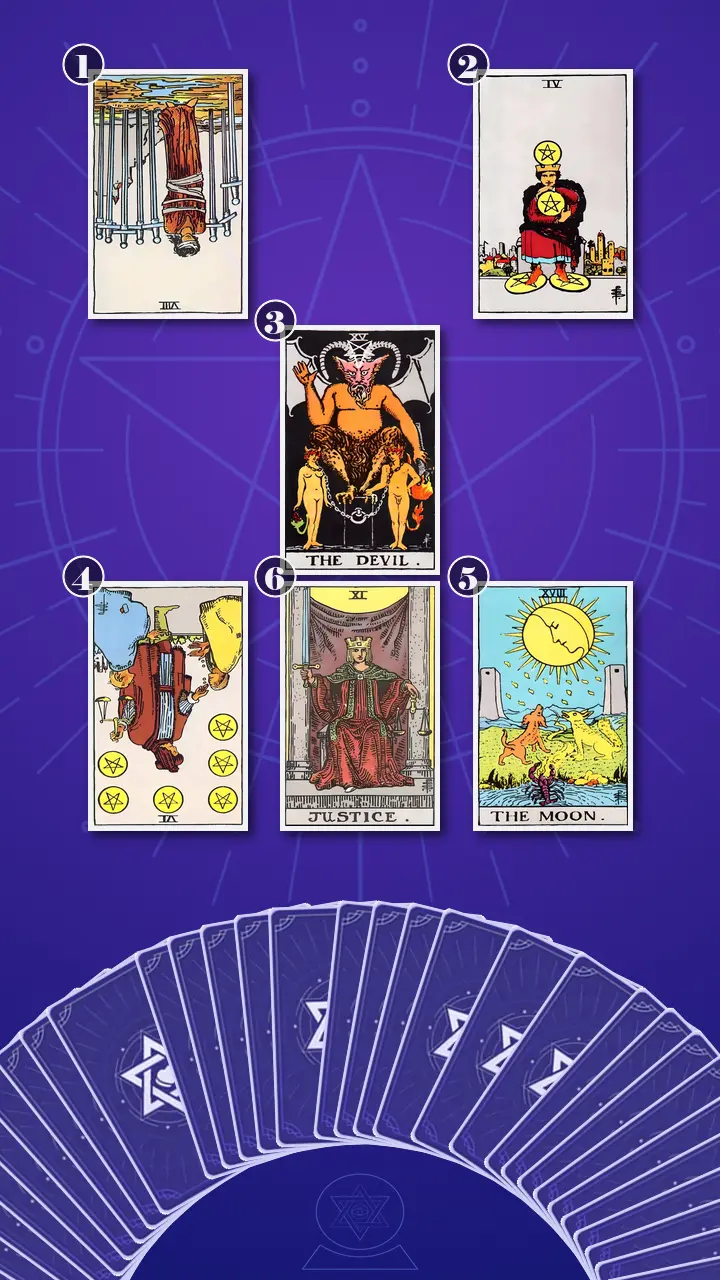
Today, I used the Relationship Spread · Context Edition, a six-position tarot spread designed for relationship dynamics, emotional self-silencing, and questions about unmet needs. The spread gives us a way to examine a pattern from several angles while keeping agency with the person asking the question.
For anyone wondering how tarot works in a consultation like this, I use the cards as an external thinking surface. Their images do not give me access to a partner’s private thoughts or announce a fixed future. They interrupt the familiar story long enough for observable behavior, emotional impact, fear, and choice to be placed beside one another.
The first position would show Maya’s observable current stance: what she did in the moment she felt hurt. The second would show the relational signal she was experiencing, without pretending to read her partner’s mind. The third would map the shared attachment pattern, the fourth would reveal the short-term stabilizer that kept the relationship looking easy, and the fifth would locate the uncertainty blocking repair. The sixth, placed below the center like the far side of a small bridge, would point to an available, self-directed next step.
This is a more precise tool than a general life reading because Maya was asking about an emotional exchange inside a partnership. It preserves the relational context while ensuring that the final answer is something she can practice, observe, and revise for herself.
The Blindfold, the Budget, and the Bridge
I laid the cards in their positions and kept the eye path simple: from Maya’s current stance to the signal she was interpreting, down through the shared pattern and its hidden cost, across the uncertain challenge, and finally toward Justice beneath the center. I read each card in context, treating the symbols as prompts for honest comparison rather than proof.
The Blindfold Coming Loose: Maya’s Current Stance
“Now I’m turning the card that shows Maya’s observable current stance: hiding hurt, saying ‘fine,’ and narrowing her perceived choices when she wants closeness but fears becoming demanding.”
The card was the Eight of Swords, in reversed position.
In the Rider-Waite-Smith image, a blindfolded figure stands surrounded by swords, with bindings crossing her hands. The reversed orientation does not mean instant freedom. It suggests that the restriction is beginning to become visible from within, which is the first condition for questioning it.
I connected it directly to Maya’s Notes app. After her partner disappointed her, she wrote the honest version, reread it for signs of neediness, deleted it, and sent a casual meme instead. The blindfold was not her lack of feeling. It was the editing process that made silence and conflict look like the only available choices, even though a smaller truth remained possible.
The energy here was a blockage beginning to loosen, with a shortage of felt safety around direct expression. I asked her to notice the exact split second before the usual “no worries”: not what her partner felt, not what the evening would become, but what one honest sentence might sound like before fear narrowed the options.
Maya gave a short, bitter laugh. “That’s too accurate,” she said. “It’s almost cruel.” Her thumb pressed hard into the edge of her phone.
“I won’t soften it into something meaningless,” I replied. “But I also won’t turn it into a sentence against you. The reversed card is an opening. It does not ask you to send a long, emotionally loaded message at midnight. It asks whether two clear sentences might exist before you decide that speaking equals creating drama.”
Her thumb lifted from the phone. She stared at the blank space where the drafts had been, then looked toward the window. The recognition had landed, but it had not yet become comfort. I let that be true.
The Coin Against the Chest: The Partner Signal She Is Interpreting
“The second position shows the relational signal Maya is experiencing or interpreting from her partner. It does not reveal his private thoughts; it shows the influence of his availability, tone, and stated preference for ease as they reach her.”
The Four of Pentacles appeared in upright position.
Traditionally, this card speaks of holding tightly, guarding resources, and protecting stability. In the image, one coin is pressed to the figure’s chest, another is held above the head, and two are fixed beneath the feet. I saw the picture of emotional stability being guarded in every direction.
Maya had heard her partner call the relationship easy and low-drama. When he became quiet, distracted, or mildly defensive, she treated that ordinary relational cue as a warning that reassurance might cost too much. She changed plans around his mood, tucked disappointment away, and kept the surface controlled while her own emotional space grew smaller.
The upright energy was excessive holding. Security had become so tightly protected that honest emotional exchange could not get through. I asked, “What did you actually observe, and what conclusion did you add? Was he quiet, or did quietness become proof that your need would be unwelcome?”
Maya rubbed the rim of her water glass. “He did go quiet,” she said. “But I don’t know that he was rejecting me. I usually fill in the rest before I ask.”
I nodded. That distinction mattered. A tarot reading for communication issues should not turn an experienced signal into a secret fact. It should help a person identify where perception ends and interpretation begins.
The Loose Chain: The Attachment Loop Beneath the Calm
“The third position maps the co-dependency pattern created between you: the mutual-looking calm that is actually sustained by concealment, reassurance, and fear of relational disruption.”
The Devil came up upright.
I told Maya immediately that The Devil was not proof that her relationship was toxic and not a diagnosis of either person. In the Rider-Waite-Smith image, the couple’s neck chains are loose enough to be examined. The card shows an attachment pattern that feels binding, not an inescapable identity.
The modern version was painfully ordinary: Maya deleted a vulnerable text, replied with a meme, checked the typing status, absorbed the awkwardness, and waited for care to arrive without risking a direct request. The relationship looked calm because she kept smoothing every uncomfortable moment, but the relationship never had the chance to learn how to repair honestly.
I brought in my signature Attachment Loop Diagnosis as a clear lens, not a label. I use it to ask whether relationship friction is being driven by an anxious-avoidant trap, deep-seated insecurity, or an observable present problem that has not yet been discussed. In Maya’s case, the sequence was visible: a missed need triggered the belief that adding an emotional need might make her too much; she hid the hurt and over-accommodated; tension dropped for the evening; the original hurt remained; loneliness and quiet resentment returned.
“The private rule sounds like this,” I said. “‘If I name this, I become the problem; if I stay useful, we stay safe.’ But genuine closeness is different from calm purchased through unequal emotional labor.”
Maya’s breathing stopped for half a beat. Her fingers tightened around the glass, her eyes went unfocused as if a familiar exchange were replaying behind them, and then a low “Oh” came from somewhere deep in her chest. Her shoulders dropped before she seemed to notice they had been raised.
I waited rather than rushing to reassure her. The fear of relational rejection deserved attention, but it did not deserve control of the interpretation. The Devil was showing the contract she could inspect: was she freely choosing a low-drama rhythm, or obeying an unspoken condition that said she must disappear her needs to remain lovable?
The Unequal Ledger: What Keeps the Evening Smooth
“The fourth position reveals the short-term stabilizer: Maya’s unequal giving, over-accommodation, and difficulty asking to receive care.”
The Six of Pentacles appeared in reversed position.
In its upright form, this card concerns giving, receiving, support, and the balance of power represented by scales and coins. Reversed, its energy shows imbalance: giving becomes excessive, receiving becomes unsafe, and care can become an unspoken test rather than a mutual choice.
Maya rearranged her schedule, comforted her partner, and said the changed plan was no big deal. When she needed the same kind of care, she waited to see whether he would notice. She had made herself useful instead of making herself visible.
“I want you to translate the merchant’s scales into an emotional ledger,” I said. “Who changes plans? Who reassures? Who asks? Who quietly waits to be noticed?”
She looked down and began counting on her fingers. “I gave flexibility so the tension would drop,” she said slowly. “But I was hoping to receive reassurance without having to ask for it.”
That sentence separated generous choice from giving that functioned as an unspoken test. I cautioned her against swinging to the opposite extreme by withholding care, keeping score, or testing her partner in return. The reversal did not demand retaliation. It invited a specific request and an honest observation of what followed.
The Fogged Route: Where Healing Stagnates
“The fifth position locates the healing stagnation: the uncertainty, projection, and unspoken fear that prevent Maya from distinguishing an actual relational cue from the story that her hurt will cost her belonging.”
The Moon appeared upright.
The Rider-Waite-Smith Moon shows a dog, a wolf, an emerging crayfish, and a winding path between two towers. I read the path as the distance between what happened and what fear says it means. The dog may appease, the wolf may panic, and the crayfish may carry something old and submerged toward the surface; all of them respond to the same unclear light.
One short text from Maya’s partner could become three browser tabs within minutes: he is busy, he is annoyed, or he is preparing to leave. The Moon’s energy was excess ambiguity and blocked discernment. An incomplete cue was being converted into a verdict before Maya had asked a clarifying question.
I introduced my second signature lens, Shadow Projection Analysis. I use it to identify fears or unmet earlier needs that may be projected onto a present partner, while keeping a firm boundary between an internal narrative and the partner’s actual behavior. The purpose is not to blame Maya for having a history. The purpose is to stop an old alarm from speaking with the authority of a confirmed fact.
I drew two columns in my notebook: What I observed and What fear predicted. Under the first, Maya wrote, “One short reply. He looked distracted. He did not answer the question.” Under the second, she wrote, “He is annoyed. I am too much. He will leave if I bring this up.”
Her shoulders rose as she wrote the second column, then lowered when she placed the pen between the two headings. “I know he was quiet,” she said. “I don’t actually know what his quiet means.”
That was the Moon’s threshold practice: she did not need certainty before speaking. She needed enough separation between fact, fear, and request to choose her next sentence. Uncertainty could invite a question instead of automatically producing self-silencing.
When Justice Put the Truth on the Table
The Upright Sword: A Fair Sentence About Hurt
The room became quieter when I reached the sixth position, the card that turns the consultation question into a self-directed next step: how Maya can express one hurt clearly, make a proportionate request, and practice reciprocity without deciding her partner’s response in advance.
Justice appeared in upright position.
Justice traditionally represents truth, balance, accountability, discernment, and the consequences of choices. In the image, the sword is upright and the scales are held at heart level. I read those symbols as equal space for Maya’s experience and her partner’s response. The sword was clear language, not an accusation. The scales were proportion, not a demand for a guaranteed outcome.
The modern sentence was simple: “When the plan changed without notice, I felt unimportant. What would help is a heads-up next time.” Three points could sit on the table: what happened, what it affected, and what would help. No mind-reading. No apology for having an experience. No attempt to script the other person’s reaction.
Justice was the antidote named by this spread. I returned to my Attachment Loop Diagnosis and traced the interruption: when a missed need triggered the fear of being too much, Maya had been treating silence as the only way to preserve closeness. Justice offered a different sequence: name the impact, make a fair request, and let the response be real. That was self-respect, emotional clarity, proportionate boundaries, honest accountability, and reciprocal care in practice.
At 8:47 PM on the TTC, Maya had opened Notes after a tense exchange and typed three versions of what hurt. The phone felt warm in her hand, fluorescent lights buzzed above her, and she sent a meme instead, hoping silence would keep the evening easy.
Stop treating silence as proof that you are easy to love; place your experience and your partner's response on Justice's balanced scales, using the upright sword to speak clearly without trying to control the outcome.
Then I gave her the plain-language version: “You do not have to erase your hurt to keep love easy. Name what happened, describe its impact, and ask for a specific response so mutual care can be observed instead of manufactured through silence.”
For a few seconds, Maya’s index finger stopped above the phone and her breath held; her face went still, as if the fluorescent carriage had become a freeze-frame. Then her eyes lost focus, and I watched her replay the quiet tone, the deleted drafts, and her own automatic “no worries.”
She looked at me with sudden, almost angry disbelief. “But does that mean I was wrong all those times? If I could have spoken, why did I keep swallowing it?”
I let the anger have air. “It means you were protecting belonging with the tools you had. Seeing the pattern gives you another tool; it does not put you on trial.”
Her jaw loosened first; then her shoulders sank, her fingers opened from a fist, and a shaky breath moved down into her stomach. The release carried a thin edge of dizziness: clarity gave her a path, but not a guarantee about another person’s response. I set a ten-minute timer and asked her to write, without sending, “I felt ___ when ___ happened. What would help is ___.” She could stop, revise, or keep it private; this was for clarity, not proof. “Now,” I said, “use this new perspective to recall last week. Was there a moment when this insight could have made things feel different?”
Maya looked at the card again. The upright sword no longer seemed to demand a verdict. It gave her a way to tell the truth while leaving responsibility for her partner’s response where it belonged.
I named the crossing for her: this was a movement from fear of relational rejection, emotional self-erasure, and hypervigilant mind-reading toward self-trust, proportionate vulnerability, and reciprocal intimacy. The first step was not fearless disclosure. It was allowing one feeling to occupy one honest sentence before fear edited it out.
The One-Page Justice Sheet
I drew the reading together as a short story. Maya’s work had taught her to smooth tense conversations, and that useful skill had followed her home. The reversed Eight of Swords showed how self-editing made silence feel compulsory. The Four of Pentacles showed her protecting the relationship’s calm as if reassurance came from a limited emotional budget. The Devil revealed the attachment loop beneath that calm, while the reversed Six of Pentacles showed the hidden cost: she gave flexibility and comfort, then waited to be cared for without asking.
The Moon explained why the hurt kept returning. An unclear tone or delayed reply became a fearful story about belonging, and the story made direct conversation feel dangerous. Justice offered the correction. Maya could separate what happened from what fear predicted, name the impact, make a proportionate request, and observe whether care became reciprocal. The cards did not decide whether she should stay, leave, forgive, or demand. They returned the decision to the person who would live with it.
Her cognitive blind spot was not simply that she had needs. It was the assumption that she had to manage her partner’s comfort before she was allowed to mention them. She had confused a low-maintenance relationship with a no-needs relationship, then called the resulting loneliness proof that she was asking for too much. The key shift was from proving that she needed almost nothing to naming one hurt plainly and asking for one specific, proportionate response.
I told Maya that my Projection Detachment Exercise could help her keep the Moon’s fog from becoming a new source of rumination. It is a structured journaling practice that separates a partner’s actual behavior from the triggered internal narrative. The goal is not to make every fear disappear or to defend the partner automatically. The goal is to decide from clearer evidence.
This is what the Contextualized Relationship Tarot Spread had offered: a map of current stance, partner signal, shared attachment pattern, stabilizer, challenge, and agency. Its value was not that the cards controlled the relationship. Its value was that the images made an invisible emotional economy visible enough for Maya to change one part of it.
Small Next Steps, Kept Deliberately Small
I gave her three practical experiments. Each one was small enough to begin after a workday, specific enough to observe, and reversible enough to remain hers.
- The Two-Sentence Hurt-and-RequestAfter one small hurt this week, open Notes when you have ten uninterrupted minutes and write, “I felt ___ when ___ happened. What would help is ___.” Read it once without turning it into a joke, then decide whether to share it with your partner or ask for ten minutes to talk after dinner.Tip: Leave out the automatic apology and “no worries” unless it is genuinely true. The exercise is for clarity, not proof.
- The Projection Detachment ExerciseWhen a delayed reply or distracted tone triggers you, create two phone notes titled “What I know” and “What I am predicting.” Put no more than three observable bullets under each, then choose one clarifying question you could ask your partner instead of reaching a relationship verdict.Tip: Set a five-minute timer so fact-versus-story reflection does not become another form of checking and replaying.
- The Visible Reciprocity PracticeIn one conversation this week, make one concrete request without adding “no pressure” or “it’s fine if not” at the end. Ask for a phone call, a repair conversation, or advance notice when plans change. Afterward, privately write three lines: “What I offered,” “What I received,” and “What I actually needed.”Tip: Keep the notes descriptive rather than turning them into a scorecard. A specific request is not a demand for a guaranteed reaction.
“You can stop if the conversation feels unsafe or overwhelming,” I added. “You are testing a sentence, not putting your worth on trial. Your partner is responsible for their response, and you are responsible for noticing what that response tells you.”

A Week Later, the Quiet Proof
Six days later, I received a message from Maya while I was making tea. “I used the two sentences,” she wrote. “We talked for ten minutes, and he agreed to give me a heads-up. I still woke up thinking, ‘What if I’m wrong?’ Then I made coffee instead of deleting the message.”
That was the kind of change I trust: not a dramatic transformation, not proof that every future conversation would be easy, but one clear action followed by real information. The fear still appeared in the morning. It simply no longer had the whole room to itself.
I thought of the cards as I read her message. The blindfold had loosened. The chain had become visible. The Moon’s path had been separated into fact and story, and Justice had given Maya a sentence she could carry without trying to control where it landed.
That was her Journey to Clarity. Tarot did not make Maya’s partner respond, and it did not choose the relationship’s future. It helped her reconnect with an inner authority that had been busy keeping everyone comfortable. Low-maintenance was no longer a synonym for self-erasure. It could mean honest, proportionate, mutual, and still free of unnecessary drama.
When your chest tightens and your jaw locks around the words “that hurt,” you may be trying to keep closeness by becoming easier to need, while the part of you longing for mutual care stays alone with the feeling.
You do not have to solve the whole relationship before you speak. You can begin by letting one honest sentence exist, naming its impact, and making room for the response to become information rather than a verdict on whether you are lovable.
If you could let one honest sentence exist without deciding in advance how your partner must receive it, what small truth would you be curious to name?