Breakup-Admin Paralysis—And Defining Done Without Feeling Neutral

The 10:40 p.m. Submit Button
I recognized the pattern immediately: the hybrid city worker who can hit a campaign deadline before lunch, then spend Sunday night reorganizing a five-minute breakup-admin task because closure procrastination has turned Send into an emotional threshold.
Casey, twenty-eight, a non-binary marketing coordinator in Toronto, had described one Tuesday night to me in precise detail. At 10:40 p.m., they had a utility-transfer page glowing on their laptop, two versions of the same message open on their phone, and a colour-coded Notion subtask waiting beside them. I could almost hear the laptop fan in the quiet kitchen, taste the cold bitterness of their tea, and feel the warmth trapped in the phone case after forty minutes of editing. Their shoulders sagged whenever the cursor reached Submit.
When I asked why they had come for a reading, Casey said, “I keep calling it a five-minute task, but somehow I lose the whole evening to not doing it. I want closure, but every piece of admin feels like another breakup. I have made three checklists and completed none of them.”
I heard the contradiction clearly: Casey wanted to separate the shared accounts, subscriptions, and practical messages so they could move forward, yet every unfinished item kept a small doorway open to the life they said they wanted to leave. Their ambivalence was not a vague cloud. It was like standing in a subway doorway after the train had stopped, one hand gripping the old rail while cold air pressed against the back of the neck.
I told Casey that I did not hear laziness or a lack of practical ability. I heard grief, guilt, frustration, and a nervous system trying to make one administrative click carry the meaning of an entire relationship. “We do not have to force you to feel neutral,” I said. “Let us draw a map of the loop instead. Our Journey to Clarity can begin with one honest question: what is the task actually asking you to do, and what are you asking it to prove?”

Choosing the Ladder Out of the Doorway
I invited Casey to place both feet on the floor, take one slow breath, and name the question without polishing it. I shuffled the deck at an unhurried pace. The small ritual was a transition of attention, not a supernatural test: a few quiet minutes to move from the glowing screen and its unread badge into a more deliberate way of seeing.
For this consultation, I chose the Four-Layer Insight Ladder. In practical terms, this is how tarot works here: the cards give us a structured cognitive mirror for the behaviour, the belief beneath it, the leverage point that can interrupt it, and the next action that can be observed in real life. They do not predict whether Casey will heal on a schedule, and they do not make the decision for them.
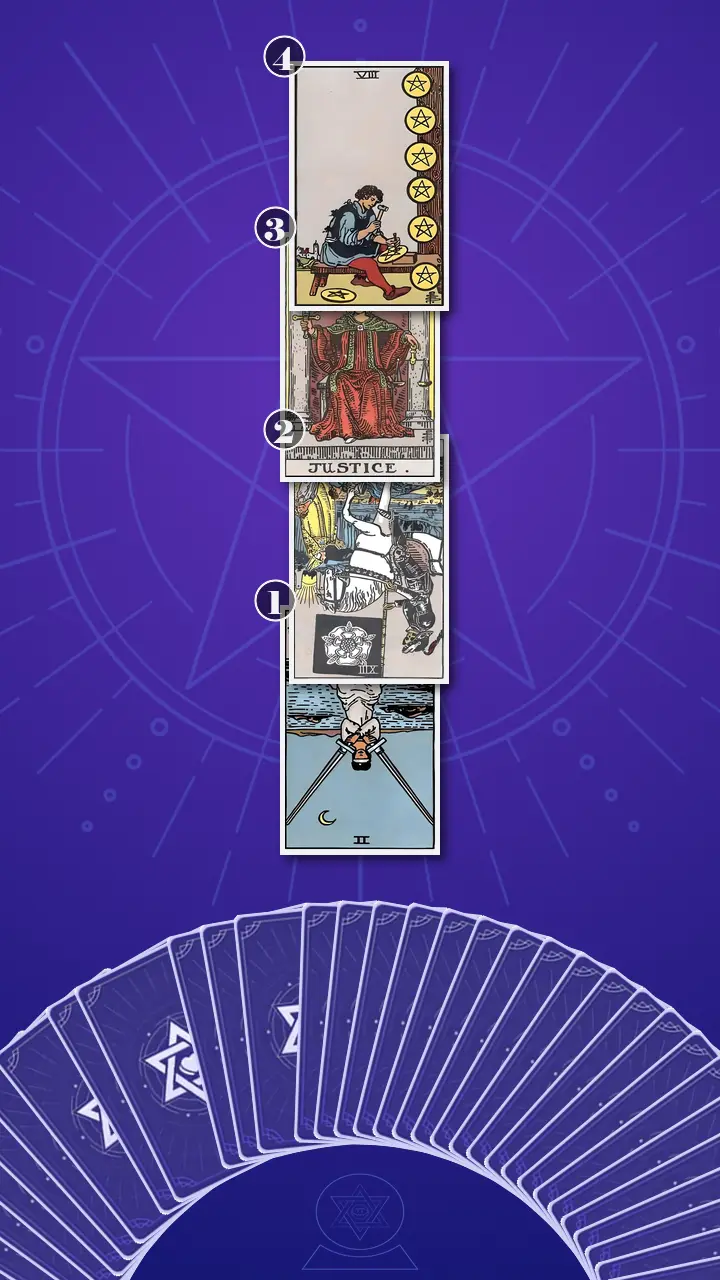
The Four-Layer Insight Ladder was more useful than a large spread because Casey was not asking for every external influence or a grand forecast. They were asking why a small task kept repeating the same avoidance loop and how movement could resume. A vertical ladder gives us the smallest sufficient structure: the bottom card shows the visible symptom, the card above it reveals the hidden fear, the bridge identifies a corrective principle, and the top card translates clarity into practice.
I explained the path to the reader as well as to Casey. We would move from the current pattern of opening, revising, and closing the same task; into the fear that completion might make the ending materially final; through a clear distinction between fact and emotional verdict; and finally toward one bounded admin session. The layout was a narrow staircase out of an unfinished doorway, where incremental movement mattered more than a dramatic leap.
Reading the Map Without Demanding Neutrality
The Open Tabs Beneath the Blindfold
I began at the bottom of the ladder. This position presents the observable symptom in the diagnosis: opening, revising, and reorganizing breakup-admin tasks without submitting the next action.
The card was the Two of Swords, in reversed position.
I pointed to the blindfolded figure and the two swords crossed defensively over the chest. In Casey’s life, the image looked like two nearly identical message drafts held up as competing evidence. At 10:40 p.m., they changed Hey to Hi, compared punctuation, researched the provider’s transfer rules again, added a dependency to Notion, and closed everything when neither version felt emotionally neutral. The reversed orientation showed that not choosing no longer created peace. It had become an overloaded holding pattern, complete with unread badges, repeated debates, and another evening spent circling a decision that had already received enough thought.
I asked Casey to listen for the sentence beneath the preparation. They gave me the pattern slowly: “I only need to send it, but first I need to make sure the greeting is right, the timing is fair, the tone is not cold, the wording cannot reopen anything, and I have not missed some important policy.” Each concern sounded reasonable by itself. Together, they formed an airless room in which more thinking produced pressure without producing a decision.
I watched Casey’s thumb freeze above the phone. Their breath paused; then their eyes lost focus as if the same draft-editing evenings were replaying behind the screen. Finally, they let out a short, bitter laugh and rubbed one hand over their shoulder.
“I have absolutely done this,” Casey said. “That is so accurate it is almost rude.”
I smiled gently. “The card is not calling you incapable. It is showing a defence that once reduced the sting for a few minutes and now keeps the whole system stuck. You do not need an exhaustive master plan for every account this weekend. The useful question is smaller: which single decision has already been considered enough?”
The Doorway That Would Not Close
I moved to the second rung. This position reveals the underlying fear that completing practical separation will make the ending materially final and threaten Casey’s sense of belonging or control.
The card was Death, in reversed position.
I said clearly that this was not a prediction of loss or harm. In this context, Death described transition, and its reversal described resistance to allowing a transition to become tangible. The black banner, the white rose, and the rider moving forward all hold ending and renewal in the same image. A submitted transfer changes an account; it does not delete the meaning or memory of the shared chapter.
I asked Casey to picture the completed form still sitting unsent. They had already filled in the name, date, and provider details. The final confirmation remained untouched because the words remove household member felt much larger than the setting itself. It felt like an announcement that they no longer belonged in a life that had once been mutual.
“Sometimes the wording is not the block; finality is,” I told them.
I saw a small drop pass through Casey’s body first: their stomach tightened, their fingers closed around the edge of the chair, and their eyes fell to the floor. Then the thought reached them. Their mouth shaped the beginning of an answer, but no sound came for several seconds, as though they were standing in a doorway with one hand still on the old handle.
“If I submit this, then it is officially...” Casey stopped. They did not finish the sentence with over, separate, or no longer ours. I let the unfinished words remain unfinished. “You can want the practical boundary and still grieve what it represents,” I said. “The account is not entitled to decide what the relationship meant. It only needs the correct information and the next appropriate action.”
When Justice Made Room for Grief
The Single Sword in the Overlapping Air
The room became unusually quiet when I reached the third rung. I could hear a streetcar bell several blocks away, then the low click of the heater. I placed the card where both reversed cards pointed toward it. This position identifies the leverage point that can interrupt the procrastination loop by separating factual responsibility from emotional meaning.
The card was Justice, in upright position. Its uncovered gaze, level scales, and single upright sword answered the first card’s blindfold and crossed blades. Justice did not demand that Casey decide whether the breakup had been fair in every emotional sense. It asked for proportion: names, dates, amounts, ownership, consent, and the exact confirmation that would mark one task complete.
For fifteen years as a perfumer, I have learned to notice when atmospheres overlap. My signature diagnostic is called Spatial Boundary Scenting: I look for the systemic imbalance created when one environment bleeds into another. My mind briefly returned to the fragrance lab, where two beautiful notes can become muddy when neither has enough room to develop. The solution is not to declare one scent wrong. It is to clear the air and restore the boundary between them.
I used that lens with Casey. Their capable work atmosphere, where campaign deadlines had owners and acceptance criteria, was separate from the home atmosphere filled with ex-linked notifications, shared-account names, cold tea, open drafts, and the emotional weight of a former household. The work-life bleed was only one part of it; the past relationship was also bleeding into the physical and digital rooms of the present. Every reminder borrowed intensity from every other reminder. Justice offered one clean separation: the account task could have a boundary without becoming a verdict.
The Sentence That Separated Fact from Verdict
I drew a plain three-column note on a sheet of paper and asked Casey to imagine the utility-transfer problem inside it. The first column was Facts. The second was Required action. The third was Done when. I asked what the form must factually accomplish, not what it must prove about the breakup.
At 10:40 p.m., the utility page is still open, your tea has gone cold, and you are editing a practical message again. You want the account separated, yet your shoulders drop as soon as the submit button makes the ending feel official.
You do not need two perfectly painless choices before you move; use Justice's upright sword to separate one factual task from the emotional verdict, then let the balanced scales define enough.
The task can make the ending official without becoming a verdict on what the relationship meant. Done is a factual standard, not a feeling you have to wait for.
I watched Casey’s thumb stop above Send. Their face went still, pupils widening as though the screen had suddenly become larger; the breath they had been holding caught high in their chest. Their gaze left the card and went unfocused, replaying the utility page, the repeated greeting, and the months of keeping the name unchanged. One hand tightened around the mug, then loosened. A flush gathered at the corners of their eyes. For a moment, the relief looked almost frightening: without the old pressure, there was no script telling them what to do next. Their mouth opened, closed, and finally released a shaky breath. Their shoulders dropped, but grief stayed in the room with us. Casey looked at me and said, “I thought I needed the perfect tone; what I need is an accurate boundary.” I let the silence stand. Then I asked, “Now, use this new view to remember last week: was there a moment when this distinction might have let you feel different?”
Casey looked back at the note. “The form is asking who holds the account and what date the transfer should happen. My grief is saying this means I have lost the whole shared life. Neither has to answer for the other.”
I nodded. This was the first real movement from heavy ambivalence and protective avoidance toward fact-based self-trust and grounded acceptance. Not closure arriving on command. Not a sudden erasure of grief. Just a clearer boundary between a practical responsibility and the emotional story attached to it. An admin task can mark an ending without judging what the relationship meant.
The Workbench with Only One Pentacle
One Active Ticket, Not the Whole Breakup
I turned to the top rung. This position translates the key shift into one repeatable behaviour: completing a clearly bounded admin task in a short scheduled session.
The card was the Eight of Pentacles, in upright position.
The craftsperson in the image attends to one pentacle while the completed pieces remain visible as separate units behind them. I connected that visual to a support queue: only one ticket is active, completed tickets are logged, and the rest are allowed to stay parked. Casey did not need to finish the breakup. They needed to finish one account, one form, one message, or one exchange arrangement with an observable result.
I explained that the grounded energy of the Eight of Pentacles was a useful correction to all-or-nothing thinking. The spread contained no Cups or Wands, and that mattered. Casey did not need a full emotional catharsis or a surge of motivation before acting. The movement was from blocked thought, through clear distinction, into ordinary repeated effort. Closure does not have to arrive before the cancellation confirmation.
I watched Casey open their calendar instead of their master checklist. They typed a Wednesday appointment at 7:10 p.m. and named it Cancel shared streaming plan rather than breakup admin. Their shoulders were still carrying some weight, but their hand no longer hovered over every possible task.
“Today I am not finishing the breakup,” they said. “I am finishing this subscription change.”
“Exactly,” I replied. “One completed boundary can coexist with complicated grief. Repetition matters more than intensity.”
Finding Clarity in the Fact-Meaning Split
I gathered the four cards into one story. The Two of Swords reversed showed the visible pattern: careful planning had become defensive overthinking. Death reversed revealed why the pattern held: a small administrative confirmation had been asked to carry the emotional finality of the breakup. Justice supplied the bridge, separating what was verifiable from what the relationship meant. The Eight of Pentacles grounded that bridge in one repeatable unit of work.
The core metaphor was still the doorway. Casey had been standing between an old shared arrangement and a new practical boundary, gripping the handle while trying to find a route with zero grief, zero guilt, and zero possibility of being misunderstood. My reading showed that such a route did not exist, but a clear next step did. The cognitive blind spot was treating emotional neutrality as a prerequisite for factual action. The key shift was to schedule one twenty-minute task at a time with a clear definition of done.
I also performed a Sensory Overload Audit with Casey. We named the quiet environmental stressors that were draining their psychological bandwidth: the unread iMessage badge, the warm phone in their hand, the open provider tab beside work notifications, the laptop fan, and the habit of doing breakup admin in the same visual space where they were expected to produce marketing work. The point was not to make Casey more guarded. It was to give each atmosphere enough room to breathe.
I offered three small next steps. None required Casey to contact their former partner, delete meaningful records, or resolve the entire list. Each one was designed to be low-risk, specific, and observable.
- Make the facts visibleFor one low-risk item, open a paper note or phone note and write three headings: Facts, Required action, and Done when. Add no more than three bullets, then identify the minimum complete step, such as receiving a submission confirmation or changing one account field.Give each heading no more than two minutes. If the three columns feel emotionally too small, keep the feelings in a separate private note; this exercise defines the task, not the relationship.
- Book one unit of closureWithin this week, schedule one twenty-minute session in a specific place, such as Wednesday at 7:10 p.m. at the kitchen table. Keep only the selected subscription, account, form, or minimum complete logistics message open. If contact is necessary, use one channel, one topic, and one factual next action.Close the master checklist and park unrelated research questions. Record the date, item, and observable result before stopping. If twenty minutes is too much, use five minutes to locate the login or required document.
- Use the Physical Boundary ProtocolWithin seventy-two hours, choose one sensory trigger to mark the partition between high-pressure output mode and deep recovery mode. Casey chose an unscented hand wash and a warm lamp: after the scheduled admin session, they would wash their hands, close the laptop into its sleeve, place it outside the bedroom, switch the phone to Do Not Disturb, and turn on the recovery lamp.Treat the boundary as absolute for the rest of the evening: no work messages, breakup-admin tabs, or extra research in the recovery space. The cue is a transition signal, not a reward for feeling finished.
I added one practical safeguard. If an item involved disputed money, housing rights, legal consequences, joint ownership, or safety concerns, I would not use tarot as a substitute for qualified advice. Casey could preserve records, check provider terms, and ask a lawyer, advocate, support worker, or trusted person before changing access. A low-risk task was a choice, not a command.
“The goal is not to prove that you have moved on,” I said. “The goal is to let one responsibility stop borrowing the authority of the whole relationship. You remain the person who decides what happens next. The cards can show the pattern, but the querent is the author of the boundary, the pace, and the meaning.”

A Week Later, One Confirmation
Six days later, Casey sent me a message with a screenshot of a cancellation confirmation and one sentence: “I did the twenty-minute session. I still felt sad, but I did not rewrite the task into a weekend project.”
That evening, I pictured the small change they described: one shared subscription was gone, the completion date was recorded, and the remaining items were still waiting in a closed list. Casey slept through the night. In the morning, their first thought was still, What if I got it wrong? This time, they smiled at the question before making coffee.
I did not treat that as a miracle or a final chapter. I saw it as the first concrete evidence of the emotional transformation we had named: discomfort while completing one bounded task, relief mixed with grief, and the beginning of self-trust. The doorway had not vanished. Casey had simply taken one step through it without demanding that the past become meaningless.
That was our Journey to Clarity: not a promise that the breakup would feel clean, but a way to make the next boundary clear-eyed, proportionate, and theirs. Tarot had not chosen what Casey should keep, cancel, send, or remember. It had helped them notice where thought was acting as a shield, then return the decision to the person living with its consequences.
When your thumb hovers over Send and your shoulders go heavy, changing one account can feel as if it will cancel your place in a life that once felt shared. Leaving it unchanged can keep you standing in the doorway, too. If this task did not have to explain the relationship, which one factual line might you feel willing to complete next?