The 9:10 a.m. Calendar Tetris
I said it gently: “You can protect a product launch meeting three weeks out, yet a call with your family keeps becoming ‘maybe next weekend.’”
I watched Maya (name changed for privacy), a 29-year-old product marketing manager in Toronto, press her thumb into the warm side of her phone. Her shoulders lifted by a fraction. The movement was small, but I recognised it as the body preparing to defend a decision the heart had never entirely agreed with.
She had come to me with a question that sounded like time management but carried the weight of something more intimate: “Why do I keep postponing family time until life feels less busy?”
She described the previous Saturday. At 9:10 a.m., in her apartment, she had texted that she could not make lunch and suggested sometime next weekend. Her coffee cooled beside the laptop while its fan whirred through the quiet room. A grocery-app notification pinged. She answered two non-urgent messages, edited the following week in Google Calendar, and began reorganising her task list.
By evening, the apartment was dim, the lunch had no replacement date, and the time she had supposedly rescued had dissolved into email, groceries, and calendar admin. Her jaw had set as if she were holding an invisible door shut. The guilt sat beneath her tongue like a cold coin: small enough to carry all day, hard enough to make every swallow noticeable.
“I keep making space and then filling it with something else,” she said. “I know what matters to me, but my calendar does not show it.”
I did not hear laziness or a lack of care. I heard a conditional rule: she wanted meaningful family time now, but she required a finished task list first. Because the list kept regenerating, connection remained stranded on a platform, waiting for a quieter week that never arrived.
I have lived sixty-seven winters and inherited a Highland family’s respect for natural cycles, but I do not use age or lineage to instruct anyone. I use them to hold steady while another person hears their own truth. I told Maya, “I’m not going to use tarot to predict whether your family life improves or tell you what you owe anyone. We’ll use it as a mirror. Let’s make a map of the fog, then see which part of the path is actually yours to choose.”

Choosing the Four-Card Bridge
I invited Maya to put both feet on the floor and take one unforced breath. I shuffled slowly while she held one precise question in mind: not “How do I become perfectly balanced?” but “What keeps making wanted family connection feel impossible until everything else is done?”
I chose the Situation-Obstacle-Advice-Outcome tarot spread. In my practice, this is how tarot works best: not as a verdict, but as an organised way to examine card meanings in context. Maya’s problem was a focused, self-reinforcing loop, so four positions could show the complete mechanism without adding unsupported drama.
I laid the cards in a horizontal line. The first position would show the visible diagnosis: family plans being moved while other tasks flowed into the opening. The second would reveal the maintaining mechanism beneath that behaviour. The third would identify the corrective principle, the shift capable of changing Maya’s relationship with time. The fourth would show an integrated direction available through her choices, not a guaranteed future.
I left a little more space between the second and third cards. That gap mattered. The first two cards would describe the postponement loop; crossing the gap would take us from diagnosis to possibility. The final card would ask whether an insight could become a rhythm sturdy enough to survive an ordinary workweek.
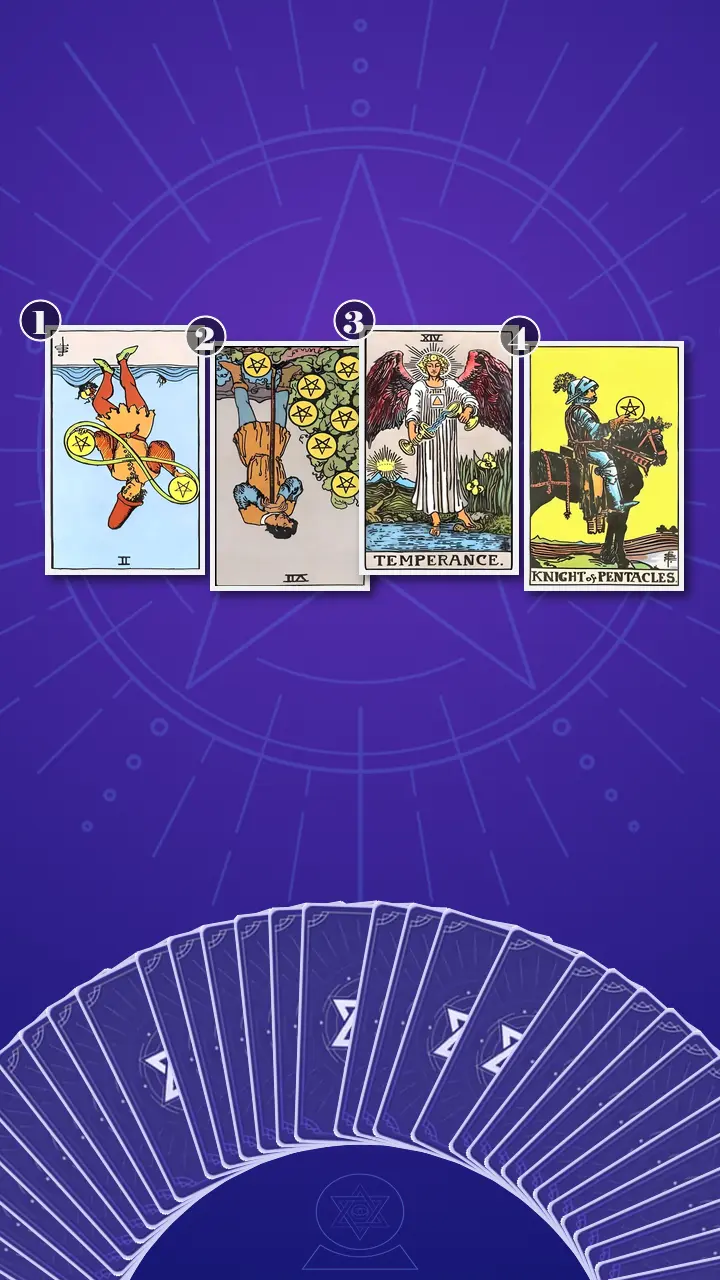
The Calendar That Kept Moving
Position 1: Two of Pentacles Reversed and the Endless Reschedule
I turned over the card representing the diagnosis in observable form: rescheduling family contact, filling the released time with more tasks, and experiencing the calendar as an unstable juggling act.
It was the Two of Pentacles, reversed.
I pointed to the two pentacles bound by an infinity-shaped loop. In the upright card, the figure adapts to changing demands. Reversed, that movement has stopped producing balance. I read it as an excess of adjustment combined with a deficiency of stable prioritisation. Maya was not standing beside a temporarily crowded calendar. She was actively maintaining a loop in which every opening received another task.
I translated the image into a scene she knew. At 4:36 p.m. on a Tuesday, a deadline shifts and she drags Sunday’s family dinner into the following week. Within minutes, the open block receives a grocery order, a workout, inbox cleanup, and “finish deck.” The calendar looks busy but organised. Family remains the only stated priority that can move without an immediate replacement date.
“The thought underneath it sounds reasonable,” I said. “I’m only moving dinner because the deadline changed. Once the deck is done, I can be properly present. But the card asks us to separate motion from balance. Moving the block relieves the immediate trade-off; it does not protect what you intended to return to.”
Maya let out a short laugh, then looked away from the table. There was no amusement in it. “That is painfully accurate,” she said. “Honestly, kind of brutal.”
I did not rush to soften the recognition or turn it into blame. “The card is not accusing you,” I said. “It is showing the design of the loop. You created movement because movement gave you a brief sense of control. That makes sense. Now we can examine whether the movement is taking you where you want to go.”
I gave her the first diagnostic phrase: Every postponed plan leaves a receipt: what took its place. I asked her to think about the last call, meal, or visit she moved and name the exact replacement, not the broad category of “work” or “life admin.”
“Slide formatting,” she said after a pause. Her fingers stopped moving against the phone. “The deck was already usable. I spent thirty-five minutes changing how it looked.”
Position 2: Seven of Pentacles Reversed and the Wrong Metric
I turned over the card representing the maintaining mechanism: delayed gratification turning family time into a future reward while unreviewed task investment widened the gap between Maya’s values and her behaviour.
It was the Seven of Pentacles, reversed.
I showed her the worker who should be pausing to assess the crop. Reversed, the evaluative pause is blocked. There is plenty of effort, but too little honest review of what the effort is producing. I read this as an excess of task investment and a deficiency of value-based assessment.
I placed it beside a Friday Notion review. Maya could point to a shipped campaign, cleared admin, and an organised apartment, yet she could not identify when any of those investments had made the promised family visit more likely. Her dashboard contained many completed tickets, but no measure for closeness. It was optimised for a life she could count, while the life she missed remained outside the metrics.
“Your rule has become tasks now, connection later,” I said. “But each finished obligation creates another condition. You reach Friday with fourteen checked boxes and still ask, ‘Why am I behind, and when exactly did family become more possible?’”
As I looked at the cultivated field on the card, I remembered standing beside my grandmother on Highland ground while she tested the soil with the edge of a spade. She never called a field fruitful because it looked busy. She asked what the labour could actually sustain. That old memory gave me the cleanest language for Maya’s modern dashboard.
“A full task list is not proof of a well-invested week,” I told her. “That does not make the tasks worthless. It means task completion cannot be the only valid definition of a worthwhile life.”
Her breathing paused. Her gaze lost focus as though she were replaying several Fridays at once. Then her jaw tightened before releasing around a long, low exhale.
“I always think the guilt means I need to plan something bigger next time,” she said. “A whole day, maybe. Then that feels impossible too.”
I nodded. “That is the overcorrection this card warns about. Guilt turns a missed ordinary call into an imagined make-up event. The planning threshold rises, cancellation becomes more likely, and the next contact carries the weight of repayment. I want to ask a simpler question: which completed task genuinely made contact more possible, and which task only helped you feel temporarily caught up?”
When Temperance Let Both Cups Matter
Position 3: Temperance and the Week That Already Exists
The rain against the window had softened to a measured tapping when I reached across the wider gap in the spread. The room seemed to quiet with it. I turned over the card representing the key shift from placing family after busyness to integrating a small form of wanted connection within ordinary life.
It was Temperance, upright, the catalyst and antidote of the reading.
I drew Maya’s attention to the continuous stream moving between the two cups, one foot on land and one in water. I read this as balanced energy: flexible integration, moderation, present-tense permission, and trust in small, consistent acts of care. The water does not wait for one cup to become irrelevant. It moves in measured amounts between both.
In Maya’s life, the modern scene was specific. She books a thirty-minute Thursday call before reaching inbox zero, allows two optional tasks to remain unfinished, and tells her family member in advance that she has half an hour. The experiment is not whether she can become perfectly present. It is whether choosing connection automatically makes the rest of her life unmanageable.
I used the lens I call Seasonal Energy Diagnostics. I do not begin by asking whether someone is productive enough. I ask which season their system is living through, and whether they are demanding a spring harvest from winter ground. Maya’s tight shoulders, weekend overflow, and late-night calendar edits looked like winter depletion, yet she kept demanding perpetual spring output. She postponed relational nourishment until an imaginary harvest when every obligation had finally been gathered.
“No living season works that way,” I said. “A field is never made worthy of rest by becoming permanently finished. Temperance is not asking you to abandon responsibility. It is returning a small stream of chosen connection to the season you are actually living.”
I brought her back to the loop. At 9:10 on Saturday, she had moved lunch to next weekend; email, groceries, and calendar admin had filled the gap. By evening, her shoulders were tight and no replacement existed. She was still trying to make one correct scheduling decision that would put the whole week under control.
An empty calendar is not the price of meaningful connection; choose one manageable family ritual now and let Temperance's flowing cups show how responsibility and closeness can share the same week.
I let the sentence remain between us.
For one beat, Maya stopped breathing. Her fingers hovered above the phone as though another calendar block were waiting to be moved. Her eyes shifted past me, replaying the Sunday when her mother had been free but the dishwasher was running and Monday’s slides were unfinished. Then resistance arrived before relief. Colour rose into her face, her brows drew together, and she said, more sharply than before, “But doesn’t that mean I’ve been doing this wrong for years? I hate that. I thought I was being responsible.” Her shoulders stayed high while her hands clenched, loosened, and finally settled open on her knees. A thin brightness gathered along her lower eyelids. The anger did not disappear; it changed shape into grief for the ordinary contact she had kept postponing, followed by the slight dizziness of realising that a clearer path would now require her own choice.
I answered without turning the insight into a verdict. “No. It means you found a strategy that gave you short-term control during crowded weeks. It worked for that purpose, so you repeated it. Now you are seeing its cost. Clarity is not a conviction for the past; it is new information for the next choice.”
I waited until her hands opened, then asked, “Now, using this new perspective, can you remember a moment last week when this insight might have changed how the choice felt?”
“Sunday at 6:42,” she said quietly. “I saw my mother was available. I told myself twenty distracted minutes would barely count, so I sent a heart reaction and spent thirty-five minutes fixing slides.”
“What would Temperance have asked instead?” I said.
She looked at the two cups. “What amount of contact can this real week hold?”
I put the shift into one more sentence: Connection does not need permission from the end of your task list; it needs one realistic place inside the life you already have.
I could see the emotional transformation beginning, not as a sudden cure for guilt, but as one movement from guilt-driven task urgency toward grounded trust. Maya was no longer trying to prove that a clear week existed. She was considering whether sufficient presence might be allowed to count inside an imperfect one.
Position 4: Knight of Pentacles and the Promise That Can Be Kept
I turned over the card representing cognitive and behavioural integration: family care becoming a modest, dependable rhythm that could continue without ideal scheduling conditions.
It was the Knight of Pentacles, upright.
I pointed to the stationary horse and the single pentacle held steadily at eye level. After the moving calendar blocks of the first card, the stillness was striking. I read it as balanced Earth energy returning in a steadier form: patience, practical boundaries, and follow-through without spectacle.
The card did not show a dramatic reunion or a perfect family day. It showed Maya and one receptive family member agreeing on a Sunday 6:00 p.m. call every other week, with a thirty-minute default and a clear option to reschedule to one specific time within forty-eight hours. The ritual would be too modest to function as repayment for past guilt, which was precisely why it might be repeatable.
“It does not have to be impressive,” I said. “It has to be real enough to happen again. Consistency can carry more care than an elaborate someday.”
I also made the boundary explicit. “Reliability does not mean unlimited access. Either person can decline, end on time, or suggest another option. And none of this applies where contact is unsafe, pressured, unwanted, or emotionally costly. Tarot does not convert family into an obligation. We are discussing a form of connection you already want, with someone receptive to it.”
Maya nodded slowly. Her eyes remained on the unmoving horse. “Every other week sounds almost too small,” she said. Then the corner of her mouth lifted. “Which probably means it might actually happen.”
I smiled with her. The Knight offered no guarantee about the relationship or the future. It showed a direction available if she chose it: one visible commitment, protected calmly enough to survive changing deadlines, groceries, laundry, and imperfect attention.
The One Week That Did Not Need to Be Cleared
I gathered the four cards into one coherent story. The Two of Pentacles reversed showed Maya’s visible movement without balance. The Seven of Pentacles reversed revealed the rule underneath it: measurable tasks counted as present investment, while closeness was deferred as a future reward. Temperance brought emotional value into the practical system rather than asking her to reject work. The Knight of Pentacles turned that new proportion into one modest act of reliability.
The deeper influence was not simply a demanding job. Work deadlines, domestic labour, commuting, health, and rest could all create genuine limits. The maintaining pattern appeared when Maya used family time to escape the discomfort of leaving any obligation unfinished, then watched optional tasks expand into the recovered space. Her cognitive blind spot was the belief that control meant having no unfinished tasks. The spread offered another definition: control could also mean keeping one chosen commitment while some non-urgent tasks remained undone.
The direction was clear but not rigid. Maya did not need to leap from repeated postponement into an overengineered family schedule. She needed a small experiment that could test whether responsibility and chosen connection were truly incompatible.
I framed the actionable next steps as three grounded practices. I asked her to treat them as experiments, not moral tests. Any real deadline, health need, rest requirement, or safety boundary could take priority without making her a failure.
- The Winter Dormancy Ritual For seven days, Maya would consciously do nothing about the blocked goal of becoming completely caught up. She would meet genuine commitments, protect health and rest, and stop optional polishing at her planned work shutdown instead of chasing a finish line that regenerated overnight. Tip: When the urge to earn connection appeared, she would say, “The task list may remain unfinished for one week; I am observing what that brings up.”
- The Ten-Minute Replacement Receipt At Wednesday lunch, Maya would set a ten-minute timer. For three minutes, she would write one line about the last postponed plan: “I released this time, and it was filled by ___.” For the remaining seven minutes, she would open Google Calendar before her task manager, find one twenty-to-forty-five-minute window in the current week, and text a receptive family member: “Could you do Thursday at 7:30 or Sunday at 6:00 for a short call? No stress if neither works.” Tip: A five-word receipt is enough. The purpose is observable evidence, not self-criticism or another tracking system.
- The Steady Contact Protocol If the first short contact felt workable for both people, Maya would ask whether an every-other-Sunday call or twice-monthly meal suited them. The shared event would state: “Thirty minutes is enough; either person may end on time or reschedule once with a specific replacement within forty-eight hours.” Tip: Record only whether the contact happened and whether the duration was workable. Do not grade how profound, warm, or perfectly present it felt.
I asked Maya which action felt least dramatic. She chose the ten-minute receipt and two-option text. That choice mattered. The reading had supplied a mirror and a structure, but she remained the author of the boundary, the relationship, the timing, and the amount of contact.

A Week Later: Thirty Minutes That Counted
Six days later, I received a message from Maya. She had written the receipt first: “I cancelled lunch, and the time went to optional deck formatting, grocery comparisons, and moving calendar blocks.” Seeing the sentence had made her wince, but it had also made the supposed mystery concrete.
Then she had sent the two-option invitation. Her mother chose Thursday at 7:30. Maya kept the call to thirty minutes, said at the beginning that she still had work open, and discovered that the conversation did not collapse under the weight of its brevity. They spoke about a new neighbourhood bakery, a cousin’s train delay, and a plant that had somehow survived beside a cold window. Nothing cinematic happened. That ordinariness was the proof.
After the call, she stared at two unchecked slide tasks for three minutes. The old thought, “What if this makes everything slip?” still came. This time, she closed the laptop anyway.
She did not tell me that guilt had vanished or that work-life balance was solved. She told me she slept through the night, woke with the familiar fear that she had made the wrong trade-off, and then smiled because the unfinished slides were still manageable. The call had not caused the rest of her life to fall apart.
I knew the cards had not booked that call. Maya had. Tarot had made the circular rescheduling, the wrong metric, the integrating stream, and the steady commitment visible. She had decided what those images meant in her real life. That was the quiet proof of her Journey to Clarity: not certainty, but ownership.
If I have described a version of your own crowded calendar, I want to leave you with the same gentleness I offered Maya. When your shoulders tighten at the thought of stepping away, postponing the people you miss can feel safer than discovering that the rest of life will remain unfinished. Simply seeing that bargain clearly means you are no longer standing at its invisible beginning.
So I will leave one question beside Temperance’s flowing cups: if connection did not have to wait for a perfectly clear week, what small, dependable form of wanted connection would you feel comfortable pouring into this one?
This story is adapted from psychological research, written so that those in a similar struggle can see their own pattern in it — and find their next step clearly.These insights are not a substitute for professional psychological, medical, legal, or financial advice.
Learn more about our Journey to Clarity.
How did this insight land for you?
🫂 This Resonates Deeply
🌀 Living This Story
✨ Now I See Clearly
🌱 Seeing New Possibilities
🧰 Useful Framework
🔮 The Confirmation I Needed
💪 Feeling Empowered
🚀 Ready for My Next Step
Author Profile
 AI
AI Esmeralda Glen
1021 readings | 598 reviews
“As the seventh generation of a Highland healing family, I see modern anxieties as a simple, temporary disconnection from nature's rhythm. I bring 67 years of lived seasons not to instruct you, but to hold space for you. Using tarot as a mirror, I want to gently guide you out of the chaos, helping you breathe deeply and rediscover the organic, steady heartbeat of your own life.”
In this Timing Tarot Reading :
Core Expertise
- Seasonal Energy Diagnostics: Diagnosing your deep exhaustion as a misalignment with natural seasons—trying to force a spring harvest during a winter dormancy phase.
- Social Clock Decoupling: Detaching your core self-worth from artificial timelines like peer pressure or societal milestones.
Service Features
- The Winter Dormancy Ritual: A grounded challenge to consciously do 'nothing' regarding a blocked goal for one week, eradicating guilt and rebuilding organic energy.
Also specializes in :
Explore Related Patterns:
Deferred Life SyndromeMaya repeatedly moves family plans to maybe next weekend without assigning a replacement date. The open block fills with other tasks, and the promised quieter week remains in the future while family is the only stated priority that can keep moving without immediate restoration. Her rule places measurable obligations in the present and wanted connection after completion. Because the task list regenerates, every finished item creates another condition that must be met first. The future becomes a psychological holding area for a valued life that current productivity is supposed to earn but never actually releases. Deferred Life Syndrome appears when you organize meaningful living around a later version of reality in which competing demands have finally disappeared. The audit is not whether family should outrank every legitimate need; it is whether the prerequisite for contact can ever be satisfied by the system you are currently using.
Productivity as SafetyAfter Maya cancels Saturday lunch, the recovered time is absorbed by non-urgent messages, groceries, calendar administration, and optional formatting. Similar openings are filled within minutes, even when the replacement task does not materially improve the next chance for family contact. Measurable activity gives her a short-term sense of control over an unfinished week. Because tasks can be counted, moved, and completed, they become a psychological safety signal; connection remains harder to quantify and requires tolerating the fact that other obligations will still exist afterward. Productivity therefore operates as a defense against incompletion, not merely as efficient behavior. When Productivity as Safety is active, you may keep working because stopping feels exposed rather than because the next task is genuinely necessary. Seeing that function clearly creates a different question: whether the task protects a real responsibility or protects you from the discomfort of choosing connection before everything is settled.
Timing PerfectionismAt 6:42 on Sunday, Maya sees that her mother is available but decides that twenty distracted minutes would barely count. After other missed contact, guilt pushes her toward planning a whole family day, which feels too large to fit and therefore becomes easier to postpone again. The obstacle is not simply a lack of time. An ideal standard determines when connection is legitimate: Maya must be fully present, the task list must be finished, and the available block must be substantial enough to compensate for previous delays. That standard converts an imperfect opportunity into an invalid one before the contact can begin. Timing Perfectionism can make postponement feel respectful because you appear to be waiting until you can do the relationship justice. In practice, the permission threshold keeps rising. Recognizing the rule allows you to evaluate whether a smaller form of wanted contact is genuinely inadequate or merely unable to satisfy an idealized scheduling standard.
Action BiasAt 9:10 a.m., Maya cancels lunch and then moves through non-urgent messages, grocery decisions, calendar editing, and task-list reorganization. The released time does not become rest or protected family time; it becomes visible activity, and the movement itself provides a brief sense that the competing demands are under control. When you respond to pressure by creating motion, activity can function as a defense against the harder decision of what must remain unfinished. The calendar may look increasingly organized while the commitment that matters to you remains movable, because rearranging tasks offers faster relief than tolerating a genuine trade-off. Action Bias becomes visible when doing something feels safer than protecting one chosen thing. Recognizing it lets you audit whether an action is materially serving your priorities or merely reducing the discomfort of standing still long enough to choose.
Zero-Sum ThinkingBefore the Thursday call, Maya predicts that choosing connection while work remains open could make everything else slip. Her calendar repeatedly resolves the trade-off in one direction: work and administrative tasks stay, while wanted family time moves. This prediction treats responsibility and closeness as competing systems that cannot both remain active in the same imperfect week. Once time is framed as a zero-sum contest, even a bounded call can feel like evidence that work is being neglected. The framework filters out differences between a real deadline, optional polishing, and a thirty-minute commitment. Zero-Sum Thinking narrows your choices before the actual cost has been tested. Maya's follow-up provides counterevidence: the call happens, the slides remain manageable, and neither side of her life collapses. That does not prove every trade-off is harmless; it shows that the assumed incompatibility deserves examination rather than automatic obedience.
Reactive OvercorrectionWhen Maya feels guilty about missed contact, she does not simply restore the next ordinary call. She imagines a whole day that could make up for the absence, then finds that larger plan too difficult to schedule. The next interaction begins carrying the weight of repayment before it has even happened. The compensatory plan attempts to neutralize guilt through scale. It briefly promises a more complete repair, but it also increases the time, energy, and emotional significance required to begin. The response therefore undermines its own purpose: the more important the make-up event becomes, the easier another postponement becomes. Reactive Overcorrection can turn a small lapse into a demanding corrective project. When you notice that escalation, you can separate repair from spectacle and ask what proportionate action is repeatable now, while preserving the other person's choice and your own boundaries.
Values-Based Decision MakingMaya says that she knows family connection matters to her, but her calendar does not show it. She eventually places a short call inside a week that still contains unfinished work, choosing a form of contact that is wanted by her and workable for the other person. The important shift is from stated value to observable allocation. She does not wait for every competing demand to disappear, and she does not turn family into an authority she must obey. She gives one chosen relationship a realistic place in the current week because it reflects the life she says she wants. Values-Based Decision Making lets you ask which choice expresses your priorities under real conditions, not ideal ones. It replaces both guilt and total optimization with a bounded action that remains yours to choose, revise, or decline.
Boundary DiscernmentMaya begins the Thursday call by saying that she has thirty minutes and still has work open. The proposed routine also allows either person to decline, finish on time, or offer one specific replacement, so contact is dependable without becoming unlimited. These details give wanted connection a clear container. A time boundary reduces the fear that family contact will consume an undefined amount of energy, while mutual choice prevents reliability from becoming forced access or a moral debt. The relationship can matter without either person's autonomy disappearing. Boundary Discernment helps you distinguish a protected commitment from an open-ended obligation. When the amount, timing, and right to decline are explicit, connection no longer has to wait for a completely empty week before it can feel manageable.
Cognitive DissonanceMaya says that she knows what matters to her while admitting that her calendar does not show it. When she considers that the strategy may have operated for years, she reacts with anger and grief because she had understood the same behavior as evidence that she was being responsible. Two self-consistent stories are colliding: responsible people finish their obligations before stepping away, and the life Maya wants includes ordinary family connection now. Optional task substitution makes it harder to preserve both accounts. The resulting friction is cognitive rather than moral; new evidence is challenging an established explanation of her choices. Cognitive Dissonance can intensify defensiveness when changing a pattern appears to invalidate your past identity. Treating the conflict as information allows you to keep the legitimate value of responsibility while revising the rule that responsibility requires every unfinished task to outrank chosen connection.
Self-AccountabilitySix days after the reading, Maya writes down exactly what replaced the canceled lunch: optional deck formatting, grocery comparisons, and moving calendar blocks. She then sends two concrete options, keeps the selected call to thirty minutes, and closes her laptop while two slide tasks remain unchecked. This sequence turns guilt into observable information. Instead of using a vague story about being too busy, she examines the actual replacement behavior and tests a different choice. The mechanism is not self-punishment; it is reality-based ownership of where the time went and what she can choose next. Self-Accountability allows you to separate responsibility from blame. You can acknowledge the design of a decision, measure its consequences, and make a proportionate correction without turning one postponed plan into evidence that you have failed someone or must repay the past.
Explore Related Struggles:
Completion-Integration SplitMaya postpones lunch so she can finish her obligations and eventually be more present, but the recovered hours dissolve into email, groceries, calendar administration, and slide formatting. The method intended to prepare her for connection keeps removing connection from the week. You enter the Completion-Integration Split when one part of life is allowed to begin only after another part is fully resolved. Since real responsibilities continue to regenerate, the sequence never reaches its second stage; the struggle lies in wanting closeness while using completion as the admission price for it.
Metric-Compass FusionMaya can point to a shipped campaign, cleared administration, an organized apartment, and fourteen checked boxes, yet none of those indicators tells her whether family contact became more possible. Her systems make completed work highly visible while leaving closeness outside the dashboard. You experience Metric-Compass Fusion when what can be counted begins to decide what deserves time. The measurable signal stops serving your values and starts replacing them, so a busy week can look responsible even while the relationship you consciously miss remains structurally unprotected.
Moving Finish Line TrapMaya moves family time until the deck is finished, the inbox is cleared, or a quieter weekend appears. Each opening is then occupied by another task, and each completed task exposes another condition that seems reasonable enough to satisfy first. You are caught in the Moving Finish Line Trap when the promised point of readiness changes faster than you can reach it. Postponement offers immediate relief from one trade-off, but the requirement for future connection quietly expands, locking wanted contact behind an endpoint that ordinary life cannot hold still.
Perfect Readiness TrapMaya sees that her mother is available but decides twenty distracted minutes would barely count, then spends thirty-five minutes polishing slides that are already usable. After other missed plans, she imagines making up for them with a whole day, which feels too large to schedule. You become locked in the Perfect Readiness Trap when imperfect contact is disqualified before it can happen and the acceptable alternative keeps growing. The standard is meant to protect the meaning of connection, yet it leaves ordinary, repeatable closeness unable to qualify for a place in your real week.
Productivity-Safety FusionMaya moves family plans when unfinished work makes the week feel difficult to contain, and rearranging the calendar gives her a brief sense of control. Even a short call appears capable of making everything slip until she finally leaves two slide tasks unchecked and discovers that they remain manageable. You encounter Productivity-Safety Fusion when continued output becomes the evidence that life is still under control. Connection then carries more than a time cost: it asks you to release the protective signal of completion, leaving wanted closeness trapped behind a work state that must first feel secure.
Value-Action SplitMaya protects a product launch meeting three weeks ahead, yet a wanted family call repeatedly becomes "maybe next weekend." She can name family connection as important while watching email, errands, and optional slide polishing receive the actual hours available to her. You meet the Value-Action Split when a value remains sincere but lacks decision-making authority at the moment of trade-off. The friction is not proof that you do not care; it is the lived strain of seeing your calendar repeatedly enact a different hierarchy from the one you consciously endorse.
Explore Related Emotions:
Completion AnxietyAt 9:10 a.m., Maya cancels lunch and then spends the recovered time answering non-urgent messages, editing her calendar, and reorganising tasks. The sequence shows that the unfinished list is not merely occupying her time; it is setting the emotional condition under which family contact is allowed to happen. When any open task makes wanted connection feel premature, you can remain braced for completion even though completion keeps moving away. Completion Anxiety names that unsettled inner weather without blaming your work ethic or turning family into an obligation, and seeing the condition clearly gives you room to decide whether it should keep governing your time.
Guilt-Laced LongingMaya sees that her mother is available on Sunday, sends a heart reaction, and spends thirty-five minutes polishing slides that are already usable. Earlier, the cancelled lunch leaves a cold, persistent pressure beneath her tongue while the apartment darkens around the empty space where contact was meant to be. You can genuinely miss someone while repeatedly postponing the form of contact you actually want. Guilt-Laced Longing names the resulting mixture of tenderness and inward discomfort, while preserving the central fact that this is chosen connection, not a debt imposed by family expectations.
Integration ReliefMaya takes the Thursday call while work remains open, keeps the conversation to thirty minutes, and later finds that the two unchecked slide tasks are still manageable. The experiment gives her observable evidence that contact can enter an ordinary week without requiring work, rest, or personal limits to disappear. Integration Relief is the easing that comes when two valued parts of life no longer have to compete under an all-or-nothing rule. You are not being asked to become perfectly balanced; you are discovering that a bounded amount of closeness and a responsible amount of unfinished work can coexist without destroying each other.
Self-Betrayal AcheMaya says, "I know what matters to me, but my calendar does not show it," after another family plan disappears into optional formatting and administration. Her words identify a painful mismatch between a value she has chosen for herself and the priorities her repeated actions make visible. When your behaviour keeps protecting what is measurable while leaving what matters personally unrepresented, the pain can feel directed inward. Self-Betrayal Ache does not claim that one postponed plan defines you; it names the accumulating hurt of watching your own system repeatedly override a connection you still want.
Empty Calendar AnxietyThe block released by Saturday lunch is almost immediately absorbed by email, groceries, calendar editing, and task reorganisation. Maya says she keeps making space and filling it with something else, which shows that an opening itself has become difficult to leave unclaimed. When blank time feels exposed rather than available, you may rush to convert it into proof that you are catching up. Empty Calendar Anxiety captures the pressure beneath that conversion: open space does not yet feel like something you can inhabit or direct, so measurable tasks claim it before a chosen relationship can.
Hollow ControlWhen a Tuesday deadline moves, Maya drags Sunday dinner into the next week and quickly fills the released block with errands, inbox cleanup, a workout, and more deck work. The calendar becomes orderly again, but the family plan remains the only stated priority without a definite return point. The reshuffling offers you a brief reduction in immediate conflict because every demand appears contained somewhere. Hollow Control describes the emptiness that follows when this visible order still cannot protect what you intended to value, revealing that movement and command are not always the same as meaningful direction.
Missed Window GriefOn Sunday at 6:42, Maya notices that her mother is free but lets the moment pass because twenty distracted minutes seems too small to count. When the larger insight lands, her anger changes shape into grief for the ordinary contact she has kept postponing. Missed Window Grief is the sorrow attached to opportunities that were available, wanted, and still left unused while attention went elsewhere. For you, recognising that loss can hurt without becoming a sentence against the past; it can clarify why small contact in the present deserves a real place rather than another indefinite promise.
Agency ReliefMaya chooses the least dramatic action, writes a replacement receipt, and sends two possible times to a receptive family member. The relationship, duration, timing, and limits remain hers to define, while the calendar becomes evidence she can examine rather than an authority issuing permission. Agency Relief appears when a supposedly mysterious loop becomes specific enough for you to make a different choice inside it. The relief does not come from controlling every demand or guaranteeing a relationship outcome; it comes from recognising which part of the next step is genuinely yours to choose.
Clarity ShockMaya stops breathing for a beat, her hands clench and loosen, and she sharply asks whether she has been doing this wrong for years. Several postponed moments become visible at once, including the Sunday when her mother was free and usable slides still won her attention. Clarity Shock arises when a familiar strategy is suddenly seen in full, both as something that once provided short-term control and as something carrying an intimate cost. You may feel destabilised because the new view removes the old explanation, but it also returns the next decision to your own authorship rather than condemning the choices already made.
Grounded Self-TrustAfter the call, Maya stares at two unchecked slide tasks while the familiar warning asks whether everything will now slip. She closes the laptop anyway, then wakes to discover that the work remains manageable and the chosen contact has not destabilised her life. Grounded Self-Trust grows from acting with incomplete certainty and then staying present long enough to observe the result. For you, that trust does not require the old warning to vanish; it means your own values, limits, and evidence can begin carrying as much authority as the reflex to keep working.
Cautious HopeWhen Maya hears the suggestion of an every-other-week call, she says it sounds almost too small and then recognises that its smallness may be why it can actually happen. The possible rhythm is modest enough to survive changing deadlines, limited attention, and the right of either person to decline or reschedule. Cautious Hope does not assume that guilt has vanished or that every future plan will hold. It lets you imagine dependable connection on the basis of a workable experiment, giving possibility a concrete shape without asking you to overpromise to yourself or anyone else.
Explore Related Contexts:
Family Time ScarcityMaya cancels Saturday lunch without setting a replacement, moves a Sunday dinner when a deadline shifts, and passes up an available call with her mother to polish slides that are already usable. Each opening is quickly claimed by work or life administration, so family contact repeatedly loses its place. Her calendar is not simply full. It distributes scarcity unevenly by protecting measurable tasks while treating family plans as movable capacity. Because the task list regenerates, the condition attached to connection creates an ongoing shortage rather than a temporary scheduling conflict. When your wanted family time is always the most negotiable block, scarcity can persist even when small windows are technically available. Naming that allocation pattern lets you assess which limits are fixed and which blocks have become scarce because nothing in the system protects them.
Permanent Temporary ModeSaturday lunch becomes maybe next weekend, a Sunday dinner is dragged into the following week, and an available Sunday call is postponed through a brief reaction instead. Each decision is framed as a short delay until the current work is handled. The task list continually produces a new condition, so the exceptional busy period never closes. Family contact remains provisional while deadlines and administrative tasks receive present-tense status, turning repeated temporary deferrals into the normal arrangement. When your life is organized around a calmer period that never receives a date, waiting can become a stable social position rather than a brief pause. Recognizing that structure restores a concrete choice between continuing indefinite deferral and assigning connection a place within current conditions.
Practicality Over IntimacyMaya sees that her mother is available on Sunday, sends a heart reaction, and spends thirty-five minutes adjusting slides that are already usable. Her weekly review can display a shipped campaign, cleared administration, and an organized apartment, but it has no equivalent measure for ordinary closeness. That measurement structure gives practical activity immediate legitimacy. Family contact is positioned as a future reward that becomes permissible only after visible obligations are complete, allowing even optional polishing to outrank a relationship she actively wants to maintain. When your schedule recognizes only what can be finished, counted, or cleaned up, intimacy can be displaced without ever being explicitly rejected. The useful distinction is between genuinely necessary work and practical activity that has inherited priority merely because its completion is easier to verify.
Work Life Boundary CreepAt 4:36 on Tuesday, a shifted deadline sends Sunday dinner into the following week, and the open block soon contains inbox cleanup and deck work. On Saturday, Maya's laptop, messages, and calendar administration remain active inside the apartment after lunch is canceled. Digital work does not need a formal request to cross into personal time once every visible opening is available for professional cleanup. The home and weekend become overflow space, while family plans supply the flexible margin that absorbs deadline movement. When your work boundary is defined by whether another task exists, it has no reliable stopping point. Seeing the creep as a time-allocation structure helps you separate real deadline requirements from optional work that has expanded because personal time was left unprotected.