Finding Clarity in the 12:58 a.m. iMessage Glow
You’re a late-20s Toronto professional with a hybrid job, and one unexpected text from someone you haven’t talked to in two years triggers full-on 3 a.m. brain—like your nervous system thinks it’s 2022 again.
Jordan said it almost verbatim as they settled into the chair across from me—camera on, hoodie up, the kind of careful posture people wear when they’re trying not to take up too much emotional space. They’re 29, a marketing specialist, the kind of person who can sound completely “fine” on a Monday status call and then get absolutely flattened by a notification at night.
They described Wednesday at 12:58 a.m. in their condo bedroom: streetlight leaking through the blinds like pale stripes, phone screen on the lowest brightness, duvet twisted around their legs. Thumb hovering over a name in iMessage. Before they even read the second line—before meaning had time to form—there it was: chest tightening, throat going dry, hands jittering like they’d had too much caffeine on an empty stomach.
“I open the thread,” they said, voice low like the apartment might overhear. “I reread it. I type ‘Hey.’ I delete it. I check their Instagram like it’s going to give me… context. And then I’m mad at myself because I thought I was over this.”
The question was simple on the surface—They texted after two years. Why does my anxiety spike like before?—but the contradiction underneath was loud: longing for clarity and emotional closure, while fearing a loss of safety and control if the old dynamic restarts.
The anxiety itself wasn’t an abstract feeling in Jordan’s story. It was a full-body alarm: like trying to hold a glass of water steady on a subway platform while someone keeps bumping your elbow—no spill yet, but your whole system bracing for it.
I let that land and kept my voice steady, the way I do when someone’s nervous system is already sprinting. “We’re not going to treat this like an emergency you have to solve at midnight,” I said. “Let’s make a map. Our whole Journey to Clarity today is about turning that spike into one grounded next step—something your body can live with.”
Choosing the Compass: The Celtic Cross · Context Edition
In my café, I’ve watched a thousand mornings begin the same way: the grinder’s low roar, the first hiss of steam, that moment the street starts smelling like coffee and everyone’s shoulders drop a fraction. That’s what I aim for in a reading too—not mystery, but a shift in state. Focus. Breath. A little more room inside your ribs.
I asked Jordan to take one slow inhale, then a longer exhale—nothing dramatic, just enough to signal, We are here, not back then. While they did, I shuffled.
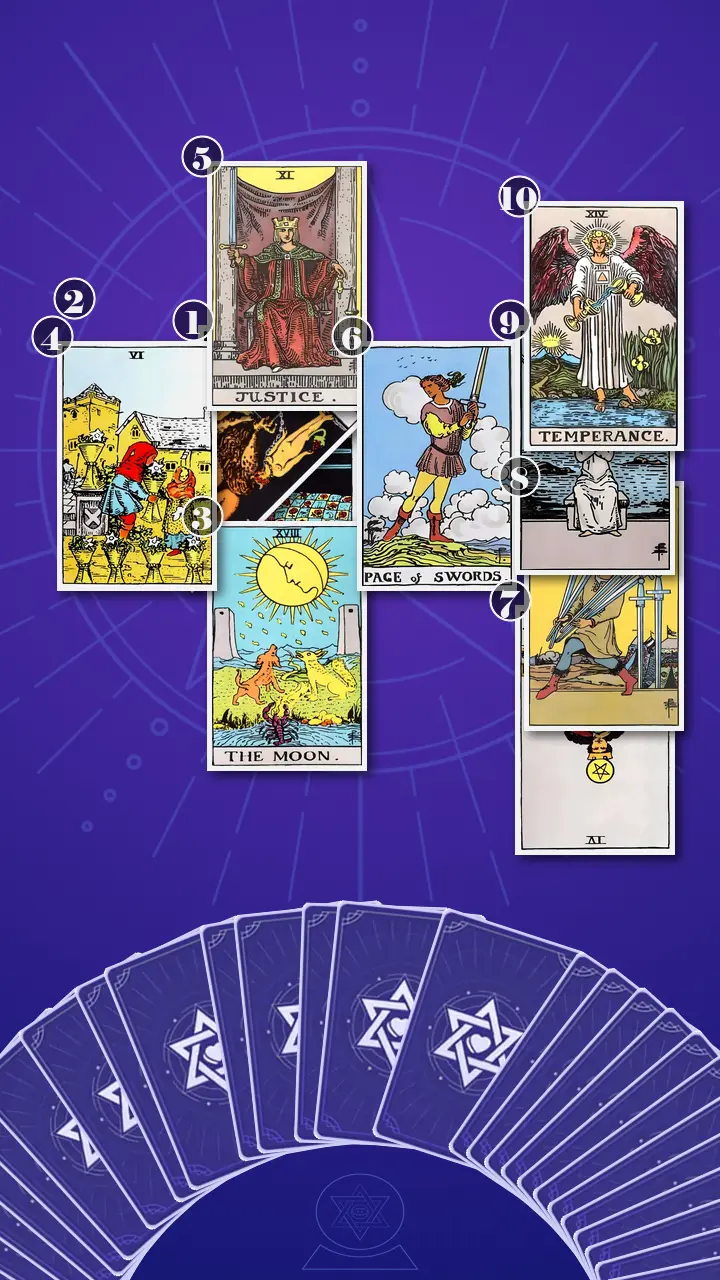
“Today, we’ll use a spread called the Celtic Cross · Context Edition,” I said.
And for you reading this: I choose this version when the question isn’t just “Should I reply?”—it’s layered relationship reactivation. The structure separates the trigger (what’s happening right now) from the hook (what pulls you back), the root fear under the surface, and finally the integration (how to move forward with boundaries and nervous-system stability). It’s practical. Ethical. It doesn’t pretend to predict someone else’s motives like a fixed script.
I previewed the map for Jordan: “The first card will show the immediate trigger-state—what the spiral looks like in real time. The crossing card will reveal the hook. And the card above will show your conscious intention—what you believe the ‘right’ response should be. Then we’ll climb toward integration.”
Reading the Map: From Trigger to Terms
Position 1: The immediate trigger-state (the spiral in real time)
“Now turning over,” I said, “is the card that represents the immediate trigger-state: what the anxiety spike looks like in real time.”
Nine of Swords, upright.
It was almost painfully literal: the figure sitting upright in bed, hands to face, darkness pressing in. “This,” I told Jordan, “is 1 a.m. brain. It’s you in your Toronto apartment, phone on dark mode, rereading their text like it’s a document you’re supposed to solve. Chest tight. Hands a little shaky. Draft, delete, scroll up for evidence—like if you find the right clue, you’ll finally feel safe.”
The energy here isn’t just “worry.” It’s Air in excess—thoughts multiplying faster than your body can metabolize them. The nervous system treats one message like a courtroom cross-examination. That’s why you can “know” it’s just a text and still feel like you’re back in it.
I mirrored the loop out loud, because naming it pulls it out of the shadows: “If I answer wrong… / If I don’t answer… / If I wait…”
Jordan let out a small laugh that didn’t reach their eyes. “That’s… too accurate,” they said. “Like, borderline rude.” Their shoulders stayed high, but their jaw unclenched a millimeter—the kind of tiny release that tells me, Okay, they feel seen.
Position 2: The key obstacle (the hook that pulls you back)
“Now turning over,” I said, “is the card that represents the key obstacle: what is hooking you back into the old pattern.”
The Devil, reversed.
“You tell yourself you’re fine,” I said gently, “but your thumb keeps reopening the chat thread and their profile ‘just to check.’ Every time you see last-seen status or a typing bubble, there’s a jolt—refresh, jolt, refresh. Not because you’re weak. Because your body is chasing certainty like a quick hit.”
This is a blockage loosening. Reversed, The Devil often means the chains are already loose—you can step away—but the compulsion loop keeps pretending it’s life support.
I gave Jordan a quick “hook inventory,” the way I might list tasting notes when someone can’t name what they’re craving: validation, control, closure, attention. “Which one is it tonight?” I asked.
They stared at the card for a second, then looked away toward their window. “Control,” they said. “If I can figure out what they mean, I can respond correctly and stay safe.”
“Exactly,” I said. “And stepping away doesn’t have to be dramatic blocking. Sometimes it’s just… not feeding the slot machine at 1 a.m.”
Position 3: Subconscious driver (the fear under the text)
“Now turning over,” I said, “is the card that represents the subconscious driver: the underlying fear and emotional memory that fuels the spike.”
The Moon, upright.
“You read one short sentence,” I said, “and your mind generates five storylines—apology, breadcrumbing, loneliness, manipulation, sincere reconnection. None of which can be proven from the text.”
The energy here is uncertainty that becomes projection. The Moon isn’t telling you you’re irrational; it’s showing you that your nervous system reacts to the atmosphere you remember, not only the words you can see. It’s like walking through fog: you keep moving your flashlight—more rereads, more Instagram context—but the fog is in the situation.
Jordan’s fingers, which had been clenched around a mug, loosened and re-gripped. “It’s the ‘maybe,’” they said. “Like… maybe this is the start of the same thing.”
“That’s the root,” I agreed. “Not the text. The blank space your body fills in.”
Position 4: The past imprint (what the old connection trained you to expect)
“Now turning over,” I said, “is the card that represents the past imprint: what the old connection trained your nervous system to expect.”
Six of Cups, upright.
“Two years later,” I said, “their text drags up the highlight reel: inside jokes, the version of them that felt safe. You catch yourself thinking, ‘Maybe I overreacted back then,’ because the memory is warm—even if the relationship also trained you to doubt yourself. A younger part of you wants a simple repair and a clean ending.”
The energy here is sweetness that edits. Not lying—just selective. Nostalgia can be a comfort, but it can also be a filter that softens the cost.
Jordan’s mouth tightened, then relaxed. “I hate that I still miss the good parts,” they admitted.
I nodded. “You can want closure and still choose distance. Those two can coexist.”
Position 5: Your conscious intention (values, boundaries, the ‘right’ response)
I paused before turning this one. The café behind me was quiet in that late-afternoon way—espresso machine cooling down, a distant clink of a spoon against ceramic. Even through the screen, Jordan seemed to feel the shift.
“Now turning over,” I said, “is the card that represents your conscious intention: what you believe you should do to handle this ‘right’—your values and boundary ideals.”
Justice, upright.
“In daylight,” I said, “you open Notes and make two columns: what you actually know versus what you’re assuming. You draft something short, factual, self-respecting—something you’d feel okay about even if no one applauded it. You stop trying to manage their reaction and focus on what you’re available for now, in the present tense.”
This is balance. Healthy Air. Not spiraling—structured. Justice says: facts, proportion, terms. Not punishment. Not dramatics.
And this is where my café brain kicks in—my Social Espresso Extraction lens. In coffee, “more time” doesn’t mean “better.” Over-extraction makes it bitter. Under-extraction makes it sour. The goal is the optimal extraction time for the context.
“Jordan,” I said, “your anxiety is acting like you need infinite ‘extraction time’ from their text—more rereads, more context, more decoding. Justice says: set the extraction time. Decide how long you’re willing to engage with this message and what you’re willing to offer—then stop.”
The Bridge Moment: the old emergency turns back into a choice
Setup: I could feel what they were caught in because I’ve seen it a hundred times—someone treats “reply vs not reply” like a permanent identity decision. It was 12:58 a.m. energy: rewriting the same two-line response like it’s an exam, while their body already decided it’s danger.
Stop treating the text like a verdict you must survive, and start treating it like a choice you can weigh—Justice’s scales and sword are your permission to be clear, factual, and self-respecting.
Reinforcement: Jordan went still in a way I recognize—the three-beat chain of a real insight landing. First: a tiny freeze, breath paused at the top, fingers hovering like they forgot what to do next. Second: the eyes unfocused for half a second, like their brain replayed the last few nights in fast-forward—bed edge, blue light, draft deleted, profile refreshed. Third: a long exhale that seemed to come from the bottom of their ribs, shoulders dropping as if they’d been holding up a backpack they forgot they were wearing.
“But if I don’t decode it,” they said, and there was a flash of anger under the fear, “doesn’t that mean I could misread them and get hurt again?”
I kept my tone warm, not dismissive. “It means you stop asking your nervous system to do an impossible job at midnight,” I said. “Set a 10-minute timer. Make two notes titled FACTS and STORIES. Under FACTS, write only what’s literally true—‘They texted “hey” at 9:42 p.m.’ Under STORIES, dump the interpretations—‘They’re testing me,’ ‘I’ll spiral again.’ Then pick one boundary sentence you could live with even if they never reply. If your chest tightens or you feel dizzy, put the phone face down and do three slower exhales. You’re allowed to stop. The goal is steadiness, not forcing a decision.”
I leaned in slightly. “Now—using this new lens—think back over last week. Was there a moment when you felt the tight throat before you had a thought? A moment when, if you’d treated the text as a choice instead of a verdict, you might have done something different?”
Justice is the bridge from Jordan’s starting state—notification hijack, rumination, compulsive checking—toward their desired state: calm, boundary-led clarity and steadier self-trust. It’s not about being “over it.” It’s about becoming someone who can hold the past as information without letting it run the present.
Position 6: Near-term trajectory (how engagement tends to go without a boundary)
“Now turning over,” I said, “is the card that represents the near-term trajectory: your next mode of engagement if you keep interacting without a clear boundary.”
Page of Swords, upright.
“This is curiosity with caution,” I told Jordan. “Not an emotional essay. Not a performance review of your healing. One clean move: ‘What are you reaching out for?’ or ‘I’m open to one brief catch-up call, but I’m not revisiting the relationship history.’ Then you put the phone down and go back to your actual life—meeting, dinner, laundry—rather than orbiting their reply.”
The energy is Air in training. Focused questions instead of catastrophic forecasting. Page of Swords doesn’t promise you won’t feel activated—it promises you can use words like a tool, not like a self-punishment.
Position 7: Self-position (how you’re holding control, distance, or openness)
“Now turning over,” I said, “is the card that represents your self-position: your current coping posture.”
Four of Pentacles, reversed.
“You keep your phone within reach all day,” I said, “and replay what you ‘should’ say without admitting what you want, because wanting anything feels risky. You’re trying to feel safe by controlling every interpretation and outcome. But the clench is exhausting—and it keeps the text feeling powerful.”
Reversed, this is an invitation: loosen the grip without throwing the doors wide open. The energy is a release valve—not chaos.
Jordan nodded once, very small. Their thumb stroked the edge of their phone like it was a worry stone.
Position 8: Environment (external clarity vs vagueness)
“Now turning over,” I said, “is the card that represents the environment: what the other person’s approach or the social context is signaling.”
Seven of Swords, upright.
“This is that context-free ‘hey,’” I said. “Vague outreach that makes you do all the emotional labor. You don’t have to accuse them. But you also don’t have to negotiate with unclear communication.”
The energy is partial information. Enough to trigger you, not enough to ground you. And it validates something important: some of the fog isn’t just “in your head.” It’s in the way the approach is shaped.
Jordan’s expression changed—less shame, more discernment. Like their brain finally had permission to say, yeah, this is unclear without spiraling into self-blame.
Position 9: Hopes and fears (the inner knot)
“Now turning over,” I said, “is the card that represents your hopes and fears: what you secretly want and what you fear it will cost.”
Two of Swords, upright.
“Frozen truce,” I said. “Phone face down, then face up. Replying feels like risk; not replying feels like unfinished business. The pause can be wise—but only if it’s intentional rather than endless.”
The energy here is self-protection through pause—but without a plan, it becomes its own cage. This is where decision fatigue turns into days of chest-tightness that never resolves.
Jordan swallowed. “I keep telling people I’m ‘thinking,’ but it feels like I’m just… bracing.”
“Exactly,” I said. “And bracing burns more energy than choosing.”
Position 10: Integration outcome (the healthiest direction forward)
“Now turning over,” I said, “is the card that represents integration: the healthiest direction for your nervous system and boundaries.”
Temperance, upright.
“This is regulation first,” I said. “Then response. Temperance is titration—small amounts, steady hands. Like making tea: steep, taste, adjust. Or like adding creamer to coffee one splash at a time—you don’t chug the whole thing and hope your body forgives you.”
The energy is balance and pacing. One foot on land, one in water: feelings acknowledged, reality respected. Temperance doesn’t demand you be unbothered; it teaches you not to flood yourself.
I watched Jordan’s face soften. They didn’t look “fixed.” They looked… a touch more inhabitable. Like they could breathe in their own life again.
The One-Page “Terms & Temperature” Plan for Next Steps
I pulled the whole spread together the way I’d describe a blend to someone who can’t name why their espresso tastes sharp: not by shaming the palate, but by explaining the components.
“Here’s the story the cards tell,” I said. “A single text triggers a Nine of Swords loop—your mind interrogates the night. The Devil reversed shows the hook: compulsive checking that promises control. The Moon and Six of Cups explain the fuel: uncertainty plus nostalgia editing, which makes the past feel present. Justice is your growth edge—facts and fair terms. Page of Swords is your clean communication style. The Four of Pentacles reversed says your body is tired of clenching. Seven of Swords says the environment is genuinely vague. Two of Swords shows why you freeze—peace versus regret. And Temperance offers the way through: regulate, then respond in measured doses.”
The cognitive blind spot here is subtle but common: you’re trying to feel safe by decoding their intent, when the real safety comes from defining what you are and are not available for. That’s the key shift—away from subtext math, toward a present-tense boundary that protects your nervous system and your values.
To make this practical, I offered Jordan (and you) a small, doable plan. I also brought in one of my café tools—my Social Thermometer. In my world, “too hot” burns the tongue and “too cold” hides flavor. In relationships, same. The goal is a temperature you can actually sip.
- The 20-Minute Reply-Window ProtocolPick one 20-minute slot tomorrow (for example, 6:10–6:30 p.m.). Only during that window, you may read the thread and draft a response. Outside the window, mute/hide alerts and do not reread.Your brain will argue it’s “too simple” and you need more context. Treat that as The Devil loop talking. Time is a tool you’re allowed to use.
- The Facts vs Stories Note (2 minutes)Open Notes. Make two headings: FACTS and STORIES. Under FACTS, write only literal truths. Under STORIES, write every interpretation your mind generates. Then choose one boundary sentence you can stand behind even if they never reply.If your chest tightens or you feel dizzy, put the phone face down and do three slower exhales. You’re allowed to stop; steadiness matters more than speed.
- The Two-Line Boundary Text (fact + boundary)If you choose to respond, cap it at two lines: one fact + one boundary. Examples: “I saw your message. What are you reaching out for?” or “I’m open to one brief catch-up call, but I’m not revisiting the relationship history.”If you feel the urge to overexplain, pause and ask: “Am I trying to empty pressure, or am I choosing a boundary?” If needed, use an exit line: “I’m going to think about this and get back to you.”
A Week Later: The Quiet Proof
A week after our session, Jordan messaged me—not with a dramatic update, but with the kind of proof I trust most.
“Did the reply window,” they wrote. “Muted the chat outside it. Facts vs Stories note felt almost stupidly simple… which is why it worked. I sent: ‘I saw your message. What are you reaching out for?’ Then I made tea and put my phone on the counter across the room. My chest didn’t do the whole elevator drop.”
They added something that made me smile in that soft, human way: “I still felt weird after. But I slept.”
That’s Temperance. Not hype. Not an instant personality transplant. Just the nervous system learning, in small repetitions, that a text is not a fire.
When one text makes your chest go tight and your mind start negotiating tone like it’s life-or-death, it’s not “proof you’re back at square one”—it’s the old safety alarm trying to run the present.
If you didn’t have to decode them at all, what’s one small boundary you’d choose tonight that would let your body feel safe again—without needing to make the whole story mean something?
This story is adapted from psychological research, written so that those in a similar struggle can see their own pattern in it — and find their next step clearly.These insights are not a substitute for professional psychological, medical, legal, or financial advice.
Learn more about our Journey to Clarity.
How did this insight land for you?
🫂 This Resonates Deeply
🌀 Living This Story
✨ Now I See Clearly
🌱 Seeing New Possibilities
🧰 Useful Framework
🔮 The Confirmation I Needed
💪 Feeling Empowered
🚀 Ready for My Next Step
Author Profile
 AI
AI“For twenty years, I’ve listened to stories unfold over the warm aroma of coffee. I don’t believe life’s complexities always require grand theories to be solved; often, we just need a safe place to tidy up our reality. I don’t offer high-minded preaching—just grounded, heartfelt insights to help you regain your sense of control amidst the clutter of daily life.”
In this Friendship Tarot Reading :
Core Expertise
Service Features
Also specializes in :
Explore Related Patterns:
Certainty SeekingJordan opens the thread, checks Instagram for context, and watches the message as if the right clue might make the whole situation safe. The clearest sentence in the session is the control logic underneath it: if they can figure out what the other person means, they can respond correctly and avoid getting hurt again. Certainty seeking makes ambiguity feel intolerable. You are trying to replace relational risk with enough information, but the other person's vague 'hey' cannot provide the safety that only your own terms and limits can create.
Anxiety SpiralBefore Jordan has even made meaning from the message, the body alarm is already online: tight chest, dry throat, jittery hands, and the sense that one text has become an emergency. The mind then tries to stabilize the alarm by rereading, drafting, deleting, and checking for evidence. You are not just worrying in a loose or abstract way; the spike recruits cognition into a closed loop. Each question creates another possible danger to manage, so the attempt to think your way into safety becomes the engine that keeps the anxiety moving.
Mind ReadingOne short sentence produces five possible storylines before any of them can be proven: apology, breadcrumbing, loneliness, manipulation, or sincere reconnection. The text is vague enough to trigger Jordan and too thin to ground them, so their mind supplies motives to make the blank space feel manageable. Mind reading is a protective attempt to avoid being blindsided. You are trying to stay ahead of harm by inferring intent, but the inference starts carrying more weight than the actual evidence, so the present message becomes a courtroom for unproven meanings.
Relational Baggage LoopThe 12:58 a.m. message lands after two years, and Jordan's body reacts like it is 2022 again: chest tight, throat dry, hands jittering before the second line is even read. The old connection is not just remembered as content; it is reactivated as a safety script, so the present notification gets filtered through the atmosphere the relationship trained their nervous system to expect. You can see the loop in the pull between 'maybe this is the start of the same thing' and the warm highlight reel of inside jokes. The pattern is not proof that nothing has changed; it is a learned relational template asking for old data to make a new decision, which is why clarity has to come from current boundaries rather than from reliving the previous dynamic.
Boundary DiscernmentIn daylight, Jordan moves toward a short, factual response they can stand behind: 'What are you reaching out for?' or one brief catch-up call without revisiting the relationship history. The focus shifts away from managing the other person's reaction and toward naming what Jordan is actually available for now. Boundary discernment turns the message from a verdict into a choice. You can want closure and still choose distance, which is the psychological difference between decoding someone else's subtext and defining the terms your nervous system can live with.
Freeze ResponseJordan's thumb hovers over the message, then 'Hey' gets typed and deleted. Later, the phone goes face down and face up again, because replying feels risky while not replying feels like unfinished business. The freeze is not simple indecision; it is self-protection through suspended action when both available moves feel dangerous. You are conserving safety by delaying movement, but without a deliberate boundary the pause turns into bracing, and bracing burns energy without giving you an actual choice.
Emotional RegulationJordan is asked to take one slow inhale and a longer exhale, not to make the feeling disappear, but to signal that they are here and not back then. Later, the reply window, muted chat, tea, and phone across the room show the same principle in action. Emotional regulation appears here as pacing, not pretending to be unbothered. You are teaching the body that activation can be met in small doses before response, so the old alarm no longer gets to set the timing for your decisions.
Compulsive CheckingJordan's thumb keeps reopening the chat thread and the profile 'just to check,' with every last-seen status or typing bubble creating another jolt. The phone stays within reach all day, turning the message into a small object of surveillance and emotional pressure. Compulsive checking promises a quick hit of control, but it trains the body to stay attached to the notification. You can recognize the loop because the behavior offers seconds of relief while preserving the same unresolved question that made you check in the first place.
Nostalgia BiasThe text drags up the highlight reel: inside jokes, the version of the other person that felt safe, and the thought that maybe Jordan overreacted back then. The warm memory is real, but it sits beside another fact in the story: the relationship also trained them to doubt themself. Nostalgia bias edits by warmth, not by accuracy. You can miss the good parts without handing them authority over the full record; the key is noticing when a comforting memory starts minimizing the cost the connection also carried.
Explore Related Struggles:
Certainty-Safety FusionJordan keeps trying to make one vague text safer by extracting certainty from it. They reread the thread, check Instagram, watch for tiny signals, and treat the message like a document that can be solved. When they say that if they can figure out what the sender means, they can respond correctly and stay safe, the core equation becomes visible. You are not simply reacting to a notification. You are watching safety get outsourced to someone else's unclear intent. The harder you work to decode them, the more the present gets organized around an answer you do not control. Certainty starts carrying a job it cannot perform, which is protecting you from a relational outcome before any real terms have been set. The useful shift is not forcing yourself to be unbothered. It is noticing where your body asks interpretation to become protection, then returning safety to what you can actually choose: time limits, literal facts, and a boundary sentence you can stand behind.
Clarity-Exposure SplitJordan types 'Hey,' deletes it, and stays suspended over the same small doorway. The pull is real because part of them wants clarity, repair, or a clean ending. The brake is also real because contact could reopen a dynamic that once made them doubt themselves. You are standing between two valid needs that do not easily share space. Clarity asks you to move closer to the source of the question, while self-protection asks you not to hand the past a new opening without terms. That split is why the text feels larger than the text itself. The work is not to pick closure or safety as if only one can exist. The work is to make any movement toward clarity pass through your present boundary first, so exposure is not mistaken for progress.
Monitoring-Safety FusionJordan's thumb keeps returning to the thread and the profile, even when there is nothing new to learn. The phone stays within reach through the day, and every tiny cue becomes a possible safety signal. Last-seen status, typing bubbles, and old messages start functioning like instruments on a dashboard that never gives a stable reading. You get pulled into monitoring because it feels active, practical, and protective. The problem is that monitoring keeps the old connection alive inside your space even when no real conversation is happening. Instead of creating steadiness, it trains your attention to orbit the same uncertainty. This is why muting the chat and placing the phone across the room matters in the story. Those actions do not erase the feelings. They interrupt the false contract that says you have to keep watching in order to stay safe.
Relational Resurrection TrapA text after two years does not land as a neutral new event. Before Jordan even finishes reading, their body is already back in the atmosphere of 2022. The message reactivates not just a person, but a whole relational climate. You feel the spike because the present contact carries the shape of a past system. One short message can seem like the beginning of the same pattern, the same self-doubt, and the same need to stay alert. The old connection appears to resurrect itself before you have had a chance to decide whether it belongs in your life now. The way out is to treat the return as information, not inevitability. A person can reappear without the old dynamic being granted automatic access to your attention, your sleep, or your terms.
Binary Choice LockJordan keeps turning the phone face down and face up, with the pause hardening into a kind of frozen truce. Replying feels like opening a risk. Not replying feels like leaving unfinished business in the room. The choice shrinks until two options carry the weight of the whole history. You get stuck because the decision stops being a message decision and starts feeling like a verdict on who you are now. One reply seems to prove you are available again. Silence seems to prove you are closed, avoidant, or unresolved. Neither frame gives you enough room to act like a person with options. The release comes from making the decision smaller and more bounded. A two-line text, a twenty-minute window, or a clear exit sentence breaks the false binary by giving you a third position: engaged with terms, or disengaged with intention.
Boundary Ambiguity LockThe other person sends a context-free 'hey,' and Jordan is left doing the emotional labor that the message refuses to do. The outreach is enough to activate the old system, but not clear enough to ground a present response. It opens a door without saying what room it leads to. You can feel trapped because ambiguity makes you supply both sides of the conversation. You imagine the apology, the breadcrumb, the sincere reconnection, and the repeat of the old pattern, all from one small fragment. The lack of terms becomes the space where your body starts bracing. Boundary clarity becomes the counterweight here. Asking what they are reaching out for, limiting the reply window, or naming what you are not available for turns the vague field back into a navigable exchange.
Nostalgic Belonging LockThe text pulls up the highlight reel: inside jokes, warmth, and the version of the person that once felt safe. Jordan can remember the cost and still miss the good parts. That is what makes the past persuasive rather than simple. You are not failing because a warm memory still has force. The lock forms when familiarity starts editing the full record, making you question whether the old hurt was exaggerated because the good moments are easier to feel in the present. Belonging becomes tied to a selective version of the past. A cleaner frame lets both truths stay on the table. You can miss what was real and still refuse to let nostalgia write the terms of access now.
Explore Related Emotions:
Backslide AnxietyAn unexpected text after two years lands just before 1 a.m., and the body answers before the message has a story attached to it. Chest tightening, dry throat, jittering hands, and the sense that the system thinks it is 2022 again create a very specific inner weather, the fear that one notification can drag you back to a version of yourself you worked hard to leave. Backslide Anxiety fits because the spike is not only about the person texting. It is about the old safety alarm acting like progress can be erased in one moment. You can know intellectually that it is just a message and still feel the old loop rebooting, which is why the real work in the story is separating an old imprint from a present choice.
Certainty HungerJordan says control is the thing they are chasing, and the behavior shows it in small repetitions. Reopening the chat, checking the profile, replaying possible motives, and trying to respond correctly all point to the same ache, the need for enough certainty to feel safe. Certainty Hunger fits because the story is not driven by simple curiosity. You are trying to extract emotional security from partial information, and the more the message stays vague, the more your system wants one more read, one more clue, one more piece of proof.
Hypervigilant AnxietyJordan rereads the thread, drafts and deletes 'Hey,' checks Instagram for context, and keeps looking for the clue that would make the body stand down. The mind turns a short message into a live evidence board, where every last-seen status and possible tone feels like it has to be inspected before you can move. Hypervigilant Anxiety names that over-alert scanning state. It is not a lack of intelligence or self-control; it is the exhausting feeling of having to monitor every signal because uncertainty feels unsafe, even when the actual facts in front of you are minimal.
Message DreadThe iMessage glow becomes the whole room for a moment, with the phone dimmed, the duvet tangled, and your thumb hovering over a name you have not touched in two years. Before the second line is even read, the body treats the notification as a charged object. Message Dread belongs here because the fear is attached to the arrival itself, not just to the content. The text becomes a portal back into unfinished emotional material, so opening it feels less like reading words and more like letting an old atmosphere back into the room.
Mixed Signal DreadThe other person sends a context-free 'hey,' which gives Jordan enough contact to react but not enough information to land. The vagueness makes Jordan do the emotional labor of generating possible meanings, from apology to breadcrumbing to sincere reconnection. Mixed Signal Dread names the feeling of being pulled into a relational atmosphere where the signal is too thin to trust and too loaded to ignore. You are not inventing all of the fog; part of it is built into the unclear approach, and that makes your body brace for what might be hiding behind it.
Verdict DreadThe text starts to feel like a verdict that must be survived, and the reply becomes something Jordan rewrites as if it could decide who they are now. Replying feels risky, not replying feels unresolved, and the pause turns into bracing rather than rest. Verdict Dread fits because the message gets inflated into a high-stakes judgment on your healing, your boundaries, and your future safety. The emotional pressure spikes when a small response starts feeling like proof of whether you are strong, over it, or about to lose ground.
Cautious Self-TrustA week later, Jordan sends a short factual response, makes tea, puts the phone on the counter, and still feels weird without collapsing into the old loop. The body does not become instantly serene, but it learns that discomfort can be held without handing over control. Cautious Self-Trust names that small but real shift. You are not forcing certainty or pretending the past has no charge; you are testing the possibility that your present self can feel activated and still choose a boundary that protects you.
Control FatigueJordan keeps the phone within reach all day and replays what they should say without admitting what they want. The grip on every interpretation and outcome is meant to create safety, but the story keeps showing the cost in tight shoulders, clenching, and a body that is tired of staying ready. Control Fatigue names the exhaustion underneath the strategy. You are not simply trying to make a good choice; you are trying to manage another person's possible reaction, your own desire, and the old consequences all at once, which turns control into a draining emotional load.
Grounded AgencyIn daylight, Jordan opens Notes and separates what they know from what they are assuming. The reply window, the two-line boundary, muting the chat, and putting the phone across the room all turn a midnight spiral into a sequence of choices. Grounded Agency fits the steadier side of the story because the resolution is not to become untouched by the text. It is to move from decoding their intent to defining your own terms, so the message stops being something that controls the room and becomes something you can weigh.
Guarded LongingJordan admits they still miss the good parts, then also says wanting anything feels risky. That combination matters because the story is not only about fear; there is a careful, hidden reach toward closure, repair, or at least a cleaner ending. Guarded Longing captures the ache of wanting contact without wanting to surrender your safety. You are not required to pretend the pull is gone, but naming it lets you separate desire from obligation and choose contact only under terms your body can live with.
Nostalgia Loop AnxietyTwo years later, the message brings back inside jokes and the version of the person that once felt safe. Jordan can miss the good parts and still remember that the connection trained them to doubt themselves, which makes the memory warm and destabilizing at the same time. Nostalgia Loop Anxiety fits because the past is not returning as a clean fact file. It arrives edited by sweetness, and that edit creates the uneasy question of whether you misread things back then or might get pulled into the same pattern now.
Quiet Self-RespectJordan stops trying to manage the other person's reaction and focuses on what they are available for now. The boundary sentence is brief, factual, and livable even if no one applauds it, which gives the self a place to stand. Quiet Self-Respect fits because the story's cleanest movement is away from performing the perfect response and toward a response that does not abandon your own terms. You can be civil, curious, and clear without offering unlimited access to your attention or history.
Hard-Won ComposureJordan's release shows up in tiny physical increments, with a jaw unclenching, a long exhale, shoulders dropping, then later a night where the chest does not do the whole elevator drop. The improvement is modest, but it is embodied. Hard-Won Composure names the calm that arrives through pacing, not denial. You still feel weird after the message, but the weirdness no longer has to run the whole night, and that difference is exactly why the story lands as progress rather than instant closure.
Explore Related Contexts:
Breakup Closure LimboJordan has not spoken to this person in two years, yet the text immediately brings back the unfinished question of repair, distance, and the relationship history. Replying feels risky, while not replying feels like leaving something unresolved. That is the shape of closure limbo: the past is not actively happening, but it has not been cleanly metabolized into a settled boundary either. You are suspended between wanting a clean ending and fearing that engagement reopens the old dynamic. The spike is tied to that unfinished container. A boundary-led response does not need to solve the whole history; it only needs to define what kind of contact is available now.
Digital Intimacy Boundary ConfusionJordan keeps the phone close, reopens the chat thread, checks the profile for context, and reacts to last-seen status or a typing bubble as if each signal might explain the whole situation. The relationship is not occurring in a room; it is being mediated through platform cues that keep inviting interpretation. That digital layer blurs the boundary between information and contact. You can feel like you are doing research, while the phone is actually keeping the old connection active in your body and schedule. This context is about the interface, not personal weakness. Muting the chat, limiting the reply window, and moving the phone across the room turn the device back into a tool instead of letting it function like an open emotional channel.
Mixed Signal LimboThe message is a context-free hey, followed by no clear stated purpose. Jordan responds to that gap by rereading, checking Instagram, and trying to infer whether the outreach is apology, loneliness, breadcrumbing, or sincere reconnection. The external structure is ambiguity with consequences: there is enough contact to activate the old bond, but not enough information to make a grounded choice. You are being handed the emotional labor of building context that the other person did not provide. Mixed Signal Limbo captures why the body treats the text like a live problem. The uncertainty is not just inside you; it is built into the way the communication arrives, and clarity begins when you require a direct ask instead of negotiating with fog.