Warm Contact Changed the Feeling—Not the Dealbreaker Fact

The 12:47 a.m. Version History
Maybe your Notes app contains a clean one-sentence boundary followed by three paragraphs beginning with “unless.” I recognized that digital paper trail when Jordan (name changed for privacy) told me about their Toronto kitchen. I am Giulia Canale, and I have learned across cultures that what we often lack is not another opinion, but one moment of being accurately understood.
At 12:47 a.m., the reveal message glowed on Jordan’s phone beside the original boundary in Notes. The refrigerator hummed into the quiet apartment, the phone felt warm against their palm, and their jaw tightened as they typed a third sentence beginning with “unless.” I heard how moving the calendar reminder from this weekend to next weekend gave them one more night before the attachment might become an actual loss.
Jordan asked me, “Why am I bargaining with a dealbreaker instead of choosing to leave?” I heard the core contradiction immediately: honoring a revealed relationship boundary by leaving, or negotiating an exception so the consequence of enforcing it could remain postponed.
Ambivalence was not just a word in the room. I could feel it in the image Jordan gave me: a browser page refreshing over and over even though the content had not changed, the act of refreshing feeling more active than accepting what was already displayed. Their chest tightened, their thumb kept returning to the same thread, and every affectionate follow-up briefly made the facts feel less final.
I said, “You are not only debating the dealbreaker; you are negotiating when the loss has to become real. We do not have to force a dramatic answer tonight. We can make a clear map of the pattern, the fear protecting it, and the smallest action that would let you trust your own standard again. That is our journey to clarity.”

Choosing a Compass Without a Verdict
I invited Jordan to place both feet on the floor, take one ordinary breath, and hold the question without trying to improve its wording. I shuffled slowly, treating the ritual as a psychological transition: a way to move attention from the glowing message and the imagined consequences into a shared, visible structure.
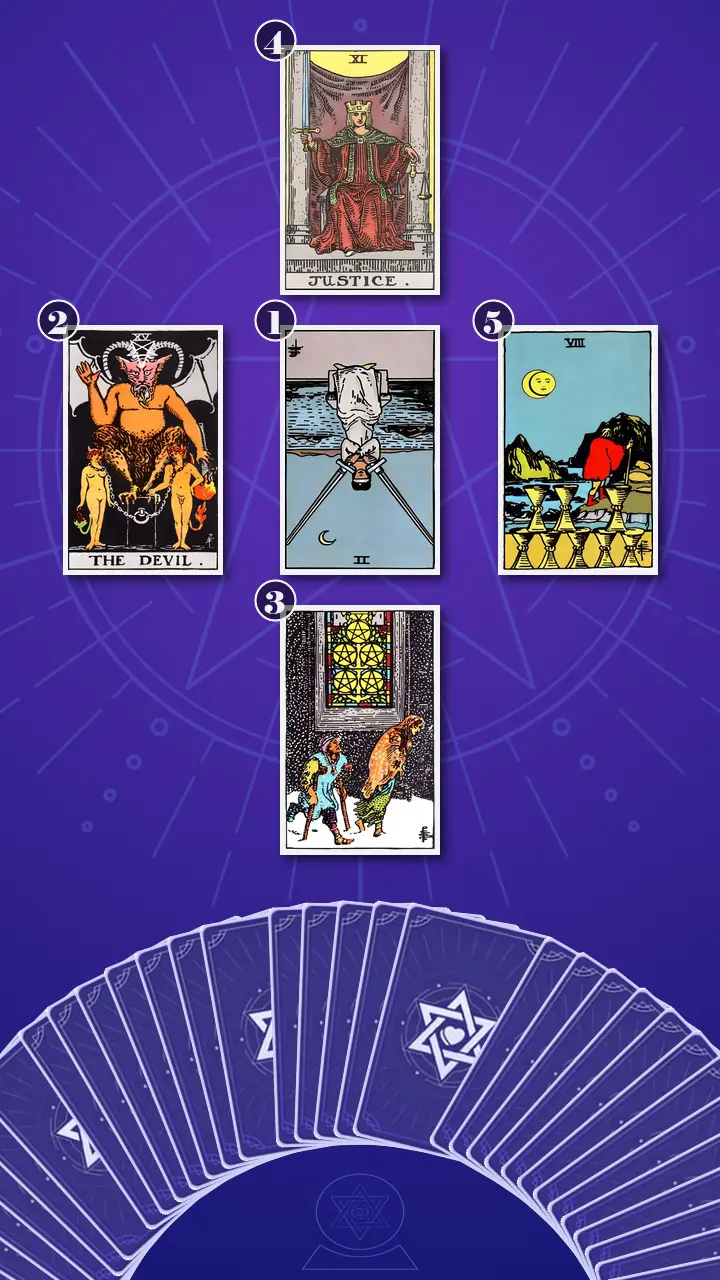
For this reading, I used The Shadow Spread, a five-card cross designed for relationship boundary clarity. When people ask how tarot works in a moment like this, I explain that I am not using the cards to predict what another person will do or to prove that fate has chosen an outcome. I use them as a structured cognitive tool: each image gives us a stable surface for separating verified facts, protective strategies, hidden fears, conscious standards, and practical next steps.
This spread suited Jordan because the question was not really about the other person’s motives or the future of the relationship. It was about the inner defense that made a previously non-negotiable line suddenly negotiable. The center would show the Present shadow, the visible bargaining loop. The card to the left would reveal the Protective bargain that kept the loop rewarding. Below it, the Hidden fear would show why leaving felt like a threat to belonging. Above the center, the Reclaimed standard would restore proportion. To the right, the Integrated next step would translate clarity into self-authored movement.
The cross also offered a useful visual sequence: the mind begins with two arguments blocking one another, moves through attachment and fear, then returns to one upright standard before allowing emotion to move. That is why this focused five-card Shadow Spread could do more for this question than a larger relationship spread filled with speculation about someone else.
The Screen That Would Not Become Final
Present Shadow: The Two of Swords, Reversed
Now I turn over the card for the Present shadow: the observable bargaining, repeated message review, and postponed boundary action described in the question. The card is The Two of Swords, in reversed position.
The blindfold and crossed swords gave me the exact image I needed. I saw Jordan’s 12:47 a.m. scene in the card: the reveal open on one side, the original boundary in Notes on the other, and a third “unless” trying to keep both interpretations equally alive. At 12:47 a.m., Jordan searched the thread again and moved the decision reminder to next weekend. More analysis was happening, but none of it was allowed to connect the known fact to the consequence of the stated line.
In reversed position, the Two of Swords shows blocked air becoming overload. This does not necessarily mean that Jordan is missing information or lacks intelligence. It shows competing arguments being used to prevent discernment from becoming action. The spreadsheet changes its scoring rules whenever the conclusion becomes emotionally expensive. The Notes document gains another version, but no version is permitted to become final.
I reflected the private sentence I heard underneath the loop: “I already know what the reveal says, but if I can qualify what it means, I do not have to do anything tonight.” I asked, “When you reopened the thread most recently, what genuinely new information appeared?”
Jordan gave a quick recognizing nod, then stopped. A small, bitter laugh escaped them. “That is accurate,” they said. “A little brutal.”
I answered, “The point is not to shame the strategy. It is to see its function. Every new ‘unless’ buys relief by borrowing from self-trust. We can make one evidence pass without demanding that you feel fearless or send anything before you are ready.” Jordan’s thumb moved away from the phone, but their shoulders stayed lifted, as though another argument might still be required.
The Alarm That Keeps Getting Snoozed
Protective Bargain: The Devil, Upright
Now I turn over the card for the Protective bargain: the short-term attachment reward that maintains the exception-making pattern. The card is The Devil, in upright position.
I pointed to the loose chains around the figures’ necks. The image did not label Jordan, the other person, or the relationship as evil. It showed a binding arrangement that felt compulsory while still containing participation. Each new clarification request, each warm message reread, and each narrow exception could be reopened, which meant each one also offered immediate relief.
Jordan described the 10:03 p.m. version of the loop. A warm follow-up appeared on the lock screen. Their shoulders dropped for half a second, their stomach unclenched, and they began drafting one more request for context. I said, “The affection changes the feeling of the moment. It does not automatically change the fact that met your dealbreaker.”
The Devil’s energy was excessive attachment relief and deficient boundary authority. I compared it to hitting snooze on an alarm: the pressure stops briefly, but the same decision returns with less time and more tension. The inner sentence sounded like this: “If I ask one more question, I get one more day before the loss becomes real.”
Here I used my Hidden Cost Deconstruction lens. I asked Jordan to count the emotional bill attached to one more exception: one more night of access, one more day without finality, one more workday with the message thread open behind the campaign brief, and one more small transfer of authority away from the boundary they had consciously chosen. The bargain was not proof that the boundary had become unreasonable. It was a way to purchase temporary closeness with long-term self-doubt.
Jordan winced and looked down at the card. “So the extra conversation is not neutral,” they said. “It gives me relief even if it gives me no new information.” I watched their fingers tighten around the edge of the chair, then loosen. I told them, “Wanting relief is not a moral failure. We are simply noticing what the relief is asking you to postpone.”
The Warm Window Across the Snow
Hidden Fear: The Five of Pentacles, Upright
Now I turn over the card for the Hidden fear: the belonging-related fear beneath the bargaining and the reason enforcing the boundary feels threatening. The card is The Five of Pentacles, in upright position.
The two figures moving through snow beneath the illuminated window brought the fear into ordinary life. Jordan had described a Sunday evening at a Queen West café when a friend asked, “Doesn’t that cross the line you already named?” A streetcar bell cut through the clatter of plates. Jordan gave an edited version of the reveal because saying the full answer aloud would make action feel immediate.
This card carried a deficiency of perceived warmth rather than proof that warmth was actually unavailable. I heard the anticipated first Saturday after leaving: a quiet apartment, no affectionate notification, a blank calendar block, and the thought that everyone else had somewhere to be. The body interpreted loneliness as evidence that keeping this particular attachment must be safer. Yet two friends were already nearby, offering calls, walks, and practical company that Jordan had kept outside the full story.
I asked, “When you picture the first quiet evening after enforcing the boundary, what do you fear the silence would say about your belonging?” Jordan’s breath left slowly. Their eyes moved toward the window, and for a moment they seemed to see an unread check-in from a friend rather than the message thread on the phone.
I said, “Grief can describe what the connection meant without deciding what you must tolerate. One attachment ending is not the same thing as belonging disappearing altogether. The fear deserves a place in the reading, but it does not get to masquerade as evidence about whether the dealbreaker was crossed.”
Jordan became quieter. They named one friend who would sit with them after a difficult conversation and another who would take them for a walk without asking for every detail. The illuminated window in the card did not promise that leaving would feel easy. It made support visible before anticipated loneliness could define the entire map.
When Justice Put One Sword Upright
Reclaimed Standard: Justice, Upright
Now I turn over the card for the Reclaimed standard: the capacity to compare the revealed fact with the pre-existing boundary without confusing grief with evidence. The card is Justice, in upright position.
The room seemed to quiet around the card. Justice was the catalyst and the Antidote in this reading: evidence-based self-trust, accountable boundary clarity, and the ability to hold grief without turning it into a counterargument. The scales did not ask Jordan to deny the attachment. The upright sword asked for one clean comparison.
My Jungian lens helped me slow down the moment. Years of moving across cultures taught me to notice how a familiar inner script can present itself as an objective law. Here I used my signature method, Fear-Driven Logic Decoupling, to separate Jordan’s authentic desire from the subconscious fear of failing at love, losing belonging, or regretting an irreversible choice. The question became: what does the conscious boundary say, and what is fear adding because acting on it hurts?
At 12:47 a.m., the reveal is still open beside the Notes boundary, and a third sentence begins with “unless.” The phone is warm, the kitchen is quiet, and moving the reminder to next weekend buys one more night without a verdict. The mind calls that caution; the body knows it is postponement.
Your boundary is not invalid because following it hurts; weigh the facts, name one proportionate action, and let Justice's upright sword close the loophole that endless bargaining keeps reopening.
I let the sentence remain between us. Then I added, Bargaining is not new evidence. Grief tells you the attachment mattered; it does not decide whether your stated line was crossed.
For a few seconds, Jordan froze: their breath paused, their thumb suspended above the screen, and their shoulders lifted as if bracing for another argument. Then their gaze lost focus. I watched the kitchen return in fragments—the warm phone, the third “unless,” the reminder moved to next weekend—while their mind replayed the affectionate message and the original disclosure as competing legal briefs. Finally, a deep breath moved through their chest. Their jaw loosened. Their hand, which had been gripping the phone, opened against the table. Their eyes brightened, not with a dramatic release but with the shock of finding no new loophole to defend. The relief carried a thin, dizzying edge: if the comparison could be clear, then the next action belonged to them. Jordan opened a blank note and typed the boundary, fact, and date separately. Outside, a streetcar bell sounded through the window, clean and brief. They whispered, “This hurts, and the comparison can still be clear.”
I said, “Now, use this new perspective to think back to last week. Was there a moment when this distinction could have made you feel different?”
Jordan looked at the message thread and answered, “The warm text changed what I felt. It did not add a new fact.” They did not need to decide the entire future in that minute. They had made the first essential separation: the pain of enforcing a boundary was not evidence against the boundary.
This was the first visible movement in the emotional transformation from contracted ambivalence toward evidence-based self-trust. The Two of Swords had used intelligence to keep two positions equally active. Justice used the same intelligence to place the original standard beside the verified fact. The swords had not disappeared; they had changed from crossed defenses into accountable discernment.
The Cups Left Standing
Integrated Next Step: The Eight of Cups, Upright
Now I turn over the card for the Integrated next step: the practical expression of clarity that can honor a conscious boundary while allowing attachment and sadness to remain emotionally real. The card is The Eight of Cups, in upright position.
The red-cloaked figure was walking away from eight standing cups. I emphasized that the cups were not overturned or declared meaningless. A meaningful connection can still be one Jordan chooses not to continue in its current form. The image offered emotionally honest movement, not emotional indifference and not a prediction that departure would feel clean.
In daily life, this could mean closing the message thread after one evidence pass, scheduling a clear conversation, sending a concise boundary statement, or defining a pause in contact. The card did not command Jordan to leave, and I did not use it as an order. It asked what behavior would match the chosen standard if the one-pass comparison confirmed that the line had been crossed.
Because no Wands appeared in the spread, spontaneous motivation was not the resource Jordan could wait for. Action had to be designed through a date, a proportionate step, and support arranged in advance. I asked, “What could you schedule this week that would make your behavior congruent with your boundary without requiring your feelings to disappear first?”
Jordan became still. Then they wrote, “This mattered, and I may still choose not to keep participating in this form of it.” They chose to complete the comparison, contact a trusted friend, and schedule the conversation only if the facts remained consistent with the original line. The first step was small, but it belonged to them.
The One-Page Justice Sheet
When I placed the five cards together, the story became clear. The Two of Swords reversed showed the present symptom: a Notes document with endless version history, where every new exception prevented a conclusion. The Devil revealed the payoff: postponement preserved access to attachment for another day. The Five of Pentacles gave that postponement its emotional weight: Jordan feared that losing one meaningful relationship would mean standing outside warmth altogether. Justice restored the standard. The Eight of Cups translated that standard into movement while leaving the cups, and therefore the meaning of the connection, intact.
The cognitive blind spot was not simply overthinking. It was treating emotional cost as if it were contradictory evidence. A warm message was allowed to act like an update to the facts. Anticipated loneliness was allowed to argue that the boundary must be unsafe. Grief was asked to prove that leaving would be a mistake. The shift I invited was precise: move from negotiating whether the dealbreaker counts to writing the boundary in one sentence, checking the known facts against it once, and taking one proportionate action by a defined deadline.
That is the practical heart of The Shadow Spread for relationship boundary clarity. It does not promise a painless verdict. It gives each element a proper place: facts answer the boundary question, grief describes the emotional cost, fear identifies the support needed, and action returns authority to the person who chose the standard.
I offered Jordan three small next steps. None required a perfect emotional state, a public explanation, or an immediate irreversible decision.
- The Three-Line Justice Check and Shadow Choice ExperimentOn one private evening this week, put the phone on Do Not Disturb and set a seven-minute timer. In Notes, write three separate lines: “My boundary was...” “The verified fact is...” and “The proportionate next action by [date] is....” Close the message thread while the timer runs. Then use my 48-hour Shadow Choice Experiment on paper only: write as if choosing the most feared, boundary-aligned option, and record what the fear predicts, which defense it activates, and what support would make the step manageable.This is one evidence pass and a paper exercise, not a demand to decide your entire future or send a message immediately. If seven minutes feels too long, write only the first two lines in two minutes and stop.
- The Facts-Grief SplitOn the same evening or the next day, draw two columns on paper labelled “What the facts answer” and “What this may cost me.” Spend five minutes placing each thought in only one column. When the urge to reopen the reveal appears, name the feeling in one word before deciding whether any genuinely new information exists. If writing feels too exposed, record a private one-minute voice memo beginning, “If I act on my boundary, I may grieve...”Feelings are being recorded, not appointed as the verdict. Use two words in each column if necessary, and stop if the exercise becomes too intense. Grief can be valid without becoming a counterargument.
- The Support-Before-Deadline PlanBefore the chosen decision date, text one trusted friend: “I may make a boundary decision soon. Could you be available for a 15-minute check-in afterward, without trying to solve it?” Add two support options near that date, such as a call and a walk through a familiar public place. Decide in advance what you want to keep private.You control what you disclose. If a full debrief feels too official, ask only for company or listening. Preparing support is not proof that the decision is wrong; it is a way to keep anticipated loneliness from making the decision for you.
I told Jordan that these actions were not a test of self-respect. They were small pieces of evidence that the boundary had an owner. The next step could be taken with a tight chest, a grieving heart, and an unfinished sense of certainty. That was enough.

A Door Can Close Without Erasing the Room
Four days later, I received a photo of a clean note and a message: “I scheduled the conversation and asked a friend to be available afterward.” That night, Jordan slept through. At breakfast, the first thought was, “What if I am wrong?” They smiled; doubt was present, but it was no longer holding the phone.
To me, that was finding clarity in its first trustworthy form. The cards did not make the choice for Jordan. They helped separate the unchanged fact from the changing feeling, name the fear beneath the bargaining, and turn a private argument into one proportionate action. The querent remained the author of the boundary, the grief, and the next move.
When leaving could close the door on someone who made you feel you belonged, your chest can tighten around two truths at once: the line was crossed, and you still do not want the connection to end. I do not need to make either truth smaller for the other to be heard.
If you let grief mean “this mattered” instead of “the boundary was wrong,” what is the smallest self-authored step you can imagine taking next—writing your three lines, closing the unchanged thread, or placing one source of warmth beside the date?