Pausing the Inbox Check: From Overplanning Toward Self-Trust

The 9:30 p.m. Routine That No Longer Felt Like Home
You tell yourself you will start once you know what the better version of you looks like. I have heard that sentence in many forms over twenty years of listening to people talk over the warm aroma of coffee. It often arrives just before a familiar routine is about to be questioned.
When Alex arrived at my London reading table, I watched them open a Notes app and drag the same three morning tasks between time blocks. It was 9:30 p.m. in their small rented flat in Hackney. Their phone felt warm in their hand, the radiator clicked beside the window, and the blue screen made their eyes look dry and overworked.
Alex said, “Why do I keep putting off routines that no longer feel like me?” They worked as a junior content designer, had enough flexibility to make a small change, and yet kept returning to the same convenient schedule. I heard the central contradiction clearly: they wanted routines that felt deliberately chosen, while postponing the routines that no longer felt like them because the familiar still seemed safer than an undefined self.
Their frustration sat in their body like a train held outside a Northern line platform: the doors never opened, but the engine kept humming. Their shoulders stayed raised, their thumb kept searching for another productivity video, and every postponed start brought a few minutes of relief followed by another week that felt borrowed.
I told Alex, “I am not going to treat this as a discipline failure or ask the cards to decide who you are. We can use them as a clear map of the loop, then let you choose a small way to test what fits now. Our aim is finding clarity without demanding a complete new life tonight.”

Choosing a Compass for a Familiar-Habit Loop
I asked Alex to place both feet on the floor, take one slow breath, and name the practical question again. I shuffled at an unhurried pace. The preparation was a psychological threshold, not a performance of mystery: it gave the mind somewhere to place its noise while we looked at the problem in context.
I chose the Six-card Transformation Path Grid (6) - Context Edition. For readers wondering how tarot works when the issue is procrastination rather than a dramatic external choice, this spread is useful because it traces a repeating system from visible pattern to root mechanism, then follows the route toward a grounded experiment and a flexible rhythm. A broader spread might have created more material to analyse, but Alex did not need more abstract possibilities. They needed to see why the same Monday kept arriving.
The upper row would show the observable postponement, the security-based blockage, and the hidden belief beneath the delay. The lower row would mark the catalytic reorientation, the first practical experiment, and the integrated pattern to carry forward. That sequence let the card meanings stay connected to ordinary objects: a recurring Google Calendar block, a warm phone, a saved habit video, and the small physical spaces where a chosen day might begin.
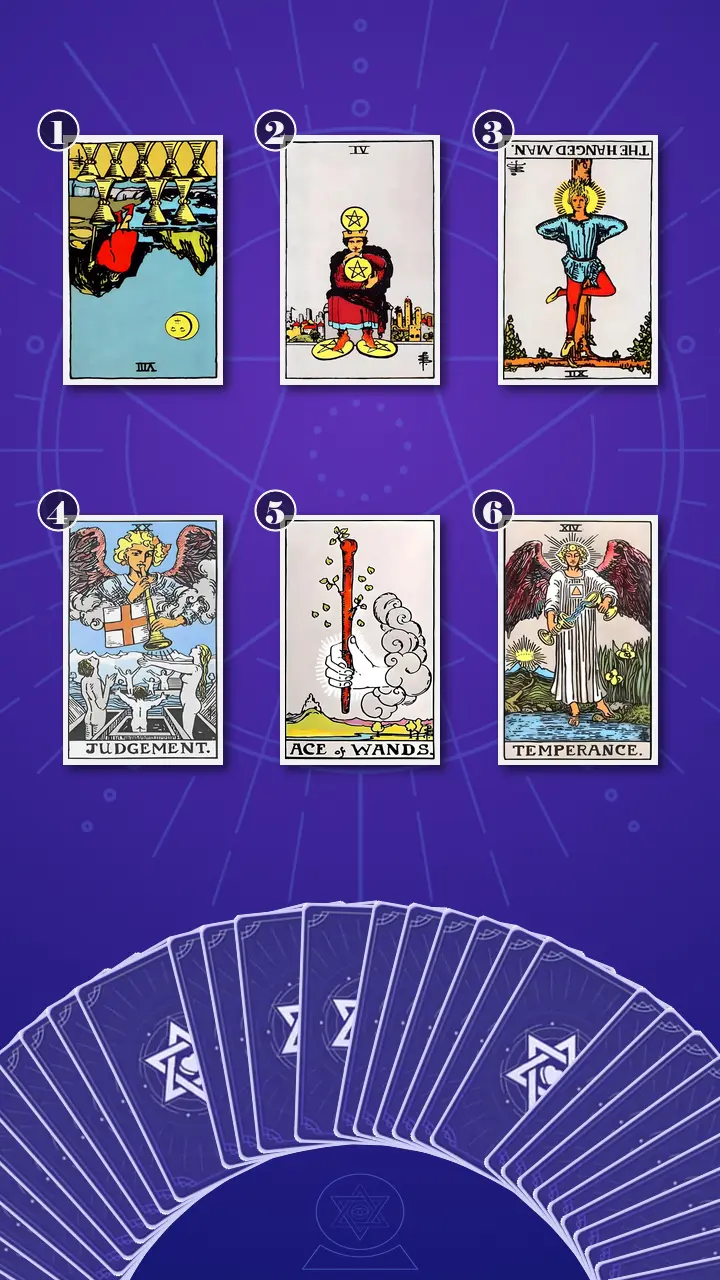
The Calendar Block That Would Not Leave
Position 1: The Departure That Stalled
Now turned over, representing the observable postponement and stagnant emotional tone described in the diagnosis, is The Eight of Cups, in reversed position.
The cloaked figure in the Rider-Waite-Smith image has recognised that the cups are no longer enough, yet the departure has not become complete. In Alex's life, this was the old routine still visible in the calendar after they had already admitted it felt empty. They opened the habit tracker, considered deleting one morning step, closed it, and repeated the same sequence because the path beyond the cups offered no guaranteed identity.
The reversed energy was a blockage in departure, not a lack of insight. Alex could see the mismatch, plan the exit, and still return to the familiar when the first uncomfortable morning arrived. This was the familiar-habit loop: immediate relief from postponing the change, followed by the heavier feeling of another week that had not been deliberately chosen. I said, “This card does not call you a failure. It shows delayed departure. You may be ready to pause one outdated step without abandoning everything that still supports you.”
Alex gave a short, bitter laugh. Their thumb stopped above the screen, their breath caught, and their eyes moved from the card to the recurring calendar block as if replaying several Sunday evenings. Then their shoulders dropped by a fraction. “That is almost too accurate,” they said.
I let the response stand without trying to make it inspirational. I wanted the recognition to remain specific. The useful question here was not whether Alex could reinvent the morning, but which one familiar action they kept reopening even though they already knew what it cost them.
Position 2: The Structure Held Too Tightly
Now turned over, representing the familiar structure and control that obstruct movement, is The Four of Pentacles, in upright position.
The figure on this card holds one pentacle against the chest, places another beneath each foot, and keeps one above the head. I read the image as a calendar block protected like emotional infrastructure. Alex kept the usual commute, the default evening screen habit, and the old morning order because each one offered a known way to get through the day. The routine was not only a source of frustration; it was also a shelter.
The energy here was excessive control. Security had become so tightly held that it left no empty space for a preference to appear. I asked Alex which part of the schedule protected a genuine need such as rest, money, access, or recovery, and which part protected only the comfort of not having to choose.
I compared the pentacle to the recurring block Alex refused to delete. “If I keep this, I know what happens,” I said. “If I change it, I might learn something I cannot control.” The same logic appeared in their planning app. Reorganising Notion looked productive, but it kept the first observable experiment out of reach. Planning becomes procrastination when it protects the system from having to answer back.
Alex winced and went quiet. They looked down at their hands, pressed their fingertips together, and then glanced toward the phone they had placed face down. The silence carried recognition without accusation. A familiar routine can be a shelter and a cage in the same week.
Position 3: The Waiting Room with Excellent Lighting
Now turned over, representing the underlying identity uncertainty and procrastination belief beneath the visible pattern, is The Hanged Man, in reversed position.
The suspended figure normally asks for a deliberate change of perspective. Reversed here, the pause had become indefinite waiting. Alex reread values exercises, compared habit systems, saved videos about disciplined mornings, and waited for a fully formed answer about who they were before testing one different day. The phone, the Notes app, and the habit tracker had become a waiting room with excellent lighting: there were endless forms to complete, but no door marked Begin.
The energy was blocked perspective. Reflection had stopped producing information because it was no longer connected to a lived experiment. I said, “You are asking certainty to arrive before action, but action is the thing that could give certainty something real to work with.” The reversed Hanged Man did not advise a reckless overhaul. It asked for a low-stakes choice that could teach Alex something without becoming a public identity announcement.
Alex's fingers tightened around the edge of the chair. Their gaze went unfocused, and for a moment the room seemed to hold the same stillness as the suspended figure. “If I keep this, I know what happens,” they murmured. “If I change it, I might find out that I do not actually want the thing I have been saying I want.”
I nodded. That fear made the postponement protective rather than inexplicable. It also revealed the hidden cost: every evening spent collecting explanations delayed the lived evidence that might have made a simple personal preference easier to hear.
When Judgement Turned the Calendar into a Changelog
The radiator clicked off just before I reached the lower-left card. In the sudden quiet, even the traffic beyond the window seemed farther away. I told Alex that we had reached the hinge of the reading, the place where recognition could either remain a description or become a response.
Position 4: The Call to Revise the Old Story
Now turned over, representing the catalytic identity-level realization that can interrupt the pattern, is Judgement, in upright position.
The angel's trumpet and the figures rising from their grey coffins make recognition visible and active. I did not read this as a prediction of a dramatic life change. I read it as an honest review of what has expired. One routine could be renamed, paused, or moved without turning the old version of Alex into a mistake.
At this point I used the diagnostic lens I call Daily Clutter Deconstruction. I asked Alex to look at the external noise around the decision: stale recurring blocks, half-finished Notes pages, saved videos, an abandoned list on the desk, and a phone repeatedly opened at the exact moment a change was supposed to begin. Physical disorder is not a moral verdict. It can be a map of psychological noise, showing where postponed choices are taking up room and quietly draining attention.
I then added an Energy Extraction Audit. We named the micro-habits that over-extracted Alex's baseline energy while offering only delayed returns: moving the same tasks between time blocks, checking a peer's polished career pivot on LinkedIn, and refreshing a habit system instead of beginning. Each habit lowered discomfort for a moment, then charged the next morning with more weight. This was the first time Alex could see that the problem was not simply a routine they disliked. It was an energy system built to avoid the instant when a preference might become real.
I asked Alex to picture 9:30 p.m. in the flat again: the same three morning tasks moving between Notes app time blocks, the phone warming their hand, the radiator clicking. Preparation was everywhere, but the old day stayed intact. The unspoken bargain was simple: I need to know who I am before I change this.
The card's message was direct. Recognition did not have to become a verdict about Alex's worth, discipline, or past choices. It could become a small calendar edit made by the present self.
The familiar routine is not proof of who you are; let Judgement's trumpet name what has changed, then answer with one self-chosen practice.
I waited, then gave the insight its simplest form.
You do not need a complete new identity before changing a routine; one honest act can show you what feels more like you now.
Alex did not nod. First, their breath stopped and the hand resting on the table went completely still. Then their eyes lost focus as the Sunday planning scene seemed to replay: the cold tea, the friends' posts, the preserved calendar blocks, the thought that everyone else was building intentionally. Finally, the breath left them in a long, uneven exhale. Their shoulders lowered, their fingers opened, and the tight line around their mouth softened. The relief was not clean. A faint anger moved through it. “But if I change it now, does that mean I was wrong about what I needed before?” they asked. I said, “No. It means the routine may have supported you then and expired now. This is information, not a verdict.” Alex looked at the card again, as if the trumpet had interrupted an old internal meeting. The room remained quiet, but the quiet no longer felt like a trap.
I asked, “Now use this new perspective to revisit last week. Was there a moment when this insight might have made the choice feel different?”
Alex thought of the morning when they had opened Notion before a content brief and spent twenty minutes renaming pages. They had called that preparation. With the new view, they could also see it as a request for a smaller experiment. That was the first movement from waiting for a complete identity before acting toward grounded self-trust built through lived routine evidence.
A Spark Small Enough to Be Real
Position 5: The First Usable Flame
Now turned over, representing the small, self-chosen and observable routine experiment that translates the reorientation into behaviour, is The Ace of Wands, in upright position.
The hand emerging from the cloud offers one budding wand, not an entire forest. In Alex's week, this was one lunch break or evening spent on a recurring curiosity: fifteen minutes of writing, sketching, walking a different route, or making a small portfolio note. It was not a career pivot, a new personality, or a promise to become a morning-routine person before Friday.
The energy was active but deliberately contained. The Ace of Wands gave the insight somewhere to go while protecting Alex from another all-or-nothing schedule. I suggested a ten-minute no-research start: choose something already available, put the phone out of reach, and begin for fifteen minutes. If fifteen felt too demanding, two minutes still counted. The point was to notice attention, energy, and resistance, not to decide what the result meant about the future.
Alex's hand moved toward the phone, then stopped halfway. They smiled at the interruption. “I could write one paragraph during lunch without downloading a new system,” they said. I could see curiosity replacing the old demand for proof, though the uncertainty had not vanished.
Position 6: Two Cups, One Chosen Rhythm
Now turned over, representing the flexible rhythm that integrates useful stability with personally chosen change, is Temperance, in upright position.
The angel pours water between two cups, with one foot on land and one in the stream. I read the image as a weekly schedule that keeps one genuinely supportive anchor while making room for one deliberate change. Alex did not have to choose between security and growth as though one would cancel the other. They could keep a reliable meal, sleep window, commute, or decompression period while moving one outdated task beside it.
The energy was balance through adjustment. Temperance prevented the Ace of Wands from becoming another extreme routine project and loosened the Four of Pentacles without treating stability as the enemy. I said, “Keep what supports you; let the rest earn its place again.” A chosen rhythm could be revised after a week based on how it actually felt, not on whether it matched an idealised version in a Notes app.
Alex leaned back and let both feet settle on the floor. The posture was not triumphant. It was steadier, like someone testing whether a new route really connected to the station before committing to it.
From Insight to Action: The One-Week Identity Experiment
I gathered the six cards into one story for Alex. The reversed Eight of Cups showed the old routine recognised as empty but not yet left. The Four of Pentacles explained why the familiar schedule stayed protected: it offered control, predictability, and a known way through the day. The reversed Hanged Man showed how identity reflection had become a waiting room. Judgement interrupted that loop with honest self-review. The Ace of Wands turned recognition into one small spark, and Temperance gave that spark a sustainable container.
The core metaphor was a furnished room that no longer felt like home. Alex had been rearranging the calendar because changing the furniture felt too revealing. The blind spot was believing that a fully formed identity had to exist before a routine could be revised. In reality, the routine could become a source of evidence. A week of lived experience might tell Alex more than another personality note, productivity podcast, or comparison scroll.
The transformation direction was therefore modest and specific: replace the demand for certainty with a reversible one-week experiment, then build a flexible rhythm from what the experiment reveals. The goal was not to prove that Alex had found the perfect self. It was to make one honest choice and let curiosity gather information.
I gave Alex three ways to begin. Each one was small enough to stop, adjust, or repeat, because autonomy mattered more than performance.
- Run the Routine Expiry CheckOn Sunday evening, open the calendar and circle one recurring step that feels expired, such as an unwanted morning task, an automatic app check, or a stale work block. Write beside it, “Pause for seven days,” choose one fifteen-minute replacement, and leave the rest of the week unchanged.If the urge to redesign everything appears, use a ten-minute no-research limit. One paused step is enough to create real information.
- Test One Fifteen-Minute SparkDuring one lunch break or evening this week, choose a curiosity that has already returned more than once, such as writing, sketching, a different walking route, or a small portfolio note. Use what is already available, do it for fifteen minutes, and record three words about your energy, attention, or resistance.Do not buy an app or watch another productivity video first. If fifteen minutes feels too large, use a two-minute version and treat the result as evidence, not a talent test.
- Use the 15-Minute Physical Anchor ExperimentWithin the next forty-eight hours, choose one minimal physical corner in the flat, such as the desk edge, bedside table, or one kitchen shelf. Set a fifteen-minute timer and radically reorganise only that corner to reclaim visible space. Then write one stable anchor and place one chosen change beside it in the week's schedule.Review the blend after seven days and choose keep, adjust, or drop. You can stop the experiment at any point; changing one corner is not a declaration about your entire identity.
I reminded Alex that rest and avoidance were not identical. If a screen-free evening genuinely restored them, it belonged in the stable-anchor column. If opening a habit app repeatedly made the first step feel further away, that was useful information for the Energy Extraction Audit. The aim was discernment, not self-surveillance.

A Week Later, the Quiet Proof
Four days later, Alex sent me a short message: “I paused the morning inbox check, wrote for fifteen minutes at lunch, and left the rest of the schedule alone. I still do not know what this means, but I know I wanted to do it again.”
That evening, they sat alone with tea beside the newly cleared corner of the desk. The change felt light, but not completely safe. The familiar question, What if I choose wrong, still appeared the next morning. This time Alex smiled, kept one useful anchor, and let the fifteen-minute experiment speak before answering.
That was the quiet proof I wanted them to have. The week had not solved an identity problem or turned uncertainty into a polished personal brand. It had shown that a routine could earn its place through lived experience, and that Alex could revise one part without erasing the parts that still helped them function.
I told Alex that the Journey to Clarity was not a journey toward a final label. It was the move from waiting for permission to act toward grounded self-trust, built one observable choice at a time. The Six-card Transformation Path Grid had not chosen Alex's next week; it had given their own attention enough structure to hear what the week was saying.
When a familiar week leaves your limbs heavy but changing it makes your shoulders tense, it is possible to miss the certainty of a routine you have already outgrown. If one small, low-stakes routine experiment could show you something about what fits now, what would you be curious to notice this week?