The Sunday Reset That Turned Into a Verdict
When a late-20s hybrid worker in a city apartment tells me that one Sunday reset TikTok turned the evening into a private report card for work, money, laundry, and a social life she barely had energy to schedule, I already know I am not looking at laziness. I am looking at comparison-fueled productivity shame.
Maya came into the quiet back corner of my café just after the dinner rush, shoulders high, phone still warm in her hand. As she talked, I could picture 6:41 p.m. in her Toronto kitchen with painful clarity: half-folded laundry to her left, a cold coffee ring on the laminate, TikTok still open and serving another Sunday reset clip while the fridge hummed and detergent clung to her hoodie. Her thumb kept tapping between Notion tabs labeled work, body, apartment, money, social life as if one more tab might finally make the week feel livable.
She gave me the kind of laugh people use when they are trying not to sound as wrecked as they feel. 'I know those videos are curated, but they still make me feel lazy,' she said. 'I spend more time planning the week than actually entering it.'
It starts as inspiration. Then it turns into an audit. What she wanted was simple: to feel on top of life. What she feared was much sharper: that she was behind in every part of it, and that Monday would expose it. In her body, the shame looked like twenty-seven browser tabs opening under her ribs at once, each one autoplaying a different version of the adult she thought she should already be. Tight chest. Buzzing hands. Shoulders creeping toward her ears. One real Sunday being measured against many edited lives at once.
I set a small demitasse between us and said, 'Inspiration can turn into self-surveillance faster than we admit. I do not want to treat this feeling like proof about your worth. I want to make a map of the loop, and then find the place where you can interrupt it.'

Choosing the Bridge: A Tarot Spread for Sunday Scaries
I asked her to wrap both hands around the cup, take one slow breath, and hold the question exactly as it was: why do Sunday reset videos make me feel behind in every part of life? Then I shuffled, slowly enough for the sound of the cards to do what it often does best in my space: lower the temperature in the room by a degree.
For this reading, I chose the Situation-Obstacle-Advice-Outcome · Context Edition spread. It is one of the clearest ways I know to show how tarot works when someone is caught in Sunday night planning paralysis, because it moves in the same order the spiral does: trigger, hidden wound, rebalancing, grounded practice. I like this structure for questions like Maya's because it is the smallest spread that still covers the full arc without overwhelming someone who already feels overwhelmed, and I keep the final position focused on integration rather than prediction. Tarot, at its best, should hand people back to themselves.
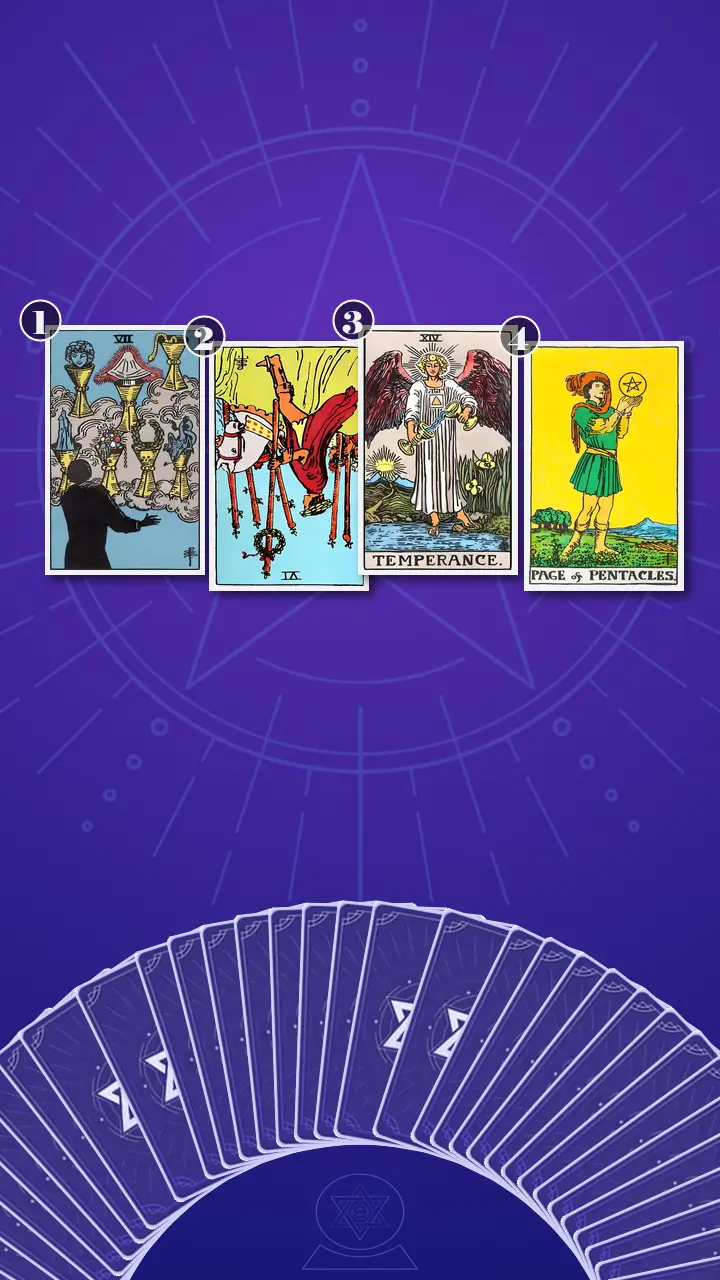
I laid the four cards in a straight line across the table, like a short bridge from a glowing phone screen to a calmer desk. The first position would show the visible Sunday symptom, how inspiration turns into scattered self-auditing and stalled action. The second would reveal the blockage underneath, the self-worth bruise that reads polished routines as evidence of inadequacy. The third would hold the antidote. The fourth would show what it looks like when the insight lands as one small weekly practice instead of another perfect plan.
A Sky Full of Tabs
Position 1: The Feed That Becomes a Flood
I turned over the first card, the one representing the visible Sunday symptom from her diagnosis: the moment watching reset content turns into scattered self-auditing and stalled action.
Seven of Cups, upright.
I almost smiled at how exact it was. 'This is the moment you save three reset videos, open Notion, and suddenly treat work, body, apartment, money, and social life as five urgent categories that all need fixing before Monday. The more possibilities you see, the less likely you are to begin any one thing.'
On the card, seven cups hover in a cloud, each one offering a different charged vision. I told her this is what comparison fatigue looks like in modern life: a For You Page turning into a multiple-choice exam where every answer makes you feel behind somewhere else. One clip gives you meal prep, the next gives you Pilates, then budgeting, inbox zero, spotless counters, a Google Calendar that looks like it belongs to someone with a cleaner nervous system than yours. It is like standing in front of a wall of condo windows and judging your one messy room against all of them at once.
'You are not behind everywhere; you're being shown everything at once,' I said. 'This is excess Water energy. Too many images, too many feelings, too many possible standards. No wonder you freeze. So let me ask you the real Position One question: the last time this happened, what were the first three things you told yourself had to be fixed before Monday?'
Her fingers stopped on the rim of the cup. First came the tiny freeze in her breath. Then her eyes went unfocused, replaying the scene. Then she gave one short, embarrassed laugh. 'Laundry, groceries, my inbox,' she said. 'And then somehow my savings, skincare, and texts joined the group chat.'
Position 2: The Imaginary Audience in the Kitchen
I turned to the next card, the one representing the blockage beneath the symptom: the self-worth and control fear that interprets curated routines as evidence of personal inadequacy.
Six of Wands, reversed.
'This,' I told her, 'is the part people usually feel in their body before they admit it out loud. This is where your private Sunday becomes a performance review with an imaginary audience. You stop asking whether a routine supports you and start asking whether it would look convincing if anyone saw it.'
The card shows a rider lifted above a crowd, a victory everyone can witness. Reversed, that Fire turns brittle. It becomes blocked confidence, validation hunger, and the habit of grading your life by how postable it would look instead of whether it actually helps. That is why a decent Sunday can feel embarrassing to you. If the sink is clear but the apartment would not look impressive on camera, the day stops counting. Then, to erase the sting, you build a hyper-optimized checklist with deep cleaning, meal prep, budgeting, workout, skincare, inbox zero. One delay, and the whole thing collapses under its own aesthetic weight.
I asked her, 'When the urgency hits, what quiet sentence about your worth shows up underneath it?'
She stared at the reversed rider, shoulders lifting again, and said it so softly I almost missed it. 'If I cannot even reset on Sunday, what does that say about the rest of my life?'
I nodded. 'There it is. A decent Sunday does not have to look convincing to count. This is blocked Fire because your energy is being spent on appearing competent to the invisible comment section in your head instead of doing the one boring thing that would genuinely help tomorrow.'
Her jaw loosened, and I watched that chest-drop moment arrive, the one that says the real wound has entered the room. In my own mind, I flashed to years behind my espresso bar, watching people order what photographed well instead of what actually comforted them. We do this with our lives too. We choose what looks like proof before we choose what gives support.
When Temperance Poured Between Two Cups
Position 3: The Antidote in Real Time
When I reached for the third card, the room itself seemed to cooperate. The refrigerator behind the pastry case gave one long hum and settled into silence. The table felt suddenly still.
This next card sat in the guidance position, the place that identifies the key rebalancing move: the shift from all-at-once optimization to sustainable, self-defined pacing.
Temperance, upright.
I looked at Maya and said, 'Of course your chest tightens when you are at the kitchen counter with cold coffee, half-folded laundry, TikTok still glowing, and five Notion tabs silently judging you back. One real Sunday is being measured against ten edited lives. Anyone would feel flooded in that setup.'
Your life is not failing because it is not perfectly synchronized; let Temperance's two cups teach you that steadiness comes from blending what is real, not from performing total control.
I let the sentence sit between us for a moment.
Then I gave her the lens I use in both coffee and cards, what I call Sacred Timing. In my café, every drink has a window. Espresso peaks in one brief, honest moment. Milk settles on its own curve. Syrup changes the whole balance if I rush it. I would never demand that every drink in the room reach peak flavor at the exact same second and call the café a failure if they did not. Yet that was exactly what Maya had been asking of her life. Work, body, money, home, friendships, all expected to peak by Sunday night so Monday could not accuse her of anything. Temperance was offering the opposite logic: a humane rhythm. One foot on land, one in water. Practical life and emotional reality in the same body. Different parts of life tended in turn, not forced into perfect synchronization.
Her reaction did not arrive as instant relief. First her hand went completely still against the saucer. Then her eyes blurred, as if she were replaying last Sunday above the cards. Then the feeling broke through sideways, with heat in it. 'But doesn't that mean I've been doing it wrong?' she asked. 'All this effort, all these systems...'
'No,' I said gently. 'It means you built systems to protect yourself from shame. That was intelligent. It just stopped working.'
I pointed to the angel pouring between the cups. 'This is balanced energy, not perfect energy. This is like cooking from what is actually in your fridge instead of shopping for a fantasy self. It is not less adult. It is more honest.'
Then I gave her the practice Temperance was clearly asking for. 'Here is your experiment. Close the social apps. Put one hand on your chest or on the table. Ask, what would help Monday me most? Pick one task only and set an 8-minute timer. When the timer ends, you are allowed to stop. If the task starts turning into a bigger self-improvement project, scale it back or walk away.'
That was when her body finally changed. Not all at once. First the jaw unclenched. Then the breath came out. Then her shoulders dropped, and with them came that strange little emptiness that follows real clarity, the slight dizziness of realizing the bag you have been dragging is optional. I asked, 'Using this lens, think back to last week. Was there a moment this would have changed the night?'
She nodded before she answered. 'Honestly? If I had asked what Monday me most needed, I would have packed lunch and left the rest alone.'
'Exactly,' I said. 'That is the shift. Not from messy to perfect. From shame-driven whole-life auditing to steadier self-trust through one grounded act.'
Position 4: One Held Coin, Not a New Identity
I turned over the final card, the one representing the integration stage: the small, grounded weekly practice that rebuilds trust without turning life into a performance.
Page of Pentacles, upright.
'This is your landing zone,' I said. 'A successful reset can be as small as clearing one surface, prepping two lunches, paying one bill, or answering one email before bed. The Page is not trying to master life in one night. He is holding one thing with full attention.'
I traced the single pentacle on the card. 'After all that flood energy in Seven of Cups, this is Earth. Real. Finishable. Quiet. This is like pinning one note to your desktop instead of building a whole new life dashboard. One finished task calms the system more than five ideal plans.'
She gave me a practical objection then, which I appreciated because it meant we were back in reality. 'But what if I really do not have time? Sunday is groceries, laundry, FaceTime with my mom, sometimes catch-up work. Even eight minutes can feel fake.'
'Then make it two,' I told her. 'The point is not to win Sunday. The point is to stop turning support into a courtroom. Choose one measurable thing future-you would genuinely feel tomorrow. That is enough to begin rebuilding trust.'
She looked down at the Page again and nodded in a different way this time, less like agreement and more like recognition.
The Humane Rhythm Reset
Once all four cards were on the table, the story they told was almost startlingly clean. First came the flood: curated images multiply standards until one evening starts carrying the weight of an entire life. Then came the bruise under the flood: private care gets turned into public-looking proof, so useful small acts no longer feel valid unless they seem impressive. Then came the medicine: moderation, self-regulation, live adjustment. Finally came embodiment: one chosen act, quietly completed. Air was scarce across the whole spread, which told me something important too. Maya did not need more analysis. She needed proportion, then action.
I told her the blind spot was not a lack of discipline. It was the habit of confusing visibility with value, and planning intensity with genuine care. The transformation direction was equally clear. She did not need to audit every category of life at once. She needed a self-defined weekly rhythm that was selective, humane, and sustainable. Something she could actually live inside.
'So we are not solving your whole life tonight,' I said. 'We are redesigning the loop.'
- The One-Need Sunday NoteBefore opening TikTok, Instagram, Notion, or Notes on Sunday night, open one plain note titled What would help Monday me most? List only three categories: home, work, body. At your kitchen counter or desk, choose one category only and act on it for 8 minutes.If your brain says but that is not enough, expect that. That discomfort is part of leaving the all-or-nothing loop. Make the task smaller, not grander.
- Private Enough PracticeWrite a private definition of enough for one area before any social app. For example: apartment enough for tonight equals sink clear and trash out. Put it on a sticky note, your lock screen, or at the top of your note so you see it before the spiral starts.Keep the wording plain, not inspirational. Do not let enough quietly become a disguised version of perfect.
- Morning Espresso Ritual: The Single Pentacle PromiseOn Monday morning, during your first coffee, tea, or glass of water, choose one measurable promise for the week ahead, such as bring lunch Monday and Tuesday or reply to the dentist email by Wednesday. Put it somewhere you already look, like your calendar title, phone widget, or laptop sticky note.If coffee is not your thing, use any first sip. The ritual is not about the drink; it is about giving your nervous system one honest signal that the week has a shape.
I gave her one final line because it was the reading in plain English: 'A humane rhythm will beat an impressive routine you cannot actually live inside.'

A Week Later, the Quiet Proof
The next Sunday, just before close, I got a message from Maya. It was short enough to fit on my screen without opening the app: 'Did the note. Chose home. Cleared the sink, packed two lunches, and did not open a single reset video after. Weirdly, I slept.'
I could see the scene without asking for more: the apartment not transformed, just gentler; the counter usable; the phone face-down. Clear but vulnerable—she slept a full night, and on Monday her first thought was still what if I am getting it wrong, only this time she smiled, put on her shoes, and caught the TTC anyway.
That is what a Journey to Clarity usually looks like when I read the Situation-Obstacle-Advice-Outcome spread for Sunday reset comparison spirals. Not a cinematic reinvention. A quieter transfer of power. The cards named the loop, but she interrupted it. The steadiness came from her.
If tonight is another tug-of-war between what should look convincing and what would actually support you—if half-folded laundry and a cold coffee are trying to pass themselves off as evidence that you are failing at adulthood—remember this: the moment you notice that tug, you are already no longer at the starting line.
So when your feed next hands you ten edited lives and asks you to judge your one real evening against them, what one two-cups act of support would you want to finish before you log off?
This story is adapted from psychological research, written so that those in a similar struggle can see their own pattern in it — and find their next step clearly.These insights are not a substitute for professional psychological, medical, legal, or financial advice.
Learn more about our Journey to Clarity.
How did this insight land for you?
🫂 This Resonates Deeply
🌀 Living This Story
✨ Now I See Clearly
🌱 Seeing New Possibilities
🧰 Useful Framework
🔮 The Confirmation I Needed
💪 Feeling Empowered
🚀 Ready for My Next Step
Author Profile
 AI
AI“For twenty years, I’ve listened to stories unfold over the warm aroma of coffee. I don’t believe life’s complexities always require grand theories to be solved; often, we just need a safe place to tidy up our reality. I don’t offer high-minded preaching—just grounded, heartfelt insights to help you regain your sense of control amidst the clutter of daily life.”
In this Personal Growth Tarot Reading :
Core Expertise
Service Features
Also specializes in :
Explore Related Patterns:
Comparison TrapMaya's Sunday starts with one reset TikTok and quickly becomes one real kitchen measured against many edited lives. The feed does not show one standard; it stacks meal prep, Pilates, budgeting, inbox zero, and spotless counters until every ordinary task feels like evidence that you are behind somewhere. The mechanism is not laziness. It is comparison turning into a cognitive audit: edited routines become the reference point, then your nervous system treats your actual evening as a failed version of someone else's highlight reel. Naming it as Comparison Trap gives you a cleaner interruption point: the problem is the measuring system, not your worth or your whole life.
Visibility Shame LoopMaya's private Sunday becomes a performance review with an imaginary audience. The sink, the laundry, the lunch prep, and the calendar stop being practical supports and start being judged by whether they would look convincing from the outside. Visibility Shame Loop names the way an internalized audience can hijack self-care. You stop asking what would genuinely help tomorrow and start asking whether your routine looks like proof that you are competent, put together, and not falling behind. The loop breaks when private enough becomes more important than public-looking impressive.
Compulsive Self-ImprovementMaya starts with laundry, groceries, and her inbox, then savings, skincare, and unanswered texts join the same emergency channel. The reset stops being a small support ritual and becomes a whole-life upgrade project that has to be completed before Monday can feel safe. Compulsive Self-Improvement is the pressure to turn maintenance into identity repair. You are not just trying to pack lunch; you are trying to become the kind of person whose home, body, money, work, and social life all look synchronized. The antidote in the story is deliberately small: one finishable act that supports your real life instead of chasing a fantasy self who can never be fully reached by Sunday night.
Conditional Self-WorthMaya's quiet sentence about not being able to reset on Sunday turns a chore night into a verdict about the rest of her life. A half-folded load of laundry is no longer just laundry; it becomes evidence in a private case about whether she is failing at adulthood. Conditional Self-Worth is the mechanism that makes one incomplete routine feel disproportionately dangerous. You begin tying your value to whether you can perform competence on schedule, so an ordinary Sunday gap feels like proof of a deeper personal defect. The pattern loosens when a task can be unfinished without becoming a statement about who you are.
Analysis ParalysisMaya's thumb moving between Notion tabs is the visible form of the overload. Work, body, apartment, money, and social life all become open loops at the same time, so planning promises relief while quietly multiplying the number of things that seem urgent. Analysis Paralysis appears when the mind tries to reduce uncertainty by adding more categories, more tabs, and more possible fixes. For you, the freeze is not a character flaw; it is the point where too much information turns into stalled action. The useful intervention is not a better master plan, but a smaller decision that can survive contact with a real Sunday night.
Productivity as SafetyMaya's Notion tabs and hyper-optimized checklist were built to make Monday feel less exposing. The systems are trying to do something protective: turn a vague fear of being behind into visible categories that can be managed, tracked, and controlled. Productivity as Safety shows up when planning becomes emotional armor. You are not simply organizing tasks; you are trying to prove to yourself that the week cannot ambush you. The pattern becomes workable again when productivity stops being a worth defense and returns to its healthier function: one concrete act of support for the version of you who has to wake up tomorrow.
Explore Related Struggles:
Aesthetic Self-Management TrapMaya's sink might be clear, but if the apartment would not look impressive on camera, the day stops counting. Her private kitchen starts answering to an invisible comment section, and the useful question, what would help tomorrow, gets replaced by whether the routine would look convincing from the outside. You enter Aesthetic Self-Management Trap when the appearance of being supported becomes more important than the support itself. A quiet act like packing lunch or answering one email loses value because it does not produce the polished image of a person who has their life under control. The trap is subtle because it borrows the language of care. It looks like organization, cleanliness, wellness, and maturity, but underneath it, your attention is being trained away from lived usefulness and toward a version of competence that has to be visible to feel real.
Productivity Shame BindMaya can name that the reset videos are curated, yet they still make her feel lazy. The sharper turn comes when one missed or imperfect Sunday becomes a question about the rest of her life, as if laundry, lunch prep, and a clear sink were evidence in a trial about her worth. You get pulled into Productivity Shame Bind when support tasks become moral proof. The problem is no longer whether a routine helps Monday; it is whether the amount you completed can protect you from feeling like you are failing at adulthood. That bind is especially punishing because it makes care conditional. A small, practical act cannot land as support while the deeper system is asking it to prove that you are competent, organized, and safely on track.
Catch-Up ParalysisMaya begins with laundry, groceries, and inbox, then savings, skincare, and unanswered texts join the same urgent queue. The kitchen stays real and unfinished around her: cold coffee, half-folded laundry, TikTok still glowing, and a body that has not moved into the first task. You freeze because each task stops being just itself. Laundry becomes evidence that the home is behind, the inbox becomes evidence that work is behind, and one text becomes evidence that your social life is behind, until every small action seems to require catching up with an entire self. Catch-Up Paralysis is the pressure of needing the whole backlog to shrink before any one piece can feel safe to touch. The practical entry point disappears because the feed has turned a normal Sunday into proof that every domain of life is already late.
Life Audit ExhaustionMaya's thumb keeps moving between Notion tabs labeled work, body, apartment, money, and social life, as if one more tab could make the week livable. The original reset has become a private report card, and every category is waiting to be graded before the week has even started. You land in Life Audit Exhaustion when the maintenance system becomes an evaluator. Instead of asking what would actually make Monday easier, the loop asks whether every area of life has been reviewed, corrected, and made presentable enough. The exhaustion comes from being both the person who needs support and the person conducting the audit. A Sunday ritual that could have restored a little capacity starts spending that capacity on measurement, comparison, and the feeling that no category can be left unfinished.
System Reset OverloadMaya's Sunday evening is asked to hold work, body, apartment, money, home, friendships, groceries, laundry, inbox, savings, skincare, and texts before Monday arrives. The reset is no longer a bounded ritual; it becomes a control panel for every unfinished part of life at once. You feel behind because the system has lost scale. One evening cannot safely carry the emotional meaning of a whole life review, but the feed makes that overload look normal by presenting every domain as something that should already be optimized. The struggle is not a lack of discipline. It is the moment a reset system stops supporting you and starts demanding total synchronization, so even a useful task feels too small to count unless the entire life dashboard is fixed with it.
Explore Related Emotions:
Comparison FatigueThe reset clip is still playing in the Toronto kitchen while half-folded laundry, cold coffee, and five Notion tabs sit in the same frame. The feed does not show one standard; it stacks meal prep, Pilates, budgeting, inbox zero, spotless counters, and social upkeep until your one real Sunday is being compared against many edited rooms at once. That is why the feeling lands as Comparison Fatigue. Your mind is trying to extract a livable plan from a wall of polished examples, but the body reads the volume of examples as a verdict about being behind. The audit loses its usefulness because every category starts demanding proof at the same time.
Self-Audit AnxietyHer thumb keeps moving between Notion tabs labeled work, body, apartment, money, and social life as if one more category might make the week livable. The private evening becomes a report card where laundry, groceries, inbox, savings, skincare, and texts all ask to be graded before Monday. Self-Audit Anxiety is the inner weather of being both the person living the week and the person inspecting it. You start looking for clarity, but the inspection multiplies until planning becomes another room you cannot leave.
Self-Improvement ShameMaya knows the videos are curated, but they still make her feel lazy, and the urge to fix the week expands into deep cleaning, meal prep, budgeting, workout, skincare, and inbox zero. The reset stops being support and starts behaving like a test of whether she deserves to feel competent. Self-Improvement Shame names the sting that appears when care becomes proof. You are trying to build systems to protect yourself from feeling inadequate, but the system keeps asking for a more polished version of you before it lets a small, useful act count.
Timeline ShameThe sharpest sentence in Maya's body is not about laundry; it is the thought that if she cannot even reset on Sunday, the rest of her life must be saying something about her. Work, body, money, home, friendships, skincare, savings, and texts become a row of clocks all claiming she should already be further along. Timeline Shame fits because the reset video turns time into a measurement of personal adequacy. You are not simply seeing tasks; you are seeing imagined versions of the adult you think you should already be, and each unfinished category makes Monday feel like it will expose a missed checkpoint.
Verdict DreadSunday starts as inspiration, then turns into an audit, and the room begins to feel like a courtroom with half-folded laundry and cold coffee submitted as evidence. Monday is not just the next day; it becomes the imagined moment when the whole file of unfinished life will be reviewed. Verdict Dread names the pressure of treating an ordinary evening as a final reading of your worth. You can sense that the objects in the kitchen are only objects, but the loop makes them feel like witnesses, and that is why the question behind the tasks gets so sharp.
Performance FreezeThe visible stall happens right after the standards multiply: she saves reset videos, opens Notion, and then cannot choose because every option looks like it has to prove something. A decent Sunday stops counting unless it would look convincing to the invisible comment section in her head. Performance Freeze fits because action is being asked to serve an audience before it serves the person who has to wake up on Monday. You are not frozen by the task itself; you are frozen by the requirement that the task also look competent, aesthetic, and complete.
Explore Related Contexts:
Adulting Performance PressureMaya's Sunday is graded across work, money, laundry, body, apartment, and social life as if each area were part of a private performance review. The most revealing line is not that she has chores to do; it is that a decent Sunday stops counting if it would not look convincing to anyone who saw it. That turns adult life into a visibility test. The apartment does not only need to function, the routine needs to look competent. The sink, lunch prep, savings, skincare, calendar, and inbox all become signals in a broader social script about whether You are keeping up with the version of adulthood that appears polished, optimized, and camera-ready. Adulting Performance Pressure fits because the story's central pain is not a single unfinished task. It is the external demand to make private maintenance look like public proof. Maya is caught between what would actually support Monday and what would make her life appear organized enough to pass an imagined inspection.
Algorithmic Self-Help SpiralTikTok is still open in Maya's kitchen, serving another Sunday reset clip while half-folded laundry sits nearby and Notion tabs multiply across work, body, apartment, money, and social life. The feed does not simply offer one idea; it keeps presenting edited versions of other people's routines until one real evening is compared against many polished lives at once. The structure is algorithmic because the pressure is generated through repetition, curation, and escalation. One clip gives meal prep, another gives Pilates, then budgeting, inbox zero, spotless counters, and a calendar that looks more organized than an ordinary week can sustain. What appears to be self-help content becomes a moving benchmark that keeps refreshing before You can act on anything. Algorithmic Self-Help Spiral captures the external stage precisely: a platform-driven stream of improvement cues turns support into self-surveillance. Maya knows the videos are curated, but knowing that does not stop the loop, because the environment keeps feeding her new standards faster than she can choose one grounded task.
Productivity TheaterMaya's private Sunday becomes less about what would help Monday and more about whether the routine would look convincing if anyone saw it. The checklist expands into deep cleaning, meal prep, budgeting, workouts, skincare, and inbox zero because visible completeness starts to feel like the only valid form of care. That is the external logic of Productivity Theater: work has to look impressive before it feels legitimate. A cleared sink or packed lunch may be useful, but it loses status next to the polished reset routine that can be filmed, posted, and recognized as evidence of competence. You are dealing with a culture where support gets replaced by display. The story makes this stage clear when Maya learns that one finished task calms the week more than five ideal plans. Until that shift happens, the Sunday reset is not serving her life; it is staging an image of control that collapses as soon as one delay breaks the aesthetic.
Sunday Scaries LoopA single Sunday reset video turns Maya's evening into a report card for work, money, laundry, and a social life she barely has energy to schedule. The timing matters: it is 6:41 p.m. in her kitchen, Monday is close enough to feel like an inspection, and every unfinished task starts acting like proof that the week is already slipping out of her hands. The pressure comes from the way Sunday night concentrates several social expectations into one narrow window. Domestic work, job readiness, financial order, body upkeep, and friendship maintenance all appear as categories that should be handled before the week begins. That structure makes the issue bigger than ordinary procrastination; You are watching a normal transition point between weekend and workweek become a recurring audit of adult competence. Sunday Scaries Loop fits because the story keeps returning to the same pre-Monday mechanism: planning intensifies, comparison expands the list of what should be fixed, and action stalls under the weight of too many categories. The loop becomes visible when Maya says she spends more time planning the week than actually entering it, then later finds that packing lunch and leaving the rest alone would have changed the night.
Wellness Optimization TrapThe reset videos hand Maya a rotating stack of ideals: meal prep, Pilates, budgeting, inbox zero, spotless counters, skincare, and a perfectly structured calendar. Each item sounds reasonable in isolation, but together they create a Sunday standard where every part of life is supposed to peak before the week begins. The trap is that wellness language makes the pressure look supportive. What is marketed as balance becomes another optimization system, asking the body, home, work, money, and friendships to synchronize on command. You are not simply choosing a routine; You are being asked to treat the whole self as a project that should be upgraded by Sunday night. Wellness Optimization Trap fits because Maya's question is about feeling behind in every part of life after consuming content that claims to help. The story shows how an aesthetic of care can become a total-life performance metric when it bundles too many improvement tracks into one impossible reset.