The Five-Minute Lesson That Saved the Streak; Then the Block Moved

The Five-Minute Lesson That Kept the Routine Stuck
If you are a Toronto undergraduate who has ever completed the shortest lesson after dinner to protect a counter while the review that would actually help stayed untouched, I know this scene may feel uncomfortably familiar.
At 9:18 on a Tuesday night, Jordan, a 22-year-old undergraduate, joined our video session from her apartment kitchen. The refrigerator hummed through my speakers. A textbook lay open beside a cooling mug, while the green light from her phone washed over a page of unfinished notes.
She stood beside the sink and showed me the streak warning. Her thumb hovered over the easiest five-minute lesson. When she tapped it and the counter advanced, I watched her shoulders drop, but only slightly; the heaviness stayed in her chest.
“A streak is easier to fix than a routine,” she said. “I get the points, call the day a win, and close the actual review. I know I’m collecting proof that I showed up instead of changing what isn’t working.”
That was the contradiction at the centre of her question: chasing study streaks versus changing a routine that did not support meaningful learning. The app gave her brief relief, but reviewing the failed schedule felt like lifting a door she expected to find bolted shut. Her frustration had the texture of a song trapped beneath a skipping needle: movement, repetition, and no arrival.
I told her, “I’m not here to take the app away or tell you that consistency is bad. I want us to separate the number from the meaning you’ve had to make it carry. Let’s use the cards to draw a map through this study streak anxiety and see where your effort has fallen out of rhythm.”

Choosing a Ladder Through the Loop
I asked Jordan to place her phone face down, take one unforced breath, and hold a single question in mind: “Why does protecting this streak feel safer than changing my routine?” I shuffled slowly, using the pause as a transition for attention rather than as a performance of mystery.
For her question, I chose the Four-Layer Insight Ladder · Context Edition, a four-card tarot spread for study procrastination and routine redesign. This was a “why” question about a self-reinforcing pattern, not a decision between two external paths. A larger spread would have introduced timelines and predictions that Jordan did not need. She needed the smallest sufficient map of the system.
I arranged the cards in a vertical ladder. The bottom position would show the visible study behaviour. The second would expose the bargain maintaining it. The third would reveal the transforming shift, and the top card would translate that shift into a practical one-week experiment.
This is how I use tarot: not as an authority that tells someone what will happen, but as a structured mirror. Card meanings in context can turn a vague feeling into an observable pattern, and an observable pattern gives the person experiencing it more choice.
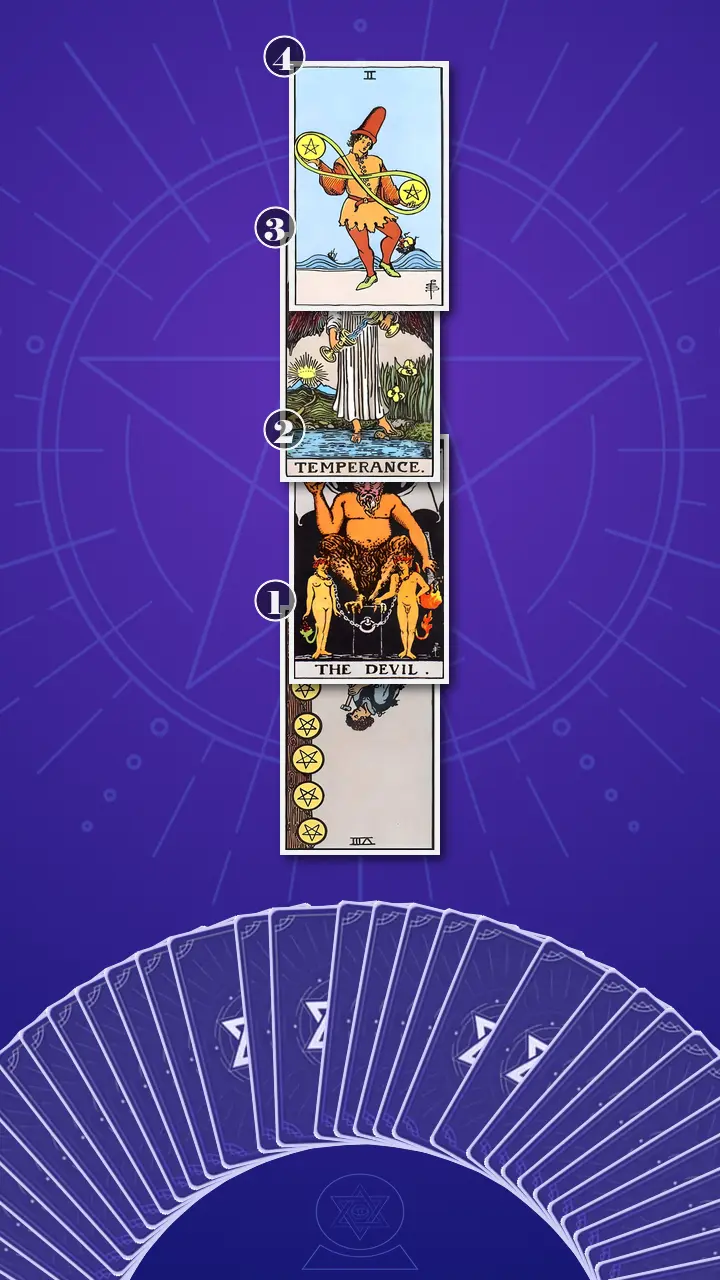
The Hammer, the Counter, and the Work Left Open
Position 1: Eight of Pentacles Reversed
I began with the position representing Jordan’s visible pattern: protecting the streak with a low-effort task while postponing the routine review. I turned over the Eight of Pentacles, reversed.
In the Rider-Waite-Smith image, a craftsperson repeats the same hammering motion while completed pentacles line the wall. Upright, that repetition can build skill. Reversed, its earth energy has become stagnant: effort is present, but the direction of that effort is no longer being tested.
At 9:18 p.m., Jordan’s kitchen table had become that workbench. Her thumb performed the modern version of the hammer stroke: open the app, tap the five-minute lesson, watch the counter turn green. The action was real, but the longer textbook review remained open and untouched. The dashboard could show another completed unit without answering whether she understood anything new.
“A streak can record repetition; it cannot repair a routine,” I said. “Which part of tonight’s effort improved your understanding, and which part only protected the score?”
Jordan gave a short laugh, but there was no amusement in it. “That’s so accurate it’s almost rude.” Her fingers tightened around the mug, then loosened. “The counter says I worked. The open textbook says I avoided the work I was scared wouldn’t go well.”
I nodded. I did not read the card as evidence that she lacked discipline. If anything, it showed disciplined motion trapped in the wrong feedback loop. The danger was not only repeating the tiny task; it was overcorrecting later by deleting the app, building an elaborate Notion system, and creating another dashboard to maintain.
Position 2: The Devil and the Ten-Second Bargain
The next position represented the procrastination mechanism and the fear beneath the gamified learning trap: immediate points and visible continuity substituting for an honest look at the misaligned routine. I turned over The Devil, upright.
I told Jordan immediately that I was not reading this card as evil, punishment, or a prediction. Its role was to show attachment: the moment a useful tool begins acting like an authority over attention.
At 10:47 p.m., a streak notification could sit above a Canvas deadline like a small digital supervisor. Jordan’s restless thumb would reach for the easiest task because the number promised immediate relief. In the card, the chains around the two figures became a metric wrapped around her attention; the pedestal became the elevated status she had given a counter that was meant to be only one signal.
“Sometimes the easiest task is not progress,” I said. “It is relief wearing a progress bar.”
The energy here was blocked and excessive at once. Jordan was not attached to learning too much. She was giving too much psychological authority to proof that could be repaired in five minutes. The bargain sounded like this: If this number breaks, what will I have left to point to? The reward was a quick release in her shoulders. The delayed cost was another evening in which the schedule, workload, and study method remained unchanged.
I invited her to imagine a ten-second gap between the warning and the tap. “In that pause, ask: What is this task giving me right now, and what is it helping me avoid? You don’t have to refuse it. Just make the bargain visible before you accept it.”
Her hand stopped halfway to the phone. For a moment her gaze lost focus, as though she were replaying a series of late-night warnings. Then she exhaled from deep in her chest. “I’ve been treating the counter like evidence about who I am,” she said. “Not just evidence that I opened an app.”
When Temperance Changed the Beat
Position 3: The Two Cups of a Flexible Study Routine
The room became noticeably quieter before I revealed the card representing the central shift: moving from chasing an uninterrupted score to testing a realistic routine and measuring actual learning. The refrigerator compressor clicked off, leaving only the faint traffic outside. I turned over Temperance, upright.
The angel pours water between two cups, keeping one foot on stable land and one in moving water. I saw neither rigid control nor total disengagement. I saw integration: a priority block, a short learning check, and a backup window being adjusted until they could coexist with classes, commuting, uneven energy, and rest.
On Sunday evening, this card would not ask Jordan to delete the app or invent a perfect replacement. It would ask her to try one 25-minute priority block before any optional streak task, write a brief note about what she understood, and keep a smaller backup window for a disrupted day. The learning goal could remain steady while the container changed.
I asked her to return in her mind to 9:18 p.m.: the warm phone, the glowing warning, and the open textbook. In that moment, she had not been choosing what would teach her more. She had been trying to end the discomfort of seeing the number at risk.
Years of sound-energy research have trained me to listen for mismatched tempo before blaming the musician. I call this a Tempo Misalignment Audit. Jordan’s app was conducting at one rigid beat per day, while her psychological and executive capacity changed with lectures, deadlines, TTC delays, and fatigue. She was trying to force her real week to obey the metronome, then interpreting every missed beat as a failure of character.
My mind flashed to a waveform pushed too hard through the wrong setting: increasing the volume would not restore clarity. Jordan did not need more pressure. She needed Execution Rhythm Calibration, identifying where ambition and daily capacity had fallen out of sync and changing the tempo without abandoning the song.
An unbroken streak cannot prove your discipline, so use Temperance’s two cups to pour your effort into a flexible routine that supports actual learning.
I let the sentence remain in the quiet.
Jordan’s breath stopped first. Her fingers stayed suspended above the rim of her mug, and her eyes widened before shifting away from the card. I watched recognition move across her face as she replayed missed blocks, rebuilt schedules, and five-minute rescues. Then resistance arrived. Her jaw set, and she said, more sharply than before, “But doesn’t that mean I’ve been doing it wrong this whole time?” Her eyes reddened, not with panic but with the sting of seeing how much effort had gone into protecting the wrong evidence. I told her, “It means the old method gave you relief when you needed relief. That is not the same as being foolish, and it does not erase what you learned. Now you can decide whether the bargain still serves you.” Her fist slowly opened on the table. Her shoulders lowered, and a shaky breath left her, followed by a brief, almost dizzy silence: the vulnerability that comes when clarity also returns responsibility. “I can keep learning without keeping this exact number alive,” she said.
I asked, “Now, using that new perspective, can you remember a moment last week when changing the time, size, or format of the study block might have felt different from giving up?”
She described a Thursday when a late seminar had erased her planned hour. She had treated the missed start time as proof that the whole day was gone, then saved the streak before bed. Temperance offered a different reading: adaptation could have been the consistency. This was the first movement from frustration-driven metric chasing and fear of changing the routine toward self-trust through measured, adaptive consistency.
“Changing the routine is not the opposite of consistency,” I said. “It is how consistency learns what fits. Keep the goal. Loosen the container.”
The Calendar Learned to Move
Position 4: Two of Pentacles Upright
The final position translated the transformation into a one-week action: use a flexible study block, review its fit, and adjust according to learning rather than score. I turned over the Two of Pentacles, upright.
The figure holds two pentacles inside an infinity loop while ships rise and fall behind him. His knees are bent because balance here is active, not frozen. The card’s earth energy had returned in a more responsive form: practical structure in balance rather than accumulation for its own sake.
I connected one pentacle to a primary calendar block and the other to a backup window. The ships became Jordan’s changing lectures, a delayed Line 1 train, an assignment taking longer than expected, or a low-energy evening. The routine would remain usable because movement had been designed into it.
I pictured Wednesday at 6:30 p.m., between a seminar and the TTC ride home. Jordan could place a realistic 25-minute block in Google Calendar and add a 10-minute backup later that day. If the first window disappeared, she could move the block rather than rebuild the week. Afterward, she could write one thing she had learned.
“Let the block move without making yourself start over,” I said. “Your calendar is a planning tool, not a public verdict.”
Jordan looked at the card’s infinity loop and nodded slowly. “So the repeatable part isn’t the exact time,” she said. “It’s returning to the learning priority.”
“Exactly,” I replied. “The streak can stay, break, or become irrelevant on a given day. You remain the person making the decision.”
Keep the Goal, Loosen the Container
I drew the four cards together into one story. The reversed Eight of Pentacles showed real effort organised around visible completion. The Devil revealed why that arrangement persisted: the counter offered fast reassurance when changing the routine felt like risking Jordan’s identity as a capable student. Temperance moved effort between more realistic containers, and the Two of Pentacles placed that flexibility into a calendar that could survive an ordinary student week.
The cognitive blind spot was simple but costly: Jordan had been treating adaptation as evidence that consistency had failed. That belief kept her on a treadmill whose score rose while the route stayed unchanged. The transformation was not from “undisciplined” to “disciplined.” It was from protecting an unbroken score to gathering honest evidence about what helped her learn.
I also noted the spread’s missing fire and air. The cards had supplied practical earth and flexible water, but Jordan would need to add a small act of initiation and a clear review of the result. Not a dramatic reinvention. Just one deliberate test and one honest sentence.
I shaped the actionable advice around my Syncopation Reset. In music, syncopation does not destroy the pulse; it changes where the emphasis falls. For three days, Jordan would move emphasis away from the daily counter and onto the moment meaningful learning actually began.
- Run the 3-Day Syncopation Reset.On three days this week, before opening the learning app, write one course priority on paper or in Google Calendar and work on it for 25 minutes at your usual desk. Mute streak notifications during the block. If 25 minutes feels too heavy, use the five-minute minimum: one problem, one paragraph, or one retrieval attempt.Stop after the minimum if your attention is spent. The experiment is measuring fit, not testing your worth.
- Create a Two-Window Routine.For two upcoming study days, schedule one realistic 25-minute primary window and one 10-minute backup window later that day. Name both by the learning outcome, such as “review two concepts,” rather than by a streak or generic productivity label. If class, transit, or energy removes the first window, move the task to the backup.Record the move as routine data, not a reset. Keep the backup small enough that flexibility does not become another planning project.
- Make One Learning-Outcome Check.After each priority block, take 60 seconds to finish the sentence, “The part that improved my understanding was…” When possible, explain, retrieve, or solve one thing from memory before checking your notes.Do not use the answer to grade your intelligence. If the result is unclear, treat that as information for the next adjustment and stop there.
I reminded Jordan that she did not have to delete the app, preserve the streak, or prove that the new routine would work forever. The purpose of the experiment was curiosity: move one beat, observe what changes, and let actual understanding become evidence.

A Grey Counter and a Quieter Morning
Six days later, I received a message from Jordan. A seminar had run late, so she moved her priority block into the 10-minute backup window instead of declaring the day lost. She reviewed two concepts, explained one from memory, and wrote, “Moving the block helped more than saving the number.”
Her streak had broken. She stared at the grey counter for three minutes, closed the app, and returned to the paragraph she could now explain. The next morning, her first thought was, “What if I’m still doing this wrong?” She smiled, moved Thursday’s block, and continued.
I did not read that as a solved life or a permanently repaired routine. I read it as quiet proof of agency. The Four-Layer Insight Ladder had made the pattern visible, but the cards had not moved the calendar block, completed the review, or loosened the counter’s authority. Jordan had.
That was her Journey to Clarity: not certainty, and not a perfect streak, but the first grounded experience of adaptation without self-abandonment. Her confidence began to rest on observed learning rather than uninterrupted completion.
If a streak alert makes your shoulders tighten over the longer task, I know it can feel safer to protect the number than to change the routine and risk discovering that the struggle follows you anyway. Simply noticing that bargain creates a ten-second space in which the counter is no longer the only voice setting the tempo.
If the number became optional for one week, which beat would you be curious to move first: a five-minute priority block, a backup window after a disrupted day, or one honest sentence about what you actually learned?