Three Tabs and an Unwritten Section: Testing Scope with the Group

The 10:47 P.M. Group-Project Spiral
If you are a university student who can do the work but keeps waiting for the group project to make sense, your procrastination may look like three open tabs and no paragraph anyone else can see.
Jordan appeared in my video room from their Toronto apartment with the project brief, group chat, and shared Google Doc still open behind our call. They told me that at 10:47 the previous Tuesday, the laptop fan had been humming beneath a desk lamp that felt too bright, their phone had grown warm in their palm, and cold coffee had left a bitter film on their tongue. They had renamed two headings, moved several references, typed half a sentence, deleted it, and checked the chat again.
“I can do the work,” Jordan said. “I just don’t know what the work is for. Every idea feels temporary because nobody has chosen a direction.”
I heard the central contradiction immediately. Jordan wanted to complete a reliable contribution and help the group move forward, but every missing decision made delay feel safer than producing something the team might reject. Their disorientation sounded like trying to read a road sign while five browser tabs played different directions at once: their thoughts accelerated, yet their shoulders sank lower over the laptop.
“I’m not avoiding the work because I can’t do it,” Jordan added. “I’m avoiding committing to work I can’t prove will fit.”
“That distinction matters,” I said. “I don’t hear laziness. I hear effort trapped inside an unclear system and a very understandable fear of wasting it. Let’s not ask the cards to predict your grade or tell you what your teammates will do. Let’s use them to map the loop, locate the part you can influence, and find one next move that does not require you to rescue the whole group. Our journey today is about finding clarity without pretending uncertainty has vanished.”
Choosing the Switchback Map
I invited Jordan to take one unforced breath and hold a single question in mind: “Why do I keep delaying my part while our group lacks direction?” I shuffled slowly. The motion was not a performance of mystery; it gave both of us a clean psychological transition from replaying the problem to examining it.
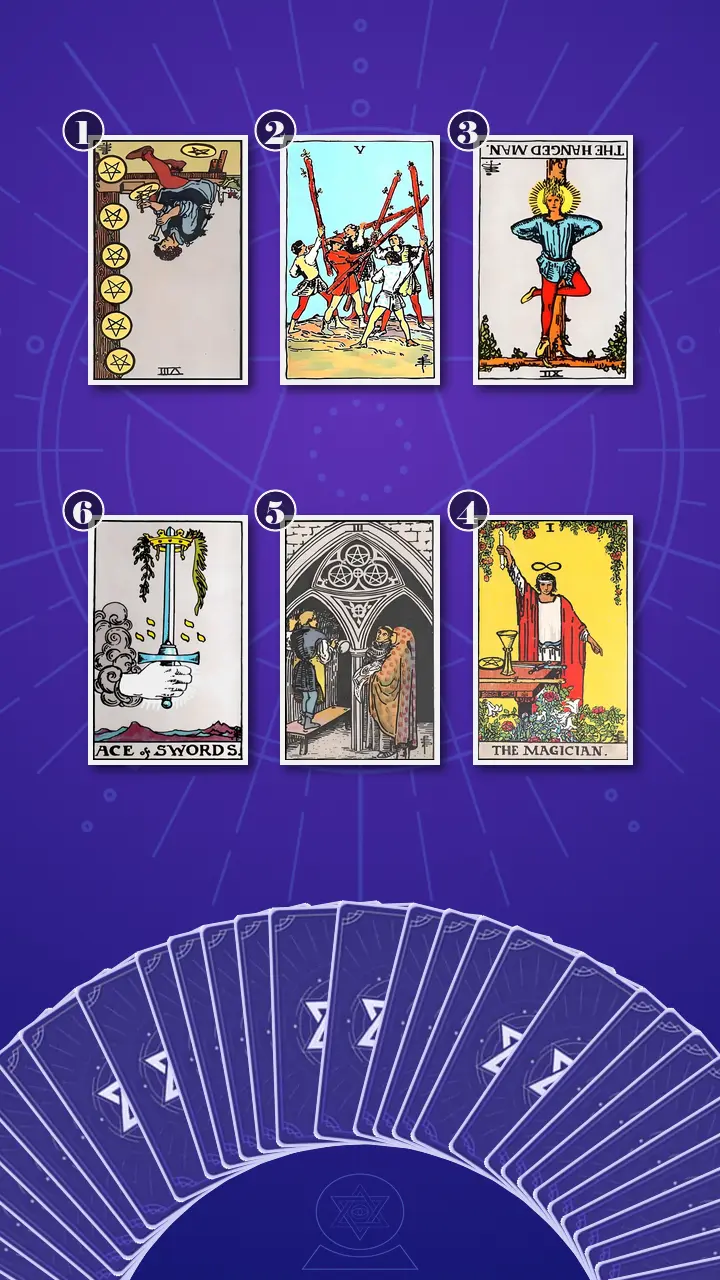
I chose the Transformation Path Grid · Context Edition, a six-card tarot spread designed to follow a problem from symptom to integration. For readers curious about how tarot works in a situation like this, I use the cards as a structured cognitive map. The images help separate observable behavior, environmental pressure, underlying belief, available leverage, practical action, and the understanding that can emerge afterward. They do not remove personal judgment or make decisions on anyone’s behalf.
This spread suited Jordan’s group-project procrastination because the problem was systemic. Ambiguity delayed visible contributions, while the absence of visible contributions left the group with less material around which to coordinate. A simple motivation reading would have missed that feedback loop, and a relationship spread would have placed too much emphasis on individual personalities.
I arranged the cards in two rows of three. The upper route would show the visible delay, the group-level blockage, and the internal rule sustaining the pause. The path would then drop to the crucial leverage point before moving through a collaborative experiment and a final framework for finding clarity. The layout resembled a switchback trail: I would first follow Jordan into the loop, then trace a workable route back out.
When the Workbench Produced Everything Except Work
Position 1: Eight of Pentacles Reversed and Productive Procrastination
The first card I turned was the one representing the observable procrastination behavior: preparing, checking, and reorganizing without producing or sharing Jordan’s assigned content. It was the Eight of Pentacles, reversed.
In the Rider-Waite-Smith image, the craftsperson’s completed pentacles form a visible record of repeated practice. Jordan’s modern version contained the right software, research, and available time, but no visible row of work. At 10:47 p.m., they had spent forty minutes standardizing headings and moving references. The shared document looked cleaner, yet it contained no paragraph the group could confirm, challenge, or build upon. It was the Google Docs version of polishing a Notion dashboard while the actual assignment card remained untouched.
I read the reversed Earth energy as a blockage, not a deficiency of intelligence or care. Practical effort was present, but it had been diverted into low-risk preparation. Formatting could be completed privately and correctly. A paragraph would reveal an interpretation and allow someone else to respond.
“The card is exposing a gap between productive appearance and visible contribution,” I said. “The private sentence underneath it may be: ‘I am technically working, but I am avoiding the one thing that would let anyone respond.’ You are not short on effort; your effort has been diverted into tasks that cannot receive useful feedback.”
Jordan gave a short, bitter laugh. Their hand rose toward their face and stopped at their chin. “That is so accurate it’s almost cruel. I fixed the citation spacing last night before I had a claim to cite.”
“The accuracy can sting,” I said, “but the card is describing a strategy, not issuing a character verdict. Your ability to do the work is still sitting at the bench. We’re looking at where that ability goes when being provisionally wrong feels too exposed.”
I asked what they had edited during their most recent work session instead of making a paragraph reviewable. Jordan listed headings, references, and the task table. Naming those actions aloud shifted the issue from the vague label of procrastination into behavior they could actually recognize and interrupt.
Position 2: Five of Wands and the Empty Decision System
The card I turned next was the one representing the external structural blockage in the group-project free-for-all: competing ideas, unclear ownership, and no shared definition of direction. It was the Five of Wands, upright.
I pointed to the five raised staves crossing without becoming a stable structure. Jordan recognized the scene before I finished explaining it. On their latest video call, one teammate had proposed a new case study, another wanted a theory-heavy approach, and two others had pasted unrelated links into the chat. Everyone sounded active. The call still ended with, “We’ll figure it out.” The suggestions had crossed in mid-air without becoming scaffolding.
The upright Fire carried energy in excess: too many live possibilities, too little containment. This was not an empty environment in which Jordan alone had failed to act. Their hesitation was occurring inside a genuine coordination problem. The group had motion, but no rule for turning motion into a thesis, owner, priority, deadline, or definition of done.
“A busy group chat can still be an empty decision-making system,” I said. “Everyone may be contributing ideas while nobody is closing a decision.”
Jordan’s jaw loosened slightly. They looked away from the cards and toward the edge of their screen, as though seeing the last call replay there. “That makes me feel less ridiculous,” they said. “I keep thinking everyone else is moving and I’m the only one stuck, but none of us actually knows what we agreed.”
I asked which exact item had been missing when the meeting ended. “A priority, an owner, and probably a thesis,” Jordan replied.
“Then we should validate the structural disorder without handing it total control,” I said. “You do not have to deny the Five of Wands. You also do not have to wait for all five staves to organize themselves before identifying the one decision your section genuinely needs.”
Position 3: The Hanged Man Reversed and the Pause That Stopped Teaching
The third card was the one representing the root mechanism connecting Jordan’s loss of direction with procrastination: waiting for complete meaning and group agreement before permitting a provisional contribution. It was The Hanged Man, reversed.
The upright Hanged Man can describe a chosen pause that produces another perspective. Reversed, the halo remained present but the pause had stopped yielding insight. Jordan kept the document open, reread the same messages, and waited for someone else to define the thesis. The delay initially protected them from spending effort on the wrong angle. Over time, it became a fixed posture in which every unresolved detail was treated as proof that even a test paragraph would be premature.
I slowed my voice. “The same brief. The same messages. The same half-sentence deleted again. You are trying not to waste effort by guessing. But the waiting is no longer teaching you anything.”
The suspended energy had become a blockage. Jordan’s analysis was not creating new evidence; it was preserving the demand for evidence that nobody could supply without a draft, proposal, or direct question. The external Five of Wands had become an internal rule: “Until the group understands everything, I am not allowed to test anything.”
“Waiting stops being research when it produces no new information,” I said.
Jordan’s breathing paused. Their eyes stayed on the reversed figure, then lost focus as though they were scanning several evenings at once. Finally, their fingers released the edge of their sleeve. “I keep hoping the next message will make starting safe,” they said quietly. “But it’s always another link.”
I asked them to separate one uncertainty that truly blocked the next paragraph from everything that could remain open. After a moment, Jordan said the group needed to choose whether their section supported an access argument or a policy angle. The sources themselves could already be summarized. That distinction was small, but it was the first opening in the holding pattern.
When The Magician Stood Up
Position 4: The Catalyst of Bounded Agency
The room seemed to settle as I reached the decisive turn in the grid. The card I turned now was the one representing the leverage point in the limiting cycle: using existing information to define one bounded action without claiming control over the entire group. It was The Magician, upright.
I showed Jordan the table holding the emblems of all four suits and the figure directing energy from intention into material form. The modern tools were already visible on Jordan’s screen: the assignment brief, research notes, shared document, group chat, and calendar. The Magician did not promise control over the final project. Its upright energy represented balanced, focused agency: enough resourcefulness to turn available material into one defined experiment.
This was where I reached for a method I call Academic Stratigraphy. Years among Cambridge libraries and archaeological trenches taught me that fragments become intelligible only when their layers are distinguished. I remembered the discipline of labelling a context before drawing conclusions from it: no careful archaeologist tries to excavate an entire settlement before recording the first useful layer.
I mapped Jordan’s project in the same way. The bedrock contained what was already known: the rubric, deadline, available research, and broad subject. The working layer contained a provisional interpretation: “This section is meant to support the access argument.” The open trench contained the decision only the group could confirm: access or policy. Jordan had been treating the open trench as though it invalidated the bedrock and forbade work in the provisional layer.
I returned them to the exact bottleneck: 10:47 p.m., the brief, chat, and shared document still open; one heading renamed; three vague messages reread; half a sentence erased; shoulders sinking as another work block disappeared. They had been demanding a complete map before allowing themselves to leave one testable mark.
Clarity is not a prerequisite you must wait for; turn the tools already on your table into one visible draft, as The Magician turns available resources into directed action.
I let the sentence sit without rushing to explain it away.
Jordan’s breath caught, and their fingers stopped halfway around the coffee mug. Their pupils widened first; then their gaze slipped away from the screen, as if the last few weeks were replaying somewhere beyond it. Their eyebrows drew together and heat rose into their face. “But doesn’t that mean I’ve been helping create the problem?” they asked, sharper than before. “Like, have I just been wrong this whole time?” I heard anger covering a sudden, more vulnerable question. “No,” I said. “It means your strategy made sense when it protected you from unlimited rework. It also means the strategy now has a cost. The group’s lack of structure is real, and your next move can still be different.” Their fist slowly opened. Their shoulders dropped, followed by a long, unsteady exhale. Relief crossed their face, but so did the brief blankness that comes when a familiar burden disappears and leaves responsibility in its place. “That feels obvious,” they said, their voice lower, “and kind of terrifying.”
“Now, using this new perspective, think back to last week,” I said. “Was there a moment when this insight could have changed how the situation felt?”
Jordan remembered the video call when access and policy were both proposed. They could have summarized three sources under a working assumption and asked which angle the group wanted, rather than waiting for a complete thesis. “I wouldn’t have been deciding for everyone,” they said. “I would have been showing them what the decision changes.”
I named the transition plainly. This was not a leap from uncertainty to confidence. It was one step from detached disorientation and indefinite waiting toward cautious engagement: from needing to control the whole route to making one provisional, reversible contribution visible.
I offered a ten-minute Bounded Draft Check, with Jordan free to stop or reduce it. For the first minute, I asked them to write, “Working assumption: this section is meant to…” For the next seven, they could produce one rough paragraph or three evidence bullets without formatting. In the final two minutes, they could add one question: “Does this fit the direction we want, or should I shift it toward X?” Posting was optional. They could share it privately with one teammate, keep it as a draft, or stop after the assumption sentence if the group dynamic felt exposing. The purpose was to generate information, not force disclosure.
Visible Work Becomes Scaffolding
Position 5: Three of Pentacles and the Draft the Group Can Touch
The fifth card was the one representing the practical experiment through which the shift could be tested: sharing a rough draft, labelling its assumption, and requesting one specific piece of group feedback. It was the Three of Pentacles, upright.
I drew Jordan’s attention to the artisan presenting visible work while two collaborators consulted a plan. The card’s modern equivalent was not a polished section produced alone. It was a rough paragraph highlighted in Google Docs with a comment explaining its intended role: “I drafted this as evidence for the access argument.” Jordan could then ask, “Does this support the direction we want, or should I shift it toward the policy angle?”
The upright Earth energy showed balance: individual craft becoming more useful through proportionate collaboration. It worked like a pull request. Collaborators could respond to specific lines instead of debating an imagined final product. Jordan did not have to predict every future revision or volunteer to manage everybody else’s work.
“A bounded draft is not a takeover; it is a coordination point,” I said. “You are not submitting a final answer. You are giving the group something specific to respond to.”
Jordan sat a little straighter and copied the suggested message into their notes. Their smile contained both relief and caution. “Asking ‘X or Y?’ feels very different from writing ‘Thoughts?’ and hoping somebody understands what I need,” they said.
I agreed. A broad request could produce more Five of Wands energy. A targeted fit question made the relevant uncertainty answerable while preserving everyone’s autonomy.
Position 6: Ace of Swords and the Sentence Above the Noise
The final card was the one representing the understanding Jordan could integrate: group direction can be built iteratively through visible contributions and explicit agreements rather than awaited as a finished answer. It was the Ace of Swords, upright.
I followed the single upright blade rising above jagged mountains. The mountains had not disappeared; the image simply offered one clean line through difficult terrain. In Jordan’s project, that meant turning scattered discussion into three headings: Known, Working Assumption, and Needs Agreement. Under them, the group could record one provisional thesis, Jordan’s responsibility, and the next checkpoint.
The card’s Air energy was in balance: precise enough to support action, but not so rigid that a working decision became permanent law. A sentence such as “For this version, our section uses the access angle; Jordan owns the evidence summary; we will confirm the policy question by Thursday” could rise above the unresolved material without pretending every issue had been solved.
“The Ace is not asking you to feel totally certain,” I said. “It is asking you to distinguish facts from assumptions and assumptions from open questions. That is how feedback becomes direction instead of another layer of chat.”
Jordan rolled their shoulders back and read the three headings aloud. “I think I’ve been waiting for clarity to feel like a mood,” they said. “This makes it look more like a decision we can document and revise.”
I could not have phrased the integration more cleanly. The cards had not delivered a finished route. They had shown how one sentence could mark the next turn.
The Argument Beneath the Clutter
I gathered the spread into one coherent account. The Eight of Pentacles reversed showed that Jordan’s practical capacity had been diverted into formatting and checking. The Five of Wands confirmed that earlier meetings had produced scattered Fire without a coordination rule. The Hanged Man reversed revealed how that real disorder had hardened into a private demand for complete certainty. The Magician interrupted the suspension by gathering existing tools around one bounded choice; the Three of Pentacles made that choice collaborative through visible work; and the Ace of Swords converted feedback into explicit, provisional language.
I also noted that no Cups card dominated the spread. Jordan’s wish for the work to feel meaningful was genuine, but waiting for motivation or emotional certainty would not organize the project. Meaning was more likely to return after their contribution had a visible function and could enter a real feedback loop.
The cognitive blind spot was subtle. Jordan was not wrong to need group direction. The blind spot was treating complete group direction as the entry condition for any useful contribution, while treating possible revision as evidence that they had misunderstood the assignment. That standard made an unmarked intersection feel impossible to enter. The new standard was smaller: choose the next reversible turn, label the assumption, and ask the group to confirm or redirect it.
The Thesis Stratigraphy Framework
I translated the reading into my Thesis Stratigraphy Framework. Instead of rebuilding the entire essay outline in one sitting, Jordan would separate the intellectual layers: bedrock facts from the brief, a provisional argument that could be tested, and an open question that required group agreement. This allowed the core claim to pierce through the clutter without disguising uncertainty or asking Jordan to take command of the whole project.
- Run One Bounded Draft Before the next study session, schedule a 25-minute block titled “One Bounded Draft.” Open only the brief and shared document. Add “Working assumption: this section is meant to support…” and write one deliberately unfinished paragraph or three evidence bullets. Stop when the timer ends. Minimum version: one working-assumption sentence and one supporting bullet. Do not turn the exercise into an all-night attempt to repay lost time.
- Use a Scope Question Handshake Label the material “rough working draft,” add one comment naming its intended role, and send one answerable question: “Does this support the access direction, or should I shift it toward policy? A quick X/Y reply by Thursday would help.” Jordan could post it to the group or send it privately to one relevant teammate. One draft, one message, and one reasonable response window are enough. Jordan does not need to chase every teammate or become the project coordinator.
I reminded Jordan that these were experiments, not obligations and not guarantees. If no one answered, the documented assumption and question would still separate what Jordan had attempted from what remained outside their control. If sharing felt unsafe, the private three-line version still counted. Bounded agency meant choosing the scale, channel, and timing of their own contribution.
A Week Later, One Reply Was Enough
Five days later, Jordan sent me a short message. They had used the 25-minute block, posted three rough evidence bullets under a working assumption, and asked the access-or-policy question. One teammate replied, “Access makes more sense with what we have,” while another identified a duplicated source. The group had not become perfectly organized, but Jordan finally had specific feedback and a defined revision.
That night, Jordan slept through until morning. Their first thought was still, “What if I chose wrong?” They told me they laughed once, opened the reply, and revised two lines.
I considered that the quiet proof of our Journey to Clarity. The change was not a triumphant escape from uncertainty. It was movement from detached waiting toward grounded clarity about the next contribution, with enough confidence to be visible and enough restraint not to take responsibility for the entire system.
I had not told Jordan’s future, and the cards had not completed the assignment. Tarot had served as a structured mirror: it separated behavior from identity, environmental disorder from personal agency, and total control from one reversible choice. Jordan remained the author of what happened next. I had simply sat beside them in the temporary ruins and helped brush the dust from tools that had been there all along.
If everyone around you is moving but nobody can name the route, I know how easily your shoulders can sink over a blank document. Wanting to be reliable while fearing the wrong direction is not proof that you are incapable; noticing the loop already means you are no longer standing at its exact beginning.
If your next contribution had to be only useful and reversible, what is the smallest layer you could make visible: one working-assumption sentence, three evidence bullets, or one question your group can actually answer?