A Portfolio Left Open, Then Ten Phone-Free Minutes in the Sun

The Tuesday-Night Waiting Room of Milestone-Based Living
I met Jordan after they told me, "I keep postponing the weekend trip, my creative project, even a cheap Friday coffee until work and my bank balance look more settled. Then every month feels like it didn't happen."
As Jordan described the previous Tuesday, I could almost enter their small Toronto apartment at 9:18 p.m. Their portfolio sat open but untouched on the laptop. Beside it, a Workday portal cast a cold square of light across the kitchen table. The laptop fan hummed, streetcar brakes scraped against the wet street outside, and their phone had grown warm from another LinkedIn refresh.
A former classmate had posted the familiar line, "I'm thrilled to announce..." Jordan had read the promotion update, checked their own application status, and moved the portfolio block to Wednesday. Their fingers kept returning to the trackpad while their chest felt weighted, as if they were carrying a suitcase for a departure that never received a platform number.
"Once I land the right role, I'll finally relax," they said. "This month is temporary. I can wait to enjoy it. But I'm starting to wonder what happens if I get there and still feel like I'm standing outside my own life."
I heard the contradiction clearly. Jordan wanted a settled, meaningful life, but because they needed visible proof that it had begun, they were treating the only day currently available as rehearsal. Their longing felt less like reaching toward a horizon and more like pressing both hands against the glass of an airport terminal, watching an imagined future take off without them.
"I don't think your ambition is the enemy," I told them. "The work and money uncertainty are real, and caution can be sensible. I want us to examine the rule underneath it: the rule that says the present does not count until a milestone authorizes it. Let's make a map of that rule and see whether it still deserves to govern your week."

Choosing a Compass for a Life on Hold
When our video consultation began later that week, I asked Jordan to place both feet on the floor and take one unforced breath. I shuffled slowly while they held the question in mind. The pause was not a mystical performance; it was simply a way to move from compulsive checking into sustained attention.
I chose the Four-Layer Insight Ladder Context Edition, an original four-card tarot spread for milestone-based living. I use it when a problem is being maintained by a loop rather than by one external choice. A ten-card spread would have created more information than Jordan needed, while a past-present-future spread might have reinforced the very assumption we were questioning: that the meaningful part of life waits somewhere ahead.
This four-card structure is deliberately compact. The first position shows the visible waiting-room behavior. The second exposes the hidden rule that makes postponement feel responsible. The third offers the perspective capable of interrupting that rule. The fourth turns the insight into a bounded practice that can survive an ordinary Monday.
This is how tarot works best in my practice. The cards do not announce a fixed destiny. Their images place an internal pattern on the table, where its assumptions, costs, and alternatives can be examined with some distance. Card meanings in context become a form of structured reflection. Jordan would remain the person deciding what to carry forward.
I laid four cards from left to right. The first two formed a dim diagnostic corridor; the third would be the point where that corridor opened; the fourth would show the ground beyond the door.
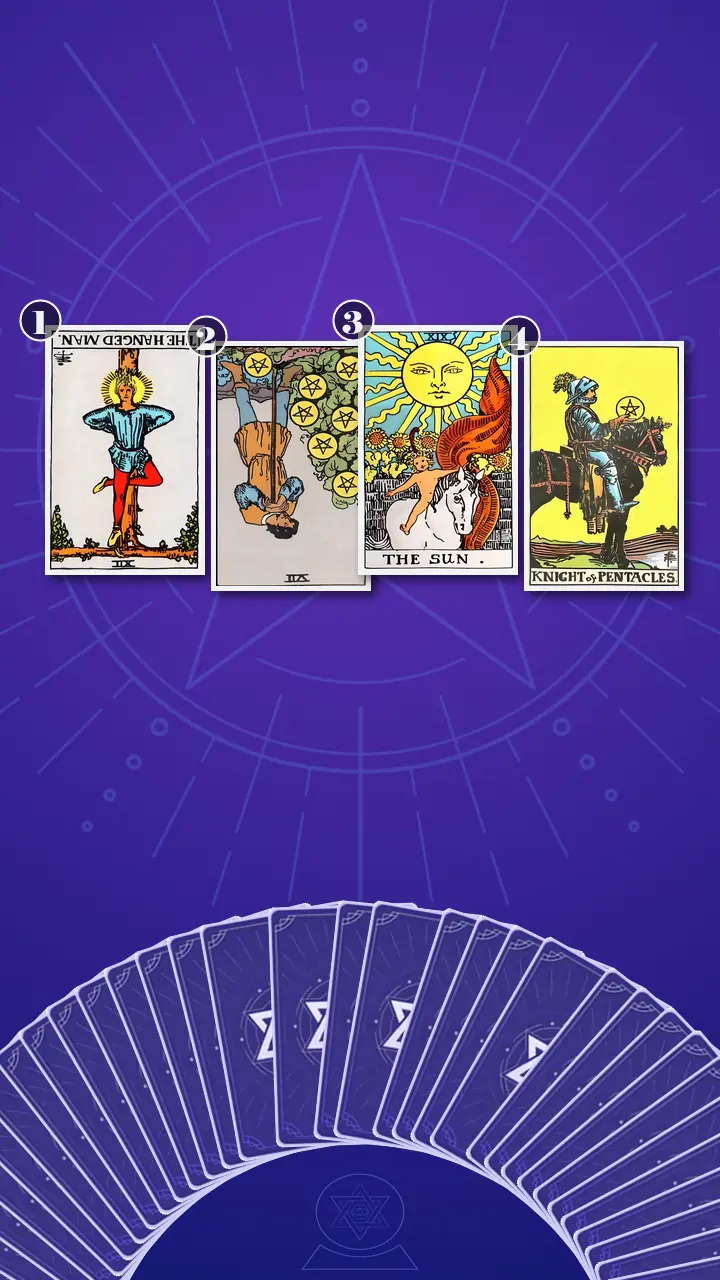
Reading the Corridor Before the Door
Position 1: The Week Held Hostage
Now I turned over the card representing Jordan's observable waiting-room behavior: the postponed rest, connection, and meaningful activity that had left the present with stagnant energy.
It was The Hanged Man, reversed.
I pointed to the bound ankle, the inverted body, and the halo around the figure's head. Upright, The Hanged Man can describe a chosen pause that changes perspective. Reversed here, the energy was blocked. Surrender had become deficiency, while resistance and suspension had become excessive. Jordan was no longer pausing in order to see differently. They were preserving a pause because movement felt permissible only after external confirmation.
"This card looks like living inside a Workday status page," I said. "Everything remains 'In Process,' so nothing outside the process is allowed to feel fully real."
I brought the card down into a specific moment Jordan had described. At 5:36 p.m. on the TTC, a low-cost Friday invitation had appeared on their warm phone while a contract application sat open in the next tab. Damp coats carried the smell of rain. The carriage lights buzzed. Their shoulders stayed fixed as their thumb hovered over "Maybe next time." No urgent task had claimed Friday, yet they kept the evening empty in case an imagined future demand needed it.
"I want to say yes, but I should wait until..." I said, giving voice to the unfinished sentence. "The missing ending might be 'until the application changes,' 'until money feels safer,' or simply 'until I feel more entitled to be unavailable for work.' The effect is the same. Remaining on standby feels responsible, but the standby period has quietly become the week itself."
Jordan let out a small, bitter laugh instead of nodding. "That's too accurate. Honestly, it feels a little brutal. I declined that plan, then didn't even work Friday night."
Their fingers tightened around their mug and then released. I did not treat the recognition as evidence of failure.
"The card isn't criticizing your caution," I said. "It's showing the difference between keeping time available for a real obligation and sacrificing it to a possibility that has not asked for it. What small part of life are you placing on hold that could still be lived this week?"
Jordan looked away from the screen. "The creative project," they said after a moment. "And probably seeing my friend. I keep acting as if both will distract me from work, but checking the portal is what actually eats the evening."
Position 2: The Harvest-Only Audit
Now I turned over the card representing the underlying mechanism: delayed gratification, outcome-dependent self-worth, and the fear that present effort has no value without a visible future payoff.
It was the Seven of Pentacles, reversed.
The gardener leaned on a tool and studied the pentacles growing on one plant. In this position, the reversal showed an excess of evaluation and a deficiency of patient recognition. Jordan was inspecting effort from the outside instead of inhabiting it. The process mattered only when it produced a harvest that could be named, posted, or entered into the "offers" column.
I asked Jordan to picture a recent Saturday. They had three completed applications, one revised portfolio sample, and a useful networking conversation in front of them. Because the offers column remained blank, they decided the week had produced nothing. They closed the personal project and opened another job board.
"At 9:40 p.m., this card is the person leaning over a laptop and switching between the portfolio, LinkedIn, and an application page," I said. "The question running underneath the tabs is: 'If this hasn't produced a result yet, does any of it count?'"
I have seen that question take many forms. It resembles refreshing analytics five minutes after publishing and declaring the whole project a failure because the graph has not moved. The visible pentacles become the scoreboard, while the worked ground of skill, conversation, persistence, rest, and daily choice disappears from view.
Jordan's breath shortened. Their eyes moved as if they were mentally listing every metric they checked. One hand pressed briefly against the center of their chest.
"I review every week like an employer," they said. "I never review it like the person who actually had to live through it."
"Exactly," I replied. "Ambition is not the problem; making aliveness conditional is. The useful part of the Seven is discernment: some investments do need to be reconsidered. The distortion begins when a slow payoff is treated as proof that the effort, or the person making it, has no value."
The Hanged Man reversed and the Seven of Pentacles reversed now formed a maintenance loop. Uncertainty prompted Jordan to check for proof. Checking offered a brief sensation of control but displaced work, rest, and connection. The resulting emptiness then seemed to confirm that life had not begun, making the next milestone feel even more necessary.
"The week counts before the update arrives," I said. "Otherwise, every finished milestone will simply hand the same measuring system to the next one."
When The Sun Opened the Waiting-Room Door
Position 3: The Present-Tense Participant
Now I turned over the card representing the central recognition: the perspective capable of reuniting Jordan's future vision with the ordinary process that could make that vision inhabitable.
It was The Sun, upright, the key card and antidote in the reading.
The room seemed to quiet around it. Even through a screen, the card altered the visual field: a radiant sun, an open child riding a white horse, a red banner lifted into full view, and sunflowers turning toward the available light. No figure was hiding in preparation. No harvest was being audited. The energy was balanced, direct, and visible.
I returned Jordan to Tuesday night. The portfolio was open, their hand had already refreshed the application portal twice, and the real task was being moved to tomorrow. Their attention had travelled into the finished life while their body remained in a blue-lit kitchen they considered too temporary to inhabit.
This was the moment for what I call Cognitive Paradigm Excavation. I treat a growth bottleneck as I would the collapse of an obsolete intellectual era: not as proof that everything built within it was worthless, but as evidence that its governing structure can no longer carry the life developing above it.
Years spent in Cambridge libraries and archaeological trenches have taught me to look closely at a fracture. I remembered once brushing compacted soil from the edge of a buried wall. The collapse did not erase the intelligence of the people who had built it. It revealed where the old plan had reached its limit. Jordan's rule, "security first, life afterward," had once protected attention, money, and hope. Now it was turning every current day into scaffolding around a building no one was permitted to enter.
I told Jordan, "A milestone may change your circumstances, but it cannot make the present real for you. Life becomes yours as you participate in it, not only when you can prove you have arrived."
The old rule that life begins only after the next milestone is too narrow; choose one visible, ordinary act of participation now, like the open rider beneath The Sun, and let it count as life rather than as a reward.
I left the sentence alone for a few seconds.
Jordan's breath stopped. Their right hand remained above the trackpad, fingers held in the slight claw they used before another refresh. Their pupils widened, then their focus slipped past my screen. I watched recognition move in three stages: first a stillness, then the silent replay of Tuesday nights and declined invitations, then a sharp inhale that lifted their shoulders higher before letting them fall. Their mouth tightened. "But doesn't that mean I've been doing the last two years wrong?" The question came out with more anger than relief, and their eyes brightened as soon as they heard themselves say it. Their fist opened on the table. A long breath left their chest, but the release did not look uncomplicated; it had the slight dizziness of stepping outside after too long under fluorescent light. For a few seconds, clarity had given them not comfort but responsibility: if the day could count, they would have to decide how to enter it.
"No," I said. "It means you used a strategy that helped you endure uncertainty, and now you can see its cost. We do not need to put your past self on trial in order to revise a rule. We only need to ask whether that rule still serves the person living under it."
I leaned closer to the card. "Now, using this new perspective, think back over last week. Was there a moment when this insight could have made the day feel different?"
Jordan described a lunch break outside an office tower. A job alert had appeared as they stepped onto the pavement. Cold air had caught in their nose, traffic had rolled over the wet road, and sunlight had rested on their eyelids for perhaps two seconds before they looked down and opened the alert.
"Nothing would have been solved if I'd put the phone away," they said. "But I could have eaten lunch. I could have been there."
That distinction mattered. The Sun was not demanding optimism, gratitude, or denial of structural uncertainty. It was offering a more precise form of permission: nothing has been solved, and this still counts. Pleasure does not have to become a performance bonus.
I explained that this marked a shift from future-focused longing and suspended energy toward grounded present-tense participation and process-based self-trust. It was not the whole transformation. It was the first crossing: Jordan had separated an unfinished circumstance from the belief that an unfinished life must remain unlived.
To reinforce the insight, I asked them to open their Notes app and make two provisional entries for the coming week: one process action supporting the future and one present-tense experience requiring no justification. Each had to be small enough to begin within ten minutes. The second was not a reward for completing the first. If time, money, or energy became tight, a free two-minute version would still count, and Jordan could stop whenever they chose.
The Still Horse and the One-Promise Week
Position 4: Cultivating Without Disappearing
Now I turned over the card representing practical integration: a bounded, process-based practice that would let Jordan participate in life without forcing a decision about their entire future.
It was the Knight of Pentacles, upright.
The knight sat on a still black horse, holding one pentacle at eye level above a cultivated field. I distinguished the stillness from the paralysis of The Hanged Man reversed. The horse was not trapped. It was steady. The knight was not scanning twelve horizons or clutching every possible goal. One commitment received careful attention.
This was earth energy in balance: reliability without urgency, discipline without self-erasure, and patience without passive waiting. The card preserved Jordan's ambition while removing the demand that ambition occupy every available hour.
I translated the image into an ordinary Monday evening. Jordan would set a twelve-minute timer at the kitchen table, revise one portfolio paragraph, and close the file when the timer ended. A twenty-minute walk would already be on the calendar. The walk would not depend on finishing another paragraph, finding a job lead, or receiving an email. One act would cultivate the future; the other would inhabit the evening.
"The single pentacle is one clean commitment," I said. "The field is the week where continuity becomes visible. The Knight does not confuse opening twelve career tabs with taking twelve useful steps."
Jordan opened their calendar. Their shoulders were lower now, although their thumb paused when they saw the blocks already devoted to applications.
"I can take this goal seriously without giving it every available hour," they said. "That sounds obvious when I say it, but I haven't been living as if it's true."
"Obvious ideas can remain structurally absent," I replied. "The card gives this one a form. Looking at the next seven days, what one future-building action and one present-tense experience can fit without either taking over the week?"
Jordan chose the portfolio paragraph and ten phone-free minutes outside during Wednesday lunch. Neither choice promised transformation. Together, they offered process-based evidence that life was already underway.
Excavating the Rule Beneath the Routine
Read as one story, the spread was coherent. Jordan had learned to handle real uncertainty through planning, comparison, and delayed gratification. Those strategies created targets and protected scarce resources, but The Hanged Man reversed showed that the protective pause had become the architecture of daily life. The Seven of Pentacles reversed revealed why: effort was judged only by public harvest, so checking for outcomes felt more legitimate than participating in an unfinished process. The Sun restored the missing resource, direct attention to an ordinary day, and the Knight of Pentacles gave that attention a repeatable structure.
The corridor was not waiting for a magical door to appear. Jordan had been walking past small exits because they did not resemble the grand entrance of a permanent offer. The cards did not claim that a lunch break could solve contract instability or make Toronto cheaper. They showed that practical uncertainty and total suspension were not the same thing.
I used my second diagnostic lens, Core Philosophy Stratigraphy, to separate the beliefs embedded in Jordan's inner foundation. Like layers at a dig, some deserved preservation. Jordan could carry forward ambition, financial boundaries, careful preparation, and the wish for stable work. They could leave behind the younger governing law that said rest, connection, creativity, and pleasure needed certification from an employer before they became legitimate.
The cognitive blind spot was not wanting a better future. It was confusing monitoring with movement and postponement with seriousness. Jordan had been treating the absence of an external result as the absence of an unfolding life.
The transformation direction was therefore precise: measure each week through one process action and one present-tense experience, rather than asking the next milestone to validate the whole week. Build the future without disappearing from the week that builds it.
The Paradigm Shift Manifesto in Practice
I call the intervention The Paradigm Shift Manifesto. The name sounds grand, but the exercise is deliberately small. Its purpose is to state the governing law of the next chapter clearly enough that Jordan can test it against real behavior: "The week counts before the update arrives. Building and living are parallel commitments, not a task and its reward."
To turn the Four-Layer Insight Ladder Context Edition into actionable next steps, I gave Jordan two bounded experiments:
- Schedule One Action and One Experience On Sunday evening, add exactly two calendar entries for the next seven days: one future-building action and one present-tense experience. Jordan chose a twelve-minute portfolio edit at the kitchen table and ten phone-free minutes outside during Wednesday lunch. Each entry needs a start time and a twenty-minute maximum. If the week becomes crowded, reduce either entry to five minutes, or to two minutes outside with the phone in a pocket. The present experience is not conditional on completing the work action first.
- Keep a Two-Line Built and Lived Log At 5 p.m. on Friday, open Notes and write two headings: "Built" and "Lived." Add one observable example beneath each, such as "revised one portfolio paragraph" and "noticed cold air and sunlight during lunch." Record evidence, not a rating of the week. Keep only two entries. Do not add a score, streak, or productivity dashboard. A missed day creates no debt, and a rescheduled action is information rather than failure.
I reminded Jordan that these were experiments, not commandments. They could change, delete, or stop either practice. Tarot had helped us identify the old law and propose a test; only Jordan's lived experience could determine whether the new law was useful.

A Week That Counted Before the Update
Four days later, I received a message from Jordan with a screenshot of their two-line note. Under "Built," they had written, "Edited the opening paragraph and stopped at twelve minutes." Under "Lived," they had written, "Ate half my lunch outside. Phone stayed in my pocket. Sun on my face, streetcar bell, cold bench."
The application was still marked "Under Review." Jordan slept through the night, then woke to the thought, "What if none of this works?" They smiled, put the phone down, and made coffee before checking.
Nothing in that message suggested that career limbo had vanished. The positive change was smaller and more credible: Jordan had produced one piece of evidence that uncertainty did not have to consume the whole day. They had revised one paragraph without turning the evening into an endurance test, and they had entered one ordinary moment before it became impressive.
I thought again of the cards laid in a line: the suspended observer, the impatient evaluator, the open rider, and the steady cultivator. The movement did not come from a prediction. It came from Jordan recognizing an obsolete rule, choosing a different measure, and testing it in the conditions of their actual life. The cards provided the map; Jordan remained the author of the journey.
When every ordinary Tuesday feels like a corridor to somewhere more legitimate, the chest stays heavy because one part of life is pursuing a future while another fears that no achievement will make arrival feel inhabited. Noticing that division does not solve everything, but it means the waiting room is no longer invisible.
If this week did not have to prove that you had arrived, what one small act would you place under "Built," and what ordinary moment beneath your own Sun would you be curious to let count under "Lived"?