Past-Self Shame: Turning an Archive Trial into a Review of One Choice

Past-Self Shame at 11:40 p.m.
I met Maya at 11:40 on a Tuesday night, when she shared her screen and showed me the cursor hovering over “Move to Trash.” At 27, she could explain a complicated product decision in a Toronto design review without losing her thread, yet one painfully earnest paragraph in her university portfolio had triggered enough past-self shame to make her want to delete the entire folder.
The laptop fan hummed through our video call. Streetcar brakes scraped along the wet road outside her shared apartment, and the blue-white screen light sharpened the tired shadows beneath her eyes. Her current Figma prototype was already open in another tab, ready to become the respectable-looking exit.
“I told myself I was cleaning up my portfolio,” she said, flexing one hand against the tightness in her chest. “But then I spent an hour polishing my newest project because I needed proof that I’m not her anymore.”
I watched her shoulders draw closer to her ears. What she called cringe seemed to move through her like an elevator door closing on a stack of loose pages, compressing an entire chapter before she could read a single line clearly.
“I know I’ve changed,” she said. “So why does seeing the old me still feel like a threat? If I make peace with her, I’m scared I’ll excuse everything. I want the lesson without having to meet the person who learned it.”
I let the last sentence settle before I answered. “I’m not going to ask you to approve that whole version of yourself, keep every artifact, or turn regret into a feel-good story. I want us to find out why review keeps becoming rejection. Tarot can give us a structured map of that pattern, but it won’t issue a verdict. You will decide what deserves to be retained, revised, released, or deleted.”
I moved her portfolio away from the trash icon and into a neutral corner of the screen. “For tonight, that folder doesn’t need a ruling. Let’s see whether we can draw a map through the fog before your delete button is asked to do a job it cannot do.”

Choosing the Compass: The Five-Card Shadow Spread
I invited Maya to place both feet on the floor and take one unforced breath. I shuffled slowly, not to manufacture mystery, but to create a clean psychological transition from reacting to observing. She closed the Figma tab but left the old portfolio open.
I chose a classic five-card Shadow Spread. For anyone wondering how tarot works in a situation like this, I use the cards as an objective pattern-recognition tool. The images externalize a private loop so that the querent can examine it without confusing every feeling with a fact or every card with a prediction.
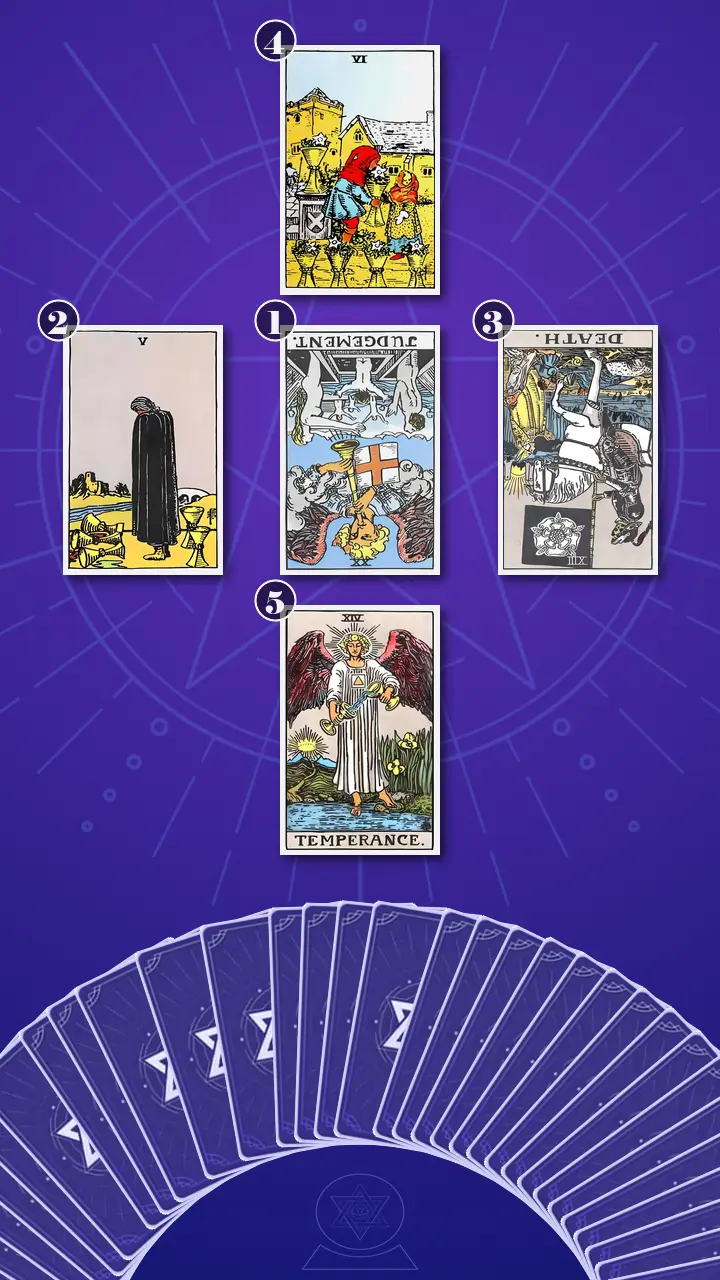
The spread was the smallest structure that could answer Maya’s question without burying it under irrelevant future outcomes. I placed the first card at the center to show how present self-rejection becomes visible. The second went to the left for the emotional root, and the third to the right for the protective strategy that creates short-term relief but long-term stagnation. Above the center, the fourth card would reveal a resource hidden inside the rejected past. Below it, the fifth would turn that resource into a grounded integration practice.
The arrangement resembled a compass. Its horizontal axis would show what kept Maya stuck; its vertical axis would lead from recoverable memory toward conscious choice. That rationale mattered because card meanings in context are more useful than isolated definitions. I was not asking, “Was the old Maya good or bad?” I was asking what happened between the trigger, the reaction, the relief, and the returning discomfort.
When an Archive Becomes a Courtroom
Position One: Judgement Reversed and the Present Shadow
I began at the center. “Now I’m turning over the card representing the observable form of your present self-rejection: closing, deleting, or discrediting past material before you can examine it.”
The card was Judgement, reversed.
In the Rider-Waite-Smith image, an angel sounds a trumpet while figures rise from open coffins. Upright, the card can describe awakening, honest self-review, and responding to a call. Reversed, that reviewing energy is blocked. The trumpet is still sounding, but the invitation to become conscious is being heard as a summons to stand trial.
I pointed toward the folder on Maya’s screen. “At 11:40, you opened your university portfolio to update your website. One earnest sentence tightened your chest, and the folder immediately became prosecution evidence. Every weak phrase seemed to prove that the earlier Maya was unacceptable. You moved it toward the trash and opened a polished current project before asking what that version understood, protected, or learned.”
I framed the energy plainly: there was an excess of judgment and a blockage in reflection. The archive itself was not preventing growth. The punitive terms of Maya’s review were preventing the figures on the card from rising into conscious examination.
“The inner rule sounds something like this,” I said. “‘If I can prove I would never do this now, then I do not have to understand why I did it then.’ That may look like digital decluttering from the outside. Internally, it turns iteration into prosecution.”
Maya gave a short laugh, but it carried no amusement. Her cursor went still. “That’s too accurate. Kind of brutal, actually. I thought I was cleaning up, but I was putting myself on trial.”
“The accuracy doesn’t make you guilty,” I replied. “It gives us a pattern we can interrupt. Context is not acquittal, and accountability is not self-erasure. We can understand why a choice happened without deciding that it was harmless, wise, or worth repeating.”
Her fingers stopped tapping against the laptop. I saw the first small change in her posture: not relaxation yet, but enough stillness to remain beside the open folder.
Position Two: Five of Cups and What the Cringe Is Covering
I moved to the card on the left. “Now I’m turning over the card representing the grief, shame, or unmet emotional meaning beneath the behaviour, the reason old material carries so much force.”
The card was the Five of Cups, upright.
The cloaked figure looks down at three spilled cups while two upright cups remain behind them. The card does not minimize what has been lost or mishandled. Its warning is about narrowed attention. In Maya’s case, grief was available to be felt, but her focus had become overconcentrated on what went wrong and deficient in its ability to register what survived.
I asked her to remember the university friend who had recently sent an old group photo and written, “You cared so much about that magazine.” Maya had replied, “Delete this cursed evidence lol.” She had noticed the awkward outfit, the friendship that later ended badly, and the ambitions she now considered naive. She had not noticed that the same period contained her early editorial eye, persistence, and willingness to make imperfect work in public.
“The joke arrived before the grief could speak,” I said. “Like Fleabag cutting to humour when sincerity gets too close, you made the old ambition into a punchline before anyone else could respond to it seriously.”
I gestured to the spilled cups. “Your current review says, ‘I can list what was embarrassing, but I cannot yet name what I lost or what survived.’ What did that chapter cost you, beyond making choices you now regret?”
Her breathing paused. Her eyes moved away from the card as if an old scene had begun replaying somewhere beyond the screen. Then her jaw loosened by a fraction.
“I lost that friendship,” she said. “And I think I lost the version of me who could make something before she knew whether it would look impressive. I miss that, which is embarrassing in a completely different way.”
“That ache is useful information,” I said. “It doesn’t cancel the regret. It tells us total self-rejection has been covering more than embarrassment. You are also mourning capacities you accidentally exiled with the identity.”
Position Three: Death Reversed and the Hard-Reset Trap
I crossed to the card on the right. “Now I’m turning over the card representing the protective strategy that reduces discomfort in the moment while keeping the larger conflict alive.”
The card was Death, reversed.
Death is a card of transition rather than literal catastrophe. The white rose on the black banner and the sunrise between the towers show continuity inside an ending. Reversed, the transformational energy becomes blocked. The old form is supposed to change, but the change stalls because Maya demands a total blackout instead of permitting a gradual, accountable transition.
I connected it to a familiar scene. Maya rewrote her LinkedIn About section, redesigned her portfolio, removed an old hobby, and cut each awkward career pivot from the timeline. The result looked cleaner but felt brittle. It could display the current identity, yet it could not explain how her judgment, values, or design instincts had developed.
“The emotional logic is a little like Severance,” I said. “If the versions never meet, perhaps neither has to answer to the other. But the split doesn’t produce a coherent whole. It just leaves both stories active behind separate doors.”
I used one of my bluntest diagnostic lenses, which I call Pseudo-Growth Eradication. I strip away the polished self-help language and audit the actual return on the behaviour. In Maya’s loop, deletion produced a few minutes of distance. Its execution rate was high, but its learning rate was close to zero. The unresolved charge returned with the next photo, draft, or affectionate story. By that measure, the hard reset was not completing transformation; it was repeatedly postponing it.
A memory from my Wall Street years passed through my mind. I remembered glossy presentations that looked reassuring because the difficult exposure had been moved out of the headline, even though it remained on the books. I had learned then that removing a risk from the visible narrative does not remove it from the system.
“You keep calling it growth,” I told Maya, keeping my voice level, “but the delete button cannot do the reflecting for you.”
Her chin lifted. “That makes it sound like all my rebranding was fake. Was I just doing growth wrong?”
I did not rush to soften the question into something less honest. “Some of the curation may have been necessary. Privacy is legitimate. Deleting material can be healthy, and you do not owe the internet an archive of your development. I’m questioning the sequence, not your right to choose. When deletion comes before understanding, it protects you from contact but cannot give you closure. The strategy was not fake. It was protective and incomplete.”
Her mouth tightened first, then softened. The resistance did not disappear, but it became specific enough to work with: she was not being asked to restore the old identity, only to stop mistaking a seamless brand for a completed transition.
Position Four: Six of Cups and the One Useful Offering
I returned through the center and moved to the card above it. “Now I’m turning over the card representing the capacity, value, or usable lesson hidden inside the past self you have treated as wholly unacceptable.”
The card was the Six of Cups, upright.
A child offers another child a cup filled with white flowers. I read that gesture as balanced, bounded exchange. It is an offering, not a command to move backward. The past does not become an authority, and the present does not have to accept the entire package.
I asked Maya to open the old case study without scrolling to the paragraph that had triggered her. Instead, I asked her to look at the research section. The typography was rough and the conclusions overconfident, but the younger designer had interviewed users with genuine curiosity and kept asking questions through uncertainty.
“You don’t have to republish this project,” I said. “You don’t have to reclaim every belief behind it. Six of Cups asks whether you can receive one useful inheritance without restoring the whole former identity. Receiving is not the same as going back.”
Maya leaned closer to the screen. Her shoulders dropped on a long exhale, and she read two interview questions aloud.
“I wouldn’t write them this way now,” she said. “But I was actually curious. I wasn’t asking just to prove I already knew the answer.”
“Do you still need that quality?” I asked.
She nodded once. “More than I want to admit. I’ve become polished enough that sometimes I only ask questions I know will sound smart.”
The Six of Cups changed the relationship with memory from forced reunion to selective exchange. I watched curiosity enter the room without requiring nostalgia. Maya did not want the whole version back, but she could finally imagine that version carrying something she still needed.
When Temperance Moved the Water
Position Five: The Bridge from Insight to Integration
The room on Maya’s side of the call became unusually quiet. Even the radiator stopped clicking. I lowered the final card beneath Judgement reversed, completing the vertical line from recovered memory to grounded practice.
“Now I’m turning over the card representing the conscious integration step: a bounded practice for retaining lessons, revising old beliefs, and releasing what no longer deserves to direct you.”
The key card was Temperance, upright.
The angel moves water between two vessels, one foot on land and one in water. I saw balanced energy rather than emotional excess or avoidance: feeling held in contact with present reality, compassion checked by discernment, and accountability kept proportional to a specific choice.
I could see the old binary beginning to tighten again. Either Maya had to accept the former self wholesale, or she had to keep proving that the present self was separate. Temperance offered a smaller and more demanding question: could she review one decision without converting it into a sentence on her entire identity?
Erasing the old cup will not prove that you have changed; keep what nourishes, revise what does not, and let Temperance's two vessels show that integration is an active choice.
I left the sentence alone for a moment. A streetcar bell sounded once through the silence, and the water in Maya’s glass caught a thin strip of monitor light.
Her breathing stopped first. Her right hand froze above the trackpad, two fingers suspended as if the delete command were still waiting beneath them. Then her pupils widened and her gaze lost focus; I could almost see her replaying the late-night sequence, portfolio to trash, trash to Figma, discomfort converted into output. Her eyebrows pulled together, and a flash of anger crossed her face before her eyes began to shine.
“But doesn’t that mean I was wrong about what growth was?” she asked. The words came out sharper than anything she had said all evening. “I spent years trying to become someone else.”
“It means one method stopped serving the goal,” I said. “That is not the same as saying your effort, your standards, or your present life are fraudulent.”
Her fist tightened once against her chest and then slowly opened. Her shoulders lowered, followed by a long, unsteady breath that sounded partly relieved and partly exposed. For a few seconds she looked almost disoriented, as though setting down a heavy bag had changed her sense of balance. Clarity had arrived with responsibility attached: if the past was no longer the sole problem, she now had choices about how to meet it.
“Now, with this new perspective, think back to last week,” I said. “Was there a moment when this insight might have made the experience feel different?”
Maya looked at the research section again. “I could have kept the curiosity, updated the part where I thought confidence meant pretending I knew everything, and stopped using overwork to erase the embarrassment. I still wouldn’t publish this version. But I wouldn’t have to delete it before learning from it.”
I made the distinction explicit.
Your past can be evidence without becoming a verdict: keep the lesson, revise the belief, and leave the identity sentence unfinished.
That was the first real movement from shame-driven identity erasure and stalled reflection toward accountable self-compassion, grounded continuity, and self-trust. It was not a demand for forgiveness or a declaration that everything had happened for a reason. It was the smaller, more credible shift from judging a whole identity to reviewing one choice.
I then ran the insight through my second diagnostic lens, the Potential Actionability Assessment. An idea does not become useful merely because it sounds profound or screenshots well. I look for the smallest disciplined milestone that can prove the cognitive upgrade exists in behaviour. Temperance gave us one: a seven-minute, low-stakes review under three headings, Retain, Revise, and Release.
“Retain the value or capacity,” I said. “Revise the belief in present-tense language. Release the behaviour you do not want directing the next similar moment. You are not required to keep, publish, forgive, or reinterpret the artifact afterward. If your chest clamps down or the material feels too exposed, stop and choose something less charged another day. Boundaries remain yours.”
The Source-Document Shift
I drew the five cards back into a single story. Judgement reversed showed the visible habit of turning self-review into a trial. Five of Cups revealed that condemnation was guarding grief, including grief for qualities Maya had exiled alongside regretted choices. Death reversed explained the defence: a polished hard reset delivered short-term relief but kept the transition emotionally unfinished. Six of Cups recovered one bounded resource from the rejected chapter. Temperance supplied the method for deciding what could cross into the present.
The five-card Shadow Spread also answered why Maya kept feeling stuck. She had been tearing earlier chapters out of the book and then demanding that the current plot explain itself. In product terms, she treated every old artifact like a failed app version that had to be removed from production, instead of checking the changelog for what the failure taught. Growth was closer to Figma version history than Severance: an earlier iteration could be visibly flawed and still explain why the current design worked.
I named the cognitive blind spot directly. Maya had fused compassion with endorsement and continuity with regression. Because of that fusion, any curiosity about the old self felt dangerous. The transformation direction was not toward blanket acceptance. It was toward reviewing one past choice at a time for what it protected, what it taught, and what no longer needed to govern the present.
“The past can become a source document rather than a verdict,” I said. “You remain the editor. Tarot has shown us the architecture of the loop, but it does not choose what stays in your life. That authority is yours.”
Two Practices for the Next Thirty Days
- The Seven-Minute Retain-Revise-Release Review On Wednesday evening, choose one low-stakes old project rather than an intimate message thread. Set a seven-minute timer and write exactly three private sentences: “Retain” for one value or skill, “Revise” for one outdated belief, and “Release” for one behaviour you do not want directing the next similar situation. Tip: Limit each heading to one sentence and do not rate yourself. The minimum version is, “This version of me was trying to…” You may close or delete the artifact afterward.
- The Evolution KPI: Count the Pause, Not the Keep For thirty days, use a private “Review Later” folder when a non-sensitive artifact triggers an immediate urge to delete. Give the item twenty-four hours, then ask, “What happened, what did I learn, and what would I choose now?” Track four completed pauses as the behavioural KPI. Keeping the artifact is not part of the score. Tip: This framework is strict about measuring the pause and flexible about the outcome. Exclude anything that creates a genuine privacy or safety concern. When overwork becomes the exit, name it accurately: “I’m reaching for productivity because this memory is uncomfortable.”
I designed the metric that way deliberately. Maya did not need to perform serenity or produce a perfectly coherent life story. She only needed evidence that a trigger could be followed by seven minutes of discernment rather than an automatic verdict. Small steps would test the new pattern under real conditions.

A Week Later: The Folder Was Still There
A week later, I received a message from Maya. She had completed the seven-minute review on the university case study.
“Retain: curiosity in user interviews,” she had written. “Revise: good designers don’t need to hide every uncertain step. Release: deleting a whole project because one paragraph makes me cringe.”
She had not restored the case study to her public portfolio. She had not posted a dramatic before-and-after story on LinkedIn. She had left the folder in “Review Later” and added one honest sentence about her career pivot to a private timeline. That was the proof: not a solved identity, but a changed next action.
She slept through the night. Her first thought in the morning was still, “What if I’m just making excuses?” She smiled, left the folder where it was, and made coffee. Clarity had not removed the question; it had reduced its permissions.
I did not see tarot rescue Maya from her history. I saw Maya use a five-card Shadow Spread to turn an invisible pattern into something she could inspect, challenge, and redesign. The cards offered images and structure. She supplied the honesty, boundaries, and choice.
When an old file makes your chest tighten and your hand move toward delete, the hardest part may be fearing that any kindness toward who you were could undo the person you worked to become. But noticing that fear already places your hand somewhere other than the verdict.
If one past choice could sit between Temperance’s two vessels as a source document rather than a sentence on your identity, what small part of it might you be curious enough to retain, revise, or release?