The 9:58 a.m. Notion Doc and the Default Note-Taker Trap
I hear some version of this from early-career women in city offices all the time: if the awkward pause after 'Can someone take notes?' hits your throat before your brain can answer, it may be people-pleasing at work, not just being organised.
When Maya sat down with me, she was 27, a junior product manager in London, and tired in that very specific hybrid-office way that lives behind the eyes. As she described a Tuesday at 9:58 a.m. near Liverpool Street, I could practically hear the room with her: the air-con buzzing overhead, the burnt coffee smell hanging above the table, the blank Notion doc already open on her laptop just in case.
She mimed the moment with two fingers moving toward an invisible keyboard. Someone asks for notes. Her throat tightens. Her stomach drops. Her mouth says yes before she has actually decided. Then the rest of the meeting goes into the document instead of coming out of her. She looked at me and said, 'I know it sounds small, but it never feels small in the moment.'
She had not come to me for a grand life forecast. She wanted to know why she said yes before she thought, why being asked to do low-visibility work made her panic, and how to say no professionally in a meeting without sounding difficult.
It did not sound small to me. The question is small; the body reaction isn’t. What she was describing felt like a Teams notification trapped in her throat — tiny on the surface, but loud enough inside her system to drown out her own thinking. Under the anxiety, I could already hear the later notes in the chord: resentment, guilt, self-doubt, the quiet replay on the Overground home.
I told her gently that wanting to stop being the default note taker at work did not make her petty, difficult, or bad at collaboration. It meant her nervous system had learned to confuse usefulness with safety. I said, 'Let’s make a map of that moment — not to shame it, but to find where choice can come back in.' That was our Journey to Clarity.

Choosing the Shadow Spread for Workplace Boundaries
Before I shuffled, I asked Maya to put both feet on the floor and give me one clean sentence for the question. Then, because sound is part of how I read stress patterns, I asked what had been on repeat on her commute lately. She laughed and said it was mostly instrumental focus playlists, brown noise, anything without a human voice. I call that Music Pulse Diagnosis. It often tells me what a system is trying to mute, and in her case the answer was immediate: even before the meeting, she was bracing to keep her own voice out of the mix.
For this kind of office housework pattern, I chose a five-card Shadow Spread. This is how tarot works best for workplace boundaries: not as fortune-telling, but as pattern recognition with structure. The visible issue is simple — somebody asks for notes — but the real material sits underneath it: fear, role confusion, and the no-choice script that arrives before thought.
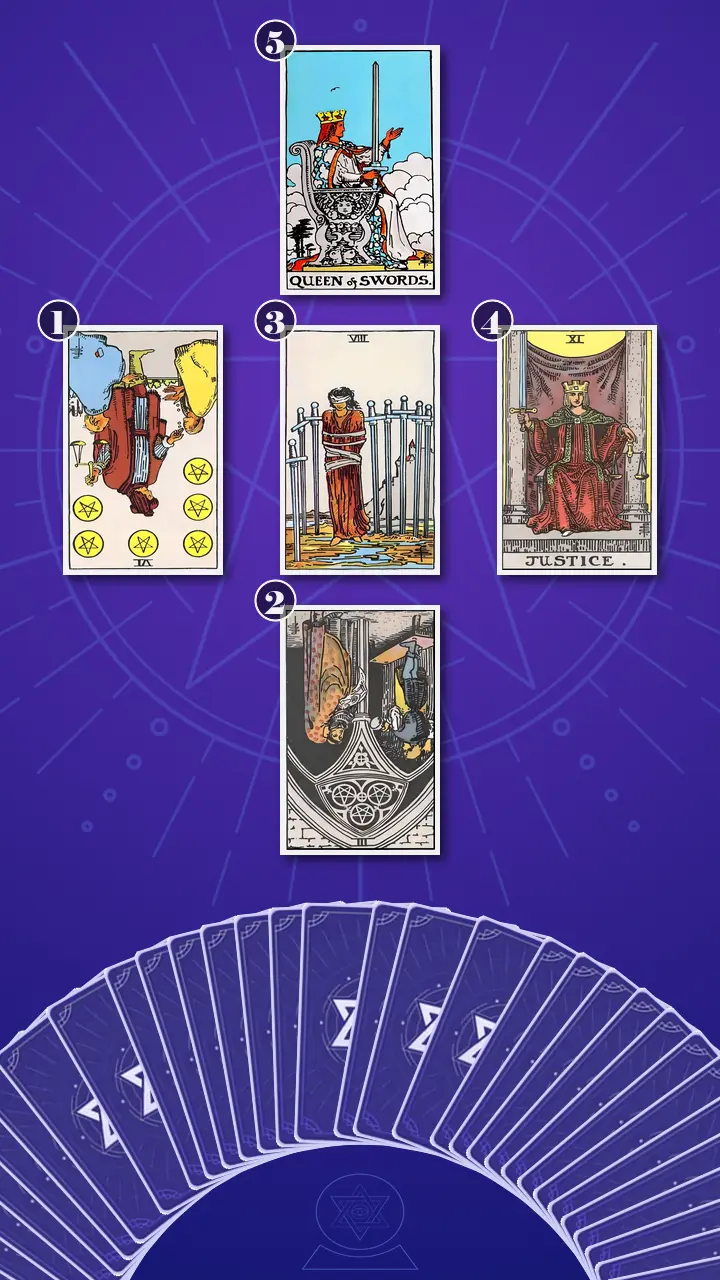
The Shadow Spread is more precise here than a bigger layout because it follows a clean sequence: symptom, root, blind spot, medicine, integration. Card 1 shows the conscious habit. Card 2 reveals the hidden driver. Card 3 sits in the centre and exposes the trap that makes the habit feel inevitable. Card 4 brings the corrective principle. Card 5 turns that principle into an actual sentence Maya can use the next time a meeting tries to swallow her whole.
As I laid the cards in a cross, the shape looked to me like a compass reset. Left was the fast yes. Below was the belonging wound feeding it. Centre was the freeze. Right was the antidote. Above was the clean response. Even before I turned the first card, I knew this reading was going to move from hands and keyboards into breath, thought, and voice.
Reading the Left Side of the Cross
Position 1: The Fast Yes — Six of Pentacles Reversed
I turned the first card. This position presents the observable card-point behavior from the diagnosis: the instant yes and the shift from participant to scribe. The card was Six of Pentacles, reversed.
In modern life, this is the Tuesday product review where the request for notes sounds casual, but the task is already tilted toward the person quickest to be agreeable. Maya says yes within two seconds, opens Notion, and gives away her attention before she has weighed whether the workload, meeting purpose, or her role make that fair. Reversed, this card is excess giving and distorted exchange. The scales are off before the meeting even starts.
I told her this was classic invisible labour: helpful on the surface, uneven underneath. Being collaborative is not the same as being instantly available for low-visibility work. If the shared Google Doc belongs to everyone, why does her focus keep auto-renewing like a subscription nobody formally assigned? Her mouth twisted into a grim little smile. 'Wow,' she said, with a soft laugh that had some sting in it, 'I thought I was just being professional.'
I asked her what exact words came out of her mouth the last time. She did not even need to think. 'Yep, happy to.' Then she rubbed her thumb against the edge of her mug and looked away, the way people do when a truth lands a little too cleanly.
Position 2: The Builder No One Names — Three of Pentacles Reversed
I turned the second card. This position reveals the underlying fear in the psychological mechanics: needing to earn belonging through usefulness. The card was Three of Pentacles, reversed.
This is the under-recognised collaborator card. In cross-functional meetings, Maya keeps the moving pieces tidy — decisions tracked, action items formatted, recap polished — while the more visible part of her role, product judgment, stays underused. Reversed, the card shows deficiency in recognition and confusion in role. The team has an architect’s plan, but the actual structure keeps rewarding her for support work instead of strategic thought.
I could see the conflict immediately: the identity she wants is thoughtful contributor; the identity the room keeps rewarding is dependable organiser. There was even a tiny Severance split in it: the organised meeting-self kept doing the labour while the strategic self stood behind the glass waiting to be let in. I said, 'If usefulness is the price of belonging, your voice will always feel too expensive.' Her whole chest lifted on a long exhale. Then her shoulders dropped. Then she said, very quietly, 'That is exactly it. People say I’m so organised, and it’s meant as a compliment, but I never know if I’ve just been professionally typecast.'
Position 3: The Screen With One Clickable Button — Eight of Swords
I turned the centre card next. This position exposes the limiting pattern’s unseen trap: treating the request as if there is no real choice once the room is watching. The card was Eight of Swords, upright.
This card is the half-second of silence made visible. The moment the request hangs in the air, Maya’s choice architecture collapses. She cannot see not today, can we rotate, or who owns notes here. She sees one socially safest-looking button, and panic makes it the only one that seems clickable. Upright, the energy here is blockage: not a lack of intelligence, not a lack of professionalism, but a nervous system that zooms so hard into the awkward pause that it cuts the exits off the map.
I pointed to the loose bindings and the gaps between the swords. 'The trap is real in your body,' I told her, 'but not as fixed as it feels from inside it.' She froze for a beat, fingers suspended around her tea, then her eyes unfocused as if replaying a recent call. When she finally spoke, it came out almost in one breath: 'I can hear myself saying yes before I’ve even decided.' That was the moment the shame started loosening. We were no longer talking about a character flaw. We were talking about a pattern.
When Justice Spoke: Finding Clarity in a Meeting Freeze
Position 4: The Medicine — Justice Upright
When I turned the fourth card, the room changed. The radiator clicked off. A cab hissed through rain outside my window. Even Maya went still, as if something in her already recognised the image before I named it. This position offers the key shift: moving from approval-driven helpfulness to fairness-driven choice. The card was Justice, upright.
Justice is the direct answer to the distorted scales from the first card. In real life, it sounds less like 'Am I allowed to say no?' and more like 'What is fair here?' It is the move from vibe-based task assignment to actual role clarity. In a workplace boundary reading, Justice is not punishment. It is proportion. It is equitable task distribution. It is remembering that fairness includes your attention, not just your attitude.
I asked her to picture the Tuesday stand-up again: the blank doc open, the room going quiet for half a beat, the stomach drop arriving before speech, almost as if the meeting itself had made the decision for her.
The line that changed the reading
Stop treating kindness as lowering your head to the page by default, and let Justice’s scales remind you that fairness includes your time, your attention, and your voice.
A request is not a verdict.
This was where I brought in one of the sound tools I use most. Years in radio taught me that dead air feels longest to the person who fears it; to everyone else, it is often just one beat. I told Maya that Justice was asking for a tempo change, not a personality transplant. I call it Breath Soundtrack: one deliberate inhale, one measured exhale, enough to stop the social algorithm from auto-clicking yes. The pause is not empty. It is where discernment comes back online.
She had a three-step reaction I know well. First came the physical freeze: her lips parted, but no sound came out, and her hand stopped halfway to her mug. Then the thought sank in: her gaze drifted past me, as if she were replaying every meeting where she had mistaken fairness for selfishness. Then the emotion arrived, surprisingly sharp. 'But if I pause,' she said, a flash of anger under the fear, 'won’t people think I’m difficult over something tiny?' I shook my head and kept my voice steady. 'No. They may think you’re choosing. Those are not the same thing.' I watched her shoulders unclench, then drop lower than they had all session. She drew one slow breath, almost looked dizzy with the relief of having a cleaner standard, and I asked, 'Now, with this new lens, can you think of a moment last week when this would have made the request feel different?' She nodded immediately. 'Roadmap review,' she said. 'I could have asked if we rotate.' That was the crossing point — from panic-driven compliance to fairness-based self-trust.
The Boundary in Sentence Form
Position 5: The Integration — Queen of Swords Upright
I turned the final card. This position shows the concrete next-step embodiment of the target state: a clear, respectful boundary and a new response script. The card was Queen of Swords, upright.
If Justice is the principle, the Queen of Swords is the sentence that survives the moment. In modern life, this is Maya saying, I can’t take notes today, but I’m happy to rotate next time, without adding a defensive paragraph that erases the boundary by the end of the line. Upright, this card is balanced Air: clarity without cruelty, warmth without self-erasure. Sword up, palm open.
I told her the tone mattered as much as the words. Not icy. Not apologetic. Just clean. Like a short Slack message that says exactly what it needs to say and then stops — noise-cancelling headphones for social pressure. She repeated the line back to me once, then again more slowly. By the second time, her voice had lost that upward lilt people use when they are asking permission to have a limit. She looked at the card and gave the smallest nod. She could hear herself in it.
From Panic-Driven Compliance to Fairness-Based Self-Trust
Once all five cards were on the table, the story was unmistakable. Maya’s pattern begins in unequal giving: the room hands her a pen and, inside her body, it quietly turns into a leash. Beneath that sits role confusion and a fear that being reliable matters more than being insightful. The blind spot is the no-choice story — the belief that public silence is danger, so fast helpfulness becomes the safest exit. Then Justice and the Queen shift the whole structure. The way out is not winning the room. It is stabilising herself inside the room.
I named the blind spot plainly: she had been treating fairness as something she was only allowed to claim with a perfect excuse. That is why resentment kept arriving later as score-keeping instead of a boundary in the moment. The transformation direction was just as plain: from usefulness as belonging to contribution with boundaries; from social freeze to cautious honesty; from automatic yes to deliberate choice. Fairness includes your attention, not just your attitude.
So I gave her three very small next steps — not life overhaul steps, just actions that could interrupt the default note-taker script in one real week.
- The Fairness-First PauseBefore her next recurring product call, I told her to put a private line at the top of her agenda: Pause. What is fair? What is my role here? When a support-task request lands, she keeps the notes doc closed for one full breath before answering.I set this to my Breath Soundtrack: one four-count inhale and one slower exhale. The goal is not to be fearless; it is to buy one beat of choice.
- The Rotation QuestionIn the very next meeting where somebody asks for notes, actions, or recap ownership, I told her to ask one fairness question out loud or in chat: Do we have a rotation for notes on these calls, or who usually owns the recap here?If speaking feels too exposed, she can type it into Teams first. The smallest win is not the perfect boundary; it is proving the room can hold a question.
- The One-Sentence BoundaryI had her save three short lines in her phone and on a sticky note by the laptop: I can’t today. Can we rotate? I’m here to contribute on this one, so I can’t capture notes as well. Then I asked her to use one of them in a lower-stakes meeting this week.My BGM Prescription for practice was simple: play one steady instrumental track while making tea and say the line aloud once. No apology spiral, no essay, no softening it until it disappears.
Because her freeze was body-led, not just thought-led, I added a tiny piece of White Noise First Aid: ninety seconds of low brown noise before the meeting, then silence right before joining. I wanted her nervous system to stop treating the ask like a fire alarm and start hearing it for what it was — a request that could be weighed.

A Week Later: The Quiet Proof
A week later, I got a message from her while she was standing on the Overground platform. She had used the rotation question in a roadmap call. Somebody else took notes. She still felt the stomach drop. She still checked Slack twice afterward, half-expecting fallout. But she also made the product-risk point she would normally have typed into silence. Clear, but still a little shaky — exactly the kind of proof I trust.
That is what I love about a Shadow Spread tarot reading for workplace boundaries and note-taking requests. It does not ask someone to become fearless overnight. It maps the chain: symptom, fear, blind spot, medicine, integration. And sometimes finding clarity is simply this: the old script fires, but it is no longer the only script in the room.
When a half-second of silence can close your throat and send your hand to the keyboard before you’ve even checked yourself, of course the request doesn’t feel small — it feels like belonging is on the line.
If fairness had one breath of space in your next meeting, what sentence might become possible for you?
This story is adapted from psychological research, written so that those in a similar struggle can see their own pattern in it — and find their next step clearly.These insights are not a substitute for professional psychological, medical, legal, or financial advice.
Learn more about our Journey to Clarity.
How did this insight land for you?
🫂 This Resonates Deeply
🌀 Living This Story
✨ Now I See Clearly
🌱 Seeing New Possibilities
🧰 Useful Framework
🔮 The Confirmation I Needed
💪 Feeling Empowered
🚀 Ready for My Next Step
Author Profile
 AI
AI“Through ten years of sound energy research, I’ve found that when we struggle, it's usually just our internal rhythm falling out of sync under pressure. I know firsthand the frustrating helplessness of wanting to move forward but feeling paralyzed. Without overwhelming theories, I want to be the soothing background track that helps you recalibrate, turning your heavy burdens back into a light, effortless, and harmonious melody.”
In this Introspection Tarot Reading :
Core Expertise
- Mental Noise Cancellation: Diagnosing severe internal friction not as a moral failing, but as a chaotic overlapping of incompatible psychological frequencies.
- Resonance Healing Calibration: Identifying the 'dissonant baseline' of your chronic anxiety and calculating the specific acoustic or rhythmic input needed to soothe it.
Service Features
- The Frequency Reset Pause: A customized rhythmic breathing or acoustic grounding technique to forcefully lower your brainwave state from a frantic beta frequency to a restorative alpha state.
Also specializes in :
Explore Related Patterns:
Assertive CommunicationMaya's new sentence, "I can't take notes today, but I'm happy to rotate next time," gives the boundary a form that can survive the pressure of the meeting. It is concise, professional, and does not bury the limit under a defensive paragraph. Assertive Communication fits because the shift is not from kindness to coldness. It is from automatic compliance to clear language that protects both collaboration and self-respect, allowing her to participate as a product thinker rather than disappearing into the document. The pattern is upright because it restores choice without escalating the room. You can hear it when her voice loses the upward lilt of asking permission to have a limit: the boundary becomes a normal sentence, not a personal confession or a workplace rebellion.
Boundary DiffusionMaya has the blank Notion doc open "just in case," which shows the boundary dissolving before the request is even made. By the time someone asks for notes, the shared task has already started to feel privately assigned to her. Boundary Diffusion fits because the line between team responsibility and personal obligation has become blurry. Instead of asking who owns the recap, whether there is a rotation, or whether her role in that meeting is strategic contribution, she absorbs the task as if the group need automatically overrides her attention. The pattern becomes clearest when fairness needs a perfect excuse before she can claim it. You are seeing a boundary system that can understand the issue afterward, but in the moment treats a reasonable limit as something that must be justified, softened, or postponed.
Fawning ResponseMaya's throat tightening, stomach drop, and instant movement toward the keyboard show that the yes is body-led before it is thought-led. The request for notes activates a fast appeasement script, where agreeing immediately feels like the quickest way to reduce social exposure. Fawning Response fits because her compliance is not simply a preference for being helpful. It is a nervous-system strategy that tries to keep the room comfortable by making herself easy, useful, and non-disruptive before anyone has actually pressured her directly. The cost is that her boundary disappears at the exact moment she needs access to it. You can see the pattern in how the public ask becomes a private alarm: fast helpfulness buys short-term safety, but it also teaches the room to keep assigning her the work she never consciously chose.
Freeze ResponseThe half-second of silence after "Can someone take notes?" makes Maya's options collapse. She can name possible responses later, but inside the meeting her attention tunnels into the awkward pause until "yes" feels like the only clickable button. Freeze Response fits because the blockage is not a lack of intelligence, professionalism, or vocabulary. It is a pressure-state response where social visibility narrows perception, disrupts decision-making, and temporarily blocks access to the boundary scripts she already understands. You can see the mechanism shift when she uses one breath before answering. The pause does not make her fearless; it gives her nervous system enough space to stop treating a request like a verdict and start treating it like something that can be weighed.
People-PleasingMaya's automatic "Yep, happy to" lands before she has checked whether taking notes is fair, useful, or aligned with her role. The behavior looks organized from the outside, but the story shows it functioning as a defense mechanism: quick helpfulness reduces the immediate social threat of being seen as difficult. The deeper pattern is that usefulness has become a safety strategy. When the room rewards her for being the dependable organizer, her strategic voice gets pushed behind the support role, and saying no starts to feel like risking belonging rather than making a normal professional choice. People-Pleasing fits because the issue is not kindness itself; it is the loss of choice inside kindness. You are watching a repeated coping loop where approval-driven compliance protects against discomfort in the moment, then creates resentment, self-doubt, and invisible labor afterward.
Values-Based Decision MakingMaya's turning point comes when the question changes from "Am I allowed to say no?" to "What is fair here?" That reframing moves the decision out of approval management and into a values-based standard she can actually use in the meeting. Values-Based Decision Making fits because fairness becomes the anchor for action. Instead of letting panic, politeness, or public silence decide for her, she evaluates the request against role clarity, equitable task distribution, and the value of her own attention. This is why the rotation question works. It does not attack anyone or overexplain the boundary; it brings the hidden decision rule into the open, giving you a way to act from principle rather than from the reflex to stay easy to like.
Emotional RegulationMaya's one-breath pause interrupts the automatic yes at the exact point where her body usually takes over. Keeping the notes doc closed for that breath creates enough space for the request to become a decision instead of a reflex. Emotional Regulation fits because the work is not purely cognitive. She already knows she could ask about rotation; the missing piece is downshifting the body alarm so her thinking, voice, and professional judgment can reconnect under social pressure. The pattern is practical but psychologically deep enough to matter. You are not trying to erase the stomach drop overnight; you are building a small regulation ritual that lets choice come back online while the room is still watching.
Rejection SensitivityMaya reads the awkward pause as a social signal with consequences: if she does not fill it, she may be seen as difficult. Even after she asks a reasonable rotation question and someone else takes notes, she checks Slack twice, half-expecting fallout. Rejection Sensitivity fits because the story repeatedly shows neutral or low-stakes workplace ambiguity being processed as possible social penalty. The cognitive bias is not random insecurity; it is a threat-scanning filter that makes silence, delay, and other people's unknown reactions feel loaded. That filter explains why the note-taking request feels bigger than the task itself. You are not just deciding whether to type meeting notes; you are trying to manage the imagined cost of being less instantly agreeable, which keeps the fear of disapproval at the center of the decision.
Relational ScorekeepingMaya's resentment arrives later, after the meeting has already taken her attention and turned her into the default scribe again. Because the boundary does not happen in the room, the cost gets processed afterward through guilt, self-doubt, and the quiet replay on the Overground home. Relational Scorekeeping fits because the unmet boundary becomes an internal ledger. She keeps giving in the moment, then privately measures the imbalance after the fact, which makes the workplace exchange feel increasingly unfair without giving the room a clear signal to adjust. This pattern matters because it shows why simply "being more helpful" does not resolve the tension. You can keep the peace externally while building an internal case file of invisible labor, and that is the loop that turns a small meeting task into a recurring source of resentment.
Explore Related Struggles:
Boundary CollapseThe blank doc is open before anyone formally assigns the task, and the yes arrives before Maya has checked her own capacity or role. By the time the meeting starts, the boundary has already been softened enough that the request can walk straight through it. You can see the collapse in how quickly her attention becomes communal property. She is still present in the room, but her participation moves into capturing everyone else's words instead of offering her own. The work of repair is not becoming colder; it is letting the boundary stay intact long enough for choice to happen.
Fairness-Agency SplitThe shared doc supposedly belongs to everyone, yet Maya's focus keeps auto-renewing onto it whenever the room goes quiet. Even when she can name the imbalance later, in the moment she treats fairness like something she needs a perfect excuse to claim. You can see the split close when she asks about a rotation in the roadmap call. Someone else takes notes, her stomach still drops, and she still checks Slack afterward, but she also makes the product-risk point she would normally have typed into silence. The struggle is learning that fairness is not a verdict handed down by the room; it is a standard she can use to recover agency inside the room.
Permission ParalysisWhen the question hangs in the air, Maya sees one socially safest-looking button: yes. The story names other options, not today, can we rotate, who owns the recap here, but in the live meeting they disappear from the map. You are watching a choice problem turn into a permission problem. The issue is not that she lacks an answer; it is that her system waits for the room to prove she is allowed to have one. The struggle lives in that tiny gap between knowing a fair response exists and feeling permitted to say it while people are watching.
Utility-Belonging FusionAt 9:58 a.m., Maya already has the blank Notion doc open just in case, and the moment someone asks for notes her hand moves before her judgment does. The room receives her usefulness immediately, while her own product thinking gets pushed into the background. You can see the fusion in the way reliability becomes more than a work habit. It starts acting like a passcode for belonging: if she is helpful fast enough, she feels less exposed; if she pauses, the room suddenly feels like it might withdraw approval. The struggle is not that she is organised. It is that being useful has become the route her body trusts more than being heard.
Voice-Safety FusionThe request hits Maya's throat before it reaches a decision. Her stomach drops, her mouth says yes, and the half-second of silence feels loud enough to erase the other sentences she could use. You can feel how voice and safety have been wired together in that meeting room. Speaking a limit does not read as a normal professional choice from inside the moment; it reads like visibility without protection. That is why the boundary has to begin as one breath, because her voice needs a small pocket of safety before it can carry a clear no.
Responsibility-Authority SplitIn the cross-functional meetings, Maya tracks decisions, formats action items, and polishes the recap while the more visible part of her role, product judgment, stays underused. The team benefits from her responsibility, but the authority attached to her actual role does not expand with it. You can feel the split when being called organised lands as both a compliment and a professional typecast. She is trusted with the container of the meeting, not fully with the strategic voice inside it. The struggle is carrying the work that keeps the room functioning while losing access to the contribution that would let her be seen as more than support.
Explore Related Emotions:
Approval AnxietyThe line 'Yep, happy to' arrives so quickly that it sounds more like social protection than a real answer. You are trying to keep the room smooth, avoid looking difficult, and stay on the side of being easy to work with. Approval Anxiety fits because the request is not only about notes; it becomes a test of whether people will still read you as collaborative. The emotional charge comes from needing the room to approve of your limit before you feel allowed to have one.
Boundary GuiltWhen fairness enters the room, Maya immediately asks whether pausing will make her seem difficult over something tiny. A simple limit starts demanding a perfect excuse before it feels legitimate. Boundary Guilt captures that inner pinch: you can see what would be fair, but claiming it still feels like taking too much. The guilt tries to turn a professional boundary back into an apology, even when the request can simply be weighed.
Cautious Self-TrustA week later, Maya still feels the stomach drop, but she asks whether notes rotate and then makes the product-risk point she would normally have hidden in the recap. The old body reaction is still present, yet it no longer owns the whole meeting. Cautious Self-Trust names that shaky proof: you can act with choice while still feeling the aftershock. The trust is not loud or polished; it is the quiet evidence that one different sentence can survive the room.
Conditional Belonging FearMaya hears compliments about being organised, but the praise starts to feel like a role she cannot step out of. The room rewards the dependable organiser while the product thinker waits behind the glass. Conditional Belonging Fear names the feeling that usefulness has become the entry fee for being included. You are not just weighing a task; you are sensing that saying no could threaten the version of you the workplace knows how to accept.
Invisible Labor DreadThe blank Notion doc is already open just in case, and the meeting's decisions, actions, and recap start pulling her attention away from the product conversation. The work looks helpful on the surface, but it drains visibility from the part of her role she actually needs to inhabit. Invisible Labor Dread belongs here because the ask carries the weight of being quietly drafted into support work again. You dread not the typing itself, but the way a casual request can make your contribution disappear into admin.
Performance FreezeWhen the notes request lands, your throat tightens, your stomach drops, and your mouth says yes before your mind has checked the workload or your role. The body treats the awkward pause like the whole room has already made the decision. That is the emotional logic of Performance Freeze: not laziness, not lack of professionalism, but a moment where visibility compresses choice into one safe-looking move. You still have agency, but in that half second it gets buried under the need to make the silence end.
Quiet Self-RespectThe sentence 'I can't take notes today, but I'm happy to rotate next time' is short enough to hold its shape. By the second repetition, her voice loses the upward lilt of asking permission to have a limit. Quiet Self-Respect fits because the boundary is not dramatic; it is clean. You are allowing your contribution to include discernment, not just availability, and that gives your voice a firmer place to stand.
Visibility PressureThe half-second of silence becomes huge because the room is watching, and once people are waiting, options like not today or can we rotate disappear from view. Even after she asks the rotation question, Maya checks Slack twice for fallout. Visibility Pressure is the feeling of being inspected while making a tiny choice that does not feel tiny inside. The pressure comes from knowing that a boundary will be seen, interpreted, and possibly judged in real time.
Self-Betrayal AcheThe meeting goes into the document instead of coming out of her, and the product-risk point she normally would have typed into silence only gets spoken after she interrupts the old script. That detail shows the personal cost of the automatic yes. Self-Betrayal Ache names the hurt of watching your own voice get traded for being useful. You are not only losing time; you are feeling the quiet bruise of abandoning your judgment before anyone else has even challenged it.
Suppressed ResentmentThe sting shows up in the grim smile, the commute replay, and the way resentment arrives later as score-keeping instead of a sentence in the moment. The yes keeps the meeting smooth, but it leaves a residue after the room is gone. Suppressed Resentment fits because the feeling has nowhere clean to go while you are busy being agreeable. It builds in the gap between what you gave away and what you never got to ask for.
Clarity ReliefWhen the standard shifts from 'Am I allowed to say no?' to 'What is fair here?', Maya's shoulders drop and the room feels easier to read. The request stops acting like a verdict and becomes something that can be weighed. Clarity Relief fits because the emotional fog clears around one usable principle. You do not have to become fearless; you only need a cleaner standard that lets your attention, time, and voice count as part of the equation.
Explore Related Contexts:
Conditional Belonging PressureMaya says she wants to be seen as a thoughtful contributor, but the room keeps rewarding the dependable organiser. When she imagines pausing before answering, the fear is not that the notes will fail; it is that people will read her as difficult for not smoothing the moment over. The external structure here is a workplace belonging economy where usefulness buys social ease. You are dealing with a setting where being included can start to feel conditional on being instantly helpful, especially when the request is public and the silence is uncomfortable. That condition compresses choice. A simple no becomes loaded because it seems to put your place in the room at risk, even when the actual request is only about who types the recap.
Office Housework TrapMaya has the blank Notion doc open before anyone asks, and when the note-taking request lands, her hand is already moving toward the keyboard. The task looks small from the outside, but it immediately changes her function in the room: her attention goes into capturing the meeting instead of shaping it. The pressure is structural because office housekeeping often hides inside the language of collaboration. You are not only facing a request for notes; you are facing a workplace script where the person quickest to be agreeable becomes the quiet infrastructure for everyone else's clarity. That is why saying no feels bigger than the task itself. Refusing the notes is not just refusing typing; it interrupts a repeated distribution pattern that has been using your focus, time, and visibility as if they were automatically available.
Undefined Role ScopeThe meeting asks for notes without naming an owner, a rotation, or a standard for who should carry the recap. Maya cannot see not today, can we rotate, or who owns this here because the room has left the task floating until someone absorbs it. That vagueness is not neutral. You are facing a role-design gap where support work gets assigned by atmosphere instead of by agreement, and the most socially responsive person becomes the fallback system. This helps explain why the no disappears so fast. When ownership is undefined, refusing does not feel like a normal boundary; it feels like leaving a visible hole in the meeting, even though the hole was created by the absence of a clear rule.
Skill Underutilization TrapIn cross-functional meetings, Maya keeps the moving pieces tidy while the more visible part of her product role stays underused. The week she does not take notes, she makes the product-risk point she would normally have typed into silence. The cost is not only extra admin. You are watching a strategic role get rerouted into documentation, which means the work that should build judgment, credibility, and career signal keeps losing space to support labor. That makes the note-taking request feel charged because it threatens more than your calendar. It can decide whether your contribution is heard as product thinking or buried as meeting maintenance.
Soft Skills TaxMaya is repeatedly described through usefulness, organisation, and ease: the junior PM who keeps decisions tracked, action items formatted, and recaps polished. The compliment that she is so organised lands with a sting because it may also be a professional typecast. The tax appears when coordination skill becomes treated as an unlimited resource rather than recognised work. You are not simply being asked to help; you are being positioned as the person whose soft skills can quietly subsidise the meeting. That frame makes refusal harder because the request is attached to a valued identity. Saying no can feel like stepping outside the version of competence the workplace has been rewarding, even when the boundary is fair.
Meeting Ownership ResetA week later, Maya asks the rotation question in a roadmap call, and somebody else takes notes. She still feels the stomach drop, but she also makes the product-risk point that would usually have disappeared into the document. The shift comes from changing the ownership structure of the meeting, not from becoming a different person overnight. You are moving the task out of silent self-assignment and into a clearer team rule: who owns notes, whether there is a rotation, and whether the distribution is fair. That reset matters because it gives your boundary somewhere external to stand. The old script may still fire, but the room now has a new question inside it, and that question can redistribute the work before your automatic yes takes over.