The Yearbook-to-LinkedIn Loop in a Cramped NYC Living Room
If your Sunday Scaries include doom-scrolling LinkedIn promotions and then reopening your resume at 11:30 p.m. to ‘fix one line’ instead of applying, this is your pattern.
Taylor showed up to my video call from a cramped New York City apartment that looked like it was doing its best. Roommate noise muffled through a wall. A coffee table that doubled as a desk. And right there—open like evidence—an old yearbook, glossy pages catching the lamp light.
“I found it in a box under my bed,” she said, and even through the screen I could see how her thumb kept tracing one bright caption like it might change if she rubbed hard enough. “And now I can’t stop… checking. I’ll look at a page, then I’m on LinkedIn like I’m about to get graded.”
Her phone kept lighting up with group chat pings. She didn’t pick it up, but her hand twitched toward it anyway—restless, automatic. Her jaw looked like it was holding a secret. Chest tight. The kind of tight that doesn’t feel like emotion, until you notice you’ve been breathing like you’re trying not to disturb anyone.
“It sounds like you want a confident, forward-moving career identity,” I said gently, “but there’s also this fear that if you make one imperfect, visible move, it’ll prove you’re not as capable as the version of you in that yearbook.”
Taylor swallowed and gave me a small, embarrassed laugh. “I feel like I peaked at seventeen and I’m trying to recreate that feeling.”
The anxiety in her didn’t read as dramatic. It read as contracted—like trying to do a full-body workout inside a subway turnstile. A tight-chest, clenched-jaw pressure that kept pushing her hands back to the screen: fix, edit, polish, control.
“Okay,” I told her. “Let’s not try to solve your whole identity tonight. Let’s make a map. We’re going on a Journey to Clarity—one that’s practical enough to hold up on a Monday morning, not just at 1 a.m.”

Choosing the Compass: Celtic Cross · Context Edition
I asked Taylor to take one slow breath in through her nose and out through her mouth—nothing mystical, just a nervous system handrail. While she did that, I shuffled my deck with the steady rhythm I learned years ago on transoceanic voyages, when the sea itself taught you: you can’t force the waves, but you can learn how to move with them.
“Today I’m going to use a spread called the Celtic Cross · Context Edition,” I said.
For anyone reading this who’s ever Googled “tarot spread for career anxiety and past identity” at midnight: I use the Celtic Cross here because this isn’t a yes/no question. Taylor doesn’t need a prediction. She needs a chain-of-cause map—what’s happening now, what intensifies it, what’s underneath it (especially the yearbook-triggered identity script), and what integration looks like when the goal is finding clarity and next steps, not a dramatic reinvention.
In this version, I pay special attention to a few positions:
—The center shows the observable loop: what you do when anxiety hits.
—The root shows what past story is fueling the pressure.
—The outcome position shows the integration path: how to reconcile who you were with who you’re becoming.
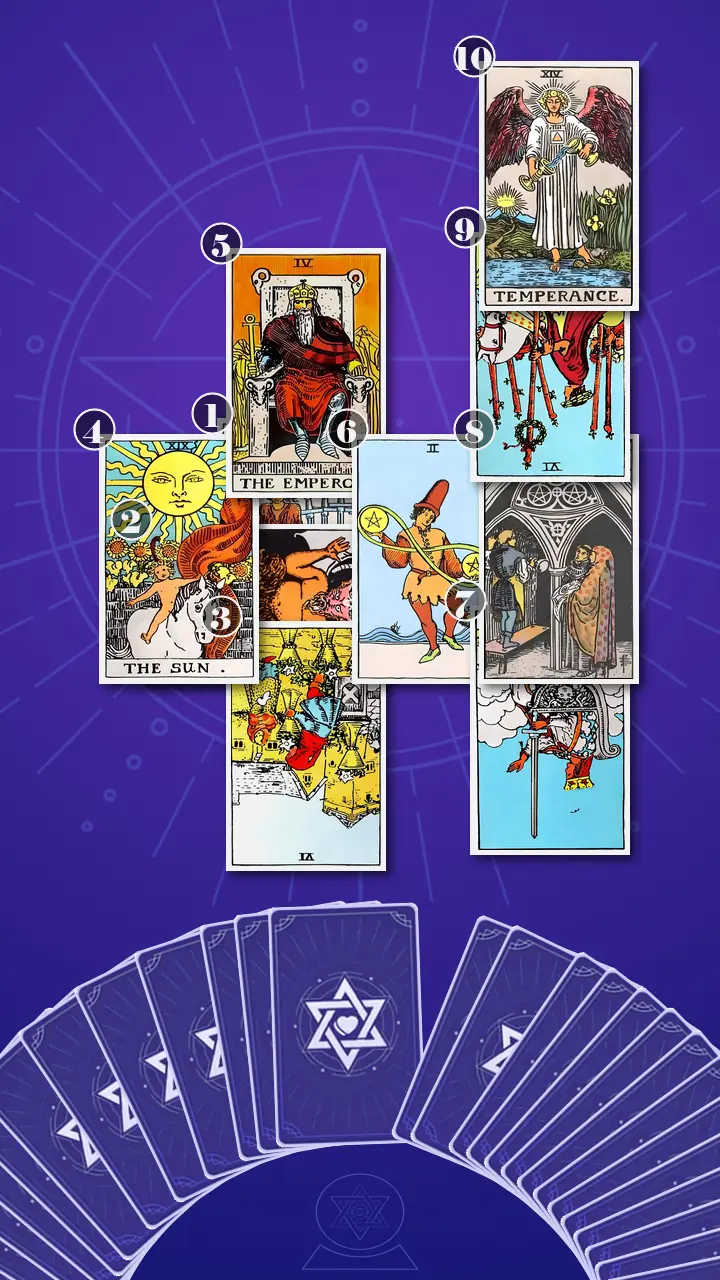
Reading the Map: The Panic Cockpit and the Parts of You on the Controls
Position 1: The Observable Loop — Eight of Swords (upright)
“Now flipped over,” I said, “is the card that represents your present career anxiety pattern as a concrete, observable stuck point.”
Eight of Swords, upright.
I angled the card toward the camera. “This is the ‘panic cockpit’ card,” I told her. “Resume tab open. LinkedIn tab open. Job board tab open. Three windows like a flight deck at 11:38 p.m.—and the inner monologue is, ‘If I keep editing, I can avoid being seen.’”
In Tarot terms, the Eight of Swords is a mental bind. In modern life terms, it’s decision fatigue disguised as productivity. The blindfold and loose bindings matter: the restriction is real in how it feels—but it’s also partially maintained by the rules you’re obeying automatically.
“Polishing isn’t progress if it keeps you invisible,” I said, keeping my tone warm but clean. “Your mind is trying to keep you safe by keeping you in the editing loop instead of the ‘submit’ moment.”
Taylor snorted—one short laugh that didn’t reach her eyes. “That’s… brutal,” she said. Then her shoulders dropped a few millimeters, like her body was relieved the pattern had a name.
Position 2: The Crossing Chain — The Devil (upright)
“Now flipped over,” I continued, “is the card that represents what intensifies the anxiety—the attachment or fear that keeps the loop active.”
The Devil, upright.
“This isn’t ‘bad’,” I told her, because people hear Devil and immediately brace. “It’s honest. The Devil is the part of you that learned: ‘I’m only safe if I’m impressive.’”
In her world, impressive didn’t mean vanity. It meant rent. It meant not being the person who moved back home. It meant walking into a room and not feeling exposed.
“This card looks like status as a binding contract,” I said. “Titles. Prestige. Approval. The inverted torch—energy that’s supposed to light the way gets flipped into pressure.”
She touched her jaw unconsciously. “It’s like LinkedIn is a casino,” she admitted. “Refresh, refresh, refresh. Like I’ll see something that proves I’m still… winning.”
“Exactly,” I said. “And the Devil’s trick is that it offers short-term relief: control the narrative, don’t risk rejection. Long-term cost: no new evidence. So the fear gets louder.”
Position 3: The Root Script — Six of Cups (reversed)
“Now flipped over is the card for the deeper root: the past identity script revived by the yearbook.”
Six of Cups, reversed.
“This is the nostalgia distortion card,” I said. “The yearbook is a cup offered with a flower—sweet, sincere. Reversed, it becomes a gift you can’t set down.”
I watched her face soften and then tighten again, like warmth and grief arrived at the same time. “That version of me felt safe,” she said quietly, staring at the yearbook off-screen. “Because everyone agreed on who she was.”
“Yes,” I said. “And now the past is acting like an annual performance review you didn’t consent to.”
From a Jungian lens, this is an old persona—the ‘promising one’ mask—getting reactivated. Not because you’re shallow. Because it once brought belonging.
Position 4: The Snapshot That Still Glows — The Sun (upright)
“Now flipped over is the card that represents the specific past identity snapshot—the version of you the yearbook is reactivating.”
The Sun, upright.
“This is literally a yearbook artifact,” I said, and she gave me a bittersweet smile. “The Sun is uncomplicated visibility. Being seen and celebrated. The child on the white horse—confidence without over-explaining.”
In other words: the old identity wasn’t just ‘smart.’ It was publicly affirmed. That glow becomes a measuring stick. And when adult growth is slower, quieter, and messier, the nervous system reads it as danger.
“Your yearbook self is a snapshot, not a contract,” I said, and I saw her throat bob as if the sentence landed somewhere physical.
Position 5: The Career Ideal in Armor — The Emperor (upright)
“Now flipped over is the card for your conscious career ideal—what you think you must become to feel secure.”
The Emperor, upright.
“You want structure,” I told her. “A plan that can’t be questioned. A title progression that would look legitimate on paper and calm your brain.”
The Emperor is leadership and boundaries. But in a perfectionism loop, it can become rigidity: the belief that there is one ‘real’ career, and you must choose it perfectly before you move.
Her eyes flicked away from the camera. “If I can’t explain my career in one clean sentence, it means I’m failing,” she said, like she was quoting an inner policy memo.
I nodded. “That’s the Emperor trying to protect you. But a career isn’t a single sentence. It’s an evolving structure.”
Position 6: Near-Future Rhythm — Two of Pentacles (upright)
“Now flipped over is the card that represents your near-term direction if you engage this consciously.”
Two of Pentacles, upright.
“This is the antidote to ‘one forever choice,’” I said. “It’s a season of juggling without making it mean you’re failing.”
The infinity loop around the coins is key: it’s repeatable, not dramatic. It’s calendar-blocking energy. Notion dashboard energy. Two lanes—career experiments and recovery—instead of one giant tab called ‘Figure Out Your Life.’
“Stop auditioning. Start experimenting,” I told her. “One application. One message. One portfolio step. Not the whole identity at once.”
She exhaled, small. “That sounds… less like stepping onto a stage.”
Position 7: The Inner Prosecutor — Queen of Swords (reversed)
“Now flipped over is the card for how you relate to yourself while navigating career pressure—your inner voice and stance.”
Queen of Swords, reversed.
“This is the inner editor turning into the inner prosecutor,” I said. “Discernment becomes a blade aimed inward.”
I asked, “What’s the first cutting sentence that shows up when you open a job posting?”
Taylor didn’t hesitate. “You’re not qualified. It’ll be embarrassing.”
“Let’s do the translation,” I said, the way I would in therapy, and the way I did on cruise ships when travelers needed something usable before the next port. “Harsh line: ‘If it’s not impressive, it’s pointless.’ Fair line: ‘I’m nervous because this is visible. I can still send one application.’”
Her face shifted—eyes narrowing, then softening—as if she recognized her own voice on a recording for the first time.
Position 8: The Real World Is Not a Comment Section — Three of Pentacles (upright)
“Now flipped over is the card for your external reality—what support or feedback is actually available beyond social comparison.”
Three of Pentacles, upright.
“This is the craft room,” I said. “The opposite of solitary spiraling.”
In modern terms: swapping ‘comment-section career advice’ and TikTok rabbit holes for one trusted human and one concrete question. Code review instead of solo coding. A project sprint with a teammate.
“You don’t have to hallucinate what ‘good’ is,” I told her. “You can ask.”
Taylor made a face like the idea was both obvious and terrifying. She reached for her phone, stopped, then picked it up again—fear spike, then intention.
“There’s one person,” she said. “A senior on my team who actually likes me.”
“Good,” I replied. “That’s the card working.”
Position 9: The Applause Hangover — Six of Wands (reversed)
“Now flipped over is the card for your hopes and fears around visibility—recognition, being behind, what success must look like.”
Six of Wands, reversed.
“You want to be seen,” I said, “and you’re scared of being seen not-winning.”
This is the fear-of-being-average-in-public card. It’s refreshing notifications. It’s interpreting neutral responses as verdicts. It’s choosing impressive-looking moves for optics, then feeling depleted.
“This is where we build private metrics,” I said. “Quiet wins. Evidence you can trust—because likes, titles, and applause are noisy.”
When Temperance Spoke: The Pour That Turned Pressure into Progress
Position 10: Integration Path — Temperance (upright)
I let the room get quiet for a beat before turning the last card. Even through a screen, you can feel when someone is bracing for a verdict.
“Now flipped over,” I said, “is the card that represents your integration path—the most empowering direction for reconciling past identity with present career development.”
Temperance, upright.
The image on Temperance always makes me think of my childhood in Venice—water moving through narrow canals, never rushing, never stopping, always finding the next open route. When the flow is blocked, you don’t scream at the water. You clear the passage.
And because my work is mind-body informed, I watched Taylor as I spoke. Her shoulders were practically living in her ears. Her jaw was still clamped like she was holding back a confession.
“I’m going to say this in a body-aware way,” I told her, careful and non-medical. “I can’t diagnose anything—but in an energy lens, that shoulder-and-jaw tension often shows up when someone is carrying responsibility overload and trying to control outcomes. That’s the Eight of Swords in your muscles.”
Setup: Taylor was still stuck in that familiar loop—staring at the yearbook page, her name next to a glowing caption, then flipping to LinkedIn like it’s the only way to prove she’s still that person. The question underneath all the tab-toggling was basically, ‘What if I take a step and it doesn’t sparkle?’
Delivery:
Stop living like your yearbook spotlight is a life contract, and start pouring your past strengths into today’s small experiments—Temperance is the steady mix that turns pressure into progress.
I didn’t fill the silence after. I let it echo.
Reinforcement: Taylor’s reaction came in layers, like weather shifting.
First, a freeze—her breath held for a second, fingers hovering over her phone as if the old reflex wanted to argue. Then her eyes unfocused, not in dissociation, but in that way people look when a memory montage starts playing: yearbook superlatives, teachers’ praise, the warmth of being “the one who will do something big.” Then the release: a slow exhale that sounded like someone finally put down a bag they didn’t realize they were still carrying.
Her shoulders sank. Not dramatically—just enough that I knew her nervous system heard permission. Her jaw worked side to side, unclenching, as if she’d been biting down on a rule. Her eyes got a little shiny and she blinked hard, annoyed at herself for it.
“But if I stop treating it like a contract,” she said, voice small and a little sharp, “doesn’t that mean I… wasted it? Like I didn’t become what everyone thought?”
There it was—the unexpected reaction. Not relief first. Anger. Grief. The fear that letting go means admitting failure.
“No,” I said, steady. “It means you get to stop being managed by other people’s projections. Temperance isn’t erasing the past. It’s integrating what was real—drive, curiosity, care—into something livable now.”
I leaned in. “Now, with this new lens: can you remember a moment from last week—maybe a time you hovered over ‘Submit’—where this insight would have changed how you felt?”
Taylor’s gaze dropped to the side, toward the yearbook. “Tuesday night,” she said. “I had an application open. I kept rewriting one bullet point because it didn’t sound… impressive enough.” She swallowed. “If I had thought, ‘I’m allowed to run an experiment,’ I could’ve just sent it.”
“Exactly,” I said. “This is the emotional transformation your cards are asking for: from self-doubt and over-control to grounded clarity built through evidence. Integration is a rhythm, not a reveal.”
From Insight to Action: Evidence-First Career Experiments (and a 3-Minute Reset)
I summarized the story I saw in the spread—so Taylor could feel it as one coherent thread, not ten separate lessons.
“Here’s the arc,” I told her. “The Eight of Swords shows the current stuck loop: editing and comparing instead of moving. The Devil explains why it feels so urgent—because somewhere inside, success has become proof of worth, like a prestige subscription you’re scared to cancel. The Six of Cups reversed and the Sun show the root: nostalgia and visibility. You miss how safe it felt to be agreed-upon. The Emperor shows your conscious ideal: a plan so solid nobody can question you. But the Two of Pentacles and Three of Pentacles offer a different path: rhythm and real feedback. The Six of Wands reversed names the shaky relationship with applause. And Temperance is the integration: mixing your past strengths into small, repeatable steps until your body believes you’re safe even while learning.”
“Your cognitive blind spot,” I added, “is thinking that your next step has to prove you. That’s why you keep curating a flawless identity instead of collecting real-world data. The transformation direction is clear: shift from curating to testing. From ‘Who am I supposed to be?’ to ‘What can I try this week?’”
Then I gave her what she actually needed: something she could do in the next 48 hours, even with a tight chest.
- The 10-minute “Temperance Pour” (once, then stop)Set a 10-minute timer. In your Notes app, make two columns: “Then (Yearbook Taylor)” and “Now (Real Taylor).” Write 3 concrete strengths from then (skills/traits, not awards). For each, write 1 small way it could show up this week (example: “good writer” → “send one draft for feedback”). Choose ONE micro-step to do in the next 48 hours.If your chest tightens and you start spiraling into proving yourself, cut it in half: write one strength + one micro-step and stop. The goal is evidence, not perfection.
- Minimum viable application (one role, one timer)Pick ONE role to apply to this week. Do one 20-minute pass on your resume (timer on). Submit with the version you have when the timer ends—no hours of rewriting bullets.When your brain argues “But I need to be sure,” treat that as a cue to time-box, not to stop. Evidence beats vibes—especially at 11:30 p.m.
- One trusted human, one concrete question (Three of Pentacles)Send one message to a coworker/mentor you trust: “Could I ask you one quick career question? What strength do you see me using most, and what’s one skill you think would level me up in the next 3–6 months?”Keep it specific so it doesn’t feel like asking for validation. You’re gathering skill data, not asking them to rank your worth.
Before we ended, I offered her one of my quick recovery techniques—because the modern career spiral isn’t just mental; it’s screen-induced exhaustion plus a nervous system that never gets a clean “done.”
“Three-minute reset,” I said. “Not to ‘fix’ your life. To clear the canal so the water can move.”
“Feet on the floor. Drop your shoulders on the exhale like you’re taking off a backpack. Roll your neck gently once each direction. Then look away from the screen and pick one object in the room—your mug, your book, anything—and name three details about it. This is Venetian Aqua Wisdom in a tiny form: we restore circulation by creating one open channel.”

A Week Later: Ownership, Not Certainty
A week later, Taylor sent me a message that was almost aggressively simple: “I did the 10-minute Pour. Then I sent the message to my coworker. I hated it for five minutes. But she replied with actual advice. Not judgment. I’m applying to one role on Friday.”
It wasn’t a Hollywood ending. She didn’t become a new person overnight. She still woke up some mornings with that first flicker of “What if I’m behind?”—but now it didn’t hijack her whole day. She had a rhythm. She had evidence. And she had one human connection that was more real than a hundred LinkedIn refreshes.
That’s what I love about Temperance, especially when you’re 28 and living under the shadow of a shiny old snapshot: it doesn’t demand a reinvention. It asks for a steady mix. A little past strength. A little present reality. A small action that makes your nervous system trust you again.
When you’re trying to build a real adult career while an old, shiny version of you is quietly grading every move, even clicking “submit” can feel like stepping onto a stage with your worth on the line.
If you stopped treating that yearbook snapshot like a contract for who you have to be, what’s one small, real-world experiment you’d let yourself run this week—just to gather evidence?
This story is adapted from psychological research, written so that those in a similar struggle can see their own pattern in it — and find their next step clearly.These insights are not a substitute for professional psychological, medical, legal, or financial advice.
Learn more about our Journey to Clarity.
How did this insight land for you?
🫂 This Resonates Deeply
🌀 Living This Story
✨ Now I See Clearly
🌱 Seeing New Possibilities
🧰 Useful Framework
🔮 The Confirmation I Needed
💪 Feeling Empowered
🚀 Ready for My Next Step
Author Profile
 AI
AI“Having traveled across cultures... I've learned that what we often lack isn't a simple answer, but a moment of being truly understood. I use a Jungian psychological lens to help you deconstruct your subconscious patterns—not to prove anything, but to be the gentle companion who helps you unravel your knots, free of judgment, so you can reconnect with your inner wisdom.”
In this Introspection Tarot Reading :
Core Expertise
- Shadow Integration Audit: Objectively mapping suppressed emotions (anger, shame, grief) that are covertly draining your psychological bandwidth.
- Inner-Critic Neutralization: Deconstructing the harsh, subconscious self-judgment loop that masquerades as 'self-discipline'.
Service Features
- The Active Imagination Protocol: A structured psychological journaling technique to safely dialogue with your 'Shadow', turning internal friction into deep self-compassion.
Also specializes in :
Explore Related Patterns:
Achievement FusionTaylor’s fear that one imperfect visible move will prove she is not as capable as the yearbook version shows that achievement has become fused with personal safety. Her career anxiety spikes because applying for a job is no longer just a practical step; it feels like a public test of whether she still deserves the identity she once had. The defense mechanism is status-based self-protection. Titles, prestige, clean career explanations, and LinkedIn wins become emotional armor, giving short-term relief from exposure while increasing the pressure to stay impressive at all times. You see the fusion most clearly when ordinary career ambiguity starts feeling like a threat to worth. If a resume bullet is not impressive enough, it becomes more than a weak sentence; it becomes evidence in an internal trial. The pattern begins to shift when achievement is treated as feedback about direction and effort, not as proof of whether you are still valuable.
Identity ForeclosureTaylor’s line about trying to recreate the feeling of being seventeen reveals a career anxiety built around an old closed role. The yearbook does not merely remind her of who she was; it revives the idea that the promising one is still the only acceptable version of her. This is identity foreclosure because a past persona has started acting like a finished blueprint. The more she treats that public glow as a life contract, the harder it becomes to experiment, pivot, learn, or be visibly unfinished without reading it as failure. You can feel the mechanism when she asks whether stopping the contract means she wasted it. The fear is not only about career progress; it is about losing the identity that once secured belonging. The integration path is to separate real strengths from the old role, so drive, curiosity, and competence can move forward without requiring her to become a perfect continuation of a teenage snapshot.
Nostalgia LoopTaylor’s thumb tracing the yearbook caption, followed by the admission that she feels like she peaked at seventeen, shows that the past is not just a memory here. It has become a live identity script, one that keeps telling her the safest version of herself was the publicly affirmed one everyone could agree on. That is the engine of the nostalgia loop: the old snapshot offers emotional certainty, then quietly turns into a measuring stick. You are not simply missing a good era; you are comparing the slower, messier pace of adult career development against a frozen moment where visibility, praise, and belonging seemed to arrive as one package. The loop fuels career anxiety because it makes every current step feel like a referendum on whether that earlier version was real. When you treat the yearbook self as evidence you must recreate, LinkedIn stops being a tool and becomes a grading screen. The pattern loosens when the past is used as data about strengths, not as a contract for identity.
Visibility AvoidanceTaylor hovering over Submit and then rewriting one more bullet point shows that the real threat is not the application itself. The threat is being seen before the work can perfectly protect her from judgment. Visibility avoidance works by converting exposure into danger. A visible career move becomes loaded with the fear of being average, behind, or no longer impressive, so the mind chooses the safer ritual of polishing and private comparison. You can see why this pattern is so sticky: it promises protection from embarrassment while quietly blocking the evidence that would reduce anxiety. The way out is not forced confidence; it is controlled exposure through small public actions, like one application or one specific question to a trusted senior, so visibility becomes survivable rather than identity-defining.
Comparison TrapTaylor moving from the yearbook to LinkedIn promotions turns career reflection into a ranking environment. Other people’s updates are not processed as neutral information; they become signals about whether she is still winning, still on time, still impressive enough. The comparison trap narrows attention until the whole career field looks like a public scoreboard. That creates a cognitive distortion: someone else’s visible progress starts feeling like evidence of her private failure, even when it says nothing precise about her skills, options, or next step. You can see the cost in the loop itself. Refreshing LinkedIn and scanning status signals gives a brief hit of orientation, then leaves her with less grounded evidence than before. The antidote in the story is direct feedback and private metrics, because real career data comes from actions, conversations, and skill-building, not from treating a feed like a verdict.
Productive ProcrastinationTaylor reopening her resume at 11:30 p.m. to fix one line instead of applying is the clearest behavioral signature in the story. The action looks productive from the outside, but its function is to keep her near the career move without crossing into the visible moment where rejection, feedback, or uncertainty could happen. The psychological mechanism is avoidance disguised as preparation. Editing gives her a sense of control, but it also protects the old identity from being tested in real time. As long as the application is not sent, the fantasy of a flawless, impressive self can remain intact. You can recognize the trap because the work never becomes evidence. It becomes another loop: polish, compare, tighten, delay. The pattern loosens when the standard changes from perfect presentation to minimum viable action, where one sent application gives the nervous system more usable data than another hour of invisible refinement.
Inner CriticTaylor’s immediate thought when she opens a job posting is not a balanced assessment; it is a sentence that cuts: You’re not qualified. It’ll be embarrassing. That inner voice turns career discernment into internal prosecution. The mechanism is self-protective, even though it hurts. If the inner critic can reject the move first, it can prevent the external world from doing it later. The cost is that she starts treating her own ambition like evidence against her. You can see the pattern in the way editing becomes sharper and more punitive the closer she gets to action. The useful shift is not pretending she feels confident; it is translating the harsh line into a fair one, so anxiety can be acknowledged without being allowed to make the decision.
Explore Related Struggles:
Approval-Safety FusionTaylor says the old version of herself felt safe because everyone agreed on who she was, and the current career loop keeps asking for a new version of that agreement. LinkedIn promotions, titles, and polished resume lines become more than professional signals; they start carrying the job of making her feel protected from exposure. Approval-Safety Fusion is the point where recognition stops being a nice outcome and becomes the condition under which you feel allowed to exist in the room. You keep scanning for proof that you are still impressive because impressiveness has become a shield against being seen as behind, average, or unfinished. This struggle explains why the question is not really about whether Taylor has potential. It is about whether You can act without first securing a public guarantee that the action will preserve your worth. The past identity can still offer drive and confidence, but it cannot remain the only doorway into feeling safe.
Nostalgic Belonging LockTaylor does not only find an old yearbook; she finds a version of herself that once felt easy for other people to recognize. The caption, the praise, and the shared certainty around who she was become active again in the cramped room, sitting beside LinkedIn like a second scoreboard. Nostalgic Belonging Lock forms when the past stops being a memory and starts acting like the safest place your identity ever made sense. You are pulled toward the moment when your role was already agreed upon, while your current career asks you to tolerate uncertainty, partial progress, and a self that is still becoming. That lock can make adult development feel like decline, even when you are actually building a more accurate life. The work is to extract the real strengths from that earlier version without letting the old applause become the only acceptable proof that you belong in your own future.
Identity Verdict LockTaylor treats the career story as something that should fit into one clean sentence, the way a yearbook caption once compressed her into a bright, legible identity. When that sentence does not exist yet, the absence feels less like normal development and more like evidence against her. Identity Verdict Lock turns each career move into a ruling on the self. A job application is no longer just an application; it becomes a test of whether you have become the person other people expected, whether you are still promising, and whether the old glow was real. The pressure eases when the next step is allowed to be partial. You do not need one perfect narrative before you move; you need enough contact with reality to let a truer narrative form. The old identity can be a source of material, but it cannot be the judge of every adult experiment.
Perfect Readiness TrapTaylor opens the resume at 11:30 p.m. to fix one more line, then keeps rewriting instead of applying. The action looks productive from the outside, but inside the story it functions like a waiting room where preparation keeps replacing the moment of contact with the real world. Perfect Readiness Trap names the lock between wanting to move and needing the move to feel flawless before it counts as safe. You may tell yourself you are improving the work, but the loop quietly changes the goal: instead of gathering evidence, you keep trying to remove every possible reason someone could judge you. The yearbook makes this trap sharper because the old identity was already edited into a clean caption. Adult career growth is messier than that caption, so your system tries to polish the present until it resembles a past snapshot. The way out is not reckless exposure; it is time-boxed, evidence-first action where one imperfect submission can teach you more than another night of control.
Visibility-Execution SplitTaylor keeps cycling from the yearbook to LinkedIn to the resume tab, but the movement stalls right where a career step would become visible. The resume line gets polished again, the application stays unsent, and the screen becomes a holding area between wanting progress and avoiding exposure. That is the structure of Visibility-Execution Split: You are not simply unsure what to do next; you are caught at the point where action would make you legible to other people. The old yearbook identity raises the stakes because being seen used to mean being celebrated, while being seen now might mean being ordinary, unfinished, or still learning. The struggle is not a lack of ambition. It is the friction of trying to build a real adult career while your body treats the submit button like a public stage. Clarity begins when visible action stops being treated as a final identity reveal and becomes one concrete test that can give you evidence.
Status-Belonging FusionTaylor compares the yearbook glow against LinkedIn promotions, then refreshes as if the next post might tell her whether she is still winning. The platform becomes a public measurement field where titles, optics, and visible momentum stand in for a more stable sense of belonging. Status-Belonging Fusion takes hold when career markers become the proof that you still have a place. You do not just want progress; you want progress that can be recognized, ranked, and defended against the fear of falling behind. That fusion keeps the loop alive because status signals can only offer brief relief. A promotion post may sharpen the pressure, a polished profile may manage the optics, but neither gives you the grounded evidence that comes from trying, receiving feedback, and letting your career become real in motion.
Explore Related Emotions:
Imposter Exposure FearWhen Taylor opens a job posting, the first cutting sentence is immediate: not qualified, embarrassing. You can want the role and still feel your chest tighten at the thought of being visible before you have made yourself flawless enough to feel untouchable. The scary part is not the work itself; it is the exposure baked into the work. Clicking submit would create new evidence, but it would also remove the protection of endless editing. Imposter Exposure Fear names that charged threshold where being seen while still learning feels like proof that you never deserved the old praise in the first place.
Nostalgia AcheTaylor's thumb keeps tracing the bright yearbook caption, and her own words land with a sting: she feels like she peaked at seventeen. You are touching a memory that still glows, but the glow has started to burn because it seems to know exactly who you were before adult life became slower, messier, and less publicly applauded. The ache is not about wanting high school back. It comes from how safely defined that younger self seemed: praised, visible, and agreed upon. Nostalgia Ache names the pain of holding a warm old identity so tightly that it starts asking the present to compete with a snapshot.
Self-Audit AnxietyTaylor keeps the yearbook open under the lamp, then flips to LinkedIn as if the old caption and every promotion are part of the same grading sheet. You are not just checking career updates; you are running your current self through a private review board built from the version of you that once felt publicly agreed upon. That inner audit turns movement into evidence gathering. A resume bullet has to prove you are still capable, a neutral response starts to feel like a verdict, and applying becomes loaded with the possibility of being marked down. Self-Audit Anxiety names the contracted feeling of living inside that invisible review, where clarity begins by noticing who has been given authority to score you.
Status AnxietyTaylor calls LinkedIn a casino: refresh, refresh, refresh, as if one promotion post might prove she is still winning. You are not looking at status as vanity here; you are looking at status as a safety signal in a city where rent, titles, and public competence can feel tightly braided together. That turns every career marker into a pressure test. A title is no longer just a title, and an application is no longer just an application; each one starts carrying the burden of legitimacy, adulthood, and proof. Status Anxiety names the inner pressure of needing external rank to calm the question of whether you are still on track.
Integration ReliefTaylor's shoulders sink when she hears that the yearbook snapshot is not a contract, and her slow exhale sounds like setting down a bag she did not realize she was still carrying. You are not being asked to reject the younger self who was praised and bright; you are being asked to stop making that image manage every present choice. Integration Relief arrives when the past becomes usable material instead of a standard you must reenact. Drive, curiosity, and care can be poured into one application, one message, one small experiment. The relief is practical because it gives your current self permission to build from the old strengths without living under the old spotlight.
Timeline ShameTaylor says she feels like she peaked at seventeen, and later she still wakes up with the flicker of 'What if I'm behind?' You are not just asking whether your career is moving; you are measuring your present against an old schedule of promise that never accounted for adult uncertainty. Timeline Shame shows up when time itself starts to feel accusatory. The yearbook self becomes proof that you were once ahead, clear, and celebrated, while the current self has to explain every slower step. Naming this feeling helps separate real development from the false deadline your younger visibility left behind.
Control FatigueTaylor reopens the resume at 11:30 p.m. to fix one line, with her jaw clamped and her hands pulled back toward the screen: edit, polish, control. You are watching effort turn into containment, where the work looks productive but the actual forward motion keeps getting delayed. The loop offers a small hit of safety because nothing can be rejected while it is still being perfected. Over time, that control becomes expensive: it drains action, narrows attention, and makes rest feel unavailable. Control Fatigue names the tiredness of trying to make every outcome clean enough before you allow yourself to move.
Grounded AgencyA week later, Taylor has sent the message to her coworker, received actual advice, and chosen one role to apply for on Friday. You are no longer trying to solve the whole identity question in one heroic move; you are creating evidence through actions small enough to complete. Grounded Agency is the feeling of having a handle again without needing total certainty. It grows when private metrics replace applause, when feedback comes from one trusted human instead of a feed, and when the next step becomes an experiment rather than a public referendum on who you are.
Explore Related Contexts:
LinkedIn Performance LoopTaylor looks at a yearbook page and then opens LinkedIn like a scoreboard, reading promotions, titles, and updates as evidence of whether she is still winning. The feed does not stay neutral in the narrative; it becomes a public evaluation room that keeps pulling her back for another refresh. The platform turns career development into visible rank comparison, so polishing a resume feels safer than submitting something that could be judged. You can see the external mechanism clearly: attention metrics and professional status signals keep replacing concrete feedback with performance pressure. That is why the loop has weight. It is not just screen time; it is a career-stage environment where public proof feels easier to chase than real-world evidence.
Model Student Performance TrapTaylor keeps the yearbook open beside her while her thumb traces a bright caption, then she moves to LinkedIn as if she is about to get graded. The school-era version of her was publicly affirmed, legible to teachers and peers, and agreed upon by everyone around her. That past identity now functions like an old performance system crossing into adult work: every resume line, title, and visible move has to preserve the image of the promising one. You are not dealing with a simple memory; you are dealing with a carried-over achievement environment where early praise became a standard the current career has to keep satisfying. The pressure lands in the present because each imperfect application risks puncturing a role that once gave you social certainty. Naming this as a model student performance trap separates your actual skills from the old grading structure that keeps demanding proof.
Past Self ReintegrationTaylor's turning point starts when the yearbook self is reframed as a snapshot, not a contract. The old version carried real strengths, but the reading moves those strengths into a present-tense structure: one micro-step, one application, one trusted feedback request. This is an active transition rather than a nostalgic return. You can carry forward drive, curiosity, and care without letting the old public role manage every adult decision. Past self reintegration fits because the story does not ask her to reject who she was. It shows a practical bridge where earlier competence becomes usable material for the current career, instead of a standard that keeps grading her.
Post-Achievement PlateauTaylor says she feels like she peaked at seventeen, and the yearbook gives that sentence a physical object to attach to. The glowing caption, teacher praise, and remembered certainty create a past high point that adult work keeps getting measured against. The plateau is not a lack of movement; it is the mismatch between a public early success template and a slower, less applauded adult career. You are trying to build a real professional life while an old snapshot keeps acting like the only valid benchmark. Seeing this as a post-achievement plateau makes the pressure more specific. The task is not to recreate the applause, but to stop letting one bright chapter define what progress is allowed to look like now.