Finding Clarity on Line 1, Before the Coffee Even Hits
“You see a coworker’s promotion post before you’ve even had coffee, and suddenly you’re doing ‘timeline math’ in your head like it’s your second job.”
Jordan said that to me like it was a joke. But their laugh didn’t land as a laugh—more like the sound you make when your phone has already decided how your morning is going to feel.
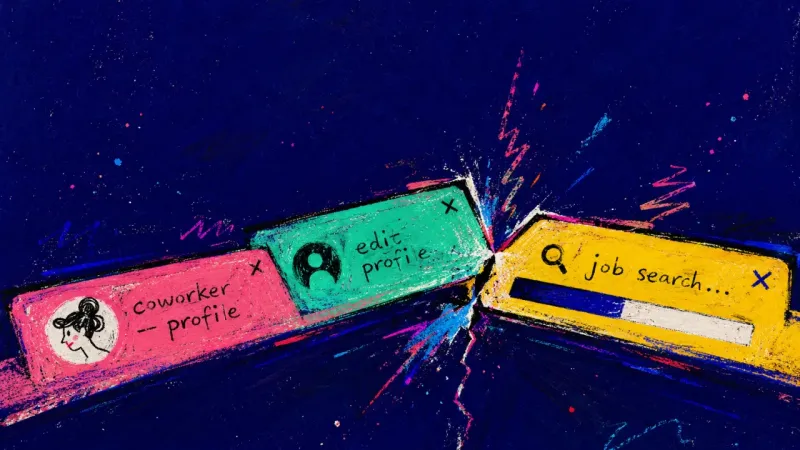
They were calling from Toronto. I could hear the TTC in the background—metal-on-metal, that familiar screech as the train pulled into Bloor-Yonge. Fluorescent light turned their screen into a harsh little mirror. Jordan’s thumb hovered, already mid-ritual: click the promotion post, click the coworker’s profile, click their own profile, and start recalculating their life like a spreadsheet with missing columns.
“I’m happy for them,” Jordan told me, voice careful. “But it also feels like a spotlight on what I haven’t done yet.”
I watched their jaw tighten on camera, the way it does when a thought is trying to become a verdict. Their chest looked held—like they’d taken a breath and forgot to give it back. Envy isn’t just a feeling; in Jordan’s body, it showed up as a tight chest and a clenched jaw, with that stomach-drop you get when congratulations roll in and your brain quietly translates it into: you’re behind.
And underneath it, the contradiction was loud: wanting career recognition and momentum… while fearing that their current pace meant they weren’t truly valuable or competitive.
I said, gently, “We’re not going to shame you for having a nervous system. We’re going to map the pattern. Let’s figure out: is this networking, or is this scorekeeping?”
Jordan’s eyes flicked down to their phone, then back up to me. “I can’t tell whether I want a promotion,” they admitted, “or I just want the panic to stop.”
“Okay,” I said. “That’s a real starting point. Let’s do a Journey to Clarity—not by forcing certainty, but by getting honest about what’s actually happening in the first sixty seconds after a post like that.”

Choosing the Compass: The Celtic Cross · Context Edition
I guided Jordan through a simple reset—nothing mystical, just functional. “One slow inhale,” I said, “and on the exhale, let your shoulders drop one millimeter. We’re telling your body it doesn’t have to sprint.” While they breathed, I shuffled.
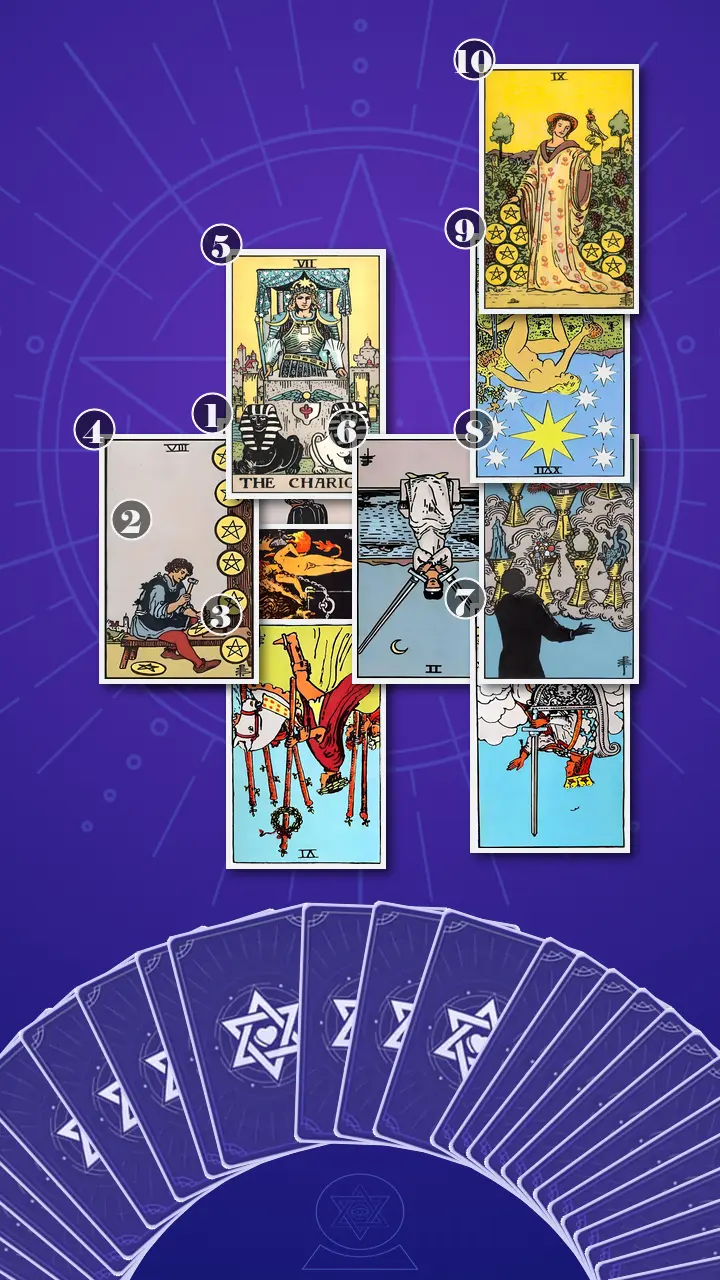
“Today,” I told them, “we’re using the Celtic Cross · Context Edition. It’s the classic spread, but aimed directly at a pattern question—because LinkedIn envy isn’t one moment. It’s a chain: trigger, hook, root need, reaction, environment, and then a way out.”
If you’ve ever wondered how tarot works in a practical, non-floaty way, this is it: the Celtic Cross gives me a structure to follow the whole system, not just the loudest emotion. We’re not asking the cards to “predict.” We’re using them to see what your mind keeps doing automatically—so you can choose something else on purpose.
“We’ll start with the center,” I explained, “because that’s the immediate LinkedIn envy snapshot—what happens right after the promotion post. Then we cross it with what keeps the loop running. Later, the staff on the side climbs like floors in the same building—from your self-talk to your environment to hopes and fears, up to an integration that actually stabilizes you.”
Jordan nodded, like their brain appreciated a map.
Reading the Map: Card Meanings in Context
Position 1: The Immediate LinkedIn Envy Snapshot
“Now turning over,” I said, “is the card that represents the immediate LinkedIn envy snapshot: the most visible feelings and behaviors right after the coworker’s promotion post.”
Five of Cups, upright.
I pointed to the image: a cloaked figure staring at spilled cups while two remain standing behind them. “This is an attention bias card,” I said. “It’s the moment your mind locks onto what feels missing—and everything else becomes background noise.”
“Modern translation?” I asked, already knowing the answer from Jordan’s story. “It’s like rereading the promotion post and replaying your timeline, but you can’t mentally turn around to notice the skills, relationships, and steady wins that are already there.”
Jordan let out a small, bitter laugh. “That’s… honestly a little too accurate. Like, damn.”
That laugh mattered. It wasn’t agreement. It was the sound of being seen in a way that’s almost annoying. I kept my voice calm. “This card isn’t saying you’re ungrateful. It’s saying: your brain is grieving something concrete—title, recognition, speed—and instead of naming the loss, it turns LinkedIn into a courtroom exhibit.”
Energy-wise, Five of Cups is contracted—narrow focus, narrowed breath, narrowed future. It makes you scan for evidence you’ve fallen behind, and then it makes your competence feel invisible.
Position 2: What Keeps the Envy Loop Running
I rested my hand on the next card. “Now we flip the one that represents what keeps the envy loop running: the sticky habit or psychological hook that intensifies comparison.”
The Devil, reversed.
The room on my end—my little reading space that still smells faintly of paper star charts from the planetarium—went quiet in that particular way it does when something central shows up. I’ve narrated thousands of nights under artificial constellations, and I’ve learned: the moment you name the true mechanism, people stop fighting the symptom.
“This isn’t a moral card,” I said immediately, because I could see Jordan brace. “It’s a habit-loop card. In reverse, it’s the moment you realize the chain is loose.”
Jordan’s expression tightened. “I mean… I need LinkedIn. Everyone at work uses it. It’s literally part of the job.”
There it was—the defense strategy. The rational voice that tries to make compulsive checking sound like professionalism. I nodded. “Totally. And here’s the nuance: you can use LinkedIn as a tool and still have it hijack your nervous system. Both can be true.”
Then I brought in my signature lens—the one I learned not from tarot books, but from watching orbital mechanics for a decade while explaining them to teenagers on field trips.
“I call this Orbital Resonance,” I said. “In astronomy, resonance is when two bodies sync in a way that amplifies motion. In workplaces, it’s when your internal worth-meter syncs to an external signal—like a coworker’s post—and suddenly your whole emotional system starts orbiting their timeline.”
“The Devil reversed says: the resonance can be broken. Not by deleting the planet—by changing your distance and your rhythm.”
The Aha Moment (Setup → Delivery → Reinforcement)
Setup: I watched Jordan’s eyes dart the way they do when a thought tries to sprint ahead of a feeling. They knew that midnight moment: swearing it’s only two minutes, chest tightening as likes climb, rewriting the headline like it’s an emergency—like optics could produce safety faster than reality can.
Delivery:
Not ‘I have to keep up’—choose to loosen the chain and let your next move be value-led, not feed-led.
I let the sentence sit between us. Even through a screen, you can feel when words land heavy—like a coin dropped into still water.
Reinforcement: Jordan went through a three-step reaction that I’ve seen in so many smart, ambitious people. First: a micro-freeze—breath paused, shoulders held, eyes fixed like they were reading fine print. Second: cognitive seep—their gaze unfocused for a second, like their mind replayed their own behavior: the “market research” tab that turns into profile-hunting; the third headline rewrite; the “Resume_FINAL_final_reallyFINAL.docx” they never actually send. Third: release—an exhale that sounded half like relief, half like grief.
“But if it’s a chain,” Jordan said, voice sharper than before, “doesn’t that mean I’ve been doing this to myself? Like… I’m the problem?”
I kept my tone steady. “It means you’ve been responding to discomfort the way a lot of people do: by reaching for certainty. LinkedIn offers certainty-shaped signals—titles, timestamps, applause. The Devil reversed says you can stop treating that certainty as oxygen.”
“Here’s the practical part,” I added. “Set a 10-minute timer. Open LinkedIn once. Write the very first sentence your mind says—verbatim. Then close the app when the timer ends, even if you feel unfinished. That unfinished feeling? That’s the loose chain tugging. Not a truth.”
Jordan swallowed, then nodded—small, but real.
I asked, softly, “Now, with this new perspective, can you think back to last week—was there a moment when this insight would’ve changed how the night went? A moment when you could’ve gone from ‘I can’t not check’ to ‘I want to check’ to ‘I’m choosing whether I check’?”
Position 3: The Hidden Root Beneath the Envy
“Now we turn over the card representing the hidden root beneath the envy: the deeper need or insecurity that the promotion post touches.”
Six of Wands, reversed.
I tapped the victory wreath and the crowd. “This is the hunger for recognition,” I said. “Not vanity—visibility. The feeling that progress only counts if it’s witnessed.”
Jordan’s face softened in a way that told me they’d been trying not to need that. “Yeah,” they said quietly. “If my career story isn’t impressive in one glance, I feel like I’m already losing.”
Six of Wands reversed is a deficiency of felt acknowledgment. The work may be solid, but without applause, the nervous system marks it as “not real.” And in a LinkedIn culture, the crowd never stops cheering—so your brain keeps waiting for your turn.
Position 4: What You’ve Been Doing That’s Real (and Unseen)
“Now,” I said, “this card represents what you’ve been doing that’s real (and often unseen): the recent effort or work context that makes the comparison feel sharper.”
Eight of Pentacles, upright.
“This is your leverage,” I told them. “This is craft. Reps. Tangible proof. The kind of progress LinkedIn rarely shows but careers are built on.”
I used the before/after cut the way I’ve learned to do when someone needs a reality anchor: “I see the 11:45 p.m. phone glow. Now I want you to picture a desk lamp, laptop open, forty-five minutes of building something that exists: a campaign teardown doc, a one-slide case study, a metrics summary, a draft brief. Something you can save in a folder called ‘Proof.’”
Jordan’s shoulders dropped a fraction. “That feels… less dramatic,” they said.
“Exactly,” I replied. “And doable. That’s the point.” Eight of Pentacles is balanced Earth energy: steady, trackable, quietly powerful. It doesn’t argue with the feed. It simply builds a reality the feed can’t take away.
I said the mantra that always works because it’s simple enough to survive a spiral: “Trade one refresh for one rep.”
Position 5: Your Conscious Intention
“Now we look at your conscious intention: what you want to feel or achieve in your career when you’re not spiraling.”
The Chariot, upright.
“You want momentum,” I said. “Not a perfect story—agency. Direction that feels self-chosen.”
I pointed out the two sphinxes, black and white. “This is the tension you named: ambition versus self-judgment. Real goals versus social comparison. The Chariot is willpower, but it’s also alignment. The question is: are you driving toward your values, or away from discomfort?”
Jordan looked away, like they were actually imagining it. “If nobody could see my career online for a month…” they started.
“Yes,” I said. “What would a win be then?”
Position 6: The Next Likely Reaction Pattern
“Now we flip the next likely reaction pattern: how envy may push you toward rushed decisions or scattered next steps.”
Two of Swords, reversed.
“This is the panic move,” I said. “Too much input, not enough inner clarity.”
I gave them the internal monologue triad because it’s painfully accurate for decision fatigue: “(1) Apply to everything. (2) Nothing fits. (3) I’m behind.”
Jordan winced. “That’s literally me with fourteen tabs open.”
Two of Swords reversed is blockage breaking into urgency. It’s movement without direction—frantic toggling between job listings, salary sites, headline edits—trying to end discomfort with a cognitive sprint. But it doesn’t end it. It multiplies it.
“Tonight isn’t for drastic moves,” I told them. “Tonight is for one next step under thirty minutes.”
Position 7: Self-Worth Script Under Pressure
“Now,” I said, “this card represents your self-worth script under pressure: the inner voice and self-image that activate when you feel ‘behind’.”
Queen of Swords, reversed.
I didn’t need to dramatize this one. Jordan already knew the voice.
“This is discernment turning into a blade,” I said. “Your intelligence gets recruited as a prosecutor.”
Jordan’s mouth tightened. “I’ll read my own resume and think, ‘This sounds weak.’ And then I delete actual accomplishments because they feel… not impressive enough.”
Queen of Swords reversed is excess Air in the harsh direction—precision without kindness, critique without coaching. It keeps the Devil loop sticky because the inner critic creates discomfort, and then the feed offers a momentary sense of control.
“One boundary with your mind,” I suggested. “When you catch a cutting thought, rewrite it into a coach-like observation. Not ‘I’m behind.’ More like: ‘I want clearer promotion criteria, so my next move is to ask for it.’”
Position 8: The Social Media and Workplace Context
“Now we look at the environment: what your workplace and social feed reinforce about success, visibility, and timeline expectations.”
Seven of Cups, upright.
I traced the floating cups in the clouds. “This is LinkedIn as an algorithmic highlight reel,” I said. “It’s optimized for signals, not context.”
Then I used the line I keep for this exact moment, because it de-escalates comparison without pretending titles don’t matter: “The feed isn’t a scoreboard. It’s a highlight reel with missing context.”
Seven of Cups is excess possibility. It’s the buffet of shiny careers—five different success templates in one scroll—and suddenly you feel like you should want all of them. Even the ones that don’t match your actual values, energy, or life.
When I worked night shifts at the planetarium, I used to watch visitors point at the brightest star and assume it was the most important one. It never is. It’s just the one your eye catches first. Social feeds do that to ambition.
Position 9: The Comparison Trigger Point (Hopes and Fears)
“Now,” I said, “this card represents the comparison trigger point: what you secretly hope the feed will give you, and what you fear it proves about you.”
The Star, reversed.
“This is the hope drain,” I told Jordan, and I watched them go still. “When someone else shines publicly, your own orientation dims.”
I used the conflict-contrast script that always lands here: “You’re not lazy—you’re getting graded by a crowd that doesn’t know your work.”
Jordan exhaled, a quiet, uncomfortable “oh… yeah” pause. Their eyes were wet but not crying. Just that edge of being touched in a place they usually keep armored.
“If your worth needs a public milestone to feel real,” I said, “LinkedIn will always feel like a courtroom.”
The Star reversed is deficiency in inner guidance. It’s not “no hope.” It’s leaky hope—hope that drains through other people’s milestones. And that’s why the Devil loop feels so compelling: you keep scrolling like the feed might finally hand you proof you’re okay.
Position 10: Integration and a Healthier Metric
“Now we turn over integration: what stabilizes you when you choose a self-defined definition of success.”
Nine of Pentacles, upright.
The image softened everything: the walled garden, the vines, the steady figure with the falcon. “This,” I said, “is quiet competence.”
Nine of Pentacles is balance—earned stability that doesn’t require an audience. It’s the feeling of standing inside your own life comfortably. Not because you ‘won,’ but because you built something that holds.
“Quiet progress is still progress—even when nobody can clap for it,” I told Jordan. And I meant it in the most practical sense: skills, savings, relationships, clarity, boundaries. Real assets. Not just optics.
The One-Window Rule and the “Proof” Folder: Next Steps That Actually Stick
I leaned back and let the spread become a story instead of ten separate meanings.
“Here’s what I see,” I summarized. “The trigger hits (Five of Cups): you fixate on what feels missing. The hook grabs (Devil reversed): you reach for the feed and for profile edits to regain control. Underneath, there’s a real need to be witnessed (Six of Wands reversed), and a real wobble in hope when others shine (Star reversed). Your mind tries to solve that wobble with sharp self-judgment (Queen of Swords reversed) and frantic options (Two of Swords reversed), because that feels like ‘doing something.’ But the way out isn’t louder branding. It’s Earth: reps, proof, boundaries, and a private metric (Eight → Nine of Pentacles).”
“Your cognitive blind spot,” I added, “is that you’ve been treating visibility as the only valid measurement. That’s why you keep returning to the feed: you’re trying to measure your worth with someone else’s ruler.”
“The key shift,” I reminded them, “is moving from public scorekeeping to private, trackable progress—choosing one measurable growth lane for the next two weeks and letting that be your primary metric.”
Jordan hesitated, then raised a practical objection—the kind that tells me they’re actually considering change. “But I don’t even have ten minutes,” they said. “My mornings are chaos, and nights are when I finally have quiet.”
“That’s real,” I said. “So we don’t put the boundary where it’s hardest. We place it where it’s most likely to succeed. Think of it like my Solar Sail Principle: you don’t fight resistance head-on—you angle it so it carries you. We’ll schedule the LinkedIn window away from bedtime, because bedtime is where the feed becomes a leash.”
Then I offered concrete, low-drama steps—actionable advice, not a reinvention.
- The 10-Minute Timer Window (7 days)Pick one daily time that is not bedtime (lunch, commute, or right after work). Set a 10-minute timer, open LinkedIn once, and when the timer ends, close the app mid-scroll on purpose.Expect the thought “This won’t be enough.” That’s the hook talking. If you slip, don’t delete the app—restart at the next window.
- First-Thought Capture (One sentence only)During your 10 minutes, write down the very first sentence your mind says when you open LinkedIn (verbatim). Example: “I’m behind,” “I need to fix my profile,” “They’re winning.” Then stop—no arguing with it.Treat it like data, not a verdict. The win is noticing the pattern, not feeling instantly calm.
- The 14-Day Growth Lane + One Quiet RepWrite one line: “For 14 days, I’m building ___.” Choose a skill, a portfolio artifact, or one feedback habit. Then schedule one 45-minute “quiet rep” session this week to build something tangible and save it in a folder titled “Proof.”If 45 minutes is too big, do 15. If your brain asks “Will this get likes?”—that’s exactly why it’s the right lane.
Before we wrapped, I offered one of my planetarium-born micro-tools—something that works because it’s physical, not inspirational.
“Try this before your next morning meeting,” I said. “I call it Earth-rotation perspective. Put both feet on the floor for ten seconds. Imagine the planet turning under you—steady, indifferent to the feed. Your career doesn’t have to lurch every time someone posts. You can move in rhythms.”
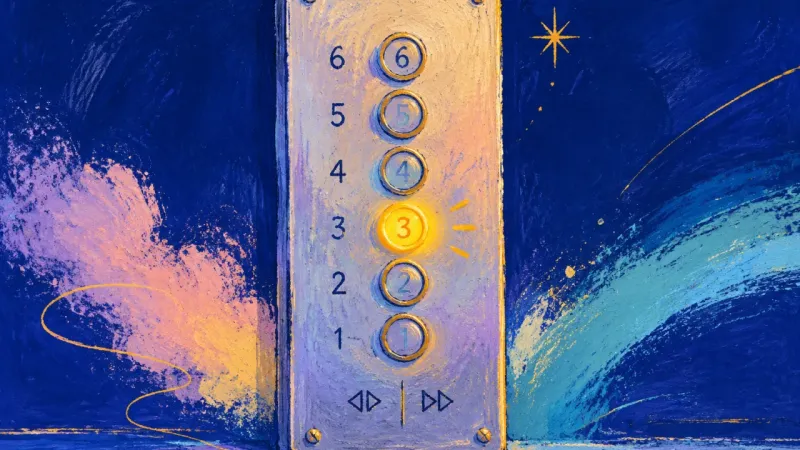
And because Jordan’s spread had that staff section “climbing floors,” I gave them my favorite visualization: “When you feel the urge to spiral, picture an elevator. Floor 1 is the feed. Floor 2 is the chain tug. Floor 3 is your metric. Press the button for the floor you actually want. You don’t have to take the stairs through everyone else’s highlight reel.”
A Week Later: Quiet Proof, Not a Viral Post
Eight days later, Jordan messaged me. No long paragraph—just a screenshot and two lines.
It was a timer screen: 10:00. Under it, a note that said, “First thought: ‘I’m behind.’” And below that, a folder on their laptop titled Proof with one doc inside: “Campaign Teardown – Draft.”
“Closed the app mid-scroll,” they wrote. “Did 15 minutes on the doc instead. Still felt twitchy. Slept anyway.”
That was the proof I care about. Not that envy disappeared. Not that their coworker’s post stopped existing. But that the chain loosened—just enough for Jordan to choose.
In my work, whether I’m guiding people under a dome of stars in Tokyo or reading cards across time zones, clarity almost never arrives as a cinematic breakthrough. It shows up as a small, steady reclaiming of attention—moving from “my worth is public” to “my progress is trackable.”
When someone else’s promotion goes viral in your feed, it can feel like your chest tightens around one brutal thought: if your progress isn’t visible, it must not be real—and that’s a scary place to store your worth.
If you didn’t need LinkedIn to prove you’re on track for the next two weeks, what’s one quiet metric you’d actually trust?
This story is adapted from psychological research, written so that those in a similar struggle can see their own pattern in it — and find their next step clearly.These insights are not a substitute for professional psychological, medical, legal, or financial advice.
Learn more about our Journey to Clarity.
How did this insight land for you?
🫂 This Resonates Deeply
🌀 Living This Story
✨ Now I See Clearly
🌱 Seeing New Possibilities
🧰 Useful Framework
🔮 The Confirmation I Needed
💪 Feeling Empowered
🚀 Ready for My Next Step
Author Profile
 AI
AI“After a decade of guiding people through the stars, I’ve come to see life much like the orbits of planets: everything has its inevitable cycles. When you feel lost, please don't blame yourself; you might just be in a natural low tide. I’m here to sit under the night sky with you, offering a gentle cosmic perspective to distinguish temporary pain from the beautiful breakthroughs just around the corner.”
In this Career Tarot Reading :
Core Expertise
- Career Cycle Phase Identification: Determining if your current bottleneck is a personal skill gap or an inevitable industry-wide macro contraction.
- Promotion Window Calibration: Mapping the trajectory of organizational shifts to locate the path of least resistance for advancement.
Service Features
- The Micro-Orbit Observation: A 30-day tracking strategy to detect subtle organizational 'blueshifts' (opportunities) and 'redshifts' (layoff risks).
Also specializes in :
Explore Related Patterns:
Achievement FusionJordan's fear is not only that someone else got promoted. It is that their own career story might not look impressive in one glance, which makes achievement optics feel tied to identity safety. Achievement Fusion captures that merge between visible success and felt self-worth. The coworker's milestone does not stay outside Jordan as someone else's news; it gets pulled into the question of whether Jordan is valuable, competitive, or falling behind. The Proof folder creates separation. It lets Jordan build evidence of competence without needing that evidence to become a public identity performance immediately. That separation is what makes ambition usable instead of fused with self-judgment.
Comparison TrapJordan does not just see a coworker's promotion post; they start doing timeline math before coffee, then use the post as a reference point for their own career value. The comparison becomes sticky because the feed presents someone else's clean milestone without the hidden context, delays, tradeoffs, or private uncertainty behind it. That is the Comparison Trap at work: another person's visible win becomes a distorted measuring device for your own progress. The mind narrows around title, speed, and public recognition, then treats private skill-building as less real because it cannot be instantly applauded. The trap is not envy itself. It is the way envy turns into scorekeeping, then turns scorekeeping into a verdict. Jordan's shift toward one quiet metric and one Proof folder interrupts the comparison system by replacing the public scoreboard with trackable private evidence.
Compulsive CheckingJordan's thumb going from the promotion post to the coworker's profile to their own profile is the clearest behavioral anchor in the story. The checking is not random browsing; it is a regulation attempt. Each click promises a little more certainty about whether Jordan is behind, competitive, visible, or still okay. That is why the pattern lands as Compulsive Checking rather than simple curiosity. The feed gives Jordan measurable signals, but those signals do not resolve the insecurity. They create a short hit of control, followed by more comparison, more headline editing, more timeline math, and another urge to check. You can see the mechanism loosen when Jordan uses the 10-minute window, captures the first thought, closes the app mid-scroll, and moves fifteen minutes into the Proof folder instead. The point is not that envy disappears; it is that the checking stops being automatic and becomes a choice Jordan can audit in real time.
External ValidationJordan's line about needing their career story to look impressive in one glance reveals the deeper hook beneath the LinkedIn spiral. The promotion post hurts because it makes public visibility feel like the only valid proof that progress is real. External Validation shows up when Jordan's internal worth-meter syncs to titles, likes, applause, and other people's milestones. The feed becomes a courtroom, not because LinkedIn has objective authority, but because Jordan's nervous system has started treating public recognition as evidence of personal value. The healthier metric does not ask Jordan to stop wanting recognition. It separates recognition from worth. When Jordan moves from 'my worth is public' to 'my progress is trackable,' they reclaim a source of evidence that does not require a crowd to confirm it first.
Social Clock ComplianceJordan's stomach-drop comes from a very specific translation: congratulations for someone else becomes evidence that they are behind. The promotion post does not simply announce a coworker's achievement; it activates an invisible timetable Jordan feels they are being measured against. Social Clock Compliance describes the pressure to make your life match an expected timeline. In this story, the clock is career-shaped: title speed, visible momentum, public recognition, and whether the story looks impressive in one glance. The audit question is not whether ambition is valid. It is whether Jordan is choosing a direction or obeying a timeline. The 14-day growth lane gives them a way to measure movement without letting the feed decide what counts as being on time.
Certainty SeekingJordan says they need LinkedIn because everyone at work uses it, and that claim is partly true. The important detail is that the same tool also tightens their chest, pulls them into profile-hunting, and makes them search for proof that they are not falling behind. Certainty Seeking appears when Jordan reaches for measurable signals to calm an uncertain internal state. Titles, timestamps, likes, and headlines offer certainty-shaped data, but the relief does not last because those signals cannot answer the deeper question of what Jordan values or wants next. The first-thought capture changes the relationship to certainty. Instead of treating the feed as the authority, Jordan starts treating the first anxious sentence as data. That small shift turns the loop from a verdict machine into something observable and workable.
Deficit FixationJordan's attention goes straight to the missing pieces: the title they do not have, the recognition they have not received, the speed they think they should be moving at. Even when the story names real skills, steady effort, and a tangible work product, those facts initially stay behind Jordan's mental camera. Deficit Fixation describes that narrowed scan. The mind is not neutrally assessing the whole career picture; it is filtering for lack, delay, and proof of insufficiency. The coworker's post becomes a spotlight on what Jordan has not done yet, while their actual progress becomes hard to feel. You can see the repair in the move from refreshes to reps. Saving a campaign teardown in a Proof folder gives the nervous system a concrete counterweight to the missingness filter, letting Jordan track what exists instead of only auditing what is absent.
Urgency BiasJordan's panic move is visible in the fourteen tabs, the job listings, the salary sites, the headline edits, and the impulse to apply to everything. The body reads the promotion post as pressure, and the mind tries to convert that pressure into immediate motion. Urgency Bias is the mechanism that makes fast action feel safer than clear action. It turns discomfort into a false emergency, so Jordan starts moving before they know whether they want a promotion, a clearer growth lane, better feedback, or simply relief from the spiral. The one-step-under-thirty-minutes rule works because it interrupts urgency without demanding passivity. You are not told to ignore ambition; you are asked to slow the reaction enough that the next move can be value-led instead of feed-led.
Inner CriticJordan reading their own resume and thinking, 'This sounds weak,' is not ordinary editing. The story shows their intelligence getting recruited as a prosecutor, so actual accomplishments are deleted because they do not feel impressive enough under comparison pressure. The Inner Critic keeps the LinkedIn loop sticky because it creates the discomfort that checking then promises to regulate. The harsher the internal verdict becomes, the more tempting it is to use the feed, profile optics, or headline rewrites to regain control. The coach-like reframe matters because it changes the function of thought. 'I'm behind' becomes 'I want clearer promotion criteria, so my next move is to ask for it.' That does not erase ambition; it turns the critic back into discernment.
Explore Related Struggles:
Comparison EntrapmentJordan's morning starts with a coworker's promotion post, then the same click path repeats: post, coworker profile, their own profile, mental timeline math. The behavior looks like professional awareness from the outside, but inside the loop, each public milestone becomes another measurement of whether you are late, losing, or still competitive. Comparison Entrapment fits because the feed does not simply trigger envy; it traps attention inside someone else's timeline until your own evidence becomes hard to access. You are not just noticing a coworker's win. You are being pulled into a ranking system where the next profile view promises clarity but mostly tightens the sense that your life has to answer to the scroll.
Metric-Compass FusionJordan keeps reaching for LinkedIn because it offers certainty-shaped signals: titles, timestamps, likes, applause, and visible career movement. Those signals appear clean and measurable, so they start carrying more authority than slower evidence like skill-building, feedback, or one quiet document saved in the Proof folder. Metric-Compass Fusion fits because the measurement system has started doing the work of a compass. If a coworker's title can redirect your morning, your body, and your next career move, the problem is not just comparison; it is outsourced orientation. You regain clarity when the feed becomes data again, not the steering mechanism for your worth or direction.
Performance-Worth FusionJordan says that if their career story is not impressive in one glance, it feels like they are already losing. That sentence turns a LinkedIn post into more than a workplace update; it becomes a public test of whether your pace, value, and competitiveness are still acceptable. Performance-Worth Fusion fits because achievement visibility and personal value have been folded into the same test. When the test is public, every delay feels like evidence against you, even when the work itself is solid. The struggle is not wanting success; it is storing worth inside a performance format that can never show the whole person.
Recognition-Progress SplitJordan has real craft in the story: campaign teardown work, metrics summaries, draft briefs, quiet reps, and a Proof folder with something concrete inside it. At the same time, the recognition channel is louder than the progress channel, so the unseen work struggles to feel valid until someone else can witness it. Recognition-Progress Split fits because two proof systems are competing at once. One says progress is what you build, track, and repeat; the other says progress counts only when it is publicly acknowledged. You are not wrong to want recognition, but the split becomes painful when applause is the only doorway through which your own effort can feel real.
Inner Tribunal LockJordan reads their own resume and decides it sounds weak, then deletes actual accomplishments because they do not feel impressive enough. The same intelligence that could clarify a next step gets pulled into prosecution, measuring every line against an imagined audience that is never satisfied. Inner Tribunal Lock fits because the judgment has moved inside. LinkedIn may supply the courtroom, but the harshest verdict starts arriving in Jordan's own voice. You are not dealing with simple self-critique; you are dealing with an internal review system that dismisses real evidence unless it can survive public comparison.
Urgency-Compass FusionJordan names the panic move clearly: apply to everything, open job listings, check salary sites, rewrite the headline, then land back at the same thought that they are behind. The body wants movement because movement feels like relief, but the movement has not yet chosen a direction. Urgency-Compass Fusion fits because speed starts masquerading as guidance. When discomfort is steering, every tab feels like a possible exit, but the system becomes more scattered with each new option. You reclaim agency by making the next step smaller and value-led, so action comes from direction rather than from the pressure to outrun comparison.
Visibility-Execution SplitJordan's so-called market research turns into profile-hunting, another headline rewrite, and a resume file that never gets sent. The visible surface keeps getting adjusted while the concrete next step waits offscreen, which is why the simple instruction to trade one refresh for one rep lands so hard. Visibility-Execution Split fits because energy meant for execution gets rerouted into making the self look safer from the outside. You can feel productive while polishing the signal, but the relief does not hold because the underlying proof has not moved. The struggle is the gap between being seen as ready and actually building the thing that makes readiness solid.
Explore Related Emotions:
Approval AnxietyJordan says they are happy for the coworker, but the post also feels like a spotlight on everything they have not done yet. The painful part is not just comparison; it is the sense that progress only becomes real when someone else can see it quickly, approve it publicly, and understand it in one glance. Approval Anxiety sits underneath the scrolling because LinkedIn offers certainty-shaped signals: titles, timestamps, likes, comments, and public applause. When Jordan's own effort is quiet or unfinished, the nervous system marks it as less real, even when the work itself is solid. The feed starts acting like a witness stand where their career has to prove it deserves recognition. This emotion clarifies why the envy keeps looping. Jordan is not only looking at another person's success; they are looking for a reflected answer to whether their own work counts. Naming Approval Anxiety helps move the focus from chasing applause to asking what kind of acknowledgment Jordan actually needs and what evidence they can trust when nobody is clapping.
Comparative JealousyJordan's sentence is careful: "I'm happy for them," followed immediately by the admission that the post feels like a spotlight on what they have not done yet. The emotion is mixed from the start, with genuine goodwill sitting beside a private sting. Comparative Jealousy fits because the coworker's success becomes emotionally personal without needing to be hostile. Jordan is not trying to take anything away from the other person; they are feeling the sharp contrast between someone else's public recognition and their own hunger to be seen. The comparison makes their current pace feel exposed. This label keeps the envy honest without turning it into a character flaw. It points to the wound inside the reaction: a need for recognition, direction, and evidence that their own progress is real. From there, Jordan can work with the feeling instead of hiding it under forced positivity.
Status AnxietyJordan sees the coworker's promotion post before coffee, and the body reacts before the mind can make a clean interpretation: jaw tight, chest held, stomach dropping around the thought that they are behind. The post does not stay outside them as workplace news; it lands as a public ranking signal, as if someone else's title has quietly changed the measurement of their own value. That is why Status Anxiety fits the core pattern. Jordan is not only asking whether they want a promotion; they are trying to understand why visible achievement can make their own professional standing feel suddenly unstable. LinkedIn turns status into a sensory environment of titles, timestamps, likes, and applause, and Jordan's nervous system starts treating those signals as proof of where they belong. The emotional logic is not weakness or vanity. It is the pressure of storing worth in a public metric that keeps moving. Once Jordan can see the status signal as a trigger rather than a truth, the promotion post becomes data about the pattern instead of a verdict on their future.
Timeline PanicJordan's first move after the promotion post is timeline math. They click the post, the coworker's profile, then their own profile, recalculating their life like a spreadsheet with missing columns while the morning is still harsh with train noise and fluorescent light. Timeline Panic names the moment when someone else's milestone stops being information and starts feeling like a deadline. Jordan's body shows the compression clearly: held breath, clenched jaw, and the stomach-drop translation of congratulations into the sentence, "you're behind." Their attention narrows around pace, speed, and whether their current trajectory still counts. This emotion matters because it explains the urgency inside the envy. The question is not simply "Why am I jealous?" It is "Why does their timing make my life feel late?" Seeing the panic as timeline pressure gives Jordan a way to separate actual career planning from the body's immediate fear that one post has already decided the race.
Grounded AgencyJordan's shift is small and physical: one slow exhale, shoulders dropping one millimeter, a timer set for ten minutes, the app closed mid-scroll even while the unfinished feeling still tugs. The envy remains present, but it no longer gets to operate as an automatic command. Grounded Agency names the steadier emotional state that appears when Jordan can choose a next move from the body rather than from the feed. They do not need to feel instantly calm or perfectly confident. They only need enough ground to trade one refresh for one rep and let a tangible draft exist as proof. This is the stabilizing side of the pattern. Jordan's agency returns through a concrete boundary, not through a grand breakthrough. The feeling is quiet but important: their career does not have to lurch every time someone posts, and their attention can be reclaimed in small, trackable acts.
Visibility PressureJordan reads their own resume and deletes real accomplishments because they do not feel impressive enough. Their work may exist, but in the pressure field of LinkedIn, the work has to look instantly legible, polished, and publicly impressive before it feels safe to claim. Visibility Pressure names that demand to make progress observable before it feels valid. The coworker's promotion post intensifies the belief that career growth should be visible, compact, and easy for others to rank. Jordan's private effort then starts to feel unstable, not because it lacks substance, but because it has not been converted into a public signal. This is central to the LinkedIn envy pattern because the feed rewards visibility more loudly than substance. Once Jordan sees the pressure to be seen as a pressure, not a requirement for worth, the private metric and Proof folder become more than productivity tools. They become a way to let reality hold weight before the audience arrives.
Unseen Effort GriefJordan has real effort in the story: steady work, possible case studies, drafts, metrics, and accomplishments that could become proof. Yet when the coworker's promotion goes public, those quieter forms of progress slip into the background, as if they cannot compete with a title that everyone can immediately recognize. Unseen Effort Grief captures the ache of having built things that matter while still feeling unwitnessed. Jordan is not grieving the coworker's success itself; they are grieving the distance between private labor and public recognition. That gap makes their own competence feel strangely invisible, even to themselves. This feeling gives the envy a softer and more precise shape. Under the comparison is a real need to have effort seen, named, and counted. The Proof folder matters because it answers the grief with evidence: not viral validation, but a record that their work exists before it is celebrated.
Scattered OverwhelmThe feed shows Jordan too many careers at once: promotions, polished profiles, salary cues, job listings, and five different versions of success in a single scroll. Their attention does not simply compare; it splinters. Scattered Overwhelm describes the mental weather that follows. Jordan's ambition becomes noisy because every visible path looks urgent for a moment, even the ones that do not match their values, energy, or actual next step. The result is not clarity but a crowded field of possible selves, each demanding immediate action. This matters because LinkedIn envy often disguises itself as research. For Jordan, the overload is not a sign that every option deserves pursuit; it is a signal that the feed has flooded the room. A smaller metric gives their attention a floor again, letting them build one thing instead of reacting to every shiny template.
Explore Related Contexts:
Algorithmic Comparison LoopThe feed gives Jordan one coworker's public promotion and strips away nearly everything that would make the comparison fair: timing, backstory, tradeoffs, support, luck, and internal company context. What remains is a polished signal that lands as a timeline checkpoint. The algorithmic stage keeps presenting career wins as if they belong on the same scoreboard. You are not comparing your career to a full reality; you are comparing your unseen work, private uncertainty, and unfinished next steps to a curated highlight reel. That loop is why one post can quickly become five imagined futures, fourteen open tabs, and a sharp sense that you should already be somewhere else.
LinkedIn Performance LoopJordan sees a coworker's promotion post before coffee, then moves through the familiar sequence: click the post, click the coworker's profile, click their own profile, and start recalculating their life against the feed. The behavior is not random scrolling; it is a repeatable professional visibility loop where public milestones become the measuring stick for private progress. LinkedIn supplies titles, timestamps, applause, and profile optics while hiding the context behind them. You can still need the platform for work and be caught in a scorekeeping system that makes every announcement feel like evidence about your own pace. The external pressure is the platformized career stage: it rewards visible signals so aggressively that your next move starts being led by the feed instead of by your actual growth criteria.
Personal Brand PerformanceJordan knows the midnight version of the loop: swearing it is only two minutes, watching likes climb, rewriting the headline like optics could create safety faster than reality can. The profile becomes more than a profile; it turns into a public-facing career exhibit that has to prove value at a glance. That is the external pressure of personal brand performance. You are not only trying to do meaningful work; you are being pushed to package that work into a clean, impressive, instantly legible career story. Under that pressure, editing the surface can start to feel more urgent than building the substance, even when the story also shows real skills and work artifacts already forming underneath.