Identity Fatigue: From a Polished Persona to One Current Value

Identity Fatigue Beneath the Polished Voice
"You are a London communications coordinator who can make any update sound confident, then leave it in drafts because the polished voice belongs to an older version of you." I said this to Jordan, then waited to see whether the words reached the room.
It was 8:12 on a Tuesday morning in the small shared-flat kitchen. I watched Jordan open a draft post before work, rewrite the first three lines into the familiar polished tone, and save it again without publishing. The kettle clicked off, the laptop fan hummed, and the faint smell of burnt toast hung beneath the blue-white light of the screen. Her jaw tightened as if the next sentence had to pass through a narrow gate.
"Why do I keep performing a public self that no longer feels like me?" she asked. She wanted a public self that felt current to become visible, but feared that dropping the familiar version would leave her without any recognizable identity. She kept speaking, posting, dressing, and agreeing in ways that made sense to everyone else, then replayed the interaction later because the words felt borrowed.
I could feel the shape of her identity fatigue without asking her to dramatize it. Alienation sat in her like a glass wall: she could see herself moving through conversations, but every gesture arrived a fraction of a second late. Beneath it were grief for the person she had once been, shame about sounding rehearsed, and longing to be visible without having to explain a complete transformation.
"You are not necessarily trying to deceive anyone," I told her. "You may be protecting a version of yourself that still gets recognized when work, rent, and social uncertainty make visible experimentation feel risky. We can look at the structure without treating it as a moral failure. Today, let us draw a map through the fog and see what your own observations already know."
The Old Facade and the Five-Card Map
I asked Jordan to take two slow breaths and hold one question in mind: what is the familiar public self protecting, and what might have room to appear if that role stopped doing all the talking? I shuffled slowly, not to summon a fixed answer, but to create a clean pause between the automatic story and the attention required to examine it.
For anyone wondering how tarot works in an identity transition, I use the cards as an objective cognitive tool rather than a prediction machine. The images give vague inner signals a visible structure. We can compare a symbol with a real behaviour, test whether the interpretation fits, and keep whatever helps us notice a choice more clearly. The cards do not decide who Jordan is, and they do not determine what she must do.
Today I used the Shadow Spread · Context Edition, a five-card tarot spread for a public identity that no longer matches the felt self. A Celtic Cross would have widened the reading toward external outcomes, but this question needed inner excavation: the visible performance, the attachment beneath it, the root pattern, the transformative resource, and one practical experiment. The layout descended like an old facade opening onto a narrow path toward daylight.
The first position would show the observable behaviour: the familiar public persona still speaking through posts, introductions, and agreements. The second would reveal the hidden attachment and the fear that made change feel dangerous. The third would name the root script that turned reflection into delay. The fourth would offer an integration resource, and the fifth would translate insight into one low-stakes public action.
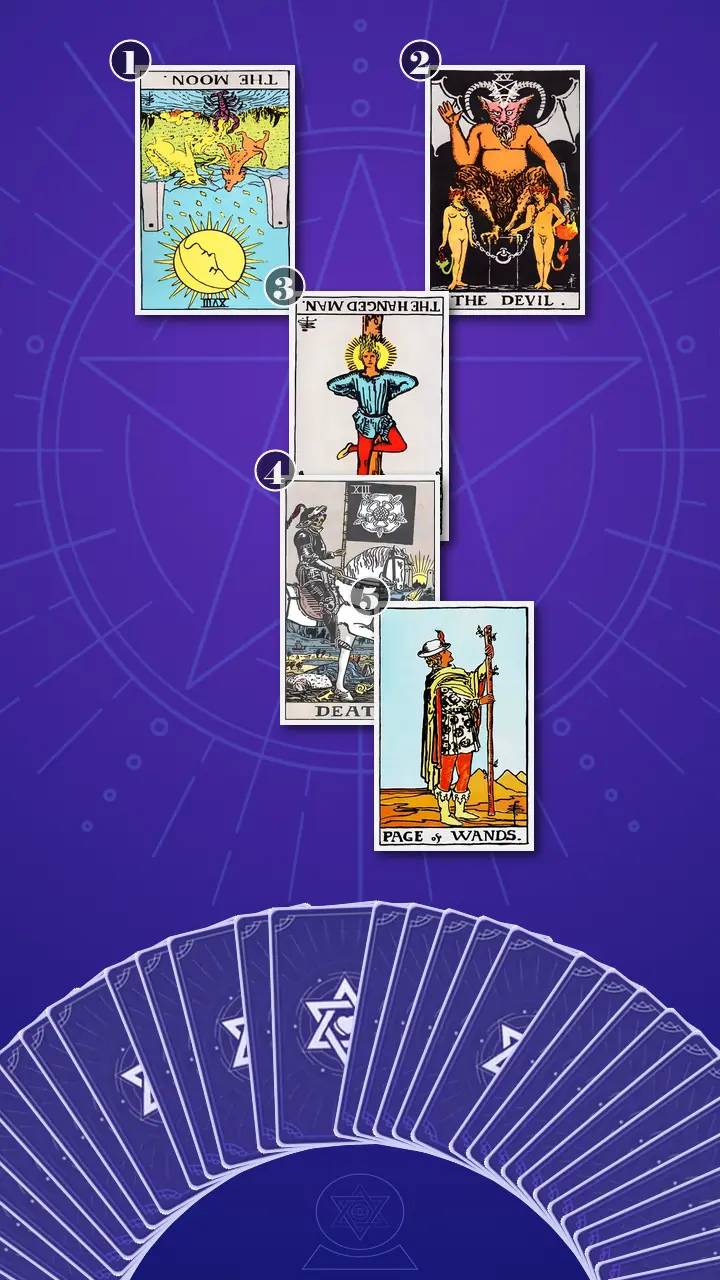
The Moon's Winding Path Through the Old Profile
The Visible Mask: The Moon Reversed
Now I am turning over the card for the position that shows the observable behaviour from the presenting problem: continuing to speak, post, and agree through a familiar public persona even when it no longer feels like me. The card is The Moon, in reversed position.
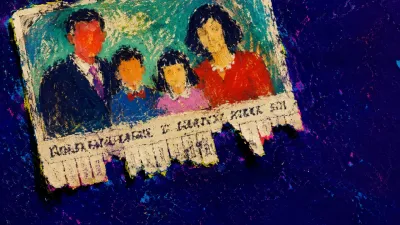
The Moon reversed brought me straight to the polished LinkedIn profile, the Instagram bio, and the rehearsed team introduction that still reflected an earlier self. The old wording was not completely false; that was part of its difficulty. Its projected light made the present self harder to see. The winding path between the twin towers looked like the sequence Jordan knew too well: draft, edit, doubt, delete, and return to the safer sentence. The dog and wolf faced the moon like two responses inside her, one socially trained and one not yet familiar. Below them, the crayfish was already emerging from the water. The mismatch had begun to surface.
Reversed, the Moon showed blocked water and an excess of reflection. Jordan was not missing all perception; she was receiving too many uncertain reflections and treating them as instructions. I asked, "Which phrase in your current public story expresses a living value, and which phrase is only a reflexive script?"
On archaeological digs, I learned that a surface artifact can be important without being the whole settlement. I call this lens Cognitive Stratigraphy: I treat a sudden emotional trigger as a surface artifact, then carefully dig downward toward the older belief that gives it so much force. Here the tight jaw before posting was not proof that Jordan had no real self. It was evidence that an old rule had been touched: keep sounding recognizable, or you may lose your place.
Jordan did not nod. She gave a short, bitter laugh. "That is too accurate," she said. "Almost cruel." Her fingers moved to the edge of her mug and rubbed the same spot twice.
"The card is not accusing you," I said. "It is showing where the fog has become a habit. The useful response is not to disappear from every public channel to prove the old persona is gone. It is to separate one living value from one automatic phrase, then make one deliberate edit for clarity rather than rewriting yourself into a new performance."
The Familiar Password That Still Opens Doors
The Hidden Attachment: The Devil Upright
Now I am turning over the card for the position that reveals the hidden attachment and underlying fear: what the familiar public self protects and why changing it feels threatening to belonging or control. The card is The Devil, in upright position.
The Devil showed the old career story as a social security system. Jordan kept the LinkedIn headline because it reliably earned a nod in professional conversations, prevented follow-up questions, and reassured colleagues that everything was on track. The familiar tone still brought replies, introductions, and approval. Like the loose chains around the figures in the card, the attachment was powerful through repetition and consent, not because it was permanently locked.
I pointed to the chains rather than the horned figure on the pedestal. "What does this version give you in the next five minutes?" I asked. "Recognition, professional credibility, access, fewer questions, control? And what does it cost you before the hour is over?"
Her inner monologue seemed to arrive before her answer: "If this version still opens doors, I cannot be the one to remove it." That was the short-term bargain. Belonging and control stayed predictable, while her range of tone, opinion, and desire grew smaller. She was not fake because she had a polished public self. She was exhausted because the role had become the only permitted route to being understood.
Jordan pressed her thumbnail into the side of her finger, then released it. "Professional credibility," she said. "And not having to explain why my answer has changed." I let the silence stand long enough for the cost to become hers to name. The chains were visible, and visible chains could be examined.
"Recognizable is not the same as current," I said. "We are not trying to destroy the useful parts of your competence. We are asking whether the old identity is still serving your values, or whether you are paying for social smoothness with another evening of self-editing."
The Notion Page With No Departure Time
The Root Suspension: The Hanged Man Reversed
Now I am turning over the card for the position that names the root pattern behind existential drift and inner conflict: the stalled perspective, limiting belief, or repeated internal script that keeps the old performance running. The card is The Hanged Man, in reversed position.
The Hanged Man reversed showed a pause that had stopped changing perspective. I could picture the Notion page Jordan had described, titled "New Identity," accumulating notes, links, career-pivot stories, and carefully worded bio drafts while the old profile stayed live in another browser tab. The suspended figure, hanging by one foot with a calm halo around his head, suggested that reflection could become insight. Reversed, the crossed legs looked less like chosen contemplation and more like a waiting room with excellent organization and no departure time.
The energy here was stagnant: too much analysis, too little surrender to a bounded experiment. Jordan kept waiting for a complete explanation before allowing any visible change. "I will change it once I can explain the whole thing," she said, almost under her breath. Her shoulders rose, and her eyes lost focus as though she were watching another evening of research replay on a screen behind me.
"A useful pause gives you a new perspective," I said. "A postponing pause asks for certainty before it permits contact with the present. Reflection becomes another performance when it keeps you from one honest experiment. The question is not whether you have thought enough. It is whether the thinking has produced one small thing you can safely test."
I suggested a twenty-minute boundary for the next week: write what is no longer true about the public persona, choose one behaviour to test, and stop when the timer ends. Jordan's fingers, which had been gripping the mug, loosened slightly. She looked uncomfortable, but the discomfort now had edges rather than an endless centre.
When Death Cleared the Path to Daylight
The Transformative Bridge: Death Upright
Now I am turning over the card for the position that shows the transformative resource that can address the collapse of the public mask by allowing an outdated identity form to end without demanding an immediate replacement. The card is Death, in upright position. The room seemed to quiet around it.
I read Death as a symbol of necessary ending, transition, and release, never as a literal forecast. The white rose on the black banner made the ending deliberate rather than destructive. The fallen king showed that status could not preserve a role after its meaning had expired. Between the twin towers, the rising sun offered a horizon without requiring Jordan to announce a finished identity.
This is where I use what I call Ruins Restoration Thinking. A ruin is not automatically a failed building; sometimes its original function has completed, and restoration begins by preserving what is structurally alive rather than rebuilding the old facade exactly as it was. Jordan did not need to bulldoze her competence, relationships, or work history. She needed to stop reviving the costume that once made those qualities easy for other people to label.
I asked her to picture 8:47 PM on the Northern line: the polished draft reopened, the carriage brakes shuddering, her jaw locking, and the honest sentence still seeming capable of making her unrecognizable. The old career story remained socially useful, yet inwardly it had already stopped carrying her.
I said, "You do not have to keep a public identity alive just because it once made you recognizable. Let the outdated form end, then let one present value guide one small visible choice."
Then I gave the bridge its sharpest form:
Stop treating public consistency as proof that you are real; let the old role fall away and let one present value guide your next visible choice, like Death clearing the path for the sun.
For one beat, Jordan froze. Her breath stopped high in her chest, her fingers hovered above the card, and the muscles around her mouth held themselves still. Then her gaze slipped out of focus. I could see the team introduction, the old LinkedIn headline, and the familiar career answer moving through her mind as if each scene were being replayed without its usual soundtrack.
Her brow tightened. "But does that mean I was wrong before?" The question carried a sudden flash of anger, not relief. I did not rush to replace the old role with a cheerful new identity. I told her that a role could have protected her, helped her build credibility, and still be complete now. Her eyes reddened. The clenched hand beside her knee slowly opened, her shoulders dropped, and a breath left her in a thin, trembling sound. The relief was real, but it brought a brief light-headedness: clear ground could feel exposed after years of standing on a script.
"Now," I said gently, "use this new perspective to remember whether there was a moment last week when this insight might have made you feel differently."
Jordan returned to the team introduction and imagined leaving one sentence plain instead of polishing it into the old voice. The shift was small but significant: from stagnant self-monitoring and fear of becoming socially unrecognizable toward present-value clarity, exploratory self-trust, and the permission to be unfinished in public.
A Small Fire, Not a Finished Brand
The Practical Integration: Page of Wands Upright
Now I am turning over the card for the position that provides a concrete, low-stakes next step for letting a current value shape one public action this week. The card is the Page of Wands, in upright position.
The Page was not looking at an audience. He was looking at the sprouting wand in his hands, standing in an open landscape with curiosity rather than a presentation prepared. The salamander-patterned tunic suggested living fire, but not a dramatic personality makeover. After Death, the energy had become available again: a balanced, exploratory fire that could learn through contact with ordinary life.
"What value would you be willing to let appear before you know whether it is your new identity?" I asked. Jordan considered the question, then said, "Curiosity. Maybe directness. Something that does not need to sound finished."
I invited her to imagine one ordinary sentence in a Slack message, a social comment, a casual plan, or a team conversation. The goal was not to prove that she had changed. It was to observe what happened when a present value entered public space without being polished into a brand. Jordan wrote one sentence, read it once, and did not immediately add a paragraph explaining what she meant.
The Ruins Were Not the Person
When I placed the five cards together, the story became coherent. The Moon showed Jordan noticing that the public image no longer reflected the felt self. The Devil revealed why the old form was difficult to release: it still supplied belonging, credibility, access, and control. The Hanged Man showed the root suspension beneath the existential drift, where research and reflection postponed exposure. Death offered the bridge, not by predicting an outcome, but by allowing a completed role to end. The Page of Wands turned that release into one curious, observable experiment.
The blind spot was not simply that Jordan had been overthinking. It was that she had been treating recognizability as identity and the absence of a replacement story as proof that no real self existed. My reading pointed in the opposite direction: stop treating public consistency as evidence of who you are, and let one present value shape one small public choice. A developing self does not need to arrive as a finished brand.
I explained that this was the practical form of Ruins Restoration Thinking. We would keep the foundation that was still sound: communication skills, professional care, meaningful relationships, and hard-won experience. We would retire one expired name tag rather than demolish the whole building. The following actionable next steps were designed to protect Jordan's work, privacy, money, and consent while giving the present self somewhere to stand.
- Retire one old name tag.On Thursday evening, open the bio, introduction, or recurring career answer Jordan uses most often. Highlight one phrase that describes a past ambition rather than a current value, write a plain replacement in a private note, wait twenty-four hours, and update only that sentence if it still feels right.Save the original privately and treat the edit as a one-week trial, not a public declaration. Leave anything affecting employment, safety, or consent unchanged until the practical boundaries are clear.
- Run a Current-Value Visibility Test.Choose one value, such as curiosity or directness, and within seven days let it shape one visible sentence in a Slack message, a conversation, a social comment, or a casual plan. Afterwards, record what happened and what your body noticed.Keep the experiment ordinary and reversible. You choose the audience, timing, and whether the sentence is shared; the point is information, not proof.
- Use the Trigger Excavation Exercise with a one-edit clarity limit.When the jaw or chest tightens before one low-stakes message, set a ten-minute timer and write the current trigger, the old rule it seems to activate, the present facts, and the value you want the message to carry. Draft once, make one edit for clarity or grammar, then send it, keep it private, or stop.If the exercise feels too exposed, write the value alone and test it through a small choice instead. The familiar polished voice may return automatically; that does not invalidate the experiment.
These are small steps because identity transition does not become safer when every change is made into an announcement. The cards had not asked Jordan to quit, rebrand, disclose more, or promise certainty. They had helped her create a bounded space where present values could produce evidence.

A Week Later, the Quiet Proof
Four days later, Jordan sent me a message: "I changed one sentence in my bio to say I am exploring curiosity-led work. I did not announce anything." That evening, she sat alone in a cafe, pleased but not celebratory; "What if I am wrong?" returned with the coffee, and she let the question remain.
I saw the first proof of the Journey to Clarity there. The old fear had not vanished, and the public story was not solved. But Jordan had stopped asking uncertainty to provide a verdict. She had let one current value speak before it could explain an entire life.
The cards had offered images, not authority. Jordan made the choices. The Moon helped her notice the reflection, The Devil showed the bargain, The Hanged Man named the delay, Death opened the threshold, and the Page of Wands carried one unfinished sentence into the world. The querent remained the person with agency, boundaries, and the right to decide what belongs in public.
When your jaw tightens at the thought of becoming harder to place, the exhaustion is not proof that you have no self; it may be the ache of outgrowing a version that once made belonging predictable. Clarity can be the first thin daylight beyond the twin towers, not a finished answer.
If one current value could choose one small, unrehearsed sentence this week, what might you let remain unfinished rather than explain into certainty?