The 10:47 p.m. Hyper-Independence Help-Refusal Loop
“I’m the reliable project coordinator who says ‘I’ve got it’ before anyone finishes offering help, then spends Wednesday night stuck in the mess I made by refusing.” That was how Casey, a 29-year-old digital project coordinator in Toronto, introduced themself on our video call.
They described sitting alone at their small Parkdale kitchen table at 10:47 p.m. The refrigerator hummed, cold coffee left a bitter film on their tongue, and the laptop pushed heat into their wrists as they replaced another teammate’s name with their own in the project tracker. Beside it, a Slack message remained open: “I can take the client notes if that helps.”
Casey wanted those notes taken. Yet the moment help arrived, their jaw tightened, their shoulders rose, and their guardedness came down like an office fire door slamming shut while relief was still trying to enter. “What am I protecting,” they asked me, “when I keep refusing help I actually want?”
The help is wanted; what feels dangerous is what receiving it might reveal. I told Casey that their refusal made sense as a protective response, even if it was now costing them sleep and connection. “Let’s give this fog a map,” I said. “Not so the cards can decide for you, but so you can see what your automatic no has been trying to do.”

Choosing a Map for What Hides Beneath the No
I invited Casey to take one slow breath while holding the question in mind, then I shuffled and laid four cards in a line. The pause was not a mystical performance. It was simply a way to move from rapid self-justification into focused observation.
I chose The Shadow Spread, a four-card shadow-work tarot spread mapping the visible refusal, the underlying fear, the protective function, and the integration response. For anyone wondering how tarot works in a reading like this, I treat the cards as structured prompts rather than fixed predictions. Their value lies in making a pattern visible enough to question.
The first position would show the exact moment Casey refused support. The second would uncover the belief that made a narrow offer feel dangerous. The third would reveal what the refusal protected and what it cost. The fourth would offer a practical way to receive support without surrendering agency. A larger spread would have added future outcomes and outside influences, but Casey’s question called for excavation, not prediction.
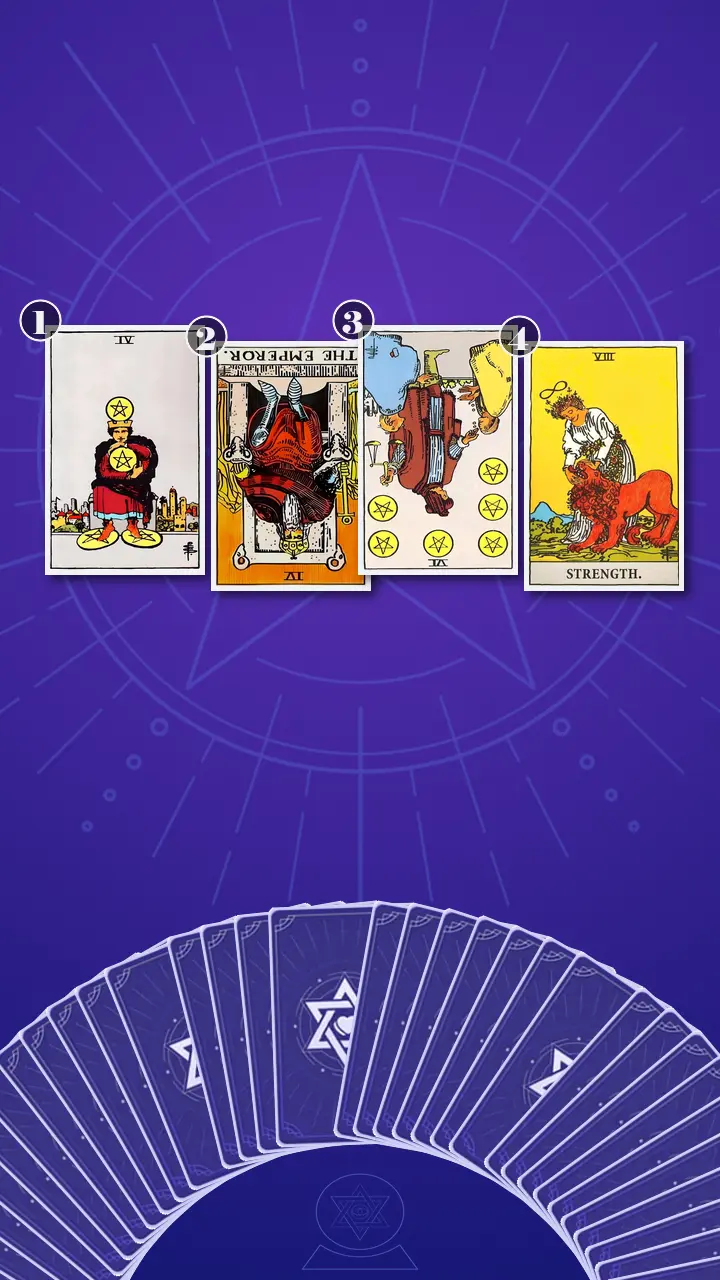
Reading the Hand That Would Not Open
Position One: The Owner, Reviewer, and Backup
The card I turned over first represented the presenting problem: the observable moment when wanted help was refused and sole ownership was retained. It was the Four of Pentacles, upright.
The figure pressed one pentacle against his chest and pinned two beneath his feet. I showed Casey how the closed posture resembled keeping every file permission, assignment, approval, and follow-up under one name. At 10:47 p.m., Casey was still the owner of every project-tracker row while the offer to take the client notes waited unanswered.
“The inner script sounds like, ‘I know I need help, but it will be easier if I just finish it,’” I said. “The short-term result is control. The longer result is that your hands remain too full to receive what you wanted.”
The card’s security energy was operating in excess. Control was not inherently wrong, but the grip required Casey to become the owner, reviewer, and emergency backup on every metaphorical project-board card. The resulting bottleneck then seemed to prove that only Casey could run the board.
Casey did not nod. First their breath paused, then their gaze dropped to their own hands, and finally a dry laugh escaped. “That’s too accurate. It’s almost cruel.”
“I’m not reading it as a verdict,” I replied. “That grip developed because control gave you something useful. We’re asking whether it is still protecting you, or whether maintaining it has become another task.” Their fingers loosened around the mug by a fraction.
Position Two: The Stone Throne Behind Competence
The card I turned over next represented the underlying fear: that accepting help could expose insufficient competence and destabilise a protected sense of worth. It was The Emperor, reversed.
I focused on the armour hidden beneath the red robes and the rigid stone throne. Reversed, the Emperor’s authority energy was blocked and overcorrected into rigidity. A colleague had offered to take meeting notes, but Casey’s mind processed the offer as if the colleague had requested control of the roadmap, the deadline, and the entire client relationship.
“What is the first ‘They might realise...’ sentence that appears?” I asked.
Casey’s answer came quietly. “They might realise I was never fully on top of it.” Their shoulders stayed high, but their eyes no longer left the card.
On archaeological digs, I learned that the visible face of a wall rarely explains why it was built. One must read the layers beneath it. I use the same disciplined lens here, something I call Cognitive Stratigraphy. The unanswered Slack message was the surface artifact. Beneath it lay a forecast: if someone entered the workflow, they might see strain. Beneath that was the older rule that competence remains credible only when no one else is needed.
I did not tell Casey that the card proved a specific trauma or history. Tarot cannot establish that. I asked instead whether the rule felt older than this job.
“Definitely,” they said after a long pause. “I don’t know where it started, but I know the feeling.”
“Then we can respect the uncertainty,” I said. “You are not only protecting control. You are protecting competence from becoming a public question.” Their chest contracted visibly, then softened with a slow exhale. The sentence had reached the load-bearing layer.
Position Three: The Invisible Invoice
The third card represented what the refusal protected Casey from experiencing and how that protection sustained overload, distance, and the help-refusal loop. It was the Six of Pentacles, reversed.
The scales in the giver’s hand and the unequal heights of the figures made Casey’s fear of hierarchy visible. A friend could offer a meal drop-off with no visit required, or a colleague could offer one set of notes, and Casey would immediately open an invisible spreadsheet: status change, possible scrutiny, future favour, repayment date.
The reciprocity energy was imbalanced. Casey was not evaluating the real offer because its terms had never been discussed. They were declining the imagined obligation beneath it. The card showed the protective bargain clearly: saying no prevented the immediate shame of feeling indebted or lower-ranked, but carrying everything alone produced exhaustion, isolation, and fewer future offers.
“What will this cost me later?” I said, naming the forecast. “That question arrives before ‘What is actually being offered?’”
Casey’s lips parted without an answer. Their eyes lost focus as if replaying several texts at once, then their shoulders lowered on a fuller breath. “I do that with everything,” they said. “Even dinner.”
“An offer is not an invoice, and clarification is not consent,” I replied. “You can ask about scope and still say no. You can also accept what was stated without inventing an extra repayment.” The card was not telling Casey to trust every offer. It was restoring their right to examine one before fear wrote its terms.
When Strength Opened Its Hands
Position Four: A Bounded Yes With the Final Decision Intact
The last card represented the key shift from total self-reliance to a bounded experiment in receiving support while retaining agency. As I turned it toward the camera, the refrigerator behind Casey clicked off. The sudden quiet seemed to widen the space between us. The card was Strength, upright.
I drew Casey’s attention to the woman’s calm, open hands around the lion’s jaws. She was neither forcing the animal into submission nor surrendering to it. Strength’s energy was balanced: courage expressed through regulated contact, clear limits, and patience rather than domination.
In modern terms, this was Casey pausing before the next automatic refusal and asking, “Do you mean just the client notes?” Once the scope was confirmed, they could answer, “Yes, please take those. I’ll keep the final client send-off.” The discomfort did not have to disappear before the choice became valid.
I call this Ruins Restoration Thinking. When a fortified identity begins exhausting the person it once protected, the cracks do not prove that the whole structure was worthless. They reveal where restoration is needed. Casey did not need to demolish their capable identity. They needed to preserve its load-bearing boundaries while adding a doorway through which one clearly defined contribution could pass.
At 10:47 p.m., the tracker had still been open and the offer to take the client notes had still been unanswered. Casey had wanted the relief, but their jaw tightened before their mind produced another reason to manage alone.
“Accepting one bounded piece of help is not giving up agency. It is choosing to stay in charge without making total control the price of feeling worthy.”
You do not preserve strength by keeping every hand away; you build it by choosing what to receive, like the woman who meets the lion with steady, open hands.
I let the sentence remain in the quiet.
Casey’s breath stopped for a beat. Their thumb hovered above the dark phone screen beside them, while their gaze moved past the cards as if an old sequence were replaying: the offer, the instant no, the late-night work. Their brows drew together before their eyes reddened slightly. Then their shoulders dropped, their clenched hand opened against the table, and a shaky breath left their chest. Relief appeared first, followed by something sharper. “But if that’s true, I could have done this months ago,” they said. “Does that mean I’ve been getting strength wrong?” For a moment, the clarity seemed to leave them almost dizzy, because it returned responsibility along with choice. I told them that an old protective strategy could become outdated without making their earlier self foolish. “Now, with this new perspective, think back: was there a moment last week when this insight might have made you feel different?”
Casey looked at the unanswered Slack message. “I could have let them take the notes without giving them the client decision.” The insight did not erase their discomfort, but it separated one task from the whole structure.
At my invitation, Casey opened their Notes app and completed a two-line draft: “Thanks. If the offer still stands, could you take the client notes by noon tomorrow? I’ll keep the final recommendation and client send-off.” I reminded them that they did not have to send it. If the scope felt unclear, they could ask first; if the discomfort rose too sharply, they could stop and return later. The draft was enough for that day.
This was the first movement from guarded overcontrol and isolated overfunctioning toward selective receptivity, negotiated support, and grounded self-respect. Casey was not becoming less capable. They were beginning to let capability include choice.
Finding Clarity Through a Permissions Menu
Taken together, the cards told a coherent story. The Four of Pentacles showed Casey protecting competence through closed ownership. The Emperor reversed revealed the hidden equation between shared input and lost authority. The Six of Pentacles reversed showed how the mind converted support into hierarchy and debt before learning the offer’s real terms. Strength supplied the unused resource: gentle self-command that could stay in contact with need without handing over the whole situation.
The blind spot was one of scale. Casey treated a narrow contribution as if it transferred total authorship, and treated a forecasted obligation as if it were already part of the agreement. The transformation was not from independence to dependence. It was from gripping the master password to using a permissions menu: another person could complete one task while Casey retained private information, final approval, and any non-negotiable boundary.
I also made the ethical limit explicit. The cards did not claim every offer was safe, equal, or free of strings. Casey remained entitled to clarify, negotiate, or decline. The key shift was simply to pause before the automatic no, establish the real scope, and choose from present evidence rather than an imagined invoice.
The Open-Hand Practice
I gave Casey three small next steps. Each was designed as an experiment, not a test of whether they could become perfectly receptive.
- The 60-Second Open-Hand Pause.Before replying to the next Slack message or friend’s offer, set a 60-second timer. Notice the first automatic-no sentence, along with the jaw, shoulder, or chest response, without sending anything yet.Tip: If a minute feels too exposed, take one breath and write only, “Part of me wants the help.”
- Scope Before Story.Reply to one offer with, “What would that include?” Then spend three minutes making two Notes columns: “What was actually offered” and “What I am predicting.”Tip: Clarification is not consent. Casey could still accept, negotiate, or decline after receiving the answer.
- The One-Task Bounded Yes.In Slack or email that week, accept one reversible contribution: “Yes, please take [task] by [time]. I’ll keep [decision or final check].” Meeting notes, one grocery item, or a 15-minute body-doubling call were enough.Tip: Keep final approval, private information, and non-negotiable deadlines under your control. Drafting the message without sending it still counts as practice.
I folded my Trigger Excavation Exercise into the first practice. When a reaction felt larger than the offer in front of them, Casey could record three layers: what happened now, what older rule or “epoch” the moment seemed to touch, and which facts belonged only to the present. They did not need to force a childhood explanation. The purpose was to stop the past from silently writing terms for the present.

Ownership, Not Certainty
Four days later, Casey sent me a brief message: “I used the draft. They took the notes. I kept the recommendation, and nobody treated me like I’d failed.” They had not solved every part of the help-refusal loop. They had completed one clean experiment.
That night, they slept until their alarm. Their first thought on waking was, “What if they think I couldn’t cope?” Then they saw the completed notes, smiled once, and kept the final client send-off exactly as planned.
I did not see that as the cards creating a result. The spread supplied a map; Casey asked about scope, named a boundary, and made the decision. Their Journey to Clarity ended not with perfect certainty, but with evidence that a bounded yes could coexist with competence.
When help lands in your inbox and your jaw locks before you can answer, the grip may be holding together two fears at once: that you cannot keep doing everything and that letting anyone see this will make you worth less. Noticing both fears already gives you more choice than the automatic no allows.
If your capability did not need to be proved in that one reply, what small task could you place in Strength’s open hand this week while keeping the final decision in your own?
This story is adapted from psychological research, written so that those in a similar struggle can see their own pattern in it — and find their next step clearly.These insights are not a substitute for professional psychological, medical, legal, or financial advice.
Learn more about our Journey to Clarity.
How did this insight land for you?
🫂 This Resonates Deeply
🌀 Living This Story
✨ Now I See Clearly
🌱 Seeing New Possibilities
🧰 Useful Framework
🔮 The Confirmation I Needed
💪 Feeling Empowered
🚀 Ready for My Next Step
Author Profile
 AI
AI“Having spent a lifetime at Cambridge and on archaeological digs, I’ve witnessed the rise and fall of countless civilizations. Please know that your current struggles are not a permanent fate, but merely a necessary fracture before rebuilding. I won't lecture you; instead, I invite you to sit with me in the ruins, using a patient, historical perspective to gently dust off the true, enduring value hidden beneath your temporary doubts.”
In this Introspection Tarot Reading :
Core Expertise
- Cognitive Stratigraphy: Treating sudden emotional triggers as 'surface artifacts', systematically digging down to locate their foundational trauma or obsolete belief system.
- Ruins Restoration Thinking: Reframing fragmented identities and chronic mental exhaustion as a necessary phase of profound internal transition.
Service Features
- The Trigger Excavation Exercise: A logical framework to trace a current, disproportionate emotional reaction back to its original 'epoch', separating the past from the present.
Also specializes in :
Explore Related Patterns:
Black-and-White ThinkingCasey initially treats one person's involvement in the client notes as though it could transfer the entire project and its authority. That interpretation collapses several independent choices into two absolute options: retain sole ownership or lose meaningful control. When you process support through this all-or-nothing frame, a narrow yes can feel indistinguishable from complete surrender. Separating execution from approval, and one task from the whole structure, reveals the hidden middle ground where help can be accepted without making capability or agency disappear.
Control CopingThe offer in Casey's Slack concerns one set of client notes, yet their mind processes it as possible control over the roadmap, deadline, and client relationship. Keeping every permission and approval under one name reduces uncertainty by preventing anyone else from entering the decision structure. When you use control to create psychological safety, total ownership can feel like the only reliable protection for agency. The strategy works briefly by quieting uncertainty, then reverses into a trap: your hands remain too full to receive help, and every contribution feels larger and more invasive than its stated scope.
Hyper-IndependenceCasey's reflexive claim that they have everything covered arrives before an offer can be fully stated, even when they want the relief. Refusal creates immediate distance from exposure, indebtedness, and possible judgement, making solitary effort feel safer than being seen with a need. When you protect yourself this way, independence does more than organise responsibility; it prevents anyone from testing the identity of the person who never needs assistance. The cost is a closed loop in which overload, isolation, and reduced support seem to confirm that relying only on yourself was necessary all along.
Relational ScorekeepingA teammate's notes or a friend's meal offer sends Casey into an invisible calculation of status, scrutiny, future favours, and repayment. Because this imagined invoice appears before the actual terms are discussed, refusing the offer feels like protection from a debt that has not yet been created. When you mentally price support before examining it, reciprocity becomes a threat forecast rather than a negotiated relationship. The pattern protects you from feeling indebted or lower-ranked, but it also blocks the evidence that some offers can remain limited, explicit, and freely chosen.
Achievement-Based Self-WorthCasey's quiet fear is that accepting one set of notes could reveal they were never fully on top of the project. The offer is therefore evaluated not only as workload relief but as a potential public test of whether their competence, status, and worth still hold. When your value is fused with uninterrupted capability, ordinary collaboration can feel like evidence against you. Refusing help then protects more than a task boundary; it protects a self-evaluation system in which being worthy depends on never being visibly stretched.
Defensive OverfunctioningAt 10:47 p.m., Casey is replacing a teammate's name with their own while acting as owner, reviewer, and backup. Taking every role keeps strain out of public view, but it also creates the very bottleneck that makes their constant involvement look indispensable. When you respond to vulnerability by doing more, overperformance becomes a defensive mechanism rather than a neutral work habit. It protects competence from scrutiny in the short term while making exhaustion, disconnection, and sole responsibility increasingly difficult to escape.
Boundary DiscernmentCasey's bounded reply assigns the client notes to a teammate while keeping the recommendation and final send-off. That division turns an undifferentiated threat into two distinct areas of responsibility, allowing contact with support without abandoning decision-making authority. When you clarify scope and reserve the decisions that genuinely belong to you, a yes no longer has to mean unrestricted access. The pattern becomes discernment rather than surrender: you can receive a defined contribution while preserving privacy, agency, and the right to revise your answer.
Explore Related Struggles:
Boundary RigidityCasey keeps every permission, assignment, approval, and backup function under one name because a narrow contribution is experienced as access to the whole project. The boundary can stay intact only by remaining completely closed, so even useful help appears to threaten final authority and private decision space. You are trying to protect agency with a boundary that has only two settings: total ownership or total surrender. That rigidity leaves no room for a defined yes, even though Casey's eventual separation of the notes from the final recommendation shows that receiving one contribution does not have to dissolve the perimeter around everything else.
Control-Reciprocity LockCasey turns a limited offer to take client notes into a forecast involving lost authority, lowered status, future favors, and repayment. Because the forecast arrives before any clarification, the imagined obligation carries more decision-making power than the offer that was actually made. You are protecting your ability to remain unindebted and in command, yet that protection locks control and reciprocity on opposite sides of the same choice. Support cannot be examined on its present terms while every contribution is treated as an invisible contract that could later claim more than you agreed to give.
Performance-Worth FusionCasey hears an offer to take one set of notes and immediately anticipates a colleague discovering that they were never fully on top of the work. Staying solely responsible does more than preserve control; it keeps capability functioning as visible proof that their value has not become questionable. You become caught when receiving ordinary support feels like submitting your worth for review. The refusal protects competence from becoming a public question, but it also makes unsupported performance the continuing price of feeling credible.
Support Access SplitCasey leaves the Slack offer unanswered while putting the task back under their own name, despite explicitly wanting the teammate to take it. The same interruption appears around a friend's meal offer, so support can be desired, available, and specific while still failing to cross the final distance into receipt. You are not stuck because no one offers or because you cannot identify what would help. The struggle sits at the point of access, where allowing support to reach you becomes entangled with exposure, obligation, and lost control, and the automatic no closes that route before you can choose its terms.
Visibility-Safety SplitCasey's jaw tightens and shoulders rise before they have assessed what the colleague is actually offering. The body begins closing the interaction because accepting the notes would not only reduce the workload; it would allow another person to see that relief was needed. You are caught between the practical safety of receiving support and the protective safety of keeping strain out of view. Help becomes difficult to accept when visibility itself feels consequential, leaving you to choose between being supported and remaining unreadable even when no actual criticism has occurred.
Systemic DepletionEach refusal sends the offered task back to Casey, extending the work into the night and allowing fewer opportunities for rest or connection. As other people receive repeated noes, future offers also become less available, so the strategy gradually removes the resources that could ease the load. You may be protecting capability in the short term while the protection steadily consumes the capacity required to remain capable. The resulting loop is self-reinforcing: carrying everything alone creates depletion, and the strained system then appears to require even tighter personal control.
Explore Related Emotions:
Cautious ReceptivityCasey drafts a precise request for the client notes while keeping the recommendation and final send-off. Four days later, they use it, allowing one contribution into the workflow without treating that opening as consent to transfer the whole project. Cautious Receptivity is the willingness to receive within terms you can see and choose. You do not have to become completely comfortable, broadly trusting, or permanently available to every offer; the emotional shift begins when one bounded yes can remain a yes without swallowing your agency.
Dependency ShameA colleague offering notes or a friend offering a meal immediately activates Casey's invisible spreadsheet of status, scrutiny, future favours, and repayment dates. The actual offer disappears beneath the anticipated meaning of becoming the person who needed something. Dependency Shame names the felt drop in worth that can accompany receiving when independence has become proof of equality. You may want the care itself while recoiling from the position you imagine it assigns you: less capable, lower-ranked, or obligated to repay your place in the relationship.
Grounded AgencyCasey separates the client notes from the final recommendation and send-off, then discovers that the colleague can complete one without taking ownership of the others. The permissions-menu framing turns a total transfer into a set of specific choices that can be clarified, negotiated, or declined. Grounded Agency is the felt steadiness of remaining the author while permitting collaboration. You stay in charge because you can define access and make the final decision, not because every task must remain under your name as proof that the decision is yours.
Guarded LongingCasey wants the notes taken, and the offered reduction in load sits visibly on the screen. Their body closes first, however: the jaw tightens, the shoulders lift, and only afterward does the mind supply another reason to manage alone. Guarded Longing captures the ache of wanting support while being unable to let it cross the threshold. You remain oriented toward what could lighten the burden, but wanting it also reveals the need you have been protecting, so desire and defence hold you in place together.
Imperfection Exposure DreadCasey quietly completes the sentence, “They might realise I was never fully on top of it.” A colleague's offer to take one set of notes is mentally enlarged into access to the roadmap, deadline, and entire client relationship because any shared visibility could expose strain behind the competent exterior. Imperfection Exposure Dread is the inner weather created when being capable seems credible only while no help is required. You are not merely protecting a task in that state; you are protecting an image of competence from becoming a public question, which makes even limited support feel like an evaluation you never agreed to take.
Need Exposure DreadCasey wants the client notes taken, yet their jaw tightens, their shoulders rise, and the offer remains unanswered. The refusal protects the brief interval before another person can witness how much support is actually wanted or needed. When visible need feels like dangerous disclosure, you can experience an offer as a spotlight rather than a resource. Need Exposure Dread names the fear that arrives before the terms are even examined: accepting may reveal your limits, so the door closes while part of you is still reaching for what stands outside it.
Regulated CourageCasey pauses before the automatic refusal, notices the jaw and shoulder response, and asks whether the offer covers only the client notes. They do not force the discomfort away; they use scope, time, and a retained final decision to stay in contact with the offer without being overtaken by it. Regulated Courage is the capacity to act while your body still expects exposure. You move carefully enough to remain present and clearly enough to protect what matters, allowing courage to look like a measured response rather than a dramatic surrender of control.
Transactional UneaseCasey's mind asks, “What will this cost me later?” before it asks what the person is actually offering. One set of notes or a meal with no visit required becomes loaded with predicted scrutiny, repayment, and altered status even though no such terms have been discussed. Transactional Unease is the sense that generosity may conceal an invoice. When you are braced for unstated conditions, declining can feel safer than discovering what acceptance supposedly commits you to, and imagined terms begin directing the relationship before either person has negotiated the real ones.
Defensive LonelinessThe Slack offer stays open beside Casey's cold coffee while they continue alone, doing the work the teammate had volunteered to take. Refusal keeps scrutiny and indebtedness outside, but it also keeps practical care outside and teaches other people that there may be no place for their contribution. Defensive Loneliness is the isolation produced by a boundary built to prevent exposure rather than to negotiate contact. You may feel safer from judgment inside that distance, yet increasingly unseen and unsupported because the same barrier blocks both the feared intrusion and the connection you wanted.
Clarity ShockCasey's breath stops, their eyes redden, and their clenched hand opens as the offer, instant refusal, and late-night work replay as a single sequence. The insight feels almost dizzying because it reveals that one task could have been accepted months earlier without giving away the final decision. Clarity Shock is the sharp impact of seeing both the protection and the cost at once. You gain more choice, but the same clarity also returns responsibility and exposes missed alternatives, so recognition can feel liberating and painful before it settles into usable understanding.
Cautious Self-TrustFour days later, Casey sends the bounded request, receives the completed notes, and keeps the recommendation and final send-off. The old thought that the colleague might see them as unable to cope still appears, but the feared loss of authority does not occur. Cautious Self-Trust grows from that discrepancy between prediction and evidence. You begin trusting your ability to receive selectively because you have watched yourself set a limit, preserve it, and remain capable, even while the older warning has not gone completely quiet.
Chronic OverwhelmCasey describes a recurring loop rather than one unusually difficult Wednesday: the immediate “I've got it,” the concentration of assignments under one name, and the late-night attempt to clear the resulting bottleneck. Every task stays active because relinquishing any part of the system feels more dangerous than carrying all of it. Chronic Overwhelm is the persistent inner pressure of having no credible place to put anything down. You may keep moving and still feel trapped beneath the total load, because the available exits are being interpreted as threats to competence rather than usable forms of support.
Control FatigueAt 10:47 p.m., Casey replaces another teammate's name with their own and remains the owner, reviewer, and emergency backup for the board. Control prevents immediate exposure, but it also creates more permissions to hold, more decisions to revisit, and another night of work at the kitchen table. Control Fatigue is what you feel when the system designed to keep you secure becomes a second workload. The exhaustion comes not only from completing the project but from continuously guarding every entrance to it, leaving your hands too full to receive the reduction in load you already want.
Cautious ReliefCasey's fingers loosen and shoulders lower when one task is distinguished from the whole structure. After the teammate takes the notes, Casey sleeps until the alarm, sees the completed work, smiles once, and retains the final client send-off exactly as planned. Cautious Relief is the lightening that arrives before complete certainty does. You can feel some pressure leave while an old concern still returns the next morning; the relief remains credible because it is attached to concrete evidence that the boundary held.
Explore Related Contexts:
Competence TaxCasey's recognised position is that of the reliable project coordinator, and accepting one set of notes is processed as possible public evidence that they were not fully on top of the project. To keep competence beyond question, Casey takes on the teammate's task, retains every approval layer, and continues working at the kitchen table at 10:47 p.m. That arrangement imposes a Competence Tax: credibility is repeatedly purchased with extra labour, lost sleep, and restricted access to collaboration. The later experiment matters because the teammate completes the notes while Casey keeps the recommendation and client send-off, and nobody treats Casey as having failed. You can preserve standards and decision authority without continuing to pay for professional legitimacy through total self-sufficiency.