The LinkedIn Promotion That Made a Meaningful Path Feel Wrong
If you can be focused and quietly hopeful at your desk, then see a peer’s new title and decide your slower progress proves you are failing, you may recognize the pattern that brought Alex (name changed for privacy) to my table.
Alex was 28, non-binary, and working in communications in Toronto. They took me back to 8:47 on a Tuesday evening: a half-finished portfolio draft glowing on their kitchen table, the laptop fan humming beneath it, and a former classmate’s promotion filling the warm phone in their palm. Alex closed the draft. Within minutes, three course pages, LinkedIn Jobs, and a Google Doc titled New Five-Year Plan had replaced it.
“Maybe this path was never right for me,” they had thought. Then they looked at me and added, “But I say that every time somebody else gets ahead.”
I heard disorientation in the rapid switching between futures, shame in the way their voice dropped, envy in the clenched hand resting beside their tea, and longing in the fact that the abandoned project still mattered. It was as if someone had shaken every road sign in their mind until all the arrows pointed at once. They wanted direction, but the feed had given them a verdict.
“A visible milestone can be real without becoming a verdict on your timeline,” I said. “I’m not going to ask the cards to choose a career for you. I want us to see what happens between the trigger and the reset, then find the point where choice becomes possible again. Let’s draw a map through the fog.”

Choosing the Hourglass Map
I invited Alex to take one slower breath and hold the question in plain language: “Why do I keep abandoning my path when everyone else seems ahead?” I shuffled while they listened to the soft rhythm of the cards. I use this pause as a transition into focused attention, not as a performance of certainty.
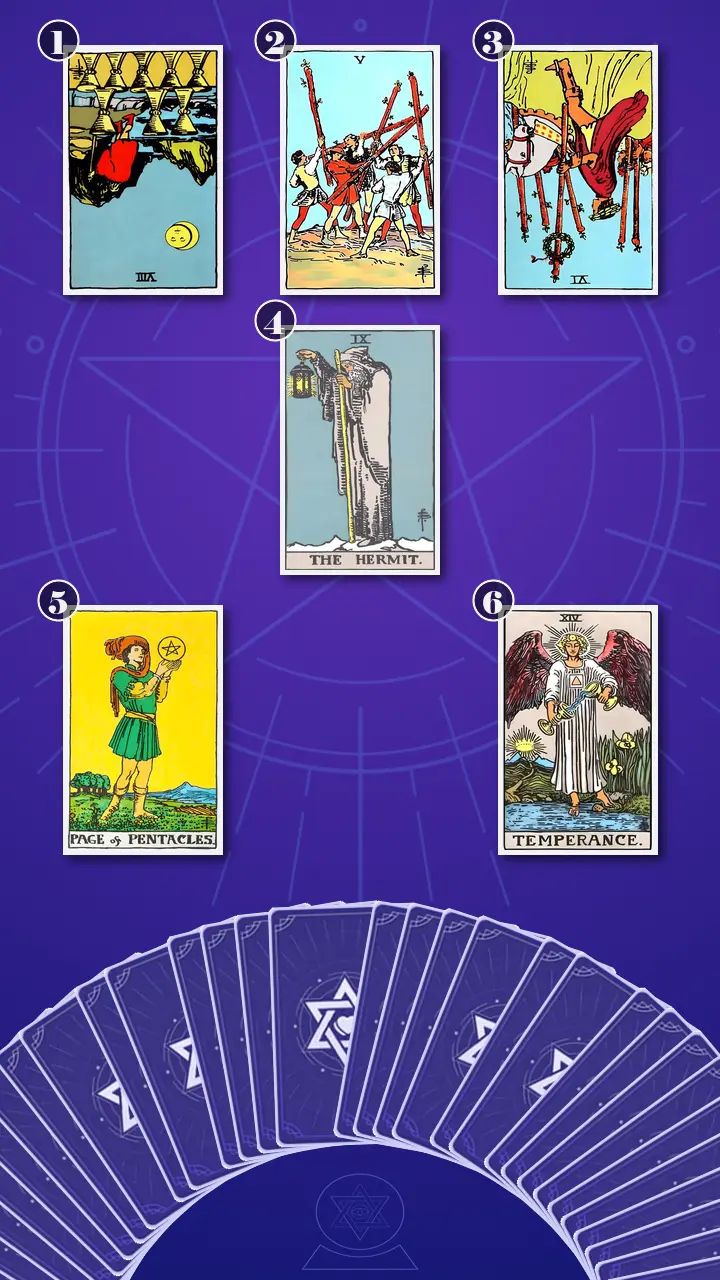
I chose the Transformation Path Grid (6) · Context Edition. This reflective six-card tarot spread works well for repeated career pivots because Alex was not choosing between two clearly defined options. We were examining a system: trigger, reaction, hidden belief, interruption, experiment, and integration.
The top row would show the observable abandonment loop, the comparison arena blocking progress, and the recognition wound underneath it. The fourth card would sit beneath them as the turning-point resource. The final two would show one practical test and a sustainable way to reassess. The layout resembled an hourglass, narrowing scattered social pressure into one point of discernment before opening into action.
“This is how tarot works best for me,” I explained. “The cards are structured prompts. They can make a pattern visible, but they do not predict which job will succeed or order you to stay. You remain the person who evaluates the evidence and directs what happens next.”
The Three-Card Loop That Kept Reopening the Tabs
Position 1: The Departure That Never Quite Ends
I turned the card in the position showing Alex’s observable abandonment loop. It was the Eight of Cups, reversed.
I read its reversed Water as a blockage: leaving brought temporary relief, but never completed the deeper decision. This was the exact moment when Alex saw a polished promotion post, closed the portfolio or course module already in progress, and opened a new route before asking what the current one had taught them. Like creating a fresh Notion workspace because the old one contains too much unfinished evidence, the clean reset looked like clarity while carrying the same unanswered question forward.
“The urge to restart may be asking for relief, not delivering evidence,” I said.
Alex gave a brief, bitter laugh. “That’s so accurate it’s almost rude.” Their fingers tightened around the cup and then released it.
“I know it lands sharply,” I said. “But this card is not accusing you of lacking commitment. It is separating a body-level escape response from a considered career decision. Leaving can be right. The question is whether you have stayed long enough to learn why you are leaving.”
Position 2: Five Timelines in One Arena
I turned the card representing the immediate obstacle, the social scoreboard that converted a personal pace into public ranking. The Five of Wands, upright, appeared.
I read its Fire as excess. One friend had started a master’s, one had launched a newsletter, and one had moved into a new role. Alex’s mind treated all three milestones as simultaneous requirements. The crossing wands looked like overlapping tabs, notifications, and definitions of success: plenty of motion, no shared finish line.
“Which person’s timeline becomes a requirement the fastest?” I asked.
Alex looked away from the cards. “Honestly? Whoever I saw most recently.” Their shoulders rose as they said it, reproducing the posture they had described on the TTC after a comparison-heavy scroll. I could see the distinction beginning to register: the loudest signal was not necessarily the most relevant information.
Position 3: When Finished Work Still Feels Absent
I turned the card in the position revealing the hidden driver beneath the restarting. It was the Six of Wands, reversed.
Here, recognition energy was blocked and internal acknowledgment was underfed. Alex could finish a difficult client brief or strengthen a portfolio draft, yet check titles, reactions, and announcements before deciding whether the work counted. The work was complete; the achievement felt absent. The reversed laurel showed how public proof had been asked to verify competence, belonging, and worth all at once.
“Private progress is still progress when no one is available to applaud it,” I said. “The blind spot is not that recognition means nothing. Recognition can offer opportunities and useful feedback. The blind spot is treating its absence as evidence against you.”
Alex’s thumb stopped rubbing the cup’s rim. Their gaze lost focus for a moment, as if replaying a Friday afternoon when they had minimized a strong second draft because it came without a visible victory signal. Then they whispered, “If nobody can see it, I act like it didn’t happen.”
When The Hermit Reduced the Future to One Light
Position 4: The Bridge Out of the Comparison Arena
I reached the position representing the interrupting resource. Rain tapped more softly against my window, and the reading lamp cast a narrow pool of gold over The Hermit, upright. The room seemed to reduce itself to the raised lantern.
I read the card as balanced discernment and patient solitude, not hiding. In Alex’s life, it looked like logging out of LinkedIn, putting the phone face down, and asking what they would still want to learn from the current path if nobody could see the result for six months. The lantern did not reveal a guaranteed destination. It illuminated one personal criterion and one honest test.
I used a practice I call Internal Monologue Auditing. I listen for the genre the inner voice has assigned to an ordinary scene. Alex’s career had become a live elimination show in which every peer announcement meant someone else had advanced and they were about to be cut. The Hermit changed the genre. It turned the same unfinished scene into a quiet field documentary: observe what is here, collect direct evidence, and stop demanding a spoiler for the entire film.
At 8:47 in their Toronto kitchen, Alex had been caught inside one sentence: “I need a more impressive route before anyone notices I’m behind.” I asked them to imagine the same desk, the same promotion post, and one Notes page containing only: If nobody could see this for six months, what would I still want to learn?
Stop treating everyone else's visible progress as proof that your path is wrong; use The Hermit's lantern to illuminate one self-defined step before you reconsider the route.
For a beat, Alex did not move. Their breath stopped midway in; their fingers hovered above the table. Then their eyes shifted beyond the card, unfocused, as though Tuesday evening were replaying behind them. Their jaw tightened.
“But doesn’t that mean I’ve wasted all this time restarting?” they asked, anger briefly sharpening their voice. Their eyes shone, and one shoulder dropped while the other remained held high, as if relief had arrived before their body fully trusted it.
“No,” I said. “It means restarting protected you from the pain of being visibly unfinished. That protection had a cost, but it was not stupidity. We can respect why it developed without letting it direct the next scene.” Alex opened both hands on the table. A long breath left their chest, followed by a small, unsteady laugh. Their shoulders settled, then they blinked as if the floor had shifted. Clarity had removed some pressure, but it had also returned responsibility to them.
I waited, then asked, “Now, with this new angle, can you think of a moment last week when this insight might have made you feel different?”
“Friday,” Alex said quietly. “I saw another promotion after finishing that client brief. I could have let the brief count. I could have stayed with my portfolio for ten more minutes instead of researching a whole new career.”
I watched them move from comparison-triggered disorientation toward the first, vulnerable edge of self-trust. It was not certainty. It was a willingness to let direct experience speak before public ranking rewrote the future.
One Pentacle, Then Two Cups
Position 5: An Artifact Instead of a New Identity
I turned the card representing the bounded, practical experiment: the Page of Pentacles, upright.
I read its Earth as grounded, available energy. The Page held one pentacle at eye level, not five possible identities. For Alex, this meant one portfolio revision, one completed course module, or one informational conversation, with the result treated as data rather than a referendum on worth. The path did not need to become permanent before it could teach them something.
“Stay long enough to collect one piece of evidence; leave later if the evidence asks you to,” I said.
Alex nodded slowly and pulled their phone closer, this time opening the calendar rather than a job board. The movement was small, but it replaced strategic restarting with contact with the actual work.
Position 6: Ambition at a Humane Pace
I turned the final card, representing the integrated practice of holding ambition and patience together. It was Temperance, upright.
I read its energy as Balance. The two cups became two valid sources of information: Alex’s private values and the realities of the external world. Temperance did not ask them to ignore salaries, credentials, feedback, or changing opportunities. It asked them to blend that information deliberately instead of letting every polished update pour over and erase their personal measure.
In practical terms, Alex would keep one meaningful commitment and schedule one weekly review. Reassessment would have a place; every trigger would not become an emergency. They exhaled and said, “So I can commit without trapping myself.”
“Exactly,” I replied. “Changing direction remains yours to choose. We are changing the conditions under which you make that choice.”
The Lantern-and-Evidence Check
I gathered the six cards into one story. The reversed Eight of Cups showed the repeated exit. The Five of Wands revealed the comparison arena that made escape feel urgent. The reversed Six exposed the deeper equation between public recognition and worth. The Hermit interrupted that circuit; the Page produced direct evidence; Temperance created a rhythm in which continuity and revision could coexist.
The central blind spot was treating a ranking feeling as decision-quality evidence. The spread contained no Swords, which caught my attention: Alex did not need another argument, browser tab, or perfectly optimized five-year plan. They needed a private criterion, contact with the work, and a deliberate review point. The shift was not from “quitting” to “never quitting.” It was from reactive restarting to grounded experimentation at a humane pace.
I translated the reading into three small actions. I also introduced The Director’s Cut of Self-Compassion, my method for pausing a punitive internal scene and reviewing it through the eyes of a fair, supportive director. It is not forced positivity. It is an accurate edit that separates what happened from the verdict added afterward.
- Call a 90-second cut When a peer announcement triggers a reset, write: “I saw a promotion post, my chest tightened, and now I want to replace my plan.” Then add the director’s note: “A visible milestone can be real without becoming a verdict on my timeline.” Keep the phone face down for the 90 seconds. If the exercise increases pressure, stop after naming the body cue.
- Create one piece of direct evidence By Wednesday, choose one 25-minute task: revise a portfolio paragraph, complete one module, or send one request for an informational conversation. Save the artifact in a dated folder called
direct evidence, then record what felt meaningful, what felt draining, and what the next test could teach. The five-minute version counts. One saved paragraph or calendar request is enough to begin. - Give reassessment an appointment Book a 20-minute Friday review. Ask whether new information changed your values or merely changed your discomfort. Outside that window, note the urge to pivot without obeying it automatically. Keep research to three links. You remain free to continue, modify, or leave after reviewing real evidence.
The six-card Transformation Path Grid had not selected Alex’s future. It had made their decision process visible enough for them to change it.

A Week Later: The Quiet Proof
Six days later, I received a message from Alex. Another former classmate had announced a new qualification. Alex felt the familiar drop below the ribs, wrote the trigger in Notes, and closed LinkedIn. Then they spent 25 minutes revising one case-study section and saved it in direct evidence.
“It didn’t suddenly make me certain,” they wrote. “But I learned that I still like solving the actual communications problem when nobody is watching.”
They had also slept through the night. Their first thought in the morning was still, “What if I’m wrong?” But this time, they told me, they laughed softly and opened the folder anyway.
I saw that as the quiet proof of our Journey to Clarity. Alex had not solved an entire career in a week. They had stopped outsourcing the next scene to the latest visible milestone. The cards offered a lantern and a structure; Alex chose to use them, and the authorship remained theirs.
When someone else’s milestone lights up your feed, your chest may tighten as you reach for a new plan, not because you lack direction, but because remaining visible while unfinished can feel like putting your worth at risk. Noticing that distinction means the comparison arena is no longer the only director in the room.
If you let one lantern-sized, private test count before asking whether you are behind, what might you become curious enough to notice about the unfinished path already in front of you?
Every reading at AceTarot is a journey to connect with inner wisdom and empower the path ahead. This reading shared here is a psychological mirror, not a private record—crafted to reflect universal emotional loops and help restore personal clarity. Please note that these insights do not replace professional psychological, medical, legal, or financial advice, and should not serve as the sole basis for major life decisions.
Learn more about our Journey to Clarity.
How did this insight land for you?
🫂 This Resonates Deeply
🌀 Living This Story
✨ Now I See Clearly
🌱 Seeing New Possibilities
🧰 Useful Framework
🔮 The Confirmation I Needed
💪 Feeling Empowered
🚀 Ready for My Next Step
Author Profile
 AI
AI Juniper Wilde
1056 readings | 537 reviews
“I’ve always felt our lives are films currently in production. As an artist, I know that when you feel stuck, it’s often because you’ve bravely stayed in a painful scene for just a little too long. I’m not here to coldly analyze you. I want to sit closely with you, look at those difficult moments with profound empathy, and gently hand you the pen so you have the courage to write your next beautiful act.”
In this Introspection Tarot Reading :
Core Expertise
- Internal Monologue Auditing: Identifying the destructive 'genre' (e.g., tragedy, horror) of your subconscious thoughts that constantly induces anxiety.
- Persona Fatigue Diagnosis: Assessing the heavy psychological toll of maintaining an artificial 'social character' that conflicts with your authentic self.
Service Features
- The Director's Cut of Self-Compassion: A mental editing technique to pause a spiral of self-hatred, reframing the internal narrative from a punitive judge to an objective, supportive observer.
Also specializes in :
Explore Related Patterns:
Purpose OutsourcingAlex says that whoever they saw most recently becomes the requirement fastest. A promotion, qualification, newsletter, or new role does not remain another person's milestone; it is absorbed into Alex's definition of what their own future should be. That transfer of authority is Purpose Outsourcing. The feed begins supplying direction as well as information, so the loudest visible route overrides the quieter evidence of what Alex still finds meaningful. When you restore a private criterion before reviewing external options, other people's progress can broaden your information without authoring your purpose.
Achievement-Based Self-WorthAlex can finish a difficult client brief or improve a portfolio draft, yet the accomplishment feels absent until a title, reaction, or announcement confirms it. Their own summary is precise: if nobody can see the work, they act as though it did not happen. When public recognition is asked to verify competence, belonging, and worth at once, private progress loses psychological weight. Achievement-Based Self-Worth makes each peer announcement more than information; it becomes a test of whether you count. Separating the value of the work from its current visibility allows recognition to inform your career without serving as the sole certificate of your value.
Emotional ReasoningAt 8:47, a promotion post produces a physical drop, closes Alex's portfolio, and is followed by the thought that the path may never have been right. The conclusion arrives before any new evidence about the actual communications work has been collected. The discomfort is genuine, but Emotional Reasoning turns that discomfort into a career verdict. Feeling behind becomes proof of being on the wrong path, while the relief produced by leaving is mistaken for confirmation. When you name the feeling as a signal rather than a completed assessment, you create enough distance to test the path against direct experience.
Fresh Start FantasyAlex closes a half-finished portfolio and, within minutes, replaces it with course pages, job listings, and a new five-year plan. They also recognize that this happens every time somebody else appears to move ahead. The untouched route feels clearer because it contains none of the current path's unfinished evidence. That relief can masquerade as insight, creating a Fresh Start Fantasy in which changing plans seems to resolve the discomfort while preserving the same unanswered question. When you identify the reset as a protective move rather than automatic proof that the path is wrong, you regain the option to gather evidence before leaving.
Upward Social ComparisonOne classmate's promotion makes Alex close their portfolio, while a friend's master's degree, another person's newsletter, and someone else's new role become simultaneous requirements. Alex admits that whichever milestone appeared most recently gained the most authority. Upward Social Comparison turns selectively visible outcomes into a shared scoreboard even though the people involved are pursuing different finish lines. When you compare your unfinished process with several polished endpoints, slower progress can feel like failure by construction. Seeing how the comparison is assembled lets you question the benchmark before reorganizing your life around it.
Visibility Shame LoopThe portfolio still matters to Alex, yet a peer announcement makes them close it, lower their voice, and reach for a more impressive route. Restarting removes the scene in which meaningful work is still visibly incomplete. The Visibility Shame Loop explains why abandoning the path can feel protective rather than merely inconsistent. A fresh plan conceals unfinishedness, but it also prevents the current work from becoming evidence of competence, which leaves public proof even more powerful the next time. When you allow one incomplete, private step to count, you interrupt the loop without forcing yourself to remain on a path that later evidence may genuinely challenge.
Internal ValidationAlex puts the phone down, returns to one case-study section, and notices that solving the communications problem still interests them when nobody is watching. The work becomes direct evidence rather than an audition for a visible title. When you let private contact with the work contribute to your assessment, recognition can remain useful without becoming the authority that decides whether your progress is real. Internal validation does not require dismissing external feedback; it prevents the absence of applause from erasing evidence you have already earned.
Explore Related Struggles:
Metric-Compass FusionAt 8:47, a former classmate's promotion does more than inform Alex about that classmate. It closes the portfolio, opens job boards and course pages, and changes the apparent meaning of Alex's entire route before the current work has been examined. When you use public metrics as a compass, visibility and direction become fused. A title or qualification can then feel like decision-quality evidence about your own path, even when it says nothing about what your work teaches you, what you value, or which pace remains sustainable for you.
Performance-Worth FusionA difficult client brief can be finished and a portfolio draft can become stronger, yet Alex checks titles, reactions, and announcements before allowing either achievement to count. In their own words, work that nobody can see is treated as though it did not happen. When visible performance is required to verify competence, belonging, and worth all at once, an ordinary period of private development carries an outsized cost. You are no longer only building the work; you are asking each result to establish that you deserve your place, which gives every peer announcement the power to reopen the verdict.
Comparison EntrapmentOne peer starts a master's degree, another launches a newsletter, and another moves into a new role. Alex's mind compresses those unrelated milestones into one competition, even though the participants are not pursuing the same destination and no shared finish line exists. You become trapped when other people's separate timelines are converted into simultaneous requirements for your own life. The most recent update then feels like the most urgent deficit, so your path keeps changing to answer a ranking system that can never produce a stable definition of being caught up.
Completion-Exposure BindThe portfolio remains meaningful to Alex, but it also holds visible proof that their work is unfinished. A fresh plan contains none of that accumulated incompleteness, so closing the draft removes Alex from the scene in which progress can be inspected before it has become a polished outcome. When being unfinished feels like putting your worth on display, completion becomes difficult for reasons that have little to do with the value of the path. Restarting offers a clean identity before the existing work can test you, teach you, or become complete enough to count on its own terms.
Protection-Progress SplitAlex keeps returning to a portfolio that still matters, yet a peer's promotion can make them close it within minutes and begin designing a different future. The collision is not between caring and not caring. It is between moving the meaningful work forward and escaping the exposure of having progress that is still incomplete, private, and less impressive than someone else's announcement. You can become stuck when the action that protects you from judgment also interrupts the progress that could generate real clarity. Seeing both functions restores choice: staying is not a permanent sentence, and leaving does not have to occur before the current path has produced enough evidence to evaluate.
Relief-Progress FusionWithin minutes of seeing the promotion, Alex replaces a half-finished portfolio with three course pages, LinkedIn Jobs, and a new five-year plan. The reset changes the surface immediately, but the unanswered question about the current path travels into every replacement route. You can mistake the pressure released by restarting for proof that you have found a better direction. Relief is real, but when it is made responsible for evaluating the path, each exit feels briefly clarifying while preventing the sustained contact that could reveal whether the work fits, needs adjustment, or genuinely should end.
Recognition-Progress SplitAlex can finish a difficult client brief or strengthen a portfolio draft and still look to titles, reactions, and announcements before letting that progress register. The work has materially changed, but the internal record remains blank until the change is reflected by a public signal. When you cannot fully receive progress without recognition, sustained effort becomes difficult to trust. You may keep producing evidence while feeling as though nothing is accumulating, leaving every visible peer milestone with more authority than the work you have actually completed.
Explore Related Emotions:
Career FOMOOne promotion post sends Alex from a portfolio draft into three course pages, LinkedIn Jobs, and a replacement five-year plan, while a master’s degree, a newsletter, and a new role all begin to look simultaneously necessary. The abundance of visible routes does not expand their freedom; it makes the path already underway feel dangerously incomplete. Career FOMO emerges when you experience every alternative as a possible opportunity you are already late to claim. That sensation can pull you away from direct evidence about the work you are doing, but recognizing the pull allows options to remain information rather than commands to replace your entire future.
Hollow RecognitionAlex can finish a difficult client brief or improve a portfolio draft, then check titles, reactions, and announcements before deciding whether that work counts. Their own summary is precise: if nobody can see the achievement, they act as though it did not happen. When recognition is asked to confirm competence, belonging, and worth all at once, completed work may leave no stable sense of completion inside you. Hollow Recognition captures the absence that remains after real effort, while distinguishing a reasonable desire for feedback from surrendering the entire meaning of your progress to public applause.
Imperfection Exposure DreadThe portfolio still matters to Alex, but they close it as soon as another person’s polished milestone appears, and the session identifies restarting as protection from the pain of being visibly unfinished. The clean new plan offers temporary cover because it has not yet accumulated drafts, uncertainty, or evidence of ordinary incompletion. When remaining on a path means letting yourself be seen before the outcome looks impressive, you may experience persistence as exposure rather than progress. Imperfection Exposure Dread names the feeling beneath the reset, making it possible to evaluate the work separately from the fear that unfinished automatically means unworthy.
Timeline PanicAt 8:47 on Tuesday evening, a former classmate’s promotion appears beside Alex’s half-finished portfolio, and the active draft is replaced within minutes by courses, job listings, and a new five-year plan. The speed of that reset shows how another person’s visible progress turns a personal timeline into an apparent emergency before the existing path can be assessed. When every recent milestone becomes evidence that you should already be somewhere else, slower progress can feel less like development and more like immediate failure. Timeline Panic names that compressed inner weather while preserving a crucial distinction: the urgency is real, but it is not automatically reliable evidence about which path deserves your next step.
Timeline ShameAlex’s voice drops when they admit that another person getting ahead makes their own slower progress look like failure, and their private sentence is even sharper: they need a more impressive route before anyone notices they are behind. The lowered voice and imagined scrutiny show that pace has become more than a practical concern; it has become something they feel compelled to hide. When your timeline becomes a public measure of adequacy, unfinished work can feel personally exposing even when it is meaningful and improving. Timeline Shame captures the pressure to conceal an ordinary stage of development, while naming it creates room to separate how visible your progress is from what that progress actually says about you.
Cautious Self-TrustSix days later, Alex sees another qualification announcement, closes LinkedIn, revises one case-study section, and opens the saved folder even though the next morning still begins with “What if I’m wrong?” The doubt remains present, but it no longer receives automatic control over the work. Cautious Self-Trust is not certainty about an entire career; it is the willingness to let your own direct experience count before a public ranking rewrites it. Each small return to the folder gives Alex evidence that they can hear uncertainty, remain unfinished, and still choose the next step for themselves.
Grounded AgencyAlex pulls the phone closer and opens the calendar instead of a job board, then later responds to another peer announcement by closing LinkedIn and revising one case-study section for 25 minutes. These small movements replace a total reinvention with direct contact with the work and a defined point for reassessment. Grounded Agency is the felt return of choice to a scale you can actually use. Alex does not surrender the freedom to leave or modify the path; they change the conditions under which that decision will be made, allowing evidence rather than the latest trigger to direct the next move.
Solitary ClarityAlex logs out of LinkedIn, puts the phone face down, and considers what they would still want to learn from the current path if nobody could see the result for six months. With the feed temporarily removed, multiple identities and finish lines narrow into one private criterion and one honest test. Solitary Clarity describes the quieter inner space in which your preference can become audible without having to defeat every external opinion. The destination remains unresolved, but Alex gains enough distance from the scoreboard to distinguish personally relevant information from the loudest recent signal.
Accountable Self-CompassionWhen Alex asks whether all the restarting means they have wasted their time, the response names the reset as protection from the pain of being visibly unfinished rather than evidence of stupidity or deficient commitment. The protective purpose is acknowledged alongside its real cost, without turning either side into a verdict on Alex’s character. Accountable Self-Compassion allows you to understand why a response developed while remaining honest about what it interrupts. For Alex, that combination reduces the need for punishment and preserves responsibility: the old protection can be respected without being handed authority over the next scene.
Comparative JealousyAlex’s hand clenches beside their tea as a former classmate’s promotion fills the phone, and later milestones from other peers reproduce the same comparison pressure. The bodily reaction gives the contrast a clear edge: someone else is displaying the recognition and movement Alex wants, while their own meaningful work remains unfinished and largely unseen. Comparative Jealousy does not require hostility toward the people advancing around you. Here it names the ache created when another person visibly possesses what you want for yourself, and acknowledging that ache can reveal the desire underneath it without allowing the comparison to decide whether your current path still matters.
Explore Related Contexts:
Algorithmic Reinvention LoopThe promotion post is followed within minutes by three course pages, LinkedIn Jobs, and a document titled "New Five-Year Plan." A later qualification announcement activates the same opening for reinvention, showing how each fresh signal can replace the route under examination before that route has yielded enough evidence. A feed can place many polished futures in front of you while concealing the different timelines, tradeoffs, and unfinished stages behind them. When every new example becomes a possible replacement identity, you remain busy redesigning the route but lose sustained contact with the work that could clarify it. Naming that external loop restores your ability to decide which signals deserve investigation and which can pass without reorganizing your life.
LinkedIn Performance LoopAt 8:47 on Tuesday evening, a former classmate's promotion appears beside Alex's half-finished portfolio, and the portfolio is closed within minutes. Later promotions and qualifications repeat the interruption, allowing LinkedIn's stream of visible milestones to function like a live ranking table inside otherwise private work time. When your progress is measured through that table, a title carries immediate social proof while a strong draft or completed client brief remains comparatively invisible. Recognizing the platform as a performance arena lets you separate useful career information from the ranking pressure attached to its presentation, so the latest post no longer has automatic authority over your next move.
Premature Career Pivot PressureAlex closes a portfolio that still matters and begins researching a new career before asking what the current work has revealed. The same sequence follows a completed client brief: another promotion appears, the finished work loses standing, and a different future starts demanding attention. This is a career crossroads repeatedly declared before the available evidence supports one. External milestones create urgency, but they do not establish whether your present route is unworkable, underdeveloped, or still worth testing. You retain the right to pivot; the practical point of leverage is deciding that a pivot will follow direct experience and a deliberate review rather than the most recent public comparison.
Social Clock PressureOne friend starts a master's, another launches a newsletter, and another moves into a new role. Alex does not encounter these as three people following different paths; the milestones collapse into simultaneous requirements, with whichever person appeared most recently setting the most urgent deadline. The resulting timetable has no shared destination, yet it assigns a clear social penalty to moving more slowly. You are being asked to compare unlike credentials, projects, and roles as though they belonged to one race. Separating those timelines exposes the faulty external standard and makes room for a pace based on what your own path actually requires.
Career Pivot Validation TrialAlex chooses one portfolio revision, one course module, or one informational conversation and treats the result as data rather than a verdict on their worth. In the session, they open the calendar instead of a job board; six days later, they revise a case-study section and save the artifact after another classmate's announcement. That bounded trial creates evidence about the actual communications work before a larger identity decision is made. You do not have to promise permanent commitment to learn from a path, and you do not have to abandon it to preserve your freedom. A defined experiment gives you a fairer basis for continuing, modifying, or leaving.