When the Honest Post Leaves the Real Choice Offscreen
If you are a late-twenties communications professional who can write a flawless vulnerable caption but freezes when a friend asks what you actually want next, I may recognize the particular exhaustion behind your public authenticity.
Jordan brought that exhaustion into our video consultation from their shared Toronto apartment. At 8:47 p.m. the previous Tuesday, they had sat at the dining table with a cooling bowl of instant noodles, the radiator clicking behind them and a warm phone pressed into their palm. They redrafted an Instagram confession about feeling lost, then deleted the one sentence admitting they wanted to leave a prestigious client account.
The published version was candid. Every feeling in it was real. Comments calling Jordan brave and authentic arrived almost immediately, making their face buzz with relief. Then the notifications slowed. Their throat tightened as they looked at the next day's calendar and saw the untouched client meeting still waiting there.
“I told the truth,” Jordan said to me, rubbing one thumb across the edge of their phone. “So why do I still have no idea what to do?”
I heard more than confusion in the question. I heard disorientation with a physical shape: the sensation of stepping off a brightly lit stage and discovering that the floor beyond the spotlight has no visible markings. Public recognition had reached them, but no private direction had arrived with it.
“A coherent story can be true and still leave the choice untouched,” I told them. “I am not here to judge what you share or tell you that privacy is morally superior. I want us to examine why being understood has become disconnected from knowing what you want. Let's draw a map of that fog and find one piece of ground you can actually stand on.”

Choosing a Map for the Life Behind the Caption
I invited Jordan to place both feet on the floor and take one slower breath. I shuffled while they held the question in mind. I use that pause as a transition for attention, not as a mystical performance. Tarot works best here as a structured mirror: the cards organize patterns so the person in front of me can evaluate them, challenge them, and choose what to do.
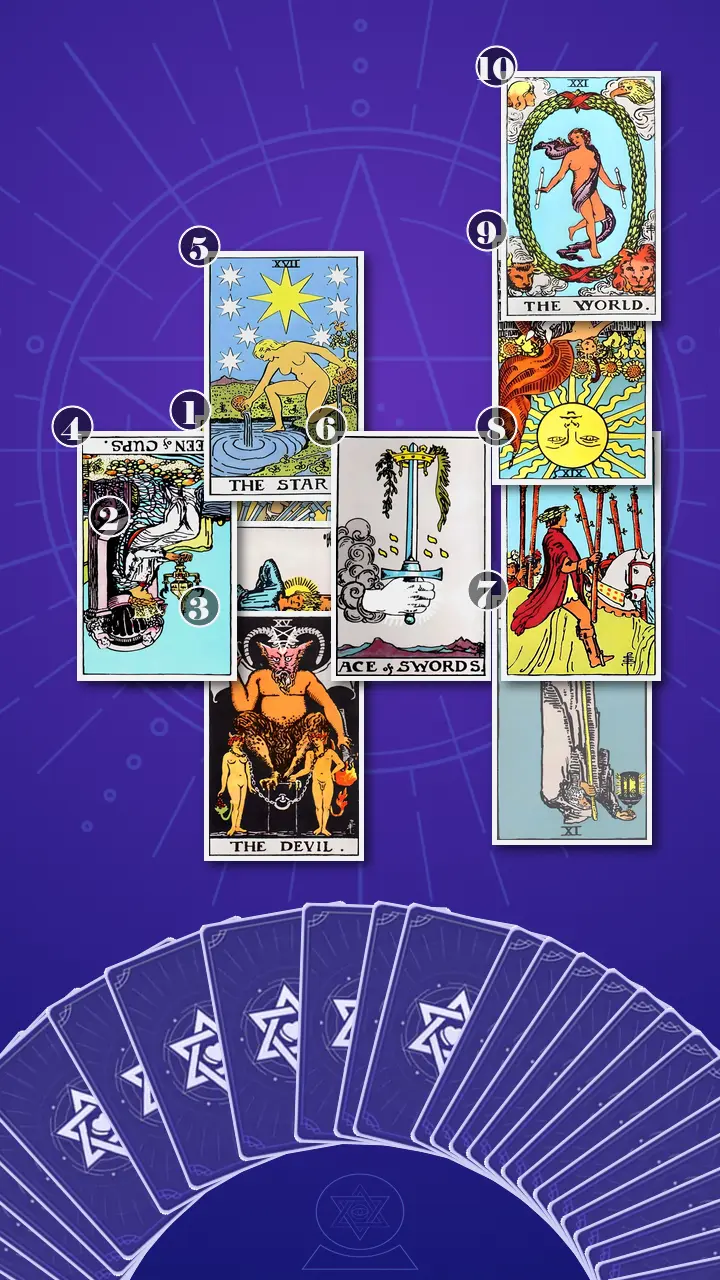
I chose the Celtic Cross · Context Edition, a ten-position spread for external validation and private direction. A simple decision spread would have forced Jordan's situation into “stay or leave,” but their real question was why every possible choice became an audience-facing explanation before it could become a preference.
The central positions would show the observable performance, the resistance beneath it, and the self-worth bargain at its foundation. The right-hand staff would examine Jordan's relationship with inner guidance, the public feedback loop, the fear surrounding visibility, and the direction of integration. This was not a forecast of what fate would do to Jordan. It was a contextualized Celtic Cross designed to reveal what Jordan could do with the pattern once they could see it clearly.
The Two Swords Left in the Drafts
Position 1: Seven of Swords, Upright
The card I turned over for Jordan's present mask behavior, what performing honesty looked like in observable action and what remained afterward, was the Seven of Swords, upright.
I pointed to the figure carrying five swords while looking back at the two left behind. “This is your Tuesday-night caption. The five swords are the feelings you made portable and publishable. The two left behind are the concrete need and the decision that would have changed your actual week.”
The card reflected Jordan deleting the sentence about wanting off the client account, publishing the emotionally revealing but decision-safe version, and checking the response to see whether that selected version had been accepted. Its Air energy was operating in excess as defensive strategy. Language was not absent; it was working overtime to manage exposure while keeping the consequential preference offstage.
“Everything I posted was true,” Jordan said slowly, “but the one truth that would require a choice was still in drafts.”
They gave a short laugh with a bitter edge, looked away from the screen, then pressed their lips together. “That is so accurate it feels a little brutal.”
“Then we slow down,” I replied. “The Seven of Swords is not calling you dishonest. It is showing us that disclosure and decision are different operations. The strategy protected you from a frightening choice. We can respect why it formed without letting it run the whole system.”
Position 2: The Hanged Man, Reversed
The card I laid across it represented the resistance that kept public honesty from becoming inner direction, especially after attention faded. It was The Hanged Man, reversed.
I described the quiet evening Jordan rarely allowed to remain quiet: a podcast queued, a Reddit advice thread opened, a Notion career board reorganized, and another post begun before an unanswered question had been given two uninterrupted minutes. The bound foot showed a condition that faster narration could not solve. The inverted body offered a new angle, but reversal turned voluntary suspension into blocked pause.
This was a blockage of surrender rather than a deficiency of information. Jordan could appear to be moving through research, content, and conversations while the private decision remained suspended. I asked what they usually opened before giving an unanswered question two quiet minutes.
Their fingers began counting without intention: “Reddit. Two podcasts. TikTok search. Usually the group chat.” Their hand stopped, then dropped into their lap. The answer had reached their body before they tried to explain it.
The Bargain Beneath the Applause
Position 3: The Devil, Upright
The card I turned for the value-based fear beneath the performance, what Jordan believed recognition had to prove about being worthy of being known, was The Devil, upright.
I brought their attention to the loose chains around the two figures. The image did not tell me Jordan was trapped by an evil force. It showed me a compelling bargain maintained through repetition. After a vulnerable post, comments calling Jordan brave, real, and self-aware created genuine connection and a temporary sense of solidity. When that lift faded, another revealing story seemed necessary.
I pictured the Line 1 train Jordan had described: damp coats, takeaway coffee, fluorescent lights, and brakes shrieking into Bloor-Yonge while their thumb moved between a client deck and the comment feed. Each new notification briefly filled the hollow place in their chest. The Devil's Earth energy had become fixed in excess, turning welcome recognition into a condition for feeling real.
“I know the praise does not answer me,” Jordan said, almost under their breath, “but for a minute it proves I am someone worth answering.”
I let the sentence settle before responding. “Wanting to be seen is human. The category error is asking visibility to establish worth and direction. Applause can confirm connection; it cannot supply direction.”
Position 4: Queen of Cups, Reversed
The card I turned for the emotional habit that had trained Jordan to create a public narrative before identifying a private need was the Queen of Cups, reversed.
I asked Jordan to imagine the Queen's closed cup as a feeling that had not yet been opened, interpreted, or displayed. After a difficult client meeting, Jordan would write a polished reflection about emotional exhaustion and feel held by the replies. Only later would they realize they had never asked whether they needed food, solitude, reassurance, a workload conversation, or a different assignment.
The reversal showed a deficiency of private containment. Emotional Water flowed outward before it could tell Jordan what care or change the feeling required. The problem was not excessive sensitivity. It was a sequence issue: Jordan made an experience legible to other people before receiving it themselves.
Their gaze lowered to the cup on the card. Their shoulders drew inward, then loosened with a long exhale. “I can write three paragraphs about burnout before I can say, 'I need tonight alone.'”
Position 5: The Star, Upright
The card I turned for Jordan's conscious self-story, the ideal of being publicly honest and what that ideal left out, was The Star, upright.
I was glad to see it. The Star protected what was sincere in Jordan's openness. They genuinely wanted personal essays and candid posts to make other people feel less alone. I had no interest in flattening that wish into attention-seeking.
I pointed to the two pitchers, one pouring into the shared pool and the other onto the land. The Star's Water was balanced when honesty replenished both destinations: public connection and private life. I asked whether a recent truth had changed how Jordan spent an evening, set a boundary, or chose a project, or whether it had only become visible.
Jordan remembered sitting in a Leslieville cafe and privately writing, “I want tonight to myself.” Their shoulders had dropped until they began converting the sentence into a relatable post about burnout. The original decision about declining a party disappeared inside the content.
“I really did want it to connect with people,” they said. “I also never answered whether I was going out.”
“Both facts can be true,” I said. “The Star is asking whether your honesty reaches the ground of your own life as well as the shared pool.”
When the Ace Cut Through the Feed
Position 6: Ace of Swords, Upright
The card I turned for the next reflective opening, a small truth that could be named before it was shared publicly, was the reading's key card: the Ace of Swords, upright.
The room seemed to contract around its clean vertical line. Rain ticked against Jordan's window, and even the radiator went briefly quiet. I centered the sword emerging from cloud, not as perfect certainty, but as precise naming. This was discerning Air in balance: language no longer managing an image, but separating what Jordan knew, wanted, and was willing to test.
I asked them to picture the 11:26 p.m. version of themselves with seven possible futures in Notes, three advice tabs open, and rain tapping the glass. Another explanation was always available. The smallest private preference was harder because it could not hide inside complexity or borrow authority from an audience.
My mind flashed to the performance dashboards I used to read on Wall Street, where a metric became dangerous when it was asked to measure something it was never designed to measure. I used a diagnostic lens I call Network ROI Analytics. I drew three columns on a page: Connection Return, Direction Return, and Energy Cost.
Jordan's posts often produced real Connection Return. The friends, readers, and conversations were not fake. But refreshing the response produced almost no Direction Return and carried a high Energy Cost. That distinction mattered. The audience had not failed Jordan; it had been assigned an impossible job. The Ace changed the primary metric from “Did people recognize me?” to “Did one clearly named preference influence one choice?”
You do not find yourself by polishing another confession; you find yourself by raising the Ace of Swords of a private truth and letting it cut one small choice free.
I left a pause around the sentence, then translated the symbol into plain language.
You do not need a better confession. You need one private truth that is allowed to affect one small choice.
Jordan's inhale stopped halfway. Their fingers froze above the edge of the table, and their eyes lost focus as if several old posts were replaying behind them at once. Then their brow tightened. “But does that mean all those posts were fake? Does it mean I have been doing honesty wrong this whole time?” The words came out sharper than anything they had said earlier.
I watched the anger give way in three small movements: their jaw unclenched, their fist opened against the tabletop, and a trembling breath left their chest. Their eyes reddened, but their shoulders finally dropped. Relief appeared first, followed by the slight dizziness that arrives when clarity returns responsibility to the person who asked for it.
“No,” I said. “Your posts may have been honest and deeply connecting. They simply could not make a private choice for you. This is not a verdict on your past. It is permission to change the sequence.”
I invited them back into lived experience. “Now, using this new perspective, can you think of a moment last week when this insight might have made you feel different?”
Jordan returned to the Leslieville cafe. “I could have kept 'I want tonight to myself' private long enough to decline the party. I did not need to know whether it represented my whole personality. It only needed to guide that night.”
I nodded. That was the emotional crossing I had been waiting for: a move from audience-dependent identity relief and private disorientation toward self-trusting discernment. The preference was provisional, modest, and actionable. It did not have to explain Jordan forever. It only had to guide one honest test.
The Lantern, the Crowd, and the Life Between Them
Position 7: The Hermit, Reversed
The card I turned for how Jordan currently related to inner guidance, whether they listened privately or outsourced direction to the audience, was The Hermit, reversed.
I described their late-night Notes file titled “Possible Next Lives,” surrounded by podcasts, Reddit threads, and identity explainers. The lantern was meant to illuminate the next few feet of path, not become another signal sent toward the crowd. Reversed, its energy showed a deficiency of self-consultation. Jordan kept gathering reassurance after sufficient information had already arrived.
“If I keep searching, I can call myself open-minded,” Jordan said. “If I choose, I might have to own being wrong.”
“And that is why the choice must be reversible,” I replied. “Inner guidance does not require total isolation or total confidence. Being understood is not the same task as understanding what you want. You can name your view first and still seek grounded feedback afterward.”
Position 8: Six of Wands, Upright
The card I turned for the public feedback loop that rewarded visible vulnerability and helped the mask stay in place was the Six of Wands, upright.
The rider's laurel wreath became engagement metrics, shared essays, affirming comments, and colleagues praising Jordan's emotional intelligence. Their environment rewarded candid communication because Jordan was genuinely skilled at it. Social Fire was useful when it celebrated connection, but excessive when it became proof that a public role was internally aligned.
I linked this card back to the Devil's loose chain. The feedback loop was easy to repeat because it worked on its own terms. It could show that a story resonated. It could not show whether Jordan wanted the client account, the party, or the proposed career pivot.
Jordan nodded once, slowly. The shame in their face softened as the pattern became a mechanism rather than a character flaw.
Position 9: The Sun, Reversed
The card I turned for Jordan's hope that visibility would feel like wholeness, and their fear that direct clarity might expose an unstable self, was The Sun, reversed.
I saw blocked access to warmth rather than an absence of joy. Jordan could have a genuinely good Saturday afternoon and still feel that it had not fully happened until it was photographed, captioned, or mentioned in a group chat. If the response was quiet, the afternoon's value dimmed afterward.
The reversal showed a deficiency in receiving an unwitnessed experience. I asked what might happen if one satisfying hour remained undocumented. Jordan smiled uneasily, touched their throat, then admitted, “I think I would be afraid it did not count.”
“That fear is information,” I said. “It is not a command. You remain free to share. The experiment is discovering whether warmth can reach you before it becomes visible.”
Position 10: The World, Upright
The card I turned for the integrating direction, bringing private truth and public expression into one life without predicting an external event, was The World, upright.
I followed the dancer inside the wreath and the four figures around the frame. The card's Earth energy held the spread in balance. Integration did not require Jordan to delete every platform, reject feedback, or discover a permanent true self. It meant allowing their private calendar, actual boundaries, lived experiments, and public voice to describe the same life.
I offered a possible sequence rather than a prophecy: Jordan names a preference privately, acts on it once, learns from the result, and then decides whether sharing would create connection or seek certification. Expression follows experience.
“So I can still post,” Jordan said, testing the thought aloud.
“Of course,” I answered. “The World is not withdrawal. It is choice. Your public voice can become a continuation of your life instead of a replacement for it.”
The One-Sentence Compass
I gathered the Celtic Cross into one coherent account. The Seven of Swords showed a controlled confession that left the actionable preference outside the frame. The reversed Hanged Man revealed why another explanation felt safer than an unshared pause. The reversed Queen of Cups showed feeling becoming content before becoming a need, while the Devil and Six of Wands exposed the recognition bargain that kept the cycle rewarding. The Star protected Jordan's sincere wish for connection. The Ace of Swords restored clean language, and The World placed that language inside lived action.
The cognitive blind spot was simple but consequential: Jordan had been treating narrative coherence as evidence of direction and audience recognition as evidence of alignment. Neither was useless, but neither could substitute for choosing. The transformation was not from public to private, or from connection to isolation. It was from narrating vulnerability for recognition to practicing private honesty long enough for one unperformed preference to shape a concrete choice.
I gave Jordan three small experiments. None required a permanent career decision, a dramatic digital detox, or blind trust in the cards.
- Run the five-minute private clarity check. Before opening Instagram or TikTok one morning this week, sit at the kitchen table with a paper notebook and complete three lines: “I notice...”, “I want...”, and “Today I choose...” Keep each answer to one sentence. Set a five-minute timer and keep the page private for twenty-four hours. On a low-energy day, reduce the exercise to three words: “I want ___.”
- Give one charged draft a sorting pause. When the urge to post an emotional experience arrives, label the feeling, the concrete need, and one possible response in Notes. Add a timestamp and revisit it the next day, then freely choose to post, revise, send it to one trusted person, or delete it. Treat the pause as consent and sorting time, not a prohibition against support or sharing. The minimum version is sixty seconds and one need word such as “rest,” “space,” or “help.”
- Live one reversible choice before explaining it. Choose one career curiosity and give it a private twenty-minute test, such as outlining an editorial portfolio piece or reading one relevant job description. Wait forty-eight hours before deciding whether to discuss it publicly. The test is meant to generate information, not declare a new identity. Jordan can change their mind, seek practical feedback after naming their own view, or keep the experiment private.
“Privacy is not dishonesty,” I told Jordan as they photographed only the action list, not the spread. “Sometimes it is where a preference becomes audible.”

A Week Later, One Quiet Decision
Six days later, I received a message from Jordan. They had written “I want tonight to myself,” declined an optional event with one direct sentence, and spent twenty minutes outlining an editorial project without announcing a career pivot. The following morning, their first thought was still, “What if I am wrong?” This time, they made coffee before opening Instagram.
I did not read that as a solved life. I read it as quiet proof. Jordan had moved from audience-dependent relief toward one act of self-trusting discernment. The cards had not chosen for them. They had used the reading to notice a pattern, name a preference, and reclaim the authority to test it.
When the notifications stop and your throat tightens around the choice you still cannot name, it can feel as though everyone has met the honest version of you except you. I want you to remember that noticing this gap already places the Ace in your hand; clarity can begin as one modest sentence rather than a final identity.
If no one could react to it yet, which small preference are you curious enough to let become your one-sentence compass and shape the next hour?
This story is adapted from psychological research, written so that those in a similar struggle can see their own pattern in it — and find their next step clearly.These insights are not a substitute for professional psychological, medical, legal, or financial advice.
Learn more about our Journey to Clarity.
How did this insight land for you?
🫂 This Resonates Deeply
🌀 Living This Story
✨ Now I See Clearly
🌱 Seeing New Possibilities
🧰 Useful Framework
🔮 The Confirmation I Needed
💪 Feeling Empowered
🚀 Ready for My Next Step
Author Profile
 AI
AI“I spent years in the intense, high-stakes world of Wall Street. I know exactly how isolating and heavy the weight of uncertainty can feel in the dead of night. I use strategic, commercial logic not to be cold, but to protect you from unnecessary friction. Think of me as a fellow traveler who has walked the same rocky path—offering sharp but deeply supportive wisdom to help you clear the fog and confidently win your narrative back.”
In this Social Tarot Reading :
Core Expertise
- Network ROI Analytics: Treating social engagements as investments to identify high-drain, zero-return relationships masking as 'networking'.
- Toxic Hierarchy Filtration: Deconstructing subtle power plays and status games within your broader professional or social circles.
Service Features
- The Social Divestment Plan: A cold, calculated protocol to tactfully liquidate your energetic investment in toxic circles without triggering unnecessary drama.
Also specializes in :
Explore Related Patterns:
Approval-Driven Decision ParalysisThe client meeting remained on Jordan's calendar after the brave caption, and the party decision disappeared when 'I want tonight to myself' became a public reflection. Jordan could produce a compelling explanation but froze when another person asked what they actually wanted next. If a preference must first become coherent, relatable, and socially validated, an ordinary reversible choice begins to carry the weight of a public identity verdict. You can then delay acting while you search for an explanation that removes the risk of disagreement or proves in advance that the decision is correct. Approval-Driven Decision Paralysis is the point where the validation strategy stops producing useful motion. The audience cannot certify a private preference, so the decision remains suspended even after your feelings have been expressed and understood.
Approval-Driven Self-SilencingJordan deleted the sentence about wanting to leave the client account, then later converted 'I want tonight to myself' into a relatable post before deciding whether to decline the party. In both moments, the emotional explanation survived while the preference capable of setting a boundary disappeared. This sequence lets you remain visible, thoughtful, and easy to understand without requiring another person to respond to a direct no, a changed plan, or a potentially inconvenient need. The silence is selective: you are not suppressing every feeling, but filtering out the part that would require self-assertion and expose you to disagreement. Approval-Driven Self-Silencing explains why extensive honesty can coexist with feeling unknown to yourself. The public narrative contains your emotional state, while the sentence that could organize your behavior is repeatedly denied enough authority to reach the calendar.
Performative VulnerabilityJordan's Tuesday-night caption preserved every feeling that could be made candid and relatable while removing the sentence about wanting to leave the client account. The post was emotionally true, and the connection it generated was real, but its edited structure kept the preference with practical consequences outside the frame. When you disclose emotion while withholding the choice embedded inside it, vulnerability can become a defense against exposure rather than a route through it. You receive the relief of being understood without having to risk a boundary, test a preference, or discover that someone disagrees. Performative Vulnerability does not mean your feelings are fake. It names the repeated sequence in which an honest public narrative successfully manages visibility while leaving your private direction untouched, so recognition arrives without the clarity you expected it to provide.
Premature VulnerabilityAfter the client meeting, Jordan made emotional exhaustion legible to readers before asking whether the feeling pointed toward food, solitude, reassurance, a workload conversation, or a different assignment. At the cafe, 'I want tonight to myself' became content before it was allowed to become a decision. The difficulty lies in sequence rather than sincerity. When you externalize a feeling before privately receiving it, other people's understanding can arrive before you have translated the experience into care, a limit, or a testable preference. The outward expression then feels complete even though the inward processing has barely begun. Premature Vulnerability leaves you publicly known but privately underconsulted. Sharing is not the problem; the pattern becomes costly when the audience receives your experience before you have had enough uninterrupted contact with it to learn what you need.
Visibility Reassurance LoopThe first comments calling Jordan brave and authentic produced an immediate physical lift, while the slowing notifications brought back the tight throat and the unchanged client meeting. Jordan also noticed that a good hour could feel as though it had not fully counted until it was documented and acknowledged. That relief is a reinforcement signal. When being seen briefly makes you feel solid or worth answering, checking the response and producing another revealing story become reliable ways to regulate uncertainty, even though neither behavior can tell you which assignment, evening, or career experiment you actually want. The Visibility Reassurance Loop persists because it genuinely delivers connection. The trap appears when you ask that connection to certify your worth and direction; the reassurance fades, the original choice remains, and another round of visibility feels necessary.
Borrowed Certainty LoopBefore giving an unanswered question two quiet minutes, Jordan opened Reddit, two podcasts, TikTok search, and the group chat. Their 'Possible Next Lives' file remained surrounded by advice tabs and identity explainers even after they acknowledged that more information was no longer the missing ingredient. Each new source lets you postpone the point at which your own provisional judgment must become visible to you. Continued searching can feel careful and open-minded, but it also distributes responsibility across other voices so that no single preference has to risk being imperfect or wrong. The Borrowed Certainty Loop creates movement without resolution. You keep collecting perspectives because they reduce the immediate pressure of choosing, yet the accumulating input makes your own signal harder to distinguish and sends you back out for still more certainty.
IntellectualizationAfter a difficult client meeting, Jordan could write three polished paragraphs about emotional exhaustion before asking whether they needed food, solitude, reassurance, a workload conversation, or a different assignment. The language clarified how the experience could be understood while postponing what the experience required. Intellectualization turns complexity into a controlled cognitive task. When you explain, research, categorize, and narrate, you can stay productively engaged with the subject while remaining insulated from the less predictable experience of naming a need and accepting the consequences of a choice. The result is not a lack of insight but a gap between insight and action. You may understand your emotional story with exceptional precision and still feel lost because the explanation has organized the feeling without allowing it to become a preference.
Internal ValidationSix days later, Jordan wrote 'I want tonight to myself,' declined an optional event with one direct sentence, and privately outlined an editorial project without announcing a new career identity. The next morning, doubt was still present, but Jordan made coffee before opening Instagram. These actions let a modest preference influence behavior before an audience evaluates it. When you use your own observation as enough authority for one reversible test, you stop demanding that certainty, praise, or a permanent self-definition arrive before movement is allowed. Internal Validation does not require rejecting feedback or becoming completely self-sufficient. It changes the sequence: you name your view, let it shape one choice, learn from what happens, and then decide whether outside input would support reflection rather than replace it.
Explore Related Struggles:
Metric-Compass FusionOn the Line 1 train, Jordan's thumb moves between a client deck and the comment feed, with each notification briefly making their position feel more solid. The same public response is then asked to indicate whether the client account, social plan, or proposed career direction is actually right for them. You become disoriented when a metric that accurately measures connection is also required to measure alignment. Engagement can show that your words reached people, but once it becomes your compass, a strong response can make a misaligned role look correct and a quiet response can make a valid private experience feel doubtful. The audience has not failed in this structure; it has been assigned a function it cannot perform. Separating connection return from direction return restores a place for your own preference without dismissing the real relationships created by public expression.
Performance-Worth FusionAfter Jordan shares something vulnerable, comments calling them brave, real, and self-aware create a temporary sense of solidity. When the lift fades, another revealing story seems necessary, even though Jordan already knows the praise cannot answer the underlying decision. You become locked into a demanding bargain when visible honesty is asked to prove that you are real enough, worthy enough, or important enough to answer your own needs. The disclosure can remain completely sincere, yet its public reception starts carrying the additional burden of certifying the person who disclosed it. That fusion helps explain why silence after the applause feels larger than an ordinary drop in engagement. Untangling worth from performance does not invalidate your public voice; it makes room for a preference to deserve consideration before anyone reacts to it.
Recognition-Progress SplitComments calling Jordan brave and authentic arrive almost immediately, and the recognition produces genuine relief. When the notifications slow, however, the client meeting is still waiting, the party has not been declined, and the proposed career pivot has not been tested. You can receive meaningful connection from being seen while discovering that recognition and progress operate through different channels. The response tells you that other people recognize the story; it cannot tell you which assignment fits, whether you need the evening alone, or which curiosity deserves a private trial. The resulting split is exhausting because one side of the system visibly works while the other remains stationary. Preserving the value of connection while refusing to mistake it for movement allows public response and private progress to take on separate, more accurate roles.
Clarity-Exposure SplitJordan can draft seven possible futures, explain their exhaustion with precision, and publish vulnerable material, yet the sentence about leaving the client account stays in drafts. They also acknowledge that continued searching preserves the position of being open-minded, while choosing would make them responsible for possibly being wrong. You may therefore encounter clarity as more than useful information. A precise preference removes some protective ambiguity: it gives you something concrete to act on, but it also exposes you to consequence, revision, and the fact that no audience can guarantee the outcome. That exposure creates a bind in which complexity remains safer than a modest answer. Recognizing the cost attached to clarity makes the freeze intelligible without treating it as a lack of intelligence or honesty; the missing element is permission for a provisional choice to exist without becoming a permanent identity verdict.
Vulnerability Without ContainmentAfter a difficult client meeting, Jordan can write three polished paragraphs about exhaustion before asking whether they need food, solitude, reassurance, a workload conversation, or a different assignment. At the cafe, the sentence about wanting the evening alone also starts moving toward an audience before it becomes a boundary. You can be genuinely vulnerable and still lack a private container in which the experience is received before it is displayed. When emotional material flows outward first, other people may understand it clearly while the concrete need inside it remains unopened by the person who must act on it. The difficulty is not openness itself. It is a sequence in which expression repeatedly arrives before self-reception, leaving you publicly known but privately under-informed about the care or change the feeling was pointing toward.
Research-Authorship SplitJordan fills the quiet around an unanswered question with Reddit, two podcasts, TikTok search, a group chat, a reorganized Notion board, and another draft. Their own description makes the tradeoff explicit: continued searching can be called open-mindedness, while choosing would require ownership of a possible mistake. You can remain highly active in research while authorship of the decision stays suspended. External perspectives keep adding language and possible futures, but after enough information has arrived, each additional input occupies the same limited space in which your provisional view would need to form. This split does not require rejecting advice or pretending to know everything alone. It identifies the point where consultation stops supporting your judgment and starts postponing the moment when your own answer is permitted to enter the conversation.
Explore Related Emotions:
Hollow RecognitionAt 8:47 p.m., Jordan deletes the sentence about leaving the client account, publishes the safer confession, and receives comments calling them brave and authentic. The recognition is genuine, yet the next day's meeting remains on the calendar exactly as it was. You can be accurately seen without feeling any closer to the choice that belongs to you. Hollow Recognition names that strange emptiness after successful disclosure, when applause reaches the public self but cannot touch the private preference waiting offscreen. Seeing that limit clearly allows recognition to remain connection without requiring it to become your compass.
Identity PR FatigueEvery possible choice becomes an audience-facing explanation before Jordan allows it to become a preference. They redraft confessions, reorganise a career board, open advice threads, and begin another post while the actual decision remains suspended. Continually making an unfinished self coherent for other people consumes energy that could have gone into a modest private experiment. You are not only deciding what to do; you are also preparing the story that will make the decision understandable, relatable, and consistent with everything already shared. Identity PR Fatigue names the exhaustion of managing that public continuity while your lived direction remains unresolved.
Polished AlienationJordan can write three polished paragraphs about emotional exhaustion before saying, "I need tonight alone." After a difficult client meeting, they make the experience legible to other people but do not first ask whether they need food, solitude, reassurance, a workload conversation, or a different assignment. The public account can be coherent, sincere, and recognisable while the person who must choose remains difficult to reach. You may recognise yourself in every sentence and still feel estranged from the need underneath the prose. Polished Alienation names that separation between an articulate public self and a private self whose simplest preference has not yet been received.
Preference Exposure DreadThe sentence about wanting to leave the prestigious client account stays in Jordan's drafts, and the sentence about wanting a night alone disappears inside a relatable post. In both moments, the broad emotional truth remains available while the specific preference that could alter real life is pulled out of view. A preference carries exposure because it can produce a consequence, disappoint an expectation, or turn out to be provisional. You may find public vulnerability easier to tolerate than the smaller sentence that reveals what you want right now. Preference Exposure Dread names the pressure around letting that sentence stand long enough to guide a choice, even when it cannot guarantee that the choice will be correct.
Reassurance CrashComments arrive almost immediately after Jordan publishes the confession, making their face buzz as each notification briefly fills the hollow place in their chest. When the feed slows, their throat tightens and the untouched client meeting comes back into focus. The responses create real contact, but their effect drops away because the underlying question has not moved. You are left carrying both the fading lift and the choice that recognition could never make. Reassurance Crash captures that bodily descent from briefly feeling confirmed to discovering that the private uncertainty is still waiting in the same place.
Cautious Self-TrustSix days later, Jordan writes "I want tonight to myself," declines an optional event with one direct sentence, and privately outlines an editorial project for twenty minutes. The next morning still brings the thought "What if I am wrong?", but they make coffee before opening Instagram. Self-trust does not arrive here as permanent certainty or a declaration of identity. You let one preference influence one reversible choice while preserving your right to learn and change your mind. Cautious Self-Trust names that quiet willingness to hear yourself first even when doubt remains in the room.
Directionless UrgencyReddit, two podcasts, TikTok search, the group chat, a reorganised career board, and seven possible futures in Notes all appear before Jordan gives one unanswered question two quiet minutes. The activity looks like forward movement, but the client account, party decision, and career curiosity remain where they started. Each new input increases motion while making your own signal harder to distinguish. Directionless Urgency is the pressured feeling that an answer must be found immediately, paired with the disorienting discovery that more searching has only created more routes. Naming the weather makes it possible to recognise when information has stopped clarifying and started crowding the ground from which you could choose.
Clarity ReliefJordan's inhale catches when they first wonder whether all their earlier posts were fake. After disclosure and decision are separated, their jaw unclenches, their fist opens against the table, and a trembling breath leaves their chest. The insight removes the need to condemn your past sincerity before changing what happens next. Earlier posts can remain honest and connecting while you reclaim the separate task of choosing. Clarity Relief is the release that comes when a painful pattern becomes specific enough to examine and responsibility returns as something workable rather than a verdict on who you have been.
Explore Related Contexts:
Personal Brand PerformanceJordan deletes the sentence about wanting to leave the prestigious client account, then publishes a candid caption that earns immediate recognition for being brave and authentic. After difficult meetings, they can also produce polished reflections about exhaustion before identifying whether they need food, solitude, a workload conversation, or a different assignment. When your most rewarded public role is the articulate and emotionally aware communicator, genuine experience can become audience-ready material before it becomes a private instruction. Personal Brand Performance names the external stage on which authenticity is socially recognized as content while the less polished preference remains offscreen. Seeing that role clearly lets you keep the connection created by public expression without allowing the demands of a coherent public identity to decide which truths are permitted to affect your calendar.
Social Proof PressureComments calling Jordan brave, real, and self-aware arrive almost immediately after the vulnerable post, but the next day's client meeting remains untouched. The same external scorecard reaches beyond posting: a good Saturday afternoon can lose value afterward when it has not been photographed, captioned, or mentioned in the group chat. Social Proof Pressure emerges when audience response is asked to verify not only whether a story connected, but whether an experience counted and whether a choice is aligned. You receive real relational feedback from that system, yet its metrics cannot determine whether you want the client account, the party, or the career experiment. Separating connection evidence from direction evidence restores a practical boundary around what public recognition can and cannot measure.
Strategic Privacy WindowJordan keeps the sentence “I want tonight to myself” private long enough to decline an optional event, then spends twenty minutes outlining an editorial project without announcing a career pivot. The next morning still brings doubt, but they make coffee before opening Instagram, preserving the order in which the choice was made. A Strategic Privacy Window is a bounded interval in which a preference can affect real life before public response begins shaping its presentation. You are not required to withdraw from sharing or treat privacy as morally superior; the temporary boundary simply gives your calendar, workload, and experiments first access to what you have named. Public expression can then follow as a chosen form of connection rather than the place where an emerging preference must seek permission to exist.