A Friend's Promotion Filled the Week; One Question Changed the Pace

The 11:40 p.m. LinkedIn Spiral
I recognized the scene before Jordan explained it: a Toronto junior UX designer sees a friend's promotion on LinkedIn and responds by opening Notion, stacking a course, portfolio work, workouts, and networking into one week, then calling the pressure Career Pivot Anxiety.
Jordan sat across from me with their phone face down on the table, as if it might start speaking again. I listened while they recreated the previous night: 11:40 p.m. in a small apartment kitchen, blue screen glowing against the dark window, the fridge humming, the phone warm in their palm, one leg moving beneath the table while they typed a seven-day plan.
"I know I am growing, so why does it feel like I am late?" Jordan asked. They wanted to keep moving forward, but every promotion, graduate programme, relocation, or relationship update from a friend turned that ordinary desire into an urgent demand to catch up. Within minutes, growth became a course, a portfolio case study, a workout streak, and several networking messages.
What Jordan called anxiety looked to me like a browser with every tab playing audio at once: the mind kept opening new windows, the jaw stayed clenched, and the body leaned toward the next task before the current one had finished. Shame, envy, and exhaustion were hiding underneath the motion. I named the pattern gently: Comparison Fatigue.
"I am not here to tell you that your friends' success is meaningless or that ambition is the problem," I said. "Let's find the part of the pattern that is asking you to sprint, and then give your growth a route it can actually travel. We can make a map through this fog without handing your choices over to the cards."

Choosing a Map for a Moving Target
I asked Jordan to take three ordinary breaths and notice the question beneath the question. Then I shuffled slowly, using the movement to mark a transition from reacting to observing. The point was focus, not a supernatural test; the cards would give us images to think with, while Jordan remained the person who knew their life from the inside.
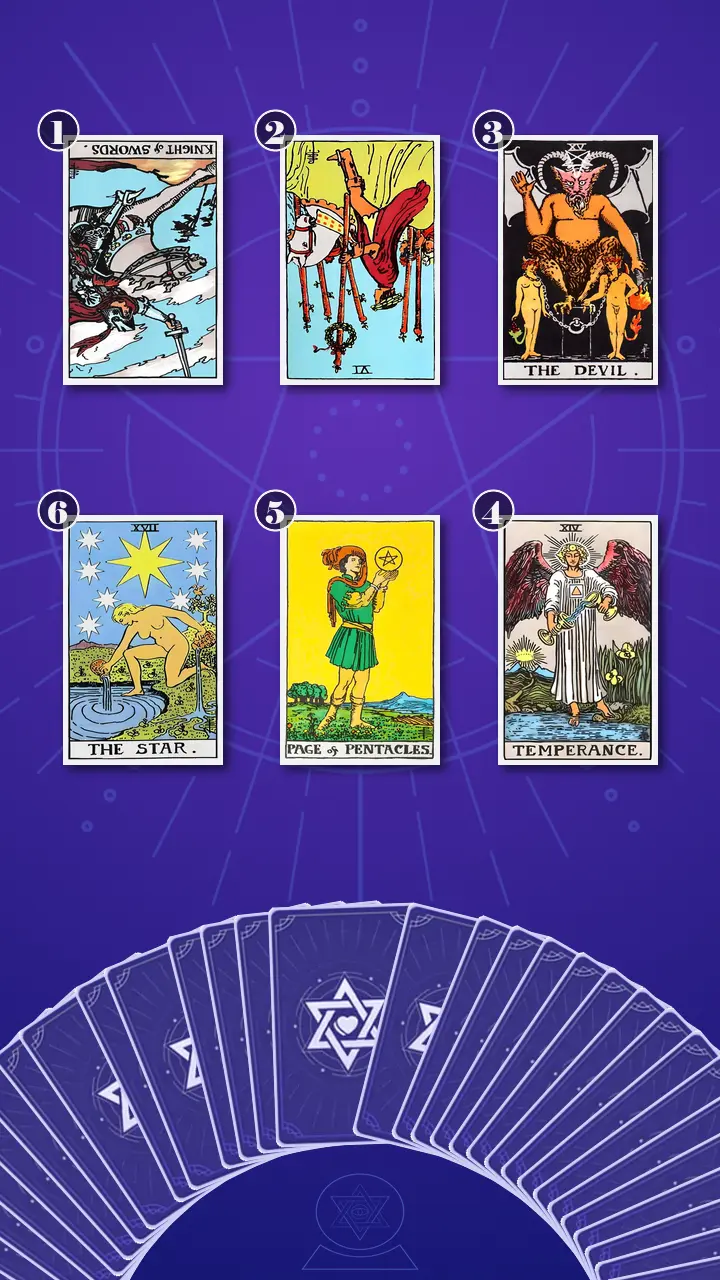
"Today I'm using the Transformation Path Grid (6), Context Edition," I explained. "This six-card Transformation Path Grid tarot spread fits because we're looking at a repeating rush, not choosing between two external options. It traces the visible behaviour, the pressure that rewards it, the deeper attachment beneath it, the pivot that can interrupt it, one practical experiment, and the kind of self-trust that may grow from staying with that experiment."
I pointed across the two-row layout. "The first card shows the present loop: what happens after a peer milestone. The second shows the recognition pressure that keeps the sprint alive, and the third reaches the worth-based fear underneath. The fourth is the hinge. The last two ask what you can practise and what perspective becomes possible when your own evidence matters more than someone else's timeline."
For anyone wondering how tarot works in a reading like this, the structure is a reflective map. It separates a trigger from the meaning attached to it, and it turns card meanings in context into questions about observable choices. It does not forecast whether Jordan will receive a promotion, finish a course, or arrive at a fixed destination.
Reading the Loop Without Calling It a Character Flaw
Position 1: The Cursor Pressing Start Too Soon
"Now revealed is the card for the present loop: the observable sprint after seeing friends' progress, including stacking goals, switching plans, and restarting."
"It is the Knight of Swords, in reversed position."
I looked at the charging horse, the raised sword, and the trees bent sharply by the wind. Reversed, this is excess Air: thought has become speed, and action has outrun direction. I connected it to the 11:40 p.m. scene. A friend's promotion appears, Jordan opens three course pages, rewrites the weekly plan, adds deadlines, and feels the body surge before asking what actually matters.
"The raised sword is like a cursor hovering over start now," I said. "The click creates motion before you have checked whether the goal belongs to you. Speed can create the feeling of progress before it creates evidence. The useful pause is not a rejection of ambition. It is the moment in which you choose what the movement is for."
Jordan let out a short, bitter laugh. "That's too accurate," they said. "Almost rude."
I did not ask them to agree with the card. "Then let's keep the useful part and leave the drama behind," I said. "When the first plan becomes tiring, can you wait long enough to learn from its scale instead of treating the need for adjustment as proof that you need a completely new identity and system?" Jordan looked down at the raised sword and rubbed their thumb along the phone case, recognition arriving with a little resistance.
Position 2: The Applause That Would Not Stay
"Now revealed is the card for the immediate reinforcement: the need for visible recognition and the comparison that briefly makes rushing feel justified."
"It is the Six of Wands, in reversed position."
The wreath on the raised wand became, in our conversation, a LinkedIn promotion banner, a portfolio view count, or the polished announcement that makes private effort feel real only after someone else has witnessed it. I asked Jordan to picture finishing a difficult UX task, then checking reactions and a friend's promotion timing before allowing any satisfaction. Reversed Fire here is recognition that cannot settle inside; ambition keeps asking the public to certify it.
I named the sequence aloud: "They are moving. I am late. I need a bigger plan now. If I cannot sustain it, something is wrong with me." The surrounding figures on the card became an imagined audience, not a group of villains. A friend's visible milestone held information about that friend's life, but Jordan's mind converted it into a private performance review.
I watched three small reactions pass through Jordan. Their breath paused; their jaw tightened; then their eyes went unfocused, as though a specific quiet accomplishment had been replayed and erased. Finally, their shoulders lifted in a tired shrug. "I can care about them and still feel jealous," they said. "That makes me feel worse."
"Those feelings can coexist without becoming instructions," I replied. "We are not deciding that sharing is shallow or that privacy is morally better. We are asking whether public recognition is being used as your only measuring tool."
Position 3: The Subscription to Urgency
"Now revealed is the card for the root mechanism: the underlying attachment and worth-based fear that repeats the same rush even after it causes exhaustion."
"It is The Devil, upright."
I explained that I was using this image as a symbolic mirror, not as a diagnosis, omen, or claim about Jordan's character. The chained figures suggested the bargain that had formed beneath the planning: sign up for another course or build an even larger schedule, buy a few hours of control, then use the resulting exhaustion as evidence of being behind or undisciplined.
The chains in the Rider-Waite-Smith image look binding, but they are also loose enough to invite a question. I used my Gravity Well Identification lens and asked what was exerting the downward pull. It was not Jordan's friends. It was the obsolete rule that visible achievement was the price of worth, reinforced by a phone, a competitive early-career workplace, and an endless supply of new systems that made uncertainty feel like a technical problem.
"The pattern is a recurring subscription to urgency," I said. "The first payment buys relief. The renewal arrives as exhaustion, unfinished work, and another reset. Which permission did you accept automatically, and which one might you review without trying to redesign your entire life tonight?"
Jordan's fingers closed around the edge of their sleeve. I saw the chest tighten, the eyes move back through the sequence, and then a deep breath break through the silence. "I want a life that feels like mine," they said. "But I keep building one for an audience." I let that sentence stand without correcting it. It held the shame, envy, and genuine desire in the same frame.
When Temperance Poured Between Two Cups
Position 4: The Hinge Between Ambition and Capacity
The room changed when I reached the lower row. The fridge continued to hum, but the sound seemed farther away; the cards no longer looked like a scoreboard. I turned toward the centre of the route.
"Now revealed is the card for the key pivot: the practical rebalancing that separates genuine growth from a peer-imposed deadline and interrupts the repetition cycle."
"It is Temperance, in upright position."
The angel's two cups offered a different answer to the raised sword. One cup held Jordan's desire to learn, contribute, and move forward. The other held Toronto workdays, commuting, meals, tired evenings, and the actual capacity left after a junior UX design shift. The measured stream between them did not ask Jordan to mute ambition or maximise intensity. It asked for a pace that could survive seven days.
I drew a small orbit in the margin of my notebook. This is my Cognitive Spiral Mapping lens: I trace the path from peer milestone to the thought "I'm late," from that thought to an overloaded plan, from the plan to temporary control, from control to exhaustion, and from exhaustion to the conclusion that an even faster restart is needed. Feeling stuck is not automatically a character verdict; sometimes the circling is a necessary orbital slingshot phase before a new intellectual direction becomes visible.
At this point, the question was not "How do I slow down forever?" It was "What can I repeat when I am tired?" That distinction was the bridge. The upper row had routed effort through comparison and returned it as inadequacy. Temperance gave the same effort a measured exchange between desire and capacity.
The Familiar Emergency
At 11:40 p.m. in a Toronto apartment, Jordan sees a friend's promotion, opens Notion, and fills seven days with a course, portfolio work, workouts, and networking. The rush feels like ambition, but the tight jaw and warm phone tell another story: fear is already steering.
A friend's milestone is evidence about their timeline, not a deadline for your worth. Temperance suggests that growth becomes more trustworthy when ambition and real capacity can occupy the same process. You do not need to abandon momentum; you can stop using speed as the receipt that proves you are moving.
For one beat, Jordan's breath stopped. Their fingers hovered above the edge of the Temperance card, still as a cursor over "start now." Then their eyes lost focus, and I could almost see the Sunday planner replay: the coloured blocks, the crowded week, the private promise that a bigger plan would make the fear safe. Their jaw tightened once more before releasing. A slow breath moved through their chest; their shoulders dropped, but the drop brought a faint, unsteady dizziness, as though they had been carrying a heavy backpack and had forgotten the room would feel different without it. Their eyes reddened. "But if I stop rushing," they said, "doesn't that mean I was wrong about everything?" I let the silence stay kind and ordinary. "No," I said. "It means you are testing a different route." I pointed between the two cups and asked them to hear the old voice, "Make the plan bigger; then I'll feel safe," beside a new one, "What could I repeat when I'm tired?" Then I asked, "Now, use this new view to remember last week: was there a moment when it could have felt different?"
Jordan did not open Notion immediately. They placed the phone screen-down, waited through the first twenty minutes of the urge, and wrote, "I can let this feeling exist without turning it into a seven-day emergency." The pause did not erase the comparison. It created a small area around it where a choice could happen.
"Ambition needs a pace it can survive," I said. "This is a first step from comparison-triggered urgency toward sustainable, values-aligned growth and grounded self-trust. It is not a promise that you will never feel late again. It is evidence that the feeling does not have to hold the steering wheel."
One Figma Component, Not a New Life
Position 5: The Apprentice Who Stays With One Skill
"Now revealed is the card for the action: one small, self-chosen learning practice that can be repeated without using friends as a scoreboard."
"It is the Page of Pentacles, in upright position."
I focused on the Page's concentrated gaze on one pentacle, the cultivated field beneath them, and the distant mountains beyond it. This was grounded Earth: a practical beginning, patient attention, and evidence built through repetition. I translated it into one UX research skill, four 25-minute sessions, and one factual note after each session. One Figma component could stay open in close view while the rest of the design system waited.
"A small practice may feel unimpressive beside a friend's promotion," I said, "but it gives you contact with the work itself. The mountain does not need to be completed this week for the field beneath your feet to be real."
Jordan glanced at the blank page in their notebook. I saw the old impulse reach for a more impressive goal, hesitate, and settle. "I could practise one interview technique," they said. "I would probably want to add a certification by day three." I smiled because the honesty mattered more than the certainty. "Then day three will give us useful information about the pattern."
Position 6: The Star Beyond the Imaginary Leaderboard
"Now revealed is the card for integration: the self-trust and hope available when growth is measured by alignment and continuity rather than visible speed."
"It is The Star, in upright position."
The large star and the smaller stars opened the landscape after the crowded upper loop. The figure pouring water onto the land and into the pool suggested that practical contribution and inner restoration could develop together without demanding the same speed from each. I read this as hope that remains available, not a prediction that every outcome will arrive on schedule.
"After a modest week of practice," I said, "notice whether the work still interests you when your phone is face down. That quiet interest is not less real because it has no announcement attached to it. The quiet work still counts before it becomes a story other people can see."
Jordan looked toward the dark window. The city lights reflected in the glass, but for once I did not see them checking those lights against anyone else's destination. Their face was still tired. Their mouth held a question. Beneath it, I saw a little more room.
Finding Clarity on a Route That Can Survive
I read the six cards as one coherent story. A peer milestone activates an old rule about worth; the reversed Knight of Swords turns that rule into immediate motion; the reversed Six of Wands supplies a brief hit of public reassurance; and The Devil shows why the bargain repeats after the reassurance fades. Temperance does not destroy the desire to grow. It changes the route, blending ambition with capacity. The Page of Pentacles makes that change observable through one skill, while The Star gives the practice a wider, personally meaningful horizon.
The blind spot is not a lack of effort. I told Jordan that they had been treating visible motion, a packed calendar, and a new system as evidence that progress was real, while treating continuity as too ordinary to count. The transformation direction is clear: replace peer-timed acceleration with one self-chosen, measurable practice that can be repeated for seven days regardless of what friends are doing.
I then used my Orbit Expansion Strategy. I invited Jordan to zoom out far enough to see the whole trajectory rather than judging one tired evening as the entire orbit: identify the comparison trigger, name the outcome that actually belongs to them, check the capacity available this week, choose one repeatable action, and record what the work reveals. The strategy was not an escape route from effort. It was a way to find the precise trajectory and momentum needed to leave the old cognitive gravity well.
"You are allowed to stop, continue, adjust, or try again after the timer," I said. "The experiment gives you information, not a new scorecard."
- The 20-minute comparison pauseThis week, when a friend's LinkedIn, Instagram, or group-chat update makes me want to redesign my week, I can save the post, set a 20-minute timer, write "What do I actually want from this?" in Notes, and complete one 10-minute task before changing the plan.If waiting feels like losing time, I can use the timer as a boundary rather than a test. When it ends, I can stop, continue, or leave the task for another day.
- The single-skill practiceBy Wednesday, I can choose one UX skill, write its name at the top of a note, and schedule four 25-minute sessions before Sunday. After each session, I can record one thing I practised, one question that remains, and one possible next step.I can use the 10-minute version on a tired evening. If I miss a session, I can resume at the next available slot instead of rebuilding the entire plan.
These were intentionally small next steps. They left room for healthy feedback, rest, and changing direction based on evidence. They did not require Jordan to mute friends, hide accomplishments, reject opportunities, or pretend that envy and shame had vanished. They only moved measurement closer to the work and farther from the imaginary leaderboard.

A Quiet Proof, Not a Victory Lap
A week later, I received a message from Jordan: "I did four 25-minute sessions on one interview technique. I still wondered this morning, What if I'm wasting time? But I didn't rebuild the plan." They had sent one narrow question to a peer, then sat alone with tea, pleased and a little tender.
That was not a solved life or a guaranteed new timeline. It was the first small proof that a modest practice could survive contact with an ordinary week. In my reading, that is how the Journey to Clarity begins: not when every question disappears, but when the person asking the question can interpret their own evidence with less punishment.
When a friend's promotion lights up your phone and your jaw locks around a new seven-day plan, you may feel safer outrunning your capacity than allowing a quiet week to seem like proof that you are not enough. I have learned that noticing the reflex is already a clear mark on the map, and that the cards are most useful when they return the map to the person holding it.
If one small practice could belong only to you for the next seven days, what might you become curious to notice about your pace when the imaginary scoreboard goes quiet and no friend's update is in the room?