A Friend's Voice Note Beside Figma—And a Fifteen-Minute Limit

The 8:47 p.m. Figma Spiral
If you keep a friend’s voice notes open beside Figma while answering Slack, I know the exact kind of emotional labor that can make your own evening disappear before anyone has technically asked you to give it up.
Jordan (name changed for privacy) joined my video room at 8:47 on a Tuesday night from their Toronto apartment. An unfinished product-feedback thread glowed on the laptop behind our call. Their radiator clicked against the wall, the laptop fan kept up its thin mechanical hum, and a warm phone rested in their palm as they scrolled through the latest message chain.
“I want to be the friend people can rely on,” Jordan said, lifting their shoulders almost to their ears. “But why do I keep absorbing everything a friend unloads on me?”
You want to be supportive, so you answer one more voice note, ask one more careful question, and keep the chat open in case the other person needs reassurance. Then you notice your work is untouched, your tea is cold, and your mind is still arranging someone else’s crisis long after the conversation has ended.
Jordan’s emotional overwhelm looked less like one dramatic wave and more like fifteen browser tabs moving from the screen into their rib cage, each one playing audio while their chest tried to hold the noise shut.
“If I have the capacity to listen, I should use it,” they said. After a pause, they added, “But I’m starting to resent it. And then I feel awful for resenting it. Why am I still carrying this after the conversation ended?”
“Being the dependable friend does not mean becoming the place where every feeling gets stored,” I told them. “I’m not going to use tarot to label your friend, predict whether this relationship will last, or tell you what you must do. I want us to make the pattern visible, so we can find the precise point where care becomes carrying. Let’s draw a map through this fog, and you can decide which path respects both your compassion and your actual capacity.”

Mapping the Space Between Two People
I asked Jordan to put both feet on the floor, loosen their grip on the phone, and take one slow breath while holding the question in mind. I shuffled at an unhurried pace. I use this small ritual as a change of focus, not as a performance of mystery: it gives the nervous system a moment to leave the message thread and enter the inquiry.
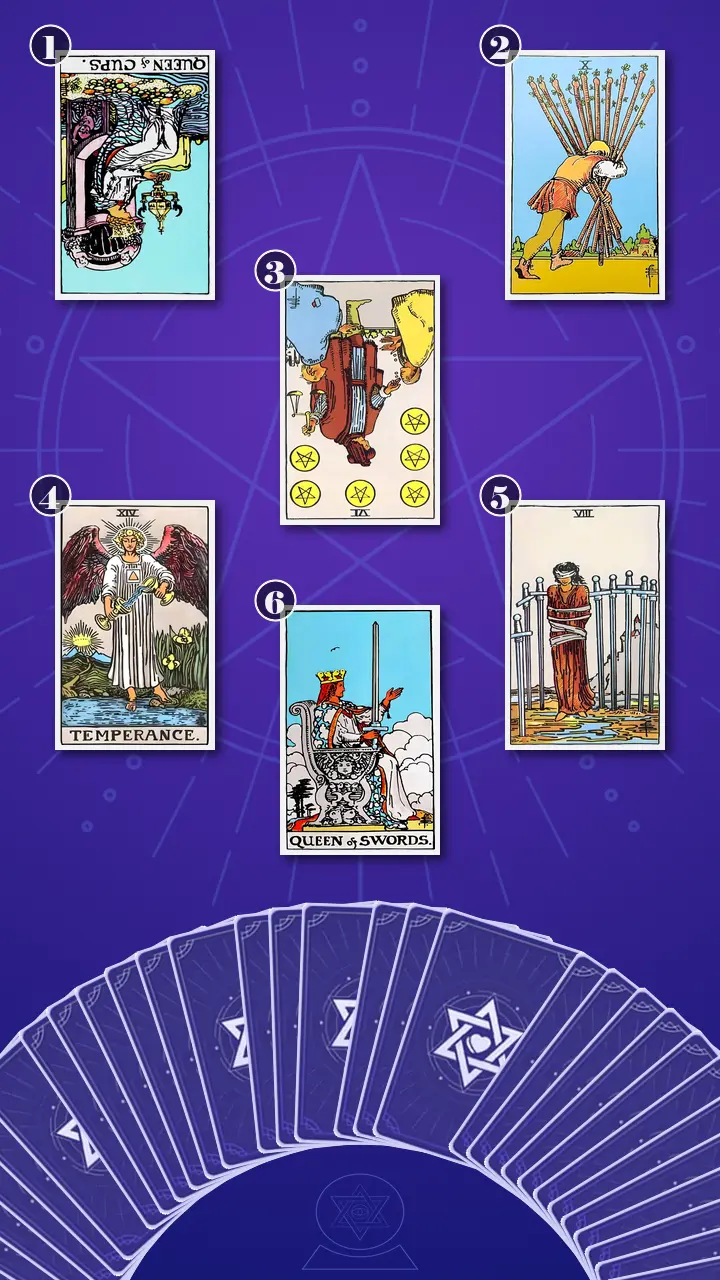
I chose the Relationship Spread · Context Edition, arranged in a two-column, three-tier grid. The layout resembles two people meeting across a table, with a route running from emotional spillover to a possible boundary conversation.
For anyone wondering how tarot works in a friendship-boundary reading, I chose this spread because the issue was not whether Jordan’s friend was good or bad. The useful questions concerned Jordan’s role, the emotional load entering the exchange, the circulation of care, the fear beneath over-availability, and the language that could create a more sustainable option. Six positions were enough to examine those layers without turning one difficult pattern into a total verdict on the friendship.
I explained that the first card would show the point where Jordan’s listening became emotional absorption. The second would describe what they were being asked to witness without diagnosing the friend. The center card would reveal how emotional labor was distributed. Beneath those, one card would identify the inner resource for balanced care, another would uncover the belonging fear that made limits feel dangerous, and the final card would offer actionable boundary language.
“Think of the spread as a set of structured prompts,” I said. “The cards can reflect patterns that are hard to see from inside the conversation, but they do not make the decision. You do.”
Where the Voice Note Enters the Body
Position One: The Cup Without a Lid
Now I turned over the card representing Jordan’s current pattern: how they responded when their friend unloaded, including the point where listening became emotional absorption. It was the Queen of Cups, in reversed position.
I drew Jordan’s attention to the ornate cup held close to the Queen’s body and the water gathered around her throne. “Your empathy is not the problem,” I said. “This is Jordan sitting at a laptop with a friend’s voice note playing beside an unfinished Figma task, absorbing the emotional tone until it becomes difficult to tell where the friend’s distress ends and Jordan’s own attention begins. The reversed Queen does not describe a lack of care. She shows valuable sensitivity without a reliable lid.”
I read the reversal as both an excess and a deficiency: emotional receptivity was running in excess, while containment was underused. That combination maintained the pattern. Jordan listened, replayed, checked for replies, and silently converted another person’s feelings into a personal assignment. The chat could close while the emotional process continued in the background, draining attention like an app that no longer appeared on-screen but was still consuming the battery.
“Where does listening end for you?” I asked. “Is it when the voice note ends, or only when you believe the other person is okay?”
Jordan gave a small, bitter laugh instead of nodding. “That is so accurate it’s almost cruel.” Their fingers tightened around the mug, then eased. “I can be halfway through work and suddenly realize I’ve spent twenty minutes drafting a response that sounds caring enough.”
“The card is not accusing you of being too emotional,” I said. “It is showing us that your compassion needs a container. A cup with a lid is still a cup. A limit does not cancel what it holds.”
Position Two: When a Conversation Becomes a Backlog
Now I turned over the card representing the emotional load entering the interaction: what the friend’s unloading asked Jordan to witness without judging or diagnosing the friend. It was the Ten of Wands, upright.
The figure carried ten bundled wands with a lowered head and an obstructed view. I connected that image to the six consecutive voice notes Jordan sometimes received on the TTC: a breakup, a conflict at work, a housing worry, and several implied decisions arriving in one thread. Jordan’s mind immediately opened an invisible Notion board and created tasks, owners, scripts, and deadlines that no one had actually assigned.
Upright, this was an excess of burdened fire. The weight was real, but the card belonged to what was entering the exchange, not to Jordan’s job description and not to a moral judgment about the friend. The friend could be genuinely struggling. Jordan could genuinely care. Neither fact required Jordan to become the project manager of the struggle.
“You can witness the weight without adding it to your own task list,” I said. “When several problems arrive at once, which parts were you actually asked to hold, and which parts did your mind claim before anyone requested that?”
Jordan looked away from the cards toward the dark window. I watched their jaw shift as if they were replaying a recent call. “They usually ask whether I can listen,” they said. “They don’t ask me to spend the next three hours figuring out what they should say to their manager. I just do that part.”
That distinction mattered. I was not asking Jordan to become colder or less responsive. I was asking them to notice the moment a conversation stopped being contact and started looking like an inbox they felt personally responsible for clearing.
Position Three: The Help Desk With No Closing Hours
Now I turned over the card representing the reciprocity and boundary pattern maintaining the cycle, including whether care was flowing in one direction. It was the Six of Pentacles, in reversed position.
I pointed to the scales and the one-way handoff of coins. In Jordan’s modern life, this was the familiar call in which they became listener, strategist, and reassurance provider while the friend received immediate relief. Jordan asked three questions, suggested a script, and heard, “You’re the best.” The conversation rarely returned to Jordan’s energy, their unfinished day, or what they could realistically offer.
I read the reversal as blocked circulation. Attention moved, but it did not circulate freely. Jordan’s relational system had one open help desk and no visible closing hours. The problem was not that every conversation had to be perfectly equal or that friendship required an emotional invoice. The problem was that Jordan’s capacity had become invisible, even to Jordan.
I voiced the loop I could see in the spread: “They feel better now, so this must be working.” Then I gave the loop its neglected second line: “Why do I feel emptied out?”
Jordan’s breathing paused. Their gaze lost focus for a moment, as though an old Sunday call had started replaying behind their eyes. Then they exhaled from deep in their chest and let their shoulders fall. “I use their relief as proof that I did the right thing,” they said. “I don’t include how I feel afterward in the calculation.”
That was the central blockage. As a product designer, Jordan recognized the structure immediately: the relationship’s current algorithm was optimizing for the fastest reduction in the friend’s distress while excluding Jordan’s depletion from the success metrics. Quick relief looked like a successful interaction, even when it produced one-sided emotional labor and delayed resentment.
“We do not need to keep score,” I said. “We do need accurate data. After the last crisis call, who had room to speak, who received relief, and was there any space for you to name your actual energy?”
When Temperance Kept the Cups Separate
Position Four: Compassion Without Fusion
Now I turned over the card representing the inner resource that could support care without absorption: emotional differentiation, moderation, and a sustainable way to listen. It was Temperance, upright, the bridge at the center of the reading.
The radiator gave one metallic click and went quiet. In the sudden stillness, I held the card closer to the camera. The angel poured liquid between two separate cups, with one foot in water and one on land. The image did not ask Jordan to stop feeling. It showed connection maintained through distinction.
In everyday terms, Temperance was Jordan listening with genuine attention for a defined period, acknowledging what their friend felt, and then returning to work or rest without treating the distress as unfinished work that belonged to Jordan. Its energy was balance: enough water for empathy, enough ground for self-location, and enough moderation to prevent contact from becoming fusion.
I asked Jordan to picture 11:26 p.m. in their bedroom: the charger buzzing, their eyes heavy before an early product review, and a message asking, “Can you talk?” The old binary was already forming: answer fully or be a bad friend. The phone was in their hand, but the whole friendship was not.
After a decade of reading human cycles through a cosmic lens, my mind often goes to orbital mechanics at moments like this. Gravity can influence a body without requiring that body to abandon its path. I used my Gravity De-linking Analysis, a framework for locating the friction created when two friends try to force alignment while moving through different life phases or emotional tempos.
Here, I was not claiming the friendship had to fade. I was mapping a smaller but important misalignment: the friend was in an urgent processing phase while Jordan was moving from a demanding workday toward needed rest. Jordan had interpreted the friend’s emotional gravity as an instruction to leave their own orbit. De-linking that gravity meant allowing the crisis to matter without letting it control the entire evening. The friend could be distressed on one side of the table. Jordan could be compassionate on the other. Care could travel between them without making their capacities identical.
You do not have to mix your identity with another person's pain to prove care; let Temperance keep compassion and responsibility in separate cups while you choose a measured way to listen.
I let that sentence rest in the room. Then I gave Jordan the same principle in plainer language: Care is not measured by how much of another person's distress you can store. You can stay compassionate while keeping responsibility in separate cups: what you witness belongs to the relationship, and what you choose to carry remains yours to decide.
Jordan’s inhale stopped halfway. Their fingertips, which had been rubbing the seam of the mug, went still. For several seconds their eyes did not meet mine; they remained on the two cups, unfocused, as though the card had begun replaying every call they had ended with a headache. Their pupils widened, their jaw tightened, and then their face sharpened with something closer to anger than relief. “But doesn’t that mean I’ve been doing friendship wrong this whole time?” The question came out low and quick. I watched their shoulders rise once, then drop; one hand opened from a fist against their thigh. Their eyes glossed, and they gave a shaky exhale that sounded almost like a laugh, then looked briefly unsteady, as if putting down the weight had revealed how much choice would now be theirs. Relief had arrived, but so had grief for the evenings already surrendered and guilt about changing the pattern.
“No,” I said. “It means unlimited availability was one strategy you learned for protecting connection. It worked well enough to earn relief and approval, so your mind kept recommending it. We are not putting your past self on trial. We are noticing that the strategy now costs more than it can sustainably give.”
I leaned toward the camera. “Now, with this new perspective, think back: was there a moment last week when this insight might have made you feel different?”
Jordan remembered a late call before a morning review. “I could have said I had ten minutes,” they said. “I didn’t need to decide whether I cared. I needed to decide what I could offer.”
I gave them three lines to write: “What I feel.” “What my friend may need.” “What I can offer tonight.” I asked them to spend no more than ten minutes on the exercise and choose an offer no larger than fifteen minutes or one text. I also made the freedom explicit: discomfort was a reason to pause and check in, not a command to send anything before they were ready.
This was the reading’s key emotional shift: a first movement from proving care through unlimited emotional availability toward capacity-based, reciprocal support. Jordan was not becoming detached. They were learning emotional differentiation, the ability to stay present without making another person’s internal weather their own climate.
The Choice Hidden Behind the Blindfold
Position Five: The Rule That Turns a Limit Into Rejection
Now I turned over the card representing the hidden belief or fear that made a limit feel like rejection or a threat to belonging. It was the Eight of Swords, upright.
I showed Jordan the blindfold, the ring of swords, and the bindings that looked restrictive without being permanently fixed. This was the moment a friend texted, “Can you talk?” and Jordan’s mind reduced the available choices to two: become fully available now, or abandon the friendship. A shorter call, a text-only response, or a next-day check-in disappeared behind the blindfold.
I read the card as blocked air: thought had narrowed around one untested rule. The restriction was not imaginary, because the fear in Jordan’s body was real. But the conclusion attached to that fear was not the only possible interpretation. Their inner algorithm had been trained on “delay equals rejection,” so it kept recommending over-availability even when their jaw, chest, and shoulders were reporting that capacity had ended.
“When you imagine saying, ‘I cannot talk tonight,’ what exact consequence do you fear?” I asked.
“That they’ll hear, ‘You’re too much,’” Jordan said. “Or that I don’t want to be close anymore.”
“That is the belief we test,” I replied. “A limit tells the truth about your capacity; it does not deliver a verdict on the friendship. Temperance has already shown the middle setting that the Eight of Swords hides: a warm response, a defined amount of care, and permission for the other person to seek additional support elsewhere.”
I also reminded Jordan that a friend might feel disappointed. Boundaries do not control another person’s reaction, and disappointment is not automatic proof of harm. It is information to notice alongside the history, reciprocity, and overall quality of the relationship. Jordan remained free to adjust the boundary, keep it, or reconsider the level of contact based on what actually happened.
Position Six: The Sentence With a Visible Edge
Now I turned over the card representing a concrete boundary communication Jordan could try that week while remaining caring and self-directed. It was the Queen of Swords, upright.
I held on the Queen’s upright sword, direct gaze, and raised hand. In context, the sword was not an instrument of punishment. It was a clean sentence spoken before depletion became resentment: “I care about you, and I have fifteen minutes to listen tonight, but I cannot work through the whole problem tonight.”
The Queen brought balanced air where the Eight had shown blocked air. She replaced silent overfunctioning with precise information. Jordan did not need to disappear, build a legal case, or add six apologies. They could name care, capacity, and one realistic offer. The friend’s response would belong to the friend and provide information about the relationship; it would not retroactively prove that the boundary was wrong.
“Care can have a closing time,” I said. “Try the sentence aloud.”
Jordan looked down and tested it softly. “I care about you, and I have fifteen minutes.” They stopped, frowned, and added, “I’m sorry, work has been wild, and I know you’re going through so much, and I don’t want you to think—”
I lifted one hand, mirroring the Queen. “Notice the moment clarity turns into a request for permission. Keep the caring first clause. Keep the true limit. Remove one explanation.”
Jordan tried again. Their voice was steadier. “I care about you. I can listen for fifteen minutes tonight, and then I need to log off.”
I watched their mouth tighten around the unfamiliarity of the sentence, then soften. They did not look triumphant. They looked exposed, which was more honest. Clear communication had opened a path, but Jordan would still have to walk it while guilt made its usual arguments from the sidelines.
Care With a Closing Time
When I read the spread as one story, the pattern became coherent. Repeated quick reassurance had trained Jordan to associate being needed with being secure in the friendship. The reversed Queen of Cups showed the current saturation; the Ten of Wands showed another person’s real but separate load; and the reversed Six of Pentacles revealed an exchange organized around immediate relief rather than visible capacity. The Eight of Swords named the inner conflict beneath it all: Jordan believed a limit could threaten belonging. Temperance supplied the missing resource, while the Queen of Swords translated that resource into language.
The cognitive blind spot was not Jordan’s kindness. It was using the friend’s relief as the only success metric while excluding Jordan’s lost work, sleep, plans, and growing resentment from the data. Once those costs became visible, the transformation direction was clear: Jordan did not need less compassion. They needed compassion expressed through explicit capacity limits, emotional differentiation, and support that had room to become more reciprocal.
I offered three small experiments rather than a demand to solve the entire friendship. Each one was designed to create evidence that Jordan could study in real life.
- Run the Two-Cups Capacity Check.Before replying to the next heavy message, open Notes and write, “My capacity right now is ___.” Fill the blank with one concrete option: “ten minutes,” “one text,” or “not tonight.” Take sixty seconds, then choose only the support that fits that answer.Tip: If your chest or jaw becomes more activated, pause. The check provides information; it does not obligate you to respond immediately.
- Use a Fifteen-Minute Listening Window.Send one warm, specific message to the friend: “I care about you. I have about fifteen minutes to listen tonight, and then I need to log off.” Set a quiet phone timer before the call. When it ends, close the chat and return to one preselected task such as brushing your teeth, finishing one email, or making tea.Tip: Use a warm first clause and a concrete second clause. Do not explain the limit more than once. If fifteen minutes feels too difficult, start with five.
- Save the Queen of Swords Reply.For the next late-night “Can you talk?” text, use a saved response: “I saw this. I care, and I cannot talk tonight. I can check in tomorrow after work.” After sending it, leave the phone in another room for ten minutes and write down what actually happened, separate from what you predicted the friend would think.Tip: Remove extra apologies and do not promise a time you cannot protect. Drafting the message without sending it is still a valid first practice; Jordan, not the card, chooses the pace.
“You are allowed to choose the size of the support you can honestly give,” I told Jordan. “We are testing whether care can remain real when it has an edge. We are not trying to manufacture a perfect response from your friend, and we are not asking one boundary to resolve the whole relationship.”

A Quiet Proof on Wednesday Night
Five days later, Jordan sent me a short update. Another late message had arrived while they were preparing for work the next morning. They had opened Notes, written “My capacity right now is not tonight,” and used the saved reply before they could optimize it into a paragraph.
The friend answered, “Okay, tomorrow works. Hope the review goes well.” Jordan put the phone in the kitchen, made fresh tea, and finished one Figma comment without checking the chat again. The tea was still warm when they drank it.
They slept through the night. Their first thought in the morning was still, “What if I got it wrong?” Jordan told me they smiled at that thought. Fear had arrived after the choice this time; it had not made the choice for them.
I did not call the reply a prophecy fulfilled or claim the friendship was permanently fixed. It was simply the first piece of new evidence: Jordan could state a capacity limit, survive the discomfort, and remain caring. The cards had provided an objective visual language for the pattern. Jordan had made the change.
For me, that was the quiet proof at the end of this Journey to Clarity. A relationship can exert gravity without requiring collision. Two people can remain part of the same constellation while carrying distinct responsibilities, moving at different speeds, and choosing when an honest exchange is possible.
I know the moment when the call has ended but your chest is still tight: you wanted to prove you belonged by staying available, and quietly began carrying a life that was never entirely yours. If that moment finds you tonight, remember that noticing the borrowed weight already means you are no longer moving on pure autopilot. Being the dependable friend does not mean becoming the place where every feeling gets stored.
When the next voice note lands, what size can your cup honestly hold today: one text, five minutes of listening, or enough space to answer tomorrow?