Fixing Every Friendship Lull: Letting One Clear Message Stand

When Compulsive Friendship Repair Reaches 11:40 p.m.
If you are the reliable late-twenties friend with a full-time city job who still rewrites one unanswered check-in at midnight, I suspect you know how friendship anxiety can disguise itself as thoughtfulness. Maya, a 28-year-old product designer in Toronto, came to me because she could manage shifting deadlines and blunt Figma comments, yet one quiet message thread could make every problem-solving instinct in her body light up at once.
She described the previous night to me in forensic detail. At 11:40 p.m., she had opened the unanswered iMessage thread for the fourth time. She deleted “no pressure,” added it back, checked her friend’s latest Instagram Story, and opened Google Calendar to find another date. The phone had grown warm against her palm. Her radiator clicked in the dry condo while blue light stung her tired eyes.
“I know friendships change,” she told me, pressing her restless fingertips together, “but why does this change feel like something I’m supposed to fix? If I stop trying, I’m scared nothing will be left.”
I heard the contradiction immediately. Maya wanted to preserve a friendship that mattered deeply, but she also feared that giving it room would reveal that the bond no longer belonged in her life. Every lull therefore felt less like an ordinary change in adult friendship and more like a verdict on whether she still had a place.
What she called anxiety had the physical logic of an elevator stalled between floors: pressure gathered behind her ribs while her hands kept reaching for buttons that had already been pressed. Sending another message briefly created movement. When closeness did not immediately return, the stalled feeling came back with grief, guilt, and an even stronger urge to intervene.
“I’m not going to tell you whether this friendship will stay or end,” I said. “That would turn uncertainty into theatre, and it would take your agency away. I want us to see the pattern clearly enough that you can choose your next move without asking one text message to settle your entire sense of belonging. Let’s draw a map through the fog.”
Choosing the Bridge: A Contextual Six-Card Relationship Tarot Spread
I asked Maya to place both feet on the floor, take one unforced breath, and hold the question in plain language: “Why do I keep fixing a friendship that needs room to change?” I shuffled slowly. I treat this preparation as a transition for attention, not a supernatural performance. It gives the nervous system a moment to arrive before the analytical mind starts building another case.
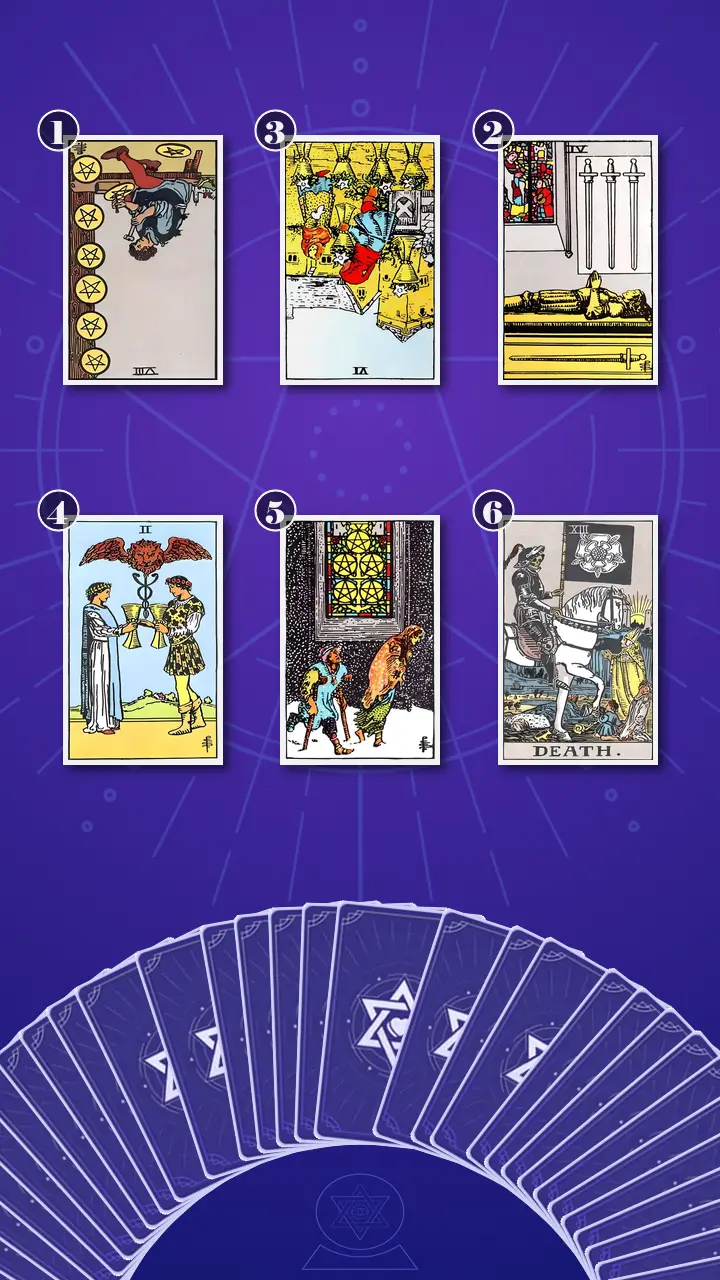
I chose the Relationship Spread · Context Edition, a contextual six-card Relationship Tarot Spread for examining space, reciprocity, nostalgia, and transition in a changing friendship. This spread was precise enough to separate six things Maya had been experiencing as one tangled emergency: her fixing behavior, her friend’s observable communication patterns, the shared cycle, the bond’s real resource, the fear beneath the cycle, and the developmental path available to Maya.
I explained to the reader in front of me, and to anyone wondering how tarot works in relationship questions, that position two had a deliberate limit. I would not claim access to the friend’s private thoughts. I could examine only what Maya had actually encountered: slower replies, cancelled plans, pauses, direct requests, and follow-through. Position six would not predict a fixed outcome either. It would show an integration path Maya could consciously explore.
I arranged the cards as a two-level bridge. On the upper row, Maya’s effort and her friend’s observable signals faced one another through the current dynamic. On the lower row, mutual care, exclusion fear, and transformation showed what could support, obstruct, or change that dynamic. I would begin with Maya’s role, move through the central pattern to the observable pause, then read the lower row toward the final card.
This structure mattered because card meanings in context should clarify a decision, not replace one. The spread could help Maya distinguish care from control and feeling excluded from having confirmed evidence of rejection. Maya would remain the person deciding what level of contact, reciprocity, and uncertainty was acceptable in her life.
Reading the Bridge Between Effort and Space
Position 1: The Friendship as an Unclosed Work Ticket
“The card I’m turning first represents your observable fixing behavior and the contracted effort you bring to every change in contact,” I said. I revealed the Eight of Pentacles, reversed.
The image usually shows patient craftsmanship: a figure repeating the same careful motion over a row of pentacles. Reversed, that diligence had become blocked earth energy, then tipped into excess. Maya was not lacking commitment. She was applying commitment beyond the point where it could produce useful information.
I connected the card to a scene she knew well. After a cancelled plan, she would rewrite a careful message during her commute, send it, and begin drafting the next check-in before receiving a reply. The friendship had become like a work ticket she could not close. Every silence prompted another revision, and effort briefly felt safer than uncertainty.
“It’s like a Figma file that keeps receiving revisions after the actual brief has changed,” I said. “The private script is: If I can just find the right wording, then the response will prove we’re okay. But expressing care once and managing for a particular response are not the same action.”
Maya gave one short laugh, but there was no amusement in it. “That’s too accurate. It’s actually a little brutal.” Her breath caught first; then her eyes dropped to the card as if she were replaying her last three drafts; finally, her thumb stopped rubbing the edge of her phone case.
I softened my voice without softening the insight. “The card isn’t criticizing how much you care. It’s showing you where care has been recruited to manage fear. That pattern makes sense because doing something gives you a few minutes of control. It also leaves you responsible for both sides of the friendship.”
I placed my fingertip beside the repeated pentacles. “Care expressed once is still care. Before your next follow-up, ask: am I communicating one need, or am I trying to engineer the response that would make my chest release?”
Position 3: When the Past Becomes Today’s Service-Level Agreement
I moved to the upper centre of the bridge. “The card I’m turning now represents the self-reinforcing dynamic in which nostalgia and repeated repair keep the friendship tied to its former rhythm.” I revealed the Six of Cups, reversed.
I saw the preserved flowers in the cups and thought of archived voice notes, old photos, recurring jokes, and routines kept beautiful inside a phone. In Maya’s life, the card looked like comparing a two-line exchange at 11:40 p.m. with the nightly university conversations that once seemed effortless. If today contained fewer messages, she treated today as a diminished version of something real.
Here, water energy was not absent. It had pooled around memory. The friendship’s history was so emotionally concentrated that the present bond could not move without being compared with its earlier form. Maya kept offering the old rhythm back to the present, then reading the present’s inability to reproduce it as failure.
I placed the Six of Cups beside the Eight of Pentacles. “The old routine has become the friendship’s service-level agreement. But adult schedules, identities, and social circles have changed. Nostalgia can honour a bond, but it cannot negotiate its present terms.”
I used the Ship of Theseus image because it met Maya where her design mind already lived. “If enough planks change, is it still the same ship? Your fear says every original plank must stay in place or the friendship was never real. I’m asking a different question: what quality might remain meaningful even when the structure changes?”
Her lips parted, but she did not answer immediately. Her gaze went soft, then shifted toward the rain-dark window. After a long breath, she said, “I miss who I was with her then. It’s not only the messages.”
“That matters,” I said. “You may be grieving a rhythm, a friendship, and an earlier version of yourself at the same time. Grief deserves room, but it does not have to become an instruction to recreate the past.”
Position 2: The Hands That Do Not Press Send
I turned to the card opposite Maya’s position. “This card represents your friend’s observable pauses, requests, and communication patterns as you encounter them. It does not give me permission to invent motives.” I revealed the Four of Swords, upright.
The resting figure’s hands were folded while three unresolved swords remained overhead. I read that image as a balanced expression of air: thoughts still existed, questions still existed, but neither had to become an immediate conversation. In Maya’s situation, this looked like receiving a brief reply, noticing her thumb hovering over Send, and leaving the thread for the evening.
“I can’t tell you whether your friend is resting, distracted, reconsidering the bond, or simply moving through a crowded week,” I said. “I can tell you that the observable signal is reduced engagement. Another message may obscure that signal before you have learned anything from it.”
I turned Maya’s phone face down beside the card. “Nothing has been settled, but nothing has to be sent tonight. Space is information, not an automatic verdict.”
Her shoulders rose before they lowered. “Waiting feels like I don’t care. Or like I’m trying to manipulate her into reaching out.”
“That’s why the pause needs a definition,” I replied. “Intentional space is not silent punishment. You are not withholding affection to produce a result. You are allowing one clear act of care to stand without doubling it, while remaining available for direct questions, urgent logistics, or safety needs.”
I watched her glance at the face-down phone, keep both hands around her tea, and exhale without reaching for it. The concerns had not vanished. For a few seconds, however, they were allowed to exist without becoming another message.
Two Cups at Equal Height, One Window in the Snow
Position 4: Where Maya Is Met, Not Merely Effective
“The card I’m turning now represents the genuine relational resource worth preserving, especially mutual care, respect, and freely chosen reciprocity,” I said. I revealed the Two of Cups, upright.
Two figures faced each other while holding separate cups at equal height. I read the water energy here as balanced: neither person carried both vessels, and neither had to chase the other across the image. The card did not promise constant access. It showed mutual recognition expressed through visible participation.
I asked Maya to review the last month without grading punctuation, response speed, or message length. Which conversations felt nourishing because both people moved toward them? Which invitations, check-ins, or accommodations had been freely offered? Where had she felt met rather than merely effective?
She remembered that her friend had called after Maya’s difficult product review without being prompted. The call had been shorter than their university conversations, but it had been attentive. She also noticed that the plans she most enjoyed were not the ones she rescued with three replacement dates. They were the ones both people chose and confirmed.
“Reciprocity is what remains visible when you stop carrying both sides,” I said. “It may be uneven without being absent, and you still decide whether the level available works for you. The important change is that you measure the bond through present behaviour rather than through how efficiently you can keep it moving.”
I saw a small release travel through her body: her jaw loosened, her gaze returned to the spread, and one corner of her mouth lifted. The card had not solved the friendship. It had given her a better unit of measurement.
Position 5: The Instagram Story as a Lit Window
“The card I’m turning now represents the underlying fear that space will lead to exclusion and confirm that you no longer belong,” I said. I revealed the Five of Pentacles, upright.
Maya had already given me the card’s modern scene. At 6:14 p.m. on Line 1, she had seen an Instagram Story showing her friend at a crowded dinner after declining Maya’s invitation. Train brakes squealed. Wet wool and takeaway coffee filled the carriage. Her stomach dropped as the thought arrived: There was room. Just not for me.
The Five of Pentacles validated the coldness of that moment without confirming the conclusion Maya drew from it. Earth energy had contracted into a perceived deficiency: one image became a complete social ranking, and one declined plan became proof that no place remained for her. The feeling of being outside was real. The Story was still limited evidence.
I compared the fear to an algorithm trained almost entirely on exclusion. Once activated, it ranked ambiguous cues as proof of rejection: a short reply, an unconfirmed plan, a group photo, a timestamp. It down-ranked other data, including Maya’s supportive relationships and the moments when this friend had moved toward her freely.
“What do we actually know from the screen?” I asked. “We know your invitation was declined, and we know your friend attended another event. We do not know from that image alone how the plan arose, what capacity was available, or where you rank in anyone’s heart. Before another repair message, can you separate the event from the belonging story your body built around it?”
Maya’s chest visibly tightened. Her eyes narrowed as if the Story had returned to the space between us; then she pressed her palm below her collarbone and whispered, “Everyone else is inside, and I missed the moment when I stopped belonging.”
“That sentence is the fear,” I said. “It is not a verdict. We can respect how sharply it hurts without handing it authority over the next message.”
When Death Raised the White Rose
As I reached for the final card, the room became unusually still. Rain tapped the window in a slower rhythm, and a distant streetcar bell sounded once before the city noise folded back into the background. I left a little more space around this card because I knew its name could trigger fear before its meaning had been explained.
Position 6: Letting the Old Form Complete Its Work
“The card I’m turning now represents the integration available when you permit the old structure of the friendship to change. It does not forecast a fixed ending.” I revealed Death, upright.
I clarified immediately that Death in tarot is not a prediction of literal death, nor did it decree that Maya’s friendship must end. Upright, its transformative energy moves rather than clings. The skeletal rider advances beneath a black banner bearing a white rose, while sunlight rises between distant towers. The card acknowledges grief and asks which exhausted form must be released so that present truth can become visible.
Looking at that white rose, I remembered friendships my own travels had forced to change across borders and time zones. Some had become occasional but honest. Others had completed their place in my life. Distance had altered the routines without retroactively deleting what the people involved had meant to me. That private memory kept my interpretation grounded: transition can reveal value, but it cannot guarantee continuity.
The Savior Complex Audit Beneath the Fixing
I brought in a Jungian tool I call Savior Complex Auditing. I do not use it to diagnose someone as a savior or make care sound pathological. I use it to examine whether being the fixer has quietly become a condition for feeling valuable in the relationship.
I asked Maya three questions. What concrete problem had her friend actually asked her to solve? Which identity was she trying to preserve when she reopened every relationship conversation? If she stopped fixing and allowed her friend to choose freely, what did she fear that choice would say about her?
“She didn’t ask me to solve anything,” Maya said. Her fingers tightened, then released. “I think I’m trying to stay indispensable. If I’m useful enough, maybe I can’t be left out.”
I told her that this was the shadow side of the Maintainer archetype: devotion becoming an attempt to secure belonging through usefulness. Death invoked the Transformer instead, the part of her capable of grieving a completed structure without deciding that the love, history, or person attached to it had been fraudulent.
I returned Maya to 11:40 p.m.: the warm phone, the blue screen, the edited “no pressure,” and the calendar search. She had called the draft care, but her tight chest was asking one message to settle a much larger belonging question. Death asked what could happen if the old routine were allowed to finish.
You do not preserve the friendship by keeping its old routines alive; you honor it by letting Death's white rose mark an honest transition into a form both people can freely choose.
I let the sentence remain in the room.
I watched Maya’s breath stop first. Her fingertips froze above the rim of her cup, and her pupils widened slightly. Then her gaze lost focus, as though archived threads and missed Sunday messages were replaying somewhere behind her eyes. Her face tightened before the resistance reached her voice. “But doesn’t that mean I was wrong this whole time? That I made it worse by trying so hard?” I told her no: the effort had been a protective strategy, probably one that once helped her keep important connections alive. Clarity was not an indictment of her past self. It was a responsibility to notice when the strategy no longer served the present. Her eyes reddened. She opened the hand that had been clenched against her knee, lowered both shoulders, and released a breath that sounded half like a laugh and half like grief. For a moment, the relief left her looking almost dizzy. “Then I don’t know what happens next,” she said quietly.
“That is the vulnerable part of clarity,” I replied. “You no longer have the illusion that effort can control the result, but you do have a more honest way to participate.”
I invited her back into lived experience. “Now, using this new perspective, can you think of a moment last week when this insight might have let you feel differently?”
She returned to the Line 1 Story. “I could have admitted that I felt left out without sending a casual follow-up to make the feeling go away. I could have gone home, talked to someone who was actually available, and waited until I knew what I needed.”
I gave her the insight again in its simplest form: A friendship can remain meaningful without remaining identical; let the old rhythm end before asking the present bond to name itself.
I named the emotional crossing I had just witnessed. This was movement from anxiety-driven friendship repair and fear of exclusion toward tolerance for space, present-tense reciprocity, and steadier self-trust. It was not complete acceptance. It was the first moment Maya could feel grief without immediately converting it into a task.
Care Without Chasing: The Next 48 Hours
I drew the six cards into one coherent story. The reversed Eight of Pentacles showed Maya working harder whenever the bond changed. The reversed Six of Cups explained why: she was measuring the present against a protected memory. The Four of Swords interrupted that maintenance with deliberate stillness. The Two of Cups offered a better measure, which was visible reciprocity. The Five of Pentacles named the exclusion fear that made stillness feel dangerous. Death allowed the old structure to end without forcing an immediate judgment about the friendship’s total meaning.
I returned to the image Maya had brought into the session: holding a door open with both hands because letting it close felt equivalent to losing the room. Her cognitive blind spot was the assumption that more effort could answer a belonging question. In reality, gripping the door prevented her from seeing whether anyone else would reach for the handle, whether another entrance existed, or whether she wanted to remain in that room under the available terms.
I also pointed out that no Wands had appeared in the spread. More initiative was not the missing ingredient. The transformation direction was simpler and harder: name one need once, allow a defined pause, grieve the old rhythm, and observe what remains freely mutual. That is the practical value I want from a contextual six-card Relationship Tarot Spread: not a command from fate, but actionable advice that returns the next decision to the person living it.
The One-Message Space Window and the Reciprocity Check
I gave Maya two deliberately small practices. Neither required her to declare the friendship over, suppress an important boundary, or pretend that distance did not hurt.
- The One-Message Space Window.If Maya had not already expressed her need, she would use my Compassionate Detachment Protocol in one or two sentences: “I value our friendship, and I know our rhythm has changed. I’d like to have coffee sometime this month if that works for you. There’s no need to answer tonight; I’ll leave the next step with you.” If the need had already been expressed, she would send nothing further. She would then add a private calendar event called Space Window and wait 48 hours before considering another non-urgent message. When the urge to follow up appeared, she would set a seven-minute timer and write under three headings: What happened, What I am afraid it means, and The one need I have already expressed or could express once. In this context, compassionate detachment meant respecting both people’s emotional reality while refusing to absorb the full relational workload.Start with one evening or a two-hour phone-free block if 48 hours feels too activating. Direct questions, urgent logistics, and safety needs remain exceptions. The pause is observation, not a test or punishment.
- The Present-Tense Reciprocity Check.Maya would create a two-column note titled Carried by Me and Freely Offered. Across the next four weeks, she would log at least three observable interactions: who initiated, who responded with care, who suggested or confirmed a plan, and who made room without a second prompt. After each interaction, she would complete one sentence: “I felt met when...” or “I felt responsible for both sides when...” She would record behaviour only, without interpreting her friend’s motives.Do not turn the note into a scorecard or courtroom exhibit. Reciprocity can be uneven without being absent, and Maya retains the right to decide whether the level available is nourishing enough for her.
I reminded her that the protocol was not a clever way to make her friend come back. A pause used to produce a reaction would repeat the same control cycle in quieter clothing. Its purpose was to let Maya’s nervous system settle enough for current evidence, grief, and personal choice to occupy the same frame.

Six Days Later: A Quiet Phone, a Different Morning
Six days later, Maya wrote that she had sent one clear invitation and left her phone in the kitchen for the evening. No reply had arrived. She slept through the night; at breakfast, “What if I’m wrong?” returned, and this time she met it with a small smile.
I did not read the unanswered message as a happy ending or a failed experiment. The meaningful change was smaller and more durable: Maya had experienced uncertainty without automatically turning herself into the friendship’s project manager. She had made room for disappointment, other available connections, and the possibility that a clear answer might emerge gradually through behaviour.
That was the quiet proof of our Journey to Clarity. The cards had not saved the friendship, ended it, or chosen its next form. They had made Maya’s maintenance loop visible and helped her separate a lit-window feeling from confirmed exclusion. Maya remained the person with the authority to express a need, honour a boundary, welcome mutual contact, or step back if the present bond could not meet her.
If a quiet phone makes your chest tighten, I know it can feel as though keeping both hands on the friendship is the only way to keep your place in it. I would ask you to remember Death’s white rose and the two cups held at equal height: an old rhythm can end without making the friendship meaningless, and care does not become more real because one person carries all of it.
If you named one need once and let the old rhythm be over for now, what small sign of a second cup being freely raised toward yours would you be curious to notice?