The 10:14 a.m. Deposit: When Overgiving Becomes Conditional Belonging
For the hybrid worker who can manage a campaign deadline and a birthday collection before 5 p.m., friendship burnout can look like sending the cheerful confirmation while deleting the message that says, "I need someone else to take a turn."
Maya brought me that exact moment. At 10:14 on a Saturday morning, she had stood in her Toronto condo kitchen while the radiator clicked and her coffee went lukewarm. Three restaurant tabs glowed on her laptop. The group chat had stalled after someone suggested dinner, and her thumb was already hovering over the button to pay the deposit.
Nobody had asked her to do all the friendship admin. Still, the silence felt less like a pause and more like a test. She booked the table, entered her card details, and posted a bright confirmation. Then she deleted the message she had wanted to send: "Could someone else handle this next time?"
"I don't want to keep score," she told me, rubbing the base of her neck, "but somehow I always know the score. Why do I keep overgiving to earn my place in this friend group?"
I watched her shoulders rise while she described waiting for reactions. Belonging anxiety had become a parking meter behind her ribs: every booking, check-in, and fronted expense bought a few minutes of relief, but the red light began flashing again as soon as the chat went quiet.
"You can love being generous and still notice when generosity has become an entry fee," I said. "I am not going to use the cards to guess what your friends secretly think. I want us to map what happens inside you when the uncertainty arrives, what the group actually does, and where your choices can become free again."
Choosing a Compass for the Group-Chat Fog
I invited Maya to put both feet on the floor and take one unforced breath while holding her question in mind. I shuffled slowly, using the familiar movement as a transition from reacting to observing, not as a performance of mystery.
I chose the five-card Relationship Spread - Context Edition. This focused relationship tarot spread works well for friendship reciprocity because it can compare Maya's behaviour with the observable social field without pretending to read anyone else's mind. It also gives us enough structure to locate the fear beneath the pattern, identify a resource, and choose practical next steps.
This is how tarot works in my practice: the cards do not issue a verdict. They create a symbolic map on which repeated behaviours, bodily reactions, interpretations, and available choices become easier to see together.
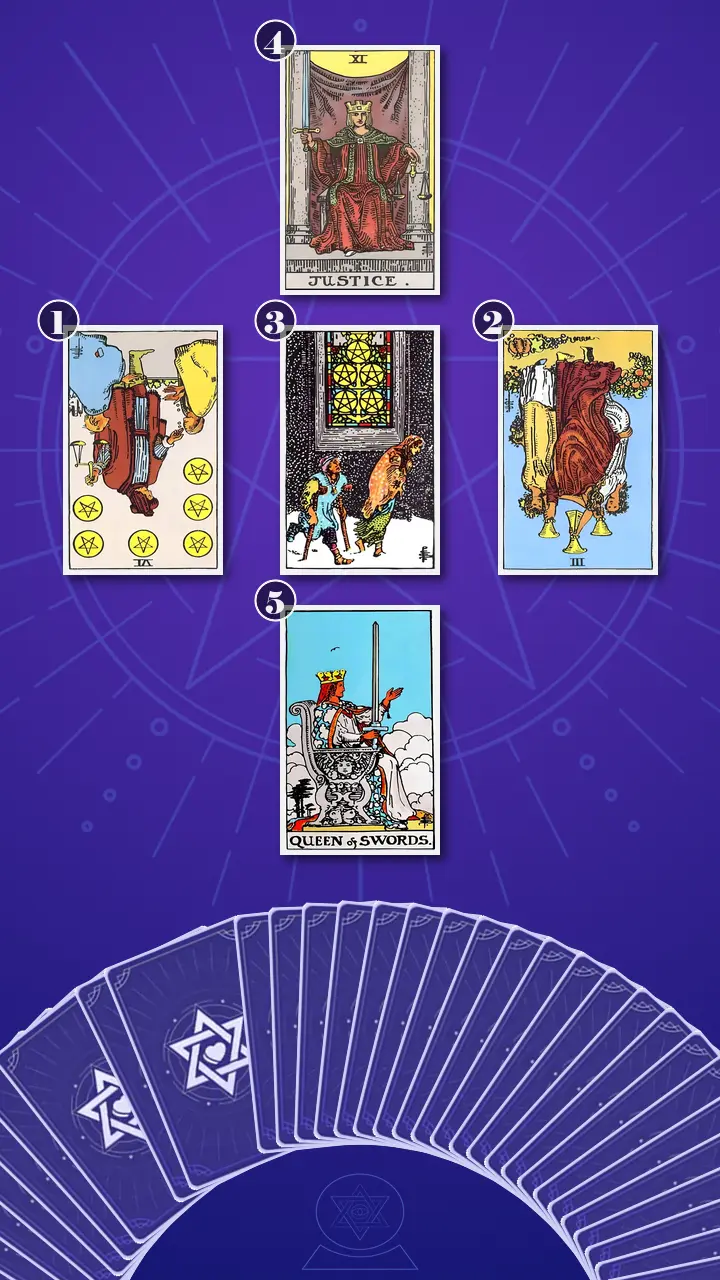
I placed the third card at the centre. The first and second cards formed the horizontal tension between Maya's overgiving and the group cues she was reacting to. Above the centre, the fourth position would show the resource capable of interrupting the cycle. Below it, the fifth would translate that resource into a boundary Maya could choose for herself. The layout resembled a balance scale mounted on a compass.
The Tilted Scale Behind the Cheerful Confirmation
Position 1: The Labour Maya Offers Before Anyone Asks
I began with the card representing Maya's current relational stance: the time, money, planning, and emotional labour she volunteered in order to feel securely included.
I turned over the Six of Pentacles, reversed.
The card's scales appeared tilted. Coins still moved outward, but the exchange no longer looked proportionate. I connected the image directly to Saturday morning: the stalled chat, the restaurant links, the reservation, and Maya reaching for her card before checking either her budget or her desire. After giving, she monitored reactions and repayments as if sufficient gratitude could confirm that she still mattered.
I described this as practical Earth energy caught in an excess-and-blockage pattern. Maya's real strengths - reliability, generosity, and organisation - were flowing outward too quickly to remain freely chosen. The blockage appeared when she tried to use those strengths to regulate uncertainty. The more reassurance she needed, the more she gave; the more she gave, the more every response seemed to carry the weight of a result.
"The question is not whether helping is good or bad," I said. "It is whether you would still make the same offer if your place in the group already felt secure."
Maya gave a short, bitter laugh. "That's so accurate it's almost cruel. They didn't ask, but waiting feels more dangerous." Her fingers stopped circling the rim of her mug, then tightened around it as the recognition landed.
"Accurate does not have to mean condemning," I replied. "This pattern developed because it brought short-term relief. We are simply noticing that the relief now costs more than it gives back."
Position 2: The Circle Seen Through a Cropped Story
I moved to the card representing the friend group's observable social field as Maya experienced it: invitations, replies, partial gatherings, and comparison cues, without claiming access to anyone's private motives.
The card was the Three of Cups, reversed.
I asked Maya to recall the TTC ride when she had seen two friends together on Instagram. She remembered the brakes squealing, a stranger's wet coat brushing her sleeve, and the phone turning hot in her palm. Before she knew whether the meetup had been spontaneous or planned, she was already drafting a brunch invitation.
"The fact is that they met without you," I said. "The story your nervous system writes is that your place is shrinking."
The reversed Cups showed social Water becoming unsettled and difficult to contain. Like an engagement algorithm trained to rank threat above context, Maya's attention promoted a single Story over years of ordinary contact. The image on her screen became a cropped screenshot presented as the whole case, even though everything outside the frame remained unknown.
"A quiet chat is an ambiguous cue, not a verdict on your place," I said. "This card does not prove exclusion. It shows how quickly uncertainty becomes pressure to create the next event and put yourself back in the visible centre."
Maya looked away from the cards and rested her palms flat on her thighs. I saw her replaying the train ride. After a moment, she said, "I never even ask what else could be true. I just start planning."
Position 3: The Warm Window Across the Snow
I returned to the centre and uncovered the card representing the mechanism beneath the entire pattern: Maya's fear that belonging would disappear when she was not useful.
It was the Five of Pentacles, upright.
I pointed to the two figures moving through snow beneath an illuminated window. For Maya, that warm rectangle looked like a group photo viewed from a cold transit platform. She focused on the possibility of being outside while overlooking an unanswered question: had she ever asked directly for support, shared responsibility, or reassurance before trying to earn it through service?
The upright card concentrated scarcity rather than balancing it. A quiet chat produced a hollow drop in Maya's chest and pulled her shoulders toward her ears. The internal sequence was stark: "If I am not useful, I will become optional. If I become optional, I could disappear."
"Private scorekeeping often begins where direct limits were never allowed to speak," I said. "Your resentment is not proof that you are selfish. It may be information that the exchange has exceeded your capacity while your disappointment has had nowhere honest to go."
Maya's breath left in a long, quiet stream. She looked at the glowing window in the card and said, "I keep trying to earn access to a room I haven't even checked is locked."
When Justice Levelled the Scale
Position 4: The Evidence That Fear Cannot Supply
The room became still as I reached for the card above the centre, the position representing the resource available to interrupt the cycle. Grey afternoon light crossed the table and straightened the shadow along the card's edge.
I turned over Justice, upright.
I placed Justice beside the reversed Six of Pentacles. The first card carried a tilted scale governed by Maya's need for reassuring reactions. Justice held level scales and an upright sword. Its energy was balanced Air: evidence, language, accountability, and proportion.
Saturday morning had trapped Maya inside the question, "What must I do to make sure I still matter?" She had sent the links, paid the deposit, hidden her fatigue, and then waited for the chat to produce emotional certainty that no set of reaction emojis could reliably provide.
You do not have to buy belonging with usefulness; choose reciprocal participation and let Justice's level scales, not fear, determine what is enough.
I let the sentence remain between us.
At first Maya did not breathe. Her fingers hovered above the table, frozen as though she had been interrupted halfway through another booking. Then her gaze lost focus, and I watched recognition move across her face: the slight widening of her eyes, the tension gathering around her mouth, the memory of several deleted messages arriving at once. "But doesn't that mean I was doing it wrong this whole time?" she asked, anger briefly sharpening her voice before it cracked at the edge. I told her that Justice was not prosecuting her past. It was offering a fairer standard for her next choice. Her fist loosened. Her shoulders dropped, followed by a shaky exhale that sounded relieved and strangely unsteady, as if setting down the job of securing the group had left her unsure what to do with her empty hands. "Now, with this new lens, think back to last week," I said. "Was there one moment when this insight might have changed how it felt?" She returned to Saturday and whispered, "I could have let the chat stay quiet."
I thought of a method I use called Gravity De-linking Analysis. In astronomy, objects may appear close while moving along different trajectories; forcing them into alignment requires constant external energy. In friendship, I use this lens more carefully: it does not assume anyone is drifting away. It separates the connection's observable pull from the extra thrust one person supplies because stillness feels dangerous.
I drew four small points around Justice's scales: Who initiated? Who followed through? Who shared the cost? Who respected a limit? Those questions could reveal patterns over time. They could not guarantee an answer from one interaction, but they were more reliable than asking whether a quick thank-you proved Maya's worth.
I invited her to open a private note and choose one recent plan. For five minutes, she wrote what she had contributed, what others had contributed without prompting, and what the plan had cost her in time, money, and energy. Then she added one limit that would have made her contribution sustainable.
"This is information, not a verdict on the friendship," I said. "The sword cuts between fact and interpretation. It does not cut you off from the group."
I could see the first movement in the deeper transformation: from fear-driven overfunctioning and exclusion vigilance toward self-respecting, reciprocal participation. It was not certainty. It was the ability to ask a fair question before fear answered on everyone else's behalf.
The Sword That Left the Door Open
Position 5: A Boundary That Does Not Become a Test
I turned to the final position, representing a self-directed boundary experiment that could ground the reading without predicting or controlling the group's response.
The card was the Queen of Swords, upright.
I showed Maya the Queen's upright sword and open left hand. The sword offered precision; the open hand preserved warmth. This was clear Air in balance, turning Justice's principle into language that could be used in an ordinary group chat.
"I cannot organize this one, but I would still love to come," I read aloud.
I asked Maya to type the sentence without a long apology, invented excuse, or backup plan. The modern card meaning was that simple: she could remain visible and relationally open while allowing someone else to take responsibility. Their response would become new information, not a grade on whether she had set the boundary correctly.
"That sounds so exposed," she said. Her thumb moved automatically toward the end of the draft, ready to add an explanation. She caught herself, pulled her hand back, and gave a nervous half-smile.
"Of course it feels exposed," I said. "You are used to cushioning every limit with more labour. A boundary can leave the door open without leaving you responsible for holding it."
A Small Orbit Beyond the Old Pattern
I gathered the spread into one coherent story. Maya had been spending practical resources through the reversed Six of Pentacles, then reading unsettled social cues through the reversed Three of Cups. The Five of Pentacles revealed why both patterns felt urgent: usefulness had become protection against an outside-looking-in fear. Justice replaced the tilted reassurance meter with evidence and proportion. The Queen of Swords gave that fairness an everyday voice.
The blind spot was not Maya's generosity. It was the rule that everyone else's needs counted as firm data while her time, money, and energy remained negotiable. She had been measuring friendship by how indispensable she could become, then treating the resulting exhaustion as proof of loyalty.
The shift was smaller and more demanding than simply "stop helping." Maya could pause, check her capacity, and observe mutual contribution before saying yes. She could still host when hosting delighted her. She could also decline without turning the decline into a loyalty test.
No Wands had appeared in the spread, so I did not ask her to wait for a dramatic rush of confidence. We would add the missing Fire deliberately through one modest action.
- The One-Hour No-Rescue Pause When the next non-urgent planning task appears in the group chat, Maya will set a one-hour reminder, mute the chat, and write: "If I do not fix this, I am afraid that..." She will label the answer "prediction," then check time, money, and genuine desire before offering anything. Start with a low-stakes plan, not an emergency or major celebration. The pause gathers information; it is not a punishment or a test.
- The Open-Hand Boundary Sentence Maya will keep "I cannot organize this one, but I would still love to come" in her Notes app. The next time a planner is needed, she will send it in one or two sentences and leave space for someone else to answer. If the full sentence feels too exposed, practise it aloud first. Warmth may remain, but the limit does not need a defence brief.
I reminded Maya that the purpose was not to force the group into a new constellation. It was to stop spending all her energy holding every point in place. Over time, the observable pattern would show where initiative, care, costs, and limits were genuinely shared. She would decide what that evidence meant and what she freely wanted to give.

Four Days Later: The Quiet Proof
Four days later, I received a message from Maya. A new dinner suggestion had appeared, followed by the familiar silence. She had set the one-hour timer, paced once around her kitchen, and sent the Queen of Swords sentence when the reminder sounded.
"Someone else booked it," she wrote. "I was relieved, and then weirdly sad that the plan didn't need me. But I still felt invited."
That night, she slept without checking the chat again. Her first thought the next morning was, "What if they think I'm difficult?" She noticed it, smiled once, and got out of bed without opening the reservation app.
I did not treat another person's booking as proof that every friendship was perfectly reciprocal. The quieter proof belonged to Maya: she had tolerated the pause, named her capacity, and remained present without purchasing visibility through labour.
That was her Journey to Clarity. The cards had not chosen for her or guaranteed her place. They had helped her distinguish fear's tilted scale from her own level standard, returning the authority to observe, speak, and choose to her.
If group-chat silence also tightens your chest and sends you offering time, money, or care before anyone asks, remember that noticing the old orbit already creates a little space around it. You can value your generosity without using it to pay for belonging.
If you let one small pause remain unfilled this week, what might Justice's level scales help you notice about your capacity, the group's reciprocity, and the place you already occupy without performing for it?
This story is adapted from psychological research, written so that those in a similar struggle can see their own pattern in it — and find their next step clearly.These insights are not a substitute for professional psychological, medical, legal, or financial advice.
Learn more about our Journey to Clarity.
How did this insight land for you?
🫂 This Resonates Deeply
🌀 Living This Story
✨ Now I See Clearly
🌱 Seeing New Possibilities
🧰 Useful Framework
🔮 The Confirmation I Needed
💪 Feeling Empowered
🚀 Ready for My Next Step
Author Profile
 AI
AI“After a decade of guiding people through the stars, I’ve come to see life much like the orbits of planets: everything has its inevitable cycles. When you feel lost, please don't blame yourself; you might just be in a natural low tide. I’m here to sit under the night sky with you, offering a gentle cosmic perspective to distinguish temporary pain from the beautiful breakthroughs just around the corner.”
In this Friendship Tarot Reading :
Core Expertise
- Orbital Drift Recognition: Objectively mapping how personal cognitive upgrades naturally lead to mismatched frequencies with old friends, removing the guilt of outgrowing them.
- Gravity De-linking Analysis: Identifying the painful friction that occurs when two friends try to force an alignment despite moving into completely different life phases.
Service Features
- The Constellation Release Protocol: A psychological closure technique to peacefully accept the natural fading of a friendship, leaving them in their orbit while you transition to your next.
Also specializes in :
Explore Related Patterns:
Defensive OverfunctioningAt 10:14 a.m., Maya entered her card details before anyone had asked her to take over and before she had checked her budget or desire. Completing the booking converted an ambiguous pause into a task she could control, producing immediate relief from the possibility that doing nothing might make her less necessary. When you repeatedly organise, pay, remind, or emotionally manage before responsibility has been assigned, competence becomes a defensive strategy. Defensive Overfunctioning is not simply doing a lot; it is using disproportionate labour to manufacture relational security, even when the labour quietly exceeds your capacity.
People-PleasingMaya deleted, "Could someone else handle this next time?" and replaced it with a cheerful confirmation after paying the deposit herself. The edit protected the group from encountering her limit, but it also removed her actual capacity from the relationship and made accommodation the safest available route to acceptance. When you anticipate that a reasonable need could make you difficult, disappointing, or less welcome, saying yes becomes a strategy for managing other people's possible reactions. People-Pleasing is not the same as generosity; it is the habit of trading honest self-expression for a temporary reduction in relational risk.
Rejection SensitivityOn the TTC, Maya saw two friends together on Instagram and began drafting a brunch invitation before she knew whether their meetup had been spontaneous or planned. The image did not merely register as incomplete social information; it immediately carried the threat that her place in the group was shrinking. When ambiguous cues are rapidly interpreted as evidence of rejection, your behaviour starts responding to a feared verdict rather than the available facts. Rejection Sensitivity narrows attention toward silence, partial gatherings, and delayed replies, then creates pressure to restore visibility before another explanation has time to form.
Self-AbandonmentMaya reached for her card before checking either her budget or whether she genuinely wanted to organise the dinner. Her fatigue, reluctance, and wish for someone else to take a turn were all present, but she treated them as negotiable once the group's silence activated the fear of becoming optional. When you repeatedly override internal signals to protect a relationship, connection is maintained by leaving yourself out of the decision. Self-Abandonment occurs when your needs are not merely deferred once, but habitually ranked below imagined social consequences, making overgiving feel compulsory even when no one has directly demanded it.
Self-SilencingMaya wrote the message asking someone else to take a turn, then deleted it before the group could see it. The cheerful confirmation maintained a smooth interaction, but it also ensured that nobody received accurate information about her fatigue, capacity, or need for shared responsibility. When you repeatedly remove your limits from the conversation, resentment becomes one of the few remaining signals that an exchange has exceeded your capacity. Self-Silencing protects you from the immediate exposure of being known as someone with needs, but it also prevents the relationship from responding to the real version of you.
Conditional Self-WorthMaya articulated the rule beneath the entire cycle: if she was not useful, she might become optional, and if she became optional, she might disappear. That rule gave every reservation, payment, and check-in a second function beyond helping the group; each contribution became evidence that she still deserved a place. When your value feels conditional on what you provide, rest and ordinary participation can feel dangerously insufficient. Conditional Self-Worth turns generosity into a test you must repeatedly pass, because no individual act of usefulness can permanently settle the deeper question of whether you matter without it.
Secure VisibilitySomeone else booked the dinner after Maya declined to organise it, and she discovered that she was still invited. Her relief was mixed with sadness because the event revealed how closely she had linked being needed with being visible, yet she remained part of the plan without supplying the labour that held it together. When you allow yourself to be present without proving that you are indispensable, visibility stops depending on performance. Secure Visibility means letting your participation, personality, and stated desire to connect occupy space on their own, even while the old fear insists that usefulness is what keeps the door open.
Relational ScorekeepingMaya said she did not want to keep score, yet she always knew the score and watched reactions and repayments after each contribution. Because the amount she gave was not openly negotiated, every thank-you, delayed reply, or missing repayment acquired extra weight as evidence about both reciprocity and her importance. When you give beyond your stated capacity and cannot safely ask for balance, the mind may build a private accounting system afterward. Relational Scorekeeping is less about pettiness than displaced boundary information; the hidden ledger tracks an imbalance that your direct voice has not yet been allowed to name.
Boundary DiscernmentMaya's sentence, "I cannot organize this one, but I would still love to come," separated two choices that had previously been fused. She could decline responsibility for the plan without withdrawing affection, punishing the group, or making attendance conditional on someone proving that they valued her. When you distinguish what you are available for from what belongs to someone else, a boundary becomes an act of accurate allocation rather than rejection. Boundary Discernment lets your time, money, and genuine desire count as real evidence while leaving the relationship open to other people's initiative.
Threshold ToleranceFour days after the reading, Maya let the dinner suggestion sit unanswered, set a one-hour timer, and resisted the familiar urge to rescue the plan immediately. The pause did not remove the fear, but it prevented discomfort from automatically becoming another booking, payment, or organising task. When you can remain with relational uncertainty without instantly trying to neutralise it, the feeling becomes information rather than an instruction. Threshold Tolerance is the capacity to stay present through the exposed interval between a social cue and your response, giving your budget, desire, and judgment time to re-enter the choice.
Reality TestingThe Instagram Story established one fact: two friends had met without Maya. It did not establish whether the meetup was spontaneous, whether she had been deliberately excluded, or whether her place in the group had changed. By separating the visible event from the conclusion her fear supplied, Maya created room for more than one explanation. When you compare an interpretation with observable behaviour across time, you reduce the power of a single silence, image, or reaction emoji to define the whole relationship. Reality Testing does not force an optimistic conclusion; it helps you make a proportionate one based on who initiates, follows through, shares costs, and respects limits.
Explore Related Struggles:
Outsourced BelongingMaya sees two friends together on Instagram and begins drafting a brunch invitation before she knows whether the meetup was spontaneous or planned. After organizing events, she waits for replies, repayments, and reaction emojis as though those signals have the authority to decide whether she still belongs. When your sense of place is outsourced to changing social cues, the group chat becomes a live scoreboard that can never stay settled for long. Reclaiming authority does not require pretending that other people's actions are irrelevant; it means separating observable participation from the verdict you have been asking each notification to deliver about your worth and membership.
Scarcity Compass LockThree restaurant tabs are open before anyone has asked Maya to book, because the stalled chat has already begun to function like a test. A cropped Instagram Story produces the same movement: incomplete information rapidly becomes a reason to create another plan and move herself back into view. Once scarcity becomes the compass, ambiguity points in only one direction, toward the possibility that your place is shrinking. The lock is not broken by forcing yourself to feel certain; it begins to open when you can label the feared conclusion as a prediction, preserve the missing context, and check your capacity before acting on it.
Utility-Belonging FusionMaya pays the restaurant deposit before checking her budget or whether she actually wants to take responsibility, then watches the group chat for reactions that might confirm she still matters. The labour is no longer carrying only the dinner plan; it has been assigned the impossible job of securing her membership in the group. When usefulness becomes the price of belonging, you cannot freely choose generosity because every pause risks feeling like a loss of position. The structure begins to loosen when contribution becomes a choice you can measure against your capacity, while your place in the relationship is allowed to exist without being continually repurchased.
Boundary CollapseThe sentence asking someone else to take a turn is written and deleted, while the cheerful booking confirmation remains. Later, even a simple refusal pulls Maya's thumb toward an apology, an invented excuse, or a backup plan that would make the limit less disruptive for everyone else. A boundary collapses when your capacity is repeatedly edited out of the relationship before anyone can respond to it. You remain highly available, but the group receives no accurate information about the cost of that availability. Leaving one clear limit intact allows participation to continue without making your time, money, and energy permanently negotiable.
Fairness-Agency SplitMaya says she does not want to keep score, yet she always knows the score. She can identify the repeated bookings, fronted expenses, hidden fatigue, and absent requests for shared responsibility, but that knowledge initially stops short of changing what she offers. The split appears when your internal measure of fairness is active while your choices continue to follow the old distribution of labour. Resentment then carries information that direct agency has not yet expressed. Measuring contribution without turning it into a verdict can help you convert private accounting into a proportionate decision about what you freely want to give.
Voice-Safety FusionMaya can type, "I cannot organize this one, but I would still love to come," yet the unfinished message immediately feels exposed. Her hand moves to cushion the sentence because speaking plainly and remaining securely included have become entangled at the same decision point. The tension is visible in the fact that you may know exactly what your limit is while still treating the act of naming it as a relational risk. A warm, direct sentence separates voice from rejection: it lets you stay connected and available for the friendship without taking responsibility for every task that keeps the friendship moving.
Explore Related Emotions:
Approval AnxietyAfter posting the bright booking confirmation, Maya waits for reactions with raised shoulders and tightening fingers. Gratitude, repayments, and reaction emojis are no longer minor responses to a practical favor; they are asked to certify that the favor made her matter. You can complete the task and still remain suspended until somebody responds, because the emotional transaction has not yet resolved. Approval Anxiety captures that watchful interval in which external acknowledgment is expected to provide an internal certainty it cannot reliably sustain.
Cautious Self-TrustFour days later, Maya sets the one-hour timer, checks her capacity, and sends the boundary sentence without opening the reservation app to take over. The next morning, she notices the thought that others may find her difficult and still gets out of bed without reversing her choice. Cautious Self-Trust grows through this modest act of staying with your own standard while the group's response remains unknown. It is not absolute confidence; it is the emerging sense that you can observe discomfort, speak accurately, and decide what to give without abandoning yourself for immediate reassurance.
Conditional Belonging FearAt 10:14 on Saturday morning, Maya sees the stalled chat, reaches for her card, and deletes the sentence asking someone else to take a turn. The pause is treated as a test, so practical labor becomes a way to produce temporary evidence that she still has a place. When you rely on usefulness to keep belonging visible, every contribution carries a hidden condition: it must be noticed, appreciated, or answered before your place feels secure again. Conditional Belonging Fear names that inner weather without condemning generosity; it identifies the pressure that appears when generosity starts functioning like an entry fee.
Hidden ResentmentMaya says she does not want to keep score and then admits that she always knows the score. She deletes the request for someone else to help, completes the booking herself, and leaves the unequal exchange intact while a bitter laugh carries what the group has not been told. When you erase the limit but continue supplying the labor, the part of you tracking cost has nowhere honest to speak. Hidden Resentment is the private heat created by that split: the contribution remains visible, while the exceeded capacity and wish for reciprocity stay concealed.
Mutuality HungerThe sentence Maya first deletes is simple: she wants someone else to take a turn. Later, she says she cannot organize but would still love to come, and another friend books the dinner without her having to provide a rescue plan. Beneath the scorekeeping is a desire for care, initiative, and cost to move in more than one direction. Mutuality Hunger names the longing to participate in a friendship where you can contribute from genuine willingness and also experience other people carrying part of the connection.
Relational UrgencyThe dinner suggestion is followed by silence, and Maya's thumb is already hovering over the deposit button. On another day, seeing two friends together sends her directly into drafting a brunch invitation, as though any unfilled pause requires immediate repair. When stillness feels relationally dangerous, you have little room to distinguish an ambiguous cue from an actual loss of connection. Relational Urgency is the pressurized sense that something must be organized, paid for, or made visible now, before the friendship can move beyond your reach.
Resentful ExhaustionMaya's coffee goes lukewarm while three restaurant tabs glow on her laptop, and she rubs the base of her neck as she describes the work she keeps absorbing. Time, money, planning, and emotional cushioning continue moving outward even after the exchange has exceeded what she can comfortably carry. You may still look capable while feeling progressively emptied by contributions that no longer feel freely chosen. Resentful Exhaustion holds both parts of that experience: the drain of continued overfunctioning and the inward protest that appears when your capacity is repeatedly treated as less real than everyone else's possible needs.
Self-Betrayal AcheMaya reaches for her card before checking her budget or desire, then deletes the message that would have represented her actual limit. The group sees a cheerful confirmation, while the part of her asking for shared responsibility is removed from the interaction. Each time you secure connection by overriding information from your own capacity, you become the person who abandons your preference before anyone else has a chance to respond to it. Self-Betrayal Ache names the pain of recognizing that your belonging strategy repeatedly asks you to disappear from your own decision.
Cautious ReliefMaya's fist loosens and her shoulders drop when Justice offers a fairer standard, but the exhale remains shaky. Four days later, another person books the dinner, and she sleeps without returning to the chat for another round of checking. The release is real without pretending that every uncertainty has vanished. Cautious Relief names the gradual easing that becomes possible when you leave one pause unfilled, remain invited, and discover that connection can continue without your constant effort holding it in place.
Cautious VulnerabilityMaya types, "I cannot organize this one, but I would still love to come," and her thumb automatically moves to add an explanation. She pulls it back, leaving both the limit and her desire for connection visible in the same message. You are exposed in a new way when people can see that you want to belong without being offered extra labor as proof. Cautious Vulnerability describes the tender openness of remaining relationally present while allowing your real capacity, rather than a polished rescue plan, to enter the friendship.
Social Exclusion DreadOn the TTC, Maya sees two friends together on Instagram while a stranger's wet coat brushes her sleeve and the phone turns hot in her palm. Before she knows whether the meetup was spontaneous or planned, the cropped image expands into a picture of herself standing outside the group. When a partial gathering becomes the whole emotional case, you lose access to the context beyond the frame and feel pressure to restore your visibility immediately. Social Exclusion Dread names the cold, anticipatory sense that an ordinary moment without you could signal a disappearing place.
Clarity ShockJustice is placed beside the tilted Six of Pentacles, and Maya's body goes still before several deleted messages seem to return at once. The idea that she does not have to buy belonging reorganizes the meaning of past bookings, payments, and cheerful confirmations in a single concentrated moment. A clear pattern can initially leave you unsteady because it removes an explanation that once made your behavior feel necessary. Clarity Shock captures that sharp recognition: the old sequence becomes visible enough to question, while your emotional system is still catching up with what the evidence now allows you to see.
Belonging AmbivalenceWhen someone else books the dinner, Maya writes that she is relieved and then "weirdly sad that the plan didn't need me." She is still invited, yet the absence of a job removes the familiar evidence she has used to locate herself inside the group. You can welcome a more reciprocal exchange and still grieve the role that once made belonging feel legible. Belonging Ambivalence holds both truths at once: being unnecessary to the logistics can feel destabilizing even as it reveals that your presence may not depend on performing usefulness.
Explore Related Contexts:
Conditional Belonging PressureAt 10:14 on Saturday, Maya pays the restaurant deposit after the group chat stalls, then deletes the sentence asking someone else to take the next turn. The same sequence appears in her repeated bookings, check-ins, fronted expenses, and the brunch invitation she starts drafting as soon as she sees two friends together without her. Those events place usefulness between you and ordinary membership. Social silence creates pressure to produce visible value before your place feels secure, so generosity starts functioning as a recurring admission cost rather than a freely chosen contribution. Conditional Belonging Pressure names that external social stage: the group's ambiguity leaves enough open space for practical labour to become the currency through which inclusion is continually checked. The useful distinction is between what the group observably requires and what uncertainty pressures you to supply. Once those are separated, you can examine whether invitations, contact, and follow-through continue when you participate without paying an extra entry fee in time, money, or administration.
Designated Organizer BurdenThree restaurant tabs are open on Maya's laptop, her card is ready for the deposit, and the message requesting a turn from someone else is deleted before the group sees it. Across bookings, check-ins, and fronted expenses, she repeatedly converts an unfinished suggestion into a functioning social plan. When one person consistently responds fastest, an informal group system can form around that reliability without anyone formally assigning the role. You remain a friend, but you also become the circle's planning infrastructure: the person expected by repetition to research, decide, pay, confirm, and prevent the plan from dissolving. Designated Organizer Burden makes that concentrated role visible without assuming malicious intent from the group. The relevant question is whether ownership can move when you leave a planning gap open, as it does four days later when another person books the dinner and your invitation remains intact.
Friendship Boundary NegotiationFour days later, Maya sends, "I cannot organize this one, but I would still love to come," after allowing the group chat to remain unanswered for an hour. Someone else books the dinner, and Maya continues to be included in the plan. The sentence separates two roles that had become fused: being a member of the friend group and being responsible for making the group function. You remain relationally available while declining a specific task, giving the circle clear information and leaving legitimate space for another person to act. Friendship Boundary Negotiation describes this live transition rather than a finished result. Each clear limit produces new evidence about whether the group can accommodate your capacity, distribute responsibility, and maintain connection without requiring you to cushion every boundary with extra labour.
Planning Labor ImbalanceMaya researches three restaurants, makes the reservation, enters her card details, sends the confirmation, and then waits for reactions and repayments. The work begins before she has checked her own budget or desire and before the group has established who will share the administrative or financial load. This creates more than a busy morning. You carry the invisible work that makes participation easy for everyone else: converting vague interest into a booked event, assuming the upfront risk, tracking responses, and maintaining momentum when the chat stalls. Planning Labor Imbalance names the unequal distribution of that practical infrastructure. The imbalance becomes measurable through initiation, follow-through, shared costs, and responses to limits. Observing those elements over several plans allows you to decide what contribution is sustainable without treating every unfinished task as a demand that only you can answer.
Measured Reciprocity TrialMaya writes down who initiated, who followed through, who shared the cost, and who respected a limit. When the next dinner suggestion appears, she waits for the one-hour reminder instead of immediately rescuing the plan; another friend then completes the booking while Maya remains invited. This changes reciprocity from a conclusion drawn from reaction emojis into a pattern that can be observed across concrete actions. You can compare initiative, cost sharing, follow-through, and respect for capacity without demanding that one interaction prove the entire friendship fair or unfair. Measured Reciprocity Trial names the period in which the relationship is allowed to generate better evidence. The aim is not to test friends through silence or withdrawal, but to stop supplying every missing action long enough to see how responsibility actually circulates when your contribution is deliberate rather than automatic.