The Friday Dinner Where Jordan Became a Footnote
I first met Jordan, a 26-year-old non-binary junior UX designer in Toronto, after they described a strange split in their life. In a structured work meeting, they could defend a design decision while a FigJam board filled with notes. At dinner with one charismatic friend, they could barely keep a sentence alive.
“I don't run out of things to say,” Jordan told me. “I just stop believing I should say them.”
“You are not running out of things to say,” I replied. “You are editing yourself before the room can receive you.”
Jordan took me back to 7:42 on a Friday evening, inside a crowded Korean restaurant near Dundas West. Forks tapped against bowls, overhead lights buzzed, and the phone beneath their palm felt warm. They had begun describing a successful UX presentation when their friend interrupted with a bigger, faster story. Jordan felt their throat close as if an invisible hand had lowered their microphone. Their shoulders folded forward, and they smiled.
“Mine wasn't a big deal anyway,” they had said.
The table kept moving. Jordan spent the rest of dinner asking follow-up questions, laughing in the right places, and making themselves easy to include because they were becoming increasingly difficult to see. On the Line 1 train home, the brakes squealed while they scrolled through Instagram Stories of the friend laughing beneath rooftop lights. Blue light washed over their hands as they replayed the sentence they had never finished.
“I want to stay close to them,” Jordan said to me. “I don't want to compete for attention or make it weird. But I leave every hangout feeling like nobody met the real me.”
I heard the central conflict immediately: Jordan wanted connection with someone they genuinely admired, but they feared that taking up equal space would threaten their belonging. Their body treated visibility like a fire alarm. A tight throat, a reflexive laugh, a smaller posture, then the familiar sentence: “I'm good with anything.”
I told Jordan I was not going to use tarot to declare whether their friend was good, bad, secretly jealous, or destined to leave. I wanted the cards to function as a psychological map. “Let's look at what happens, what you predict will happen, and where those two things have become tangled. We are not searching for a verdict. We are looking for clarity you can use.”

Choosing the Compass: A Five-Card Relationship Spread
I invited Jordan to place both feet on the floor, take one slow breath, and hold the question without rehearsing an answer: “Why do I keep making myself smaller around my main-character friend?” I shuffled slowly, using the rhythm as a transition from replaying the past to observing it.
I chose a classic five-card Relationship Spread. I use this friendship tarot spread when the problem involves two distinct relational positions and the exchange created between them. It is focused enough to examine reciprocity and boundaries without producing layers that the question does not need.
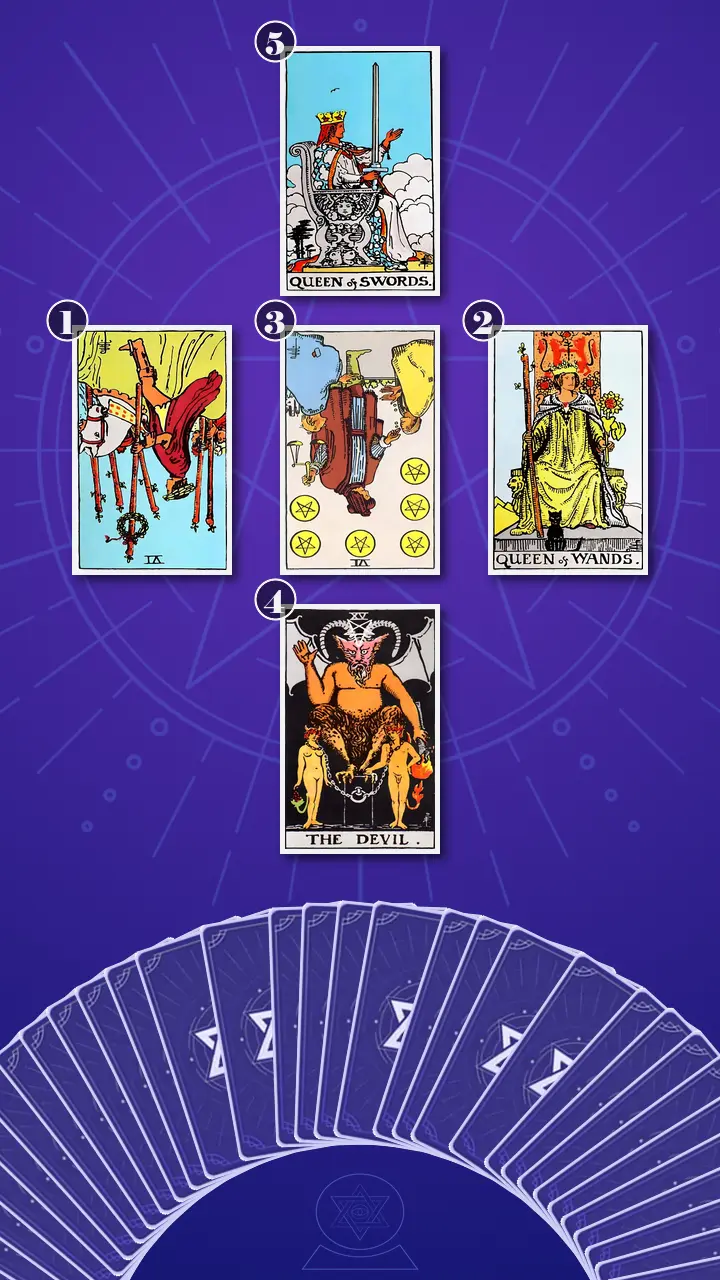
I placed the first card on the left to show Jordan's stance in the relationship and the second on the right to represent the friend's social style as Jordan encounters it. The third went between them to reveal the shared pattern. The fourth sat below the centre, exposing the hidden belief that keeps the pattern in place. The fifth rose above it as practical guidance.
The layout resembled a compact compass. Its horizontal line compared two voices without blaming either person. Its vertical line moved from the private constraint below to a clearer response above. That symmetry mattered to me. Jordan was responsible for their choices, but they were not responsible for inventing reciprocity on behalf of two people.
When Recognition Turns Down Its Own Volume
Position One: The Six of Wands Reversed
I turned over the card representing Jordan's observable self-minimising behaviour and the contracted state that appeared when attention was shared. It was the Six of Wands, reversed.
Upright, the card's rider holds a public position, crowned with a laurel while the surrounding crowd has a chance to witness the achievement. Reversed, that Fire was blocked. Jordan was stepping down from visibility before anyone had asked them to move.
I connected the image directly to Friday dinner. Jordan began sharing a successful presentation, saw their friend preparing to speak, and converted the achievement into “It wasn't a big deal anyway.” The reversed laurel was like deleting a LinkedIn celebration post before anyone could react because the draft suddenly felt too attention-seeking. Jordan predicted the crowd's response, withdrew the win, and then treated the resulting silence as proof that no one cared.
“When the conversation starts moving toward your friend's story,” I asked, “what do you do with your own sentence?”
Jordan gave a short laugh, but the sound had a bitter edge. “That is so accurate it feels a little cruel. I don't even wait to be rejected. I do it for them.”
Their fingers tightened around the mug and then released. That distinction mattered. The card was not saying Jordan lacked accomplishments or social value. It showed a blockage in allowing recognition to land. Each disclaimer acted like a hand closing the presentation window the second Jordan's own slide appeared.
Two Kinds of Fire in the Same Room
Position Two: The Queen of Wands Upright
I turned over the card representing the confident, high-visibility style Jordan experienced in their friend, without claiming access to the friend's private motives. It was the Queen of Wands, upright.
I pointed to the tall sunflower, the lions on the throne, and the Queen's direct posture. This was balanced, expansive Fire: quick expression, warmth, initiative, and comfort with being noticed. In Jordan's account, the friend entered a gathering, proposed the venue, told an animated story, and received attention without first checking whether anyone else intended to lead.
Their social energy was like autoplay. It was immediate and easy for the room to follow, but it was not proof that nobody else could choose what played next. The Queen described visible behaviour, not malicious intent.
“What does your friend actually do?” I asked. “And what conclusion do you add about your own value when they do it?”
Jordan looked away from the cards. “They interrupt. They can be intense. But I think I also decide that everyone prefers them before anyone says that.”
“Exactly. Visibility is not competition unless the relationship has been organised as a competition.”
I watched Jordan sit a fraction more upright. The friend might genuinely crowd the room at times, and Jordan did not need to deny that. But another person's sunflower did not require Jordan to cut down their own. The question was whether two people could remain visible, and that could only be answered through interaction, not comparison.
The Group Chat That Looked Democratic
Position Three: The Six of Pentacles Reversed
I turned over the card representing the uneven pattern of attention, care, and decision-making created by Jordan's deference meeting the friend's visibility. It was the Six of Pentacles, reversed.
The scales on this card should measure exchange, but reversed Earth showed a practical imbalance. Jordan listened to a twenty-minute voice note, asked thoughtful questions, let their friend choose the venue, and compressed their own update into one sentence. The group chat looked collaborative, but the first suggestion became the default because Jordan kept deleting their vote.
Jordan described a Sunday morning when coffee had gone bitter beside their phone. Their friend had proposed a pricey brunch, chosen the time, and begun discussing reservations. Jordan typed, “I'd rather do something closer to the east end,” watched the cursor blink, deleted the sentence, and sent, “I'm good with anything.”
“Calling it easygoing does not make the preference disappear,” I said. “It only makes it harder for anyone to know you had one.”
I explained that this was a deficiency of observable reciprocity. Jordan was giving attention, flexibility, and emotional labour, but hiding their desire to receive curiosity and influence in return. The friend therefore received incomplete information. The relationship could look smooth while Jordan's chest carried the irritation of an unpaid balance.
“So am I causing the whole thing?” Jordan asked, their jaw tightening.
“No. Your friend remains responsible for how they listen, interrupt, and respond. You are responsible for whether you make your needs available to be responded to. Those are different responsibilities.”
I asked Jordan to imagine tallying the last three gatherings: who asked follow-up questions, who finished stories, who chose the default, and who adjusted a preference before anyone objected. The reversed scales were not asking us to find a villain. They were asking us to make the exchange measurable.
The Rule Nobody Put in Writing
Position Four: The Devil Upright
I turned over the card representing the hidden belief that Jordan had to trade visibility for belonging. It was The Devil, upright.
I never use The Devil as a threat. Through a Jungian lens, I read it as a shadow contract: a protective strategy repeated so often that it begins to feel like identity. The most important symbols were not the horns or the dark pedestal. They were the loose chains around the two figures.
I returned to Jordan's 12:14 a.m. ritual after a group hangout. They would lie beneath a heavy duvet while passing headlights moved across the ceiling. Their phone warmed their hand as they zoomed in on photos, noticed their friend at the centre, and found themselves half-visible at the edge. Then the unwritten rule would appear: stay easy, stay useful, stay included.
The friend might never have stated that rule. Jordan still treated it like a UX constraint that had somehow entered production without ever appearing in the brief. Every social screen was designed around it. Do not disagree. Do not ask for equal attention. Do not make anyone uncomfortable. Do not discover whether the connection can hold the unedited version of you.
Having travelled across cultures, I have watched social rules change from room to room. The most restrictive rules are often the ones nobody says aloud, because an unspoken rule cannot be questioned until someone notices they have been obeying it.
I used a diagnostic lens I call Guilt-Trip Deconstruction. I asked Jordan to separate freely chosen care from care purchased through fear. When they answered long voice notes immediately, asked five follow-up questions, and swallowed their own disappointment, were they acting from generosity, or paying an emotional subscription because they feared the invitations might stop if they cancelled it?
The hidden code became clear: “If I do not make room for them, I am selfish. If I ask them to make room for me, I am needy.” That code turned Jordan into an unpaid manager of the friendship's emotional comfort.
Jordan stopped moving. Their gaze remained on the loose chains.
“I keep telling myself I'm protecting the connection,” they said quietly. “But I'm also protecting myself from finding out whether the connection can hold me.”
That was the Devil's opening. The chain was familiar and powerful, but familiarity was not the same as permanence. An unwritten group-chat rule could be tested by leaving one preference visible. Curiosity could begin where prediction had previously closed the conversation.
When the Queen's Sword Cleared the Room
Position Five: The Queen of Swords Upright
The room seemed to become quieter as I turned over the card representing the practical shift from pre-emptive self-erasure to calm, specific expression and evidence-based discernment. It was the Queen of Swords, upright.
The Queen held her sword vertically while extending an open hand. I read those symbols together: firmness without punishment, direct language without a closed heart. Her balanced Air could clear the overheated comparison between the two Wands, examine the unequal Pentacles exchange, and question the Devil's assumed contract.
In Jordan's life, the card was remarkably ordinary. It was Jordan saying, “I want to finish what I was saying,” at a noisy dinner. It was Jordan typing, “I'd rather go somewhere closer to home,” and leaving the message intact. The sword separated the friend's observable response from the rejection Jordan had already rendered in their head. The open hand allowed that response to arrive.
I also brought in a lens I call Savior Complex Auditing. I was not asking whether Jordan wanted to rescue anyone from a dramatic crisis. I was asking whether they had become responsible for fixing the room's emotional weather. By yielding the floor, laughing off hurt, and agreeing to every plan, Jordan ensured that nobody else had to feel disappointed, interrupted, challenged, or briefly uncomfortable. They were preserving smoothness by absorbing all the friction.
“What if your job is not to keep the entire interaction comfortable?” I asked. “What if your job is simply to be honest enough for a real relationship to respond?”
I asked Jordan to return to the Friday dinner: the fork clinking, the louder story arriving, their successful presentation shrinking into “not a big deal.” I asked them to notice the exact second their shoulders folded and the familiar prediction took control: if I finish, I will look needy.
The deeper shift is not 'become more charismatic.' It is: 'Let one honest sentence stay visible long enough to become evidence. Equal friendship is tested through honest presence, not preserved through self-erasure.'
You do not have to disappear to keep the peace; name one honest need and let the Queen's upright sword separate actual evidence from anticipated rejection.
I let the words remain between us without rushing to soften them.
Jordan's inhale stopped first. Their fingers hovered above the mug, suspended as if they had forgotten what they meant to do. Then their eyes moved past me and lost focus. I could see them replaying dinners, deleted messages, interrupted stories, and every moment when they had mistaken anticipatory surrender for kindness. Their mouth tightened before their shoulders finally dropped.
“But doesn't that mean I've been wrong this whole time?” they said. The question came out sharper than anything they had said so far. Anger appeared before relief, followed by a brief shine in their eyes. “I've spent years trying to be the easy friend.”
“It means the strategy made sense when you believed friction would cost you belonging,” I said. “You do not need to shame the part of you that learned it. You can thank it for trying to protect you and stop giving it sole control of the microphone.”
Jordan pressed both feet into the floor. Their fist loosened one finger at a time, and a long breath left their chest with a faint tremor. Relief came, but so did the exposed feeling of having no old script to hide behind.
“Now, using this new perspective, think back to last week,” I invited. “Was there a moment when this insight could have made you feel different?”
Jordan remembered typing a preference in the group chat and deleting it. “I could have left it there. Not to force them to choose my plan. Just to let them know I existed in the decision.”
I nodded. That was the first real movement from pre-emptive shrinking toward grounded self-respect. It was not instant confidence. It was discomfort, followed by honest participation, followed by curiosity about the actual response. One clear sentence was not a verdict on the friendship. It was a way to gather real information.
Two Sentences That Make Reciprocity Visible
I gathered the spread into one coherent story. The reversed Six of Wands showed Jordan withdrawing recognition before it could land. The Queen of Wands showed the friend's visible Fire, which Jordan had mistaken for proof that only one person could matter at a time. The reversed Six of Pentacles showed the practical result: attention and decisions flowing unevenly. The Devil revealed the private belonging contract that kept the pattern repeating. The Queen of Swords offered the missing Air: language precise enough to let reality answer.
I also noticed that no Cups card appeared. Feelings were everywhere in the reading, but they were being managed indirectly. Admiration became extra attention. Hurt became humour. Anger became agreement. Wanting became “anything is fine.” Jordan did not need more social intensity. They needed words for what the unspoken feelings were already trying to communicate.
The central blind spot was not simply low confidence. Jordan had been treating predicted rejection as collected evidence. In UX terms, they were redesigning the entire friendship around a user response they had never tested. The shift was smaller and more rigorous: offer one truthful input, observe what happens, and decide what the response reveals about reciprocity.
I gave Jordan two low-stakes practices. Neither required a confrontation, a friendship verdict, or a new personality.
- Run the One-Sentence Visibility Experiment.Before the next group dinner, practise “I want to finish what I was saying” or “Give me one second to finish this” aloud once. If an interruption happens, say the sentence calmly and continue your original point for one or two sentences. Afterward, record only the observable response: waited, apologised, interrupted again, changed the subject, or asked a follow-up question.Keep the first test low-stakes. One attempt is enough, and you can stop without turning the evening into a confrontation.
- Use the Compassionate Detachment Protocol in the Group Chat.Before the next plan is finalised, use three parts: acknowledge the other preference, state your own, and release responsibility for controlling the outcome. For example: “I get why that place works for you. I'd prefer somewhere quieter and closer to home. If the group chooses the original place, I'll decide whether I can join.”Draft it in Notes, remove apologies and jokes, then send the smallest truthful version. Do not follow it with “but honestly anything is fine.” The group may choose differently, and you still retain the right to opt in, opt out, or suggest another plan.
I reminded Jordan that actionable advice should create information, not force an outcome. A respectful response would be useful information. Defensiveness, another interruption, or a refusal to make room would also be information. The Queen of Swords did not promise that every relationship would welcome Jordan's full presence. She showed Jordan how to stop answering that question on the relationship's behalf.
“You do not have to become the loudest person in the room to stop disappearing from it,” I said.

A Week Later, the Message Stayed Sent
A week later, I received a message from Jordan. At 11:18 on Sunday morning, the group chat had started organising another brunch. Jordan typed, “I'd prefer the earlier time, and somewhere not too loud.” They did not add an apology. They did not send a second message cancelling the preference.
One person replied that the earlier time worked. Their friend suggested two quieter places. Nothing cinematic happened, which was precisely why the moment mattered. Jordan's preference entered the plan, and the group responded to a real piece of information instead of an edited profile.
Jordan slept through the night. Their first thought the next morning was still, “What if I made it weird?” They smiled at the familiar alarm and left the message where it was.
I did not tell Jordan that tarot had made them brave. The five-card Relationship Spread had made the pattern visible, but Jordan had supplied the sentence, tolerated the discomfort, and allowed reality to answer. Their journey to clarity was not a transformation into someone louder or less caring. It was the first movement from fear-driven agreeableness toward equal participation, clear boundaries, and grounded curiosity.
When your throat tightens and your shoulders fold in at the exact moment you want to be seen, trading your voice for belonging can feel safer than discovering how the relationship will respond. I want you to remember that noticing the trade already places you somewhere beyond the beginning.
If you let one clear sentence stay in the room without pre-editing it, what might you become curious to notice about the response?
This story is adapted from psychological research, written so that those in a similar struggle can see their own pattern in it — and find their next step clearly.These insights are not a substitute for professional psychological, medical, legal, or financial advice.
Learn more about our Journey to Clarity.
How did this insight land for you?
🫂 This Resonates Deeply
🌀 Living This Story
✨ Now I See Clearly
🌱 Seeing New Possibilities
🧰 Useful Framework
🔮 The Confirmation I Needed
💪 Feeling Empowered
🚀 Ready for My Next Step
Author Profile
 AI
AI“Having traveled across cultures... I've learned that what we often lack isn't a simple answer, but a moment of being truly understood. I use a Jungian psychological lens to help you deconstruct your subconscious patterns—not to prove anything, but to be the gentle companion who helps you unravel your knots, free of judgment, so you can reconnect with your inner wisdom.”
In this Friendship Tarot Reading :
Core Expertise
- Guilt-Trip Deconstruction: Uncovering the subconscious codependency that forces you to act as an unpaid 'emotional dumping ground' for friends.
- Savior Complex Auditing: Identifying whether your inability to set boundaries stems from a deeply ingrained psychological need to 'fix' others.
Service Features
- The Compassionate Detachment Protocol: A psychological boundary script to validate a friend's emotions while firmly refusing to absorb their psychological toxic waste.
Also specializes in :
Explore Related Patterns:
Conflict AvoidanceJordan smiles after an interruption, turns hurt into humor, and deletes a preference before anyone has the chance to disagree with it. They explicitly want to avoid competing for attention or making the interaction weird, so even minor friction is treated as a threat to the friendship. When you equate relational safety with uninterrupted smoothness, self-erasure can masquerade as keeping the peace. Conflict Avoidance works by removing the information that could produce a difficult moment, but it also removes the information required for genuine reciprocity. The room stays comfortable because you absorb the interruption, disappointment, and adjustment that would otherwise be shared. Allowing one calm disagreement or request to remain visible does not guarantee a comfortable response, but it does reveal whether the relationship can negotiate difference without requiring your disappearance.
Guilt-Driven People-PleasingJordan listens to a twenty-minute voice note, asks thoughtful follow-up questions, accepts the friend's plans, and reduces their own update to a sentence. Those actions can resemble generosity from the outside, but the hidden rule changes their function: making room feels morally required, while asking for room feels selfish or needy. When you use extra care to prevent rejection, care becomes a protective payment rather than a fully voluntary exchange. Guilt-Driven People-Pleasing keeps the relationship smooth by making you responsible for disappointment, interruption, and discomfort that two people would normally negotiate together. It also conceals the wish for reciprocal curiosity, leaving the other person with incomplete information about what you need. The useful audit is not whether you should stop being caring; it is whether a specific act of care is freely chosen or purchased through fear of losing your place.
Mind ReadingJordan sees the friend preparing to speak and decides what the room will prefer before anyone expresses a preference. They withdraw the achievement, receive no response to the part they removed, and then experience that silence as confirmation that nobody cared. When you answer for the room in advance, an internal forecast can acquire the authority of social evidence. Mind Reading closes the feedback loop before the relationship has participated in it. The defense reduces the immediate uncertainty of waiting for a response, but it replaces observable information with a conclusion shaped by anticipated rejection. A clear sentence interrupts that loop because it gives other people something real to answer and gives you evidence that can either support or revise the prediction.
Self-SilencingJordan's unfinished dinner story, reflexive smile, and "Mine wasn't a big deal anyway" show the voice being withdrawn before the room has evaluated it. The same edit appears in the group chat when a real preference is deleted and replaced with "I'm good with anything." When you expect equal presence to threaten belonging, silence can function as a defense: a need that never becomes visible cannot be directly rejected. That protection carries its own cognitive trap. Other people receive an edited version of you, the relationship continues without responding to your actual position, and the resulting lack of recognition can look like proof that your voice never mattered. Self-Silencing names this repeatable pre-emptive edit, while awareness creates the option to leave one proportionate sentence intact long enough for reality to answer.
Visibility AvoidanceJordan begins with a real achievement, notices the friend preparing a larger story, and immediately lowers both the significance of the achievement and the visibility of their body. Later, photos of the friend at the center and Jordan at the edge become the material for another round of self-comparison. When you experience being noticed as a possible threat to inclusion, shrinking can feel safer than waiting to discover whether the room can hold two visible people. Visibility Avoidance is doing more here than producing quiet behavior. It controls exposure by withdrawing recognition before recognition can become socially uncertain, but that also prevents you from collecting evidence that your presence may be welcome. The relevant shift is not becoming louder than the friend; it is allowing an achievement, preference, or unfinished sentence to remain perceptible without treating someone else's attention as an instruction to disappear.
Zero-Sum ThinkingThe friend's animated story, venue suggestion, and ease with attention repeatedly cue Jordan to remove a story, vote, or preference of their own. The friend becoming more visible is interpreted as evidence that Jordan must become less visible, even though the room has not declared that rule. When you treat attention as a fixed resource, another person's social confidence can feel like a direct deduction from your own value. Zero-Sum Thinking turns coexistence into competition before an actual contest exists. It narrows the available choices to taking over or disappearing, which makes equal participation seem aggressive rather than ordinary. Recognizing the scarcity frame allows you to test a third possibility: the friend can remain expressive while your sentence, preference, or achievement also remains in the room.
Reality TestingJordan is asked to distinguish the friend's observable behavior from the conclusion that everyone must prefer the friend, then to record concrete responses rather than inferred motives. When the brunch preference remains visible, the group supplies new data: one person accepts the earlier time, and the friend suggests quieter venues. When you test a prediction with a proportionate action, reality gains a chance to confirm, complicate, or disprove the rejection your mind anticipated. Reality Testing does not require assuming that every response will be kind or accommodating. Its function is to stop designing the entire relationship around evidence that has never been collected. By keeping the anxious thought and the observed response in separate columns, you can evaluate reciprocity from what people actually do rather than deciding the outcome on their behalf.
Post-Event RuminationJordan replays the unfinished sentence on the train, examines post-hangout photos late at night, and notices the thought "What if I made it weird?" even after the group responds constructively. The interaction has ended, but the mind continues searching it for signs of exclusion. When you repeatedly review an event through the same threat-focused filter, reflection stops gathering new information and starts rehearsing the original fear. Post-Event Rumination extends the social alarm beyond the room and strengthens selective attention to what looked awkward, peripheral, or unfinished. Because the review privileges imagined mistakes over contradictory evidence, it can make the next act of self-expression feel dangerous before it begins. A more rigorous debrief separates observable events from interpretations and gives accommodating responses the same evidentiary weight as anxious predictions.
Explore Related Struggles:
Belonging-Authenticity SplitAt Friday dinner, Jordan reduces a successful presentation to "not a big deal," then stays at the table by asking questions, laughing on cue, and leaving their own sentence unfinished. They retain a place in the interaction, but the achievements, preferences, and thoughts that would let someone know them are progressively edited out. The friction sits between being included and being present as a full person. When you make belonging depend on withholding whatever might compete, inconvenience, or draw attention, the relationship can remain socially intact while authenticity has nowhere to land. Recognizing that trade creates room to test whether connection can respond to one unedited contribution instead of deciding in advance that only a smaller version of you will be welcome.
Evidence DisconnectionJordan decides that everyone prefers the friend before anyone says so, withdraws their achievement or preference, and then reads the resulting silence as evidence that nobody cared. The same sequence appears in conversation and planning: the input is deleted first, leaving the relationship unable to produce data about how it would have been received. Prediction has entered the process as though it were an observed result. When you act on anticipated rejection and then evaluate only the outcome created by your withdrawal, the evidence set remains closed around the original expectation. The later brunch message interrupts that closure: Jordan leaves a preference intact, and the group responds with an earlier time and quieter options. One response does not settle the friendship, but it restores the distinction between what was forecast and what actually happened.
Low-Maintenance Worth LockAfter group hangouts, Jordan studies photos in which the friend occupies the center while they remain half-visible at the edge. The recurring rule is concrete: answer the long voice note, ask the extra questions, accept the plan, and stay easy enough that no one has a reason to stop including them. Jordan later names the duration of this role directly: they have spent years trying to be the easy friend. The lock forms when having ordinary needs is treated as a liability and requiring little becomes evidence of relational worth. You may keep the atmosphere convenient while losing any reliable way to know whether people value your presence or simply encounter your accommodation. Naming the condition matters because it separates freely chosen generosity from the requirement to purchase belonging by staying undemanding.
Voice-Safety FusionWhen the friend's faster story enters the dinner conversation, Jordan's throat tightens, their shoulders fold, and a reflexive smile appears before anyone has responded to the point they were making. The body closes the microphone at the exact moment their voice would require equal space. Expression has become fused with a prediction about relational safety: finishing may look needy, disagreeing may make things weird, and stating a preference may jeopardize inclusion. When your voice is processed as a threat before the room has answered, silence can feel protective even as it keeps the relationship untested. Jordan's later message shows what becomes possible when one sentence remains visible: discomfort can still arise, but an actual response can finally replace the response that was anticipated.
Agreement-Agency SplitDuring brunch planning, Jordan types that they would prefer somewhere closer to the east end, watches the cursor blink, deletes the sentence, and sends "I'm good with anything." The outward agreement keeps the plan moving, but it contradicts a preference that already exists and removes Jordan from the decision without removing them from the gathering. Each automatic agreement preserves participation while transferring agency to whoever speaks first or most confidently. When you communicate consent without communicating your actual position, other people receive permission to proceed but no chance to account for you. The struggle becomes visible in the gap between joining a shared plan and existing inside its formation. Leaving one preference intact restores participation without requiring control over the final outcome.
Reciprocity DeficitJordan listens to a twenty-minute voice note, asks thoughtful follow-up questions, lets the friend select the venue, and compresses their own update into one sentence. The group chat appears collaborative, but the first proposal becomes the default after Jordan deletes the preference that would have made another option visible. The unevenness is carried through attention, curiosity, and influence, not only through who speaks the longest. When you give extensively while concealing what you want to receive, the relationship cannot fully demonstrate whether reciprocity is available. That does not make you responsible for another person's interruptions or listening choices. It clarifies the separate issue that mutuality can only be measured when both people's information is allowed into the exchange.
Explore Related Emotions:
Cautious Self-TrustA week later, Jordan types, "I'd prefer the earlier time, and somewhere not too loud." They leave the message sent, add no apology, and resist sending a second message that cancels the preference. The group responds to the actual information: one person accepts the earlier time, and the friend suggests quieter places. Cautious Self-Trust does not require Jordan to feel completely secure before speaking. The familiar thought that they may have made things weird still appears the next morning, but it no longer controls the message. You can trust yourself in a measured way by allowing a truthful sentence to exist, noticing the response, and retaining your choices afterward. The trust grows from participation and evidence, not from forcing the internal alarm to disappear first.
Conditional Belonging FearAt the Friday dinner, Jordan's friend interrupts their successful UX story, and Jordan immediately folds forward, smiles, and says it was not a big deal. They later explain that they want to remain close to this person and do not want equal attention to make the relationship weird. The concrete trade is repeated throughout the story: less voice in exchange for a greater sense of inclusion. When you treat belonging as conditional on being easy, useful, and undemanding, ordinary self-expression can feel like a threat to the connection. Conditional Belonging Fear names the inner alarm that says your place may disappear if your full presence becomes inconvenient. Recognizing that alarm does not prove the friendship is secure, but it lets you stop confusing a protective prediction with evidence about what the relationship can actually hold.
Low-Maintenance ShameJordan's private rule says that failing to make room for the friend would be selfish, while asking the friend to make room for Jordan would be needy. That rule appears in unfinished stories, deleted group-chat preferences, immediate replies to long voice notes, and years spent becoming the easy friend. Ordinary needs are not merely inconvenient within this code; they seem to say something unacceptable about the person who has them. Low-Maintenance Shame appears when you feel more socially acceptable for needing less, asking for less, and producing no friction. It can make self-erasure resemble kindness because the alternative feels morally suspect. Jordan's sharper question, "Doesn't that mean I've been wrong this whole time?", exposes how deeply the identity has been invested. Naming this shame creates room to view a preference as information rather than evidence that you are too much.
Performative LonelinessAfter Jordan's story is interrupted, they spend the rest of dinner asking follow-up questions, laughing in the right places, and remaining easy to include. On the train home, they replay the sentence they never finished and later admit that every hangout ends with the sense that nobody met the real them. They were present at the table, but the version available to others had been heavily edited. Performative Loneliness is the isolation of being socially included through a role that conceals what you wanted to say, choose, or receive. You can appear engaged and connected while privately experiencing the absence of genuine contact. The loneliness does not require inventing hostile motives for anyone else. It grows from the gap between the person participating outwardly and the person whose unfinished sentence never entered the relationship.
Preference Exposure DreadOn Sunday morning, Jordan types that they would prefer somewhere closer to the east end, watches the cursor blink, deletes the sentence, and sends, "I'm good with anything." The same contraction appears at dinner when an unfinished story is reduced to "not a big deal." In both moments, a specific preference becomes difficult to leave exposed long enough for another person to answer. Preference Exposure Dread is not the absence of a preference. It is the sense that allowing one to remain visible could reveal you as difficult, selfish, or needy. You may remove the request before anyone can reject it, but that also prevents the relationship from demonstrating whether it can respond with curiosity or compromise. Leaving one small preference intact creates information without requiring you to control the outcome.
Self-Betrayal AcheJordan describes the pattern with painful precision: "I don't even wait to be rejected. I do it for them." They close their own presentation window, delete their own vote, and protect the friendship from ever having to reveal whether it can hold an equal version of them. The repeated withdrawal is self-authored, even though it developed as an attempt to preserve connection. Self-Betrayal Ache names the pain of realizing that your protective strategy has required you to abandon your own voice before anyone else could. That recognition can carry anger without requiring you to shame the part that learned the strategy. The old response tried to prevent rejection by deciding the outcome early. Allowing one sentence to remain visible is a way to stop answering for the relationship and begin returning authorship to yourself.
Visibility PressureJordan can defend a design decision while a FigJam board fills with notes, yet their throat closes when a charismatic friend interrupts their dinner story. Their shoulders fold at the precise moment their own achievement is becoming visible. The contrast shows that Jordan has not run out of thoughts or communication skills; the pressure is activated by this relational setting and what visibility appears to risk inside it. Visibility Pressure makes being noticed feel less like ordinary participation and more like entering a competition you never wanted. You may start reducing your volume before the room asks you to, especially when someone else's social energy is fast and expansive. The body's contraction is real, but it is not a completed verdict about your value or the amount of space available. It is a signal that your presence has become entangled with anticipated social consequences.
Clarity ShockJordan stops moving while dinners, deleted messages, interrupted stories, and years of being the easy friend line up in their mind. Their next question comes out sharper than anything they have said: "Doesn't that mean I've been wrong this whole time?" Anger appears before relief because the new understanding does not merely explain one dinner; it reorganizes how Jordan sees a long history of accommodation. Clarity Shock arrives when a familiar identity is suddenly revealed as a protective strategy rather than a fixed personality. You can see the pattern clearly and still feel destabilized by what that clarity changes. Jordan no longer has to treat the insight as an indictment of their past self. It can become a precise distinction between what once felt protective and what now prevents the relationship from receiving real information.
Cautious ReliefJordan's fist loosens one finger at a time and a long breath leaves their chest after they recognize that the old strategy was trying to protect belonging. A week later, their preference remains in the group chat, the group works with it, and Jordan sleeps through the night. Nothing dramatic happens; the relationship simply responds to a real piece of information. Cautious Relief is the measured release that follows when your visible presence does not produce the immediate rupture you predicted. The next-morning question, "What if I made it weird?", still returns, so the release is not built on certainty or a promise that every future response will be welcoming. It comes from discovering that discomfort can be tolerated long enough for reality to answer, giving the body a reason to loosen without abandoning discernment.
Hidden ResentmentJordan listens to a twenty-minute voice note, asks thoughtful questions, allows the friend to choose the venue, and compresses their own update into a single sentence. At dinner, a reflexive smile covers the interruption; later, their laugh has a bitter edge, their jaw tightens, and the exchange is described as an unpaid balance. The visible smoothness depends on Jordan privately carrying nearly all of the friction. Hidden Resentment builds when you repeatedly provide attention and flexibility while making your wish for reciprocity unavailable. Because the disappointment is converted into humor, agreement, or silence, nobody has to respond to it, and the imbalance can continue looking effortless. The feeling is not proof that the friend is entirely at fault. It is evidence that the current exchange has costs Jordan can no longer fully absorb without an internal protest.
Explore Related Contexts:
Designated Peacekeeper BurdenJordan yields the floor, laughs after being interrupted, and agrees to plans they did not choose. Each adjustment removes a small point of friction for the friend and the wider group, allowing the gathering to continue without anyone else having to address the imbalance. The room's comfort is therefore being maintained through one person's repeated accommodation. When you occupy this peacekeeping role, ordinary acts of participation can start to look disruptive because everyone else has become accustomed to you carrying the adjustment.
Low-Maintenance Friendship PressureJordan describes spending years as "the easy friend," then demonstrates that role by deleting a brunch preference and sending "I'm good with anything." Their continued agreeableness makes plans simple for everyone else, but it also prevents the group from encountering their real limits and choices. Low-maintenance friendship pressure develops when convenience becomes the version of you that the relationship most often receives. You remain easy to include, yet the inclusion has less value because it is organised around reduced needs rather than your full participation.
Emotional Labor ImbalanceJordan listens to a twenty-minute voice note, asks thoughtful follow-up questions, and keeps dinner moving after their own story is interrupted. Their friend receives sustained curiosity and flexibility, while Jordan's update is compressed into a single dismissive sentence. That distribution turns care into an uneven social workload rather than a mutual exchange. You can become highly useful to the friendship while receiving too little room for your own stories, preferences, and need for curiosity in return.
Unspoken Expectations GapJordan watches a group-chat cursor blink, deletes a request for an east-end venue, and allows the friend's first suggestion to become the plan. The group sees agreement, while Jordan privately retains a preference that nobody has been given a chance to consider. This information gap lets the friendship appear more reciprocal than its actual decision process. You cannot obtain reliable evidence about whether others will accommodate you when the expectations governing your participation remain unwritten and your input is removed before negotiation begins.