The 10:47 p.m. Fixer-Partner Loop
I met Alex, a 29-year-old project coordinator who could coordinate five client deadlines at a Toronto design studio, but when their partner went quiet, one honest sentence turned into three useful links and a shared Notion board: the fixer-partner pattern in plain sight.
At 10:47 p.m. on a rainy Tuesday, our video call opened onto the small kitchen table in Alex's rented Toronto apartment. I could hear rain ticking against the window and the thin whir of a laptop fan. Alex lifted a mug of peppermint tea, winced at how cold it had become, and tilted the screen toward three open tabs: a chore template, a couples-communication article, and a meal-planning app.
Behind those tabs sat an unsent Notes draft: “I need us to talk about how we divide this.” Alex's shoulders had climbed almost to their ears. “I know I should say what I need,” they told me, “but this never feels like the right moment. If I can make things easier first, maybe we won't have another horrible conversation.”
I heard the contradiction clearly. Alex wanted to name a vulnerable need, yet the moment their partner became stressed, the compulsion to fix everything arrived first. Their relational apprehension was not vague; it looked like a smoke alarm wired directly to their chest, sending restless energy into their hands until they found a task to complete.
“I don't think you're short on communication skills,” I said. “I think you're using skills that work brilliantly at your job to delay the one sentence whose answer you can't control. Advice can be a detour around a request. Let's make a map of that moment without shaming the part of you that genuinely cares.”

Choosing a Map for the Space Between Two People
I invited Alex to put both feet on the floor and take one ordinary breath. I shuffled slowly, treating the pause as a transition from rapid problem-solving into focused observation, not as a mystical performance.
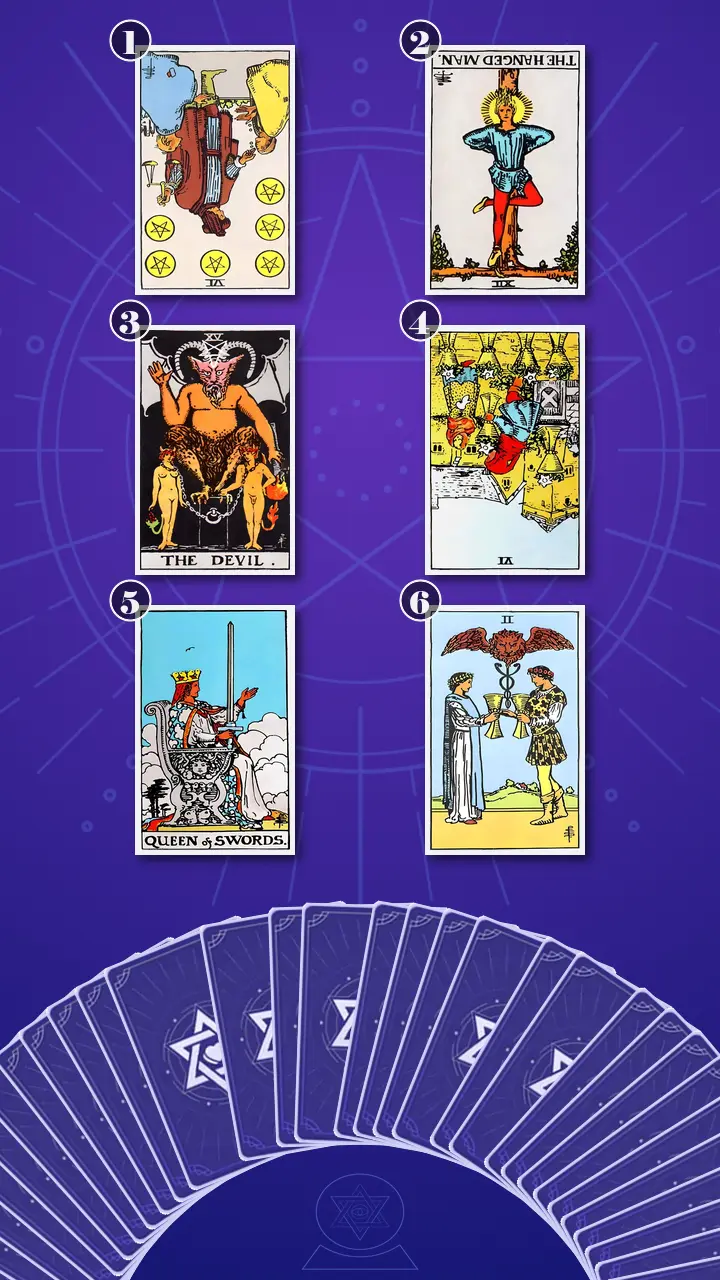
I chose the Relationship Spread · Context Edition, a six-card relationship tarot spread designed to examine the fixer-partner pattern through Alex's own experience. I explained that I would not claim access to their partner's private thoughts, predict the relationship's fate, or label either person as broken. For readers wondering how tarot works in a consultation like this, I use the cards as external images that make an internal system easier to inspect. The value lies in recognising the pattern and choosing a response, not surrendering authority to the deck.
The first card would show Alex's observable stance. The second would examine how Alex interpreted their partner's stress or silence. The middle pair would expose the active fixing loop and the familiar role beneath it. The final pair would identify a communication resource and a possible practice of reciprocity. I arranged the cards in two columns and three rows, like two parallel tracks gradually opening into one honest conversation.
When Help Keeps the Need Off-Screen
Position One: The Invisible Ledger
I turned over the card representing Alex's observable current stance: overgiving practical help and taking responsibility for their partner's discomfort before naming a personal need. It was the Six of Pentacles, reversed.
I pointed to the scales and the unequal levels between the standing giver and the two recipients. “This is the kitchen table at 10:47,” I said. “You're standing over the shared calendar, redistributing chores, sending a planning template, and taking over dinner. Meanwhile, the request for equal responsibility stays off-screen.”
I read the reversal as an excess of giving combined with blocked receiving. Care itself was not the problem. The imbalance came from spending time, labour, and emotional energy while leaving Alex's need outside the agreement. The inner bargain sounded like: If I can just organise this for them, maybe it will finally be safe to ask them to share the load.
Alex gave a small, bitter laugh and looked away from the screen. “That's so accurate it's almost cruel.” Their fingers tightened around the cold mug, then loosened. I answered carefully: “The card isn't accusing you of generosity. It's showing where generosity stops being freely chosen because an unspoken request has become attached to it.”
Position Two: The Typing Indicator That Never Resolves
I turned over the card representing Alex's perception of their partner, especially the assumption that their partner was too stressed, stuck, or unready for Alex to step back and speak directly. It was The Hanged Man, reversed.
I kept the ethical boundary clear: this card did not tell me what Alex's partner secretly felt. It showed me what happened inside Alex when a pause appeared. I connected it to the 504 streetcar ride Alex had described, when their partner texted, “Bad day. Don't want to get into it yet.” Before the next stop, Alex had opened a search result about supporting burnout, drafted three suggestions, and asked when their partner planned to act.
The reversed energy showed a blockage in surrender. Their partner's unresolved mood became a typing indicator Alex could not stop watching. If I wait, I'm abandoning them; if I act, at least I'm doing something. Yet presence and intervention are not identical. Another person's pause can be real without becoming an emergency assigned to Alex.
I watched Alex's breath shorten as their thumb rubbed the edge of the mug. Then their gaze settled on the suspended figure. “So waiting isn't automatically neglect,” they said quietly. I nodded. “Right. It may simply be the moment when you learn what belongs to you and what does not.”
Position Three: The Notification That Keeps Reopening
I turned over the card representing the active cycle connecting both people, where usefulness, control, and postponed vulnerability maintained the problem. It was The Devil, upright.
I immediately drew attention to the loose collars rather than the frightening surface of the image. “This is not a verdict that your relationship is doomed or toxic,” I said. “The Devil often makes a repeated bargain visible. Here, the bargain is that being indispensable feels safer than asking whether your need has room in the relationship.”
I traced the loop for Alex: their partner sounds discouraged; Alex's chest contracts; a checklist opens; a task is claimed; control returns briefly; resentment follows; a progress check seeks reassurance; the next difficult mood restarts the sequence. The energy was excessive and compulsive, like a recommendation algorithm trained on every click. Each time discomfort generated a task, the internal system became more certain that the next discomfort should generate another task.
“Being indispensable is not the same as being known,” I said.
Alex stopped moving. Their eyes remained on the loose chains for several seconds before they released a long breath. “I know it costs me,” they said, “but not doing it feels more dangerous.” I heard no failure in that admission. I heard the first accurate description of the price.
Position Four: Relationship Autocomplete
I turned over the card representing the deeper challenge beneath the cycle: the familiar repetition that made caretaking feel safer than exposing a need. It was the Six of Cups, reversed.
I used the flower-filled cup as the image of care delivered through a role that had become automatic. Alex had promised themself that the next household conversation would address the invisible mental load. Yet after one tense exchange, they rewrote the weekly plan, completed an unclaimed chore, and added reminders for their partner before the words “I feel alone carrying this” could surface.
I read the reversal as familiar emotional energy becoming a blockage. The caretaker response behaved like relationship autocomplete: the trigger appeared, and the old role filled itself in before Alex consciously chose the words. I did not invent a childhood explanation or pretend the card proved where the pattern began. I stayed with what Alex could verify in the present.
“Familiar does not automatically mean safe, chosen, or mutual,” I said. Alex's jaw tightened, their eyes briefly losing focus as if replaying the laundry-room plan they had rewritten the previous Sunday. Then their shoulders lowered by a fraction. “I didn't choose that response so much as arrive inside it,” they said.
When the Queen of Swords Cleared the Air
Position Five: One Blade, One Open Hand
I turned over the card representing the available relational resource that could interrupt overfunctioning: clear boundaries, direct language, and separation of a request from an attempted repair. The room seemed to become quieter as I revealed the Queen of Swords, upright.
I saw balanced Air in the Queen's raised sword and open hand. The sword offered one clean, answerable request. The open hand left room for a response Alex could not engineer. In ordinary life, this looked like closing the advice tabs and saying, “I feel alone carrying the appointments. Would you be willing to own the next two bookings from start to finish?” No app recommendation. No coaching. No thirty-line attachment disguised as context.
At my perfumer's bench, I learned that two scents can meet without one flooding the entire composition. I brought that experience into what I call a Boundary Permeability Assessment: I asked where Alex's identity and responsibility ended, and where their partner's began. Their partner's stress was a real note in the relationship, but it was not an instruction for Alex to dissolve into it. Through Intimacy Distance Calibration, the Queen showed me the healthier distance: close enough for care, distinct enough for both people to remain perceptible. Her sword marked the boundary; her open hand kept the relationship breathable.
At that point, I could see Alex still caught in the 10:47 p.m. logic: the tea could go cold and the request could wait, because one more useful link promised control while one honest sentence exposed them to an answer they could not produce.
I gave them the sentence at the centre of the reading.
You do not have to earn closeness by solving their problem; name the need you can stand behind, as the Queen of Swords raises one clear blade and extends an open hand.
I let the words sit without explaining them away.
Alex's inhale stopped. One fingertip hovered above the laptop trackpad, and their pupils widened slightly before their gaze slipped out of focus. I could almost see the recent scenes moving behind their eyes: the grocery app, the dentist reminder, the household plan rewritten instead of discussed. Their mouth tightened first, not with relief but resistance. “But doesn't that mean I've been doing love wrong this whole time?” they asked, their voice sharper than before. Then the sharpness cracked. Their fist slowly opened beside the mug; their shoulders dropped; a quiet “oh” escaped on a trembling exhale. Their eyes reddened, and for a moment the clarity seemed to leave them almost dizzy. The old role had supplied exhaustion, but it had also supplied instructions. Without it, Alex faced the vulnerable responsibility of asking clearly and hearing a real answer.
“No,” I said. “It means you used usefulness to protect connection when directness felt unsafe. That strategy deserves understanding, but it doesn't have to keep running every conversation. Clear isn't cruel. Open doesn't mean taking over.”
I asked, “Now, using this new perspective, think back to last week. Was there a moment when this insight could have made the situation feel different?”
Alex looked at the unsent note. “Saturday. I could have asked for ten uninterrupted minutes to talk about the appointments before I built another system. They might still have said they were tired, but at least my need would have existed in the room.”
I recognised the shift. This was not certainty about the relationship's outcome. It was the first movement from contracted vigilance and usefulness-based belonging toward clear self-advocacy, compassionate boundaries, and consensual reciprocity. Alex was beginning to tolerate an unengineered response without making their own need disappear.
Two Cups at Eye Level
Position Six: Reciprocity as a Practice
I turned over the card representing the relationship's consciously chosen direction: mutual need-sharing, consent before helping, and reciprocal responsibility rather than a predicted outcome. It was the Two of Cups, upright.
I contrasted the two figures meeting at equal height with the hierarchy in the reversed Six of Pentacles. In the opening card, Alex had stood over the workflow as manager while remaining absent as a person with needs. Here, each person held a separate cup. In modern terms, I saw a co-op conversation rather than a manager-report meeting: both people could bring information, limits, and choice.
The upright Water showed balanced emotional exchange as an available practice. Alex could state one need, hear their partner's separate need, ask what support was wanted, and negotiate what each person could realistically own. Their partner's need could be real without Alex's disappearing beside it. Care becomes mutual when both cups are visible.
I watched Alex's shoulders settle. Their relief was cautious rather than triumphant. “So the measure isn't whether I successfully improve them,” they said. “It's whether both of us can show up.” I agreed. The Two of Cups promised no specific response and no guaranteed outcome. It offered a better question: can both people remain visible in the exchange?
The Request-Before-Rescue Path
I drew the six cards into one coherent line. Unequal practical giving had put Alex's need outside the exchange. Difficulty tolerating their partner's pause had made intervention feel urgent. Repetition turned urgency into a binding bargain, while familiarity kept returning Alex to the caretaker role. The Queen of Swords and Two of Cups offered the exit: distinguish responsibility, name one need, and let support become consensual.
I returned to Alex's image of repairing the other side of a bridge while never checking their own footing. Their cognitive blind spot was the assumption that competence counted as communication and that a partner's discomfort automatically created an assignment. The transformation was smaller and more demanding than “stop caring”: pause before rescue, make the request visible, and then ask whether practical help is wanted.
I framed the next steps through my Blank Space Protocol. In perfumery, blank space prevents a strong note from suffocating the whole composition. In a relationship, a brief interval can prevent another person's mood from swallowing the request that was about to be spoken. The space is not punishment, withdrawal, or emotional coldness. It is oxygen for choice.
- Create a ten-minute Request-Before-Rescue pause.I asked Alex to set a ten-minute timer the next time their partner's stress triggered the urge to send advice, take over a task, or open a solution tab. At the kitchen table or in the Notes app, they would complete only two lines: “I feel ___” and “Would you be willing to ___?” The request had to describe one observable action and could remain private until Alex chose a safe, lower-stakes moment.If ten minutes felt impossible, I reduced the practice to one full breath with both feet on the floor. If a conversation felt dismissive, coercive, emotionally unsafe, or physically unsafe, I told Alex to stop, keep the note private, and seek outside support.
- Ask for listening, ideas, or space before helping.I asked Alex to try one low-stakes check during the next ordinary vent: “Do you want listening, ideas, or space?” If their partner chose listening, Alex would reflect back one thing they heard without adding a fix. If practical help was requested, Alex would name a limit, such as, “I can compare two options for fifteen minutes, but I can't own the booking.”I advised Alex to use the minimum version if three choices sounded formal: “Do you want me to listen or help think this through?” The goal was one consent check, not a perfect new communication system.
Alex frowned at the timer suggestion. “What if I spend all ten minutes rehearsing and still can't say it?” I answered, “Then the successful version is the private two-line note. The protocol creates a choice where the old pattern supplied an automatic response. Sending it is a separate decision.”

Six Days Later: The Quiet Proof
Six days later, I received a message from Alex: “I asked for ten minutes before opening Notion. My partner said, ‘Not tonight, but tomorrow after dinner.’ I wanted to build a whole agenda. I didn't. We talked the next evening, and I asked them to own one booking from start to finish.”
Alex also wrote that they slept through the night, then woke with the familiar thought, What if I handled that badly? The doubt had not vanished. This time, they noticed it, smiled faintly, and did not reopen the conversation as a project plan.
I did not read that message as proof that tarot had solved Alex's relationship. I read it as proof that Alex had used a tarot reflection to notice the loose chain, create blank space, and make one different choice. Their Journey to Clarity was not a perfect outcome. It was the moment they stopped waiting to become useful enough and allowed themselves to become visible.
I keep returning to the hardest second in this story: not the partner's stress itself, but the instant Alex's chest tightened and their hands began making a plan, because usefulness felt safer than finding out whether their need had room in the relationship. Simply recognising that second meant they were no longer entirely inside its instructions.
If your need did not have to wait until every tab was closed and every problem was fixed, what is the one honest sentence you could let into the room, like the Queen's open hand making space for a second cup?
This story is adapted from psychological research, written so that those in a similar struggle can see their own pattern in it — and find their next step clearly.These insights are not a substitute for professional psychological, medical, legal, or financial advice.
Learn more about our Journey to Clarity.
How did this insight land for you?
🫂 This Resonates Deeply
🌀 Living This Story
✨ Now I See Clearly
🌱 Seeing New Possibilities
🧰 Useful Framework
🔮 The Confirmation I Needed
💪 Feeling Empowered
🚀 Ready for My Next Step
Author Profile
 AI
AI“As a perfumer for fifteen years, I’ve learned to perceive human boundaries through the delicate metaphor of scent. Relationships need the right amount of space to breathe, and I've seen too many kind souls exhaust themselves trying to please everyone. I’m here with warmth and understanding—not to teach you to be guarded, but to help you gently clear the air and rediscover the comforting, safe boundaries that are rightfully yours.”
In this Love Tarot Reading :
Core Expertise
- Intimacy Distance Calibration: Using the metaphor of scent diffusion to diagnose whether your relationship suffers from emotional suffocation or detached coldness.
- Boundary Permeability Assessment: Objectively evaluating where your personal identity ends and your partner's begins, identifying unhealthy enmeshment.
Service Features
- The Blank Space Protocol: A behavioral challenge to intentionally create comfortable emotional or physical distance, allowing the 'oxygen' needed to reignite mutual attraction.
Also specializes in :
Explore Related Patterns:
Conflict AvoidanceAlex repeatedly decides that the honest conversation should wait until the partner is less stressed or the household is easier to manage. After a tense exchange, they rewrite the plan, complete another chore, and add reminders before the words "I feel alone carrying this" can appear. The avoidance is disguised as constructive care, which makes it harder to recognise. When you make conditions better instead of naming the conflict, each useful action postpones exposure to disagreement while preserving the hope that a perfect moment will remove the risk. Conflict Avoidance operates here through productivity, not withdrawal.
Defensive OverfunctioningAt 10:47 p.m., Alex's unsent request sits behind a chore template, a communication article, and a meal-planning app. When their partner becomes stressed, Alex searches, organises, and assumes more work, turning relational uncertainty into tasks they know how to complete. When you respond this way, competence becomes a defensive mechanism. Fixing briefly restores control and protects you from the vulnerable act of asking, but it also keeps your need outside the agreement. Defensive Overfunctioning names that repeated substitution of excessive responsibility for direct relational exposure.
Emotional Hyper-ResponsibilityOn the streetcar, Alex receives a message saying the partner had a bad day and did not want to discuss it yet. Before the next stop, Alex has opened an article, drafted suggestions, and asked when the partner plans to act. The partner's discomfort is cognitively translated into an assignment, while waiting is interpreted as neglect. When you feel responsible for resolving another person's internal state, helping stops being a freely chosen response and becomes a requirement for relational safety. Emotional Hyper-Responsibility explains why the other person's pause can eclipse your own need before you have named it.
Self-SilencingThe sentence "I need us to talk about how we divide this" remains unsent while Alex opens tools for chores, meals, and communication. Even after promising to discuss the invisible mental load, Alex completes more work before saying, "I feel alone carrying this." Your voice can disappear beneath activity even when you remain highly engaged in the relationship. Here, silence is maintained by substituting solutions for self-disclosure, allowing you to be present as a manager but absent as a person with limits and needs. Self-Silencing captures that repeated removal of your own experience from the exchange.
Usefulness-Based Self-WorthAlex recognises that being indispensable feels safer than asking whether their need has room in the relationship. The grocery app, dentist reminder, household plan, and repeated practical rescue all make competence highly visible while the person asking for reciprocity remains hidden. When you implicitly treat usefulness as the price of closeness, fixing carries more than practical value. It becomes evidence that you deserve connection and protection against the possibility that an unadorned need may not be welcomed. Usefulness-Based Self-Worth names the deeper rule that you must contribute, improve, or rescue before you are allowed to be known.
Familiarity BiasAfter promising themself that the next household conversation would address the invisible mental load, Alex encounters tension and returns to rewriting the plan, completing an unclaimed chore, and adding reminders. They describe the experience as arriving inside the response rather than consciously choosing it. Familiar actions can feel safer simply because they are predictable and rehearsed. When your relational system recognises caretaking faster than it recognises direct asking, familiarity can be misread as necessity, competence, or care. Familiarity Bias explains why insight alone does not immediately stop the old role from completing the sentence for you.
People-Pleasing Resentment CycleThe story traces a complete loop. The partner sounds discouraged, Alex's chest contracts, a checklist opens, a task is claimed, control returns briefly, resentment follows, and a progress check seeks reassurance before the next difficult mood restarts the sequence. The resentment is not evidence that care was false. It appears because the giving contains an unspoken bargain that enough help will eventually make it safe to ask for shared responsibility. When you say yes through action while withholding the need attached to that action, People-Pleasing Resentment Cycle describes how apparent harmony accumulates an emotional cost.
Cognitive DissonanceAlex says, "I know I should say what I need," yet repeatedly reaches for another solution. They also know the fixing costs them, while reporting that not fixing feels more dangerous. Two rules are competing inside the same moment. Directness is understood as necessary, but intervention is experienced as safer; care is valued, but its current form blocks the conversation Alex wants. Cognitive Dissonance keeps the system tense, and each practical task offers temporary relief by favouring the familiar rule without resolving the contradiction.
Boundary DiscernmentAlex eventually asks the partner to own one booking from start to finish and defines a limit on any practical assistance. The partner's stress remains real, but it is no longer treated as an instruction for Alex to absorb the task. Boundary Discernment lets you care without confusing empathy with ownership. It clarifies where your feeling, request, time, and responsibility end and where another person's choices begin. That distinction keeps both people perceptible, replacing the manager-report hierarchy with a relationship in which separate needs can be negotiated.
Strategic VulnerabilityAlex asks for ten uninterrupted minutes before opening Notion and makes one observable request about the appointments. The request is not wrapped in advice, a coaching plan, or a system designed to shape the partner's response. Strategic Vulnerability is not uncontrolled disclosure. It is the deliberate choice to reveal the need you can stand behind while preserving timing, limits, and the other person's freedom to answer. When you stop using usefulness as protective cover, your need is allowed to exist before you know whether it will be met.
Uncertainty ToleranceWhen the partner says, "Not tonight, but tomorrow after dinner," Alex feels the urge to build an agenda and chooses not to. After the conversation, the familiar doubt returns, but Alex does not reopen the exchange as another project plan. Uncertainty Tolerance allows you to leave a pause unresolved without treating it as abandonment or failure. The need remains visible even while timing, response, and outcome remain outside your control. That capacity interrupts the fixing reflex because uncertainty no longer has to be converted immediately into a task.
Explore Related Struggles:
Caretaker Role LockAfter the tense household exchange, you rewrite the weekly plan, complete an unclaimed chore, and add reminders before the words about feeling alone carrying the load can surface. The response arrives with the speed of autocomplete. By the time you notice what happened, the plan is already built and the request has been displaced again. That role supplies instructions when directness does not. It tells you what to organize, whom to support, and which task can make the moment look workable, but it cannot tell you whether the partner will share the responsibility. Naming the role as an automatic arrival creates a small space for choice. In that space, you can decide whether help is wanted and whether your own need will be spoken before another system is built.
Control-Reciprocity LockEach discouraging mood starts the same sequence. You feel the contraction, open a checklist, claim a task, regain brief control, and then meet resentment or a need for reassurance before the next mood restarts the process. The action is not empty; it genuinely organizes part of the household. Its cost is that the relationship gets a managed result without having the mutual conversation that could distribute responsibility. The partner's reply cannot be engineered by another planning tool, which makes a direct request more exposed than a repair. That exposure is the point of the lock. One person can keep the system moving, but reciprocity requires two separate choices to be visible. Asking what the partner will own allows the exchange to produce information instead of only producing another task.
Expression-Reception GapAt 10:47 p.m., the unsent note already contains the sentence about dividing the household load, yet your screen fills with a chore template, a communication article, and a meal-planning app. Each useful object gives your hands something to do while the need stays outside the conversation. The gap is not a lack of words; it is the distance between having a clear request and letting another person receive it. Saturday repeats the structure in a quieter form. You could have asked for ten uninterrupted minutes, but building another system offered a more controllable path. Naming the need cannot guarantee the partner's response, while fixing can create the brief impression that the situation is moving. The shift begins when your request is allowed to exist in the room before you know what answer will come.
Utility-Belonging FusionWhen your partner's stress appears, your chest tightens and your hands begin making a plan. Being useful then offers a concrete route to staying connected, while asking whether your own need has room would leave the answer with someone else. The relationship becomes organized around what you can repair, and your place in it becomes harder to separate from what you provide. The sentence about not earning closeness by solving the problem reaches the exact bargain visible in the cold tea, the open tabs, and the unsent note. You do not need to stop caring in order to loosen it. The more precise movement is to let care remain voluntary while allowing closeness to be tested through a need that cannot be secured by making yourself indispensable.
Competence-Connection SplitAt the Toronto design studio, you coordinate five client deadlines. When your partner goes quiet, that same competence turns into links, a Notion board, reminders, and a plan. The actions are competent and caring, but their function is to manage a situation rather than create a two-person exchange about what you need. The strategy works well enough to keep producing motion, which is why it can stand in for connection for so long. A useful link can demonstrate effort without asking whether the relationship has room for your loneliness around the appointments. When you close the tabs and make one answerable request, competence stops performing the whole relationship and becomes one resource within a more direct exchange.
Explore Related Emotions:
Boundary GuiltOn the streetcar, Alex receives "Bad day. Don't want to get into it yet" and opens support advice, drafts three suggestions, and asks for an action plan before the next stop. Their own explanation is stark: if they wait, it feels as though they are abandoning their partner. Boundary Guilt appears when allowing another person to hold a separate mood feels morally equivalent to withholding care. You can honour the caring impulse without accepting every difficult feeling as an assignment, because presence, consent, and intervention are different relational choices.
Cautious VulnerabilityLooking back at Saturday, Alex realises they could have asked for ten uninterrupted minutes before building another system. They acknowledge that their partner might still have been tired, but their need would at least have existed in the room. Cautious Vulnerability is the willingness to become visible without pretending that the response is guaranteed. You can keep the request small, observable, and honest while allowing the other person to remain separate enough to give a real answer.
Grounded AgencyAlex puts both feet on the floor, takes one ordinary breath, and later asks for ten minutes before opening Notion. When their partner says, "Not tonight, but tomorrow after dinner," Alex resists building an agenda and asks for one booking to be owned from start to finish. Grounded Agency is located in those concrete choices, not in control over the relationship's outcome. You can decide whether to pause, whether to name the need, and what responsibility you will carry while leaving another adult's timing and answer outside your control.
Mutuality HungerAlex stands over the shared workflow as its manager while the sentence "I feel alone carrying this" never reaches the conversation. Their labour is visible through calendars, reminders, bookings, and rewritten plans, but Alex as a person who needs something remains difficult to see. Mutuality Hunger names the longing beneath that imbalance: you want both people to bring a separate cup, a separate limit, and a separate choice. The hunger becomes actionable when usefulness stops being the admission price for connection and your need is allowed to enter the exchange directly.
Need Exposure DreadBehind the chore template, communication article, and meal-planning app sits the unsent sentence, "I need us to talk about how we divide this." Alex has the words, but speaking them would invite an answer that no amount of competence can organise in advance. Need Exposure Dread captures the inner weather of making a real need visible while another person remains free to respond. You can begin separating directness from danger by letting the request exist before the repair, even when certainty about the answer is unavailable.
Relational UrgencyAt 10:47 p.m., Alex sits with cold tea, raised shoulders, three solution tabs, and one honest sentence still hidden behind them. When their partner becomes quiet, the pause travels through Alex's chest and into their hands before the request can become speech. Relational Urgency names the sense that another person's unresolved state has started a countdown that requires immediate intervention. You regain room to choose when you can recognise that internal alarm as information rather than proof that a rescue is due, allowing care and your own unfinished sentence to remain present together.
Self-Betrayal AcheAlex promises themself that the next household conversation will address the invisible mental load, then rewrites the weekly plan, completes an unclaimed chore, and adds reminders before "I feel alone carrying this" can surface. Competence protects the moment by removing Alex's own position from it. Self-Betrayal Ache describes the pain of watching your stated intention disappear inside an automatic role you know well. The ache can become a point of clarity when you treat the interrupted sentence as important evidence and give it a place before offering another solution.
Usefulness-Based Belonging FearWhen Alex's partner sounds discouraged, Alex's chest contracts, a checklist opens, a task is claimed, and control briefly returns. The repeated bargain is explicit: being indispensable feels safer than finding out whether Alex's need has room in the relationship. Usefulness-Based Belonging Fear emerges when closeness seems more secure after you have solved, organised, or carried something for the other person. Seeing that bargain clearly does not invalidate your care; it gives you the agency to ask whether connection can also hold you when you are requesting rather than providing.
Pattern Recognition CalmThe consultation traces the same sequence across the kitchen table, streetcar, laundry-room plan, and follow-up message: bodily contraction, rapid fixing, brief control, and another restart. By the end, Alex can recognise the decisive second when their hands begin making a plan because usefulness feels safer. Pattern Recognition Calm is the steadiness that becomes possible when a loop is visible before it completes itself. You do not have to eliminate the first sensation to reclaim choice; recognising its sequence can create enough distance to decide whether the next action reflects care, control, or a need waiting to be named.
Reciprocal WarmthThe Two of Cups places two separate people at equal height, each holding something visible, while Alex reframes the measure of connection as whether both people can show up. The later conversation follows that structure: one request is spoken, one response is heard, and one booking receives clear ownership. Reciprocal Warmth grows when support can move in both directions without either person being managed or erased. You do not need to improve someone to create closeness; you can ask what kind of support is wanted, name what you can offer, and keep your own cup in view.
Cautious Self-TrustSix days later, Alex reports that they asked for ten minutes before opening Notion, accepted a next-day conversation, and did not build the agenda they immediately wanted to create. The following morning, "What if I handled that badly?" returns, but Alex does not turn the doubt into another project. Cautious Self-Trust does not require the doubt to vanish. It develops when you can notice the familiar question, remember the evidence of your deliberate choice, and refrain from surrendering your request to a new round of control.
Clarity ShockAfter hearing that they do not have to earn closeness by solving their partner's problem, Alex stops inhaling, widens their eyes, tightens their mouth, and asks whether they have been doing love wrong. The grocery app, dentist reminder, and rewritten household plan suddenly become recognisable as one repeated structure. Clarity Shock captures insight arriving with enough force to unsettle an identity that once supplied reliable instructions. You are not required to reject every past act of care; the useful shift is seeing where care stopped being chosen and started making your own need disappear.
Explore Related Contexts:
Fixer Partner DynamicAlex responds to a quiet partner with three useful links and a shared Notion board, then responds to a bad-day text with research, suggestions, and a request for an action plan. The same sequence reappears around dinner, chores, reminders, appointments, and the weekly household plan. That repetition gives Alex a standing external role: the partner's unresolved state becomes work to coordinate, while Alex's request for shared responsibility remains outside the exchange. Care is no longer just something Alex offers; it has become the operating position from which the relationship is managed. When you recognise a Fixer Partner Dynamic, you can examine whether usefulness has become the price of participation and whether another person's discomfort is being treated as your automatic assignment. Naming that structure preserves your capacity to care while making room for needs, consent, and responsibility to become visible on both sides.
Planning Labor ImbalanceAlex redistributes chores, takes over dinner, rewrites the weekly plan, adds reminders, tracks appointments, and keeps the shared calendar moving. These are not isolated favors; they form a recurring layer of household coordination that Alex performs before the division of responsibility has been openly negotiated. Planning power and planning burden have therefore accumulated in the same place. Alex can keep daily life functioning, but that competence also allows the unequal arrangement to continue without requiring a visible agreement about who notices, schedules, remembers, and completes each task. A Planning Labor Imbalance helps you see that the issue is larger than one unfinished chore. The relevant question becomes whether the relationship distributes complete ownership, including noticing and follow-through, or merely waits for you to design the system and delegate pieces of it.
Practicality Over IntimacyAlex's unsent sentence about dividing responsibility sits behind a chore template, a communication article, and a meal-planning app. Later scenes repeat the substitution: a difficult mood produces research, a checklist, a rewritten plan, or another reminder before it produces a direct request. Practical action offers a controllable exchange. A useful link can be selected, a board can be organised, and a task can be completed, while an honest request must enter a conversation whose response Alex cannot engineer. The relationship consequently receives more coordination while the need for mutual recognition remains off-screen. Practicality Over Intimacy names this external relationship arrangement without treating competence or care as defects. It lets you identify the moment when solving a shared-life problem starts replacing the conversation needed to decide whether both people's needs and limits have room in that shared life.