From Fixer-Friend Overfunctioning to Equal Friendship: One Direct Ask

Why the Fixer Friend Is Still Waiting for Equal Friendship
If you are the friend who can turn “Can I vent?” into a three-step recovery plan before asking what kind of support is wanted, fixer-friend burnout can look a lot like dependability from the outside.
Jordan joined my video call at 11:40 p.m. from the edge of their bed in a shared Toronto apartment. A four-minute voice note glowed on the phone warming their palm; streetcar noise leaked through the window, and blue screen light caught the rim of a cold water glass. In another app, an unsent message waited: “Are you free to talk? Today was rough.”
“I’ve already written three possible replies,” Jordan told me, turning the phone toward the camera. “One has a podcast episode, one has a breakup checklist, and one offers to help draft a message to their ex. I know that is a lot. I just don’t know how to leave someone hanging.”
I watched their shoulders climb as they spoke. The longing beneath their competence felt like an empty chair at a table they kept setting for everyone else: they wanted equal friendships, yet the moment a friend was distressed or a plan stalled, they became the fixer. When nobody offered the same attention back, resentment tightened in their chest, followed almost immediately by guilt for feeling it.
“Sometimes being the reliable friend is loneliness with a good reputation,” I said. “I don’t want to put your generosity on trial tonight. I want us to see where genuine care turns into responsibility you were never asked to take. Let’s make a map of that moment and find a version of friendship in which you get to participate, not just maintain.”

Choosing the Compass for a Friendship Reciprocity Reading
I invited Jordan to place both feet on the floor, take one ordinary breath, and hold the question without trying to solve it: “Why do I play the fixer when I want equal friendships?” I shuffled slowly, using the movement as a practical transition from reacting to observing rather than as a performance of mystery.
I chose the six-card Rider-Waite-Smith Relationship Spread: Context Edition. I use this relationship tarot spread when a problem lives between an internal fear and an observable interpersonal pattern. It is detailed enough to separate a friend’s actual message from the responsibility Jordan adds to it, but compact enough to avoid unnecessary prediction.
I arranged the cards in a two-column, three-row grid. The first position would reveal the role Jordan visibly performed. The middle pair would show the unequal foundation and its current cost. The last pair would name the reciprocity challenge and offer an integration practice through boundaries, direct requests, and evidence over time.
I also clarified what the spread could not do. I would not claim to know what Jordan’s friends secretly thought, and I would not use the cards to declare which friendships would survive. The spread was a structured way to examine cues, assumptions, choices, and repeated behavior. The cards could illuminate the set; Jordan would still decide how the next scene was written.
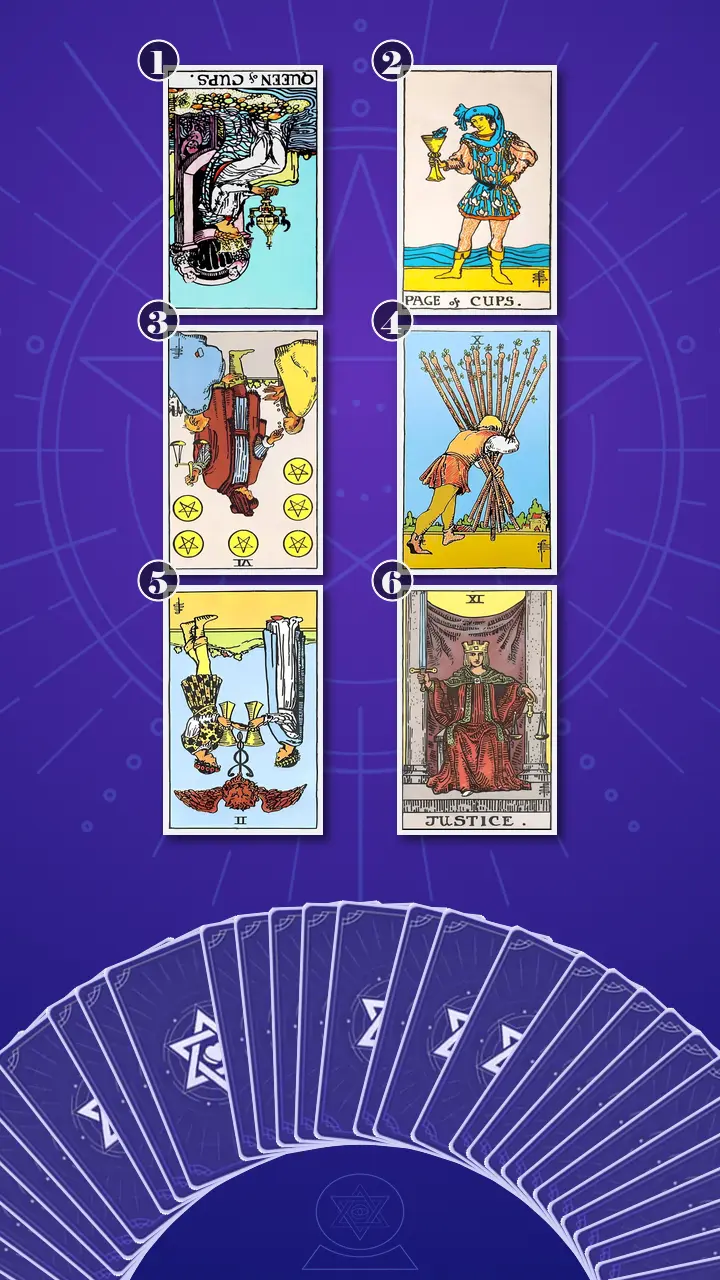
Reading the Friendship’s Hidden Operating System
Position 1: The Queen and the Cup That Stayed Closed
The first card I turned over occupied the position revealing Jordan’s enacted friendship role: the observable habit of absorbing emotional responsibility, solving problems, and concealing personal needs. It was the Queen of Cups, reversed.
I pointed to the Queen’s fixed gaze on her ornate, closed cup. She sat beside moving water, surrounded by feeling, yet the contents of her own vessel remained sealed. In this position, the reversal showed an excess of emotional attunement paired with a blockage in expressing and protecting personal capacity. Jordan’s empathy was real; the problem began when empathy automatically became an assignment.
The card mirrored the scene already open on Jordan’s phone. At 11:40 p.m., they had replayed a breakup voice note, opened Notes, drafted three solutions, and considered scheduling a morning follow-up while their own request for support remained unsent. I could almost hear the internal sequence in the silence between us: “If I can just figure out what they need, then everything will settle down.” Beneath it sat the quieter sentence: “Maybe then I won’t have to say what I need.”
Jordan’s breath caught first. Their thumb stopped above the Notes app, and their gaze slipped away from the screen as though several late-night conversations were replaying at once. Then they gave a short, bitter laugh.
“That is so accurate it feels a little rude,” they said. “I thought I was just being caring.”
“You are caring,” I replied. “The card is not asking us to discredit that. It is helping us distinguish care freely offered from care used to make belonging feel safer. Before answering one emotional message, the Queen asks whether support was requested and what you can offer without creating resentment.”
Position 2: The Message Before It Becomes a Mission
The card I turned over next represented the observable messages, silences, and unfinished tasks Jordan interpreted as requests to fix, while separating those cues from assumptions about what friends expected. It was the Page of Cups, upright.
A fish rose unexpectedly from the Page’s cup. Emotional content had arrived, but the Page held it with curiosity instead of treating it like an emergency instruction. The upright Page carried balanced openness, though Jordan had not been using enough of its beginner energy: the willingness to ask a simple question before deciding what a moment meant.
I invited Jordan to imagine receiving “Can I vent?” while riding the TTC. The Page’s response was not to open a search tab, clear the evening, or build a plan before the train reached the next stop. It was: “Yes, I have about fifteen minutes. Do you want listening, ideas, or practical help?” The cue remained at its actual size until the friend clarified the request.
“A feeling arriving in your inbox is not the same as a responsibility landing on your desk,” I said. “A voice note is a notification, not a Jira ticket automatically assigned to you.”
Jordan reopened the message and read the first line aloud: “Can I vent for a second?”
“They didn’t actually ask me to fix anything,” they said.
“Right. They asked for contact. You may still choose to offer ideas, but the Page puts one clean pause between contact and commitment. That pause is where your capacity gets a vote.”
Position 3: When Generosity Becomes the Group Infrastructure
The third card represented the habitual foundation of the role lock-in, especially the way repeated giving without visible receiving had normalized an unequal support structure. I turned over the Six of Pentacles, reversed.
In the image, a standing giver controlled both the scales and the distribution of coins while two other figures received from below. Reversed, the card revealed a blockage in equitable exchange. Generosity had become an operating system with fixed permissions: Jordan advised, arranged, reminded, and followed up; everyone else became accustomed to responding rather than initiating.
I described the familiar group-chat sequence. Jordan created the poll, booked the table, sent the calendar invitation, remembered the birthday, checked whether everyone got home, and still answered “I’m fine” when someone briefly asked about their week. It resembled a shared Notion board where every task was tagged with Jordan’s name, even while everyone continued calling it a group project.
“It’s quicker if I do it, and at least I know it will happen,” I said, naming the first half of the loop. “Then, after you do it: Why does nobody ever take initiative?”
This was where I used a lens I call Safe-Choice Sabotage Recognition. The apparently logical choice was to make the reservation, solve the problem, or smooth over the silence. It reduced uncertainty and looked responsible. But it also removed the very opening through which another person could contribute. The safe choice quietly sabotaged the inciting incident Jordan needed: asking someone else to step in and tolerating the uncertainty that followed.
Jordan pressed a palm against the center of their chest. Their shoulders drew higher, their jaw tightened, and then both loosened with a long exhale.
“So I’ve basically helped build the system I’m angry about,” they said.
“You have influenced the system,” I answered, “but that does not make every imbalance your fault. Your friends still have agency and responsibility. This card simply shows that pre-emptive fixing can hide who is willing to contribute, who needs a clearer request, and who repeatedly does not show up. We need visibility, not self-blame.”
Position 4: Ten Small Tasks, One Obstructed View
The fourth card represented the present relationship dynamic created by the fixer role, including the accumulated emotional and logistical burden keeping the imbalance active. It was the Ten of Wands, upright.
The carrier could technically hold all ten staffs, but the bundle bent their posture and blocked the road ahead. This was an excess of responsibility and effort. Capability had been mistaken for capacity, until competence itself became the reason Jordan kept receiving more invisible work.
I built the pile slowly: the birthday booking, the unanswered dinner poll, the breakup voice note, the reminder to reschedule, the conflict debrief, the ride-home check, and Jordan’s own difficult update buried beneath them. One more message was manageable. One more reservation was manageable. One more check-in was manageable. Together, they ran like twenty background apps, draining the battery before Jordan could use it for their own life.
A streetcar passed outside Jordan’s window, sending a bar of moving light across the wall. As it receded, I saw their shoulders drop several centimeters.
“I keep saying I can handle it,” they said, quieter now. “I never ask whether I have room for it.”
“That is the Ten’s practical question,” I replied. “Not whether you can carry the load, but which parts were ever yours to carry. Maintaining a friendship is not the same as getting to be inside it.”
When Gratitude Failed the Mutuality Test
Position 5: The Two Cups That Could Not Meet
The fifth card named the central challenge: Jordan wanted mutual support but avoided the direct needs, limits, and conversations through which reciprocity could become observable. I turned over the Two of Cups, reversed.
The card showed two matching cups intended to be held at equal height. Reversed, that balanced exchange was blocked. Jordan’s fixing could produce relief, praise, and dependence, but none of those responses required a friend to know Jordan’s needs or practise caring for them.
I placed two scenes beside each other. In the first, a friend received Jordan’s latest rescue plan and replied, “You always know what to do.” In the second, Jordan stared at an unsent request asking that same friend to check in after a difficult presentation. The first scene said, “They appreciate me.” The second asked, “Do they actually know how to support me?”
“Gratitude can confirm that your help worked; it cannot, by itself, confirm mutuality,” I said.
Jordan went completely still. Their fingers hovered above the unsent draft, their eyes lost focus as the distinction settled, and then their hand lowered to the blanket. Their voice came out thin.
“I don’t know whether some of them know me,” they said, “or whether they mostly know what I can do for them.”
I let the silence hold without enlarging it into a verdict. “The Two of Cups reversed does not announce that your friendships are false or doomed. It shows an interrupted exchange. One side of the cup has stayed mostly invisible. Naming an unmet need gives the relationship something real to respond to; another rescue plan does not.”
When Justice Rewrote the Next Scene
Position 6: The Scales, the Sword, and One Clear Sentence
The final card represented a constructive integration practice: one clear boundary, one direct request, and observation of reciprocal behavior over time. The room seemed to become unusually quiet as I turned it over. It was Justice, upright, the key card of the reading and the antidote to the fixer loop.
Justice held the scales at eye level and an upright sword in the other hand. The scales represented balanced assessment through observable patterns rather than private scorekeeping. The sword represented direct language: the sentence that made Jordan’s capacity and need knowable. Its upright energy brought balance through fair-minded self-respect, boundary clarity, and accountable choice.
I returned to the stalled group plan. Instead of claiming another task, Jordan could write, “I can’t organize this one. Can someone else choose the place and book it by Thursday?” Then they could observe what happened without secretly changing the conditions, inflating one good response, or explaining away repeated non-response. Justice was closer to a usability test than a courtroom verdict: state the need clearly, watch the repeated behavior, and work with the evidence.
Looking at the card, I thought of a rough cut playing on my studio monitor. If one character completes every meaningful action before anyone else enters the frame, the rest of the cast never gets to reveal what they will do. That image led me into my Narrative Fork Analysis, where I treat options as competing plotlines and ask which one serves the person’s deeper growth.
In the first plotline, Jordan remained the indispensable fixer. The story offered immediate gratitude and short-term certainty, but Jordan’s needs stayed below the fold. In the second, Jordan became a fair participant. They risked one clear limit and one visible request, allowing their friends’ responses to provide information. That plotline felt more daunting because it could reveal disappointment, but it was also the only one capable of producing genuine equality.
At 11:40 p.m., the voice note was still open while Jordan’s own ask waited in another app. They were caught in the thought, “I must become useful before I can risk being visible.” I named the hinge: “Equal friendship cannot become visible while you are quietly doing both people’s share; care becomes mutual when your limits and needs are allowed into the conversation too.”
You do not have to earn your place by carrying the whole friendship; name one limit and one request, and let Justice’s scales measure reciprocity through observable actions.
I stopped speaking. A narrow line of streetlight fell through the blinds and crossed the wall behind Jordan like the upright edge of Justice’s sword.
Jordan froze. Their inhale stopped high in their chest, and their fingers remained suspended above the phone. Then their eyes shifted away from me and unfocused; I could see them mentally replaying the unanswered polls, the reassuring texts sent after cancellations, and the requests softened until they no longer asked for anything. Their pupils widened. Their mouth tightened, and a flash of anger replaced the first shock. “But doesn’t that mean I’ve been doing friendship wrong this whole time?” they asked. I told them no: it meant a protective strategy had once made connection feel more predictable and had now started costing too much. Their eyes reddened. The fist gripping the blanket slowly opened, their shoulders lowered, and a trembling breath left them. Relief arrived, but so did the dizzy vulnerability of realizing that clarity would require an action no card could take for them.
“Now, using this new perspective, think back to last week,” I invited. “Was there a moment when this insight could have made you feel different?”
Jordan chose the unanswered birthday poll on the TTC. “I could have asked someone else to book it,” they said. “I would still have hated waiting, but I wouldn’t have had to treat the waiting like an emergency.”
I set a timer for ten minutes and asked them to open one low-stakes friendship thread. Jordan drafted: “I have capacity to listen for about fifteen minutes, but I can’t troubleshoot tonight. Could you check in with me tomorrow? I’ve had a rough day too.” I reminded them that they did not have to send it during the session and could stop if their body felt too activated. The minimum experiment was to notice which sentence felt harder to write.
“The request,” Jordan said immediately. “The limit feels guilty. The request feels like standing in the street with no coat.”
That distinction was the real breakthrough. I was watching the first movement from earning belonging through overfunctioning and resentful vigilance to fair participation through visible limits, direct requests, and observable reciprocity. It was not a complete transformation. It was the moment Jordan recognized that discomfort after pausing did not mean the pause was wrong; it meant the old role was no longer writing the scene alone.
The One-Limit, One-Request Rewrite
I gathered the six cards into one coherent storyline. The reversed Queen of Cups showed sincere empathy turning into over-responsibility. The Page of Cups separated emotional contact from an automatic assignment. The reversed Six of Pentacles revealed the historical exchange Jordan’s competence had helped stabilize, and the Ten of Wands showed its current cost. The reversed Two of Cups exposed the gap between being thanked and being mutually known. Justice supplied the missing element: clear language followed by observable evidence.
The reason Jordan played the fixer was not simply that they cared more or happened to be the most organized person in the group. Fixing reduced the immediate uncertainty of asking, waiting, and possibly being disappointed. It offered a brief sense of being needed. But by pressing down on every corner of the friendship table, Jordan prevented the table from demonstrating whether it could stand through shared effort.
I named the cognitive blind spot directly: doing more could feel like working toward equality while actually removing opportunities for equality to appear. The transformation was not from generous to cold, or from dependable to detached. It was from pre-emptive fixing to support clarification, visible capacity, and one direct request before any additional help.
I translated that direction into two small experiments. Neither was a loyalty test, and neither required Jordan to make a dramatic speech.
- The Notification, Not Assignment PauseBefore answering one venting message this week, ask the friend, “Do you want listening, ideas, or practical help right now?” If they choose listening, set a private ten- or fifteen-minute timer and respond with reflection rather than a plan.Tip: If three options feel too formal, send only, “Listening or ideas?” Offer only the forms of support that fit your actual capacity.
- The Protagonist Pivot ActionWithin twenty-four hours, choose one trusted friend and send a two-sentence message: one capacity statement and one time-bounded request. For example, “I can listen for ten minutes, but I can’t problem-solve tonight. Could you text me after my Thursday presentation and ask how it went?” Keep the drafting window to ten minutes.Tip: Read the message aloud once and stop before the disclaimers multiply. If sending feels too activating, save the clean version and choose a specific time to revisit it; the first pivot is allowing the need to remain visible.
Jordan frowned at the second action. “What if it sounds cold? They came to me because they trust me.”
“Then keep the warmth and reduce the assignment,” I said. “A boundary is information about your capacity, not a punishment for someone else’s need. You can care and still decline problem-solving. You can also revise the experiment if it feels wrong. The point is not to force a friend into the correct response; it is to stop hiding the conditions under which you can participate honestly.”
I also cautioned Jordan against disappearing for several days to see who noticed. Silent withdrawal could feel like reclaiming power, but it would create another hidden test. Justice asked for the cleaner risk: communicate once, allow time, and look at patterns rather than treating a single delayed reply as a final verdict.
No tarot card could guarantee how a friend would respond. A warm response might open a more mutual chapter; a dismissive pattern might reveal a limit in the relationship; an imperfect response might lead to a useful second conversation. Jordan remained the author of what to ask, what evidence mattered, and what they would choose after receiving it.

A Week Later, the Message Stayed Sent
Six days later, I received a message from Jordan. A friend had sent another late-night voice note, and Jordan had asked, “Listening or ideas?” The friend chose listening. Jordan stayed present for twelve minutes, did not send the advice waiting in Notes, and then said goodnight without scheduling a follow-up.
Jordan had also used the Protagonist Pivot before their Thursday presentation. They asked one trusted friend for a check-in. The friend texted that afternoon, remembered the presentation without another reminder, and asked a second question after Jordan answered. It was a small exchange, but it was the first time Jordan had gathered evidence about a visible need instead of waiting for someone to detect an invisible one.
That night they slept through until morning. Their first thought was still, “What if I made it weird?” But the message remained sent, and this time they let the question exist without repairing it.
I did not read that update as proof that every friendship had transformed. Jordan still felt the pull to claim an unanswered group task, and some people would need more than one conversation before the old roles changed. The quiet proof was simpler: Jordan had experienced care as a participant, not as the person managing both sides.
The six-card Rider-Waite-Smith Relationship Spread: Context Edition had not predicted Jordan’s future or awarded a verdict on their friends. It had made the competing plotlines visible. Jordan created the change by choosing one clear sentence, tolerating the space after sending it, and allowing another person the agency to respond.
When the group chat goes quiet, some of us feel our shoulders rise and reach for another task, because being needed has felt safer than finding out whether we can be wanted without managing everything. Simply noticing that reach means the fixer role is no longer operating entirely off-screen.
If one small need could remain visible before you lift another wand or open another Notes draft, what single, sword-clear sentence would feel honest enough to imagine saying?