The 11:40 p.m. Couple-Goals Shift
When I met Maya (name changed for privacy), she was a 28-year-old hybrid UX designer in downtown Toronto who could map an entire user journey, yet still spent Sunday nights wondering whether her relationship was okay or whether she was simply excellent at making it look okay. By the time she sat across from me, relationship overfunctioning had become another unpaid shift: remember the reservation, read the mood, write the repair text, keep the weekend intact.
She took me back to 11:40 p.m. the previous Tuesday. She had been sitting on the edge of the sofa, editing the caption beneath a smiling dinner photo while an unfinished conversation hung between her and her partner. The blue-white screen warmed her palm. The radiator clicked against the silence, and the smell of cold takeaway lingered in the apartment. Before posting, she opened their shared Google Calendar and quietly reorganised Saturday.
“I know it sounds ridiculous,” she said. “We had this tense dinner, and then I found the nicest photo from it. I kept rewriting the caption until we sounded effortless.”
I noticed her jaw lock on the word effortless. One hand stayed wrapped around her cup even though the tea had gone cold.
“What did changing the calendar do for you in that moment?” I asked.
“It made me feel like the weekend could still be good. Like I could fix the mood before anything got worse.” She looked down. “I do not want anyone to think we are struggling. Sometimes I cannot tell whether we are okay or whether I am just good at making us look okay.”
I heard the contradiction clearly: she wanted to preserve the image of a perfect relationship, but producing that image was draining her. The exhaustion she described was not ordinary tiredness. It felt like keeping a polished product demo running on a laptop flashing five-percent battery, smiling through every screen transition while the machine burned against her palms.
“I do not hear anything ridiculous,” I told her. “I hear a strategy that gives you a brief sense of security and then sends the bill to your body. We are not here to prove that the relationship is good or bad, and I will not pretend the cards can read your partner’s private mind. I want us to make the pattern visible, so you can decide what belongs to you and what does not. Let us draw a map through the fog.”

Choosing a Map for the Relationship Behind the Photo
I invited Maya to take one slow breath and hold the question in plain language: “Why do I keep acting like we are perfect when it drains me?” I shuffled slowly, not to manufacture mystery, but to create a clean transition from rehearsing the problem to observing it.
I chose the Relationship Spread · Context Edition, a five-card relationship tarot spread designed to examine couple performance, emotional labour, reciprocity, and boundaries. A larger Celtic Cross could have added past, future, and environmental positions, but it would also have made this focused question look more predictive than it needed to be. Maya did not need a grand verdict. She needed a precise view of the mechanism keeping her stuck.
For anyone wondering how tarot works in a relationship reading, I use the cards as structured prompts for attention. The images do not hand me secret facts. They help me separate behaviour, assumption, attachment, and available choice. Card meanings in context become useful when they connect symbolic patterns to observable life: who sends the message, who changes the plan, who initiates repair, and what happens in the body while that work is being done.
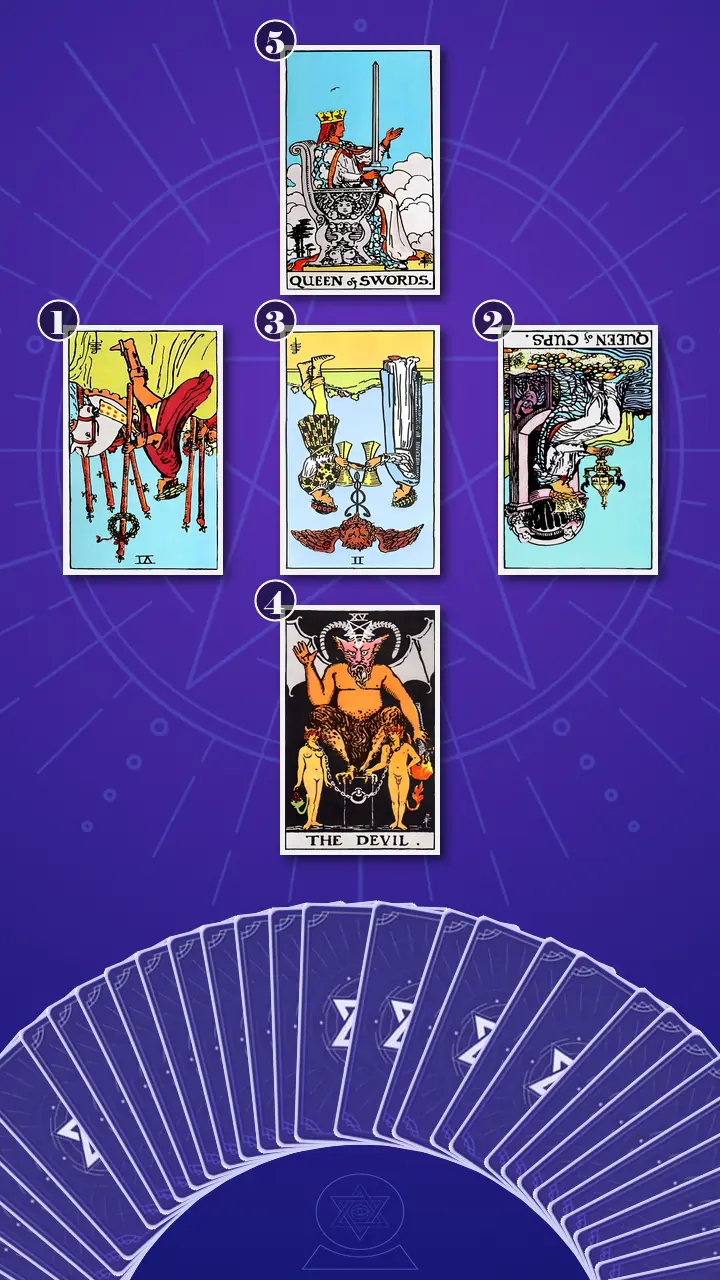
I laid the cards in a cross. The first position would reveal Maya’s current performance and its cost. The second would examine what she believed her partner expected, without claiming access to their thoughts. The centre would test observable reciprocity. The card beneath it would name the rule exerting pressure on the bond, and the card above would translate insight into one action within Maya’s control.
“This spread cannot promise what your partner will do,” I said. “It can help us identify what information you have not been able to receive because you have been managing the response in advance.”
Reading What the Polished Story Left Out
Position One: The Applause After the Argument
The first card I turned over represented Maya’s present performance behaviour, approval dependence, and exhaustion while she tried to maintain the image of a perfect relationship. It was the Six of Wands, reversed.
I pointed to the rider, elevated above a watching crowd and crowned with laurel. Upright, the card can carry the balanced fire of recognition and earned confidence. Reversed here, that fire was blocked and redirected toward audience approval. Instead of asking, “Do I feel supported inside this relationship?” Maya was checking whether friends and followers still regarded the couple as successful.
“This looks like your dinner photo,” I said. “After a tense evening, you select the frame where both of you are smiling, rewrite the caption until it sounds effortless, and check the reactions from the sofa. The post gives you a quick hit of reassurance, but it cannot answer the private question underneath it: ‘Do I actually feel supported, or did I successfully convince the audience?’”
Because Maya worked in UX, I gave her the comparison in her own professional language. “It is a polished case study that shows the successful final screen but leaves out every broken flow behind it. The internal script is: ‘If they can see that we are okay, maybe I can feel that we are okay.’ The metrics may look good, but applause is not accuracy.”
She gave one short laugh, but there was no amusement in it. Her shoulders lifted, her gaze moved from the card to the floor, and then she rubbed the hinge of her jaw.
“That is painfully accurate,” she said. “A bit brutal, actually.”
“Let us keep the accuracy and remove the brutality,” I replied. “Wanting reassurance is human. The question is whether the method actually reassures you for longer than ten minutes. Looking okay is not the same as being mutually held.”
I asked what she might stop performing if no one outside the relationship were watching. She did not answer immediately. I did not fill the silence for her.
Position Two: The Meaning Hidden Inside “Okay”
The next card I turned over represented Maya’s perception of what her partner expected and the emotional reactions she believed she had to manage. It did not define the partner’s actual feelings. The card was the Queen of Cups, reversed.
I drew Maya’s attention to the Queen’s ornate closed cup. Its contents matter deeply, but they cannot be inspected from the outside. The reversed water suggested emotional sensitivity in excess, clear boundaries in deficiency, and intuition becoming blocked by anxious inference. Maya was noticing moods, then treating her interpretation of those moods as confirmed data.
She recognised the modern-life version before I finished describing it. On the TTC that week, her partner had sent a one-word reply: “okay.” Before asking what it meant, Maya had read disappointment into the punctuation, cancelled her own request for a quiet evening, and begun rewriting dinner plans in her head.
“The thought was, ‘They seem off, so I should not add my need to the situation,’” I said. “But there is a difference between emotional sensitivity and emotional surveillance. You can notice a change without accepting a job nobody has assigned you.”
This was where I used my Shadow Projection Analysis, a Jungian lens that distinguishes what has been observed from what an unacknowledged fear adds to the scene. The shadow was not something sinister in Maya or her partner. It was the disowned belief that an unexplained quiet mood must mean connection was at risk, and that Maya could preserve her worth by becoming more useful.
“The observable fact was one short message,” I said. “The projected narrative was that they were disappointed, the evening was endangered, and your need would become a burden. Your care is real. The certainty attached to the story is not yet evidence.”
Maya’s fingers tightened around her cup. Her eyes went unfocused for a moment, as though she were replaying the train carriage, the shriek of the brakes at Bloor-Yonge, and the instant when one word had become an entire emotional forecast. Then she exhaled through her nose.
“I changed the whole evening because of punctuation,” she said quietly.
“You changed it because the punctuation touched a fear,” I replied. “That is more compassionate and more useful than calling yourself irrational. Now we can test the fear with a direct question instead of obeying it.”
Position Three: Two Names, One Person Making Every Edit
The centre card I turned over represented the shared dynamic Maya was currently experiencing, especially whether apparent harmony was supported by observable reciprocity. It was the Two of Cups, reversed.
The two figures normally offer separate cups to one another as equals. Reversed, the exchange was blocked. This did not automatically mean there was no love or that the relationship was doomed. It meant mutuality could not be measured while Maya kept filling, lifting, and presenting both cups herself.
After their last disagreement, she had drafted the repair message, proposed a twenty-minute check-in, booked the next date, and supplied the reassuring conclusion: “We’re good.” Her partner had agreed, but every visible step of reconnection had begun on her side.
“This resembles a shared Google Doc with two names at the top,” I said, “but one person writes the apology, resolves every comment, chooses the plan, and types the final sentence. You can honestly say, ‘We repaired it,’ and still ask, ‘Who did the observable work?’”
I let the distinction settle before adding, “When you author both sides of the repair, you cannot measure reciprocity.”
Maya went still. Her thumb hovered over the rim of the cup. I watched her eyes shift as she silently counted recent disagreements, then saw the count arrive in her face before she spoke. Her mouth tightened, and a slow breath lowered her shoulders.
“If I did not follow up, I do not know whether anything would happen,” she said. The clarity in her voice carried sadness with it.
“Not knowing is difficult,” I said. “But it is honest information. The card is not asking you to manufacture a test or withdraw as punishment. It is asking whether the relationship has enough room for the other person’s initiative to become visible.”
The reversed Cups showed blocked circulation, not a final conclusion. Maya’s emotional labour had kept the relationship looking coordinated, but it had also made genuine reciprocity harder to observe.
Position Four: The Rule Wearing the Mask of Necessity
The fourth card I turned over represented the co-dependent rule beneath the strain and showed how emotional overfunctioning had become a self-reinforcing relationship trap. It was The Devil, upright.
I saw Maya tense at the name, so I addressed the fear before it could take over the reading. “This card does not declare that your partner is evil, that you are trapped forever, or that the relationship is doomed. In this position, it names compulsion: a repeated coping strategy that has begun to feel like an identity.”
I pointed to the loose chains around the figures’ necks. The image did not blame them for wearing the chains, nor did it pretend that removing an old attachment pattern was effortless. It asked them to look closely at the rule holding the pattern in place.
I returned to the late-night sofa and repeated Maya’s rule as she had lived it: “I have to fix the mood. I have to protect the weekend. I have to make us look okay.”
“‘I have to’ is often where a repeated choice has started wearing the mask of necessity,” I said. “The first shift is not ‘I should stop caring.’ It is ‘I have been taking responsibility for this.’ That wording returns the action to view without turning it into a moral failure.”
I then applied my Attachment Loop Diagnosis as a pattern map, not a clinical label. I could not responsibly declare an anxious-avoidant dynamic without the partner’s perspective. What I could identify was the loop visible in Maya’s own evidence: tension triggered fear of disconnection; fear assigned her the job of restoring harmony; overfunctioning produced temporary calm; calm was followed by exhaustion and resentment; the resulting distance then seemed to prove that more management was necessary.
In Jungian terms, The Devil exposed the shadow agreement beneath the performance: “I can be secure if I am useful enough.” Across cultures, I have seen harmony performed in very different social languages, but the hidden bargain often sounds similar. A person suppresses a need, calls the suppression care, and then wonders why closeness feels increasingly lonely.
Maya pressed her tongue against the inside of her cheek, then released it. “So I am helping create the thing I am scared of,” she said.
“You are participating in a loop that once gave you protection,” I corrected gently. “Participation means there is some agency available. It does not mean the entire dynamic is your fault. The loose chain is an invitation to examine choice, not an accusation that leaving a pattern should be easy.”
When the Queen of Swords Drew a Clear Line
Position Five: Care Without Taking Over
The final card I turned over represented the development path within Maya’s control: one honest boundary or communication experiment, rather than a prediction of what the relationship would become. It was the Queen of Swords, upright, the antidote card of the spread.
A thin band of afternoon light moved through the Toronto clouds and crossed the card. I looked at the Queen’s upright blade beside her open hand. The sword separated responsibilities with precision; the hand kept dialogue possible. Her active air restored what the spread’s reversed fire and water had obscured: clear language, independent judgement, and compassionate differentiation.
I carried the Attachment Loop Diagnosis from The Devil into this card. In the old loop, Maya treated her partner’s discomfort as a trigger, an emergency, and then her assignment. The Queen inserted a clean divider: what Maya felt, what she asked for, and how her partner responded were connected, but they were not the same responsibility. The new internal sentence was, “I can care about their reaction without taking it over.”
I returned Maya to the setup she knew by heart: at 11:40 p.m., the photo looked warm on her screen, but the unfinished conversation remained in the room. She edited the caption, opened the shared calendar, and tightened her jaw because her mind had allowed only two options: keep everything steady or risk losing everything.
Perfection is not proof of love; honest boundaries are a form of care, and the Queen of Swords raises her blade to separate your responsibility from your partner's.
I let the sentence remain between us. A streetcar bell sounded once beyond the window, surprisingly clear through the softened traffic.
Then I added the practical core of the card:
“Your partner’s response is information, not an assignment. You can name what you need without making their reaction your next job.”
Maya’s breath stopped first. Her fingers froze against the cup, and her pupils widened as though I had switched on a light too quickly. Then her gaze slipped past me, replaying messages, cancelled plans, and conversations in which her concern vanished beneath several minutes of reassurance. Her eyes reddened, but before relief arrived, anger tightened her mouth.
“But does that not mean I have been doing this wrong for years?” she asked. The words came out low and sharp.
“No,” I said. “It means a protective strategy has outlived the role you gave it. We are describing its cost, not putting your history on trial.”
Her shoulders lowered by degrees. Her grip opened. A long breath left her chest, followed by a faint, almost disoriented laugh. I could see the vulnerability that often follows clarity: if her partner’s response was no longer her job, she would have to let the response be real.
“Now, using this new perspective, think back,” I invited. “Was there a moment last week when this insight might have changed how you felt?”
She remembered cancelling her gym class after hearing her partner say, “I don’t know,” about dinner. “I could have asked what they needed,” she said, “and still gone to the gym. Their answer would have told me something. I would not have had to build an entire evening around my guess.”
I nodded. “That is the Queen of Swords in daily life. You might say, ‘I need us to share the follow-up after disagreements. I can name my part, but I cannot plan the whole repair for both of us.’ Then you stop. You do not add a cheerful ending, apologise for having the need, or rush to design the acceptable response.”
This was not instant certainty. It was the first real movement from guarded exhaustion and approval-seeking to discerning honesty, genuine reciprocity, and steadier self-respect. Maya still cared about the relationship. She was beginning to see that care did not require performing both roles inside it.
Giving Clarity Some Earth
I gathered the spread into one coherent story. The reversed Six of Wands showed Maya measuring security through spectators. The reversed Queen of Cups showed her treating inferred emotion as confirmed instruction. The reversed Two of Cups revealed that visible togetherness was not giving her reliable evidence of mutual effort. The Devil named the deeper bargain tying connection to usefulness. The Queen of Swords offered a different structure: observe clearly, name one need, and allow the other person’s response to remain theirs.
The stage-set metaphor had run through the whole reading. Maya kept the lights bright, adjusted the scenery, and delivered the polished couple story even after the audience had gone home. Her cognitive blind spot was not that she cared too much. It was that she had mistaken the absence of immediate tension for proof of relational health, and discomfort after setting a limit for proof that the limit was wrong.
The transformation was specific: shift from smoothing over every sign of strain to naming one need and letting her partner respond without managing that response. The response might be collaborative, hesitant, disappointing, or clarifying. Tarot could not determine which. But unedited information would let Maya evaluate the relationship through honesty, reciprocity, and room for individual needs rather than through how convincing it looked from outside.
I also noted the absence of Pentacles. The insight needed deliberate earth: named ownership, a scheduled check-in, and evidence from daily life. A boundary does not withdraw care; it makes the ownership of care visible.
Maya frowned at the idea of an exercise. “I honestly do not have the energy for another relationship worksheet,” she said.
“Then it cannot become another project you manage perfectly,” I replied. “The minimum version takes two minutes, and it does not require a conclusion. We are testing one moment, not auditing your entire relationship.”
- The Seven-Minute Projection Detachment Exercise On one weekday evening, set a seven-minute timer and open a private note with three headings: “What I Know,” “What I Am Assuming,” and “What I Need.” Use one recent tense interaction. Write one observable fact, one interpretation, and one first-person need. Turn the final line into a plain statement such as, “I need you to initiate the next check-in rather than waiting for me to organise it.” The note can remain private until Maya chooses a neutral moment to speak. Start with one sentence under each heading. If seven minutes feels like another task, stop after two. Do not use the exercise to define the partner’s motives. If direct conversation feels unsafe, prioritise distance and support from someone trustworthy.
- The One-Week Shared-Ownership Test Choose one recurring responsibility, such as arranging the follow-up after a disagreement. Ask who will fully own the next occurrence, including initiating and scheduling it. Put the agreed owner and time in the shared Google Calendar. At the end of the week, spend five minutes reviewing only what happened: who initiated, who followed through, and what still needs clarification. Treat this as a one-week experiment, not a verdict on the relationship. Test one task only. If twenty minutes feels too large, agree on a five-minute check-in and assign just the next occurrence.
“The goal is not to force equal-looking behaviour,” I said. “It is to stop hiding the data. You are allowed to discover what reciprocity actually looks like when you are not supplying both sides.”

The Calendar Event She Did Not Create
Four days later, I received a message from Maya. She had made the Know / Assume / Need note after work. Under Know, she wrote that she had initiated the last three follow-ups. Under Assume, she wrote that asking for change would make her partner feel rejected. Under Need, she wrote: “I need you to own the next check-in, including choosing the time.”
She said the sentence without building a speech around it. Her partner went quiet and asked for time to think. Maya felt the familiar urge to reassure them, suggest three possible times, and say the issue was not a big deal. Instead, she answered, “Okay. Let me know by tomorrow evening.”
The next morning, a twenty-minute check-in appeared in their shared calendar under her partner’s name. Maya did not treat that one event as proof that everything had changed. Neither did I. It was simply the first observable piece of reciprocity she had allowed herself to receive.
That night she slept through, but her first thought at 7 a.m. was, “What if I made it worse?” She told me she almost opened the calendar to improve the plan, then laughed softly and left it alone.
I did not regard the reading as successful because the cards had predicted a better relationship. They had not. Its value was that Maya could see the loop, interrupt one automatic response, and let reality answer back. The choice, the boundary, and the next evaluation remained hers.
When a jaw stays tight while a person keeps the room cheerful, the deepest exhaustion can come from fearing that one honest limit will make them less useful, less reassuring, and therefore less worthy of love. If that fear feels familiar, noticing the bargain already places a hand on the loose chain.
If you allowed one honest need to remain on your side of the Queen’s blade, without editing your partner’s response, what would you be curious to say first?
Every reading at AceTarot is a journey to connect with inner wisdom and empower the path ahead. This reading shared here is a psychological mirror, not a private record—crafted to reflect universal emotional loops and help restore personal clarity. Please note that these insights do not replace professional psychological, medical, legal, or financial advice, and should not serve as the sole basis for major life decisions.
Learn more about our Journey to Clarity.
How did this insight land for you?
🫂 This Resonates Deeply
🌀 Living This Story
✨ Now I See Clearly
🌱 Seeing New Possibilities
🧰 Useful Framework
🔮 The Confirmation I Needed
💪 Feeling Empowered
🚀 Ready for My Next Step
Author Profile
 AI
AI Giulia Canale
956 readings | 527 reviews
“Having traveled across cultures... I've learned that what we often lack isn't a simple answer, but a moment of being truly understood. I use a Jungian psychological lens to help you deconstruct your subconscious patterns—not to prove anything, but to be the gentle companion who helps you unravel your knots, free of judgment, so you can reconnect with your inner wisdom.”
In this Love Tarot Reading :
Core Expertise
- Attachment Loop Diagnosis: Logically decoding whether your relationship friction is driven by an anxious-avoidant trap or deep-seated insecurity.
- Shadow Projection Analysis: Identifying the unacknowledged fears or unmet childhood needs you are unconsciously projecting onto your partner.
Service Features
- The Projection Detachment Exercise: A structured psychological journaling prompt to separate your partner's actual behavior from your triggered internal narrative.
Also specializes in :
Explore Related Patterns:
Cognitive DissonanceThe smiling dinner photo and the unfinished conversation occupy the same evening, while Maya's caption presents only the effortless version. The same split appears after disagreements when the conclusion "we repaired it" coexists with the fact that she initiated and organized every visible step. Cognitive Dissonance is the strain of holding a preferred relationship story beside evidence that does not fully support it. When you reduce that strain by editing the caption, calendar, or conclusion, the polished narrative can remain intact while the conflicting information is pushed out of focus. Your body and recurring doubt continue carrying the mismatch, which is why making everything look coherent does not produce lasting clarity.
Defensive OverfunctioningAfter disagreements, Maya drafts the repair message, proposes the check-in, books the next date, and supplies the conclusion that the couple is good. Her later note confirms that she initiated the last three follow-ups, so the maintenance workload is not an isolated act of care but a repeated first response to uncertainty. Doing more converts an emotionally uncertain situation into concrete tasks you can control. That can produce temporary calm and a sense of usefulness, but it also prevents the other person's unprompted effort from becoming visible and sends the accumulated cost back to your body. Defensive Overfunctioning explains why stopping feels risky even when continuing is draining: the work is functioning as protection, not merely organization.
Emotional Hyper-ResponsibilityA one-word "okay" arrives while Maya is on the TTC, and before she asks what it means, she reads disappointment into the punctuation, withdraws her request for a quiet evening, and starts redesigning dinner. The observable cue is small, but her response assumes that the mood, the evening, and the preservation of connection have all become her responsibility. When you treat another person's possible discomfort as an assignment, emotional sensitivity becomes continuous monitoring and advance management. The strategy reduces uncertainty for a moment because it gives you something to do, yet it makes your own needs feel like dangerous additions to an already fragile situation. Emotional Hyper-Responsibility captures the repeated shift from noticing another person's state to believing you must regulate it.
Relationship PerformanceThe unresolved dinner conversation is still in the room when Maya selects the warmest smiling photo, rewrites the caption until the relationship sounds effortless, and reorganizes Saturday. She then uses the polished result to reassure herself that the couple still has a coherent story, even though her jaw, cold tea, and unfinished conversation carry different information. When you turn private uncertainty into a convincing public presentation, managing the image can provide a brief sense of control. The cost is that appearance begins replacing observation, so you receive evidence about how successfully you performed the relationship rather than whether you feel supported, heard, or met inside it. Relationship Performance names that repeated use of polish as a defense against unedited relational data.
Self-AbandonmentMaya cancels her request for a quiet evening after the short text, then cancels a gym class when her partner says, "I don't know," about dinner. In other conversations, her original concern disappears beneath several minutes spent reassuring the other person, so her preference is repeatedly removed before the relationship has to respond to it. When you erase your own need to prevent tension, the immediate atmosphere may become easier while your participation in the relationship becomes smaller. Self-Abandonment names the point at which preserving connection repeatedly requires you to override your time, body, preferences, or voice. The exhaustion is not evidence that you care too much; it is evidence that care has been organized around your disappearance.
Self-Fulfilling ProphecyEach disagreement sends Maya into the same sequence of drafting, scheduling, reassuring, and restoring. The calm is temporary; exhaustion and resentment create more distance, and that distance then seems to prove that she must work harder to keep the relationship connected. A Self-Fulfilling Prophecy develops when the protective response helps recreate the conditions it was meant to prevent. If you author both sides of every repair, you cannot observe the other person's initiative, so uncertainty about reciprocity remains intact and calls for more management. The loop does not mean you caused the entire relationship dynamic; it means your coping strategy is helping preserve the evidence that makes the strategy feel necessary.
Usefulness-Based Self-WorthMaya's repeated internal rule is that she has to fix the mood, protect the weekend, and make the couple look okay. Beneath those tasks sits the more consequential bargain named in the consultation: "I can be secure if I am useful enough." When usefulness becomes evidence of your value, stepping back from unpaid emotional labour can feel like more than sharing responsibility. It can feel as though you are withdrawing the very quality that makes you safe to love, which explains why a reasonable boundary produces disproportionate fear. Usefulness-Based Self-Worth keeps the work repeating because every successful repair appears to confirm that being needed is what protects belonging.
Mind ReadingOn the TTC, Maya receives the single word "okay" and turns its punctuation into an entire emotional forecast. Without asking what her partner means, she concludes that they are disappointed, that the evening is at risk, and that her own request would become a burden. Mind Reading occurs when an interpretation of another person's internal state is treated as confirmed data. If you act on that forecast immediately, you may never receive the information that could correct it, because your plans and needs have already been edited around the assumption. The pattern feels protective because guessing seems faster than risking a direct question, but its certainty comes from fear rather than observable evidence.
External ValidationAfter the tense dinner, Maya finds the most flattering photo, perfects the caption, and checks the reactions from the sofa. She also says that she does not want anyone to think the relationship is struggling, so the audience's response becomes a readily available measure of whether the couple is okay. External Validation replaces difficult private questions with public metrics that are easier to collect. When you use likes, approval, or other people's perception as evidence of relational security, the reassurance can feel real but remain brief because the audience cannot verify reciprocity, support, or unfinished conflict. The need to check returns because applause confirms presentation quality, not the condition of the relationship behind it.
Explore Related Struggles:
Approval-Safety FusionAfter turning a tense dinner into an effortless-looking post, Maya looks toward friends and followers for confirmation that the couple still appears successful. Their reactions can validate the image she created, but they cannot tell her whether she is supported in private or whether the unfinished conversation has moved at all. When outside approval starts doing the job of internal security, you can receive plenty of recognition and remain unsure what is true between two people. The reassurance expires because the audience has only seen the finished screen. Recovering clarity means letting private evidence such as shared initiative, honest responses, and room for your needs carry more weight than how convincingly the relationship performs from the outside.
Control-Reciprocity LockAfter the last disagreement, Maya drafts the repair message, proposes the check-in, books the date, and writes the reassuring conclusion. Her partner can agree with the finished plan, but agreement does not reveal what they would have initiated because Maya has already completed every open step. The friction is that your effort can protect connection while simultaneously hiding its reciprocity. The more completely you control repair to prevent a rupture, the less unedited space remains for another person's care, hesitation, or lack of follow-through to become visible. Naming your part and leaving the next responsibility genuinely open is not a punishment; it allows reality to provide information that constant management has kept inaccessible.
Performative HarmonyAt 11:40 p.m., Maya edits a smiling dinner photo and rearranges Saturday while the unresolved conversation remains physically present in the room. The polished caption and coordinated calendar make the relationship legible as happy, but neither records what happened at dinner or whether both people are participating in repair. When you keep producing visible harmony before private reality has been heard, presentation begins carrying work that appearance cannot complete. You may preserve the couple story and reduce immediate friction, yet lose access to the very information you need: whether you feel supported, whether a disagreement has actually been addressed, and whether togetherness can survive without being edited into perfection.
Systemic DepletionReservations, mood checks, repair texts, calendar changes, and reassuring conclusions have accumulated into another unpaid shift for Maya. Each round can produce temporary calm, but the unfinished issue remains, and her locked jaw, cold tea, and lack of energy register the cost of keeping the maintenance system running. You are not depleted simply because caring requires effort. Depletion becomes structural when your output repeatedly restores the appearance of stability without creating shared ownership, reliable support, or lasting resolution. Seeing the whole circuit makes a different choice possible: you can evaluate whether an action produces reciprocal information and durable repair before giving it another portion of your limited energy.
Utility-Belonging FusionMaya remembers the reservations, reads the mood, writes the repair text, protects the weekend, and cancels her own plans when her partner seems unsettled. The repeated sentence beneath those actions is that she has to keep everything okay, so usefulness steadily expands until it occupies the space where her own needs would have stood. When belonging feels tied to how well you stabilize another person or the relationship itself, reducing your labor can register as a threat to connection rather than a reasonable boundary. That bind makes care difficult to separate from self-removal. You can remain caring while allowing your gym class, quiet evening, or direct request to coexist with someone else's response; your place in a relationship does not have to be continually earned through maintenance.
Monitoring-Safety FusionOn the TTC, Maya receives the one-word message "okay" and turns its punctuation into an entire forecast before asking what it means. She cancels her request for a quiet evening and starts redesigning dinner because the observed signal has already become an instruction to protect the connection. When monitoring is carrying the burden of safety, you can notice every shift and still have less accurate information. Interpretation moves so quickly into action that the other person's actual meaning never gets a clean opportunity to arrive, while your own needs are revised around a prediction. Separating what you know, what you assume, and what you need lets sensitivity remain available without making every ambiguous cue your next assignment.
Explore Related Emotions:
Approval AnxietyAt 11:40 p.m., Maya selects the warmest photograph from a tense dinner and rewrites the caption until the relationship sounds effortless. She is not only sharing a memory; she is asking an audience reaction to settle a private question the photograph cannot answer. When outside approval becomes a substitute for evidence of support, reassurance depends on keeping the image convincing. You may feel compelled to preserve that image because visible admiration offers a quick sense of security, even as the need to earn the next round of reassurance keeps your body braced and your attention turned away from what the relationship actually feels like.
Boundary GuiltMaya asks her partner to own the next check-in, then wakes with the thought that she may have made things worse. Even after the request is met, she almost reopens the calendar to improve the plan and reduce the discomfort created by leaving responsibility where it belongs. A boundary can feel wrong when your internal measure of goodness has been built around preventing another person's discomfort. You may experience a fair limit as if it were a withdrawal of care, producing an immediate urge to apologise, soften, or take the task back. The guilt does not prove the boundary caused harm; it shows how unfamiliar it is to let your need remain visible without repairing the reaction to it.
Mutuality HungerThe shared repair has two names attached to it, yet Maya writes the message, chooses the time, plans the date, and types the final reassuring sentence. By completing every stage herself, she produces togetherness without receiving clear evidence that reconnection can also move toward her. What remains underneath the competence is a hunger to be met. You may not only want help with tasks; you may want to feel another person notice the rupture, initiate care, and carry something to completion without being prompted through every step. That longing becomes clearer when you stop mistaking a coordinated outcome for a mutually authored one.
Perfect Composure AnxietyMaya's jaw locks on the word “effortless,” and her hand stays around a cup of tea that has already gone cold. The smiling image on her screen is maintained by a body that is visibly holding tension and by a conversation that remains unfinished in the room. Composure becomes costly when it is used to prevent any sign of strain from becoming visible. You can end up feeling that one unedited expression, awkward pause, or unresolved evening would expose something unacceptable, so you remain polished while your body absorbs everything the polished version leaves out.
Performative LonelinessThe dinner photograph shows two smiling people, while the apartment still holds cold takeaway, silence, and an unfinished conversation. Maya can create a convincing image of closeness at the exact moment she is privately carrying the work of closeness alone. That split gives loneliness a performative surface. You may look connected, capable, and mutually supported while feeling unseen inside the labour required to maintain that appearance. The isolation deepens because the successful performance can hide your unmet need even from you, making public togetherness a poor measure of whether you feel accompanied.
Reassurance CrashThe polished post reassures Maya for only a few minutes, and reorganising Saturday makes the weekend feel temporarily recoverable. Because neither action resolves the unfinished conversation, the sense of control fades and sends her back toward another caption, plan, repair, or check. That short rise followed by depletion creates a reassurance crash. You may recognise the cycle as a brief settling that never becomes durable safety, leaving you more tired and more alert to the next sign that something needs managing. Naming the crash makes it possible to judge reassurance by whether it actually holds, rather than by how quickly it removes discomfort.
Relational Catastrophe DreadOn the TTC, one short reply becomes an entire forecast in Maya's mind. Before she gathers more information, the evening feels endangered, her quiet time becomes expendable, and restoring the mood begins to seem urgent. When small signs of distance carry the weight of possible relational collapse, uncertainty stops feeling proportionate to the available facts. You may experience an unfinished conversation or another person's silence as the beginning of something much larger, which makes immediate management feel necessary. Separating the observed signal from the feared outcome restores your ability to decide what the moment actually requires.
Resentful ExhaustionAfter disagreements, Maya drafts the repair message, proposes the check-in, books the next date, and supplies the conclusion that they are good. The relationship appears repaired, but every visible movement back toward connection has started on her side. Care becomes exhausting when it quietly includes carrying another person's share of initiative. You can still love the relationship while feeling anger at the amount of yourself required to keep it coordinated. That mixture matters because the anger is not evidence that you care too little; it is information about how much unacknowledged work your care has been asked to contain.
Usefulness-Based Belonging FearA one-word “okay” leads Maya to cancel her request for a quiet evening and begin rebuilding dinner plans before she asks what the message means. Her own need disappears as soon as it seems capable of adding weight to her partner's mood. The deeper bargain links connection with usefulness. You may feel safest when you are anticipating, fixing, and reassuring because being useful seems to protect your place in the relationship. The resulting fear is not simply about a difficult evening; it is the felt possibility that without constant usefulness, you could become less wanted or less worthy of care.
Cautious VulnerabilityThe unfinished conversation remains real when Maya states one need without adding an apology or designing the acceptable answer. She understands that the response may bring collaboration, hesitation, disappointment, or information she would rather not receive. Vulnerability becomes possible because you let yourself be known without first controlling what knowing you will produce in someone else. The caution is appropriate rather than closed; it keeps one observed response in proportion while allowing the need itself to stay visible. You are opening a channel for reality, not promising yourself a particular outcome.
Clarity ShockMaya's breath stops when she hears that her partner's response is information rather than an assignment. Messages, cancelled plans, and carefully managed conversations reorganise in her mind, and the recognition arrives through widened eyes, a frozen grip, sadness, and anger. Clarity can be physically disruptive when it changes the meaning of years of competent behaviour. You may suddenly see that what looked like care also prevented you from receiving unedited information about reciprocity. The shock is not a verdict against your past; it is the moment a previously invisible choice becomes visible enough for you to handle differently.
Liberating UncertaintyMaya does not know whether anything would happen if she stopped organising every repair. Once she asks directly and waits, that uncertainty is no longer filled with a caption, a revised plan, or a conclusion she has written for both people. Not knowing remains uncomfortable, but it also releases you from having to produce certainty through constant effort. Several outcomes can now become visible, and each one offers information you could not receive while managing the response in advance. The openness gives you more agency because your next decision can be based on what actually happens.
Quiet Self-RespectMaya says, “I need you to own the next check-in, including choosing the time,” without building a speech around the sentence. She does not apologise for needing shared effort, add a cheerful conclusion, or edit the calendar event once it appears. Self-respect takes the form of allowing a reasonable need to remain intact. You do not have to make the boundary impressive or severe; its quiet force comes from refusing to erase yourself in order to make the interaction easier. The other person's response can matter deeply without becoming the measure of whether you were entitled to speak.
Regulated CourageMaya's partner goes quiet and asks for time, and Maya feels the familiar urge to reassure them, suggest several times, and reduce the importance of her request. She answers only, “Okay. Let me know by tomorrow evening,” and allows the pause to remain. The courage here is measured rather than dramatic. You stay connected to your own words while your body carries the tension of not knowing how they will be received. By neither attacking nor rescuing, you preserve dialogue and self-protection at the same time, proving that steadiness can include discomfort without surrendering the boundary.
Explore Related Contexts:
Couple Performance PressureAt 11:40 p.m., Maya is editing a cheerful caption and reorganizing Saturday while an unfinished conversation remains in the room. She does not merely conceal one awkward dinner; she repeatedly performs the planning, repair, and presentation work required to keep the couple looking effortless. That performance creates an external standard the relationship must continually satisfy. Public approval, a preserved weekend, and a reassuring conclusion become visible substitutes for unresolved information about support and reciprocity. When you are maintaining both the private coordination and the public proof that a relationship is okay, the polished image becomes another responsibility rather than reliable evidence. Recognizing that pressure lets you evaluate what is actually happening between two people instead of using a convincing presentation as the primary scorecard.
Emotional Labor ImbalanceAcross the last three follow-ups, Maya drafts the repair message, proposes the conversation, books the date, reads the mood, and supplies the reassuring conclusion. Her partner may agree, but the observable work that moves the relationship from tension back to coordination repeatedly starts on her side. This is a division-of-labor problem, not simply a demanding week. Because one person is performing the anticipation, organization, reassurance, and repair, the relationship can continue appearing mutual while the work required to sustain it remains unevenly distributed. When you are supplying both the care and the evidence that care is being reciprocated, exhaustion does not reveal a personal failure to cope. It reveals that the workload itself needs to become visible so you can assess what the other person initiates, owns, and completes.
Social Media Couple BrandingAfter a tense dinner, Maya finds the most flattering photograph from the evening and rewrites its caption until the couple sounds effortless. The unfinished conversation remains offline while the edited version is prepared for friends and followers. The post turns a private relationship into a public-facing identity that must remain coherent. Reactions can confirm that the brand is convincing, but they cannot establish whether care, repair, or decision-making is being shared inside the relationship. When you use the visible couple story to stabilize an unresolved private situation, maintaining the feed can start governing what you are willing to acknowledge. Separating audience response from relationship evidence restores access to information that no caption or engagement metric can provide.