Three Message Threads Glowed—Then Jordan Set a No-Relay Boundary

The 11:47 p.m. Peacekeeper Shift
If you are the diplomatic one in a city friend group, two clipped replies can turn an ordinary Tuesday night into unpaid crisis management. That was how Jordan (name changed for privacy), a 27-year-old non-binary junior UX designer in Toronto, arrived on my screen: still wearing their work hoodie, sitting on the edge of their bed, with the posture of someone who had technically come home but had not clocked off.
I could hear the radiator clicking through their microphone and the thin whir of a laptop fan. Blue screen light sharpened the tiredness beneath their eyes. An unfinished bowl of noodles sat beside the laptop, smelling faintly stale, while iMessage, Instagram DMs, and the main group chat glowed in three separate windows. Their phone was warm in one hand. Their jaw was locked. I watched them delete the same sentence for the fourth time.
Two friends had exchanged clipped replies about a birthday dinner. The main chat had gone quiet. Then both friends had messaged Jordan privately, each wanting to be understood without having to speak directly to the other. Jordan had already softened one person's complaint, translated the other's silence, offered a different restaurant, and considered cancelling the affordable plan they actually preferred.
"I know it isn't technically my argument," Jordan said, rubbing the hinge of their jaw, "but I can see how to fix it. If I don't smooth this over, nobody will. Stepping back feels less like a boundary and more like abandonment."
I heard the real question beneath the logistics: why did Jordan feel responsible for keeping the entire friend group together? They wanted genuine closeness, but the second the chat became tense or quiet, their body issued the same command as a fire alarm wired directly to every typing bubble: act now, or lose your place. Public silence led to private complaints; private complaints led to surrendered plans. The temporary calm that followed taught Jordan that intervention worked, even as their sleep, dinner, and resentment paid the bill.
"You are not just reading the room," I told them. "You are quietly running it. I don't want to shame the part of you that notices people so accurately. That sensitivity is real. I want us to find the point where care becomes total responsibility, then give you enough clarity to choose what happens next."
I placed my hand beside the deck. "We are not asking the cards to predict whether your friends will stay or leave. We are using them as an objective map of a pattern. You remain the person holding the pen."

Choosing the Compass: A Five-Card Relationship Spread
I asked Jordan to put both feet on the floor, let one breath leave without forcing the next, and phrase the question as plainly as possible: "Why do I keep the peace as if my friend group depends on me?" I shuffled slowly while they held that question. The pause was a way to move from reacting to observing, not a performance of mystery.
I chose the Relationship Spread · Context Edition, a five-card relationship tarot spread adapted for friendship conflict. For anyone wondering how tarot works in a situation like this, the value lies in card meanings read in context: each position separates one part of a tangled relational system so the whole problem does not have to be treated as a single emergency.
I use this spread when the question is relational but one person's role has become difficult to distinguish from the relationship itself. A larger Celtic Cross could have added timelines and outside influences, but Jordan did not need more information. They needed a clean comparison between their automatic behavior, the group's way of handling conflict, the friendship underneath that pattern, the hidden fear keeping it in place, and a constructive boundary practice.
I laid the cards in a cross. The first position, to the left, would show Jordan's automatic over-functioning as the designated peacekeeper. The second, to the right, would reveal how the friend group displaced conflict into private channels. The central card would show whether there was a genuine bond beneath the emotional labor. Below it, I would look for the hidden contract connecting usefulness to belonging. Above it, the final card would offer a non-predictive direction for integration: how Jordan could stay connected without standing in the middle.
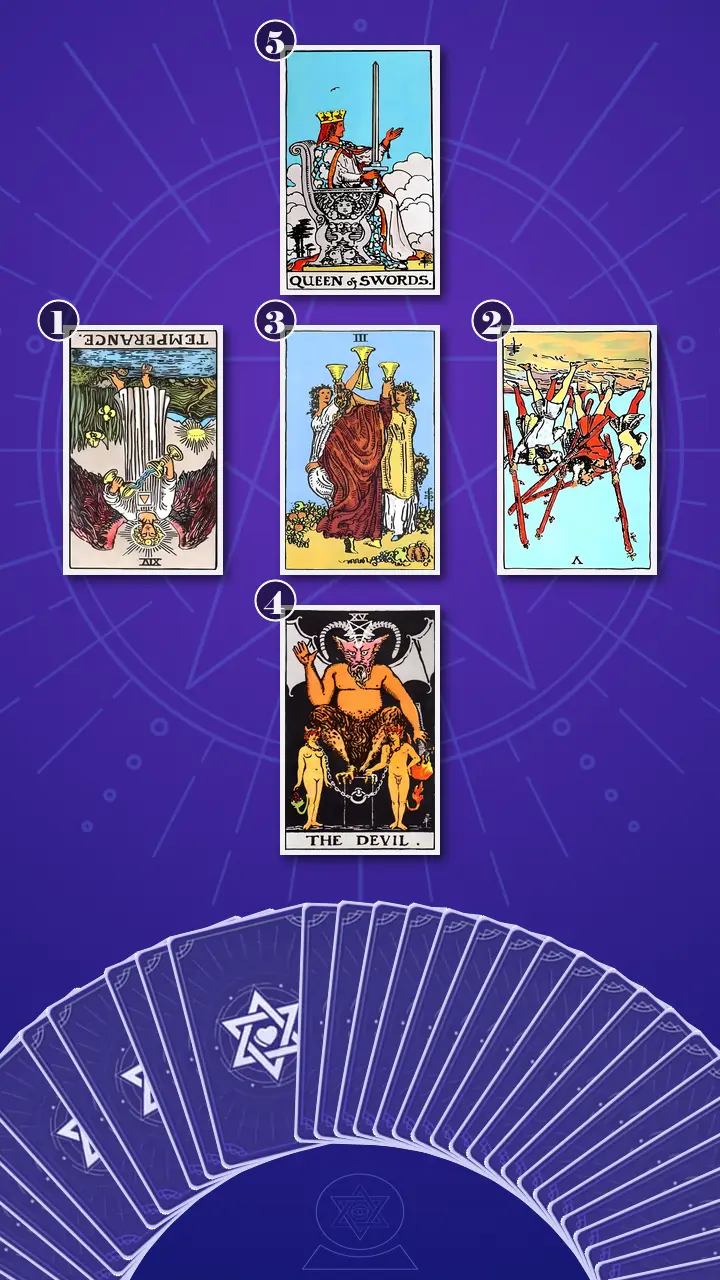
When Two Cups Became Three Message Threads
The Present Role: Temperance Reversed
I began with the card in the position showing Jordan's automatic over-functioning whenever group tension appeared. I turned it over: Temperance, reversed.
In the familiar Rider-Waite-Smith image, an angel pours liquid between two cups, balancing separate elements through careful exchange. Reversed in Jordan's current-role position, that exchange had become an excess of regulation and a blockage of proportion. Jordan was not merely participating in communication. They were trying to keep every emotional temperature within a range that felt survivable.
I pointed to the two cups. "At 11:47 tonight, these are your private threads. You take one friend's frustration, edit anything that might trigger the other person, and pour the softened version into a second chat. Then you carry the reply back. Your dinner gets cold, tomorrow's UX task stays unfinished, and the internal promise is, 'If I can phrase this perfectly, they will calm down, and then I can finally rest.'"
I let the distinction sit between us. "Your empathy is genuine. But empathy says, 'I understand why this hurts.' Total responsibility says, 'I must guarantee what everyone does with that hurt.' Temperance reversed shows the precise moment the first becomes the second."
Jordan gave one short laugh, but there was no humor in it. "That is so accurate it feels slightly brutal," they said. Their thumb stopped moving over the phone, then pressed hard against its edge.
I did not rush to soften the card. "Accurate does not mean condemning," I said. "This strategy probably protected connection before. It also uses a real professional strength: you can translate competing needs. We are only checking whether the strategy is still serving you when nobody has asked you to facilitate."
I asked Jordan to name what they had interrupted before either friend requested mediation. They looked toward the cold bowl and said, "Dinner. Sleep. A portfolio case study. Also the restaurant I could actually afford." The answer gave the card weight in ordinary life. This was not abstract people-pleasing. It was time, appetite, money, and attention being poured away one thread at a time.
Public Calm, Private Conflict: Five of Wands Reversed
I moved to the position showing the friend group's relational field, especially the habits that made Jordan's mediation seem necessary. The card was the Five of Wands, reversed.
Upright, five figures raise crossing wands in a scene of visible friction, competing perspectives, and uncoordinated participation. Reversed, the fire of disagreement was blocked and pushed underground. The group appeared calm because conflict changed locations rather than being resolved.
I described a scene Jordan knew immediately. Two friends exchange clipped replies in the main chat. Someone drops a meme to reset the vibe. Another person changes the subject. The visible argument disappears, but three private typing bubbles appear elsewhere. Within minutes, Jordan is holding incompatible versions of the same event while the shared chat looks perfectly normal.
"Public calm can be private conflict with one exhausted middle person," I said. "Everyone looks fine in the main chat, but you are holding what nobody has said directly."
This was where I used a lens I call Clique Power Dynamics. I was not looking for a villain or trying to label the entire group unhealthy. I was looking at the subtle hierarchy created by repetition: who is allowed to be blunt, who is allowed to disappear, who can complain privately, and who is expected to remain reasonable. Jordan had become "the diplomatic one," which sounded complimentary while quietly assigning them the largest share of emotional cleanup.
I told Jordan that every stable-looking friend group has roles and incentives, even when nobody consciously designed them. Each time Jordan translated the conflict, the immediate pressure dropped. Their friends received relief without practising direct repair, and Jordan received a brief sense of being necessary. The system rewarded everyone in the short term while exhausting Jordan over time.
Their shoulders rose toward their ears. Their gaze moved away from the cards as if replaying several chats at once. Then they nodded slowly. "Everyone else gets to be angry," they said, "and I have to be the one who understands everyone's context."
"That is the hierarchy," I replied. "Not a permanent truth, and not proof that your friends are malicious. It is a pattern that has gone largely unchallenged because you have been so competent at making it look effortless."
The Cups They Already Held: Three of Cups Upright
I turned to the card at the center, the position representing the genuine friendship and mutual belonging underneath the peacekeeper role. It was the Three of Cups, upright.
The energy here was balanced and reciprocal. Three figures lift their own cups while joining the same circle. No one pours for everyone else. No single person becomes the venue, courier, referee, and emotional infrastructure. Each figure contributes something distinct to the shared moment.
I asked Jordan to remember evidence of friendship that had nothing to do with mediation. After a pause, they named cheap dumplings after work, a friend who carried groceries up three flights of stairs, an unprompted birthday voice note, a TikTok sent simply because it made someone think of them, and laughter on a cramped apartment floor after a terrible movie.
"They have shown up for me in ways that had nothing to do with my usefulness," Jordan said. Their voice was quieter now.
I watched their shoulders drop by a fraction. The Three of Cups mattered because I did not want to force an all-or-nothing verdict. Jordan did not have to declare the friendship fake in order to question the job they performed inside it. Genuine affection and an unfair role can coexist. The presence of one does not erase the other.
"This card is not promising that every friendship will respond perfectly to a boundary," I said. "It is showing us that your bond contains more than the labor you provide. You have ordinary receipts of inclusion. Conflict has been louder in your nervous system, but it is not the only evidence available."
The Auto-Renewing Useful Friend Subscription: The Devil Upright
I descended to the position beneath the center, the place reserved for the hidden fear connecting usefulness to secure belonging. The card was The Devil, upright.
I clarified immediately that I did not read this card as evil, punishment, or a prediction that Jordan was trapped. In this context, its energy showed attachment, compulsion, and a blockage created by perceived powerlessness. The two figures on the card wear loose chains. The arrangement feels binding, yet the image leaves room for conscious disengagement.
I compared the card to an auto-renewing subscription called Useful Friend. It kept charging Jordan's time, sleep, preferences, and attention even though nobody could produce a contract proving that membership in the group required those payments. A tense notification arrived, Jordan's chest tightened, their solo plan became negotiable, and usefulness suddenly felt urgent.
"No one officially gave you this job, but you keep clocking in," I said.
Jordan's breath paused. Their fingers stayed suspended over the phone. Their eyes lost focus for several seconds, as though they were scanning years of birthday plans, private complaints, and neutral summaries. Then a low breath left their chest.
"If I am not necessary," they said, "am I still included?"
I did not offer the false comfort that every person would react well or that no friendship could change. "I cannot promise that stepping out of a role leaves every dynamic untouched," I said. "I can tell you that being repeatedly relied upon is not the same evidence as being freely valued. The useful question is not who deserves blame. It is whether the rule 'I must fix this to stay' is actually binding, or simply familiar."
I asked Jordan what they pictured if they left one ordinary disagreement unanswered overnight. They described the group splitting into camps, future invitations becoming awkward, and everyone deciding Jordan had been selfish. As they spoke, I noticed that the imagined consequences leapt from one silent evening to total exclusion without stopping anywhere in between. The Devil had made that invisible escalation visible.
When the Queen's Sword Drew a Line Through the Chat
The Constructive Direction: Queen of Swords Upright
Before I turned the final card, the radiator clicked once and fell silent. A narrow strip of light from my desk lamp caught the upper edge of the card as I placed it above the Three of Cups. The room seemed to narrow around one clear vertical line.
This position represented boundary-led integration: the qualities Jordan could consciously practise without asking tarot to predict the group's future. I revealed the Queen of Swords, upright.
Her sword stands vertically, creating a clean division of responsibility. Her other hand remains open. I read this as balanced air energy: clarity, discernment, and direct language operating without emotional withdrawal. The Queen did not ask Jordan to become cold. She showed that a limit and continued contact could occupy the same sentence.
I brought Jordan back to 11:47 p.m.: cold noodles, three glowing threads, jaw locked, and the conviction that waiting was not neutral but dangerous. They had described a mind demanding one perfect response that would save the mood and, beneath it, secure their place.
This was the moment I reached for my Sidekick Syndrome Diagnosis. It is a role analysis, not a clinical label. In a close group, a flattering identity can harden into a restrictive character: the clown keeps things light, the therapist absorbs every crisis, and the diplomatic one prevents anyone else from sitting with conflict. Once the cast expects that performance, stepping out of character can feel more dangerous than staying depleted.
As an artist, I often think of lives as films still in production. Looking at the Queen, I pictured Jordan discovering that "the peacekeeper" was a recurring role, not their entire identity. They could resign from that part without resigning from the friendship. The open hand kept them in the scene; the sword stopped them from performing every other character's dialogue.
Peace is not the same as carrying every conflict; choose direct, compassionate boundaries, like the Queen's upright sword separating care from responsibility.
I let the sentence remain in the quiet before I added the practical heart of the card.
A boundary does not cancel your care; it stops you from paying for belonging with endless emotional labor.
I watched Jordan go completely still. First, their breath stopped high in their chest and their thumb froze above the screen. Then their pupils widened slightly and their gaze slipped past me, as if the sentence had opened a playback reel: every late-night DM, every plan surrendered, every moment of being praised as "the reasonable one." Their mouth tightened before the resistance arrived.
"But doesn't that mean I have been doing it wrong this whole time?" they asked, sharper than they had sounded all evening. "Like I created the thing I am angry about?"
"It means you participated in a strategy that once made belonging feel safer," I replied. "That is not the same as deserving blame for the entire dynamic. Your responsibility begins with what you choose next, not with punishing yourself for what you did before you could see the pattern."
Their fist loosened one finger at a time. Their jaw released with a small sideways movement. A breath came out carrying both relief and something close to grief. Their eyes shone, but they did not look peaceful in a simple way. They looked briefly unsteady, as people sometimes do when a weight they have organized their life around is finally set down and the empty space feels almost as unfamiliar as the burden.
I asked, "Now, with this new perspective, think back to last week. Was there a moment when this insight could have made you feel differently?"
Jordan told me about a Saturday outside the AGO. They had planned a solo afternoon, coffee in hand, when a private complaint appeared. Their thumb had hovered over the reply box while streetcar wires hummed above Dundas Street. They had opened the other friend's chat before entering the gallery.
"I could have cared that they were upset and still gone inside," they said. "I could have said, 'Please tell them, not me.'"
"Exactly," I said. "You can stay connected without standing in the middle."
I named the shift plainly. This was not instant fearlessness. It was the first movement from hypervigilant peacekeeping and belonging-through-usefulness to compassionate boundaries and steadier shared belonging. Jordan's body might still react to silence, but a physical alarm no longer had to function as an instruction.
Finding Clarity by Giving Responsibility an Address
I looked across the whole spread and gave Jordan the story in one line of sight. Temperance reversed showed the visible symptom: relational intelligence had flooded into continuous regulation. Five of Wands reversed showed why the role kept receiving work: disagreement disappeared from public view and reappeared in Jordan's inbox. Three of Cups protected an essential truth: the friendship contained real affection and mutual support. The Devil exposed the hidden contract beneath the system: "I preserve everyone's peace, therefore I am allowed to belong." The Queen of Swords replaced that loose chain with a deliberate line.
I could also see how the pattern had gained credibility. At work, Jordan was rewarded for translating between product, engineering, and design. That skill followed them home like a familiar app still running in the background, consuming attention long after the professional task had ended. The skill was not the enemy. The missing setting was permission to close it.
"The blind spot," I told Jordan, "is treating the group's reliance on your mediation as proof that the group can only survive through you. Reliance may simply mean a role has become convenient. It does not prove catastrophe is waiting behind one unanswered message."
The transformation direction was concrete: pause before intervening, name what did and did not belong to Jordan, and invite direct friend-to-friend repair. I framed the goal as tolerance, not control. Jordan would not use a boundary to force an ideal response. They would use it to communicate their role clearly while allowing other adults to decide what they did next.
"But what if they think I don't care?" Jordan asked. "What if the five-minute boundary turns into five paragraphs because I panic?"
"Then we make the late-night version easier to use," I said. "A successful boundary is not one that instantly restores the mood. It is one that tells the truth about what you will and will not carry."
The Role Resignation Act
I call the intervention below The Role Resignation Act. It is not a dramatic exit from the group. It is a small conversational pivot that lets Jordan refuse the assigned character of courier while remaining present as a friend. I gave them two pieces of actionable advice, each designed to add the missing earth element to the spread through time limits, saved language, and observable behavior.
- Run the 10-minute responsibility check. At the next ordinary group-chat disagreement, note the time and open Apple Notes. Set a 10-minute timer and write one sentence under each heading: What happened, What is mine, and What belongs to them. Under Mine, include only your feeling, preference, or direct communication. Put their disagreement and repair under Theirs. Then wait up to 24 hours before volunteering to mediate. If three headings feel like too much, use Mine and Not Mine, or try a two-hour pause. This experiment is for ordinary interpersonal tension, not immediate safety, harassment, discrimination, coercion, or consent concerns that may require prompt support.
- Send the two-line Role Resignation Act. When one friend privately complains about another, reply once in the same app: "I care about both of you, but I am not comfortable carrying messages between you. Please speak directly to each other." Do not open a second mediation thread. Close the app for 30 minutes and return to the dinner, portfolio block, rest, or solo plan already in your calendar. Save the script in Notes as No-Relay Reply before the next conflict. Keep it to one care statement and one limit. If both friends explicitly request mediation, decide your conditions first: both people present, a time limit, and permission to leave.
"That is the Queen's sword and open hand in ordinary language," I said. "The limit gives responsibility an address. The care keeps the connection human. You decide whether and when a specific situation is safe enough for the script. The card is not issuing an order; it is showing you an available choice."

Six Days Later: The Quiet Proof
Six days later, I received a message from Jordan. A friend had privately complained about another person just as Jordan was beginning a protected portfolio hour. Jordan opened the saved No-Relay Reply, changed one word so it sounded like them, and sent it before adrenaline could draft a five-paragraph defense.
"I felt sick for twenty minutes," they wrote. "The main chat stayed awkward. One friend replied, 'Okay, fair.' They spoke directly the next day. I did not fix the conversation, and I finished the first screen of my case study anyway."
Jordan had not solved their entire social life. They slept through the night, then woke with "What if I made it worse?" as their first thought. This time, they smiled at the thought, made coffee, and waited until after breakfast to check the chat.
I read that delay as the quiet proof of change. The five-card Relationship Spread had not predicted an outcome or magically installed a boundary. It had separated friendship from obligation, made an assumed contract visible, and offered language Jordan could test. Jordan supplied the courage, the timing, and the action.
That was the Journey to Clarity I witnessed: not certainty that nobody would ever be disappointed, but a steadier confidence that Jordan could remain caring while their friends held their own cups, spoke directly, and shared responsibility for repair. Belonging was no longer a wage Jordan had to earn through emotional labor.
If the group chat goes quiet and your chest tightens before anyone has even asked for help, I want you to remember what that alarm may be trying to protect. One unhandled conflict can feel as though it will prove your place was secured by what you carried, not by who you are. Noticing that hidden contract is already the moment your hand reaches the loose chain.
If you let one small silence stay in the cup of the people who created it, what part of you might finally have room to remain in the circle without taking charge?