When Friendship Overfunctioning Starts at 10:47 p.m.
I knew the pattern before Jordan had finished her first sentence: she spent her workday catching missing details at a Toronto agency, then became the unpaid project manager of every late-night “Can I vent?” before asking what anyone actually needed.
At 10:47 on a Wednesday night, she had been sitting on the edge of her bed with six rental-listing tabs open for a friend who had only texted that moving felt overwhelming. The laptop fan warmed her leg. Congealed takeout smelled faintly of garlic beside the keyboard, while her own unanswered messages waited beneath the rental spreadsheet she had started building.
Her shoulders had climbed toward her ears, her jaw was locked, and every new notification felt like another app refreshing on a phone already stuck at three percent. She wanted reciprocal friendship, but the second someone sounded overwhelmed, she started managing because leaving the problem with them felt dangerously close to leaving them.
“I know they didn’t ask me to fix it,” she said when we met. “But I can already see how it’ll go wrong. I’m tired of being the responsible one, and I still hate watching things fall apart. I want to be a friend, not everyone’s emergency contact.”
“I don’t think your capacity to care is the problem,” I told her. “I think care is crossing into responsibility before anyone has agreed on what support means. We’re not here to predict which friendships will last or to judge anyone’s motives. Let’s use the cards to draw a map of the pattern, then find the part of it you can actually change.”

Choosing the Map for a Parent-Friend Dynamic
I asked Jordan to place her phone face down and let one full breath finish before we began. I shuffled slowly, using the repetition as a way to narrow our attention rather than as a performance of mystery.
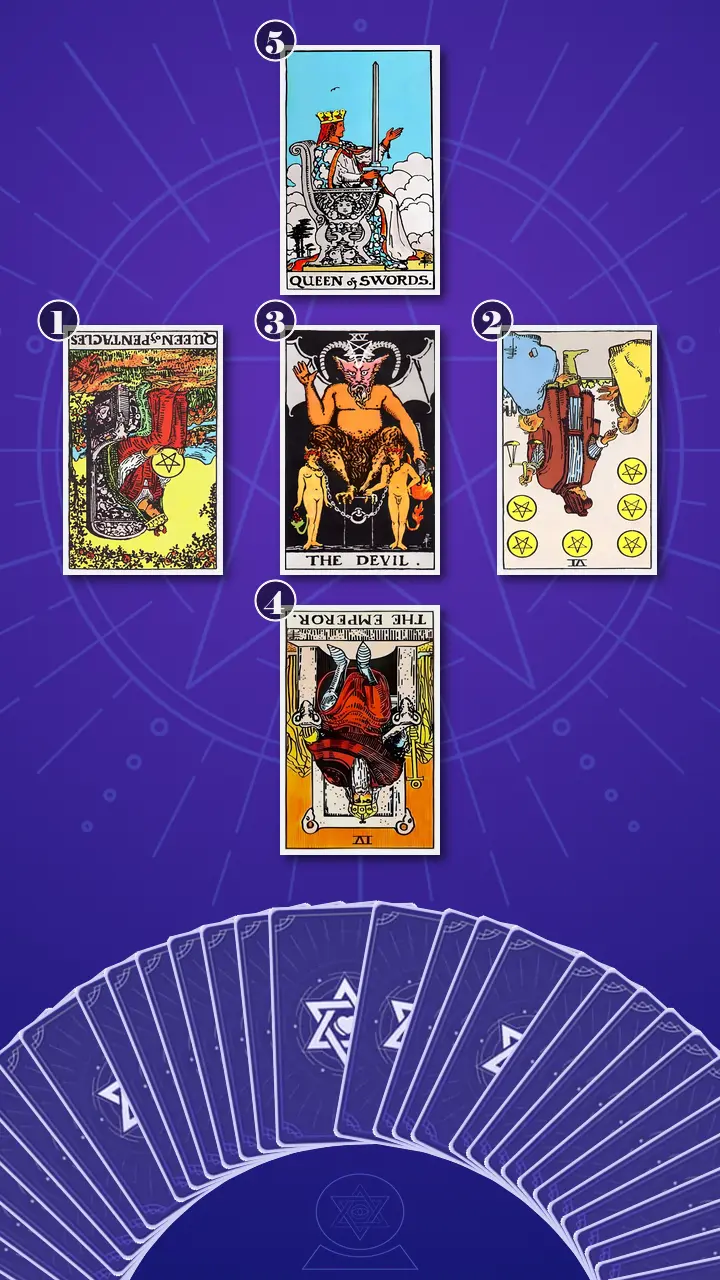
I chose a five-card Relationship Spread. Its cross-shaped layout examines the self, the other person’s observable participation, the shared dynamic, the underlying foundation, and the direction that could make the relationship more conscious.
For anyone wondering how tarot works in a friendship-boundary reading, this spread is useful because it does not pretend to expose another person’s private thoughts. It shows a feedback system. Jordan’s behavior could be examined beside what her friends visibly did in response, while the central and vertical cards could reveal why the pattern felt compulsory and where her agency remained.
I placed the shared relationship field at the center, Jordan’s contribution to the left, and her friends’ participation to the right, like scales mounted on an axis. Beneath the center would sit the rule supporting the parent role. Above it would be the integrating direction: a way to preserve care while returning decisions, logistics, and consequences to the adults who owned them.
Reading the Feedback Loop
Position 1: The Problem Already in Her Lap
I began with the card representing Jordan’s current contribution to the lock-in: the anticipatory problem-solving and self-neglect that established her as the parent friend. I turned over the Queen of Pentacles, reversed.
The Queen held her pentacle close, but reversed, care and possession became difficult to distinguish. I brought Jordan back to 10:47 p.m.: the warm laptop, the cold dinner, the rental tabs, and the thought she had described almost word for word: “They only mentioned the problem, but I can already see everything that could go wrong, so I may as well handle it.”
This was Earth energy in overextension. Jordan’s practical competence was abundant, but it moved so quickly that consent, capacity, and reciprocity were blocked from entering the exchange. A friend’s discomfort became a project in Jordan’s lap while her food, sleep, work, and requests for support slipped outside the frame.
“Care is not the same as taking custody of the outcome,” I said. “The question in this position is not whether you should care less. It’s what personal need gets postponed each time you move from concern to ownership.”
Jordan gave a short laugh with a bitter edge. “That’s so accurate it’s a little brutal.” Her thumb rubbed the seam of her sleeve, then stopped. “Last week it was dinner. Before that, I skipped the gym to mediate an argument nobody asked me to join.”
“Your generosity isn’t a defect,” I said. “We’re looking at the moment a genuine strength becomes automatic. That moment is where choice can return.”
Position 3: The Unread Message That Felt Like a Chain
I turned next to the center, the position representing the shared relationship field and the implicit bargain linking usefulness with belonging. The card was The Devil, upright.
I watched Jordan’s eyes settle on the loose collars around the two figures. In her life, that loose chain was a non-urgent message she was technically free to answer in the morning. Her phone could remain face down, yet her shoulders rose and her mind began drafting solutions because delay felt capable of damaging the friendship.
The Devil showed attachment energy in excess: not proof that her friends were harmful, and not a prediction that she was trapped, but a repeated bargain that had started to feel compulsory. Its terms were simple and costly: “I manage the problem, and you confirm that I am needed.” The chain was loose, but the fear of distance made it feel locked.
After fifteen years as a perfumer, I often understand relationship boundaries through what I call Boundary Permeability Diagnosis. When scent strips touch, materials transfer; without enough clean space between them, it becomes difficult to tell which note began where. I use the same questions here: Whose urgency entered the room? Who owned it before contact? At what moment did Jordan begin breathing it as though it were hers?
“This isn’t about declaring your friends too much,” I told her. “It’s about noticing when someone else’s distress bleeds into your psychological space and your body converts it into an assignment. You can be present with the feeling without absorbing custody of the problem.”
Jordan’s breathing paused. Her gaze drifted to her phone, still face down beside her. “I know this isn’t mine to fix,” she said quietly, “but if I leave it alone, what does that say about me as a friend?”
“It says you’re allowing another adult to remain an adult,” I replied. “Chosen support can be intimate. Compulsory usefulness cannot create real reciprocity because nobody gets to negotiate it.”
Position 2: The Group Chat Trained to Wait
I crossed to the card representing the friends’ side of the recurring pattern: the observable ways other people deferred, received, or participated after Jordan assumed responsibility. I turned over the Six of Pentacles, reversed.
The reversed scales recalled another scene Jordan had described. Someone posted, “We should do dinner soon.” Jordan supplied three dates, opened OpenTable, checked dietary needs, booked the restaurant, and sent the final reminder. Everyone else responded with thumbs-up reactions while she resented being the organizer.
The card showed reciprocity blocked rather than absent. It did not establish that every friend was exploitative. It showed an exchange trained around Jordan distributing structure from above while other people waited for the next prompt. The pattern worked like an algorithm: every time Jordan rescued the plan, the group learned to recommend more responsibility to her.
“Every rescue teaches the group who is expected to move first,” I said. “You resent that they wait, but you also step in before they have to move. What have they had a genuine chance to own without reminders?”
Jordan opened her mouth, closed it, then leaned back. Irritation crossed her face before recognition softened it. “Not much,” she admitted. “I tell myself I’m saving time. Then I use the fact that they didn’t help as proof that they never would.”
That distinction mattered. She was not accepting all the blame; she was noticing the lever within her reach. Returning one task would give her information that taking over could never provide.
The Armor Under the Helpful Plan
Position 4: When Responsibility Became Command
I turned the card beneath the center, representing the underlying challenge: the rule that a responsible person must prevent mistakes and maintain order for other adults. The Emperor appeared reversed.
Jordan recognized it in what happened after a friend ignored her advice. She would write a more detailed plan, monitor whether each step had been followed, and treat the friend’s consequences as evidence that she should have controlled the situation more closely. Her agency dashboard had quietly expanded until another adult’s life looked like one more project she was expected to deliver.
The Emperor’s structural energy was distorted in two directions: too much authority over other people’s outcomes and too little authority over Jordan’s own time. The correction was neither passivity nor disappearance. It was self-directed structure: “I can state what I have room for without writing their next steps.”
I thought of formulas I had overcorrected early in my perfumery career, chasing every rough edge until the fragrance became technically orderly and emotionally flat. Some materials need proportion and air, not another drop added in panic. Jordan’s friendships needed the same distinction. Structure could define her capacity without controlling someone else’s response.
She released a long breath and lowered both feet firmly to the floor. “So I could say, ‘I can listen for fifteen minutes, but I can’t manage messages tonight,’ and stop there? No checklist for what they should do next?”
“Exactly,” I said. “A first-person limit ends at your boundary. An instruction crosses into theirs.”
When the Queen of Swords Cleared the Air
Position 5: The Boundary With an Open Hand
As I reached for the final card, the radiator clicked off and the room became unusually still. Rain slid down the window in clean vertical lines. I turned the card representing the integrating direction: the Queen of Swords, upright.
Her sword stood vertical, giving the limit a precise edge. Her other hand remained open toward the horizon. I read the two gestures together: “I care about what is happening. I can listen for fifteen minutes tonight, but I cannot make this decision or handle the follow-up for you.” The boundary ended the assignment without ending the contact.
This was balanced Air: direct language, independent judgment, and compassionate discernment. In my Boundary Permeability Diagnosis, the goal is not to seal a person behind glass. It is to restore enough clean air for each note to remain distinct. The Queen’s sword marked where Jordan’s time and responsibility ended; her open hand kept warmth in the composition. A boundary changed the document permissions. It did not delete the shared file.
Jordan was still caught in the old binary: remain indispensable or become cold. I could see her testing every possible limit for evidence of abandonment, as though a fifteen-minute endpoint could deliver a verdict on years of friendship.
You do not have to earn friendship by managing everyone; name your limit, preserve your care, and let the Queen's upright sword separate support from control.
I let the sentence rest in the room before giving her the deeper principle beneath it.
Reciprocity starts when usefulness stops being the admission price for belonging: care can stay, while ownership goes back to the person whose life it is.
Jordan’s inhale stopped halfway. Her fingers hovered above the card, and her pupils widened before her gaze slipped toward the rain-striped window, as though old conversations were replaying there. Then her mouth tightened. “But doesn’t that mean I made this happen? That I’ve been the problem?” The anger in her voice was brief and bright; underneath it, I heard grief. “It means you have influence, not sole authorship,” I told her. “You learned one part of a two-person pattern, and influence gives you a place to begin. This is not a verdict.” Her fist loosened against her knee. Her shoulders lowered by degrees, and a shaky breath left her, almost a laugh. Her eyes reddened, but she did not look away. For a moment, the clarity seemed to leave her slightly unsteady: if the role was not compulsory, she now had to choose what she would and would not carry.
I leaned toward the card. “Now, with this new perspective, think back: was there a moment last week when this insight could have made you feel different?”
She thought of a late voice note about a landlord deadline. “I could have said I was sorry she was dealing with it and asked whether she wanted listening or ideas. I didn’t have to spend my lunch writing the recovery plan.” Her voice remained tentative, but her jaw had released.
I named the crossing I had just witnessed: this was movement from compulsory usefulness and control toward clear, bounded care within reciprocal adult friendship. It was not certainty, and it did not remove the guilt overnight. It was the first moment Jordan could imagine discomfort without treating it as an order.
Before we moved on, I set a seven-minute timer and asked her to choose one non-urgent message she felt compelled to solve. She drafted three lines: acknowledge the feeling, ask, “Do you want listening, ideas, or practical help?”, and name one limited offer she could genuinely make. I told her she did not have to send it. One sentence was enough, and she could stop if the exercise became uncomfortable. An immediate safety emergency would call for appropriate local support, not this pause.
Returning Responsibility Without Closing the Door
Viewed together, the five-card Relationship Spread told a coherent story. A learned rule had linked responsibility with control. The reversed Queen of Pentacles turned concern into practical ownership; the reversed Six showed how other people participated less once Jordan moved first. The Devil exposed the hidden contract binding usefulness to belonging. The Emperor revealed why more instructions felt safer than uncertainty. The Queen of Swords offered the unused resource: authority over Jordan’s own participation, expressed in language that stayed clear without becoming cold.
Jordan’s cognitive blind spot was speed. She had treated her ability to anticipate a need as proof that she was responsible for meeting it. By acting before friends had space to respond, she could not discover who might contribute, who might respect a limit, or which relationships relied too heavily on her labor.
The transformation was practical: pause before helping, confirm what was requested, make one bounded offer, and leave the decision and consequences with the person whose life they belonged to. Tarot could not make those choices for Jordan or certify how every friend would respond. It could make the feedback loop visible enough for her to run a different experiment.
The Space Calibration Ritual
I translated the reading into what I call the Space Calibration Ritual. In perfumery, blank air prevents one material from contaminating the next assessment. In friendship, small digital and physical gaps can stop another person’s urgency from becoming automatic labor before Jordan has checked her capacity.
- Create a twenty-minute air gap.For one non-urgent message this week, place the phone face down, use Focus mode, and wait twenty minutes. Write one sentence naming what was explicitly requested, then ask, “Do you want listening, ideas, or practical help?”If twenty minutes feels inaccessible, begin with two. Do not use the pause for an immediate safety emergency.
- Use the open-hand boundary.Save this reply in the Notes app and use it with one friend when capacity is low: “I hear that this is a lot. I can listen for fifteen minutes. I cannot take on the planning tonight.” Stop before adding instructions.The minimum version is one honest sentence. Warmth can remain even when the offer has an endpoint.
- Run the no-reminder reciprocity test.For one low-stakes group plan, post the times you are available, ask a named friend to own the booking and confirmation, then mute the chat for one hour without sending a reminder.Use an ordinary dinner or coffee plan, not housing, safety, or high-impact travel. The goal is information, not a secret test of loyalty.
I reminded Jordan that reciprocity was not identical scorekeeping. Different friends might contribute in different ways. The useful question was whether responsibility could circulate once she stopped picking up every unassigned ticket.

A Week Later, One Less Tab Open
Six days later, Jordan sent me a short message. A friend had texted that the move was becoming overwhelming. Jordan waited, asked the support-menu question, and learned that her friend wanted ten minutes of company, not a housing strategy. Jordan listened, named her endpoint, and returned to dinner without opening a single rental tab. The next morning, her friend sent two listings she had found herself.
Jordan slept through the night. Her first thought in the morning was, “What if she thinks I’m selfish?” Then she noticed the thought, smiled once, and made coffee before checking the chat.
That was the quiet proof of her Journey to Clarity. The cards had not rescued the friendship or enforced the boundary. Jordan had used them as a mirror, noticed the old contract, and made one different choice while the guilt was still present.
When a friend’s problem lands in your phone and your shoulders rise before you have even replied, it can feel as though the only way to keep the connection is to become useful enough that nobody has a reason to leave. But noticing that pressure is already a small clearing in the air.
If care did not have to become management the next time a typing bubble appears, what small, honest limit could you name with the Queen’s sword while keeping your other hand open?
This story is adapted from psychological research, written so that those in a similar struggle can see their own pattern in it — and find their next step clearly.These insights are not a substitute for professional psychological, medical, legal, or financial advice.
Learn more about our Journey to Clarity.
How did this insight land for you?
🫂 This Resonates Deeply
🌀 Living This Story
✨ Now I See Clearly
🌱 Seeing New Possibilities
🧰 Useful Framework
🔮 The Confirmation I Needed
💪 Feeling Empowered
🚀 Ready for My Next Step
Author Profile
 AI
AI“As a perfumer for fifteen years, I’ve learned to perceive human boundaries through the delicate metaphor of scent. Relationships need the right amount of space to breathe, and I've seen too many kind souls exhaust themselves trying to please everyone. I’m here with warmth and understanding—not to teach you to be guarded, but to help you gently clear the air and rediscover the comforting, safe boundaries that are rightfully yours.”
In this Friendship Tarot Reading :
Core Expertise
- Boundary Permeability Diagnosis: Identifying friends whose lack of limits is metaphorically 'bleeding into your space' and causing emotional suffocation.
- Vibe Contamination Auditing: Recognizing when a highly sensitive or negative friend is unconsciously polluting your personal psychological atmosphere.
Service Features
- The Space Calibration Ritual: A behavioral directive to implement specific 'digital and physical blank spaces', preventing enmeshment and restoring breathable boundaries.
Also specializes in :
Explore Related Patterns:
Control CopingWhen a friend ignores Jordan's advice, she writes a more detailed plan, monitors each step, and interprets the consequences as evidence that she should have controlled the situation more closely. Her anticipation of what could go wrong is converted directly into authority over what another adult should do. This strategy turns uncertainty into logistics. Planning and monitoring create temporary predictability, but they also direct your agency outward: you gain more control over someone else's next steps while losing authority over your own time, energy, and participation. Control Coping sits beneath the parent role because fixing is being used to regulate the discomfort of not knowing what another person will choose. The workable shift is not passivity; it is directing structure toward your own capacity while allowing other adults' decisions and consequences to remain outside your control.
Emotional Hyper-ResponsibilityEvery new notification raises Jordan's shoulders and starts her mind drafting solutions before she has asked what the sender needs. When a friend experiences consequences after ignoring advice, Jordan reads the outcome as evidence that she should have intervened more forcefully. Another person's discomfort is therefore not only witnessed; it is personalized as your responsibility. The body registers urgency, the mind begins planning, and the distinction between caring about an outcome and owning that outcome becomes blurred before conscious consent can occur. Emotional Hyper-Responsibility explains why the parent role can feel compulsory even when nobody explicitly assigns it. The relevant point of change is the moment distress becomes an internal order: you can recognize the feeling, check the actual request, and return responsibility without denying the relationship.
Friendship OverfunctioningAt 10:47 p.m., Jordan has six rental tabs open and a new spreadsheet underway even though her friend only said that moving felt overwhelming. The same sequence appears around dinner plans and late-night venting: a loose expression of need becomes a project before anyone has agreed on what help is wanted. Your practical competence can become a defense against relational uncertainty when acting feels safer than asking. By supplying the structure immediately, you gain short-term order and a clear role, but consent, capacity, and other people's participation are prevented from entering the exchange. Friendship Overfunctioning explains the parent-role lock because each takeover establishes you as the expected first mover. The pattern is not evidence that caring is defective; it identifies the point where freely chosen care becomes automatic responsibility and where a pause can restore choice.
People-Pleasing Resentment CycleJordan books the restaurant, handles the reminders, and then resents being the organizer. She says she is tired of being the responsible one, yet the moment she anticipates a problem, she moves back into the same role. The contradiction is sustained by a hidden relational transaction. You provide more labor than you freely chose because usefulness appears to protect connection; resentment then records the cost of an agreement that was never explicitly made, while guilt makes withdrawing that labor feel dangerous. The People-Pleasing Resentment Cycle explains why anger does not automatically produce a boundary. Resentment can reveal that care has crossed into compulsory performance, but the cycle changes only when support is negotiated before you act rather than silently offered and silently counted.
Self-Fulfilling ProphecyWhen someone suggests dinner, Jordan immediately supplies dates, checks dietary needs, books the restaurant, and sends the reminder. Everyone else's thumbs-up responses then become visible evidence that she is the only person prepared to organize. The interpretation overlooks how the takeover changed the conditions of the interaction. If you move before anyone else has a genuine task to own, their passivity cannot reliably prove that they were incapable or unwilling; your protective behavior has helped produce the outcome you feared. A Self-Fulfilling Prophecy locks the parent role into the friendship's feedback system. Returning one named, low-stakes task is psychologically useful because it creates information that rescuing cannot provide: you get to observe what others actually do when your intervention no longer decides the result in advance.
Usefulness-Based Self-WorthJordan looks at a nonurgent message she could answer in the morning and immediately wonders what leaving the problem alone would say about her as a friend. The story makes the hidden bargain explicit: she manages the problem, and the friendship confirms that she is needed. When usefulness becomes evidence of belonging, another person's distress carries more than a request for support. It becomes an opportunity to secure your relational value, while a limit can feel like proof that you are selfish, dispensable, or insufficiently caring. Usefulness-Based Self-Worth clarifies why insight alone does not dissolve the role. You may understand that the task is not yours and still feel compelled to take it because the deeper issue is not the spreadsheet; it is the learned equation between being needed and being worthy of connection.
Black-and-White ThinkingJordan tests every possible limit against two extreme identities: remain indispensable or become cold. Even a fifteen-minute endpoint feels capable of delivering a verdict on years of friendship, and after maintaining it successfully, her first thought is still that her friend might see her as selfish. This binary filter removes the broad middle ground between total management and emotional withdrawal. When you treat a single boundary as evidence of your entire moral value as a friend, a modest limit carries the psychological weight of abandonment rather than the practical meaning of capacity. Black-and-White Thinking helps explain why the parent role feels safer than a negotiated friendship. The ten-minute conversation provides corrective evidence: warmth, a clear endpoint, and independent action can coexist, even while the old either-or thought remains present.
Self-AbandonmentJordan's dinner congeals beside the keyboard while her own unanswered messages sit beneath an unsolicited rental spreadsheet. On other occasions, she skips the gym to mediate an argument and gives up her lunch to write a recovery plan that nobody requested. Her needs are not simply forgotten at random; they are repeatedly moved outside the frame when another person's discomfort appears. You may preserve the identity of the capable friend by treating your food, rest, plans, and requests for support as more negotiable than everyone else's urgency. Self-Abandonment names the personal cost hidden beneath the parent role. Reintroducing your own capacity before offering help is not selfish scorekeeping; it prevents care from requiring your routine disappearance from the relationship.
Boundary DiscernmentSix days later, Jordan asks whether her friend wants listening, ideas, or practical help. She provides ten minutes of company, names her endpoint, returns to dinner, and leaves every rental tab closed while her friend later finds two listings independently. That sequence separates emotional presence from practical custody. You can acknowledge distress, clarify the request, and choose a limited offer without treating another adult's problem as either your assignment or something you must coldly ignore. Boundary Discernment is the emerging alternative to the parent role because it preserves connection while restoring ownership. The guilt may remain temporarily, but it no longer has to function as an instruction; the boundary creates real information about what each person can contribute.
Explore Related Struggles:
Boundary CollapseA friend's overwhelmed message reaches Jordan's phone, and her body responds before any support has been negotiated: her shoulders rise, her jaw locks, and the problem begins occupying her attention as an assignment. Meanwhile, her dinner, sleep, exercise, unanswered messages, and requests for support are pushed outside the frame. Boundary Collapse describes the point where another person's difficulty no longer remains beside you and instead takes over your available space. You are not choosing between caring and becoming cold; the actual struggle is preserving enough separation to check what was requested, what you can offer, and who retains ownership of the decision. That separation gives care a boundary without requiring the connection to close.
Caretaker Role LockJordan hears that moving feels overwhelming and, before asking what support is wanted, opens six rental tabs and builds a spreadsheet. She repeats the same move with dinners, arguments, and late-night messages, so the friendship position she wants and the management position she takes keep competing within the same exchange. When you recognize care becoming automatic custody, Caretaker Role Lock names the bind: stepping back can feel like failing the relationship, while stepping in keeps you from participating as an equal friend. The point of leverage is the moment before responsibility changes hands, when you can offer support without silently accepting ownership of the entire outcome.
Competence-Obligation FusionJordan can see missing details, predict practical complications, and produce a plan before her friends have decided what they want. When someone ignores her advice and encounters a consequence, she responds by making the next plan more detailed, as though better foresight should have given her greater control. Competence-Obligation Fusion takes hold when the ability to help is silently converted into a requirement to help. You may then experience every noticed risk as an assigned responsibility, leaving little room to distinguish what you can do from what you have actually agreed to carry. Reclaiming that distinction allows competence to remain a resource instead of functioning as an unlimited claim on your time.
Control-Reciprocity LockWhen someone suggests dinner, Jordan supplies the dates, checks dietary needs, makes the booking, and sends the reminder while everyone else responds with a thumbs-up. The plan succeeds, but the success conceals a cost: nobody else has to move, and Jordan later reads their inactivity as proof that the entire plan always depended on her. Control-Reciprocity Lock is the closed loop created when taking charge prevents other people from showing initiative, then their reduced initiative makes taking charge seem even more necessary. You cannot obtain reliable information about who will participate while completing every unclaimed task in advance. Returning one bounded responsibility interrupts the loop and allows reciprocity to become observable rather than assumed either present or absent.
Utility-Belonging FusionA non-urgent message can remain unanswered until morning, yet Jordan's shoulders rise and her mind begins drafting solutions because delay seems capable of damaging the friendship. The practical task and the relationship become fused: managing the problem offers immediate evidence that she is still needed. You can become locked into a parent role when usefulness starts carrying the weight of belonging. Utility-Belonging Fusion describes the visible tug between wanting mutual friendship and relying on service to secure your place within it. Separating those two things does not require withdrawing care; it creates room to learn whether the connection can remain intact when your contribution is chosen, limited, and negotiated.
Self-Erasure ReliabilityJordan works through rental listings while her dinner congeals, leaves her own messages unanswered, and later recalls skipping the gym to mediate an argument she was never asked to join. Her dependability stays highly visible to other people, while the ordinary needs that would make her a participant rather than a service provider repeatedly disappear from view. Self-Erasure Reliability names the structure in which being consistently available is maintained by making your own limits, plans, and support needs negotiable first. The role can appear generous and functional from the outside even as it leaves you with progressively less authority over your time. Making one personal need visible is not a withdrawal of care; it tests whether reliability can exist without requiring you to remove yourself from the relationship.
Explore Related Emotions:
Boundary GuiltJordan asks, “If I leave it alone, what does that say about me as a friend?” Even after a limited response works, her first morning thought is that her friend may see her as selfish. The anticipated moral verdict turns an ordinary limit into evidence that she has failed someone. Boundary Guilt makes your available capacity feel less important than another person's possible disappointment. The guilt can remain present without proving that the limit is wrong; Jordan's successful experiment shows that you can treat it as information from an old association rather than an instruction to resume managing.
Mutuality HungerJordan says plainly that she wants reciprocal friendship and wants to be a friend rather than everyone's emergency contact. Her complaint is not that people have needs; it is that planning, prompting, and responsibility keep flowing through her while she waits to be met as an equal. Mutuality Hunger is the longing for care to circulate rather than continually travel in one direction. For you, recognising that hunger can clarify why overfunctioning eventually feels so painful: the labour may create usefulness, but it cannot by itself create the shared participation you actually want.
Usefulness-Based Belonging FearA non-urgent message sits face down beside Jordan, yet her shoulders rise and her mind begins drafting solutions because waiting feels capable of damaging the friendship. Every time a friend's discomfort becomes a project before support has been negotiated, usefulness starts functioning as proof of her place in the relationship. When this pattern is yours, the underlying fear is not simply that a problem will go unsolved. It is that being less useful could make you less necessary and therefore less secure in the connection. Naming that bargain gives you a way to separate genuine care from the work of continually earning your place.
Cautious Self-TrustSix days later, Jordan waits, asks what kind of support her friend wants, listens for ten minutes, and returns to dinner without opening a rental tab. The next morning, the thought that she may seem selfish still appears, but she makes coffee before checking the chat. Her behaviour is no longer waiting for complete internal certainty. Cautious Self-Trust grows when you can hear an old warning without automatically organising your life around it. The trust is tentative because one successful boundary cannot answer for every friendship, yet Jordan now has direct evidence that she can remain caring, tolerate discomfort, and choose within her actual capacity.
Resentful ExhaustionAt 10:47 p.m., Jordan has six rental tabs open, congealed takeout beside her, and her own messages unanswered beneath a spreadsheet nobody requested. In the group chat, she supplies every date, booking, dietary check, and reminder, then watches everyone else respond with thumbs-up reactions. Her effort keeps the friendship machinery running while steadily removing her from her own evening. Resentful Exhaustion forms when you continue giving after your capacity has already been overdrawn and then feel the unfairness of being the only person in motion. The resentment is useful data: it points to an offer that exceeded consent or capacity, not to a defect in your ability to care.
Agency ReliefJordan's fist loosens and her shoulders lower when influence is separated from sole authorship. She can acknowledge her participation in the feedback loop without accepting total blame for a pattern involving more than one adult. That distinction gives her a practical place to begin. Agency Relief arrives when you no longer have to choose between helplessness and complete responsibility. You can alter your offer, timing, and limits while leaving the other person's choices intact. The relief comes from recovering a proportionate sphere of action rather than controlling the entire relationship.
Control FatigueAfter a friend ignores her advice, Jordan responds by writing a more detailed plan and monitoring whether each step is followed. Her attempt to prevent one mistake expands another adult's life across her agency dashboard, while authority over her own dinner, sleep, and time recedes. Control Fatigue is the drained feeling produced when you keep trying to manufacture certainty through more instructions and closer supervision. The reading locates a narrower form of control that belongs to you: deciding what you can offer, stating it clearly, and allowing the other person to own the response and consequences.
Identity GriefWhen Jordan hears that the parent role is not compulsory, her pupils widen, old conversations seem to replay, and her eyes redden without turning away. The insight does more than change a behaviour; it unsettles the identity of the responsible friend who always knows what to do. Identity Grief can surface when you release a role that has been costly but has also made your value feel legible. Grieving that familiar version of yourself does not require returning to it. It allows you to acknowledge what the role provided while choosing a less burdensome way to belong.
Explore Related Contexts:
Emotional Labor ImbalanceJordan moves from catching missing details throughout her workday to managing late-night venting, housing concerns, and friendship conflicts, while her own unanswered messages remain beneath someone else's spreadsheet. Dinner, sleep, gym time, and requests for support are repeatedly displaced by listening, anticipation, coordination, and follow-up. That distribution makes care a form of one-way relational labor rather than a resource that can circulate. You are encountering an emotional labor imbalance when your role depends on tracking everyone else's needs while the network has little established practice of noticing or carrying yours; making the labor visible allows reciprocity to be evaluated through participation rather than assumed from affection alone.
Fixer Friend DynamicAt 10:47 p.m., Jordan has six rental-listing tabs open and a new spreadsheet underway even though her friend only said that moving felt overwhelming. Her competence converts an unstructured disclosure into a project before the friend has requested practical intervention, while Jordan's own messages and dinner remain unattended. Each early rescue gives the friendship network a reason to wait for Jordan's next plan, gradually making the fixer position part of how the group functions. You can become locked into the same role when noticing a solvable problem repeatedly grants you ownership by default; pausing before taking action reveals whether support was requested and whether responsibility can move back to the person whose life it concerns.
Friendship Reciprocity GapJordan completes plans before friends have a genuine opportunity to take a step, while her own messages and requests for support remain unanswered beneath their tasks. In the group chat, others contribute thumbs-up reactions only after she has supplied dates, reservations, dietary checks, and reminders. The resulting gap is not established by a single imperfect exchange; it is produced by a repeated allocation in which initiative and maintenance stay concentrated with Jordan. You cannot see the network's actual capacity for reciprocity while every opening is filled in advance, so leaving one task unclaimed becomes a way to observe who contributes, who respects a limit, and which relationships depend disproportionately on your labor.
Emergency Contact Boundary PressureA non-urgent message reaches Jordan late at night, and the response expands into rental research before listening, ideas, or practical help have been distinguished. A later landlord voice note similarly occupies her lunch with a recovery plan, prompting her to say that she wants to be a friend rather than everyone's emergency contact. Without agreed response windows or support terms, ordinary distress can enter through the same channel as an urgent assignment. You face emergency contact boundary pressure when access to your attention remains functionally open across meals, work breaks, and bedtime; clarifying urgency and scope before participating restores a difference between being reachable and being responsible.
Care Work SpilloverJordan spends her paid workday catching missing details at a Toronto agency and then performs similar coordination for friends at night without a defined endpoint. The same labor occupies her lunch during a landlord problem and displaces dinner, sleep, exercise, and personal communication after work. Practical competence has become portable infrastructure that follows her across the boundary between employment and friendship. You encounter care work spillover when personal relationships repeatedly recruit the same planning and monitoring function that already consumes your workday; defining the size and timing of an offer protects friendship from becoming an unpaid second shift.
Friendship Role RenegotiationJordan drafts a response that acknowledges her friend's difficulty, asks what kind of support is wanted, and names one limited offer without adding a checklist. Six days later, she uses that structure during another moving conversation, listens for the requested ten minutes, and returns to dinner while her friend retains responsibility for the housing search. The social role is being renegotiated through changed participation rather than a declaration about anyone's character. You are in a friendship role renegotiation when care remains present but planning rights, follow-up labor, and consequences are redistributed between adults; each bounded exchange tests whether the connection can continue without requiring you to occupy the parent position.