Finding Clarity in the 9:18 p.m. Kitchen
“You’re a late-20s NYC professional who can design a whole user flow at work,” I said, watching her face for that tiny flinch of recognition, “but one rent-related email can trigger full-on money anxiety and a Chase-app refresh spiral.”
Maya didn’t smile. She did that thing people do when they’re trying not to cry and also trying not to be dramatic about it—she pressed her tongue to the back of her teeth, like she was holding a door closed.
She told me about Sunday at 9:18 p.m., in her tiny kitchen, under an overhead light that felt a little too bright for the hour. She’d been helping her parents sort old boxes. A cracked banker’s box. Dust and cardboard smell. She unfolded a paper that looked like it had been handled a hundred times—an old eviction notice. Official font. A date that didn’t belong to her current life.
“My stomach just… dropped,” she said. “And then my thumb opened my banking app. Like autopilot.”
She described the sequence with the precision of someone who’s done it enough times to hate it: bank app, refresh; notes app, rework categories; bank app again, because the first check didn’t land. The numbers didn’t change. Her body did. Tight chest. Jaw locked. A clenched stomach that made spending—groceries, a dentist appointment, even replacing shoes—feel like breaking a rule.
“I can be fine all week and one piece of paper can ruin my nervous system,” she said, and her voice went sharp on the last word, like she was mad at it for being true.
In my world—ten years guiding people through a Tokyo planetarium—panic looks like when someone sees a meteor shower forecast and suddenly believes the sky is going to fall tonight. But the sky isn’t falling. It’s just a reminder that it could.
“What you’re describing isn’t a math problem,” I told her, gently and plainly. “It’s a safety alarm. And we’re going to treat it like one. Let’s try to find clarity—not by forcing yourself to ‘get over it,’ but by mapping what actually happens in you when that alarm goes off.”
Choosing the Compass: The Four-Layer Insight Ladder
I asked Maya to take one slow breath in through her nose and exhale like she was fogging a mirror—just enough to shift her nervous system from “incident response” into “I’m here.” Then I began to shuffle.
I don’t treat tarot like a spooky performance. For me, the shuffling is a focusing device—like dimming the planetarium lights so your eyes can finally catch the faint stars.
“Today,” I said, “we’ll use a spread I designed for moments exactly like this: the Four-Layer Insight Ladder · Context Edition.”
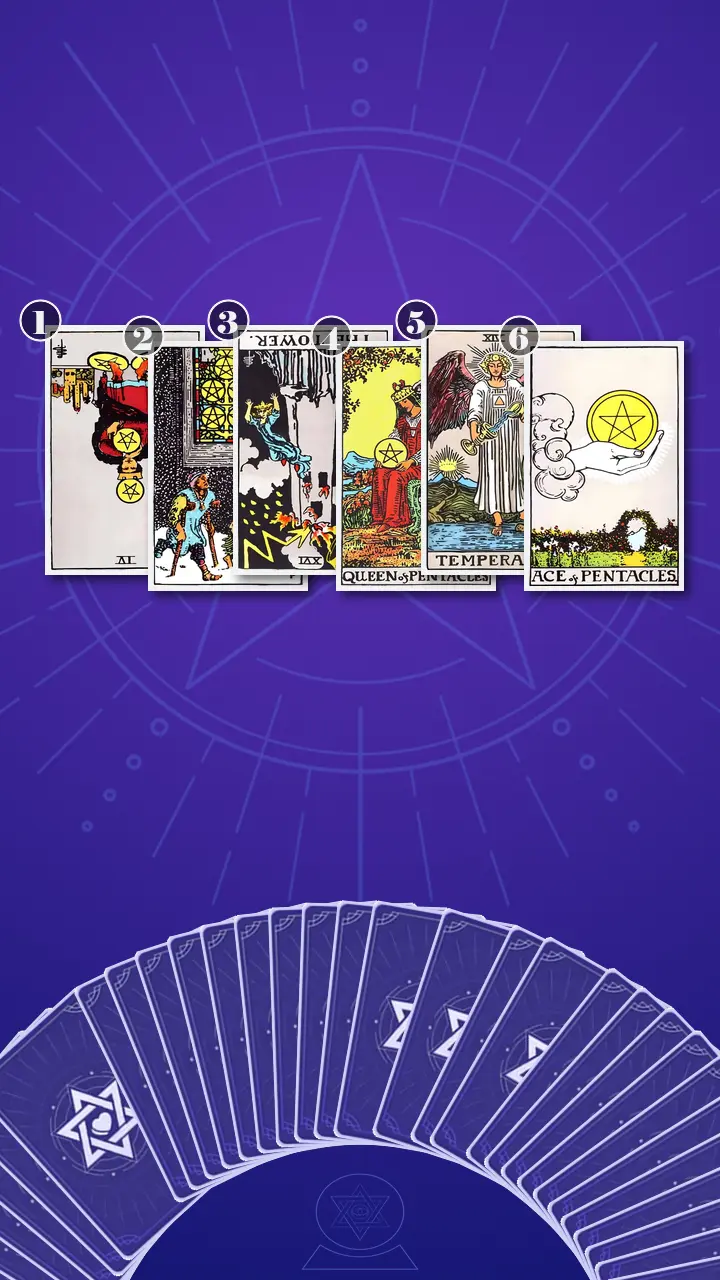
For readers who wonder how tarot works in a practical way: this spread keeps the card count minimal while still moving in a clean arc—present behavior → root memory → core fear → inner resource → key shift → actionable next step. A traditional timeline spread can miss the loop that anxiety runs (trigger → control ritual → short relief → long-term unsafety). And a full Celtic Cross would add noise when what we need is signal.
I told her what to expect. “The first card will show your money-anxiety ritual—what you do within ten minutes of a trigger. The middle cards go beneath the surface: the emotional memory and the belief your nervous system is trying to prevent. Then we’ll look at what support you already have, the shift that changes the whole dynamic, and one measurable step you can do this week.”
Reading the Map: From Grip to Memory
Position 1: The Visible Money-Anxiety Ritual
“Now flipping over,” I said, “is the card that represents the visible money-anxiety behavior pattern showing up right now—what you do after the trigger.”
Four of Pentacles, reversed.
In the Rider-Waite image, the figure clutches one coin to their chest, pins another to their crown, and traps two under their feet—like safety has to be held, locked, and stood on.
I didn’t over-mystify it. “This is lockdown mode,” I told her. “Right after the eviction notice, you check your balances twice, tighten three budget categories, cancel a plan you were actually looking forward to… and you still don’t feel safe. You feel temporarily in control.”
Reversed, this card reads like an energy that’s gone from balance to blockage. The instinct to be careful is valid—especially in New York. But the grip has gotten so tight it’s starting to backfire.
“Control can feel like safety, right up until it makes your life smaller,” I said. “And I’m hearing that ‘smaller’ part in you—fewer dinners, fewer comforts, fewer yeses—not because you chose it from your values, but because the fear is driving.”
Maya let out a short laugh that didn’t have any humor in it. “That’s… yeah. That’s actually kind of brutal.” Her fingers tightened around her mug, then loosened like she’d been caught holding her breath.
Position 2: The Emotional Memory the Notice Woke Up
“Now flipping over,” I said, “is the card that represents the emotional memory the eviction notice wakes up—the felt story underneath the facts.”
Five of Pentacles, upright.
This card always feels like weather. Snow. Hard sidewalk. Two figures outside a warm, lit window.
“The eviction notice isn’t just paper,” I told her. “It’s a portal.” I watched her eyes flick down to the card like she didn’t want to agree too fast. “Your adult brain reads the date and thinks, ‘That was then.’ But your body hears, ‘You could lose your place.’ And suddenly every rent-related notification, every landlord email, every housing headline feels personal—like you’re back outside looking in.”
Then I gave her the line that often unhooks shame from the story.
It’s not the number—it’s the memory.
Her throat moved like she swallowed something that wasn’t there. A quiet exhale. Not dramatic. Just… honest.
“I’m an adult now,” she said softly, almost like she was testing whether she was allowed to say it. “So why does my body feel twelve?”
“Because your nervous system learned its version of safety during a time when safety wasn’t guaranteed,” I said. “And it doesn’t update just because your spreadsheet says you’re fine.”
Position 3: The Core Fear That Keeps the Loop Running
“Now flipping over,” I said, “is the card that represents the core fear or belief that keeps the pattern running—what your nervous system thinks it must prevent.”
The Tower, reversed.
Even reversed, The Tower is the image of a lightning bolt and a crown knocked loose—stability feeling temporary, accidental, easy to lose.
“This is the hidden engine,” I said. “Not ‘I should budget better.’ Not ‘I need more financial literacy.’ It’s: the floor can drop. Any time.”
I let myself speak in a sharper systems language, because sometimes it’s the only thing that matches what people are living: “This is the emotional equivalent of being on-call for a crisis that hasn’t happened.”
And then, because she’s a New Yorker with a phone and a brain that doesn’t like silence, I painted the montage the card was already showing me—late-night spreadsheet tabs, doomscrolling layoffs headlines, re-running budgets at 1:13 a.m., rewriting the definition of “enough savings” so relief never arrives.
“Your brain calls it planning,” I said. “But your body calls it bracing.”
Planning is finite. Bracing is endless.
She nodded fast, like she wanted to interrupt but didn’t know how without admitting how specific it was. “I do this exact ritual,” she said. “I open Bloomberg, then r/personalfinance, then YNAB templates, then I’m like… why is it 2 a.m. and I’m still not calm?”
“Because the goal of bracing isn’t calm,” I said. “It’s preventing humiliation. Preventing the ‘I didn’t see it coming’ feeling. The Tower reversed is your system trying to stop lightning with vigilance.”
Position 4: The Resource You Already Have (That Isn’t Punishment)
“Now flipping over,” I said, “is the card that represents a supportive inner resource you already have for building real safety without punishment.”
Queen of Pentacles, upright.
She’s seated like someone who knows the difference between control and care. The pentacle isn’t clutched. It’s held like something you steward.
“There’s a version of you,” I said, “that already knows how to create steadiness. Not by restricting joy, but by tending basics. A bill calendar that lives outside your anxious brain. Groceries that actually feed you for two to three days. Rest that isn’t earned by suffering first.”
I saw Maya’s shoulders lift, then drop, like her body was negotiating with the idea.
“And I want to say this clearly,” I added, because the shame in money anxiety always tries to pretend it’s helpful: Your budget isn’t a morality test.
She blinked hard. “That’s… not how it feels.”
“I know,” I said. “That’s why this card matters. It’s the Provider energy—care without punishment.”
When Temperance Poured Between Two Cups
Position 5: The Integration Pivot (The Key Shift)
I paused before turning the next card. The city sounds outside my window—distant traffic, someone’s music leaking through a wall—felt like they turned down a notch, as if the room itself knew we were approaching the hinge point.
“Now flipping over,” I said, “is the card that represents the key psychological shift that transforms control into steadiness—how to integrate fear with reality.”
Temperance, upright.
In the image, an angel pours water between two cups with impossible calm. One foot is on land, one in water. A path leads toward a bright horizon—like progress that happens by repetition, not drama.
Setup. I named the exact moment she’d described: the subway ride where she checks the balance, then checks again because the first time didn’t “land,” and her jaw stays tight anyway. “That’s the loop,” I said. “You’re trying to make numbers do the job of safety.”
“Here’s what Temperance is offering,” I continued, keeping my voice steady. “You don’t become safe by gripping harder—you become safe by building a steady rhythm you can actually keep.”
Delivery.
Stop treating money like a lightning strike you must prevent, and start blending fear and facts like Temperance pouring between two cups—slow, steady, and repeatable.
I let that sentence sit between us. No extra explanation for a beat—just air.
Reinforcement. Maya’s body reacted in layers. First, a tiny freeze: her breath caught, her eyes held on the card like it might move. Second, the cognitive seep: her gaze unfocused for a second, like she was replaying the last week—rent email, bank app, notes app, bank app again. Third, the emotional release: she exhaled from low in her chest, shoulders softening, but her face tightened with a flash of irritation.
“But if I stop… checking,” she said, and her voice went up at the end like a question she didn’t want to ask, “isn’t that how people get blindsided?”
“That’s the Tower talking,” I said. “It thinks vigilance is the only barrier between you and collapse.”
In the planetarium, I teach people that stability isn’t created by tensing your hands around the universe. It’s created by predictable motion—an orbit you can trust. In my work, I call it Comet Cycle Prediction: not ‘will a comet hit us,’ but ‘when do the predictable pass-bys happen, and what do we do so they don’t hijack the whole sky?’
“Rent season is a predictable pass-by for you,” I told her. “So is finding family documents. Temperance says: we don’t pretend those triggers don’t exist. We build a rhythm around them so your nervous system stops living like lightning is scheduled.”
Then I offered her the practice exactly as a small experiment—because integration is built, not declared.
“Set a 7-minute timer. Open your banking app once. Write down three numbers only: (1) current checking balance, (2) next rent date + amount, (3) your ‘floor’ number (the minimum you want to keep in checking). Then close the app and put your phone face-down. If you feel your chest tighten, place one hand on your sternum and take three slower breaths. You’re allowed to stop early—this is a practice, not a test.”
Her eyes went wet, and she looked annoyed about it, which told me we’d hit something real. She put her palm lightly to her chest anyway, like she was trying on a new rule that wasn’t a rule.
“Now,” I asked, “use this new lens and look back at last week. Was there a moment—maybe on the train, maybe in bed at 11:42—where this could’ve changed how you felt by even five percent?”
Maya stared at the edge of the card, then nodded once. “Yeah,” she said. “There was a night I didn’t even need information. I needed… permission to unclench.”
“That’s the shift,” I said. “This isn’t just about a money decision. It’s your nervous system moving from scarcity-triggered hypervigilance and control-based budgeting toward grounded, values-based safety built through consistent routines.”
Position 6: The One Seed You Plant This Week
“Now flipping over,” I said, “is the card that represents one practical, measurable next step for this week that begins rebuilding trust through consistency.”
Ace of Pentacles, upright.
An open hand offers a coin. Not a lecture. Not a test. An offer.
“This is your ‘one seed’ card,” I said. “Not a full financial overhaul. Not a personality transplant. Just one tangible action you can repeat.”
And I watched Maya’s face change in a way I’ve seen a thousand times on starfield ceilings: the moment someone realizes the night sky isn’t judging them for not knowing every constellation. It’s just… there. Mappable. Learnable.
The One-Seed Money Practice: Next Steps That Don’t Require Midnight Spreadsheets
I pulled the whole ladder together for her in one clean story: the eviction notice reopened the Five of Pentacles memory of being outside the warm window. Her system responded with Four of Pentacles reversed lockdown—tightening, checking, canceling—because it believes grip equals safety. Underneath, The Tower reversed runs an internal “other shoe” countdown, turning planning into bracing. But she also has Queen of Pentacles competence—the ability to care for herself with systems that don’t punish. And Temperance is the bridge: integrate fear with facts through a repeatable rhythm.
The cognitive blind spot I named gently was this: she kept treating monitoring as the only form of safety. As if being safe had to be earned through constant checking. The transformation direction is different: consistent, values-based systems create safety—so the system holds the work, not her midnight vigilance.
Then I gave her a few “doable this week” steps. Not to fix her entire financial life—just to start retraining the alarm.
- The Sunday 20-Minute Check-In (finite planning)Pick one 20-minute window this week (for example, Sunday at 5:00 p.m.). Review only: bills due, next rent date + amount, and one small plan for the week. When the timer ends, you stop—even if you want to keep tweaking.Expect the urge to perfect it. Don’t. This is Temperance: a repeatable cadence, not a one-time performance.
- Range-First Budgeting (a middle path you can live with)Choose one category (like groceries). Set a weekly minimum and maximum instead of a rigid cap. Spend inside the range without doing a post-purchase balance check.If checking feels compulsive, write the urge in your notes app instead of acting on it: “I want to check because my body feels 12.” Then breathe for 30 seconds.
- A $10–$25 “Buffer” Auto-Transfer (the Ace of Pentacles seed)Set up (or confirm) one weekly auto-transfer—even a small amount—from checking to savings. Label it something calming like “buffer,” not “catch up.”This is proof-through-repetition. Missing a week doesn’t mean you’re back at zero; you just return to the orbit next pass.
Before we ended, I added one boundary that often matters as much as the numbers: “Outside your scheduled check-in,” I said, “you don’t negotiate with the banking app. If the urge spikes, you do the 7-minute numbers-only practice or you put your phone face-down and do something sensory—tea, face wash, two minutes outside. We’re teaching your body that ‘activated’ doesn’t equal ‘emergency.’”

A Week Later: Ownership, Not Certainty
A week later, Maya messaged me a photo—not of a spreadsheet, not of a perfect budget—just her phone calendar with a tiny recurring block: “Money check-in (20 min).” She said she did it in a café, alone, with headphones in. She felt weirdly proud, then a little sad, like she’d been working this hard for safety for a long time.
I told her the truth I’ve learned under planetarium domes: clarity isn’t a single bright answer. It’s a rhythm that makes the dark feel navigable.
When money anxiety hits, it’s not that you can’t do math—it’s that your body still acts like an eviction countdown is running, so every ‘normal’ purchase feels like the moment you could lose safety.
If you didn’t have to earn safety through constant checking, what’s one tiny, repeatable money rhythm you’d be willing to try this week—just as an experiment?
This story is adapted from psychological research, written so that those in a similar struggle can see their own pattern in it — and find their next step clearly.These insights are not a substitute for professional psychological, medical, legal, or financial advice.
Learn more about our Journey to Clarity.
How did this insight land for you?
🫂 This Resonates Deeply
🌀 Living This Story
✨ Now I See Clearly
🌱 Seeing New Possibilities
🧰 Useful Framework
🔮 The Confirmation I Needed
💪 Feeling Empowered
🚀 Ready for My Next Step
Author Profile
 AI
AI“After a decade of guiding people through the stars, I’ve come to see life much like the orbits of planets: everything has its inevitable cycles. When you feel lost, please don't blame yourself; you might just be in a natural low tide. I’m here to sit under the night sky with you, offering a gentle cosmic perspective to distinguish temporary pain from the beautiful breakthroughs just around the corner.”
In this Family Tarot Reading :
Core Expertise
Service Features
Also specializes in :
Explore Related Patterns:
Certainty SeekingThe second balance check happens because the first one does not land, not because the information was missing. Then the definition of enough savings moves again, and relief stays just out of reach. Certainty Seeking is the attempt to make uncertainty disappear before you allow yourself to feel safe. In this story, the mind wants a number, a plan, or one more confirmation strong enough to prevent the humiliation of being caught off guard. The problem is that no amount of checking can prove that life will never shift. This pattern keeps the anxiety running because it mistakes emotional certainty for practical preparedness. You may gather useful information, but the deeper demand is impossible: a guarantee that nothing destabilizing will ever happen again.
Compulsive CheckingThe old eviction notice in the 9:18 p.m. kitchen sends your thumb to the banking app before any conscious decision catches up. You check, rework categories, and check again because the first number does not land in your body, even though the balance has not changed. That ritual is not really about math. It is a short relief loop where monitoring gives the nervous system a hit of control, then teaches it that another check might finally make safety feel real. The more the app becomes the emergency exit, the more your body treats uncertainty as something that must be solved immediately. Compulsive Checking fits because the behavior is concrete, repeated, and self-reinforcing. The pattern is not that you are bad with money; it is that your alarm system has learned to outsource safety to a refresh button, and the button can never provide the emotional update you are asking for.
Control CopingAfter the notice, you do not only look at the numbers. You tighten categories, cancel something you wanted, and shrink the week until it feels more controllable. The move makes sense in the moment because restriction can feel like a handle when your body is flooded. Control Coping shows up when control becomes the substitute for safety. The budget, the categories, and the canceled plans are not just practical tools anymore; they become emotional defenses against the fear that the floor could drop. That is why the strategy gives temporary steadiness but also makes life smaller. The pattern is not carefulness itself. The issue is that fear has taken over the steering wheel, so every decision gets filtered through threat prevention rather than through values, needs, and realistic planning.
Emotional RegressionThe line about being an adult whose body feels twelve is the clearest clue in the story. Your current competence is still there, but the old eviction notice pulls a younger safety state into the room before your adult reasoning can fully orient. Emotional Regression does not mean you are immature. It means a present trigger has activated an earlier emotional template, so your body responds from the age at which safety felt unstable. That is why a spreadsheet can say one thing while your chest, stomach, and jaw seem to be living in another time. The pattern matters because shame often attaches to the mismatch. Once you can see it as a state shift rather than a character flaw, the work becomes more precise: help the younger alarm update to the adult facts, instead of trying to bully the body into getting over it.
HypervigilanceThe old notice has a date from another life, but your body reads it like a current alert. Rent emails, landlord messages, housing headlines, and finance feeds become signals to scan, as if one missed detail could be the start of losing safety. Hypervigilance is the pattern underneath that constant scanning. Your system is trying to prevent the shock of being blindsided, so it stays emotionally on call for a crisis that has not happened. The problem is that vigilance can gather information without creating safety, especially when the body keeps asking for proof that no future collapse is possible. In this story, planning has a clear endpoint, while bracing does not. The anxiety persists because the mind treats watchfulness as protection, even when the actual numbers are stable enough to stop checking for the night.
Scarcity MindsetGroceries, a dentist appointment, and replacing shoes start to feel like breaking a rule, even though they are ordinary forms of care. The anxiety turns normal spending into a moral risk, so fewer dinners, fewer comforts, and fewer yeses begin to look like responsibility. Scarcity Mindset fits because the story is not just about having limited resources. It is about the nervous system behaving as if any use of resources could trigger loss of safety. That belief makes even reasonable spending feel dangerous, and it quietly trains you to confuse deprivation with protection. The deeper mechanism is a safety equation built from an old housing alarm. If spending equals danger, then restriction feels virtuous, but the cost is that your current life gets organized around preventing a collapse that is not actually happening in the moment.
CatastrophizingA paper from the past becomes a present-tense prediction in your body. The old notice does not simply remind you that eviction happened around your family; it starts to imply that the same floor could drop again, any time. Catastrophizing appears in the way one cue expands into a whole future-collapse scenario. A rent email, a housing headline, or a normal purchase gets pulled into the same threat story, so the mind starts preparing for the worst possible outcome rather than checking what is actually true right now. The pattern is powerful because it masquerades as preparedness. Your brain calls it planning, but the emotional sequence is closer to bracing, where the imagined disaster becomes so vivid that present-day facts lose their calming power.
Family Pattern RecognitionThe eviction notice came from your parents' old box, not from your current landlord, and that distinction is the turning point. The paper belongs to family history, but your body reacts as if it has crossed into your present safety. Family Pattern Recognition is the upright movement of the story because it lets you name the inherited alarm without becoming trapped inside it. The trigger is no longer treated as proof that you are failing with money; it becomes evidence that your nervous system learned safety in a context where housing felt uncertain. That recognition creates separation. You can respect why the alarm exists while also asking whether the current facts require the same response, which is how clarity starts replacing shame.
Explore Related Struggles:
Monitoring-Safety FusionThe old eviction notice sends Maya straight into the Chase app: balance check, category rewrite, another check because the first one did not land. The numbers stay the same, but the checking starts carrying a job it cannot finish, as if repeated visibility could become felt safety. You can see the friction in the way planning keeps turning into bracing. A rent email, a landlord message, a housing headline, or a late-night spreadsheet tab does not simply ask for information; it demands reassurance from a system that only returns data. Monitoring-Safety Fusion names that bind. The app becomes a temporary handrail, but the more it is used as proof that nothing will collapse, the more safety gets outsourced to the next refresh instead of rebuilt through a rhythm you can trust.
Inherited Vigilance LoadThe paper in the cracked banker's box belongs to her parents' past, yet Maya's body receives it like a present-tense warning. Her adult mind can read the date, but her stomach drops and the banking app opens before any deliberate choice has time to form. You are watching an old housing-threat signal travel forward into adult routines. Rent emails, landlord messages, and headlines become charged because they touch a stored family memory of not being fully housed, fully protected, or fully certain. Inherited Vigilance Load fits because the fear is not only about the current balance. It is the extra watch-duty carried from a history where safety had to be scanned for, defended, and updated before the body would believe it was real.
Scarcity Compass LockAfter the notice, ordinary spending starts behaving like danger in Maya's body. Groceries, a dentist appointment, replacing shoes, dinners, small comforts, and plans she actually wants all get pulled into the same tightened field. You can have enough information to make a reasonable purchase and still feel as if the choice is breaking an invisible rule. The compass that should point toward values, care, and daily livability starts pointing only toward preventing the next possible drop. Scarcity Compass Lock captures that narrowing. Money stops being a tool for sustaining a life and becomes a directional system organized around not losing ground, so even responsible choices feel suspect unless they reduce immediate threat.
Money Shame BindMaya says spending on groceries, the dentist, or shoes can feel like breaking a rule, and the reader later hears the deeper line: the budget is not a morality test. That sentence lands because her money system has been carrying judgment, not just arithmetic. You can see shame enter through the fear of being blindsided or humiliated, the fear that not checking enough would mean she should have known better. Money choices become evidence in an inner trial, where comfort looks irresponsible and rest feels unearned. Money Shame Bind fits because the struggle is organized around moral permission. The issue is not simply whether the numbers work; it is whether she is allowed to use resources without first proving that she has suffered, prepared, or punished herself enough.
Resource Control BindMaya tightens categories, cancels plans, reruns budgets, and treats restriction as the first move after the alarm goes off. The grip gives her a brief sense of control, but the same grip makes her world smaller. You can see the bind because the tool that is supposed to create steadiness starts extracting aliveness from the week. Control protects the rent line while quietly making food, care, rest, and pleasure feel negotiable. Resource Control Bind names the point where managing resources becomes fused with self-protection. The struggle is not that budgeting exists; it is that every resource decision has to prove it can prevent collapse before it is allowed to support a livable life.
Explore Related Emotions:
Scarcity AnxietyThe old eviction notice lands in Maya's hand under the too-bright kitchen light, and her body moves before her mind can make sense of it: stomach dropping, thumb opening the banking app, chest and jaw locking around numbers that have not changed. You can see the emotional logic in that sequence. The paper is old, but the body treats it like a current safety alert. Scarcity Anxiety fits because the story is not describing simple budgeting concern. It is the feeling that ordinary needs might put safety at risk, so groceries, dental care, and shoes start to carry the charge of breaking a rule. You are not just checking whether money exists; you are trying to find proof that having needs will not endanger your place in the world. The deeper pattern is that past instability has become welded to present spending. When the boundary between then and now blurs, your system does not experience a purchase as neutral. It experiences it as a possible mistake, and that makes even competent adult money management feel haunted by a shortage signal that keeps asking for more proof.
Hollow ControlThe ritual is almost mechanical: bank app, refresh, notes app, rework categories, bank app again. It gives Maya something to do with the alarm, but the story is clear that the action does not truly land. Her numbers do not change, and her body does. Hollow Control names that gap between grip and safety. The checking creates a temporary sense of command, but it does not create the felt steadiness she is actually seeking. That is why the loop can keep going even after the relevant information has already been gathered. The emptiness shows up in how much of her life the control starts to claim. Fewer dinners, fewer comforts, fewer yeses, and less room to breathe all point to the same inner weather: control is active everywhere, but safety still feels absent.
Hypervigilant AnxietyThe 2 a.m. sequence is precise: Bloomberg, r/personalfinance, YNAB templates, budget tabs, and another attempt to define enough. Maya calls it planning, but the story shows a body staying on duty long after the practical questions have already been answered. Hypervigilant Anxiety fits because her attention is organized around preventing the feeling of being blindsided. The banking app becomes less like a tool and more like a watch station, something she returns to because silence itself starts to feel risky. The inner cost is that life becomes an incident-response shift for a crisis that has not happened. You are not seeing laziness, irrationality, or poor discipline; you are seeing a nervous system trying to purchase certainty through alertness, even when alertness is the thing keeping it activated.
Not-Enough PanicMaya checks the balance, then checks again because the first look does not land. She reworks categories, returns to the app, opens late-night tabs, and keeps moving the line for what would count as enough savings. The numbers stay mostly still; the threshold inside her keeps shifting. Not-Enough Panic captures that moving target. The distress is not solved by more information because the question underneath is not only how much money is there. It is whether any number can feel protective enough to let her stop bracing. That is why normal spending becomes so loaded. A grocery run or dentist appointment is not processed as a practical choice; it feels like the exact moment the safety buffer could fail. You are seeing panic attach itself to adequacy itself, making enough feel like a horizon that retreats every time she approaches it.
Adult Child PanicMaya can design a whole user flow at work, but the old family notice makes her ask why her body feels twelve. That sentence is the hinge of the story. Her adult competence is real, and so is the younger body-state that appears when housing safety is touched. Adult Child Panic names the split between present capacity and old alarm. The trigger is not simply financial; it is relational and developmental, because the document belongs to her parents' history and still enters her own body as if the same countdown were running. You can feel the panic in the mismatch. The spreadsheet may say she is fine, but the part of her that learned safety when safety was not guaranteed does not update through logic alone. The emotional work begins when that younger response is recognized as information rather than treated as drama.
Rulebook ShameGroceries, a dentist appointment, and replacing shoes all become emotionally marked as if they are rule violations. That detail matters because these are not reckless purchases. They are ordinary care, yet Maya's body treats them like evidence that she has stepped out of line. Rulebook Shame fits the way money turns into a private moral exam. The budget stops being a map and starts feeling like a judge, so every comfort, dinner, or yes has to justify its existence before she is allowed to receive it. The result is a life that gets smaller without feeling freely chosen. You can track the shame through the cancellations and the tightened categories: the issue is not only restriction, but the sense that needing, spending, or wanting has to be defended against an invisible rulebook.
Security HungerMaya says she did not need more information that night; she needed permission to unclench. That line reveals the want underneath the checking. The goal was never endless optimization. It was the feeling that safety could exist without constant proof. Security Hunger fits the upright movement of the story because the practical steps are all trying to give that longing a shape: a 20-minute check-in, three numbers only, a small buffer transfer, and a rhythm that can be repeated. These are not grand fixes; they are containers for a body that wants steadiness. The hunger is not weakness. It is the part of you asking for safety to become ordinary, predictable, and livable. When a system can hold the work, your attention does not have to keep standing guard at midnight.
Cautious Self-TrustA week later, Maya sends a photo of a recurring calendar block instead of a perfect spreadsheet. That detail is small, but emotionally precise. She is not proving that she will never feel activated again; she is proving that she can return to a structure without letting the spiral take over the whole night. Cautious Self-Trust fits because the trust here is not loud or complete. It is experimental. The 7-minute practice, the Sunday check-in, and the boundary around the banking app give her a way to stop before the alarm feels fully satisfied. The pride she feels in the cafe matters because it comes with sadness, not denial. You can sense her beginning to trust her own capacity while also realizing how long she has been working this hard for safety. That mixture makes the self-trust feel earned, tentative, and real.
Explore Related Contexts:
Family Money Script PressureThe old eviction notice comes from your parents' boxes, not from Maya's current mailbox, yet it immediately changes what ordinary spending seems to mean. Groceries, a dentist appointment, and replacing shoes start to carry the weight of a family rule about what safety costs. This is family money script pressure because the pressure does not arrive as a formal instruction. It arrives through artifacts, old paperwork, and inherited caution, then shows up as a private rulebook where comfort looks suspicious and every purchase has to prove it will not threaten rent. The point is not to blame the family history or dismiss the caution it created. The point is to name the external script clearly enough that you can choose which parts still protect you and which parts are shrinking your life.
Scarcity Lifestyle Lock-InMaya checks the bank app, reworks categories, checks again, then cancels a plan she actually wanted. The numbers do not change, but her life gets smaller through fewer dinners, fewer comforts, and fewer yeses. That is the lock-in point. Scarcity is no longer just a budget constraint; it becomes a lifestyle system where groceries, dental care, and shoes feel like rule violations even when they are ordinary needs. The external pressure comes from a city-rent reality and a family housing memory that keep asking spending to prove it will not cause collapse. You can work with this by tracking where caution protects actual obligations and where it starts taxing your ability to live. The goal is not reckless spending; it is restoring enough range that safety is not purchased by deleting every nonessential part of your life.