A Rescue Plan Was Ready, Then One Support Question Took Its Place

The 8:47 P.M. Fixer Loop
I know the moment: a 28-year-old project coordinator in Toronto opens Google to answer a friend's distress message before asking what kind of help the friend wants. I have watched that moment arrive in cafes, on subway platforms, and beside dinners that have gone cold. Casey was living inside it when she came to me.
At 8:47 p.m. on a Tuesday, she had tapped her Presto card, boarded the northbound TTC Line 1, and played a friend's WhatsApp voice note at double speed. The carriage lights buzzed above her, the phone warmed her palm, and the brakes shrieked at the next stop. Before the friend had finished explaining, Casey had drafted a list of resources and typed, “I can handle the next step.”
She told me she wanted to understand why helping felt so automatic and resentment arrived so reliably afterward. “Why do I keep fixing them while quietly resenting the role?” she asked. Her calendar, she said, was full of other people's loose ends, while her own deadlines and requests for support kept sliding into a later date.
I could see what the resentment was doing to her body. It sat behind her breastbone like a receipt she could not throw away, while her shoulders stayed lifted and her jaw held the pressure of every unspoken limit. I named the possibility of caretaker burnout in friendships and emotional labor in relationships, without turning either phrase into a verdict about the people she loved.
“You can love someone and still resent the role you keep playing for them,” I told her. “We do not need to decide who is guilty today. We can look at the pattern clearly, then find the smallest place where you can choose your part. Our work is to draw a map through the fog, so your care becomes yours again.”

The Six-Card Map for Finding Clarity
I asked Casey to place both feet on the floor, take one slow breath, and hold the question without trying to improve it. I shuffled slowly while the coffee machine clicked behind me. The ritual was a practical transition: a few quiet seconds to move from reacting to observing, not a promise that the cards could control what happened next.
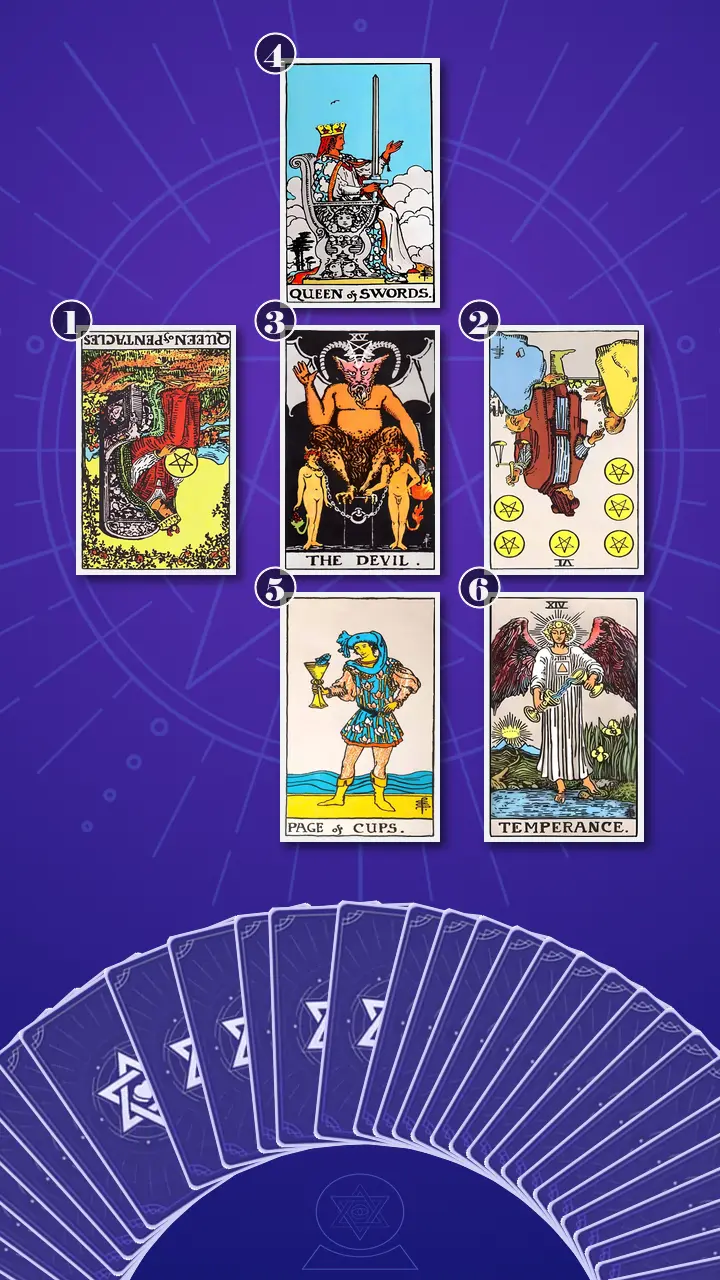
For anyone wondering how tarot works in this kind of reading, I explained that I was using images as an objective reflection tool. The cards could help us name behavior, attachment, communication, and choice, but they could not prove another person's motives or predict the future. I chose the Relationship Spread · Context Edition because Casey's question belonged to relationship dynamics: repeated overfunctioning, unequal emotional labor, unclear boundaries, and a support pattern nobody had openly negotiated.
A Celtic Cross would have added broad life-domain positions that were not necessary for this focused relational loop. This six-card relationship tarot spread gave us the fewest positions that still covered the self, the other person, the bond, the conflict, the practical adjustment, and the integrating lesson. The center card would show the hidden attachment, the upper card would identify the conscious tension, and the lower cards would form a path toward shared responsibility.
I placed the cards in a compact cross, with the visible role on the left and the other person's participation on the right. The central bond sat between them like a conversation diagram, while the cards below opened toward a doorway. I told Casey that the layout would not tell her to stay, leave, forgive, or withdraw. It would show where her own response created leverage.
What the Pentacles Were Carrying
The Calendar That Kept Opening
“Now turning is the card for the querent's visible role in the dynamic: the observable fixing behavior and contracted emotional energy described in the diagnosis,” I said. “The standard meaning here is the querent's role, stance, and contribution in the relationship.”
I turned over the Queen of Pentacles, in reversed position. I pointed to the large pentacle held close to the Queen's body, the rabbit at her feet, and the lush garden around her throne. Upright, this Queen represents grounded care, practical support, and stewardship of real resources. Reversed, the same earth energy had become overextended. Care was still genuine, but self-protection and clear limits had gone missing.
In modern life, this was Casey opening her calendar, laptop, and resource folders the instant someone said they were struggling. It was the 8:47 p.m. train, the drafted solution, the offer to handle the next step, and the realization afterward that her own evening had been spent. The pentacle translated into her time, attention, logistics, sleep, and emotional steadiness, all held so tightly that she had started treating them as available by default.
“This card does not say that your competence is the problem,” I said. “It shows practical care becoming an automatic assignment. The small risk is that, after feeling overused, you swing toward abrupt refusal just to prove you are no longer the caretaker. The card is asking for a middle ground: ask what kind of help is wanted, then offer one bounded action.”
Casey gave a short, bitter laugh instead of nodding. “That is too accurate,” she said. “Almost rude.” I let the humor stay in the room. Her mouth softened afterward, but her thumb kept rubbing the edge of her phone, as though she were deciding whether recognition felt safer than agreement.
The Invisible Ledger of Help
“Now turning is the card for the other person's participation in the exchange implied by fixing them,” I said. “This position examines what is requested, accepted, returned, or left unspoken without deciding the other person's motives. Its standard meaning is the other person's position, needs, and manner of participating in the relationship's exchange.”
The card was the Six of Pentacles, in reversed position. The merchant's scales, the two kneeling figures, and the coins moving from one hand to another made the structure of support visible. Reversed, the exchange had become uneven, dependent, or quietly conditional. It did not mean the other person intended to exploit Casey. It showed that the terms of giving had never become clear enough for either person to see them.
I connected it to the moments Casey had described: rewriting a difficult email, searching for local resources, making a follow-up call, or absorbing an unfinished task, then waiting for a quick thank-you to prove that the cost had been noticed. A delayed reply could make her reopen the invisible spreadsheet of time, effort, gratitude, and access. “Resentment often starts where an unspoken limit keeps getting crossed,” I said, “including a limit nobody has heard stated.”
I asked what she hoped another person would infer when she said, “No problem,” while moving her own plans. Casey looked down at the card. “I want them to know it was a lot without making me ask for credit,” she said. “And I want them to notice when the same thing keeps happening.”
Her shoulders rose as she said it, then lowered by a fraction. I told her the card was not a demand to make every act of care transactional or to refuse small kindnesses until someone paid her back. It was an invitation to name what she was freely choosing before the relationship acquired a private ledger.
The Contract Nobody Read
The Chains with Room to Move
“Now turning is the card for the hidden attachment that maintains the fixer role,” I said. “This position usually shows the central bond or repeated exchange shaping the relationship. In this reading, it asks what being useful seems to promise and what it quietly costs.”
At the center of the cross lay The Devil, in upright position. I kept my voice calm. The card was not a supernatural warning, and it was not a sentence about Casey's character. I showed her the loose chains around the two figures, the dark pedestal, and the raised torch. The chains looked binding until I noticed the space around their necks. That detail made the card about awareness and choice rather than fate.
In daily life, this was the moment Casey knew another person could probably manage the next step, yet reached for the repair kit anyway. On a Sunday evening in her Parkdale apartment, she had reopened a WhatsApp thread after deciding to put her phone down. The refrigerator hummed in the dim room. She sent one more practical suggestion because fixing felt safer than discovering whether the relationship would remain close without her intervention.
I thought of Severance, not as a diagnosis but as a useful shorthand for the split Casey described: the efficient, responsive self other people saw and the private self that registered the cost after the task was complete. In my twenty years of listening over coffee, I had learned to look beneath a dramatic accusation for the ordinary mechanism carrying it. Here, the mechanism was simple and powerful: someone became distressed, Casey became useful, the immediate discomfort quieted, and the unpaid cost arrived later as resentment.
I placed my finger beside the loose chains and gave the pattern two voices. “If I fix it, I stay connected,” I said. “If I stop, I may find out whether I was only valued for fixing.” I did not assign either thought to the other person. The tension belonged to the role and the belief attached to it: usefulness and belonging had fused.
Casey's breath paused first. Her eyes went unfocused, as if a series of old messages had started replaying behind them. Then her fingers tightened around the coffee cup before slowly releasing it. “That is the part I do not want to admit,” she said. “Sometimes I feel relieved when someone says I am the only person who knows what to do.”
I told her that relief was information, not evidence of failure. The fixer role offered control and quick connection, but it also narrowed her choices. The chains were learned, familiar, and real in their effects, yet still loose enough to question. I asked her to notice the next time the role activated before deciding whether the relationship itself was the problem.
When the Queen of Swords Drew the Line
The Boundary That Kept the Door Open
“Now turning is the card for the conflict between offering care and taking responsibility for another person's problem,” I said. “This position is the main lesson requiring attention, and it also holds the constructive action that can interrupt the loop.”
The card was the Queen of Swords, in upright position. Her sword stood visibly upright, while her other hand remained open beside the throne. The butterfly motifs suggested change earned through lived experience, not a demand for emotional coldness. The sword was discernment. The open hand was care that had not disappeared.
I used my signature lens, Daily Friction Deconstruction, and stripped the drama from the thought that “they always need me.” I asked Casey to name the mechanical sequence: a message arrived, she opened Google, she drafted a full plan, she offered to own the next step, and she never stated her capacity. Then I used Emotional Clutter Sorting to separate relationship incompatibility from fatigue, household pressure, work deadlines, and unspoken emotional labor. The cards did not decide whether anyone was right for her. They made the moving parts visible enough for her to decide with less distortion.
“The Queen's sentence is not a withdrawal,” I said. “It is a complete action: ‘I can listen for fifteen minutes, but I cannot take this task on.’ The over-explanation that usually comes afterward is not required. Care can remain present while responsibility goes back to the person whose problem it is.”
Casey was no longer deciding whether she cared. She was caught in the old equation: if she set a limit, someone might be disappointed; if they were disappointed, she might lose her place. A complete rescue plan sat ready in her mind, neat enough to hide its cost.
Do not confuse being needed with belonging; choose clear limits and honest words, as the Queen's upright sword separates care from responsibility.
For a second, Casey's breathing stopped. Her eyes fixed on the sword, widened slightly, and then dropped to her hands. Her fingers had been curled around the mug; one loosened, then the other. I could see her replaying the last week: the late message, the moved deadline, the bright “No problem” sent while her jaw clenched. “But doesn't that mean I have been doing all of this wrong?” she asked, her voice low and uneven. “No,” I said. “It means you have been using a skill as a substitute for a conversation. We are changing the terms, not putting you on trial.” Her shoulders sank with a careful, almost startled release. A quiet “Oh” came from deep in her chest. Her eyes shone, and she took one breath that reached all the way down. Relief arrived with a small dizziness, the vulnerability of no longer having a complete plan to hide behind.
“Now, with this new perspective, can you think back to last week and name one moment when this insight could have made the conversation feel different?” I asked.
Casey remembered a partner saying, “Can you just deal with this?” outside a grocery store near Queen Street West. She had said yes before checking her evening. This time, she imagined saying, “I care about this, and I have fifteen minutes to talk. I cannot manage the practical details tonight.” The imagined sentence did not guarantee a comfortable response. It did give her a place to stand.
I named the shift clearly: this was a first step from automatic rescuing toward conscious care. It was not the end of guilt, and it was not proof that every relationship would suddenly become reciprocal. It was the moment Casey could see that belonging did not have to be purchased with constant usefulness.
The Question Before the Rescue
The Fish in the Cup
“Now turning is the card for a bounded communication adjustment,” I said. “Its standard meaning is a constructive attitude or action that can improve the relationship. Here, it asks Casey to receive information about another person's need before deciding what action is required.”
The card was the Page of Cups, in upright position. The Page's attentive gaze rested on the unexpected fish emerging from the cup, while blue water stretched behind the figure. I read the fish as the answer Casey could not know in advance. A distressed message might require listening, ideas, practical help, or simply a witness. Curiosity had to arrive before competence.
“Do you want listening, ideas, or practical help right now?” I asked her to try. “That question changes the input before your troubleshooting workflow launches. It does not commit you to providing whatever answer comes back. It only lets the other person say what they are actually asking for.”
Casey opened her phone and typed the question into a blank note. Her thumb hovered over the screen, then she deleted a second sentence that began with an apology. “It feels almost too simple,” she said. “Which probably means I have been making it complicated.”
I watched her place the phone face down. That small movement mattered. She was not disappearing from the conversation; she was allowing a reply to exist before she took control of it.
Two Cups, One Shared Responsibility
The Measured Pour
“Now turning is the card for the integrating lesson of chosen care, visible reciprocity, and releasing the identity of being indispensable,” I said. “This is a direction available through self-exploration, not a prediction about what another person will do.”
The final card was Temperance, in upright position. I pointed to the angel pouring between two cups, one foot on land and one in water, and the path leading toward a distant light. The image offered balance without pretending that balance was automatic. Casey could remain emotionally present and practical while refusing to become responsible for the entire outcome.
In ordinary life, Temperance was one bounded offer followed by a clear handoff: “I can review the first paragraph; you can decide whether to send it.” It was listening for ten minutes, sending one resource, or helping with one defined task, then returning to her own evening without monitoring whether the help worked. One cup could hold her care. The other cup still belonged to the person with the problem.
“You do not have to disappear to stop carrying what is not yours,” I told her. “Measured care is not a performance of perfect balance. It is the willingness to adjust the amount you pour before exhaustion has to make the decision for you.”
Casey exhaled slowly. The relief was real, but it did not erase the fear that someone might be disappointed. She looked at the path on the card and nodded once. This time, the nod was not agreement with a verdict. It was recognition that staying connected and leaving ownership visible could occupy the same scene.
The One-Page Boundary Map
When I gathered the cards into one story, the pattern became straightforward. Casey's work had rewarded responsiveness, organization, and catching loose ends, so practical care felt like a familiar route to approval. The reversed Queen of Pentacles showed that she carried that competence into every relationship. The reversed Six of Pentacles showed how quickly an unspoken offer became an unequal exchange and a private ledger. The Devil revealed the hidden contract beneath it: usefulness seemed to promise belonging. The Queen of Swords supplied clear language, the Page of Cups supplied curiosity, and Temperance showed a way to help without owning the result.
The blind spot was not simply that Casey said yes too often. She had been treating resentment as a verdict on other people when it was often data about a limit she had never stated. That did not mean every relationship was balanced or that other people had no responsibility for their behavior. It meant the most immediate leverage point was her own response: ask first, name capacity, offer specifically, and leave the next step visible.
The transformation direction was from automatic rescuing and usefulness-based belonging toward conscious, bounded care and shared responsibility without private resentment. I told Casey that the goal was not to become less loving or to stop being reliable. It was to let support be an offer with an end point instead of an assignment she silently accepted.
- The Support Menu PauseAt the next distressed text, voice note, or in-person request from a friend or partner, wait ten minutes before drafting a solution. Ask, “Do you want listening, ideas, or practical help right now?” Then wait for the answer before offering anything else.Use the smallest version first: ask the question and do nothing for two minutes. Asking does not commit Casey to providing help, and she can say, “I care about this, but I do not have the capacity to continue tonight.”
- The 24-Hour Micro-Boundary ResetFor one relationship where Casey often overfunctions, set one clear time boundary in the shared rhythm of the next 24 hours: no new practical troubleshooting after 9 p.m. Casey can say, “I can talk tomorrow, but I cannot manage this tonight,” and keep her evening for sleep, food, or her own deadline.Choose a low-stakes request and keep the sentence short. Boundary guilt may arrive as a tight jaw or a fast heartbeat, but the other person's disappointment is information about the moment, not a verdict on Casey's character.
- The One-Offer HandoffIn one real conversation this week, offer only one observable action, such as reviewing the first paragraph or sending one resource, then name the owner's next step: “I can review this part; you can decide whether to send it.” Do not check for the result for the following hour.Use that hour for a scheduled task, a meal, or a walk. If the urge to intervene returns, notice it and choose whether to continue freely. Leaving space is not abandonment, and monitoring the result is not the same as caring.
I reminded Casey that these were experiments, not tests of whether another person loved her enough or responded perfectly. The point was to make the terms of care visible. That was actionable advice she could begin without making a dramatic relationship decision.

The First Morning After the Old Contract
Four days later, Casey texted me from a cafe near Queen Street: “I asked first. They wanted listening. I gave fifteen minutes, then went home.” Sunlight had reached her table, though her coffee went cold while she sat alone, proud and a little unsteady. She added, “I still felt guilty on the walk back, but I did not send a second message.”
That was the proof I trusted: not a solved relationship, not a promise that nobody would ever ask too much, but one clear pause between another person's discomfort and Casey's automatic repair kit. Her next step had become hers again. The guilt remained briefly, yet it no longer had the authority to rewrite her boundary.
I told her that the cards had not made her less caring. They had helped her see care as a conscious choice, responsibility as something that could remain shared, and reciprocity as something revealed through honest terms rather than private scorekeeping. That is what finding clarity looked like here: a steadier kind of care, built one small sentence at a time.
When you are always the one making the problem manageable, your shoulders stay lifted and your chest stays tight because part of you is still wondering whether being wanted means being useful.
If one relationship could remain connected without you carrying its next step, what is the smallest honest amount of care you would want to offer there?