Finding Clarity in the 9:40 p.m. Scroll
If you can hold a project constraint in a Monday stand-up but start rewriting a clear no when the family group chat objects, you may know the specific shame of family boundary guilt.
Maya joined our video session from her small Toronto apartment on a rainy Tuesday. Three notifications buzzed against her kitchen counter while the radiator clicked and water ticked against the window. Blue light washed over the paragraph she was deleting and rebuilding with both thumbs.
She had originally typed, “I’m not available this weekend.” By the time I saw her, that sentence had become a detailed account of deadlines, exhaustion, transit times, and all the ways she might rearrange Saturday anyway.
“I can say no until they sound disappointed,” she told me. “Then I feel like I have to explain it well enough that they can’t be upset. Eventually I just say, ‘Okay, I’ll make it work.’”
I watched her shoulders climb toward her ears. Her throat tightened before each notification had even finished sounding. The anticipatory dread looked less like ordinary indecision and more like standing beside a smoke alarm that could go off at any moment: every objection felt urgent, even when nothing practical was on fire.
At work, Maya could tell a stakeholder that a feature did not fit the current sprint. With family, every comment became a mandatory change request until her original requirement disappeared. The contradiction was clear: she wanted personal boundaries, but she feared the escalating conflict that followed when she held them.
“I don’t think your problem is that you don’t know your boundary,” I said. “I think the difficult part begins after you state it. Let’s map the sequence between their pushback and your surrender, then find the smallest point where you can choose differently.”

Choosing the Compass for Family Boundary Pushback
I invited Maya to put her phone face down, let one breath reach below her collarbones, and hold the question without trying to solve it. I shuffled slowly. I use this kind of preparation as a transition into focused observation, not as theatre and never as a claim that the cards control an outcome.
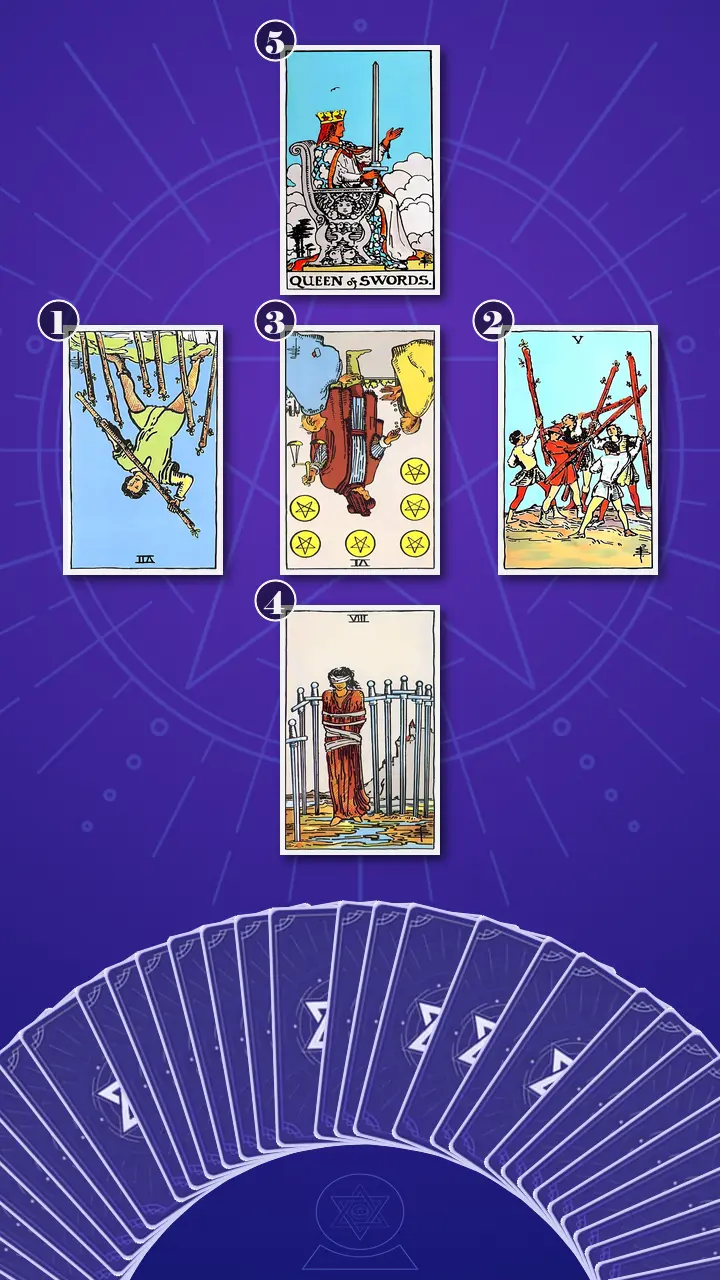
I chose the five-card Relationship Spread · Context Edition. It was more useful here than a sprawling general reading because Maya’s question involved one identifiable relational cycle: her stance, the pressure she observed, the exchange created between both sides, the learned obstacle beneath it, and the principle that could interrupt it.
I placed the shared dynamic at the centre, Maya’s stance and the family pressure on either side, the hidden response below, and the constructive practice above. I told her the spread would move from the visible symptom to the root, then rise toward an empowered response. Tarot, as I use it, is an objective reflection tool: it makes a pattern visible enough to examine, but Maya would remain the author of every next step.
Reading the Many Wands
Position One: The Moment a Clear No Becomes a Defence Brief
I began with the position representing how Maya’s boundary stance changed once family resistance started. I turned over the Seven of Wands, reversed.
The traditional image shows one figure defending elevated ground against six raised wands. Reversed, that defensive energy had moved into blockage and depletion. I connected it to the scene still glowing on Maya’s counter: one clear message, three objections, an expanding text box, and the thought, “I was sure until they replied; now I need a better reason.”
“More reasons do not make a boundary more valid,” I said. “They create more handles for debate. The exact point to notice is where explaining becomes negotiating against yourself.”
Maya gave a short, bitter laugh. “That’s so accurate it’s almost rude.” Her thumb returned to the edge of her phone, then stopped. I did not hurry to soften the recognition. I told her the card was describing a sequence, not exposing a character flaw. Pressure rose, her body prepared for rejection, and surrender restored immediate quiet. Any nervous system could learn to repeat the move that made the noise stop.
Position Two: Five Objections Are Not Five Emergencies
I moved to the position describing the family pressure Maya directly observed and revealed the Five of Wands, upright.
The intersecting staffs resembled a group call in which one person discussed logistics, another questioned Maya’s reason, and a third said, “You’ve changed.” The upright Fire energy was in excess: too many competing points arrived too quickly for the original practical limit to remain centred.
I was careful not to assign hidden motives to her relatives. Their disappointment might be sincere. The problem was the form of the exchange. One limit had turned into five simultaneous debates, and Maya was treating every repetition of disagreement as a separate support ticket with an immediate-response SLA.
“If I answer each point correctly, maybe the whole thing will settle,” Maya said, looking away from the screen.
“What if it settles when you stop supplying new material,” I asked, “rather than when everyone agrees?”
Her jaw loosened slightly. She looked back at the card as though she had just noticed that none of the figures in it was actually listening.
Position Three: The Calendar With One Person Marked ‘Available’
The centre position represented the feedback loop between pushback and appeasement. I turned over the Six of Pentacles, reversed.
The card’s scales were meant to measure exchange, but reversed Earth showed the balance destabilised. In Maya’s shared calendar, the family request appeared fixed while her recovery time appeared blank and therefore available for reassignment. What they needed counted as real; what she needed became a preference she had to defend.
This was where I used my Family Power Dynamic Decoding lens. I explained that money, housing, transport, caregiving, and access to family resources can create real leverage, but I would not assume coercion where Maya had not described it. We audited only observable terms: whose plans stayed fixed, whose time moved, what practical consequences followed a no, and whether support arrived with conditions.
“The issue isn’t whether generosity is good,” I said. “It’s whether you are choosing what to give. Care offered freely creates connection. Access obtained because you cannot tolerate the backlash creates resentment.”
Maya’s fingers tightened around her mug, her gaze went unfocused as if replaying several cancelled Saturdays, and then she released a low breath. “I keep treating my downtime like it doesn’t count because nobody else can see what it’s for.”
Position Four: The Hidden Third Button
I descended to the position holding the learned response beneath the conflict and revealed the Eight of Swords, upright.
The blindfolded figure captured a restricted Air pattern: Maya’s mind offered two buttons, “Give in” or “Lose them.” On the Bloor-Yonge platform, with train brakes screeching and a long message hot in her palm, replying tomorrow barely registered as an option.
I did not tell her the external pressure was imaginary. I pointed to the visible opening between the swords. The restriction was meaningful without being total. She could repeat the limit, mute a non-urgent thread for thirty minutes, move logistics to text, or end one heated call without ending the relationship.
I also introduced Guilt-Debt Neutralization. Years earlier, on a trading floor, I learned that an urgent-looking liability still had to be verified before it entered the books. I now apply that discipline to inherited emotional claims. “You disappointed us” may be a real feeling. “Therefore you owe us your Saturday” is a proposed debt, not an automatically valid one.
Maya’s chest rose and held. Her eyes stayed on the gap between the swords. Then she frowned. “If I stop replying, it still feels like I’m abandoning them.”
“That feeling deserves care,” I said. “But a feeling can be evidence of an old association without being evidence that you are committing abandonment. A pause is not a rupture.”
When the Queen Raised One Upright Sword
Position Five: Precision Without Emotional Cutoff
The room grew quieter before I turned the final card. Even the rain had softened. In the position representing the practice that could preserve connection without abandoning the boundary, I revealed the Queen of Swords, upright.
Her Air energy was balanced: clear perception, self-authorised judgement, and direct language. One vertical sword replaced all the diagonal wands. Her other hand remained open. I read that combination as precision without hostility, receptivity without surrender.
Maya was still caught in the 9:40 p.m. reflex: three messages landed, her shoulders rose, and a one-sentence no became a defence brief designed to make everyone stop being disappointed.
You do not need to win every argument to keep a boundary; hold one clear sentence like the Queen’s upright sword and step out of the contest.
I let the sentence remain between us. Maya’s breathing stopped for a beat, and her fingers hovered above the phone as though another reply had just arrived. Her pupils widened. Then her expression hardened.
“But doesn’t that mean I’ve been doing it wrong all this time?” she asked, anger sharpening the last word.
“It means you used the strategy that once bought the fastest quiet,” I said. “That is not the same as choosing it forever.”
Her gaze slipped out of focus as memories seemed to pass behind it. The anger softened into grief; her eyes reddened, her raised shoulders descended, and the fist resting against her sleeve slowly opened. She exhaled with a slight tremor, then sat back as if the release had left her briefly unsteady. Clarity had removed an old excuse, but it had also returned responsibility to her hands.
I asked, “From this new angle, was there a moment last week when one sentence and a pause might have felt different?”
“Friday on the subway,” she said quietly. “I could have answered the next morning.”
I nodded. This was the first movement from anticipatory dread and conflict-driven appeasement toward calm self-authorisation. Family pushback did not turn her boundary into a draft. Their disappointment could be real without becoming her instruction.
The Strategic Disengagement Plan
I drew the spread together as one escalation sequence. The reversed Seven showed Maya losing her ground; the Five showed conflict multiplying; the reversed Six exposed an exchange in which her time carried less practical weight; and the Eight revealed the learned conclusion that resistance was futile. The Queen did not promise unanimous approval. She restored one thing the cycle kept removing: Maya’s authority over her own participation.
Her blind spot was trying to make a boundary unchallengeable before she allowed herself to keep it. The shift was smaller and more demanding: state one concise limit, repeat it once, and pause when pressure escalated. A boundary was not a court case. It was a decision supported by consistent action.
I shaped the next steps around my Strategic Disengagement Plan, a calculated way to reduce the conversational and practical leverage that kept pulling Maya back into debate.
- Write the one-sentence boundary. Before one low-stakes family request this week, Maya would open Notes and write: “I am not available for that.” She would share a reason only if she freely wanted to, not to purchase approval. Minimum version: write the first five words and read them aloud once.
- Repeat once, then pause. If the request returned, Maya would send: “I understand you’re disappointed. My answer hasn’t changed.” If pressure continued, she would say she was pausing the conversation and mute the thread for thirty minutes. Start with ten minutes if thirty feels too activating; genuine safety or practical emergencies remain separate exceptions.
- Restore equal weight to capacity. Before the next plan, Maya would make two private bullets: “I can offer” and “I cannot offer.” She could propose one bounded alternative only if she genuinely wanted it, such as a twenty-minute Sunday call instead of Saturday attendance. Remove any extra offer added solely to prevent disappointment.
I added one non-negotiable qualification: if a direct limit could threaten housing, money, caregiving access, immigration status, or physical safety, the plan should become lower risk and include trusted practical support. Good boundary advice accounts for material power. It does not demand dramatic confrontation as proof of courage.
“You do not need unanimous approval to be unavailable,” I told her. “The pause is where a stated boundary becomes a practised boundary.”

A Week Later: The Quiet Proof
Six days later, I received a short message from Maya. A family request had arrived while she was having coffee with a friend. She had checked her two bullets, sent one sentence, repeated it once, and put her phone on Focus mode for thirty minutes. Her Saturday remained hers.
She slept through the night, but her first thought the next morning was still, “What if I’ve damaged something?” She told me she had smiled at the thought, not because the fear was silly, but because it was no longer the only voice with voting rights.
I did not see that week as tarot predicting a better future. I saw Maya create one piece of evidence that discomfort could remain unresolved without forcing capitulation. The cards had made the pattern legible; she had supplied the choice, the sentence, and the pause.
When the family chat keeps lighting up after you have said no, I know the tight throat may be bracing for more than an argument. It may be bracing for the possibility that choosing your own time could cost you your place in the family. Simply recognising that fear means the old algorithm is no longer operating completely out of sight.
If their disappointment did not have to become your emergency tonight, what one clear sentence could you let stand like the Queen’s upright sword?
This story is adapted from psychological research, written so that those in a similar struggle can see their own pattern in it — and find their next step clearly.These insights are not a substitute for professional psychological, medical, legal, or financial advice.
Learn more about our Journey to Clarity.
How did this insight land for you?
🫂 This Resonates Deeply
🌀 Living This Story
✨ Now I See Clearly
🌱 Seeing New Possibilities
🧰 Useful Framework
🔮 The Confirmation I Needed
💪 Feeling Empowered
🚀 Ready for My Next Step
Author Profile
 AI
AI“I spent years in the intense, high-stakes world of Wall Street. I know exactly how isolating and heavy the weight of uncertainty can feel in the dead of night. I use strategic, commercial logic not to be cold, but to protect you from unnecessary friction. Think of me as a fellow traveler who has walked the same rocky path—offering sharp but deeply supportive wisdom to help you clear the fog and confidently win your narrative back.”
In this Family Tarot Reading :
Core Expertise
- Family Power Dynamic Decoding: Uncovering how resources (money, housing, inheritance) are weaponized by elders to maintain hierarchical control.
- Guilt-Debt Neutralization: Treating parental emotional blackmail as unverified psychological 'bad debt' that needs to be audited and dismissed.
Service Features
- The Strategic Disengagement Plan: A calculated protocol to establish clear financial and emotional boundaries, systematically minimizing the leverage points your family uses against you.
Also specializes in :
Explore Related Patterns:
Defensive OverexplainingMaya's one-sentence refusal expands into a detailed account of deadlines, exhaustion, transit times, and possible compromises as soon as her family objects. Those extra reasons do not simply communicate context; they turn a completed decision into an open defence brief, giving every relative more material to question. When you explain until nobody can remain upset, explanation becomes a defence against disapproval rather than a neutral exchange of information. You begin negotiating against your own decision, and the temporary relief that follows surrender teaches the cycle to restart the next time a clear no meets resistance.
Emotional Hyper-ResponsibilityMaya says she must explain her refusal well enough that her relatives cannot remain upset, while each objection registers as an emergency before any practical consequence has been established. Her task quietly expands from communicating her availability to managing the emotional state of everyone in the conversation. When you assume responsibility for preventing another person's disappointment, a boundary can feel valid only after they approve it. This creates an impossible standard: because you cannot control their reaction, you keep changing your own answer, taking on emotional labour that belongs on both sides of the relationship.
Family Role RegressionMaya can tell a stakeholder that a feature does not fit the sprint, yet the same clarity collapses when a family group chat challenges her availability. Her general ability to identify and communicate limits is therefore visible; what changes is the relational setting and the role she occupies inside it. When familiar family pressure reactivates an accommodation-based role, your adult competence can temporarily give way to an older conversational script: explain, absorb the objections, and restore calm by moving yourself. The contrast matters because it shows that you do not lack boundary skills globally; a family-specific cue is changing which skills feel available.
Guilt-Driven People-PleasingMaya can hold the word no until her relatives sound disappointed; then she explains, rearranges, and finally says, "Okay, I'll make it work." That surrender restores immediate quiet, so appeasement is reinforced even though it costs her recovery time and leaves resentment behind. When you experience guilt as a demand for corrective action, another person's disappointment can feel like proof that you have failed them. Giving in then becomes a way to recover short-term approval and calm, while the repeated sacrifice of your own plans keeps the deeper boundary cycle intact.
Self-AbandonmentIn Maya's shared calendar, the family request appears fixed while her recovery time looks blank and available for reassignment. Several cancelled Saturdays show what happens next: the original limit disappears, and she acts against the exhaustion and capacity she had already recognised. When you repeatedly treat your own needs as less real because they are private or difficult to prove, maintaining connection can require abandoning your side of the decision. The pattern is deeper than generosity; it is the loss of equal standing for your time, rest, and prior judgment whenever relational pressure rises.
Black-and-White ThinkingOn the subway, Maya's mind offers only two buttons: "Give in" or "Lose them." Replying tomorrow, repeating the limit, ending one heated call, or reducing participation without ending the relationship barely registers until those options are explicitly placed in front of her. When you compress disagreement into total capitulation versus total rupture, backing down can appear to be the only relationship-preserving choice. The distortion is not that the relationship has no stakes; it is that intermediate choices disappear, leaving fear to present one extreme response as the sole safe option.
Uncertainty ToleranceAfter Maya sends one sentence and repeats it once, she leaves the family disagreement unresolved for thirty minutes instead of continuing until everybody approves. The next morning, the thought "What if I've damaged something?" still appears, but she does not reopen the decision or surrender her Saturday. When you can let uncertainty and guilt remain present without treating them as commands, capitulation is no longer the fastest available form of emotional regulation. Uncertainty tolerance does not require certainty that nobody will be disappointed; it allows you to discover through experience that unresolved discomfort can coexist with a maintained relationship and a maintained boundary.
Assertive CommunicationSix days after the session, Maya checks what she can offer, sends one sentence, repeats it once, and places her phone on Focus mode when the objections continue. She neither attacks her relatives nor supplies a growing defence; her words and subsequent action communicate the same decision. When you use direct language without making agreement a prerequisite, a boundary becomes observable through consistency rather than persuasive force. Assertive communication allows you to acknowledge disappointment while keeping authorship of your participation, so connection no longer requires surrender and clarity no longer requires hostility.
Boundary DiscernmentThe session separates the observable statement, "You disappointed us," from the added claim that Maya therefore owes the family her Saturday. It also restores practical weight to recovery time and checks for real material consequences instead of assuming that every emotional objection carries the same authority. When you distinguish another person's feeling from your obligation, you can respond with care without converting their reaction into an instruction. Boundary discernment keeps the audit precise: genuine emergencies and material leverage still matter, but ordinary disappointment does not automatically overrule your capacity or erase your right to decide.
Explore Related Struggles:
Agreement-Agency SplitOne family limit turns into several debates, and Maya responds by adding deadlines, transit times, exhaustion, and possible compromises. She is no longer communicating a decision; she is trying to construct an explanation so complete that nobody can reasonably remain disappointed. When agreement becomes the condition under which your choice is allowed to stand, other people's objections acquire veto power over your agency. You remain caught between holding the limit and repairing every negative reaction it creates. The struggle becomes clearer once consensus and consent are separated: relatives can disagree with your decision without becoming its co-authors.
Autonomy Guilt BindMaya begins with a clear sentence about her weekend, but family disappointment changes what that sentence seems to cost. Keeping Saturday for herself becomes entangled with guilt about letting people down, so a decision about availability starts carrying the weight of a decision about whether she is still caring and connected. You can know your boundary and still become stuck when autonomy immediately generates a perceived relational debt. The pressure point is not uncertainty about what you need; it is the bind that makes acting on that knowledge feel as though you must choose your own life at someone else's emotional expense. Seeing that bind separates their disappointment from your authority to decide what you can give.
Boundary CollapseMaya's original sentence is only five words long, but every objection makes it expand until the refusal disappears. Deadlines, exhaustion, transit times, and possible rearrangements enter the text box, giving the family more surfaces to contest while leaving less room for the decision she had already made. You encounter collapse when a stated limit cannot survive contact with another person's resistance. The boundary remains verbally present for part of the exchange, yet it stops governing your actions and eventually becomes the concession it was meant to prevent. Recognising the point where explanation turns into self-negotiation allows you to locate the collapse before your original answer is edited away.
Harmony-Safety FusionMaya eventually says, "Okay, I'll make it work," and the immediate noise stops. The surrender does not resolve the disagreement about who controls her Saturday; it purchases quiet by removing the limit that produced the conflict. You may back down even when your boundary is clear because short-term harmony has become the practical signal that the relationship is secure. Continued disagreement then feels intolerable, while capitulation offers instant relief and is therefore easier to repeat. The deeper shift is allowing other people to remain disappointed without making the absence of harmony proof that the connection is failing.
Third Path BlindnessOn the Bloor-Yonge platform, Maya can see only two available buttons: give in or lose them. Replying tomorrow, repeating the same sentence, muting the thread, or ending one heated call without ending the relationship barely registers while the message is hot in her hand. Your agency contracts when pushback makes every intermediate option disappear from view. That leaves capitulation looking like the only path that preserves connection, even though the story later shows that a delayed response can leave both the boundary and the relationship intact. The third path begins wherever you can allow disagreement to remain unresolved without treating it as a final rupture.
Urgency-Compass FusionMaya's shoulders rise and her throat tightens before each notification has even finished sounding. A family objection arrives with the force of an emergency, and she treats every repeated point as a separate support ticket requiring an immediate and satisfactory response, even when nothing practical is on fire. When urgency becomes your decision-making compass, the loudest reaction displaces the clearest information about your capacity. You back down because speed leaves little room to distinguish disappointment from danger or a request from an instruction. The thirty-minute pause matters because it interrupts that fusion long enough for urgency to stop deciding what your original boundary means.
Capacity-Obligation FusionIn Maya's shared calendar, the family request appears fixed while her recovery time looks blank and therefore available. Several cancelled Saturdays have taught the exchange the same practical rule: another person's visible plan has weight, while time reserved for rest must first prove that it deserves protection. You become structurally vulnerable to obligation when capacity is measured only by whether a calendar slot is occupied. Having time is then mistaken for owing time, and an unseen need is treated as less real than a visible request. The conflict is not simply about scheduling; it is about whether your limits retain equal weight when they protect recovery rather than an externally legible commitment.
Explore Related Emotions:
Anticipatory DreadThree notifications buzz against Maya's kitchen counter, and her shoulders rise before each sound has even finished. Your body can begin preparing for the next objection before you know what the message says, turning a family chat into the emotional equivalent of waiting beside an alarm. Anticipatory Dread forms in that interval between stating the limit and expecting the backlash. The expectation makes every reply feel immediately consequential, but recognising the bodily sequence gives you a place to pause before anticipated conflict becomes an automatic surrender.
Boundary GuiltOne clear sentence, "I'm not available this weekend," grows into a detailed account of deadlines, exhaustion, transit times, and possible compromises. When your relatives object, the boundary stops feeling like a decision and starts feeling like a case you must prove before you are permitted to keep it. That expansion reveals the inner pressure of Boundary Guilt: you can know your limit clearly and still feel responsible for making everyone comfortable with it. Seeing where explanation turns into negotiation allows you to treat the guilt as a reaction to pushback, not as proof that your boundary is unfair.
Conditional Belonging FearOn the Bloor-Yonge platform, Maya's mind offers only two buttons: "Give in" or "Lose them." When your available choices collapse this way, a delayed reply or an unchanged no can feel less like a communication decision and more like a threat to your place in the relationship. Conditional Belonging Fear is the subjective weight beneath that binary. You are not merely trying to avoid an argument; you are bracing for the possibility that self-protection could reduce your inclusion. Naming that deeper fear makes room for a third position in which disagreement can remain unresolved without defining whether you belong.
Defensive ReliefThe words "Okay, I'll make it work" end the immediate noise after Maya has explained, revised, and negotiated against herself. When you surrender the limit, the argument settles quickly enough for your body to register that quiet as a reward. Defensive Relief is the short-lived ease purchased by ending resistance rather than resolving the underlying conflict. It helps explain why backing down can remain compelling even when you understand the cost: the relief is real, but naming what it costs restores your ability to choose whether immediate quiet is worth giving up your time.
Grounded AgencyMaya checks two private bullets, sends one concise limit, repeats it once, and steps away from the thread. These ordinary actions give your internal decision a practical form, so the boundary no longer depends on producing the perfect explanation or securing unanimous agreement. Grounded Agency is the steady sense that you remain the author of your participation even when other people keep objecting. It is built from observable evidence rather than forced confidence: you choose the sentence, the pause, and how much of your time remains available.
Cautious AutonomySix days later, Maya checks what she can offer, sends one sentence, repeats it once, and places the thread on Focus mode for thirty minutes. Her Saturday remains hers, yet the next morning still begins with the thought, "What if I've damaged something?" Cautious Autonomy is the felt experience of choosing your own time while residual concern remains present. Your independence does not have to arrive as total certainty; it can begin as one protected decision that proves discomfort may continue without automatically overruling you.
Self-Betrayal AcheMaya's original requirement disappears while the family request remains fixed, and her gaze drifts across several cancelled Saturdays. When you repeatedly say "I'll make it work" after already knowing that you are unavailable, the final agreement can feel disconnected from the person who first recognised the limit. Self-Betrayal Ache names the pain of watching your own decision lose practical weight in real time. It does not frame you as weak; it marks the gap between what you know you need and what you feel able to protect once relational pressure begins.
Bittersweet ReleaseMaya's expression hardens, her last word sharpens, and then her eyes redden as her raised shoulders descend and her closed fist opens. Your body may soften when an old strategy is understood, even while the recognition leaves you briefly unsteady. Bittersweet Release holds the two sides of that opening: self-blame loses some of its grip, while responsibility returns to your hands. The release is meaningful precisely because it does not erase the cost of what has happened; it lets that cost be felt without turning it into a permanent verdict on who you are.
Clarity ShockMaya gives a short, bitter laugh when she sees that more reasons have only created more handles for debate, then asks whether she has been doing it wrong all this time. The pattern becomes clear in a single sharp moment, and that clarity lands before she has had time to arrange it into a comfortable story about herself. Clarity Shock carries both recognition and exposure: you can finally see why the cycle repeats, but you can also see the point where your own participation becomes changeable. Because the sequence is treated as learned rather than defective, the shock can move toward authorship instead of hardening into self-condemnation.
Explore Related Contexts:
Family Boundary BacklashMaya's original message says she is unavailable, but family objections quickly turn that decision into a defense brief about deadlines, exhaustion, and transit. The family's requested plan remains fixed while every expression of disappointment reopens her availability, allowing relational pressure to operate like a veto over a decision she had already made. When your no repeatedly triggers questioning, character commentary, or demands for a better reason, you are dealing with more than ordinary scheduling friction. You back down because the exchange makes continued resistance carry an immediate social cost, while capitulation restores quiet; recognizing that structure lets you separate the validity of your limit from whether everyone approves it.
Family Group Chat Pile-OnThree notifications land while Maya is rewriting her message, and the later reconstruction shows several relatives advancing different challenges at once: one addresses logistics, another questions her reason, and a third says she has changed. The group channel aggregates those separate reactions into a single wall of pressure, even though the original issue is only whether she is available that weekend. You face a pile-on when one decision produces multiple conversational fronts and each front appears to require its own defense. The volume can make disagreement look like evidence that your decision is defective, but the number of objections does not create additional authority over your time; it only increases the response load placed on you.
Family Calendar Boundary CreepIn Maya's shared calendar, the family request remains fixed while her recovery time appears blank and is therefore treated as movable. She begins searching for ways to rearrange Saturday, and the scene connects that response to several previously canceled Saturdays rather than to a single scheduling exception. You encounter calendar boundary creep when unstructured time is repeatedly ranked below plans that other people can name, see, or request. The external constraint is not a lack of hours but an unequal rule for allocating them: their plans arrive as commitments, while your rest is treated as spare capacity until you give it equal practical weight.