Acting Younger for Family Help: Name the Need, Keep Your Choice

The Apology Draft at 10:42 PM
I knew the shape of the problem when I met Jordan (name changed for privacy): she was a 27-year-old early-career product designer in Toronto who could walk a team through a product decision, but the second rent, a move, or a surprise bill made her text family, her voice turned younger and her practical concern became a full apology draft.
At 10:42 PM on a Tuesday, I watched her check a rent reminder in the warm light of her phone while the refrigerator hummed behind her and wet winter boots dripped beside the condo door. She typed, 'Could you help with $600 until the 15th?' Then she deleted it, added details about her short-term contract, apologised twice, and let her shoulders fold toward the screen.
Jordan told me, 'I know how to solve this, but I do not know how to ask without handing over the decision.' Her throat tightened as she said it. I could see the request sitting between us: the need was adult and practical, but she believed she had to act like a child to access her family's support.
I did not hear weakness in that pattern. I heard a person trying to protect both belonging and agency with an old strategy that had become expensive. The shame was not an idea floating above her; it was a narrow band around her chest, a smaller voice arriving before the real one. I said, 'You can need help without auditioning for the child role. Let us look at the pattern without judging it, and draw a map toward clarity together.'

Choosing a Compass for Family Support
I invited Jordan to place both feet on the floor, take one slower breath than inhale, and hold the question in a single sentence. I shuffled slowly, treating the preparation as a psychological transition: a way to move from replaying an old family conversation into observing the present one.
I told her, and I tell the reader now, that we would use the Transformation Path Grid (6) - Context Edition. Tarot does not decide whether her family will help, whether their terms will be fair, or what she must do next. It gives us a symbolic structure for noticing how a recurring pattern operates, then checking each insight against reality.
This six-card spread suited the question because the issue was not simply whether Jordan should accept support. It was a repeating relational loop: an adult need became a childlike performance, the performance brought short-term relief, and the relief strengthened the same role. A Celtic Cross would have widened the reading into general influences and outcomes. This grid gave us distinct places for the visible regression, the attachment beneath it, the inherited rule, the interrupting insight, the practical experiment, and the integrated stance.
I explained the route across the two-row grid. The first card would show the observable regression at the family resource gate. The second would reveal the immediate bargain that kept it active. The third would examine the inherited permission rule. The fourth, directly below it, would offer the turning point. The final two cards would show how clarity could become a bounded request and a steadier way to receive care.
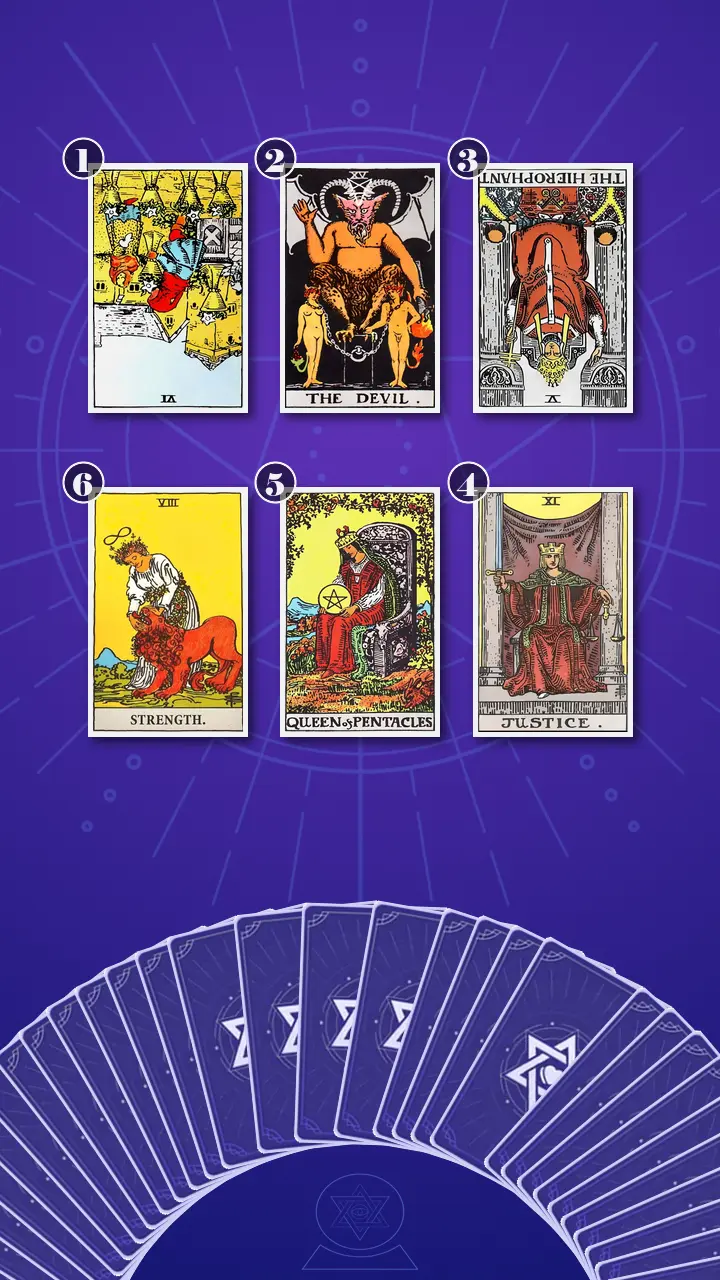
Reading the Loop That Looked Like Help
Position 1: The Familiar Cup
Now turned over was the card representing the observable regression at the support gate: the younger tone, helpless framing, or surrender of choices that appeared whenever family resources were requested.
It was the Six of Cups, in reversed position. I pointed to the smaller child offering a flower-filled cup to the taller child in the village courtyard. In Jordan's life, that image became the moment a rent reminder arrived, she drafted a concise request for a short-term loan, and then replaced it with a younger-sounding explanation about being overwhelmed. The practical need stayed the same. The language became a rehearsal of the old route to care, like reverting to an old character setting whenever the family group chat lit up.
Reversed Cups showed emotional memory blocked in place. The past was not being integrated into the present; it was being replayed as a condition of access. The child role felt reliable because it had once made care more reachable. But I also named the overcorrection risk: proving adulthood by refusing every offer or hiding a genuine need until the bill became urgent would still leave the old pattern in charge.
Jordan did not nod. She gave a tight, almost embarrassed laugh and said, 'That is too accurate. It is like I have to make the situation sound worse before I am allowed to need anything.' Her thumb stopped moving over the edge of her phone. I let the recognition sit without turning it into a verdict.
Position 2: The Hidden Subscription
Now turned over was the card representing how Inner Child Fixation turned conditional support into a cue to shrink, apologise, or seek permission, keeping the present loop active.
It was The Devil, upright. I showed Jordan the loose chains around the two figures, the shared pedestal beneath them, and the raised torch held in a fixed frontal gaze. I translated the scene into a modern life scenario: she needed help with moving costs, and before anyone had said no, she assumed the price would be surrendering the neighbourhood she wanted, accepting a lecture about her contract work, and sounding grateful enough not to challenge it.
The Devil was not telling me that her family was automatically cruel or manipulative. It was showing an attachment bargain that could be examined rather than obeyed. The support looked free in the banking app, but Jordan expected a hidden subscription agreement to appear on the next screen: oversight, approval, compliance, and a smaller self. The immediate relief of receiving help kept the bargain in place; later, she would agree on a call and stare at the ceiling with resentment.
I used my Emotional Blackmail Deconstruction lens carefully here. I separated actual guilt-trips, silent treatments, or stated conditions from the subconscious manipulation tactics Jordan feared might arrive. Then I traced the inner monologue in three beats: 'Maybe I should make this sound worse.' 'Then they will understand.' 'Then I will owe them a version of myself.' Fear could add extra terms before anyone else had spoken them.
Jordan let out a short laugh that caught in her throat. 'Why does help always feel like a transaction?' she asked. Her fingers tightened around the phone, then loosened. I told her that the question itself was useful: it located the invisible price tag without deciding in advance whether every part of it was real.
Position 3: The Rule No One Had Confirmed
Now turned over was the card examining Repetition Compulsion: the learned belief that replaying the dependent role was the safest route to belonging and access to family support.
It was The Hierophant, in reversed position. I focused on the crossed keys at the Hierophant's feet and the two acolytes receiving instruction. For Jordan, they became the difference between an actual support condition and a rule she carried inside. A relative might ask, 'Have you considered waiting another month before moving?' Jordan's nervous system translated the question into, 'We will only help if you do what we think is sensible.' Before she could ask what support was available, she edited her plan.
The reversed Hierophant showed a permission structure being questioned, but not yet released. I compared it to an old workplace handbook still open in a browser tab after the company has changed its policies. The document feels official because it has been there for years. I asked Jordan to hold two sentences apart: 'They asked a question. I heard a verdict.' Then I asked her to distinguish what was explicitly said from what her body filled in before she could check.
I watched her look toward the rain-streaked window. She replayed a Sunday video call, a moving quote on the kitchen table, and the moment she had said, 'I do not know, what do you think I should do?' Her mouth tightened. Then she wrote two headings in her Notes app: actual family condition and rule I learned to expect. The old rule had not disappeared, but it had become visible enough to question.
When Justice Cut Through the Entry Fee
Position 4: The Sword and the Scales
Now turned over was the card identifying the first adult-sized distinction that could interrupt the loop: separating the need for support from the performance of helplessness and making the family's resource terms explicit.
It was Justice, upright. The upright double-edged sword, balanced scales, symmetrical pillars, and red robe changed the room's rhythm. I could almost hear a streetcar bell outside, clean and brief, as if the city had supplied a line through the fog.
Justice did not promise approval. It asked for a fair account: What is the need? What terms are actually offered? Which decision remains Jordan's? A plea asks someone to rescue the whole situation. A request names the part she is asking them to help with.
I used my Adult-Child Regression Auditing skill at this point. I did not ask Jordan to condemn the younger part of herself. I traced the environmental trigger, the body shift, the learned role, and the short-term payoff. A rent reminder activated the fear of losing belonging; the fear narrowed her voice; the helpless presentation made care feel safer; then the resulting oversight reduced her agency. Once the sequence was visible, it was no longer a personality verdict. It was a circuit with an interruption point.
At 10:42 PM, after checking the rent reminder and reopening the same family text thread, Jordan had been deleting the plain sentence and rebuilding it into an apology. Her thumbs kept moving, but her shoulders had already dropped. I could see how hard she was working to make the request acceptable before anyone had responded.
Stop treating helplessness as the entry fee for family support; use Justice's upright sword and balanced scales to state the need, clarify the terms, and preserve adult choice.
For a few seconds, Jordan's breath stopped. Her eyes lost focus as if an old call were replaying behind them, and one hand remained suspended above the Notes app. Then her face tightened with a flash of anger. 'But if I ask that plainly,' she said, 'doesn't it mean I was wrong all those times?'
I answered, 'It means the old strategy made sense in the conditions you learned it in. It does not have to be the only strategy available now.' Her gaze dropped to the three columns I had drawn: Need, Terms, My decision. The anger stayed for another breath, then changed shape. Her shoulders lowered. Her fist opened finger by finger. A shaky exhale left her chest, followed by a quieter one that reached all the way down.
I asked, 'Now, use this new perspective to remember whether there was a moment last week when this insight could have made you feel different.' Jordan looked at the rent reminder again. She said, 'When my mum asked whether moving was sensible. I treated the question like a veto before she had even offered a condition.' That was the crossing: from shame-driven shrinking toward grounded adult agency, not a dramatic cure, but the first moment in which care and choice could occupy the same frame.
I gave her the concrete practice behind the insight: within ten minutes, she could write, 'I need [specific resource] by [date]. I can manage [one task] myself. I am deciding [the life choice that remains mine].' She did not have to send it. Hearing her adult voice before anyone else responded was the experiment.
Position 5: The Pentacle Held Securely
Now turned over was the card translating the shift into one bounded request that named the resource, timeframe, and decision boundary while preserving Jordan's agency.
It was the Queen of Pentacles, upright. I focused on the pentacle held securely in her lap, the cultivated garden around her, and the rabbit at her feet. This was care made practical: a due date circled on a calendar, a moving quote in an inbox, a four-line budget instead of a shame spiral disguised as financial planning.
I connected it to Jordan's one-page support plan: the exact moving amount, the date it was needed, what she could cover, what help she was requesting, and which logistics she would manage herself. Receiving support did not require handing over the entire problem. She could book the mover, track repayment, or choose the neighbourhood while accepting a defined contribution from family.
The Queen of Pentacles showed balance rather than forced independence. I told Jordan, 'A shared expense can be logged as support received, not as proof that you failed.' She opened her budgeting app and typed the amount without adding a judgment beside it. Her shoulders remained slightly raised, but her hand was steady.
Position 6: The Gentle Hand
Now turned over was the card exploring what support could look like when Jordan accepted help without replaying the child role, allowing self-trust and belonging to coexist with adult boundaries.
It was Strength, upright. The woman's gentle hand on the lion's mouth, the infinity symbol above her head, and the white roses against the red cloak gave me the image of patient containment. Strength was not telling Jordan to become invulnerable. It asked her to meet the wish for care without handing that vulnerable part the steering wheel.
I invited her to notice the body before the words: feet on the floor, one slower exhale than inhale, the throat tightening before a call. The old reflex was like phone autocomplete inserting 'I'm sorry' every time she began typing a direct ask. She could notice the suggestion without selecting it. I offered the self-address: 'A part of me wants care. I do not have to shame that part, and it does not have to run the conversation.'
Jordan nodded, more quietly now. 'I can feel the urge to shrink without treating it like an instruction,' she said. That was the integrated lesson. The pattern might return under pressure, but she could practice compassionate self-direction instead of punishing herself for needing help or refusing help to prove a point.
The Need-Terms-Decision Map
When I placed the six cards back into their grid, the story became clear. The reversed Six of Cups showed an adult need being carried through a remembered child role. The Devil revealed the hidden subscription Jordan expected to pay for care. The reversed Hierophant exposed the inherited rule that treated family questions as permission checks. Justice introduced facts, terms, and decision rights. The Queen of Pentacles grounded that clarity in a practical resource plan, and Strength gave Jordan a repeatable way to stay present when her throat tightened.
The blind spot was not that Jordan needed more discipline, more money, or a perfect independence plan. It was the assumption that direct adult language would automatically close the family resource gate. That assumption made over-explaining feel protective, even when it handed over the decision and created resentment. The direction of change was precise: replace the child-role performance with one direct adult request that named the specific need, the timeframe, and the decision that remained hers.
I named the practice The Regression Circuit Breaker. It was a grounding protocol for high-stress family interactions: feet on the floor, facts in front of me, one adult sentence spoken before the old role could take over. It did not ask Jordan to win an argument or guarantee that her family would agree. It helped her accept, decline, or renegotiate support with a clearer view of what was actually available.
- Draft the Adult-Voice RequestWithin a ten-minute Notes app block, write: 'I need [specific resource] by [date]. I am asking whether you can help with [specific amount or task]. I am keeping [decision] as my decision.' Keep the request private until it sounds like your own voice.If the wording feels exposed or cold, shorten it to one sentence. You do not have to send it on the same day.
- Separate Facts from Inherited RulesBefore one family call this week, make two columns titled 'what they actually said' and 'what I feared it meant.' Add no more than three points to each, then write the specific amount, deadline, and support term that still needs checking.Treat a question as information until its conditions are explicit. A question from them is not automatically a veto from you.
- Keep One Practical TaskAfter accepting help, retain one adult task such as booking the mover, choosing the neighbourhood, setting a repayment date, or emailing the landlord. State that boundary in the same conversation where the support is discussed.If your throat closes, place both feet on the floor and say, 'I want to think about that before I answer.' The goal is one retained choice, not a perfect family conversation.
I watched Jordan read the list twice. She did not look transformed in the glossy, social-media sense of the word. She looked more like someone who had finally found the actual size of the problem. It was smaller than the shame story, and more concrete than the fear.

A Week Later, One Inch More Direct
Four days later, I received a message from Jordan. She had sent the three-line request about rent, stated that she would keep the decision about her contract search, and accepted a partial contribution with a repayment date. Her family still had questions. This time, she answered one, paused on another, and did not revise her entire plan.
She booked the moving consultation herself, then sat alone in a cafe near Union Station with a coffee going cold. The request had been clear, but the morning still carried a small ache: what if they disagreed, what if the terms changed, what if she had misread everything? She opened her Notes app, saw the sentence she had not apologised for, and let herself smile before the doubt finished speaking.
That was the quiet proof I wanted her to have. The family outcome was not magically guaranteed, and the old reflex had not vanished. But Jordan had approached the same doorway at full height. She had asked what fare was actually needed, accepted the answer she could live with, and kept one hand on the decision about her own life.
My Journey to Clarity with Jordan was not a prediction about her family. It was a careful movement from shame-driven shrinking to grounded adult agency: from asking permission to naming a need, from treating care as control to making the terms visible, and from demanding invulnerability to allowing support without surrendering choice.
The six-card Transformation Path Grid can be useful wherever a practical request keeps activating an old relational role. I use it to ask better questions, not to replace judgment. The cards offered Jordan images; she supplied the honesty, the boundaries, and the next sentence.
When a practical need makes your throat tighten and your voice go small, it can feel as though care will only reach you if you hand over the adult part of yourself that already knows what it needs. Clarity can begin with noticing that bargain without shaming the part that learned it.
If you let your next request stay one inch more direct, what part of the decision would you want to keep in your own hands?