When Family Help Becomes a Power Fight: Keep the Ask Visible

The 8:47 PM Ask: When Family Help Becomes a Power Fight
I met Alex (name changed for privacy), a 29-year-old early-career communications professional in Toronto who could spend longer explaining why she needed a short-term practical favor than making the ask. She described the scene from the previous evening: at 8:47 PM on the TTC Line 1, northbound from a downtown communications job, she opened her Notes app to ask family for help with a housing-related payment while keeping her career options open. The fluorescent lights buzzed, her phone warmed her palm, and every glance at the banking alert tightened her chest and locked her jaw.
The request was one sentence. Before she could send it, she had added the backup plans she had researched, the shifts she could pick up, and proof that she was not being irresponsible. When her family replied with advice about the responsible job or apartment, the question shifted from practical support to authority. “I asked for support, not a vote on my whole life,” she told me. “The moment I need something, it feels like I have to hand over the steering wheel.”
I heard frustration as a subway door cycling shut against her ribs, with restless current running down her legs whenever an offer seemed to carry an invisible price. Under that pressure I heard helplessness, defensiveness, and a quiet longing for support that did not require surrender. She had nearly searched how to ask family for help without losing autonomy, but even that search felt like another case to build. I told her, “You do not have to choose between gratitude and autonomy in this room. We can look at the request, the conditions, and the old fear separately. Our Journey to Clarity starts by giving the fog a map.”
After a lifetime at Cambridge and on archaeological digs, I have learned that a fracture is evidence of pressure, not a permanent sentence. I would not lecture Alex, diagnose her family, or predict what anyone would do. I would use the cards as a structured cognitive tool, not an oracle, so she could see the pattern, test the terms, and decide what remained hers.

The Crossed Bridge on the Table
I asked Alex to place both feet on the floor, set her phone face down, and take one slow breath while holding only the question. Then I shuffled slowly. The gesture was a practical threshold, a way to stop the replay long enough to observe the exchange instead of rehearsing the next defense.
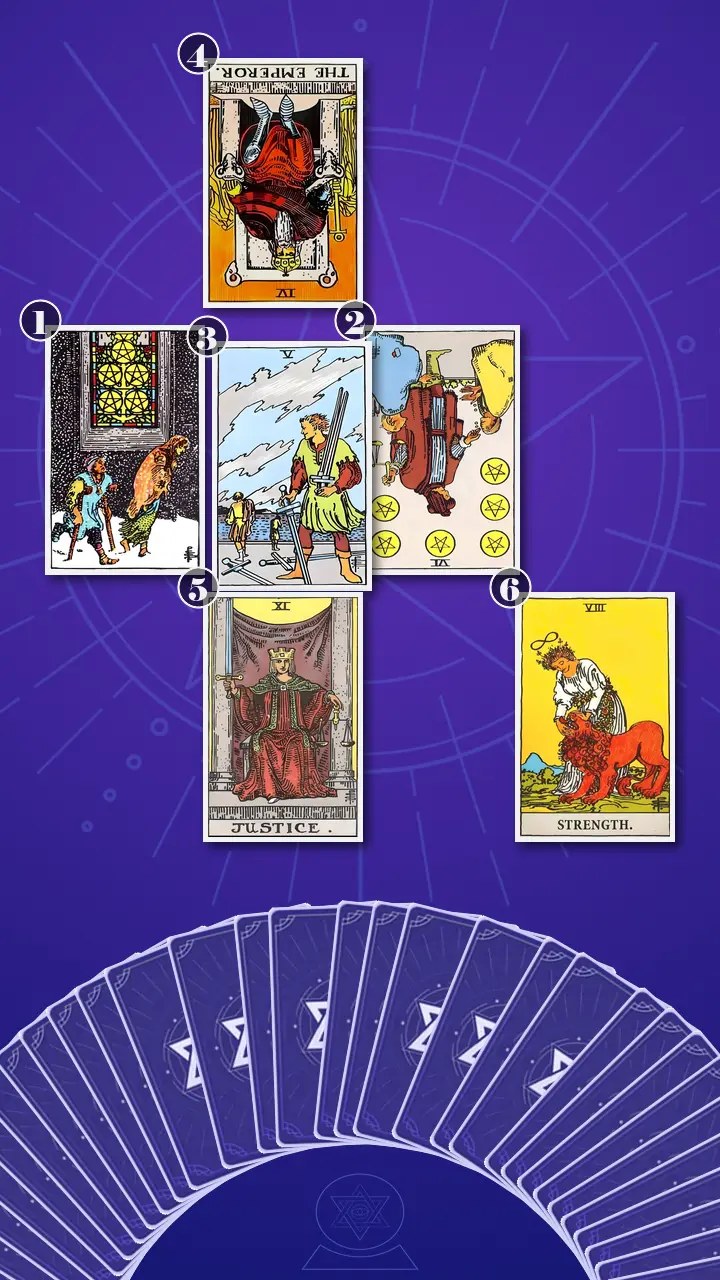
I chose the Relationship Spread · Context Edition. For anyone wondering how tarot works in a question like this, it is a six-card contextualized relationship tarot spread for exploring family support, autonomy, and boundaries. Its structure separates Alex's visible need, the family's resource position, the shared escalation, the hidden authority wound, the fairness principle, and the self-directed next step. The context edition sharpens the other-party card around Family Resource Gatekeeping and the challenge around negotiated boundaries. That made it a better fit than a decision spread or an inner-excavation spread: the presenting problem was not simply which option to choose, but why asking for help became a power fight.
The crossed-bridge layout placed position 1 on one side and position 2 on the other, with position 3 at the blocked center. Position 4 rose above the conflict as the hidden authority wound; position 5 grounded it below with explicit terms and reciprocity; position 6 opened a side path toward regulated courage. I told Alex that we would read card meanings in context, position by position, and keep the final decision with her.
The Lit Window at the Threshold
Position 1: The Five of Pentacles at the Threshold
“Now flipped,” I said, “is the card representing the querent's visible stance when asking for help: the concrete request and the emotional energy of needing support while trying to appear self-sufficient.” It was Five of Pentacles, in upright position.
The two figures in the card move through snow beside a lit stained-glass window. Like them, Alex was outside a family resource she could technically approach: at the kitchen counter or on the TTC, she opened a draft about one practical expense and turned one sentence into a case for her competence. The need was real, but asking felt like standing in public without a coat.
Upright, the card's energy showed a deficiency of felt safety, not a prophecy of deprivation and not a verdict on her worth. The bent posture and nearby light showed a person deciding whether she was allowed to be visibly in need. I asked, “When you last asked family for a practical favor, what did you write to prove you had already tried everything before stating the one thing you needed?”
Alex did not nod. She gave a small, bitter laugh, rubbed her thumb along the edge of her phone, and said, “I asked for help, but I made it sound like a press release proving I had already tried everything.” I answered, “That is a protection strategy, not a character flaw. The card is showing the weight at the threshold so we can name the request without shaming the person carrying it.” Her shoulders lowered a fraction, though she kept the phone in both hands.
The Offer With an Invisible Admin Setting
Position 2: The Six of Pentacles Above the Exchange
“Now flipped,” I said, “is the card representing the family's resource position, the way practical support is offered, controlled, or made conditional.” It was Six of Pentacles, in reversed position.
A family member might offer to cover or handle a practical gap, then pair the offer with a preferred job, housing plan, spending rule, or ongoing check-in. Before Alex clarified which part she needed, she was arguing about whether accepting the resource gave relatives a vote in the rest of her life. The elevated hand distributing coins became a modern image of a shared phone plan where the person paying also expects admin access to every setting.
Reversed, the Six showed a blockage in the giving-and-receiving circuit: resources were present, but the exchange did not feel level. The uneven scales were not proof that the giver meant harm; they showed why family financial help with strings attached can feel like an unpaid future invoice for obedience. I told Alex, “Support is not a vote on your whole life. A condition may be a real term of an offer, but it is not automatically authority over every choice.”
“So the card says they are controlling me?” Alex asked. I kept the card between us. “It says the structure feels unequal and needs clarification. We do not have to decide their motive before we separate the offer, the condition, and the decision that remains yours.” She turned her phone face down and took a slower breath; the practical question began to reappear.
The iMessage Victory That Lost the Question
Position 3: The Five of Swords in the Center
“Now flipped,” I said, “is the card representing the interaction pattern that turns a request into a power fight: the sequence between need, condition, defense, and counter-control.” It was Five of Swords, in upright position.
The figure collecting abandoned swords after the confrontation matched the aftermath I had heard in Alex's texts. One “you should” message became a ten-paragraph iMessage about respect, gratitude, and every previous attempt to control her. I heard the inner replay like this: “I asked for X -> they added Y -> I proved Z -> now nobody is discussing X.” She could finish with the strongest evidence and sharpest final line, yet the practical request would still be unanswered while both sides walked away from the shared problem.
Here Air was overactive: analysis, rebuttal, mental replay, and the urgent need to establish who was right. The Five of Swords was the central blockage, not because Alex was the sole cause of conflict, but because being right had begun to substitute for being heard and getting the need addressed. “The goal is not to win the exchange,” I said. “It is to keep the request visible.”
At first, Alex's thumb froze above the last blue bubble and her breath stopped halfway in. Then her eyes went unfocused, as if the message thread were replaying in front of her. Finally, a hollow “oh” left her chest and her shoulders dropped. “I can win the wording and still be sitting with the bank alert,” she said. I asked her to distinguish protecting a boundary from prosecuting the entire relationship. The distinction did not make her less justified; it gave the original need somewhere to stand.
The Stone Throne Beneath the Text Thread
Position 4: The Emperor Under the Argument
“Now flipped,” I said, “is the card representing the hidden authority wound beneath the argument, the deeper fear that keeps the conflict saturated with questions of control.” It was The Emperor, in reversed position.
The stone throne, the armor beneath the red robe, the ram heads, and the barren mountain landscape made authority look hardened and inflexible. An ordinary condition, such as discussing how the help would be used or when Alex would check in, landed as a future rule about where she lived, what work she took, or whose approval she needed. She was responding to feared future authority before clarifying what authority the current offer actually contained.
Reversed, The Emperor showed authority hardened into rigidity or overreach, but it also exposed a second blockage: Alex's protective system had started treating any structure as a takeover. This did not make the family harmless or make her alarm irrational. It asked a narrower question: which authority was actually present in this exchange, and which authority had older conflicts imported?
At this point I used my signature diagnostic lens, Generational Trauma Excavation. I use that phrase carefully: I trace repeated family behavioral loops across multiple generations to remove personal blame, not to diagnose Alex or put relatives on trial. We looked at the layer beneath the current phrase: support becomes advice, advice becomes obedience, and obedience becomes a threat. I did not need to prove which ancestor laid the first stone; I needed to show that an old loop could be present without becoming Alex's fault or her permanent future.
My years at Cambridge and on archaeological digs returned to me then. A buried foundation can explain a crack without dictating what gets built above it. I said, “When a relative says what you should do, what future rule do you fear that suggestion will become? How much belongs to this offer, and how much belongs to older conflicts?”
Alex pressed two fingers to the table. “I hear, ‘We help only when you follow our plan,’ even before anyone has said that.” Her eyes went to the Emperor's armor, then away. I did not tell her to ignore the alarm. I invited her to name it precisely, because a named fear could be checked against the actual terms instead of steering the whole conversation.
Justice Makes the Terms Visible
Position 5: Justice Below the Conflict
“Now flipped,” I said, “is the card representing the boundary and reciprocity principle that can interrupt the cycle, the terms that must be named so help does not automatically become decision-making authority.” It was Justice, in upright position.
Justice did not ask Alex to forgive, submit, or declare her family good. Its balanced scales, upright double-edged sword, symmetrical pillars, and direct gaze asked for proportionate facts: what was requested, what was offered, what was expected, and what choice remained hers. The modern translation was simple: “I am asking for this specific support. I will decide how to use it. If that condition does not work for you, I will make another plan.”
To make the card usable, I opened a new Notes page and wrote four headings: What I need, What they are offering, What they expect, and What I decide. Under the fourth heading, Alex wrote the housing or career decision that would remain hers. I told her, “A condition tells you the terms of an offer; it does not automatically decide your life. If the terms do not work, a clear no is information, not a verdict on your independence.”
At first, Alex tried to put the entire family history under “What they expect.” I asked her to keep that history in a separate note rather than using it to negotiate this one exchange. “I do not have to judge the whole family to clarify this one exchange,” she said slowly. Outside, a streetcar bell sounded, and a band of window light fell across the four headings like a small set of balanced scales.
The page looked almost embarrassingly plain. Alex crossed out two assumptions, reread the actual condition more slowly, and left the concrete terms intact. Justice brought clear Air back into balance: not emotional denial, not a courtroom verdict, but language precise enough to reduce the need for a defensive case.
When Strength Replaced the Struggle for Dominance
Position 6: Strength Opens the Side Path
The room became still when I moved to the lower right of the crossed bridge. The radiator clicked off, the city traffic thinned, and the warm phone in Alex's hands became the only bright object between us.
“Now flipped,” I said, “is the card representing the self-directed next step in communication: the practical exit that lets vulnerability and autonomy occupy the same sentence.” It was Strength, in upright position.
The woman on the card rests a calm hand on a lion rather than forcing it down. The infinity symbol, white robe, and flower garland give the scene patience and continuity. As the Bridge card, Strength does not ask Alex to make the family agree. It asks her to stay in contact with her own authority while intensity is present. Its invoked energy is regulated courage, self-possession, compassion without submission, and the ability to hold a firm boundary without turning it into an attack.
The modern translation was immediate: during a family call, Alex might notice her jaw tighten, pause, and say, “I appreciate the offer, and I will make the final decision about what happens next.” No ten-minute evidence dump, no demand that the other person approve her boundary, and no need to mute the feeling or overpower the conversation.
This was where I used Inherited Belief Stratigraphy, an archaeological lens I developed for separating authentic values from obsolete, fear-based beliefs passed down through a family. On the top layer, Alex found values she actually chose: privacy, self-direction, and mutual care. Beneath it sat a rule that sounded inherited rather than true to her: accepting help means owing obedience. We could preserve care and bury that rule. Strength did not erase the older layer; it stopped letting the layer write the next sentence.
“At 8:47 PM on the TTC, you are not writing a request so much as assembling a defense: the practical need is one sentence, the evidence of competence is a page, and one family condition makes your hand hover over Send.”
“You do not have to win the power fight before asking for support. The clearer move is to name the specific help you need and the choice that remains yours. A family condition can be part of an offer without becoming automatic authority over your life.”
You do not need to tame the relationship by force; choose steady, bounded honesty and let Strength's gentle hand replace the struggle for dominance with self-possession.
For one beat, Alex froze: her thumb stopped above the warm phone, her breath held high, pupils widened. A brightness gathered at her eyes. Then her gaze slipped out of focus, replaying the last blue iMessage bubble beside older conversations. Her jaw trembled before her fingers opened. “But if I need the help,” she said in a low voice, “doesn’t that still mean they get a say?” Anger arrived before fear. I answered, “They may have terms. You still choose whether to accept them. A calm boundary does not make an unfair offer fair.” Her lower lip tightened; then her shoulders sank and a surprised laugh left her. I set a ten-minute timer and asked her to write: “I am asking for ___.” “The decision about ___ stays mine.” “I can accept or decline ___ as part of this offer.” I asked her to read them once and notice her jaw, chest, and breathing; sending was optional, and she could return later. “Now, use this new perspective to remember last week,” I said. “Where might one sentence have changed the temperature?”
I named the crossing plainly: this was a small move from frustration, hypervigilance, and defensive over-explaining toward regulated self-possession, explicit boundaries, and clearer reciprocal support conversations. It was not proof that her family would become easy. It was proof that Alex could ask, assess the terms, accept, negotiate, or decline, and remain the author of the decision. “You can ask without handing over the wheel,” I said.
Finding Clarity: Terms Before History
When I laid the six cards beside one another, the bridge became legible. The Five of Pentacles showed a real material need at a lit window. The reversed Six of Pentacles showed support arriving through an uneven gate. The Five of Swords turned that imbalance into sharp Air, while The Emperor reversed revealed the buried authority wound. Justice gave the bridge a level surface, and Strength supplied the side path: a small, steady action that did not require anyone to surrender or dominate.
The loop answered why family support turned into arguments. Accepting help was being interpreted as surrendering control; the request was made defensively; a condition was heard as a threat; the family responded to the defensiveness or restated its authority; the practical need disappeared; and the original fear felt confirmed. The main blockage was not a fixed personality flaw. It was the moment a present offer became a referendum on the whole relationship.
I named the cognitive blind spot carefully: Alex was often answering the feared future rule instead of the actual present condition. She was trying to prove that help could not control her before stating what she needed. The key shift was from proving independence to naming the request, the boundary, and the choice that remained hers before the conversation escalated. That is the answer I would give to anyone asking how to ask family for help without losing autonomy.
The Lineage Artifact Review
For the action plan, I introduced my communication strategy, The Lineage Artifact Review. I asked Alex to treat each inherited belief as an artifact on an archaeological table, not as an eternal law: What did this belief once protect? Does it match the facts of this offer? Does it support mutual care, or does it demand obedience? She could consciously preserve mutual care and bury the rule that gratitude requires access to her decisions. History could remain honored as information without being allowed to run the current negotiation.
From Insight to Action: Keep the Request Visible
I kept the next steps small enough to test. The point was actionable advice, not a perfect script or a promise that one boundary would repair every family conversation.
- The Need-Boundary-Choice ScriptWithin the next week, choose one non-urgent resource or practical task you genuinely need. In a short text or a scheduled ten-minute call, name it in one sentence, add the decision that remains yours, and state the condition you can accept or decline. After you send or say it, wait for the actual response before answering imagined future control.Implementation tip: If the draft feels too bare, keep it bare for ten minutes. If the terms do not work, say, “I understand those are your terms, and I will make another plan.”
- The Lineage Artifact ReviewBefore the next family conversation, set a five-minute timer in Notes and make four headings: What I need; What they are offering; What they expect; What I decide. Ask one clarifying question, such as, “Is this help a gift, a loan, a shared task, or something else?” Then name one condition you can accept and one you cannot, without turning either into a verdict on the whole family.Implementation tip: Keep the older family history in a separate note. If the terms are unclear, ask for time and return with an answer instead of agreeing while activated.
- Strength Pause-and-RepeatBefore a family call this week, put both feet on the floor and notice your jaw, chest, and breathing. Use one line: “I hear your view. I am asking for this specific help, and I will make the final decision about what happens next.” If the conversation shifts into old conflicts, repeat it once, return to the practical terms, and end at a pre-set ten-minute limit.Implementation tip: A pause is not submission. If the exchange becomes insulting, threatening, or unsafe, end it and use another support option; the smallest version is one breath and one repeated sentence.
I reminded her that she could accept, negotiate, decline, or ask for time. A clearer boundary was not a demand for a particular family response. It was a way to keep her authority visible while the offer was assessed.

The Quiet Proof of a Clearer Ask
Five days later, I received Alex's text: “I sent the three lines. They offered a loan with clear terms; I declined the check-in condition and made another plan.” The reply was not perfect. She sat alone in a café, relieved, and reread the thread once.
The practical problem had not vanished, and neither had the family history. But the cards had made the loop observable, and Alex had chosen what to do with what she saw. The tarot did not rescue her or decide her future; it gave her a map. She remained the person who could choose the terms, the resource, the boundary, and whether to cross the bridge. That was the first proof of her shift from hypervigilance and defensive over-explaining to regulated self-possession and reciprocal support.
I leave the same distinction with you: when you need family help, your chest can tighten before you have even hit Send, because receiving the resource feels like handing over the steering wheel and proving you cannot keep your own life. Noticing that tightening is already a small return to your own authority.
If you could ask for one specific thing while keeping one decision visibly yours, what would you want that sentence to sound like?