Waiting for Family Repair Before Letting Go? A Defined Pause

The 11:40 p.m. Family Thread
I opened the session with the sentence I had been waiting to say: “You can map a complicated user journey in Figma, but at 11:40 p.m. you are still moving the same paragraph around an unsent family message because one-more-draft thinking says there is a perfect explanation left.” I met Alex (name changed for privacy) in Toronto a few days after another difficult family call.
Alex described the scene so precisely that I could see it with them: they were sitting on the edge of a condo bed, dragging the same paragraph around on a hot phone while childhood photos stayed open in another app. Blue light stung their eyes, a streetcar ground around the corner below, and the alarm for the next morning kept counting down. The question they brought me was direct: “What am I still trying to fix before I let my family go?”
I heard the central conflict beneath it. Alex wanted to release a family attachment that kept hurting them, but release felt forbidden until the childhood rupture had been repaired, understood, or answered with the right apology. Regret was not an abstract feeling in that room; it was a wet wool coat over the chest, a tight thread around the throat, and a drained heaviness that returned each time an old message was reopened. I said, “I do not think you are failing because the history is still complicated. Let us look at what the repair project is protecting, and let us draw a map toward clarity without asking the cards to make the contact decision for you.”

Choosing a Map for the Unfinished Room
I asked Alex to place the phone face down, take one slow breath, and name the question once without improving it. Then I shuffled slowly. I explained that the pause was not a mystical test; it was a way to move attention from the notification loop into a focused conversation.
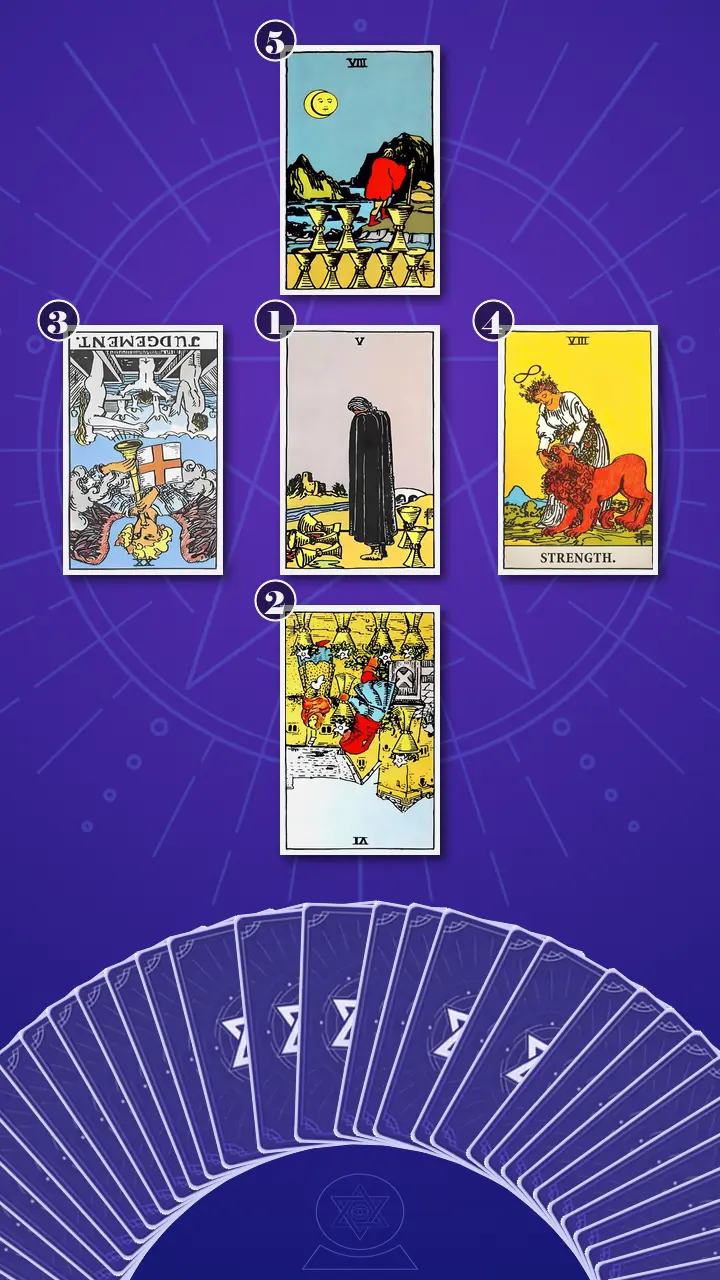
I chose the classic five-card Shadow Spread because this question was aimed inward. A Relationship Spread might pull attention toward relatives’ motives, while a Celtic Cross could introduce more dimensions than Alex needed. This five-card Shadow Spread for family estrangement, childhood repair patterns, and boundary clarity could follow the exact sequence keeping release conditional: the visible regret, the childhood need underneath it, the protective bargain that waits for outside approval, the inner resource available now, and a grounded form of release.
I told Alex, and I also tell anyone reading this, that this is how tarot works best here: as a structured reflection tool. The cards cannot issue a verdict about whether someone deserves contact, predict reconciliation, or command permanent estrangement. They can give card meanings in context, so ordinary behaviour becomes easier to see. We would begin at the centre with the repair project, drop below it to the formative root, move left to the defence pulling attention backward, cross to the right for the unclaimed strength, and rise to the integration threshold above.
“The first card will show what keeps appearing in your conscious behaviour,” I said. “The second will show what childhood need gives today’s messages their extra weight. The third will show why your decision remains pending. The fourth is the resource that can change the pattern, and the fifth asks what release could look like without deciding the entire future tonight.”
Reading the Map Without a Verdict
The Visible Knot: Five of Cups, Upright
I began with the position that identifies the present repair project visible in Alex’s behaviour: the loss, conversation, or imagined family version they kept trying to recover before allowing release. I turned the card and found the Five of Cups, upright.
The three spilled cups immediately brought the late-night family thread back into the room. Alex opened the message intending to check one detail, then spent the evening reconstructing the relationship that should have existed. In the card’s energy, grief had become stagnant water and attention had narrowed into excess. The black-cloaked figure faced the spill so completely that the two upright cups behind them were difficult to notice, even though they remained available. I read those cups as present friendships, self-knowledge, and choices that had not disappeared simply because the family relationship had failed to become what Alex needed. The bridge in the distance suggested movement, but it did not pretend that movement could restore the spilled cups.
I gave the loop a sentence: “If I can reconstruct what spilled, I will not have to accept what was lost.” Then I asked, “When you reopen the thread, are you trying to recover a specific apology, proof that you mattered, a different childhood memory, or permission to stop trying?” Alex let out a short, bitter laugh. “That is too accurate,” they said. “A little cruel, honestly.” I did not rush to soften it. I said, “The card is naming the job regret has been assigned, not judging the grief. You can mourn what was missing without turning mourning into another editing task.” Alex looked down at the spilled cups, then rubbed the edge of their phone with one thumb. The defence had become visible as an active repair project rather than a vague feeling of being stuck.
The Room Beneath the Room: Six of Cups, Reversed
I read position two as the childhood need beneath the fixation and the reason present family contact carries the weight of an earlier rupture. The card was the Six of Cups, reversed.
I brought in the Sunday evening invitation Alex had described. At 6:18 p.m., a warm but vague holiday message appeared in the family group chat as if nothing difficult had happened. Tomato sauce cooled on the stove, the refrigerator hummed, and Alex’s shoulders rose toward their ears before they had decided whether to reply. The adult question was, “Do I want contact this time?” The younger question underneath was, “Does this mean they finally want me in the way I needed?” I read the reversal as blocked childhood energy, not childishness. The flower-filled cup offered between the two children became an unfinished exchange that current relatives were being asked to complete through an adult conversation.
I said, “This card does not ask you to deny the younger part or force it to grow up faster. It asks you to separate honouring what that part needed from requiring today’s family to recreate an old emotional room exactly. A current invitation may be meaningful and still not repair the whole past.” Alex became very still. Their eyes stayed on the small painted cups, and their fingers tightened around the phone before slowly loosening. I asked, “When a family message changes your mood within seconds, what did the younger part seem to want them to notice, defend, say, or do?” I saw recognition arrive with grief rather than relief. The age-shift inside the reaction had become easier to name.
The Pending Approval: Judgement, Reversed
I read position three as the protective function of the shadow: the defence that postpones grief until the family provides sufficient explanation, accountability, or validation. I turned over Judgement, reversed.
The trumpet on the card became the call Alex already heard in the form of exhaustion, repeated behaviour, and the wish to stop resuming the old role. Reversed, the call was treated as incomplete until someone else answered first. I connected it to the Saturday afternoon Queen West cafe scene. Alex had slid the same family exchange across a table and asked a trusted friend to read it again while cups clinked and the espresso machine hissed. Their friend had said, “Your boundary makes sense,” but the reassurance had lasted only a few hours. The energy here was blockage: clear observation was being buried under endless analysis of motive.
I said, “Tell me again that I am allowed,” and then supplied the doubt I had heard in Alex’s account: “But would you agree if you knew everything?” I had spent years on a Wall Street trading floor, where every decision could be sent back through another review until the cost of delay became invisible. I recognised the same false promise here: one more round of peer review would supposedly produce an internal sign-off. But the perfect explanation cannot create willingness on the other side. I told Alex, “Closure is not a permission slip your family has to sign. Repeated behaviour can be information even when motive remains uncertain.” Their stomach tightened; I saw it in the way they folded forward and pressed one palm beneath their ribs. They looked ready to ask a friend for another verdict, then stopped. The major blockage was not a lack of evidence. It was the belief that a boundary would become fair only after everyone agreed with the account behind it.
When Strength Put a Hand on the Send Button
I slowed down before turning the fourth card. The room grew quiet enough for the radiator to click once. This was the position that identifies the emotional capacity Alex could use to care for the younger self without making family repair a prerequisite for safety, worth, or belonging.
The Antidote: Strength, Upright
I turned over Strength, upright. The woman’s relaxed hands around the lion’s mouth showed intensity being met without suppression, obedience, or force. I connected it to the modern scene Alex knew well: one more comprehensive explanation open on the phone, a hand hovering above the send button, and a present-day adult asking what the younger part hoped the reply would provide before anyone in the family had a chance to answer. The energy was balanced, steady fire. It was not the force required to win an argument. It was compassionate courage, emotional regulation, and practical self-parenting.
At this point I used my signature diagnostic lens, Guilt-Debt Neutralization. I explained, “When guilt arrives as an emotional invoice, I audit it before I pay it. What part is verified? What part is an old belief that you owe access, reconciliation, or another explanation in order to prove you belong? A feeling of guilt is real information, but it is not automatically a debt.” I was careful not to assign motives to Alex’s family. The point was not to label anyone or erase accountability. It was to stop treating a surge of guilt as proof that Alex owed an immediate response. The steady hand on the lion became the steady hand on the phone: feeling the intensity, acknowledging it, and choosing before it composed the next message.
Alex was still caught in the familiar calculation. The unsent message remained open, old photos sat behind it, and tomorrow’s alarm kept getting closer. They were editing language, but the hope attached to the draft was much older than tonight’s conversation. The question was no longer only whether the wording was fair; it was whether a reply could finally make the younger self feel protected and included.
You do not have to keep wrestling the past until it submits; Strength asks your adult self to meet the hurt with the steady, compassionate hand shown resting on the lion.
For a moment, Alex’s breath stopped. First, their fingers froze above the phone and their face went blank, as if the sentence had interrupted a physical reflex. Then their gaze lost focus; I could see old scenes and recent messages being replayed behind their widened eyes, each one carrying the same request for recognition. Finally, a small sound came from the back of their throat. Their shoulders lowered, their clenched hand opened against their knee, and their eyes grew bright without spilling over. The relief was real, but it arrived with a slight dizziness, the vulnerable blankness of having no new argument to prepare. Alex exhaled in a shaky line and said, “I could care for that need before deciding what to send.” I asked, “Now, use this new perspective to remember last week. Was there a moment when this insight might have made you feel different?”
I told Alex that this was the first step from regret-driven repair and external verdict dependency toward compassionate self-authority, grounded grief, and a clearer choice about family contact. It did not mean forgiving the family, abandoning hope, or deciding on permanent separation. It meant that care for the hurt part could begin before a reply. The adult self could believe the pain without first winning a unanimous ruling about it.
The Moonlit Gap in the Cups
A Path That Does Not Destroy the Archive: Eight of Cups, Upright
I read position five as the integration threshold: a grounded form of stepping away from compulsive repair work while retaining freedom to choose future contact according to present evidence and values. I turned over the Eight of Cups, upright.
The cloaked figure walked away from eight carefully arranged cups, but did not smash them. That gap mattered. I translated it into a simple scene: Alex could place existing drafts in an archive, turn the phone face down, and pause new explanations for seven days without pretending the relationship had never mattered. The emotional water that had been pooled in regret could begin to move. The moonlit path was not bright certainty, and the mountains did not promise an easy route. They showed considered movement supported by the staff in the figure’s hand.
I said, “This card does not order permanent no contact. It asks whether emotional release can stop being conditional on one more family response. You can leave the repair project for a defined period while keeping the future open.” Alex swallowed, then gave a small nod that held both sadness and relief. “I am not declaring that none of this mattered,” they said. “I am seeing what becomes visible when repair is not tonight’s assignment.” I watched their phone turn face down. The messages remained intact. The meaning of the gesture was not abandonment; it was a temporary change in investment.
From Insight to Action: A Boundary With a Review Date
When I gathered the five cards into one story, I could see a clear sequence. The Five of Cups showed regret staring at what had spilled. The reversed Six of Cups showed the childhood need that kept asking the present to reopen an old room. Judgement reversed showed the protective bargain: no release until the family or a trusted audience supplied the final verdict. Strength introduced the missing capacity, a steady adult presence that could believe, protect, and comfort the hurt part before anyone replied. The Eight of Cups then offered movement without erasing significance.
I named the cognitive blind spot plainly. Alex had been treating every contact choice as a moral sentence on the entire family history, so even a temporary pause felt like proof of failure. The key shift was smaller and more practical: before initiating another repair conversation, name the childhood need the conversation is meant to meet, then choose one present-day act that meets part of it without requiring family participation. That is how insight becomes actionable advice rather than another idea to analyse.
I also introduced my Strategic Disengagement Plan. I use that phrase for a calculated, time-limited way to reduce the channels that keep a painful pattern in control of attention. It is not punishment, a demand for permanent estrangement, or a way to make the family understand. It simply reduces the leverage of late-night notifications, unsent drafts, and immediate replies long enough for Alex to observe present-day capacity. A temporary boundary can be information, not a life sentence.
- The Before-Contact Need CheckBefore opening or replying to a family message this week, Alex will open Notes and spend ninety seconds with both feet on the floor. They will write, “What I needed then was...” and “One part of that need I can offer myself today is...” Then they will decide whether the draft serves the present-day adult or repeats the childhood request for recognition.The smallest version is one sentence or thirty seconds. If noticing the body feels overwhelming, stop and switch to a neutral grounding task; the contact decision can wait.
- The Strategic Disengagement PlanFor seven days, Alex will place existing family explanations in a folder marked “Review After [date],” mute the family group chat during sleep and focused work hours, and keep a ten-minute review appointment at the end of the pause to notice changes in sleep, concentration, urges, and recovery after contact.Define any genuinely necessary exception in advance. The pause can be shortened, extended, revised, or ended; its purpose is observation, not a permanent ruling about the relationship.
I made one distinction especially clear: caring for the younger part does not let the family off the hook. It does not erase the record, cancel a desire for accountability, or guarantee that future contact will work. It only prevents immediate protection from being held hostage by the next response. Alex could still want an apology and still choose contact later. For tonight, the work was to stop asking one message to repair an entire childhood.
I also reminded Alex that a five-card Shadow Spread for family estrangement, childhood repair patterns, and boundary clarity is most useful when it returns to observable life: the family group chat, the unsent explanation, the tight throat, the reassurance loop, the reviewable boundary. The cards had clarified the emotional bargain. Alex remained the person who would decide what happened next.

Ownership, Not Certainty
A week later, Alex sent me a message: “I used the two lines, archived Draft 27, and muted the chat until morning. I still want them to understand, but I did not make understanding the assignment last night.” The change was small and measurable, not a solved life. Alex slept through one night, woke with the familiar thought, “What if I am wrong?” and smiled before making coffee. The morning was clearer, but not completely light.
I thought of that as the quiet proof of a Journey to Clarity. The Shadow Spread had not chosen low contact, no contact, reconciliation, or permanent distance. It had helped separate grounded grief from mutual repair, and it had returned the authority for the next choice to the person living it.
When your throat tightens over one more unsent explanation, stepping back can feel less like ending an argument and more like admitting that the home you needed may never confirm that you belonged. Belonging can be practised now, even when the past remains disputed.
If you did not need a final family verdict tonight, what small form of belonging might your present-day self want to make room for?