The Old Role Inside an 11:40 p.m. Thread
I know the moment: a long-term friend replaces spontaneous calls with scheduled ones, and the inner operating system translates the update into, “If I stop reaching, I’ll find out whether I still matter.” The fingers move before the need has even been named.
At 11:40 p.m. on a Wednesday, Maya, a 28-year-old junior UX designer in Toronto, joined my video room from her apartment after a long hybrid-work day. Blue laptop light flattened the color of the room. Her radiator clicked behind her, and she held her phone so tightly that she eventually glanced down and said, “It’s literally warm.”
She showed me the thread. Her friend had written, “Can we talk later this week?” Maya had typed, “You used to just call me,” deleted it, sent an old university photo instead, and checked the conversation three more times before opening our session.
“I know people change,” she said, rubbing her thumb along the phone case, “but I don’t understand why our friendship has to change with them. I’m only asking for the kind of friendship we already had. Why do I keep pushing them into a role they’ve clearly outgrown?”
I could hear the conflict inside that question. Maya wanted her friend to remain the always-available listener who had once stayed up through university deadlines and breakups. At the same time, she could see the scheduled calls, declined heavy conversations, and new routines telling her that the role had changed.
Her fearful longing felt like bracing both hands against a closing TTC door while the warning chime kept sounding: holding on hurt, but releasing the pressure felt like agreeing to be left on the platform. She was not only reacting to a later call. She was trying to find out whether the old closeness still counted, and whether she still belonged.
“Missing that version of the friendship doesn’t make you unreasonable,” I told her. “But missing a role and being entitled to its continuation are different things. I’m not going to use tarot to claim I know what your friend secretly feels or to predict whether the friendship will last. I want us to identify what is observable, what your fear adds to it, and where you still have a choice. Let’s draw a map through the fog.”

Choosing the Bridge: A Five-Card Relationship Spread
I asked Maya to put both feet on the floor, take one ordinary breath, and hold only the consultation question in mind. I shuffled slowly, not as a supernatural performance, but as a transition from refreshing the same thread to examining the pattern with attention.
I chose a five-card Relationship Spread because the question involved two people, a shared history, a recurring source of friction, and a possible way forward. A larger spread would have produced more information than we needed. This structure was precise enough to separate Maya’s behavior from her friend’s observable boundaries without pretending that a tarot reading granted access to another person’s private thoughts.
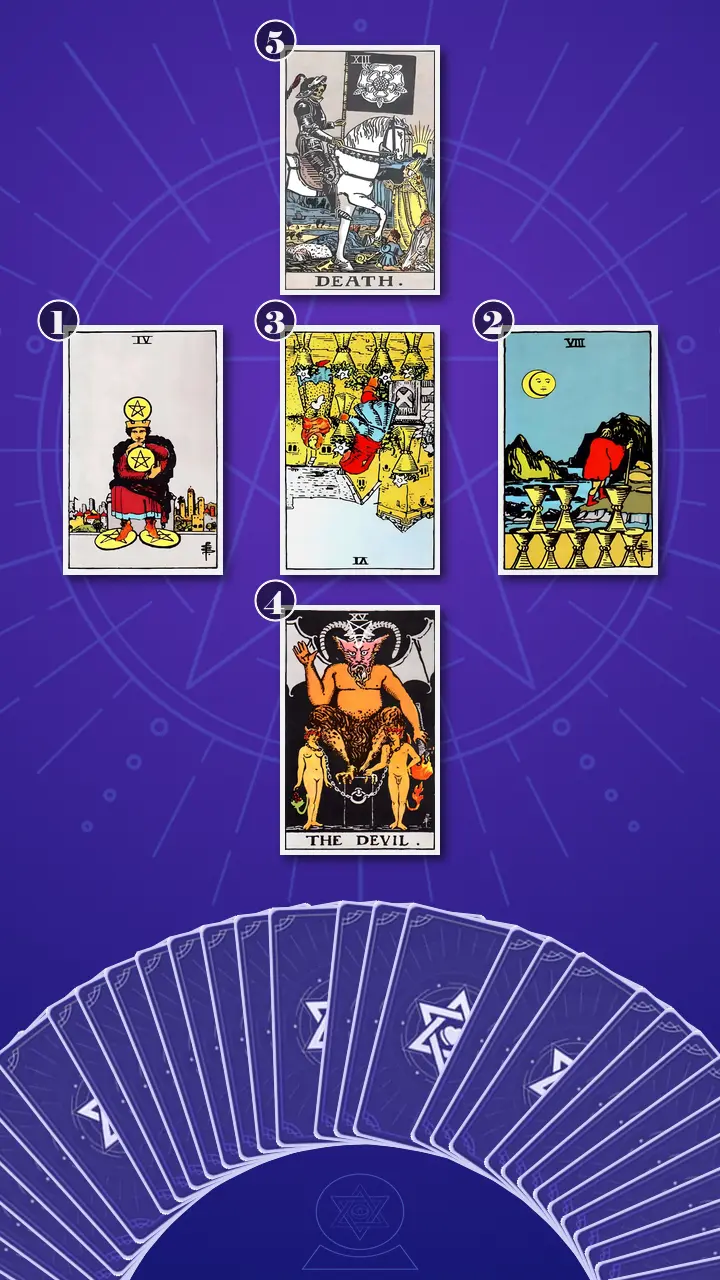
I arranged the cards as a cross. The first position would show how Maya was trying to hold the familiar role in place. The second would examine the friend’s visible movement through changed availability. The center would reveal what shared history had become. Beneath it, I would look for the fear sustaining the cycle. Above it, the final card would offer guidance for finding clarity about current mutual capacity.
This is how tarot works at its most useful for me: not as a verdict machine, but as a structured cognitive tool. The cards give shape to competing facts, feelings, and assumptions. The person across from me still decides what to say, what boundary to respect, and what relationship they are willing to participate in.
Reading the Friendship in Its Present Tense
Position One: The Grip That Calls Itself Care
I turned over the card representing the reminders, monitoring, and repeated bids through which Maya tried to preserve familiar access. It was the Four of Pentacles, upright.
In the Rider-Waite-Smith image, a figure presses one pentacle against his chest while pinning two more beneath his feet. A city sits in the distance, visible but separate. I asked Maya to notice how difficult movement becomes when security depends on keeping every access point fixed.
In her life, the card was almost literal. Her friend wrote, “Can we talk later this week?” Maya immediately compared that message with spontaneous university-era calls, checked the thread repeatedly, and considered using a photograph to pull the conversation back into its old shape. Her read receipts had become a tiny relationship dashboard, even though response time could not tell her what the bond meant.
I read the card as an excess of fixed earth energy. The wish for security was understandable, but control had started doing the job of trust. Each extra message briefly reduced the pressure in Maya’s chest, which taught her nervous system to reach again the next time contact felt different. The short-term reassurance maintained the long-term role lock-in.
“When your friend says they can’t call tonight,” I asked, “what do you actually do next?”
Maya gave one sharp laugh, but there was no amusement in it. “That’s so accurate it’s almost cruel. I wait about two minutes, tell myself I’m being chill, and then send something that makes it harder for them not to answer.”
I did not let accuracy become an indictment. “The card isn’t calling you cruel,” I said. “It is making the sequence visible. Wanting reassurance is a need. Designing the interaction so another person has less room to decline is a behavior. Once we separate those two things, the behavior becomes changeable without shaming the need beneath it.”
Position Two: The Path Beyond the Old Arrangement
I turned over the card representing the friend’s observable movement beyond the old role, including scheduled calls, firmer limits, and new routines. It was the Eight of Cups, upright.
The cloaked figure walks away from eight standing cups toward a difficult mountain path. The cups have not been smashed. They remain upright, and that detail mattered. I did not read this as proof that the friend wanted to abandon Maya. I read it as evidence that one emotional arrangement no longer appeared workable in the same form.
Maya could observe that her friend now preferred Google Calendar to spontaneous midnight calls, sometimes declined emotionally heavy conversations, and spent time with a newer social circle. Her mind then added a conclusion: “They have time. They just don’t choose me.” An Instagram Story could show a crowded dinner table, but it could not disclose capacity, motive, or the full meaning of a friendship.
I read the Eight of Cups as balanced movement that Maya experienced as threat. Her friend seemed to be updating their operating system while Maya kept asking the new version to run the same emotional software. That update might alter the rhythm, but the card did not say the entire relationship had been deleted.
“Their changed capacity is information, not a verdict on your worth,” I said. “What have they actually changed, and what story do you attach to those facts?”
Maya’s shoulders rose before she answered. She looked away from the cards and toward the dark window. “They ask to schedule things. They say no when they’re drained. The story I attach is that they can still be spontaneous, just not with me.”
“That story deserves to be heard,” I said, “but it still needs to be distinguished from the observation. ‘They offered Thursday’ is a fact. ‘I have lost my place’ is an interpretation. Both can exist in your mind, but they are not the same category of evidence.”
Position Three: When a Memory Becomes a Standing Obligation
I turned over the center card, representing the shared history that connected them and the outdated script that history had begun to carry. It was the Six of Cups, reversed.
Upright, the flower-filled cup can be a tender gift from the past. Reversed, I saw that gift acquiring terms and conditions. In Maya’s current pattern, an old university photo or inside joke began as a real expression of affection, then quietly became evidence that the friend should still provide the same availability now.
The reversal showed blocked water energy. Instead of allowing memory to move through the present, Maya was redirecting every changed interaction back toward an earlier courtyard, an earlier schedule, and two earlier versions of themselves. A formerly voluntary act of care was being treated like a permanent friendship duty.
“A memory can be precious without being a contract,” I said.
Maya picked up her phone, opened the photograph she had sent, and then locked the screen without showing it to me. Her fingers tightened, loosened, and settled on the table. “But if the history doesn’t count for anything, what was the point of ten years?”
“It counts as history, intimacy, and real care,” I replied. “It just cannot obligate either of you to keep performing the same job forever. I’m also not asking you to overcorrect by disappearing, never initiating again, or pretending the friendship meant nothing. The question is whether the past can remain a foundation instead of becoming a job description.”
The Loose Chains Beneath the Read Receipts
Position Four: The Bargain That Keeps Asking for Proof
I turned over the card representing the hidden fear that a changed role would remove Maya’s sense of belonging and keep the pressure cycle active. It was The Devil, upright.
I clarified immediately that I was not calling Maya evil, toxic, or incapable of healthy friendship. In the Rider-Waite-Smith card, two figures wear chains, but their collars are loose enough to remove. I read the card as a blockage created by repeated participation, not an unchangeable character flaw.
The modern version of the chain appeared whenever Maya checked a read receipt, tested whether her friend would still respond on demand, or added more context after a clear limit. Beneath those actions sat a private bargain: “If they answer now, I’m still important. If they don’t, I have to try again.” Maya wanted closeness, while the resulting pressure left the friend less room to choose closeness freely.
An old trading-floor instinct surfaced in me. I remembered how easily a polished dashboard could create the feeling of objectivity while measuring the wrong variable. Maya had response times, cancellations, initiation counts, and Instagram evidence. None of those metrics could calculate consent, warmth, repair, or mutual willingness.
I brought in a framework I call Reciprocity ROI Analysis. I do not use it to price affection. I use it to examine the current emotional give-and-take: who has room to offer what, whether care is voluntary, whether limits are respected, and whether one person’s sense of security depends on the other person performing unpaid emotional labor on demand.
Maya’s dashboard measured access, not reciprocity. The asymmetry was not simply that one person cared more. It was that Maya’s reassurance depended on an immediate response, while her friend’s current capacity required the freedom to say, “Not tonight.”
Her breathing stopped first. Her index finger remained suspended above the phone as if the next refresh had been interrupted mid-command. Then her eyes lost focus, and I could almost see her replaying the follow-up messages in sequence. Finally, she released a breath from low in her chest and lowered both hands into her lap.
“But I’m not trying to control them,” she said. Her voice was smaller, but firmer. “I’m trying to stop us from drifting.”
“I believe you,” I said. “Your intention is to recover closeness. I’m asking you to look at the effect as well. Pressure can create the very distance it was designed to prevent. That doesn’t make the wish for closeness wrong. It means the strategy is charging you both more than it returns.”
I pointed back to the loose collars. “One loose chain can be ten minutes between the urge to send a second message and the decision to send it. The first message stays. Your care stays. You simply interrupt the automatic rule long enough to say, ‘I can care about this bond without making this reply prove it.’”
When Death Raised the White Rose
Position Five: Releasing the Role Without Erasing the Friendship
The radiator behind Maya stopped clicking, and for a moment the room on my screen became unusually still. Somewhere beyond her window, a distant streetcar bell sounded once. I turned over the final card, the guidance position showing the shift from preserving an expired role to renegotiating a friendship around current capacity.
It was Death, upright.
I told Maya plainly that Death did not predict literal death, disaster, or even the inevitable end of the friendship. In this position, it represented the necessary end of the always-available listener assignment. The black banner’s white rose held grief and renewal in one image; the rising sun suggested a new form could be explored, but did not guarantee what that form would be.
I watched Maya return to the familiar binary: either her friend resumed the old role, or the friendship had meant less than she thought. Her hand closed around the phone again. She wanted closeness without making history a contract, but she could not yet picture a third option.
Closeness is not preserved by keeping an expired role alive; it becomes more honest when you let that role end and follow Death's white rose toward a form both people can choose now.
I let the sentence sit in the quiet.
For one beat, Maya did not breathe. Her thumb stopped against the black screen, and the muscles beside her mouth became completely still. Her pupils widened. Then her gaze moved past me as if she were replaying every declined call, old photograph, and “just checking in again” message. Her jaw tightened instead of softening. “But doesn’t that mean I got the last few years wrong?” she asked, with a sudden flash of anger. “Like I turned loyalty into something bad?” As soon as the words left her, her shoulders dropped by an inch. Her fingers uncurled one at a time, and her next exhale caught somewhere between a laugh and a sob. Relief arrived with a brief, almost dizzy blankness: the uncomfortable realization that the next message was hers to choose. Her eyes reddened, but she kept looking at the card.
“No,” I said. “It means a form of care that once worked stopped fitting, and fear made repetition feel safer than renegotiation. Loyalty is not bad. Grief is not failure. You can honor what happened without requiring the same arrangement to continue.”
I asked, “Now, using this new perspective, think back to last week. Was there a moment when this insight might have made you feel different?”
Maya was quiet for several seconds. “Thursday,” she said. “They offered Saturday instead of that night. I heard ‘no’ and ignored the fact that Saturday was still an offer. I sent three more messages because I wanted the old answer.”
This was where I used Sunk-Cost Decoupling in Loyalty, another framework shaped by my years in high-stakes finance. I was not reducing a friendship to an asset or calling ten years a waste. I was separating two variables that fear had fused together: the value of everything already shared, and the suitability of the current arrangement.
Past investment can establish that something mattered. It cannot, by itself, decide what either person must offer next. Ten years of friendship is evidence of ten meaningful years, not an invoice for future availability. Decoupling those facts allowed Maya to keep the history without using it to overrule current consent.
I gave her ten quiet minutes with two private lines: “The role I keep asking for is…” and “A present-tense question I could ask is…” I told her she did not have to send anything. If her chest tightened beyond what she wanted to hold, she could put the phone down and return only if and when it felt like her choice.
She wrote, crossed out her first answer, and tried again. Then she read the second line aloud: “What kind of friendship feels mutual for us at this point?”
I placed the Death card back above the center of the spread. The insight did not remove uncertainty. It changed Maya’s relationship to it. I could see the first movement from fearful, nostalgia-driven role preservation to grief-tolerant, present-tense mutual connection. She was moving from control toward curiosity, with no promise that curiosity would produce the answer she preferred.
From an Old Job Description to a Present-Tense Friendship
I laid the five cards back into one continuous story. The Four of Pentacles showed Maya clutching familiar access because predictability felt like belonging. The Eight of Cups showed observable movement away from the old arrangement. The reversed Six of Cups explained why that movement hurt so sharply: shared history had become a script for present behavior. The Devil exposed the bargain beneath the script, and Death asked Maya to release the role before deciding what the entire friendship meant.
The spread moved through three visual verbs: clutching, chaining, and releasing. Maya had been trying to preserve a living friendship inside an old photograph. Each reminder of who her friend used to be briefly steadied her, but it also pinned both people inside roles formed when they had different schedules, identities, and emotional capacities.
Her central blind spot was not that she cared too much. It was that she treated sameness as the most reliable proof of care. A scheduled call could therefore feel like rejection even when it was also an honest offer. By measuring closeness through familiar access, she missed the possibility that a different rhythm might be a renegotiation rather than a verdict.
I also noticed that the spread contained Pentacles and Cups, but no Swords or Wands. Maya had earth for tracking behavior and water for grief and memory. What was missing was air, clear language, and fire, one deliberate change in behavior. I translated those missing elements into three small next steps:
- The Two-Minute Expired-Role Note.After the next message that changes or limits availability, open a private note and complete: “What I miss is…”, “What I am treating as an obligation is…”, and “What I actually know today is…” Circle only the last line before replying.Keep the first draft factual and private. Use a two-minute timer; the task is separation, not solving the whole friendship.
- The Loose-Chain Response Pause.For one trigger this week, send no follow-up for twenty minutes after a boundary. Put the phone face down, take six ordinary breaths, and write: “I want to send another message because I am afraid…”A pause is not punishment or silent treatment. If twenty minutes feels unmanageable, use five minutes and choose again.
- The Present-Tense Friendship Check.If a conversation feels appropriate, send one message before the end of the week: “I’ve noticed our way of staying close has changed. What kind of friendship and contact feels mutual for you right now?” Choose a specific time to check for the reply.Do not attach screenshots, response-time evidence, or a case file from university. Listening does not require instant agreement, self-erasure, or acceptance of terms that do not work for you.
I also explained where my Friendship Downgrade Strategy might fit, but I did not prescribe it before the conversation. If Maya learned that the available level of contact was genuinely incompatible with what she wanted, she could gradually retire the emergency-listener expectation, reduce high-intensity bids, broaden her support network, and allow the bond to become a lower-maintenance acquaintance. That would be a boundary around her own investment, not a punishment, test, or dramatic exit.
“Let the role end before you decide what the friendship means,” I told her. “Their answer may offer a new version of closeness, a quieter connection, or a real mismatch. Tarot cannot choose among those realities for you. It can help you meet the answer without forcing it to resemble the past.”

A Week Later, the Phone Stayed Face Down
A week later, Maya messaged me: she had sent the mutual-capacity question, put her phone face down, and sat alone in a Queen Street café through one cold coffee. She felt steady and sad. The friendship was not solved; the second message simply never left her drafts.
That was the quiet proof I trusted. Maya still wanted a particular answer, and the old rhythm still hurt to miss. What had changed was her willingness to let the reply contain information instead of treating it as a referendum on her worth. She had not reached certainty. She had reclaimed authorship over her next action.
I never think of a Journey to Clarity as a moment when cards remove every unknown. I think of it as the moment a person can see the difference between love and control, memory and obligation, observation and interpretation. The cards provided the structure. Maya supplied the honesty, the restraint, and the courage to ask a real question.
If someone who once answered at midnight now asks to schedule a call, I know how quickly the chest can tighten and the warm phone can start feeling like the last proof of belonging. I want you to remember that noticing the grip is already a movement. A changed role can be grieved without being forcibly revived, and a meaningful history can remain yours without becoming a contract.
If the old always-available role could rest beside Death’s white rose as a chapter rather than a job description, what present-tense question would you quietly ask about the friendship both of you can choose now?
This story is adapted from psychological research, written so that those in a similar struggle can see their own pattern in it — and find their next step clearly.These insights are not a substitute for professional psychological, medical, legal, or financial advice.
Learn more about our Journey to Clarity.
How did this insight land for you?
🫂 This Resonates Deeply
🌀 Living This Story
✨ Now I See Clearly
🌱 Seeing New Possibilities
🧰 Useful Framework
🔮 The Confirmation I Needed
💪 Feeling Empowered
🚀 Ready for My Next Step
Author Profile
 AI
AI“I spent years in the intense, high-stakes world of Wall Street. I know exactly how isolating and heavy the weight of uncertainty can feel in the dead of night. I use strategic, commercial logic not to be cold, but to protect you from unnecessary friction. Think of me as a fellow traveler who has walked the same rocky path—offering sharp but deeply supportive wisdom to help you clear the fog and confidently win your narrative back.”
In this Friendship Tarot Reading :
Core Expertise
- Reciprocity ROI Analysis: Objectively measuring the emotional give-and-take in your core friendships to identify asymmetrical, high-drain relationships.
- Sunk-Cost Decoupling in Loyalty: Separating the 'ten years of history' from the current reality of a one-sided, demanding friendship.
Service Features
- The Friendship Downgrade Strategy: A calculated tactical approach to gradually and decently de-escalate a toxic friendship into a low-maintenance acquaintance without triggering dramatic conflict.
Also specializes in :
Explore Related Patterns:
Anxious AttachmentMaya's friend offers a later call, and Maya's mind converts that scheduling change into a test of whether she still matters. She reaches before naming the need, monitors the reply, and experiences releasing pressure as being left behind; changed access therefore registers as a threat to belonging rather than simply new information about availability. When a bond is made to prove belonging on demand, you may seek contact not only for connection but also to settle whether your place is secure. The key distinction is not between caring and becoming detached. It is between wanting closeness and assigning every reply the job of regulating your worth, which makes an outdated role feel essential even after the relationship's capacity has changed.
Boundary DiffusionMaya's friend says not tonight or offers another day, and Maya responds with more context, a nostalgic cue, or additional messages that make declining harder. Her need for reassurance and her friend's responsibility to provide it begin to occupy the same psychological space. Boundary diffusion does not mean that your need is unreasonable; it means the line between wanting something and being entitled to receive it has become difficult to hold. Restoring that distinction protects both sides of the relationship. You can make a direct request, hear the current limit, and then decide what level of friendship works for you without overruling the other person's separate capacity.
Control CopingMaya turns a scheduled call into a sequence she can manage: compare it with the past, inspect the thread, send a memory cue, and consider another message. The sequence converts relational uncertainty into observable actions, but it also shifts control from her own response toward the conditions under which her friend is expected to respond. Control coping often begins as an attempt to create safety, not as a conscious wish to dominate another person. You may be trying to protect closeness while using tactics that leave the other person less room to choose it freely. Auditing intention and effect separately makes the strategy changeable: you can keep the wish for connection while returning control to the part that is actually yours, including the timing, wording, and number of your own messages.
Friendship Role RegressionMaya compares every scheduled call with the spontaneous university-era friendship and keeps seeking the listener who once stayed up through deadlines and breakups. The history is real, but it becomes an old job description that she tries to reactivate whenever the present relationship feels uncertain. Role regression pulls a changing relationship back toward a period when each person's identity, schedule, and emotional capacity were different. You can honor the care attached to an earlier role without treating that role as the only valid form of the bond. The clarifying question is not whether the past counted, but whether both people are still choosing that assignment now.
Nostalgia LoopMaya sends an old university photo when a present-day call is delayed, and the story shows how photographs and inside jokes repeatedly redirect changed interactions toward an earlier version of the friendship. The memory offers real comfort, but it also becomes evidence that the earlier arrangement should be restored. A nostalgia loop uses the past to regulate discomfort with present change, which can make each memory cue briefly soothing and structurally restrictive at the same time. You do not need to abandon the memories to interrupt the loop. The shift is to let them confirm that care existed without using them to determine what either person must provide now.
Protest BehaviorAfter her friend asks to talk later, Maya deletes a direct complaint, sends an old university photo, and later describes sending things that make it harder not to answer. The content appears affectionate, but its immediate function is to test the bond and provoke evidence of continued access after a perceived attachment threat. Protest behavior communicates fear indirectly through actions designed to pull someone closer. You may be asking for proof when what you need is language for disappointment, reassurance, or renegotiation. Naming the need does not guarantee the preferred response, but it removes the hidden test and gives both people more freedom to respond to the actual relationship question.
Reassurance SeekingAfter her friend proposes another day, Maya waits briefly and then sends something that makes nonresponse harder. Each additional message lowers the immediate pressure in her chest, so the short-term relief reinforces the same response the next time contact changes. That reinforcement loop explains why insight alone does not stop the reaching. You may understand that another person is busy and still feel driven to obtain one more signal of safety, because the reply has become a fast method of external self-soothing. The need for reassurance remains legitimate, but separating it from the automatic follow-up lets you decide whether contact is serving mutual connection or only relieving uncertainty for the next few minutes.
Sunk Cost FallacyMaya asks what ten years meant if that history cannot preserve the old arrangement, and she initially overlooks Saturday as a genuine offer because it is not the answer she previously received. Past care has begun to function as evidence that the same care should remain available in the same form. The sunk cost fallacy fuses two separate questions: whether the friendship has been valuable and whether its previous structure still works. You do not have to devalue a meaningful history in order to assess present compatibility. Past investment proves that something mattered; it cannot independently determine what either person must consent to next.
Transactional IntimacyMaya's private bargain is explicit: an immediate answer means she is still important, while no answer means she must try again. Ten years of friendship then starts operating like an invoice for future availability, and response time becomes the payment that proves the bond. Transactional intimacy emerges when closeness is made conditional on a specific performance rather than negotiated through present consent and reciprocity. You may still care deeply, but the exchange becomes distorted when another person's availability is assigned the job of proving your value. Releasing the hidden contract makes room to ask a more honest question: what contact can both people choose now, and is that form genuinely sufficient for each of you?
Black-and-White ThinkingMaya repeatedly returns to two options: her friend resumes the old role, or the friendship meant less than she believed. Even releasing the role briefly feels like admitting that she misunderstood the previous years or turned loyalty into something bad. Black-and-white thinking makes an uncertain middle position feel psychologically unavailable. You may then push for the old answer because it appears to be the only alternative to total loss or invalidation. Allowing a third possibility does not guarantee that the friendship will remain close; it simply permits the history to stay meaningful while the present arrangement is evaluated on its own terms.
Personalization BiasMaya observes scheduled calls, declined heavy conversations, and a newer social circle, then concludes that her friend can still be spontaneous but specifically does not choose her. She also hears Saturday primarily as a rejection of Thursday, allowing a change in availability to become evidence about her personal worth. Personalization bias assigns an internal meaning to facts that may have several explanations. You do not need to dismiss the painful interpretation, but it must remain an interpretation until the relationship provides stronger evidence. Separating their capacity from your value creates enough cognitive distance to evaluate what is actually being offered and whether that offer works for you.
Relational ScorekeepingMaya tracks response times, cancellations, initiation counts, read receipts, and Instagram activity as though they form an objective dashboard of the friendship. Those metrics are real observations, but she uses them to calculate an outcome they cannot establish: whether she matters and whether the bond remains emotionally mutual. Relational scorekeeping can create the feeling of clarity while substituting countable access for less measurable qualities such as consent, warmth, repair, and voluntary care. You can use behavioral facts as information without turning them into a verdict. The audit is to ask whether the metric actually measures the value you assigned to it, or whether it is feeding confirmation bias and narrowing attention around the most threatening interpretation.
Explore Related Struggles:
Access-Belonging FusionWhen Maya's friend asks to talk later in the week, Maya immediately compares that offer with the spontaneous calls they once shared, sends an old photograph, and checks the thread again. The timing of the reply is being asked to answer a much larger question: whether she still matters and still has a place in the friendship. You can see the resulting friction in the way a practical change in availability becomes a test of belonging. When familiar access carries the full weight of relational security, a scheduled call can register as displacement even though contact is still being offered. Recognizing that fusion restores a crucial distinction: you can value access without requiring its old form to prove your worth or the bond's reality.
Control-Reciprocity LockMaya waits about two minutes after a limit, tells herself she is being relaxed, and then sends something that makes it harder for her friend not to answer. Her stated intention is to stop the friendship from drifting, yet the resulting interaction gives the other person less room to choose when and how to engage. This places you inside a difficult reciprocity problem: the harder you work to secure evidence of closeness, the less confidently that response can represent freely offered closeness. Immediate contact may reduce uncertainty for a moment, but pressure cannot provide the mutual willingness it is trying to verify. The point of seeing this lock is not to shame the need for connection; it is to recover your ability to seek reciprocity without engineering the answer.
Memory-Loyalty BindAn old university photograph begins as a genuine reminder of affection, then quietly becomes evidence that Maya's friend should still answer as they once did. When Maya asks what the point of ten years was if the friendship can change, shared history is carrying an additional demand: past loyalty must guarantee present availability. You can feel the bind because releasing the old job description seems to threaten the meaning of everything that came before it. That makes renegotiation resemble betrayal even when the history remains real and valuable. Separating memory from obligation allows you to honor what was freely given without turning it into an invoice for what another person must continue providing now.
Relational Resurrection TrapEach scheduled call, declined heavy conversation, or delayed reply sends Maya back toward the same restoration attempt: another check, an old photograph, or a message that is difficult to leave unanswered. The friend has visibly moved beyond the always-available listener assignment, but Maya keeps trying to make the present interaction reproduce it. The struggle becomes locked when reviving the former role feels safer than discovering what the friendship can actually sustain now. You may preserve movement around the old arrangement for a long time without learning whether a different bond is workable, insufficient, or no longer mutual. Letting the role end is therefore not the same as erasing the friendship; it is what makes an honest present-tense assessment possible.
Third Path BlindnessWhen Maya's friend offers Saturday instead of Thursday night, Maya hears the declined night and misses the continuing offer. She repeatedly returns to two possible conclusions: either the old spontaneous role comes back, or the friendship never meant what she believed it did. You become stuck when those are treated as the only available meanings. A friendship can retain real history while changing its rhythm, and a quieter form can be evaluated without automatically being called rejection or restoration. Seeing the missing third path does not guarantee that the new arrangement will meet your needs; it gives you enough room to assess it in the present rather than forcing every change into a verdict about the past.
Explore Related Emotions:
Bittersweet ReleaseMaya's fingers uncurl after she understands that the role can end without erasing the friendship, and a week later the second message remains in her drafts. Her steadiness does not remove what she misses, but it lets her stop using pressure to keep the old arrangement physically present. Bittersweet Release holds the simultaneous weight of loss and increased room to choose. You can let the former job description rest, retain the history as something real, and meet the present without pretending that loosening your grip feels painless.
Conditional Belonging FearMaya hears a scheduled call and converts it into "I have lost my place," then makes the next reply carry proof that she still matters. When you make familiar access the test of belonging, another person's ordinary limit can land like conditional membership in the bond. The repeated bids are therefore more than requests for contact. They are attempts to settle whether you still count, and Conditional Belonging Fear names that inner weather without turning someone else's availability into a measurement of your worth.
Friendship Drift GriefSpontaneous midnight calls have become scheduled conversations, and emotionally heavy contact is sometimes declined. The friendship has not been explicitly erased, yet you can still mourn the version in which access felt easy, immediate, and woven into everyday life. Friendship Drift Grief holds the particular pain of losing a shared rhythm while the person remains present in a changed capacity. Giving that loss a name allows the old closeness to matter without requiring your friend to reproduce it as proof that the ten years were real.
Grounded CuriosityMaya separates the fact that her friend offered Thursday from the interpretation that she has lost her place. She then asks what kind of friendship feels mutual now, allowing the answer to describe current capacity instead of requiring it to confirm a predetermined story. Grounded Curiosity is the openness that becomes possible when you stay close to evidence while keeping your preferences visible. It does not guarantee the answer you want, but it gives you a steadier position from which to learn what is actually available and decide what works for you.
Mutuality HungerMaya's dashboard measures access, while her eventual question asks what kind of friendship feels mutual for both people now. Beneath the monitoring is not merely a wish for more replies, but a wish to know that closeness is being chosen rather than extracted through persistence. Mutuality Hunger names the longing for care that can survive honest limits and remain meaningful to both people. Once you recognize that deeper appetite, you can evaluate whether the current bond offers reciprocal willingness instead of using immediate availability as its substitute.
Nostalgia AcheMaya sends an old university photograph after deleting the more direct sentence, "You used to just call me." The image carries real affection, but it also brings the earlier friendship into the present as a silent standard that today's contact is expected to meet. Nostalgia Ache is the tenderness and pain of remembering a form of closeness that genuinely mattered and no longer fits the same way. When you let memory remain evidence of past care rather than a claim on future availability, you can honor the history without making it perform another job.
Reassurance CrashEach extra message briefly reduces the pressure in Maya's chest, but the easing does not survive the next delayed response or limit. When you depend on another immediate reply to settle what the relationship means, reassurance can arrive quickly and disappear just as fast. Reassurance Crash describes the drop that follows that short-lived settling. Seeing the sequence helps you distinguish the valid wish to feel secure from a cycle in which each answer creates the need for another proof.
Relational UrgencyAfter her friend asks to talk later, Maya waits about two minutes and sends something that is harder to leave unanswered. When you experience every pause as a window in which the relationship might disappear, waiting can feel less like neutral time and more like losing ground. Relational Urgency is the resulting pressure to secure closeness before the other person has freely chosen it. Naming the urgency creates room to protect the need for connection while examining whether speed and added pressure are producing the kind of friendship you actually want.
Agency ReliefA week later, Maya sends one mutual-capacity question, places the phone face down, and lets the second message remain in drafts. The friendship is unresolved, yet the next action no longer feels as though it has already been commanded by the screen. Agency Relief arrives when you realize that another person's response can remain outside your control while your own participation is still yours to author. The room comes from recovering choice, not from forcing uncertainty to disappear.
Clarity ShockMaya becomes completely still when she sees that preserving the friendship and preserving the old role are not the same task. Her widened eyes, sudden anger, caught exhale, and brief blankness show the impact of an insight that reorganizes years of familiar behavior at once. Clarity Shock names the jolt of recognizing that loyalty can remain valuable while repetition has become costly. You are not required to convert the realization into self-condemnation; its practical value lies in making the next choice visible.
Read Receipt AnxietyMaya checks the thread three times before the session and treats read receipts, response times, and online activity as a relationship dashboard. When you are waiting for evidence that you still matter, a small digital signal can absorb questions it cannot actually answer about warmth, consent, or commitment. Read Receipt Anxiety names the tension created when the screen appears to offer certainty but only provides another incomplete metric. Recognizing that gap lets you return authority to observable communication instead of asking a timestamp to determine the value of the bond.
Explore Related Contexts:
Access as Proof PressureMaya checks the conversation three times before the session, tracks response times and cancellations, and sends more material when her friend does not respond in the familiar way. An offered Saturday is initially processed as a refusal because it does not provide the immediate access she was seeking. That turns availability into a scorecard for the entire bond. Read receipts can confirm that a message was seen, but they cannot measure warmth, consent, current capacity, or whether a scheduled alternative represents genuine care. Pressure grows because every delay is required to answer a much larger question about whether the friendship still counts. You may be inside this dynamic when access is asked to prove what only a direct, present-tense conversation can clarify. Separating contact data from relationship meaning restores your ability to evaluate the actual offer instead of making each reply carry the weight of your whole social position.
Old Friend Role Lock-InMaya compares every scheduled call with the spontaneous university-era contact her friend once provided. She sends an old photograph after being asked to talk later, expects the former midnight-listener function to continue, and treats changed availability as a challenge to the friendship's meaning. The shared history has become an informal job description. Care that was once freely offered during deadlines and breakups is being converted into a standing obligation, even though the friend's routines, social world, and stated limits now show that the old assignment no longer fits. You are facing role lock-in when preserving a relationship becomes inseparable from keeping another person in the function they once served. Naming that structure lets you honor the real history while examining the current bond without requiring either person to keep performing an expired role.
Nostalgia Timing TrapMaya answers a request to talk later in the week by sending a university photograph, then measures the scheduled call against the spontaneous midnight conversations the friends once shared. Their ten-year history is repeatedly brought into present interactions as evidence for why the old availability should continue. Memory is doing more than preserving affection here; it is setting the timetable for current participation. A photograph or inside joke begins as a real expression of closeness, then acquires an unspoken condition that the friend should still respond as the person they were during university. You are caught in this timing trap when the past is allowed to establish not only that a bond mattered, but what another person must provide now. Treating history as evidence of value rather than an invoice for future access makes it possible to see whether a current form of connection can stand on its own.
Post-Boundary Reassurance LoopWhen Maya's friend cannot call that night, Maya waits about two minutes and sends something that makes it harder not to answer. She later identifies another occasion when her friend offered Saturday instead of Thursday and she responded with three additional messages because she wanted the earlier kind of answer. The repetition creates an interpersonal loop: a boundary is communicated, a reassurance bid follows, and the original limit must now withstand extra relational pressure. Each message may briefly reopen contact, but it also reduces the friend's practical room to choose when and how to participate. You can interrupt this external sequence without denying the importance of the bond. Allowing one limit to stand long enough to observe the later offer gives you better evidence about the relationship and keeps your next action within your control.
Emotional Labor ImbalanceMaya expects her friend to retain the always-available listener function they once performed through university deadlines and breakups. When the friend declines a heavy conversation or asks to schedule it, Maya adds context and reminders that make refusal more difficult. The imbalance lies in how access is allocated, not in a provable difference in how much either person cares. Maya's reassurance requires immediate participation, while the friend's current capacity requires the ability to postpone or decline without being pulled back into the listener role. Under those conditions, care begins to operate like on-demand labor rather than a voluntary exchange. You can recognize the imbalance by asking whether both people have meaningful room to offer, refuse, and renegotiate support. That audit does not invalidate your need for care; it clarifies whether one relationship is being asked to carry a function that its current terms no longer support.
Friendship Role RenegotiationMaya's friend offers scheduled calls and proposes Saturday when the requested night does not work. Maya eventually responds by asking what kind of friendship and contact feels mutual now, then leaves her second message in drafts while waiting for the answer. Those actions move the relationship out of an inherited university-era arrangement and into an explicit negotiation between two adults with changed schedules and capacities. The friend's limit can remain valid, Maya's need for closeness can remain visible, and neither person's current role has to be decided solely by ten years of precedent. You may recognize this stage when a valued friendship cannot continue on autopilot but has not yet found its next stable form. The available path is to treat current offers, limits, and answers as usable information while retaining the right to decide whether the resulting friendship is mutual enough for you.
Measured Reciprocity TrialThe friend declines immediate contact but offers another day, while Maya asks one direct question about what kind of connection feels mutual. A week later, she allows the reply to arrive without sending the second message that previously would have pushed for faster reassurance. The resulting trial measures reciprocity through voluntary participation rather than identical effort, instant access, or a fixed communication schedule. A later offer can count as an offer, a limit can remain intact, and Maya can examine whether what is actually available meets her needs without turning either person's preference into a compulsory standard. You encounter this kind of trial when the evidence about a relationship must come from what both people freely sustain in the present. The uncertainty remains real, but respecting the test gives you clearer information about capacity, compatibility, and the level of investment you are willing to maintain.