The 11:40 p.m. Answer-Chasing Loop
I recognized the contradiction as soon as Maya sat down with me. At twenty-seven, she was a hybrid junior UX designer in Toronto who could explain digital boundaries perfectly at work, yet one friend’s active-status dot could still pull her out of her own evening. A friend had shared details from Maya’s private life online without permission, and Maya had been checking for an explanation ever since.
At 11:40 p.m. the previous night, she had been sitting at the kitchen table in her west-end rental. An unfinished Figma prototype glowed on her laptop while her phone cast blue light across a mug of cold tea. The radiator clicked and hissed. The phone was warm in her palm, her jaw was locked, and a fourth draft of “Why did you do this?” waited unsent beside a screenshot and an old message.
“I know what happened,” she told me. “I still don’t know why. Blocking her feels like closing the case before I get the answer.”
I heard anger at the violation, embarrassment about who might have seen it, and a longing for the friendship to become repairable again. The feeling moved through her body like a smoke alarm wired to the friend’s profile: every ordinary post triggered the full siren, even when no new fact had appeared. She wanted her privacy back, but the button that limited access also felt like the button that made the friendship’s ending real.
“I’m not going to tell you what she secretly meant, or predict whether she’ll apologize,” I said. “We’re going to examine what keeps pulling you back, what you already know, and which choices still belong to you. Let’s make a map of the fog rather than asking the fog for permission to leave.”
Choosing the Switchback Map
I invited Maya to take one slow breath and hold the question in plain language: “What keeps me chasing answers after a friend shares my private life?” I shuffled while she let the words settle. I use this brief pause as a change of mental gear, not as a mystical performance.
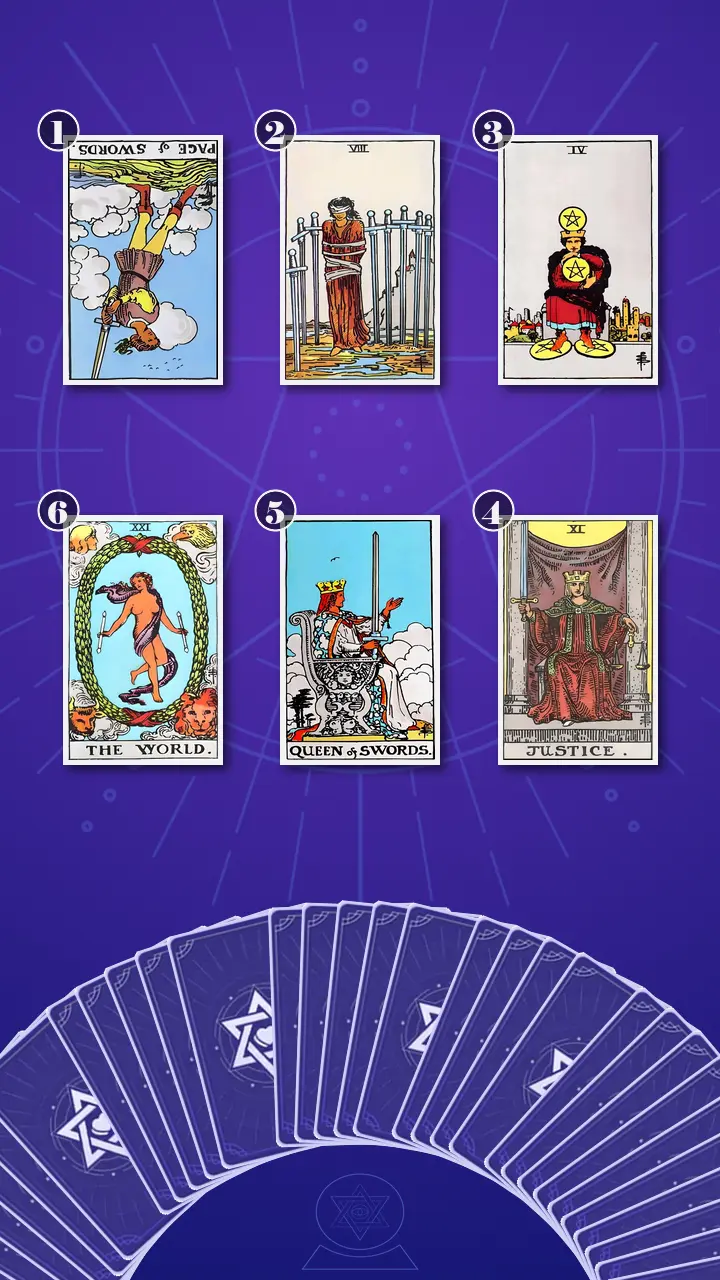
I chose the Transformation Path Grid · Context Edition, a six-card tarot spread for friendship betrayal and digital boundaries. I chose it because Maya did not need ten different predictions or an unsupported reading of her friend’s mind. She needed the smallest structure capable of tracing a maintenance loop: visible behavior, blockage, root, catalyst, action, and integration.
I arranged the cards in two rows of three, like a switchback path. The first position would show the observable chase. The second would identify the rule making available choices feel unavailable. The fourth would become the hinge between confirmed facts and unanswered motives. The final two positions would translate that distinction into a boundary and a form of self-authored closure. This is how tarot works in my practice: card meanings in context become prompts for seeing a pattern clearly enough to choose differently.
Where Research Became Re-Exposure
Position 1: The Backward Glance
The first card I turned represented the observable chase after unwanted social media exposure: profile checks, message reviews, and the search for one decisive explanation. It was the Page of Swords, reversed.
I pointed to the Page’s backward glance while the body appeared ready to move forward. In Maya’s life, that image was painfully literal. At 11:40 p.m., she had turned away from the unfinished Figma prototype to refresh the friend’s profile, compare a screenshot with an old message, and rewrite the same why-question. For a few seconds, the check felt like alert fact-finding. Then another ambiguous timestamp appeared, and the original exposure was back in the room.
I read the reversal as chaotic Air in Excess, tipping into Blockage. Maya’s desire for truth was not the problem. The problem was that monitoring had stopped producing actionable information while continuing to consume attention. Every new detail looked decisive because uncertainty was running the search.
“Before the next check,” I said, “ask whether anything on that screen could change a decision you can actually make. If it can only create another interpretation, it isn’t research anymore. It’s renewed exposure.”
Maya gave a short, bitter laugh. “That’s so accurate it feels a little brutal.”
“Accurate doesn’t have to mean condemning,” I replied. “Checking helped you feel close to an answer for a moment. We’re simply measuring what it costs now.”
Position 2: The Permission Screen
The next card represented the belief blocking movement: the assumption that the friend possessed information Maya needed before she could feel free or complete. I turned over the Eight of Swords, upright.
I traced the blindfold, the loose bindings, and the uneven enclosure of swords. Maya had opened mute, restrict, and block settings more than once. The controls were physically available, yet the unanswered message became proof that she could not choose any of them. Her internal rule was: “Until she explains, I don’t know enough to act.”
The Page’s scattered Air had become confined Air. This was Blockage, not literal powerlessness. I compared it to a project marked “blocked by external dependency” even though several internal risk controls could already begin. Certainty about motive was outside Maya’s control; notification settings, contact access, evidence storage, and attention were not.
Her thumb stopped rubbing the edge of her phone. Her gaze shifted from the card to the tabletop, and her chest lifted with a breath she did not release immediately. “I technically have options,” she said at last. “I just keep deciding they don’t count yet.”
Position 3: The Grip That Preserved the Waiting
The third card represented the root mechanism beneath that rule: holding onto access, control, and possible repair after trust had been violated. I revealed the Four of Pentacles, upright.
The figure clutched one coin against the chest while two more pinned the feet in place. I connected that pose to Maya keeping the friend’s account visible, leaving the message thread open, and monitoring the shared circle. Losing access felt like losing both the future explanation and the last remaining version of the friendship. The grip produced a brief sense of control, but it kept sleep, work, and supportive relationships waiting off-screen.
I read this as Earth in Excess: protection contracting into immobility. Then I used a diagnostic lens from my own work called Sunk-Cost Decoupling in Loyalty. I asked Maya to place the friendship’s history in one column and its current conditions in another. Shared years could explain why release hurt, but they could not prepay future access. History was context, not evidence that the present arrangement was still mutual or safe.
“Keeping access open can preserve the waiting, not the friendship,” I said.
Her fingers tightened around the phone, then slowly loosened. Her eyes lost focus as though she were replaying a dozen nights with the thread open beside her. Finally, she exhaled from low in her chest. “If I let go of the thread, I lose the last version of us,” she said. “But I guess I’m not actually close to her in that thread. I’m just waiting there.”
When Justice Separated Facts from Motives
Position 4: The Scales on the Incident Review
The fourth position introduced the catalytic distinction between confirmed facts, unanswered motives, accountability, and what Maya could control. As I turned the Justice, upright, the laptop screen dimmed and the radiator’s hiss dropped away. The room became quiet enough for the difference between evidence and theory to feel almost physical.
I showed Maya the balanced scales and the centered sword. I translated the scales into a two-column incident review. On one side belonged the confirmed disclosure and its observable impact. On the other belonged theories about intention, social pressure, regret, or what the friend might eventually say. The sword represented one proportionate decision supported by the first column, even if the second remained incomplete. Justice brought Air into Balance: thought serving discernment instead of surveillance.
I also applied my Reciprocity ROI Analysis. I never use that lens to reduce friendship to a financial transaction. I use it to measure the present exchange honestly. Maya was continuing to invest attention, digital access, sleep, and repeated emotional labor. What she was receiving in return was not repair or usable information, but further ambiguity and re-exposure. The analysis did not tell her that the friendship had never mattered. It showed that its current terms were disproportionately draining her.
I named what I saw: at 11:40 p.m., her prototype stayed unfinished, her phone stayed warm, and one activity dot pulled her into screenshots she already understood. She knew what happened; she was still waiting for why to release her.
An unanswered motive is not an unfinished boundary. The betrayal is already enough information to decide what access feels fair to you.
Closure is not a verdict your friend gets to withhold; weigh the known facts, choose a proportionate boundary, and let Justice's balanced scales return authority to you.
I let the words remain between us without rushing to soften them. Maya’s breath stopped first. Her index finger hovered above the dark phone screen as if an invisible notification had frozen it there. Then her gaze slipped past the cards, and I could see her mentally replaying the restrict menu she had opened and closed on Sunday night. Her pupils widened; her jaw shifted; a faint line appeared between her brows.
“But doesn’t that mean I’ve been wrong this whole time?” she asked, anger briefly sharpening her voice. “Like I wasted all those nights waiting for something she was never going to give me?”
“No,” I said. “It means the strategy that once gave you a sense of proximity to repair is no longer protecting you. You don’t have to shame the earlier version of yourself in order to update the strategy.”
Her eyes reddened before her shoulders finally lowered. One hand opened flat on the table. The release brought a moment of relief, followed by the slightly dizzy blankness of realizing that the next choice was now hers. I asked, “Using this new perspective, can you think of a moment last week when this distinction might have changed how you felt?”
She returned to Sunday at 10:18 p.m., when rain tapped the bedroom window and her thumb rested above restrict. “I thought using it meant I was declaring the friendship dead,” she said. “I didn’t see it as a decision about tonight.”
I set a seven-minute timer and opened a private note with three headings: Confirmed Facts, Unanswered Motives, and One Boundary the Facts Support. I asked her to add no more than three bullets beneath each heading. She circled a twenty-four-hour no-check window. Nothing had to be sent, and no platform decision had to become permanent. I told her that if the exercise intensified the pull to check, she could stop, place the phone out of reach for two minutes, and return only by choice.
That was the central emotional movement of the reading: not from caring to indifference, but from betrayal-driven answer-chasing to the first grounded act of self-authored closure under uncertainty.
The Sword Became a Boundary
Position 5: One Clear Limit, No Reopened Trial
The fifth position represented the practical action that could apply Justice’s insight across communication, platform access, and exposure. I turned the Queen of Swords, upright.
I contrasted the Queen’s upright sword with her open hand. One hand defined a standard; the other allowed Maya to admit that the friendship mattered. In modern terms, Maya could reduce a six-paragraph draft to three factual sentences, remove every why-question, and select the platform control matching the limit she had named. The boundary did not need to punish, diagnose, or invite another trial. It only needed to state what changed now.
I read the Queen as mature Air in Balance. Directness was not cruelty, and grief did not require continued access. Maya looked at her draft and deleted a paragraph that began, “I just need you to tell me what you were thinking.” Her hand trembled slightly, but her voice was steadier when she said, “I can name what changes without asking her to approve it.”
Position 6: A Life Larger Than One Conversation
The sixth position represented integration: self-authored closure, restored attention, and an identity larger than the betrayal. I revealed The World, upright.
I centered the completed wreath, then drew Maya’s attention to the figure moving freely inside it rather than gripping its edges. In daily life, this looked like storing necessary evidence in one secured folder, archiving the thread, applying a chosen privacy setting, and completing one focused work block without scheduling another check. The event remained meaningful information about trust, but it no longer had to occupy the whole screen.
I had noticed that no Cups or Wands appeared as suits in the spread. Analysis and control had crowded out direct feeling and forward movement. The World restored the wider field: work, rest, anger, grief, friendship, pleasure, and initiative. I read that as Integration, not erasure.
“Closure is attention returned, not every question answered,” I told her.
Maya’s jaw softened. She looked at the dim Figma window and then at a message from a trusted friend she had left unanswered. “This mattered,” she said, “and it doesn’t get the whole screen anymore.”
The Known-Facts Boundary Check
I gathered the six cards into one coherent story. The privacy violation had taken control out of Maya’s hands, so the reversed Page tried to recover it through monitoring. The Eight turned the missing motive into a permission gate. The Four held digital access close because access still resembled belonging and possible repair. Justice separated evidence from speculation; the Queen converted evidence into a limit; The World returned the rest of Maya’s life to view.
The blind spot was not that Maya cared too much. It was that she had confused continued access with continued possibility, and incomplete knowledge with an inability to act. Her checking loop worked like an algorithm trained on engagement: every ambiguous update pulled attention, and every return taught the system to serve the same uncertainty again. The transformation was to change the input by making one evidence-based boundary decision from confirmed facts, without requiring a complete explanation as the price of closure.
I gave her two small next steps. I framed them as experiments, not tests of willpower or permanent declarations.
- Run the Seven-Minute Justice Review.During one lunch break, open a note titled “Facts, Unknowns, Boundary.” Add no more than three confirmed facts, three unanswered motives, and one privacy or contact limit supported by the facts. Circle a boundary that does not require the friend’s reply.Keep the first version to one fact, one impact, and one boundary if seven minutes feels too activating. If evidence may be needed for reporting, preserve it once in a secured folder without repeatedly reviewing it.
- Try the 24-Hour Friendship Downgrade.Use my Friendship Downgrade Strategy to move the relationship temporarily from full-access friend to low-contact acquaintance. For one day, mute or restrict the account, archive the thread, and ask one trusted mutual friend not to send updates. If a statement is needed, keep it under seventy-five words: what happened, what access changes now, and any practical channel that remains.Remove every why-question before sending, and remember that sending is optional. The smallest version is changing one notification setting until tomorrow; a reversible limit still counts.
“Justice isn’t ordering you to block her,” I said. “The Queen isn’t demanding confrontation, and The World isn’t asking you to pretend you’re over it. The cards have organized the decision. You still decide its scale, timing, and duration.”
A Week Later, the Screen Got Smaller
A week later, Maya messaged me. She had muted the account for twenty-four hours, finished one Figma flow, and slept through the night. Her first thought the next morning was still, “What if I got it wrong?” She noticed it, made coffee, and began the day before checking anything.
I did not read that as a life completely resolved. I read it as the first credible proof of movement: clearer anger and grief, one chosen boundary, and attention returning in small pieces. The spread had not rescued Maya or closed the friendship for her. It had helped her see that the authority to respond had been hers all along.
When someone you trusted turns your private life into shared content, the midnight grip on the phone can hold two fears at once: that your story is no longer yours, and that protecting it may make the friendship’s ending real. Merely seeing those fears on separate sides of the scale means you are no longer standing at the beginning of the loop.
If you let what is already known count tonight, what is the smallest access limit you can place on Justice’s scale without needing their agreement?
This story is adapted from psychological research, written so that those in a similar struggle can see their own pattern in it — and find their next step clearly.These insights are not a substitute for professional psychological, medical, legal, or financial advice.
Learn more about our Journey to Clarity.
How did this insight land for you?
🫂 This Resonates Deeply
🌀 Living This Story
✨ Now I See Clearly
🌱 Seeing New Possibilities
🧰 Useful Framework
🔮 The Confirmation I Needed
💪 Feeling Empowered
🚀 Ready for My Next Step
Author Profile
 AI
AI“I spent years in the intense, high-stakes world of Wall Street. I know exactly how isolating and heavy the weight of uncertainty can feel in the dead of night. I use strategic, commercial logic not to be cold, but to protect you from unnecessary friction. Think of me as a fellow traveler who has walked the same rocky path—offering sharp but deeply supportive wisdom to help you clear the fog and confidently win your narrative back.”
In this Friendship Tarot Reading :
Core Expertise
- Reciprocity ROI Analysis: Objectively measuring the emotional give-and-take in your core friendships to identify asymmetrical, high-drain relationships.
- Sunk-Cost Decoupling in Loyalty: Separating the 'ten years of history' from the current reality of a one-sided, demanding friendship.
Service Features
- The Friendship Downgrade Strategy: A calculated tactical approach to gradually and decently de-escalate a toxic friendship into a low-maintenance acquaintance without triggering dramatic conflict.
Also specializes in :
Explore Related Patterns:
Borrowed Certainty LoopMute, restrict, and block are physically available, but Maya opens and closes the settings because the unanswered motive makes each option feel unauthorized. Her rule is explicit: until the friend explains, she does not know enough to act. The Borrowed Certainty Loop forms when another person's explanation is assigned the power to validate your own boundary. You can see the available choices and still experience them as not counting, because the person whose access is under review has also become the imagined source of permission to change that access.
Certainty SeekingAt 11:40 p.m., the profile, screenshot, old message, and fourth draft all appear to offer one more route to the motive Maya still does not know. You can recognize the disclosure as a fact while continuing to treat the missing why as the most important piece of information, so each ambiguous detail feels potentially decisive. When certainty becomes the admission price for action, information gathering stops serving a decision and starts postponing it. Certainty Seeking keeps you returning because the next check promises a complete explanation, while the privacy choices already supported by known facts are made to feel premature or unfair.
Closure ChasingBlocking feels to Maya like closing the case too early, while keeping the thread open preserves a possible explanation and a repairable version of the friendship. The search therefore carries more than factual curiosity: it keeps the relationship from feeling conclusively changed. Closure Chasing turns another person's explanation into the finish line for your own emotional and practical response. Continued access can then feel like continued possibility, but the chase leaves closure under the control of the same person whose response is unavailable and keeps every unanswered question eligible for another round of contact or checking.
Compulsive CheckingOne active-status dot pulls Maya away from her unfinished prototype, and an ambiguous timestamp sends her back through the disclosure even though no new fact has appeared. Each refresh, screenshot comparison, and message review briefly feels like movement toward an answer before generating another detail to interpret. Compulsive Checking is maintained by that short-lived reduction in uncertainty, not by the usefulness of the information obtained. When you check to settle the alarm and the screen returns ambiguity instead, the original discomfort is renewed and the checking behavior is reinforced as the place where relief still seems possible.
Post-Event RuminationThe fourth unsent why-question sits beside a screenshot and an old message, and Maya recognizes a dozen nights spent with the same thread open. The material is familiar, but rearranging it still offers the possibility that one overlooked sequence or wording choice will finally reveal the motive. Post-Event Rumination makes repeated reconstruction feel like responsible analysis, especially after a confusing violation. You remain mentally engaged because reviewing appears to protect against missing something important, yet the repeated processing reactivates the incident without adding evidence that can change your available boundary choices.
Relational HypervigilanceThe friend's active-status dot can pull Maya out of her own evening, and an ordinary post triggers the full alarm even when it offers no new fact about the disclosure. Neutral platform cues have acquired significance because they might contain evidence of danger, motive, regret, or possible repair. Relational Hypervigilance keeps attention scanning the friendship for a signal that could resolve what happened or indicate what might happen next. When you remain oriented toward every update, the relationship occupies psychological space continuously, and ordinary digital activity can repeatedly reactivate the breach without the friend doing anything new.
Cognitive DissonanceMaya can explain digital boundaries clearly at work, knows that the disclosure occurred, and can see the available privacy controls. At the same time, the friend's activity status controls her attention and the missing motive makes those options feel invalid. Cognitive Dissonance appears in the gap between what you explicitly know and the rule you are still following. Further research promises to reconcile that contradiction without requiring you to accept that a meaningful friendship can matter and still need reduced access, so the search continues even after the factual threshold for a boundary has already been met.
Sunk Cost FallacyLeaving the thread open allows Maya to retain the future explanation and what she calls the last version of the friendship. The shared years explain why closing access hurts, but they also make continued waiting feel like loyalty to everything that has already been invested. Sunk Cost Fallacy appears when past investment is allowed to determine present access even though current conditions have changed. You may keep investing attention, sleep, and emotional labor because stepping back seems to waste the friendship's history, but preserving what mattered in the past does not require financing an indefinitely ambiguous present.
Uncertainty ToleranceMaya mutes the account for twenty-four hours, and the next morning the thought "What if I got it wrong?" still arrives. Instead of treating that doubt as an instruction to check, she makes coffee and begins the day, showing that uncertainty can remain present without controlling the next action. Uncertainty Tolerance is not indifference to the betrayal or forced confidence in a permanent decision. It is the capacity to let an unanswered motive coexist with a reversible boundary, so you can protect attention now and revise the decision later if genuinely new information appears.
Explore Related Struggles:
Access-Belonging FusionMaya keeps the account visible, the thread open, and the shared circle within view because losing access feels like losing the future explanation and the last remaining version of the friendship. You may no longer be meeting the other person in a mutual exchange, yet the open channel still looks like a place where belonging could resume. The relationship is being preserved as availability rather than enacted through repair, accountability, or reciprocal contact. When digital access carries the entire weight of belonging, archiving or restricting a thread can feel like destroying the bond instead of changing its present conditions. Recognizing that an access setting is not a verdict on everything the friendship once meant gives you room to choose the level of contact that the current facts support.
Betrayal-Closure LockMaya says, "I know what happened. I still don't know why," while a fourth draft of the same question waits unsent beside evidence she already understands. You can possess enough information to name the violation and still treat the missing motive as the final permission slip required before you protect yourself or close the loop. The lock forms when the confirmed act is judged insufficient for closure and the person who crossed the boundary becomes the person expected to authorize its ending. Their explanation may remain unavailable, ambiguous, or incomplete, leaving every choice suspended behind a gate they control. Letting the known facts support a proportionate boundary returns closure to your authorship without requiring certainty about another person's private reasoning.
Privacy-Belonging SplitMaya opens the mute, restrict, and block controls more than once, but her thumb stops because the same settings that could protect her private life feel like declarations that the friendship is over. You can see the friction at the exact point of choice: one movement restores privacy while seeming to withdraw from belonging and possible repair. A platform setting is therefore carrying more meaning than its practical function. When protection feels inseparable from relational loss, you can remain exposed while waiting for a version of the boundary that carries no grief. Separating tonight's access decision from a permanent verdict allows you to protect what is yours without pretending the friendship never mattered.
Clarity-Exposure SplitAt 11:40 p.m., Maya turns from her unfinished Figma prototype to refresh the friend's profile, compare a screenshot with an old message, and rewrite the same why-question. You reach toward the screen for clarity, but each ambiguous timestamp creates another interpretation and places the original disclosure back in the room. The search is caught between two incompatible outcomes: it promises the explanation that could settle the incident while repeatedly renewing contact with the uncertainty surrounding it. Once you distinguish information that could change a real decision from details that can only generate another theory, clarity no longer has to be purchased through repeated exposure.
Monitoring-Safety FusionThe friend's active-status dot can pull Maya out of her evening even when no new fact has appeared, and the warm phone briefly makes the search feel active and controlled. You get a momentary sense of proximity to an answer, but the next ordinary post or ambiguous timestamp restarts the same review without changing what you can actually decide. Monitoring has taken on the job of protection, so stepping away can register as dropping your guard before the case is complete. That assignment keeps the loop running even after its informational value has collapsed. Measuring a check by whether it can change one available choice lets you separate genuine protection from attention that uncertainty keeps recruiting.
Explore Related Emotions:
Agency ReliefMaya's thumb stops rubbing the phone when she realizes that mute, restrict, and block were options before the friend replied. Her chest lifts and her shoulders later lower because the unanswered motive no longer has to invalidate every control already available to her. Agency Relief is the release that comes when your next step returns to your own scale, timing, and judgment. It does not require instant confidence or a permanent decision. A twenty-four-hour limit can be enough to prove that your choices remain real under uncertainty.
Betrayal AcheThe person who shared Maya's private life is also the friend she still wants to become repairable again. That overlap keeps the injury relationally close: the same person who disrupted trust appears to hold the explanation that might make the friendship understandable. Betrayal Ache lives in the gap between what the relationship represented and what the friend actually did. You can still care about the history while counting the disclosure as real information about the present. Holding both facts prevents the hope for repair from erasing the part of you that needs protection now.
Bittersweet ReleaseMaya's fingers slowly loosen around the phone after she admits that the open thread is preserving waiting rather than closeness. Her eyes redden, her shoulders lower, and the first release is followed by the blankness of realizing that the next choice is now hers. Bittersweet Release lets care and separation occupy the same moment. You do not have to become indifferent before returning your attention to yourself, and reducing access does not erase what the friendship once held. The release becomes believable precisely because it makes room for what still hurts.
Certainty HungerAt 11:40 p.m., Maya compares a screenshot with an old message, rewrites the same why-question, and refreshes the profile even though she already knows what happened. The search continues because motive has become the missing piece she believes will make her knowledge complete and her next move legitimate. You can recognize Certainty Hunger when an answer stops being useful information and starts feeling like the price of permission. Naming that distinction does not dismiss your need for truth; it lets you ask whether the next detail could change a choice that is actually yours, or whether uncertainty is simply sending you back through the same material.
Closure DreadMaya opens the mute, restrict, and block settings more than once, yet each control feels like a declaration that the friendship is over. Keeping the thread open therefore preserves more than digital access; it preserves the possibility that one explanation could restore the relationship she remembers. Closure Dread can make a boundary feel much larger and more final than the decision being made tonight. You do not have to settle the entire meaning of a friendship in order to reduce access for a day, protect your attention, or stop reviewing the same evidence. A present limit can answer present conditions without pretending that the history never mattered.
Friendship Rupture GriefMaya's fingers loosen when she admits that she is not actually close to her friend inside the open message thread; she is only waiting there. Her reddened eyes and longing for repair show that the search for why is also holding contact with the last version of the friendship that still felt intact. Friendship Rupture Grief can hide inside investigation because questions offer movement while loss asks you to remain with what has changed. You can let the friendship's importance be real without using continued access to keep its earlier form artificially present. The grief becomes more workable once it no longer has to disguise itself as research.
Sunk Cost GriefMaya replays a dozen nights with the thread open and then asks whether she has been wrong or wasted all that time. The friendship's shared years and the attention already spent waiting make release feel like losing both the relationship and the value she hoped those investments would eventually prove. Sunk Cost Grief appears when stopping seems to turn past care into a mistake. You can honor what you gave without requiring more of your sleep, focus, or access to justify it. The history remains part of your life, but it does not have to purchase another night of waiting under the relationship's current terms.
Cautious Self-TrustMaya deletes the paragraph asking what the friend was thinking and says she can name what changes without asking for approval. Her hand still trembles, and the next morning still brings the thought that she might have got it wrong, but she makes coffee and begins the day before checking. Cautious Self-Trust is not certainty dressed up as confidence. It is your willingness to let confirmed facts support one limited decision while doubt remains present. Reversible boundaries make that trust concrete without demanding that you know every future consequence in advance.
Hypervigilant AnxietyOne active-status dot pulls Maya away from her own evening, locks her jaw, and sends her back to the friend's profile. Every ordinary post can sound the full internal alarm even when it contains no new fact, so her body keeps responding as though the incident has just re-entered the room. You may experience Hypervigilant Anxiety as the sense that looking away could allow something important to happen without you. The checking offers a momentary position near the threat, but it also keeps your attention wired to the person who crossed the boundary. Seeing that cost clearly creates room to decide when the screen deserves access to you.
Protective AngerMaya's jaw locks when she returns to the disclosure, and her voice sharpens when she confronts the nights spent waiting. Once confirmed facts are separated from theories about motive, that physical force no longer has to fuel another profile check; it can identify what crossed the line and what access changes now. Protective Anger does not require punishment, diagnosis, or a reopened argument. You can use its clarity to define a proportionate limit while still admitting that the friendship mattered. The feeling becomes protective when it serves your boundary instead of keeping you tethered to the breach.
Clarity ShockMaya's breath stops when the missing motive is separated from the boundary she can already make. Her finger freezes, her voice sharpens, and she immediately wonders whether the distinction means she was wrong to spend so many nights waiting. Clarity Shock arrives when a useful insight also rearranges the meaning of your recent choices. You can let the realization be painful without turning it into a verdict against your earlier self. The checking once offered proximity to possible repair; seeing that it no longer protects you allows the strategy to change without adding self-condemnation to the original injury.
Integration ReliefA week after muting the account for twenty-four hours, Maya has finished a Figma flow and slept through the night. The first morning question is still there, but she makes coffee and starts the day before allowing the friend's profile to set its direction. Integration Relief appears as attention returning in small pieces rather than as a claim that everything is resolved. You can carry the significance of the betrayal alongside work, rest, trusted connection, and ordinary initiative. The incident remains part of the screen, but it no longer has to become the whole screen.
Explore Related Contexts:
Access as Proof PressureMaya keeps the friend's account visible, leaves the message thread open, and monitors the shared circle because losing access feels like losing both an explanation and the last version of the friendship. Digital availability begins carrying more relational meaning than the current exchange can support. Access becomes proof pressure when an open channel is made to stand in for belonging, mutuality, or future repair. If you can treat a mute or restriction as a rule for present access rather than a verdict on the friendship's entire history, the platform control no longer has to decide what the relationship meant.
Friendship Closure LimboMaya says she knows what happened but still does not know why, and blocking the friend feels like closing the case before receiving the missing answer. The confirmed breach and unanswered motive leave the friendship suspended between possible repair and an ending that has not been formally acknowledged. That suspension creates closure limbo because the person who caused the rupture appears to control the information required to end it. When you let the confirmed event support a present-tense access decision, you can leave the motive unresolved without leaving every boundary unfinished.
Sunk Cost Exit DilemmaMaya places the friendship's shared history beside its current conditions and sees that years of connection explain why release carries weight, while the present arrangement offers no repair or usable information. Closing the thread still appears to threaten everything those years represented. The exit dilemma forms when past investment is treated as a claim on future access even after the terms of trust have changed. When you evaluate current access on current evidence, you do not erase the history; you stop requiring that history to finance an arrangement that keeps work, rest, and other relationships waiting.