The Kitchen Table Where Adulthood Needed Citations
If you can coordinate client deadlines at a Toronto design studio but still draft a Notes app defence before family dinner, you may know the whiplash of becoming twelve at the table.
Alex came to me after one of those dinners. They described the moment so precisely that I could see it: 7:16 p.m., at the same kitchen table where they once did homework, with garlic and dish soap hanging in the air. A chair leg scraped the tile. Their plate cooled beneath the buzzing overhead light as a relative asked, “But why would you do that?” Alex unlocked their warm phone and searched for a message that could prove the timeline.
“Why does a simple question make me sound like I’m pitching my own life?” they asked me. “I know I don’t need permission, but I keep acting like I do.”
I watched their thumb rub the edge of the phone while they spoke. The apprehension had the physical texture of a seat belt locked one notch too tight: jaw clamped, shoulders lifted, breath caught high in the chest, every sentence accelerating towards a collision it was trying to prevent. Underneath it sat two sharper feelings. Alex resented having to defend a choice they had already made, then felt ashamed for entering the same debate again.
I told them, “Nothing about this makes you incapable. You’re using a strategy that tries to protect both your decision and your sense of belonging. The problem is that the strategy keeps putting your adulthood back on the witness stand.”
I was not there to predict a family verdict or tell Alex which relationship choices to make. I wanted to help them see the structure clearly enough to choose their own next line. “Let’s make a map of this scene,” I said. “Not so the cards can take the pen from you, but so you can see where you’ve been forced to repeat the same act and decide how you want the next one to read.”

A Cross-Shaped Map of the Kitchen Table
I invited Alex to take one ordinary breath and hold the consultation question in mind: “Why do I keep defending my choices at the family kitchen table?” I shuffled slowly. The small ritual was not about summoning certainty; it gave their attention somewhere to land before we examined a charged pattern.
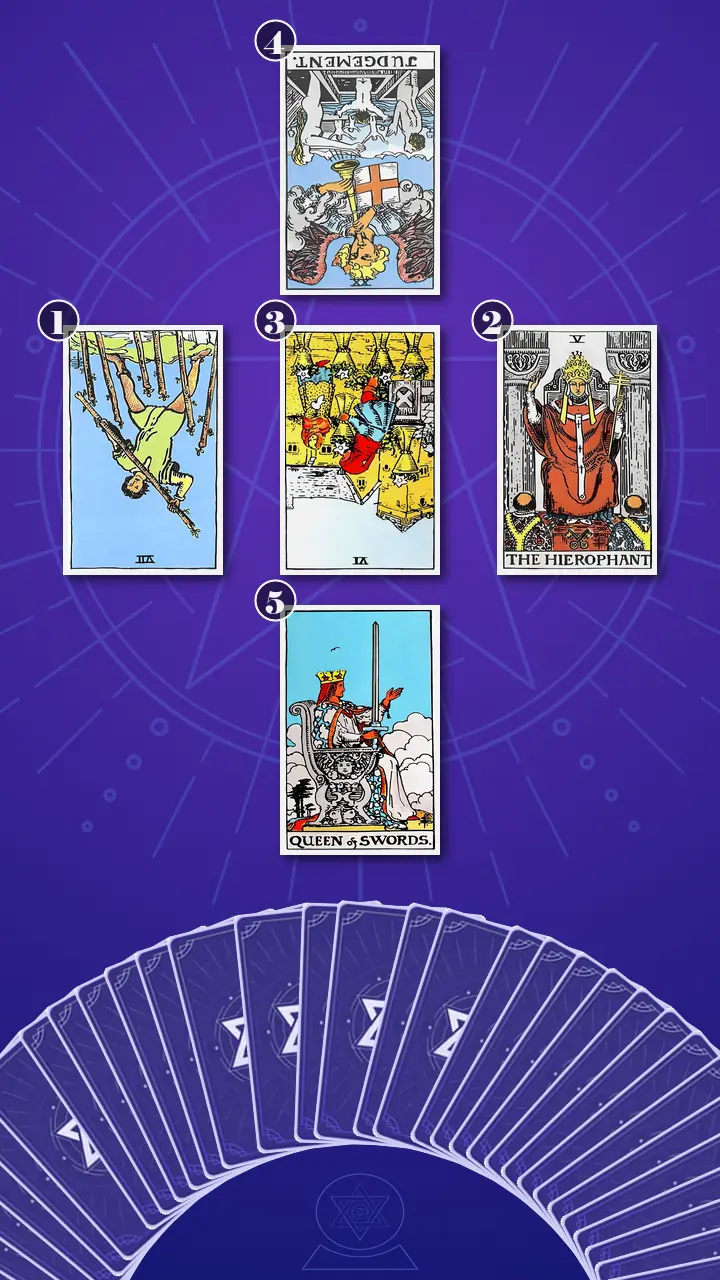
I chose the Relationship Spread · Context Edition, a five-card relationship tarot spread arranged as a cross. Seen from above, the layout resembles a kitchen table: Alex’s visible stance on one side, the standards they experience on the other, the old relational role at the centre, the internal tribunal above it, and a self-led response below.
If you are wondering how tarot works in a situation like this, I use card meanings in context as a structured mirror. This spread was specific enough to trace one repeating family interaction without claiming access to anyone else’s private motives. A broader spread would have created more information, but not necessarily more clarity. Here, I needed to show Alex three crucial layers: what they visibly did when questioned, which older role made the exchange feel so consequential, and what adult response could end the defence without automatically ending connection.
I placed the cards face down. “We are not asking whether your family will approve,” I said. “We are asking why their disapproval can feel like a ruling, and where your participation in that process can change.”
When One Question Became Six
Position 1: The Defence That Could Not Find Solid Ground
I turned the card representing Alex’s observable stance in the conflict: the over-explaining, the bracing for objections, and the assumption that every new question required another answer. It was the Seven of Wands, in reversed position.
The traditional figure stands alone on uneven ground while six wands rise towards him. His mismatched shoes make the defence look improvised, even though he is clearly working hard. Reversed, that Fire was blocked and scattered. Alex was expending enormous energy on self-protection, but every additional defence made the boundary less stable.
I brought the image directly back to 7:24 p.m. Their phone was unlocked beside a cooling plate. A second family question had produced three reasons and a screenshot. Their speech sped up while they scanned the table for the next objection. The exchange worked like a shared Google Doc left open to unlimited comments: every reply quietly changed a finished decision back into an editable draft.
“The inner logic sounds something like this,” I said. “‘If I answer this part, then they’ll understand. If they still don’t, I must have left something out.’ But your choice does not become more yours after the fifth reason.”
Alex gave a short, bitter laugh. “That’s so accurate it’s almost rude.” Their smile vanished quickly, but their shoulders lowered by a fraction.
I did not rush to make the moment more comfortable. “I know it stings,” I said. “The card isn’t mocking the defence. It’s showing why a strategy that feels responsible in the moment leaves you depleted. You are trying to create safety through completeness. Unfortunately, each extra piece of evidence also tells the table that the case is still open.”
I asked how many supporting details they had added after their first answer at the last dinner. Alex counted silently on their fingers, stopped at four, and looked away. That recognition was not an indictment. It was the first observable point in the loop, which meant it was also the first place where choice could re-enter.
Position 2: The Rulebook No One Had to Print
I turned the card representing the family expectations and standards Alex could actually observe, without pretending to know what any relative privately intended. The card was The Hierophant, upright.
The Hierophant sits between two pillars while two followers face him. The composition gives shared values an official seat. At Alex’s table, that authority appeared in phrases such as “Is that sensible?” or “That’s not how we would do it.” The card did not declare those standards evil, and it did not tell Alex to reject every piece of family guidance. It asked why familiar standards were being treated as mandatory approval criteria.
“This is like working inside an organisation with an unwritten policy everyone treats as official,” I said. “No one has shown you a document saying your personal choice needs certification, but you’re acting as though it cannot go live without sign-off.”
The Hierophant’s structured energy can be useful when it holds values worth considering. Here, however, Alex had given that structure excess jurisdiction. Listening had become outsourcing. A relative’s definition of “responsible” was being granted more authority than Alex’s knowledge of their own rent, work, schedule, relationships, and capacity.
I asked which family word made their body switch from conversation mode to courtroom mode.
“Sensible,” Alex said immediately. Their fingers stopped moving against the phone. “The second someone asks whether something is sensible, I start presenting evidence that I’m not reckless.”
“Then ‘sensible’ is not just a word in this scene,” I said. “It is the sound of the old rulebook opening.”
Position 3: The Old Chair and the Sensible Kid
At the exact centre of the spread, I turned the card representing the history beneath the exchange and the familiar child-adult role activated by the kitchen setting. It was the Six of Cups, reversed.
The image shows a taller child offering a flower-filled cup to a smaller child inside an enclosed courtyard. Upright, it can hold tenderness, memory, and familiar care. Reversed in this position, its Water flowed backwards. The past was not merely being remembered; an older role was becoming too active in the present.
I returned to Alex’s description of the same chair where homework had once been checked, the familiar cupboard handle, and the scrape of furniture against tile. At the studio, Alex could resolve an operational problem in three calm Slack lines without apologising. At this table, their voice became faster and more deferential as they listed proof that they were still the sensible, acceptable younger person.
This was where I used a lens I call Family Casting Analysis. I do not use it to label a family as toxic or invent motives for people who are not in the room. I use it to identify the role a client repeatedly finds themselves performing when an old relational script starts running.
“What part do you get cast in here?” I asked. “Not who you truly are. The part the scene keeps asking you to play.”
Alex swallowed before answering. Their throat tightened, their gaze briefly lost focus, and then their hand relaxed against the table. “The Sensible Kid,” they said. “Maybe also the family defence lawyer. If I can prove I’m responsible, I get to feel like I still belong.”
I then checked the pattern through another narrative lens: Narrative Enmeshment Diagnosis. I use that phrase as a storytelling tool, not a clinical label. It asks whether a person’s current life plot has been recruited to satisfy an inherited storyline about what a successful or responsible adulthood should look like. I could not know what Alex’s relatives secretly expected, but I could observe that Alex had begun treating independent choices about city life as auditions for the family’s definition of adulthood.
As an artist, I thought of rehearsals where an actor keeps improving a monologue long after the scene itself has changed. The extra effort is real, but it belongs to an old direction. “A role can explain your reflex without becoming your identity,” I told Alex. “You can understand why the Sensible Kid once protected belonging and still choose not to give that part every future line.”
Position 4: The Trial That Boarded the Streetcar
I turned the card above the centre, representing the active relational challenge: the point where an external question became an internal verdict and triggered another attempt to win approval. It was Judgement, in reversed position.
In the traditional image, an angel sounds a trumpet while figures rise with open arms. Reversed, that summons can become delayed awakening, harsh self-evaluation, or waiting for an external signal that never feels complete. The card showed me why leaving the kitchen did not end the argument.
Alex had described the 9:08 p.m. 504 streetcar home: rain-dark windows, the smell of wet coats and garlic still clinging to their jacket, rails screeching through a turn. Their reflection flickered in the glass while a cursor blinked after the words, “Just to clarify what I meant earlier…” They were physically miles from the table, but they were grading every answer as evidence in a continuing trial.
I described Judgement reversed as a blocked call. Instead of hearing an invitation to recognise their own authority, Alex heard a pending ruling on whether they were reckless, adult, and still acceptable. The original exchange might contain a genuine disagreement, but their mind expanded it into a total evaluation of the person making the choice.
“Let’s separate two things,” I said. I drew a line down a page and titled one side What was actually said and the other What verdict my mind added.
Alex placed “Are you sure this is sensible?” in the first column. In the second, they wrote, “You cannot trust yourself, and we might not accept the person you are becoming.”
Their breath paused. Their eyes moved away from the page as though replaying the dinner in a darkened window. Then a low “Oh” left their chest, and their shoulders dropped on the exhale.
“Those two lines are emotionally connected,” I said, “but they are not identical. Recognising that does not excuse intrusive questioning or require you to remain in a conversation that feels unsafe. It simply stops your mind’s larger conclusion from masquerading as a direct transcript.”
I turned the trumpet towards its catalytic meaning. “Maybe the unfinished feeling is not proof that you owe another explanation. Maybe it is the discomfort of not receiving the old approval signal.”
Alex stared at the two columns. “So I’m still appealing after everyone else has gone home.”
“Yes,” I said gently. “And seeing the appeal is what makes it possible not to file the next one. You can stay at the table without staying in the trial.”
When the Queen Drew One Clear Line
Position 5: The Adult Who Does Not Audition
The room became unusually quiet as I turned the final and most important card. A radiator clicked once behind me, and light from the rain-cleared window caught the card’s silver-grey edge. This position represented Alex’s self-led response: concise communication, tolerance of unresolved disagreement, and a boundary that could end the defence without automatically ending connection.
The card was the Queen of Swords, upright.
Her sword rises in one vertical line while her other hand remains open. I wanted Alex to notice both. The sword is precise speech and a defined endpoint; the open hand is continued relational availability. Upright Air appeared here in balance: not coldness, not retaliation, and not a better argument, but the ability to distinguish what is true, what information Alex chooses to share, and where their participation ends.
In everyday terms, the Queen was Alex leaving the phone face down and saying, “I have considered your concern, and I am comfortable with my choice. I am not going to keep debating it.” A relative might still disagree. The card did not promise otherwise. It showed that disagreement did not have to reopen ownership of the decision.
I returned to Family Casting Analysis, because this was the recasting point. The Seven of Wands had shown Alex as the overwhelmed Defence Counsel, fielding six objections on unstable ground. The Queen did not win that role more convincingly. She declined the role and chose another: the Discerning Adult. One clear line could do what six defensive explanations could not.
To bring that recasting into Alex’s body, I asked them to picture the streetcar again: garlic on their coat, jaw tight, cursor hovering after “Just to clarify,” and the old argument still running while the kitchen receded behind them. They were no longer sharing information. They were appealing for acquittal.
You do not need to win the old trial; speak one clear sentence, then let the Queen's upright sword mark where explanation ends.
I let the sentence remain in the room. Outside, a tyre moved softly through the wet street. Alex’s hands stayed motionless beside the card.
A choice can stay yours while someone else dislikes it. Disagreement is not a verdict, and your explanation is allowed to have an endpoint.
Alex went completely still. First, their inhale stopped halfway, and their fingers hovered as if they had been about to reach for the phone. Then their eyebrows pulled together and their gaze lost focus, replaying a history of dinners in which another reason had seemed one sentence away from safety. “But doesn’t that mean I’ve been wrong every time?” they asked, anger sharpening the edge of their voice. “That I did all that explaining for nothing?” I answered carefully: “No. It means the defence was trying to protect belonging. We can respect why it appeared without keeping it in the lead role.” The anger thinned into grief. Their jaw trembled once, their fist slowly opened, and a fuller breath moved through their chest. Relief arrived, but so did the slight dizziness of realising that clarity now asked something of them: they would have to tolerate a disagreement they could no longer solve with effort.
I asked, “Now, using this new perspective, think back to last week. Was there a moment when this insight might have made you feel different?”
Alex thought for a while. “On the streetcar,” they said. “I could have let ‘They don’t agree’ be the whole fact. I didn’t need to turn it into ‘I’m irresponsible and about to lose everyone.’ I still would’ve hated the feeling, though.”
“Of course,” I said. “The shift is not from caring to not caring. It is from shame-tinged approval-seeking towards adult self-authorisation while the disagreement remains unresolved. That first step can feel vulnerable because you are no longer using explanation to numb the uncertainty.”
I asked Alex to open the Notes app and set a seven-minute timer. They wrote three lines: “My choice is…”, “The one reason I am willing to share is…”, and “My closing sentence is…”. For the close, they chose: “I understand that you see it differently, but I am not going to keep defending this choice.”
They read it aloud once. I stopped them from rehearsing it into another performance. I also made the safety principle explicit: they could use the sentence only where it felt physically and practically safe. They could pause, leave, switch to text, or keep the sentence private. Self-authorisation included the authority not to stage a confrontation.
The Missing Earth Beneath the New Script
I looked across the five cards and gave Alex the story they formed together. The Seven of Wands reversed showed the exhausting present posture: many reactive defences on unstable ground. The Hierophant showed the inherited rulebook Alex experienced as official. The Six of Cups reversed revealed why that rulebook carried extra emotional force in the childhood kitchen. Judgement reversed exposed the private tribunal that continued after dinner. The Queen of Swords offered the unused resource: one truthful line, an open hand, and an endpoint.
The cognitive blind spot was now clear. Alex had believed that a more complete explanation would make the choice legitimate. In practice, completeness kept the decision available for revision. The transformation was not about building a stronger case. It was the movement from defendant to adult participant: state the choice once, give no more than one chosen reason, and allow another person’s opinion to remain unresolved.
No Pentacles card had appeared, which meant the reading contained insight but no automatic grounding. I explained that Alex would need to supply the missing Earth deliberately through a written sentence, a time limit, a face-down phone, and a chosen exit. This was not mystical compensation. It was practical containment for a pattern that became harder to interrupt once their jaw tightened and their speech sped up.
“A boundary ends your participation in the debate,” I said. “It does not control their opinion. The goal is not to deliver the perfect line and make everyone behave differently. The goal is to know what you will do after your answer has already been given.”
Two Small Rehearsals for the Next Family Conversation
I offered Alex two experiments rather than commandments. Each one was designed to be small enough to try without turning boundary work into another performance review.
- The Script-Flipping Rehearsal Before one low-stakes family interaction, set a seven-minute timer in your Notes app. Write one sentence naming the choice, one reason you are willing to share if you want to, and one closing sentence. Read the close aloud once while standing at your apartment door. During the conversation, give no more than those two sentences, then keep your phone face down for sixty seconds instead of producing evidence. Minimum version: write “One answer is enough” and keep it private. If the exchange escalates, say “I am leaving this topic here,” then change the subject, step outside, switch to text, or leave according to what feels safe.
- The Actual Words / Added Verdict Check After the next charged exchange, set a five-minute timer and make two columns: “What was actually said” and “What verdict my mind added.” Record one literal sentence in the first column and the larger conclusion in the second. Before sending a clarification text, wait ten minutes and ask, “Am I sharing genuinely new information, or appealing the verdict again?” Use only words you genuinely remember and mark uncertainty as “unclear.” Stop if replaying the exchange becomes more activating. The smallest version is one literal sentence and one attached conclusion.
The first practice was my Script-Flipping Rehearsal in its simplest form. Alex was not memorising a clever comeback. They were deliberately delivering an out-of-character response: the Sensible Kid and Defence Counsel would normally fill the silence with more proof, while the Discerning Adult would let one answer stand. The changed power dynamic came from changing Alex’s participation, not from forcing anyone else to approve.

The Ride Home Without the Follow-Up Essay
One week later, I received a message from Alex: “I used the two-sentence close. My voice shook. They said, ‘I still don’t get it.’ I said, ‘I know you don’t,’ put my phone face down, and helped with the dishes. I took the 504 home without sending the essay.”
They slept through the night. Their first thought the next morning was still, “What if I’m wrong?” This time, they noticed it as a question rather than a sentence handed down by a court.
I did not consider that a solved family relationship or a permanently fearless boundary. I considered it honest evidence of movement. The cards had not granted Alex authority over their life. They had made the old staging visible; Alex had chosen the sentence, endured the pause, and kept the pen.
When a question across an old kitchen table makes your jaw tighten and your voice speed up, it can feel as though staying accepted depends on turning an adult choice into a case everyone will approve. I want you to remember that noticing the trial is already different from automatically taking the witness stand.
If disagreement were allowed to remain unresolved, what one Queen-of-Swords sentence could you let stand in your own voice, with your phone face down and no sixth reason waiting behind it?
This story is adapted from psychological research, written so that those in a similar struggle can see their own pattern in it — and find their next step clearly.These insights are not a substitute for professional psychological, medical, legal, or financial advice.
Learn more about our Journey to Clarity.
How did this insight land for you?
🫂 This Resonates Deeply
🌀 Living This Story
✨ Now I See Clearly
🌱 Seeing New Possibilities
🧰 Useful Framework
🔮 The Confirmation I Needed
💪 Feeling Empowered
🚀 Ready for My Next Step
Author Profile
 AI
AI“I’ve always felt our lives are films currently in production. As an artist, I know that when you feel stuck, it’s often because you’ve bravely stayed in a painful scene for just a little too long. I’m not here to coldly analyze you. I want to sit closely with you, look at those difficult moments with profound empathy, and gently hand you the pen so you have the courage to write your next beautiful act.”
In this Family Tarot Reading :
Core Expertise
- Family Casting Analysis: Identifying your forced role (e.g., The Scapegoat, The Golden Child, The Peacemaker) within a toxic family script.
- Narrative Enmeshment Diagnosis: Recognizing when your personal life story has been hijacked to fulfill your parents' unfulfilled plotlines.
Service Features
- The Script-Flipping Rehearsal: A role-play directive to deliberately deliver an 'out-of-character' response at the next family gathering, permanently disrupting the established power dynamic.
Also specializes in :
Explore Related Patterns:
Approval SeekingAlex explicitly connects proving responsibility with still feeling that they belong, while the word 'sensible' sends them searching for evidence that they are not reckless. When you experience understanding as an approval signal, a disagreement about one choice can feel like a test of whether you remain acceptable to the relationship. Approval Seeking is the motivational mechanism beneath the defence: more reasons are offered not only to explain what happened, but to secure a favourable ruling about the person making the choice. This is why conscious knowledge that permission is unnecessary does not automatically stop the behaviour. The intellectual conclusion belongs to adult autonomy, while the repeated performance is still trying to protect belonging through external validation.
Boundary DiffusionAlex places the phone beside a cooling plate, supplies a screenshot, and keeps adding information until a finished choice functions like a shared document open to unlimited comments. When you respond this way, the issue is not simply how much information has been disclosed; it is that continued questioning is being allowed to reopen who holds authority over the decision. Boundary Diffusion captures the blurred line between considering another person's concern and surrendering ownership of your choice. Alex does not explicitly give the family decision-making power, but each new defence grants their disagreement practical jurisdiction. A clearer boundary does not require controlling their opinion. It requires distinguishing the information you freely choose to share from the point where your participation in review has ended.
Defensive OverexplainingAt 7:24 p.m., a second family question produces three reasons and a screenshot, and Alex later counts at least four details added after the first answer. When you use explanation this way, information is no longer serving only to communicate a decision; it becomes a defensive mechanism for preventing criticism, misunderstanding, or relational fallout. The strategy promises safety through completeness: if the next detail is convincing enough, the questioning might stop. Instead, every additional defence signals that the decision is still open for review, so the boundary becomes less stable as the case becomes more elaborate. Defensive Overexplaining captures this self-reinforcing loop without treating the original wish to protect both autonomy and belonging as irrational.
Family Role RegressionAt the Toronto studio, Alex can resolve an operational problem in three calm Slack lines; at the chair where homework was once checked, their speech becomes fast, deferential, and crowded with proof. When your behaviour changes this sharply across settings, the contrast suggests that the relational context is activating an older role rather than revealing an absence of adult competence. Family Role Regression describes the return to the Sensible Kid and family defence lawyer positions that Alex names themselves. The familiar table cues a script in which responsibility must be demonstrated to people occupying the evaluative side of the exchange. Seeing the role as context-dependent makes it possible to respect its former protective function without confusing that role with your present identity or giving it every future line.
Uncertainty ToleranceAlex's voice shakes when the family still does not agree, yet they leave the answer standing and ride home without sending the essay. The discomfort remains physically and emotionally present, but it is no longer converted automatically into more explanation. Uncertainty Tolerance is the capacity being exercised in that pause. The old defence tried to remove uncertainty by securing a complete approval signal; the new response accepts that no perfect sentence can guarantee agreement or belonging. When you allow 'They do not agree' to remain the whole unresolved fact, you stop treating discomfort as proof that another corrective action is required. The vulnerability is real, but it no longer has to run the conversation.
Boundary DiscernmentAt the next family conversation, Alex hears 'I still do not get it,' answers 'I know you do not,' puts the phone face down, and helps with the dishes. The response neither attacks the relationship nor supplies another defence; it separates the family's continuing opinion from Alex's authority over the choice. Boundary Discernment is visible in that distinction. When you decide what information is yours to share, where your participation ends, and what disagreement belongs to the other person, connection no longer requires unlimited access to your decision process. The face-down phone matters because the boundary is not only a sentence. It is the follow-through that prevents an endpoint from becoming the opening line of another appeal.
CatastrophizingAlex writes the literal question 'Are you sure this is sensible?' in one column and the added verdict 'You cannot trust yourself, and we might not accept the person you are becoming' in another. On the streetcar, the same cognitive jump turns family disagreement into the prospect of being irresponsible and losing everyone. Catastrophizing is operating when one disputed decision expands into a global threat to competence, adulthood, and belonging. If your mind treats those larger consequences as imminent, producing another reason can feel proportionate rather than excessive. The useful audit is not whether the discomfort is real; it clearly is. It is whether the feared verdict is a direct transcript of the exchange or a high-stakes prediction added by the mind.
Internal ValidationAlex takes the 504 home without sending the follow-up essay, then notices 'What if I am wrong?' the next morning as a question rather than a ruling handed down by a court. Doubt has not disappeared, but it no longer automatically transfers decision authority back to the family table. Internal Validation does not mean declaring yourself infallible or refusing all feedback. It means allowing your own considered knowledge of your work, rent, schedule, relationships, and capacity to count as legitimate evidence. When you can evaluate doubt internally, another person's disapproval becomes information to consider rather than certification you must obtain. That shift preserves the possibility of reflection without turning reflection into another audition for adulthood.
Reality TestingAlex places 'Are you sure this is sensible?' under 'What was actually said' and places the conclusion about being untrustworthy and unacceptable under 'What verdict my mind added.' The written separation makes the emotional connection visible without treating the two statements as identical. Reality Testing is the cognitive mechanism that checks interpretation against observable evidence before a defensive action follows. When you ask whether a clarification contains genuinely new information or merely appeals an imagined verdict, you create distance between the family signal and the meaning attached to it. That distance does not invalidate the sting of the exchange; it prevents the most threatening interpretation from masquerading as a literal transcript.
Explore Related Struggles:
Inherited Role LockThe same chair where Alex once had homework checked now holds an adult who can coordinate client deadlines, yet their voice becomes faster and more deferential when a personal choice is questioned. The cupboard, the scraped tile, and the word sensible give an earlier family part a present-day stage, and Alex begins supplying proof as the Sensible Kid and family defense lawyer. When an adult decision enters a scene that still assigns you an older role, current competence does not automatically determine how you participate. Inherited Role Lock describes the friction between the life you now manage and the part the familiar relationship keeps recruiting you to perform. Naming the role separates its history from your identity, leaving room for your present voice to decide which lines it will still deliver.
Inner Tribunal LockOn the 9:08 p.m. 504 streetcar, Alex is already miles from the kitchen when the cursor blinks after the words, “Just to clarify what I meant earlier.” The spoken exchange has ended, but Alex is still grading each answer and preparing more evidence against a verdict no relative directly stated. When you carry the questioning away from the table, another person's disagreement can become a private court that never formally adjourns. Inner Tribunal Lock names the point where the literal words and the conclusion your mind adds become fused into one continuing case. Separating what was actually said from the larger verdict exposes where the appeal is being generated and returns authorship over whether another response is filed.
Internal Authority CollapseThe word sensible makes Alex's fingers stop and shifts their body from conversation into courtroom mode. Although Alex knows their own rent, work, schedule, relationships, and capacity, the family's familiar standard is treated like an official policy that the choice cannot pass without satisfying. When you possess the relevant knowledge but still wait for an outside standard to certify your judgment, your authority remains available in practice while losing jurisdiction in the charged relationship. Internal Authority Collapse names that transfer of decision-making weight. Seeing where a relative's opinion becomes a ruling allows you to distinguish receiving input from surrendering authorship over the choice.
Ownership-Belonging FusionAt the childhood kitchen table, Alex answers a family question with three reasons and a screenshot, even while knowing the decision does not require permission. The effort is carrying two jobs at once. It must protect the choice as Alex's own while also proving that the person making it is still sensible enough to belong. When you experience self-ownership and belonging as one combined test, disagreement can feel larger than a difference of opinion. Letting your decision stand appears to put connection at risk, while defending your place in the relationship makes the decision feel less fully yours. Ownership-Belonging Fusion names this bind and makes visible why another explanation can feel necessary even after the practical decision is complete.
Boundary CollapseAt 7:24 p.m., Alex's unlocked phone sits beside a cooling plate as a second question draws out three reasons and a screenshot. The material is meant to stabilise the choice, but every addition functions like another editable comment, so the endpoint of Alex's participation keeps moving. When you try to secure a boundary by making your case complete, the boundary becomes dependent on whether the other person is finally satisfied. Boundary Collapse names the resulting structure. Your decision remains yours in fact, yet repeatedly defending it gives the conversation continuing access to review it. The face-up phone, the accelerating speech, and the next supporting detail reveal the exact moments when a finished answer is being reopened.
Explore Related Emotions:
Adult Child PanicAt the same chair where homework was once checked, Alex's jaw clamps, their shoulders rise, and the calm authority they use at the design studio disappears. The familiar kitchen recruits the sensible younger person before their present-day competence has time to enter the room. When an old setting changes your felt age this quickly, your body can begin defending a role that your adult mind no longer endorses. Adult Child Panic names that sudden loss of inner seniority: you know the choice belongs to you, yet the table makes proving that you are responsible feel immediately necessary.
Conditional Belonging FearAlex names the hidden bargain directly: if they can prove they are responsible, they get to feel as though they still belong. That is why a narrow question about one choice expands into a test of whether the person they are becoming will remain acceptable at the family table. Conditional Belonging Fear makes disagreement feel larger than disagreement. When connection seems tied to performing the sensible version of yourself, you may defend a decision long after the facts are clear because the emotional stake is no longer the choice alone; it is whether you can remain connected without passing the old test.
Evidence AnxietyAt 7:24 p.m., a second question produces three reasons and a screenshot while Alex's plate cools beside the unlocked phone. Their speech accelerates as they scan the table for the next objection, treating every gap in understanding as a request for more documentation. The search for complete proof briefly promises control, but each citation tells the table that the case remains open. Evidence Anxiety is the pressure that says safety may be hidden inside one more timeline, message, or explanation, even as you notice that no amount of evidence can guarantee another person's approval.
Permission AnxietyAlex says, 'I know I don't need permission, but I keep acting like I do,' while unlocking the phone to prove the timeline of a choice already made. The word 'sensible' turns a family opinion into something that feels like required sign-off. Permission Anxiety lives in the gap between knowing that you hold authority and waiting to feel authorised by someone else. You may have already chosen, paid the costs, and considered the consequences, yet your body still treats an unresolved objection as evidence that the decision is not fully yours.
Rulebook ShameThe word 'sensible' immediately stops Alex's fingers and opens an unwritten family rulebook. They begin presenting evidence that they are not reckless, as though adulthood remains valid only when it meets a familiar standard of responsibility. Rulebook Shame forms when missing an inherited standard feels like becoming the wrong kind of person. You are no longer evaluating whether the guidance is useful; you are trying to escape the painful implication that choosing differently makes you irresponsible, disappointing, or less acceptable.
Verdict DreadOn the 504 streetcar, Alex is physically miles from the kitchen but still grading every answer while a clarification draft blinks on the screen. The original question has become a private ruling on whether they are reckless, adult, trustworthy, and still acceptable. Verdict Dread appears when another person's disagreement feels capable of deciding something total about you. Instead of hearing a limited opinion, you brace for a final judgment on your character, so the mind keeps appealing even after everyone else has left the table.
Cautious AutonomyOne week later, Alex says the two-sentence close with a shaking voice, hears 'I still don't get it,' and answers, 'I know you don't.' They place the phone face down and help with the dishes rather than producing another argument or leaving connection behind. Cautious Autonomy is the vulnerable experience of allowing a choice to remain yours while someone else continues to dislike it. You are not required to feel fearless or detached; authority appears through the smaller act of deciding where your participation ends and staying with the uncertainty that follows.
Conflict HangoverThe kitchen argument follows Alex onto the rain-dark streetcar, where garlic still clings to their coat and the cursor waits after 'Just to clarify.' Although the conversation has ended externally, their attention remains trapped inside another round of review and revision. Conflict Hangover is the lingering inner weather left by an exchange that never received a felt endpoint. Your body may have left the room, but your mind keeps reconstructing the argument, searching for the sentence that could retroactively make the interaction safe and complete.
Enmeshed ResentmentAlex resents having to defend a completed choice, then feels ashamed for entering the same debate again. Their reasons keep flowing outward because the family's definition of responsibility has become entangled with their own sense of whether the decision is legitimate. Enmeshed Resentment is the heat created when another person's standards occupy too much room inside your self-evaluation. You can feel intruded upon and still keep explaining, because refusing the debate has not yet felt separate from refusing the relationship itself.
Protective AngerWhen Alex wonders whether all the previous explaining was 'for nothing,' anger sharpens the edge of their voice. That reaction appears at the exact point where they recognise how often their adult knowledge of work, rent, relationships, and capacity has been pushed aside by the demand to prove themselves again. Protective Anger marks the moment your sense of ownership pushes back against unlimited review. It does not require retaliation or a perfect comeback; it can become the clear recognition that access to your reasons is yours to define and that your explanation is allowed to end.
Bittersweet ReleaseAlex's anger thins into grief as their jaw trembles, their fist opens, and a fuller breath moves through their chest. Relief arrives with the recognition that the defence was trying to preserve belonging, while grief registers how much effort that role has consumed. Bittersweet Release holds both movements without forcing either one away. You can feel lighter because another appeal is no longer required and still mourn the years when extra effort seemed like the price of staying accepted; letting go does not make the old strategy foolish, only no longer necessary in the lead role.
Clarity ShockAlex places the literal question in one column and the much larger verdict in another. A low 'Oh' leaves their chest, their shoulders drop, and the familiar exchange suddenly becomes visible as two connected but non-identical events. Clarity Shock is the abrupt inner jolt of seeing that an automatic conclusion was never a direct transcript. The recognition creates room, but it also removes the familiar comfort of believing that one more explanation could solve everything; you regain choice at the same moment you realise that choice will require tolerating unresolved discomfort.
Explore Related Contexts:
Family Boundary CreepA relative's initial question does not end after Alex gives an answer; it expands into more objections, three reasons, a screenshot, and the expectation of further clarification. Across repeated dinners, the amount of information surrendered increases while the completed choice remains available for family review. The boundary problem lies in that expanding jurisdiction, not in the mere existence of disagreement. You do not have to prevent questions or control another person's opinion to restore the line; you can decide what information is available, how many times you will answer, and when the topic no longer has access to your participation.
Family InfantilizationAlex coordinates client deadlines at a Toronto design studio and can resolve operational problems in three calm Slack lines. In the same chair where homework was once checked, however, their voice becomes faster and more deferential as they try to prove that they are still the 'Sensible Kid.' The setting and family hierarchy give the earlier role more procedural weight than Alex's current adult competence. This is an externally reinforced position mismatch: the person functioning as an autonomous professional elsewhere is treated, and begins speaking, like the younger family member whose judgment still requires certification. You can recognise the old role without accepting its jurisdiction, allowing your present knowledge of your rent, work, schedule, relationships, and capacity to remain valid at the table.
Family Script PressureThe phrases 'Is that sensible?' and 'That's not how we would do it' give a familiar family standard the force of an official rule, even though no one can produce a policy requiring Alex's personal choices to receive sign-off. The pressure comes from an inherited model of responsible adulthood being used as the evaluation framework for decisions made within Alex's own circumstances. A family script becomes restrictive when listening to advice turns into repeatedly auditioning for an approved version of adulthood. You can examine which practical concerns deserve consideration while refusing the larger premise that an off-script choice must be defended until it resembles the family's preferred path.
Kitchen Table TribunalAt 7:24 p.m., Alex's phone is unlocked beside a cooling plate because a second family question has already produced three reasons and a screenshot. Each response invites another objection, so a decision made outside the kitchen is temporarily treated as evidence in an open hearing rather than as information an adult has chosen to share. The tribunal is created by the interactional structure: relatives retain the power to question, while Alex repeatedly occupies the position of witness and defence counsel. You can recover clarity by distinguishing someone's opportunity to express an opinion from any presumed authority to keep your decision under review; the disagreement may remain, but the hearing only continues while your participation remains available.