Jokes Maintained Visible Family Harmony; One Bounded Truth Followed

The 8:47 p.m. Smile That Left the Truth in Drafts
If you spend your workday smoothing competing expectations in client services, comms, hospitality, or any role where calm is part of the job, family group chat anxiety can feel like one more unpaid shift after 8 p.m. The words are personal, but the reflex is professional: soften, reassure, keep everyone moving.
Jordan (name changed for privacy), a 28-year-old client services coordinator in Toronto, appeared in my video window shortly after their weekly family call. The cool light from their laptop flattened the small apartment behind them. A fan whirred beneath the keyboard, the radiator clicked against the wall, and their phone was still warm in one hand.
At 8:47 p.m., Jordan had closed the family call after smiling, making two jokes, and saying, “Everything’s good.” They had opened Notes and typed, “I didn’t feel heard when that happened.” After watching the cursor blink for five minutes, they deleted the sentence, sent “Lovely seeing everyone” to the family chat, and opened a work email instead.
“Nothing is technically wrong,” Jordan told me, rubbing the base of their throat. “But nothing feels honest either. I don’t want a fight. I want to stop pretending.”
I could see the contradiction clearly: Jordan wanted more honesty in their family relationships, yet the moment tension appeared, they performed harmony to protect their sense of belonging. I had a name for the pattern they described: performing family harmony by suppressing honest reactions during conflict. It was a happy-family performance gap, where the visible relationship stayed cheerful while the fuller self remained off-camera.
The conflicted longing seemed to pull through Jordan’s body like two hands tugging opposite sleeves: belonging drew them toward the family, truth drew them toward their own voice, and the fabric tightened at their throat. A peaceful ending could bring real relief and still leave the real conversation untouched.
“I’m not going to use the cards to decide whether your family is good or bad, or to predict how anyone will react,” I said. “I want us to understand what keeps this pattern in motion, what it protects, and where you still have choice. Let’s give this fog a map.”

Choosing the Bridge Between Two Shores
I invited Jordan to place both feet on the floor and take one unforced breath. I shuffled slowly while they held one question in mind: “What keeps me performing family harmony when I want more honesty?” The preparation was not a mystical test. It was a way to move from replaying the last call into observing the pattern with some distance.
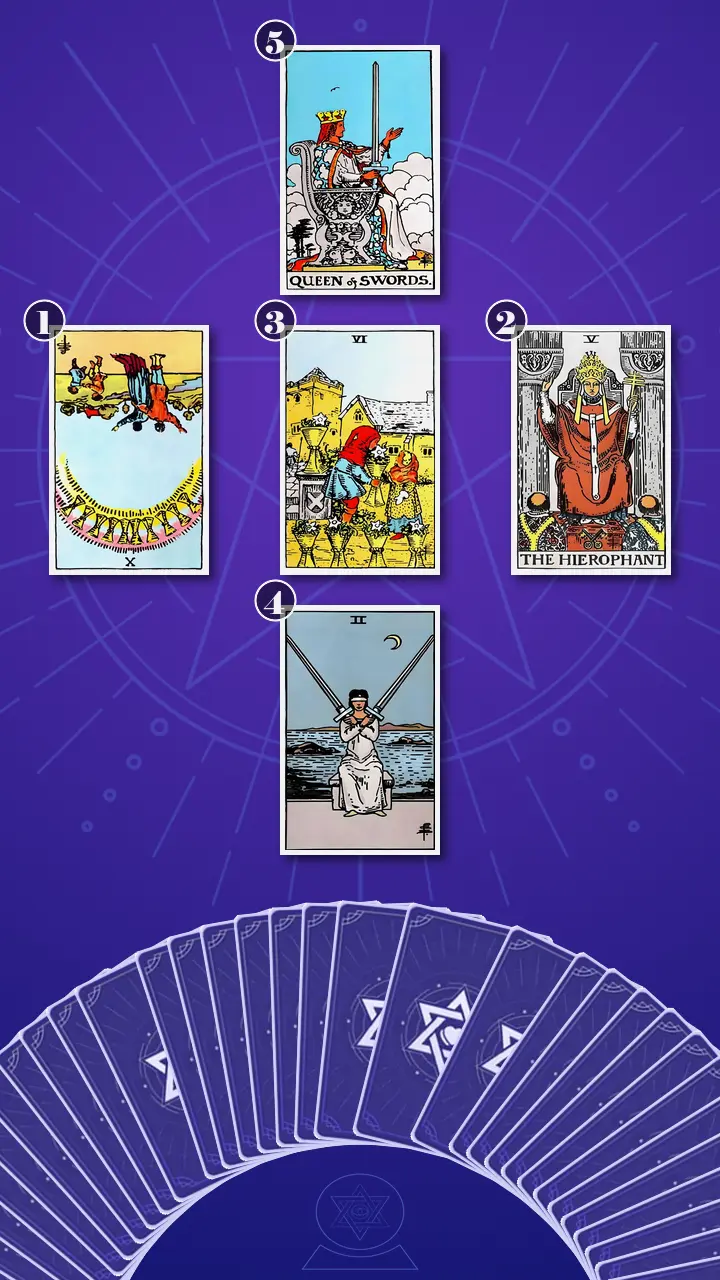
I chose The Bridge, a five-card Bridge tarot spread for family communication and boundary clarity. I use this spread when two relational needs appear to stand on opposite shores. In Jordan’s case, one shore held honest self-expression; the other held familiar family belonging. The purpose was not to force Jordan onto either side. It was to identify what could support a crossing.
This five-card relationship spread was more useful than a broad predictive layout because Jordan’s question was focused. I needed to examine their current participation, the family rules they perceived, the bond they wanted to preserve, the central communication blockage, and the quality that could create clearer connection. I did not need extra cards speculating about relatives’ private motives or promising a particular outcome.
I placed the first card on the left for Jordan’s visible harmony-maintaining stance. The second went on the right for the family code and expectations Jordan experienced. The third occupied the centre for the affection and familiarity connecting both sides. Beneath it, the fourth would expose the submerged obstacle. Above the centre, the fifth would become the bridge.
This is one way I explain how tarot works in a grounded consultation: the spread externalises a knot of thoughts so that each strand can be examined separately. Card meanings in context do not dictate the future. They give language, images, and structure to patterns the querent can then confirm, reject, or revise.
Reading the Family Map Beneath the Smile
Position One: The Family Portrait Turned Upside Down
I turned over the card representing Jordan’s presenting behaviour: the stance of maintaining visible family harmony while withholding the reactions that would reveal the gap underneath. It was the Ten of Cups, reversed.
The traditional image contains a rainbow of ten cups above a celebrating family, with raised arms, children, and a distant home completing the picture. Reversed, that complete tableau looked less like proof of fulfilment and more like a polished screenshot unable to contain what happened before or after it was taken.
I connected it directly to Sunday night. After a tense video call, Jordan had sent a cheerful “Lovely seeing everyone” message and considered sharing the best screenshot. Warm replies would confirm that the call had gone well, yet the fuller sentence, “I didn’t feel heard,” remained unsent. The visible version said connection was intact. Jordan’s throat and shoulders reported that their experience had not been included.
“This card does not tell me that every affectionate moment is false,” I said. “It shows Water in a blocked position. The care is present, but it cannot circulate honestly because too much energy is being used to maintain the complete-looking image.”
I asked Jordan what they usually did immediately after a difficult family interaction. They looked at their phone, gave a short laugh with a bitter edge, and said, “Send something cheerful, then feel awful in private. That’s so accurate it’s almost rude.”
I let the laugh settle before answering. “The card is describing a strategy, not issuing a verdict. The strategy succeeds at producing immediate calm. We’re also noticing its cost.”
Jordan’s smile faded. Their thumb moved over the dark phone screen as if reopening the deleted draft. I could almost see the contrast the card had revealed: the smiling family frame on one side, the warm Notes screen on the other, and the question between them, “Nothing visibly went wrong, so why do I feel so far away?”
Position Two: The Unwritten Group-Chat Style Guide
I turned over the card representing the family rules, harmony cues, and expectations Jordan perceived and responded to. This position did not claim access to anyone else’s hidden intentions. It showed the relational code Jordan had learned to navigate. The card was The Hierophant, upright.
I pointed to the seated figure’s raised hand, the two acolytes receiving instruction, and the crossed keys beneath the formal seat. The scene held the energy of tradition, shared language, and an established model of correct participation.
“Imagine an unofficial content policy for the family chat,” I said. “Birthdays, achievements, logistics, affectionate jokes, and polished photos are approved formats. Tension gets translated into practical updates. Disappointment stays in drafts.”
Jordan nodded once. They told me that no relative had literally forbidden disagreement. Still, whenever a conversation sharpened, Jordan automatically converted their feeling into a joke or work update. Years of repetition had taught them which version of themselves kept the call recognisably pleasant.
The Hierophant’s upright structure was not inherently harmful. Shared rituals can sustain real care. In this position, however, the energy had tipped toward an excess of compliance. Jordan was granting an old family script admin permission over every new conversation, even though they now had the adult authority to review the settings.
“Which expectations were actually stated?” I asked. “And which ones became rules because you watched what received warmth and what produced discomfort?”
Jordan’s fingers tightened around their mug, then loosened. Their gaze shifted away from the cards as if replaying years of quick subject changes. “No one technically told me I can’t say this,” they said. “But I know which version of me keeps the room comfortable.”
I heard recognition without blame in that answer. The distinction mattered. Jordan did not need to diagnose their relatives to notice the code they had internalised, and noticing it did not oblige them to reject every family tradition attached to it.
Position Three: The Sweetness Inside the Old Role
I turned over the card representing what made the performance emotionally compelling: the affection, memory, and sense of membership Jordan genuinely wanted to preserve. It was the Six of Cups, upright.
A child offered a flower-filled cup inside a sheltered courtyard. I saw a familiar exchange, gentle and rehearsed, occurring in a space where everyone seemed to know their place. The image softened the reading. Jordan was not keeping the mood up merely because they feared discomfort. The old role also held birthdays, shared jokes, remembered stories, practical support, and the relief of knowing how to belong.
Jordan described arriving at a family birthday dinner and becoming the cheerful, accommodating version of themself before they had even taken off their coat. When a comment landed badly, they told a reliable old story. Glasses clinked, the table laughed, and the tension disappeared. Their jaw stayed set for the rest of the meal.
The Six of Cups carried balanced affection, but familiarity had become over-relied upon. The role still delivered real sweetness, so questioning it could feel like threatening the bond itself. The problem was not the closeness. It was the assumption that closeness could survive only inside one familiar performance.
“The family role that once helped you belong may now be the role that keeps you unseen,” I said.
Jordan inhaled, held the breath for a moment, and released it slowly. Their eyes shone, although they did not look frightened. “That’s the sad part,” they said. “I do want this closeness. I just don’t want to disappear inside the role that once secured it.”
I let that sentence stand. Honesty did not need to become a rejection of family, and affection did not need to be used as evidence that Jordan should remain silent. The card asked a gentler, more precise question: what did Jordan genuinely want to preserve, and which behaviour had merely become the familiar container for it?
Position Four: The Phone Screen With Only Two Buttons
I turned over the card representing the central mechanism blocking honesty: the inner conflict that framed silence and rupture as the only available choices. It was the Two of Swords, upright.
The blindfolded figure held two swords crossed over the chest. Behind the still body, rocky water and a crescent moon suggested emotion pressing against a defensive pause. Air was active, but blocked. Thought had become rehearsal, prediction, and protection rather than communication.
I asked Jordan to describe the last message they had not sent. At 11:26 p.m., two drafts had been open. One said, “Never mind, it wasn’t a big deal.” The other contained several years of examples. Jordan had compared likely reactions until the timing felt impossible, then sent neither. Silence brought relief that night. By the next call, it had become more distance and more pressure to act cheerful.
“The crossed swords are like a phone screen generated by anxiety,” I said. “It gives you two imaginary buttons: ‘Say nothing’ and ‘Start a family crisis.’ If you soften the message, you fear it will not be honest. If you say it plainly, you predict that everything could change.”
Jordan’s breath rose high in their chest. Their index finger hovered over the edge of the card, then retreated. “That is literally how I think about it,” they said. “I keep waiting for a perfect way to say something imperfect.”
I turned my palm upward between us. “You are not choosing between silence and a family reckoning; there is a sentence-sized third option.”
Jordan frowned rather than relaxing. “But if it’s only one sentence, isn’t that too small to change anything?”
“Its first job is not to change the whole family pattern,” I replied. “Its first job is to let one accurate experience exist outside your head. A small real-world test gives you information. Endless catastrophic reaction forecasting does not.”
When the Queen Raised One Clear Blade
Before I turned the final card, a cloud moved beyond Jordan’s window and exposed a narrow strip of clear Toronto sky. The radiator, so insistent earlier, went quiet. I felt the reading’s imagery gather around a single question: could the same Air that had formed a defensive barrier become a deliberate voice?
Position Five: One Defined Truth and an Open Hand
I turned over the card representing the constructive bridge from automatic reassurance to bounded honesty. It was the Queen of Swords, upright.
I placed her beside the Two of Swords. The difference was immediate. Two crossed blades had become one vertical sword. The blindfold was gone. The Queen looked forward, while her open left hand remained extended toward response and dialogue.
“This is balanced Air,” I said. “Not coldness, not punishment, and not a complete case against the family. It is discernment with defined scope.”
I translated the card into a recent, lower-stakes example: “When my point was turned into a joke on Sunday, I felt dismissed. Next time, would you let me finish before we move on?” Jordan would not be claiming to speak for everyone, diagnosing a relative, or listing every previous injury. They would be naming one observable event, one impact, and one request. The other person would remain free to respond, and Jordan would remain free to pause or leave if the exchange stopped being constructive.
This was where I applied one of my core diagnostic tools, Cyclical Variable Filtering. After years of reading patterns through cycles, I have learned that temporary friction can impersonate permanent truth. I asked Jordan to separate short-lived conditions from the variables that would matter in their longer relational orbit.
The temporary variables included Sunday-night adrenaline, the phone still warm from the call, fatigue at 11:26 p.m., a workday waiting in the morning, and imagined reactions to every possible adjective. The structural variables were simpler: Was the moment safe enough? What observable event had occurred? What did Jordan feel? What specific request could they stand behind? Were they willing to let the response belong to the other person?
I then used Decision Timing Calibration to make one more distinction. A clear direction and an optimal launch window are not the same decision. The Queen did not command Jordan to send a message immediately. She asked for accurate language, conscious timing, and ownership. A private channel with twenty minutes of recovery time might be structurally better than a family group chat just before bed.
At 8:47 on Sunday, the call had ended with two jokes and “everything’s good.” The unsent message remained in Notes while Jordan’s throat stayed tight and their shoulders dropped. The room was peaceful; Jordan was still carrying the conversation.
I said, “You do not have to choose between keeping quiet and blowing everything up. Honesty can be one sentence wide: clear enough to include the real you, bounded enough to leave room for relationship.”
Keeping both swords crossed does not preserve real harmony; raise one clear blade, extend an open hand, and let a bounded truth replace the performance.
I stopped speaking. Jordan’s breath froze first, so completely that the video image seemed paused. Their pupils widened, then their gaze lost focus as though several old calls were replaying at once. Their mouth opened, closed, and tightened at one corner. “But doesn’t that mean I’ve been doing it wrong all this time?” they asked, their voice suddenly sharper. I heard anger underneath the question, followed almost immediately by grief. “It means the strategy protected something important,” I said. “It also means you can decide whether it still fits.” Jordan’s fist slowly opened against their knee. Their shoulders sank, and a trembling exhale left their chest. The relief was not uncomplicated; their expression carried the slight dizziness of someone discovering a door and realising they would have to choose whether to walk through it. I asked, “Now, with this new perspective, can you remember one moment last week when this insight might have changed how you felt?”
Jordan returned to the birthday dinner. “I didn’t need to expose everything at the table,” they said quietly. “I could have told one person later that the comment didn’t sit well with me. I could have asked them not to turn my point into a joke.”
I set a timer for ten minutes and invited Jordan to write three lines in Notes: “When [observable event] happened, I felt [one feeling]. Next time, would you be willing to [one specific request]?” I asked them to leave out every earlier grievance and every prediction about the other person’s motives. They could shorten the draft, choose a safer person or channel, keep it private, or stop if their body signalled that the timing was wrong. Making the truth visible to themselves was the exercise. Sending it remained their choice.
“Clarity is not cruelty, and a boundary is not a verdict,” I said.
I named the transition carefully. This was not instant confidence and it was not a guarantee of family agreement. It was the first movement from conflict-avoidant family harmony performance to clear, bounded honesty that leaves room for connection. Jordan was shifting from trying to control every reaction toward trusting themself to make one responsible statement and respond to what actually happened next.
The Sentence-Sized Route Out of the Stalemate
I gathered the five cards into one continuous story. The reversed Ten of Cups showed the visible symptom: a complete-looking family image that excluded Jordan’s private experience. The Hierophant revealed why that image carried authority: years of repeated harmony cues had become an internal rulebook. The Six of Cups showed what the rulebook protected: genuine affection, memory, and membership. The Two of Swords exposed the mechanism keeping the pattern in place: binary conflict predictions that suspended communication between silence and total reckoning. The Queen of Swords offered the unused resource: one accurate statement, one defined request, and an open hand that did not surrender the boundary.
For a moment, I thought of the orbital charts that have shaped my work for more than a decade. A difficult phase can be real without describing the whole orbit. Jordan had been treating every high-friction family moment as proof that honesty itself was structurally unsafe, while treating every pleasant ending as proof that silence was working. The cards separated those conclusions from the observable facts.
The cognitive blind spot was not simply “I am bad at confrontation.” It was the belief that the perfect sentence should guarantee a painless response. No sentence can do that. Jordan could be thoughtful about timing, scope, and safety, but they could not use enough editing to control another person’s feelings.
I also noted what the spread lacked. There were no Wands and no Pentacles. Insight and feeling were present, but Fire and Earth still had to be supplied through one small act of courage and one repeatable communication container. This is how tarot works at its most useful for me: it clarifies the pattern, then returns the experiment to the person living it.
- Write the One-One-One Draft.On one evening this week, set a ten-minute timer and choose one relatively low-stakes family moment from the past seven days. In Notes, write one observable event, one feeling, and one request: “When [event] happened, I felt [feeling]. Next time, would you be willing to [request]?” Read it once and remove explanations whose only purpose is to make disagreement impossible. Sending it is optional.Tip: If three lines feel too exposed, write only the observation and feeling. The minimum version still counts because the immediate goal is accurate self-contact, not a complete family resolution.
- Use the Orbital Pause Strategy.Save this phone shortcut before the next family call: “I don’t want to joke this away, and I need a little time before I respond.” When tension appears, take one full breath and use the line if appropriate. Then take a calculated 72-hour pause, with a specific calendar time to revisit the issue, so post-call activation, late-night fatigue, and work pressure can settle before you choose whether to send, revise, or leave the matter alone.Tip: The pause is not an obligation to disclose later. If someone pushes, repeat the boundary once or end the conversation. Timing, channel, recipient, and participation remain yours to choose.
“One clear sentence lets the relationship meet someone the performance has been hiding,” I told Jordan. “It may not transform the relationship immediately. It does transform your participation from automatic reassurance into a conscious choice.”

A Week Later: The Quiet Proof
A week later, I received a message from Jordan. They had used the ten-minute draft after another low-stakes moment and sent it privately to one family member during an evening when they had time afterward. The reply was not perfectly polished: “I didn’t realise it landed that way. I don’t fully see it the same way, but I can let you finish next time.”
Jordan sent the sentence, sat alone in a café with tea, and watched rain stripe the window. Relief arrived first; then came, “What if I made this weird?” The fear remained, but this time it did not delete the truth.
I did not regard the reply as proof that every future conversation would go well. I regarded Jordan’s action as the quiet proof that difference could become visible without immediately becoming catastrophe. Cautious relief had replaced certainty-seeking, and self-trust had acquired its first piece of real evidence.
The five-card Bridge tarot spread for family communication and boundary clarity did not create Jordan’s courage or prescribe their fate. It helped us distinguish a temporary wave of friction from the structural choice underneath it. Jordan decided what to write, when to send it, whom to approach, and what boundary to keep. The cards held the map; Jordan remained the author of the journey.
When a family call gets tense, some of us feel the throat tighten, reach for a joke, and hear the old calculation underneath: keep everyone comfortable, or risk finding out whether we still belong. If that calculation appears for you, noticing it already means the old family script is no longer operating entirely outside your awareness.
If connection did not require a perfect speech, what sentence-sized truth could you place between the Queen’s upright blade and open hand the next time the mood asks you to disappear?