Finding Clarity in the 6:40 p.m. StreetEasy Spiral
Lease signed. Slack open. Date tonight.
Alex appeared on my screen at 6:40 p.m. on a Tuesday from her Brooklyn bedroom, one earring in, one not. A half-zipped black dress lay across the bed behind her, Slack still glowed on her laptop, and somewhere off camera the radiator hissed like static. The laptop fan kept up a thin mechanical buzz. Her phone screen shone warm against her thumb. Her shoulders were so high they nearly touched her earrings.
‘I signed the lease because I wanted stability,’ she said, glancing at a StreetEasy tab she had forgotten to close. ‘And now I keep looking at apartments I am not actually going to rent. I have a date in twenty minutes. Work is technically still on. Nothing is wrong enough to leave, and nothing feels right enough to stay.’
I had heard versions of this question before—why do I want to start over when my life looks fine on paper?—but her version had a particular Brooklyn sharpness to it: the stable startup job feeling like a cage, the decent date feeling weirdly heavier than a bad one, the browser tabs acting like emotional escape hatches. It had that split-screen quality people joke about when they mention Severance: the functioning self was showing up, while the inhabited self was somewhere in the hallway looking for an exit. Her restlessness looked less like indecision and more like twenty tabs open in one overheating nervous system, as if stillness itself might harden into permanence.
‘Restless does not always mean wrong,’ I told her. ‘Sometimes it means unnamed. And a browser tab is not a decision, but it can be a clue. Let’s make a map of the fog before your mind tries to set fire to the whole building.’

Choosing the Map: How Tarot Works When Home, Work, and Dating All Start Feeling Like Fate
I asked her to put both feet on the floor and take one slow breath before she touched the deck. I shuffled slowly, not as theatre, but as a way of helping the mind cross from spiraling into noticing. This is how tarot works at its best: not by dictating fate, but by making a pattern visible enough that choice can return.
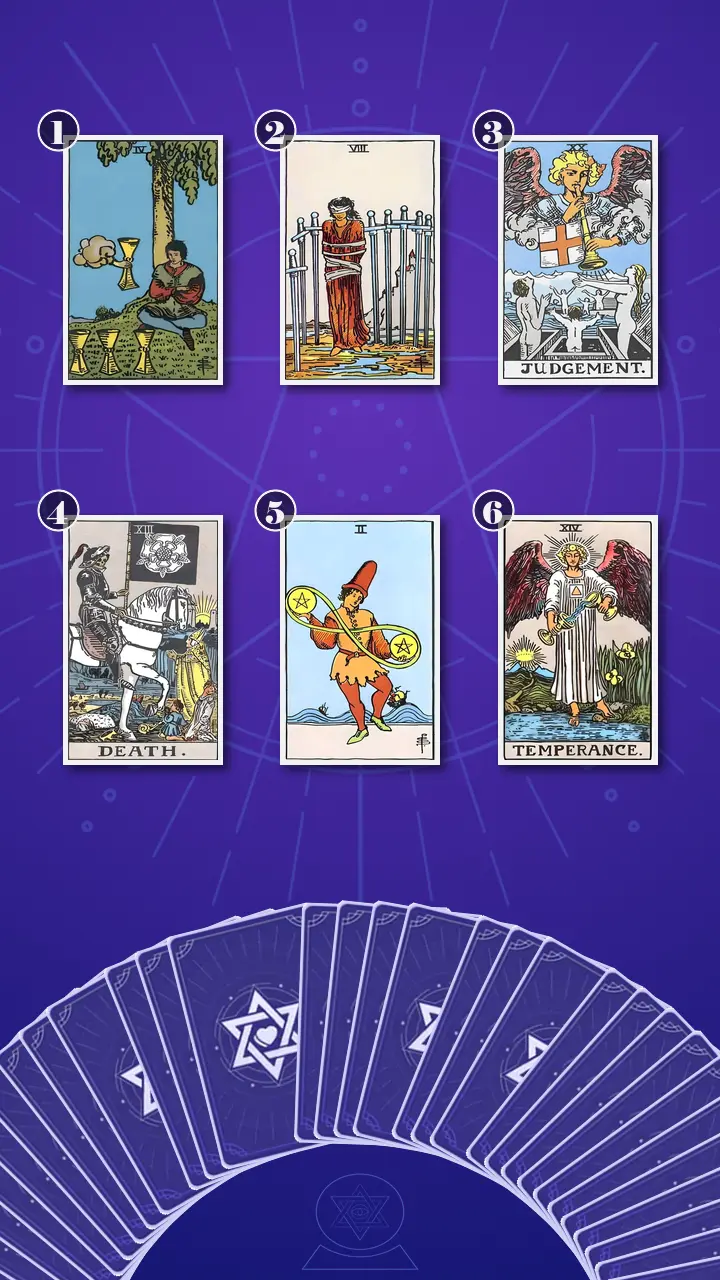
For her, I used the Transformation Path Grid (6) · Context Edition. I chose it because this was not one bad date, one bad job, or one regretted lease. It was a cross-domain reset fantasy moving across home, work, and dating all at once. A simpler spread would have flattened that into generic indecision. This six-card tarot spread kept the logic clean: symptom, blockage, root, hinge, action, integration.
I laid the cards into a grid and described the structure as I saw it: the top row would show where life felt cramped from the inside; the bottom row would show how to renovate rather than abandon it. The first card would name the surface symptom. The second would expose the mental trap that turned ordinary commitments into proof of entrapment. The fourth—usually the hinge in this spread—would tell us what actually needed to end. The final card would show what finding clarity might feel like in the body, not just in theory.
The Upper Floor: Where Life Looks Fine and Still Won’t Land
Position 1: Four of Cups — The Life That Is Technically There
I turned the card for the surface symptom in her diagnosis: the visible sense of checking out while work, housing, and dating were all still in motion. It was the Four of Cups, upright.
‘This is the exact moment we started with,’ I said. ‘The lease is signed, the job is still there, the date is still on, and yet none of it emotionally lands. Instead of feeling relieved or interested, you drift into apartment listings, alternate-career tabs, or imaginary other-city versions of yourself because elsewhere feels more alive than what is already in front of you.’
The card’s energy was not dramatic. It was a deficiency of emotional receptivity—a kind of internal bracing. The crossed arms in the image mirrored the way she held herself now, sternum locked, shoulders up, as though receiving anything from the life she had built might somehow trap her inside it. The three cups on the ground were the actual structures already present. The offered cup from the cloud was her present life trying to reach her while she stayed internally unavailable to it. It had the same muted vibe as doom-scrolling while a perfectly good text sits unanswered.
‘So the problem is not that nothing exists,’ I said. ‘The problem is that you’re physically in your life and emotionally half-absent from it.’
She gave one short laugh, dry at the edges. ‘That is annoyingly accurate,’ she said. Her fingers pressed into the center of her chest, then slid away. It was not agreement so much as recognition arriving with a sting.
Position 2: Eight of Swords — When Structure Starts to Feel Like a Life Sentence
I turned the card for the main blockage in the mechanics: the mental frame that turns ordinary commitments into proof of entrapment. It was the Eight of Swords, upright.
‘Here is the choke point,’ I told her. ‘This is what happens when a signed lease, an active Slack thread, or a date on the calendar gets interpreted as irreversible fate. Your mind converts ordinary adult structure into evidence that you are trapped, so you open LinkedIn Jobs, Google Flights, or old saved apartment searches just to recreate the feeling of choice.’
This was blockage in its clearest form. The blindfold showed narrowed perception. The loose binding showed that the situation had more room than panic admitted. The ring of swords was the thought-loop itself: if I stay with this one thing, I lose every other version of me. I have seen that logic before, not only in clients but in history. Whole states have mistaken a treaty for destiny and wrecked themselves by reacting to imagined permanence rather than present facts. Commitment anxiety works similarly. It reads one calendar invite as if it were a tattoo on identity.
‘Your body hears permanence faster than your mind can ask what is actually wrong,’ I said. ‘So a rent notification or a Slack ping feels bigger than it is. Not because you are irrational. Because your inner story keeps translating structure into fate.’
Her nod was immediate and sharp. Then came the three-part reaction I had been waiting for: first the freeze, her inhale catching halfway; then the faraway look, as if she were replaying a dozen autopay notifications and red Slack dots at once; then the release, a low breath that lifted and dropped her shoulders. ‘Yes,’ she said quietly. ‘That is exactly how my brain makes everything permanent.’
Position 3: Judgement — The Alarm Under the Fantasy
I turned the card for the deeper root beneath the symptom: the inner call, fear, or truth that kept surfacing through the reset fantasy. It was Judgement, upright.
‘This is important,’ I said. ‘Not all discomfort is panic. Some of it is signal. Under the spiral is a real reckoning: some older script about success, adulthood, or who you are supposed to be no longer fits. The urge to start over keeps returning because something true is trying to wake you up—especially right after you do the sensible thing and still feel absent inside it.’
The trumpet in the card reminded me of an ignored push notification that had finally become a blaring alarm. What began as a soft inner line—this feels off—had become louder because it had been muted for too long. The rising figures were the parts of her self coming back online. The mountains in the distance suggested a wider horizon than the one her current routine allowed. This card carried awakening energy, not chaos. It did not say she was impossible to satisfy. It said she had been performing a version of success that no longer matched the woman sitting in front of me.
‘Maybe this keeps getting louder because you never answered it when it was quieter,’ I said. ‘Praise can even make this worse. Someone says, “You have so much going for you,” and what you feel is not gratitude but the gap between what looks good and what feels true.’
Her jaw unclenched. She leaned back for the first time since we began, and the radiator seemed suddenly louder in the silence. ‘That feels horrible,’ she said, ‘but also more honest.’
‘Yes,’ I said. ‘And that honesty matters. Sometimes “I need a new life” is grief in better lighting.’
When Death Rode In With a White Rose
Position 4: Death — The Turning Point Between Escape and Renewal
I turned the card for the transformation hinge: the key shift that separates genuine renewal from dramatic escape. It was Death, upright.
The room altered the instant it appeared. The light from her window had dipped lower, and the white rose on the card seemed brighter against the dark banner. Even through a screen, I could feel the atmosphere narrow into focus. This was the core card of the reading.
At 6:40 p.m., with Slack still capable of pinging, a date outfit still waiting, and StreetEasy tabs still offering the fantasy of another life, the urge to start over can feel like the only alive feeling in the room.
This is not a sign to torch your whole life; it is a white-rose invitation to let one dead version of you go so something living can ride forward.
I let the sentence sit between us.
For a second she went absolutely still. Her breath stalled halfway in. Then her eyes slipped off the screen, unfocused, as if she were replaying a hundred tiny scenes at once: answering Slack instantly, saying yes when tired, staying polished, staying agreeable, staying impressive. When she looked back, there was heat in her face. ‘But if that’s true,’ she said, voice sharper now, ‘doesn’t that mean I’ve been building this whole thing around the wrong self?’
‘No,’ I said. ‘It means a self that once got you safely this far has reached the end of its contract.’
Because I am an archaeologist by training, my mind flashed—as it often does in moments like this—to a trench I once stood in at dusk, where an older stone threshold had been worn smooth long after the official street plan had changed. Nobody had burned the town down. They had simply stopped forcing life through a doorway built for another century. I told her that I use a lens I call Historical Case Matching. At civilization crossroads, the societies that survive are rarely the ones that torch every archive and flee. They are the ones that identify which institution has gone stale, stop feeding it, and let the city breathe again. That is what this Death card was doing. Not destruction. Selective release.
‘Using the same lens,’ I said, ‘I look for the rise-and-decline signal inside a life. Here, the dead thing is probably not the apartment, the job, or the date. It is the role you keep dragging through all of them—the endlessly available, polished, good-at-adulthood version of you. The version that answers instantly, copes beautifully, and never admits she feels absent.’
She stared at the card again. Then came the fuller reaction: first the physical softening, shoulders dropping a visible inch; then the strange blankness that often follows a clean truth, like dizziness after stepping out of a moving train; then the emotional landing, a breath that sounded almost like grief. Her eyes shone, though she did not cry. ‘After my manager Slacked me at 6:32 last week,’ she said finally, ‘I answered in thirty seconds and then started looking at apartments in Greenpoint. I didn’t want a new apartment. I wanted one evening that belonged to me.’
‘Exactly,’ I said. ‘That is the shift. From numb restlessness toward honest grief. From treating the whole life as wrong to naming one expired demand inside it. That is how self-trust begins to come back.’
Position 5: Two of Pentacles — Edit Before Erase
I turned the card for the practical experiment: the next small adjustment that could be tried without blowing up the whole structure. It was the Two of Pentacles, upright.
‘Good,’ I said. ‘Now the reading gets useful. This card says: not a verdict, an experiment. Real change here looks like closing Slack earlier, taking one night off exit tabs, slowing your dating pace, or changing how your apartment functions after work. The point is not to produce a grand new identity. It is to rebalance and gather cleaner data.’
The energy was dynamic balance—not perfection, not certainty, but responsive movement. The infinity loop around the pentacles showed adjustment rather than a single perfect answer. The ships on the waves reminded me that instability can be navigated. The juggler did not wait for life to become simple before moving. He learned by pacing.
‘I often call this my Voyage Log Technique,’ I told her. ‘Ancient navigators did not redraw the whole map because the wind shifted at dusk. They noted the current, adjusted the sail, and checked the course again in the morning. That is what this card asks of you. What if you do not need certainty first—just cleaner data?’
She frowned, but this time it was practical rather than panicked. ‘What if I can’t even do the five-minute version?’ she asked. ‘Some nights work bleeds everywhere.’
‘Then we lower the bar without lowering the honesty,’ I said. ‘Mute Slack for dinner. Make it thirty minutes, not three hours. One no-listings evening, not a spiritual cleanse. Small changes are not fake changes. They are measurable ones.’
She nodded and uncrossed her legs. That small uncrossing mattered. It was the first bodily sign that her imagination no longer needed total demolition in order to feel movement.
Position 6: Temperance — A Life You Can Actually Stay Inside
I turned the final card for the integrated state: how life feels when change is selective, embodied, and emotionally livable. It was Temperance, upright.
‘This,’ I said, ‘is not the high of a total reset. It is better. It is a life you can actually stay in long enough to feel.’
The energy here was balance in the truest sense: one foot on land and one in water, reality and feeling held together instead of split apart. The pouring between the cups was the skill of blending needs rather than forcing extremes. Work, home, desire, solitude, uncertainty—none of them had to cancel the others out. This was not numb stability or chaotic reinvention. It was a more breathable rhythm.
I also told her that this is where my habit of Long-Term Value Assessment becomes useful. Google Flights gives immediate lift. So does imagining a different neighborhood, a different job title, a different self. But Temperance asks a harder and kinder question: what rhythm would still feel honorable, sustainable, and recognizably yours six months from now? Quick relief is not always the same thing as value. This card prefers the kind of alignment that lasts.
For the first time that evening, she smiled without forcing it. It was small, but it changed her whole face. ‘That sounds less cinematic,’ she said, ‘and way more livable.’
‘Exactly,’ I said. ‘Clarity often arrives that way. Less fireworks. More unclenching.’
Edit Before Erase: Actionable Advice for the Next 7 Days
Once all six cards were on the table, the story they formed was remarkably clean. The Four of Cups showed the half-absence: a life functioning on paper while her inner contact had gone flat. The Eight of Swords showed the mental trap: every ordinary commitment inflated into permanent fate. Judgement revealed that the spiral was not random chaos but a wake-up call—an ignored discomfort becoming loud because it had been unanswered for too long. Death named the real turning point: what needed to end was not necessarily the apartment, the career, or the date, but the outdated role of being endlessly available and polished on demand. The Two of Pentacles grounded that insight in experiment, and Temperance showed the emerging outcome—a life that felt more inhabited, less trapped, and more breathable.
Her blind spot had been treating restlessness as a global verdict. If she felt trapped, she assumed the whole structure must be wrong. But the reading kept insisting on a narrower and more merciful truth: one specific misalignment was carrying the emotional weight of everything else. Renewal would come through honest edits and chosen release, not total erasure. Edit before erase.
I told her I wanted her next steps to be practical enough that her nervous system would not mistake them for another life sentence. I borrowed two of my own working methods here—Time Stratigraphy, which separates the immediate trigger from the older layer beneath it, and Artifact Restoration Thinking, which asks what is still structurally sound before deciding anything belongs in the rubble.
- The One-Misalignment Note Tonight, open your Notes app and title a page ‘Not the whole life — just this.’ Spend five minutes naming one role, rule, or expectation that feels expired. Then label it: pace, role, place, relationship, or expectation. If the urge to start over hits first, write one line only: ‘What got loud just now was...’ Tip: If your mind says ‘everything,’ that is the spiral talking. In Time Stratigraphy, we read one layer at a time.
- The No-Listings Voyage Log On one weeknight this week—ideally after rent day or after a Slack-heavy day—close Slack thirty minutes earlier than usual and give yourself ninety minutes with no StreetEasy, no LinkedIn Jobs, and no Google Flights. If the urge spikes, record a 90-second voice note instead of opening a tab. Start with: ‘What got loud just now was...’ Tip: The point is cleaner data, not perfect discipline. If ninety minutes feels impossible, do thirty and count it.
- Restore One Corner of Home Before bed this week, move your laptop off the bed and create one no-work corner in the apartment—a chair, a candle, a glass of water, one lamp. Sit there for ten minutes without multitasking and notice whether your body reads the room differently. Tip: Do not redecorate the whole apartment. Artifact Restoration Thinking begins by testing one structure, not renovating the entire site overnight.
None of these actions required her to quit her job, cancel her date, or break her lease in a panic. That was the point. You do not need to burn it down to stop performing inside it.

A Week Later: The Quiet Proof
A week later, she sent me a message just after 9 p.m. It was brief, which I took as a good sign.
‘I did the no-listings night after rent autopay,’ she wrote. ‘The first ten minutes were horrible. Then I realized I do not want a different apartment. I want evenings that are not owned by Slack.’
She had moved her laptop off the bed. She had made one corner of the room hers with a lamp and a cheap candle from the bodega. She had gone on another date with the same man and, before leaving the wine bar, typed one line into her phone: ‘More like myself, less performed.’ It was not a solved life. It was better than that. It was evidence.
She added one last sentence: ‘I still woke up this morning thinking, what if I’m wrong? But this time I laughed a little.’
That is often what a real journey to clarity looks like. Not total certainty. Not a cinematic reinvention. Just the first honest proof that you can stay with your real life long enough to name what actually needs to change. The Transformation Path Grid (6) had done exactly what it was built to do: separate symptom from story, panic from signal, and demolition fantasy from selective release.
Sometimes the tight-chest panic is not about wanting a whole new life; it is what it feels like when the life in front of you keeps asking an outdated version of you to keep showing up.
If you let yourself make one honest, white-rose edit instead of a total reset, where do you already sense you would start?
This story is adapted from psychological research, written so that those in a similar struggle can see their own pattern in it — and find their next step clearly.These insights are not a substitute for professional psychological, medical, legal, or financial advice.
Learn more about our Journey to Clarity.
How did this insight land for you?
🫂 This Resonates Deeply
🌀 Living This Story
✨ Now I See Clearly
🌱 Seeing New Possibilities
🧰 Useful Framework
🔮 The Confirmation I Needed
💪 Feeling Empowered
🚀 Ready for My Next Step
Author Profile
 AI
AI“Having spent a lifetime at Cambridge and on archaeological digs, I’ve witnessed the rise and fall of countless civilizations. Please know that your current struggles are not a permanent fate, but merely a necessary fracture before rebuilding. I won't lecture you; instead, I invite you to sit with me in the ruins, using a patient, historical perspective to gently dust off the true, enduring value hidden beneath your temporary doubts.”
In this Choice Tarot Reading :
Core Expertise
- Historical Crossroad Matching: Contextualizing your dilemma by comparing it to macro-historical turning points, providing an objective bird's-eye view.
- Enduring Value Assessment: Evaluating competing options based on what will survive the test of time versus what is merely a short-term impulse.
Service Features
- The Time Stratigraphy Exercise: A mental time-travel protocol evaluating your current dilemma strictly from the perspective of your 10-year future self, instantly dissolving trivial anxieties.
Also specializes in :
Explore Related Patterns:
Achievement FusionAlex's life is visibly working: the lease is signed, the startup job is stable, the date is decent, and the adult markers are all technically in place. The problem is that the role holding those markers together feels increasingly unreal. She is showing up as the polished, agreeable, good-at-adulthood version of herself while another part of her is searching for the exit. Achievement Fusion names the mechanism where external proof of competence becomes fused with identity. The lease, the job responsiveness, the date, and the impressive self-presentation start to function like evidence that she should feel fine. When she does not, the gap becomes destabilizing because questioning the role feels like questioning the whole self. The turn comes when the story separates the structure from the performance. Alex has not necessarily built the wrong life; she has outgrown the self-concept that keeps performing inside it. For You, that distinction matters because it turns the question from whether everything must be erased into which success script no longer deserves control over your nervous system.
Boundary DiffusionAlex is getting ready for a date with Slack still open, a laptop glowing in the bedroom, and work technically still on. Later, she sees the pattern more clearly: after a Slack-heavy day, she does not want another apartment. She wants an evening that is not owned by work. Boundary Diffusion fits because the issue is not only workload; it is the collapse of psychological and physical separation. Work enters the bedroom, the date-night window, the rented home, and the body. Without a clear line between what belongs to the job and what belongs to Alex, the apartment starts to feel less like a base and more like another extension of the inbox. For You, the signal is practical and psychological at once. Moving the laptop off the bed and creating one no-work corner are not decorative fixes; they are boundary experiments. They test whether the urge to flee decreases when your existing life finally has a protected place where you are not performing availability.
Defensive OverfunctioningAlex's most revealing moment is not the apartment search itself; it is the thirty-second Slack reply after her manager messages at 6:32. She answers instantly, then starts looking at Greenpoint apartments even though she does not want a new apartment. The sequence shows a body trying to escape after the mind has performed competence too quickly. Defensive Overfunctioning fits because the polished, always-available self has become a coping strategy. By answering fast, saying yes when tired, and staying impressive, Alex avoids the discomfort of disappointing anyone or admitting she has limits. The defense works on paper, but it creates an internal split: the functioning self keeps delivering while the inhabited self looks for an exit. For You, this pattern is not about being productive in a neutral sense. It is about using performance as psychological armor until your own evening, body, and desire disappear from the schedule. The reset urge begins to calm only when the actual overfunctioning demand is named: not a whole new life, but one evening that belongs to you.
Fresh Start FantasyAlex's StreetEasy spiral starts right after the lease is signed, Slack is still live, and a date is already on the calendar. None of those facts is dramatic on its own, but together they make the present feel sealed shut, so the mind reaches for apartment listings, career tabs, flights, and alternate-city versions of the self as a way to recreate the feeling of choice. That is the core mechanism of Fresh Start Fantasy: the nervous system mistakes a specific pressure point for proof that the entire life needs to be replaced. The browser tab becomes a defense mechanism, not a plan. It lets You feel motion without having to identify the narrower truth underneath the urgency. The later no-listings night makes the pattern visible with precision. Alex does not actually want a different apartment; she wants evenings that are not owned by Slack. The fantasy of starting over is therefore not random indecision. It is a cognitive escape hatch that appears when one expired role gets misread as a global life verdict.
Reflective DistanceAlex begins with a whole-life verdict: nothing is wrong enough to leave, and nothing feels right enough to stay. The shift starts when she puts both feet on the floor, slows down, and lets the pattern become observable instead of immediately actionable. That small pause changes the nervous system's relationship to the urge. Reflective Distance is the mechanism that lets You see a thought loop without obeying it. Instead of treating the start-over impulse as a command, Alex starts treating it as data. Closing Slack earlier, taking one no-listings night, and testing one corner of the apartment create enough space to ask what actually got loud. This is the upright movement in the story: not certainty, but a cleaner vantage point. Alex does not have to solve her whole life before tonight's date. She only has to stop merging the spiral with the truth long enough to identify the specific demand that needs editing.
Values-Based Decision MakingAlex's turning point is the move from demolition to experiment. Instead of quitting the job, cancelling the date, or treating the lease as a mistake, she tests smaller edits: close Slack earlier, pause the exit tabs, slow the pace, and see what her body reports back. Values-Based Decision Making fits because the story stops chasing immediate relief and starts asking what would remain livable and recognizably hers over time. The question is no longer which escape produces the biggest rush of possibility. It becomes which rhythm respects work, home, desire, solitude, and uncertainty without letting one of them swallow the rest. For You, this pattern turns clarity into an audit instead of a verdict. A choice does not have to feel cinematic to be correct. It has to generate cleaner data, reduce self-betrayal, and make the life in front of you easier to inhabit.
Avoidance CopingAlex keeps looking at apartments she is not actually going to rent. The listings, flights, and career tabs appear when her body reads the present as too fixed, especially after rent autopay or a Slack-heavy day. The action creates relief because it makes escape feel available, even when no real move is being chosen. Avoidance Coping names the function of that loop. The tab is not information-seeking anymore; it is emotional regulation through displacement. Instead of staying with the harder question of what feels misaligned, the mind moves into a safer interface where everything looks editable and no direct boundary has to be set. For You, the useful audit is not whether browsing is bad. It is whether the behavior gives you cleaner data or just lowers discomfort for a few minutes. Alex's no-listings night exposes the difference: when the escape hatch is paused, the real sentence emerges with much more accuracy.
CatastrophizingAlex's mind turns a lease, a Slack ping, and a date into something much larger than their actual scale. The thought loop is not simply that she has plans; it is that choosing one path seems to erase every other possible version of herself. Her body hears permanence before the situation has been reality-tested. Catastrophizing fits because the mind inflates ordinary structure into identity-level confinement. A calendar event becomes a life sentence, a rent notification becomes proof that the future is closing, and a Slack message becomes evidence that the evening is already gone. The cognitive distortion makes the present feel less negotiable than it is. For You, this pattern matters because the feeling of being trapped may be real while the conclusion may still be distorted. Once Alex tests a smaller edit, the global fear becomes more specific. The whole life is not the problem; the catastrophic frame was making one pressure point feel like total captivity.
Explore Related Struggles:
Freedom-Structure ConflictAlex signs the lease because she wants stability, then keeps a StreetEasy tab open for apartments she is not actually going to rent. Slack is still open, a date is minutes away, and each ordinary commitment starts carrying the weight of a locked door. You are not just watching someone struggle to choose an apartment, a job, or a date. You are watching structure and freedom collide in the same body: the part that wants a life to hold her meets the part that fears being held too tightly. The urge to start over becomes the mind's fast way of proving choice still exists, even when the actual need is a more breathable relationship with commitment.
Identity Shedding StrainThe clearest moment arrives when the story names the dead thing as the endlessly available, polished, good-at-adulthood version of Alex, not necessarily the apartment, the job, or the date. She remembers saying yes when tired, answering instantly, staying agreeable, and trying to cope beautifully. You are not being asked to erase the whole life when an older self stops fitting. You are being asked to notice the strain of shedding an identity that once helped you get this far but now demands too much. The urge to start over makes sense because an old role is ending; clarity begins when that ending can be selective rather than total.
Performative StabilityAlex's life is working on paper: the lease is signed, the startup job is stable, the date is decent, and she can still answer Slack in thirty seconds. At the same time, the story keeps showing the split between the functioning self who performs adulthood and the inhabited self looking for an exit. You are seeing stability maintained through polish rather than contact. The performance keeps the outer structure impressive, but it also makes her own needs harder to hear until restlessness has to speak for them. The core struggle is not that her life is fake; it is that a version of her built to be agreeable, available, and impressive has started to crowd out the person who has to live inside it.
System Reset OverloadStreetEasy, LinkedIn Jobs, Google Flights, and old apartment searches keep appearing around the same triggers: rent autopay, Slack pings, and the stretch before she leaves for a date. None of those tabs is treated as a real plan; they work like emergency exits for a life that suddenly feels too fixed. You can feel the overload in how one misalignment spreads across every domain at once. Instead of asking what specifically needs to change, the whole system gets marked for demolition. That is the trap: the reset fantasy offers instant motion, but it also prevents the cleaner data that would show which part of the life is actually asking to be released.
Partial Exit LockShe is physically in the room with one earring in, a half-zipped dress on the bed, Slack glowing, and the date still on. Emotionally, she keeps stepping sideways into tabs for apartments, jobs, flights, and imagined other-city versions of herself. You are watching an exit that never becomes an exit. The tabs give a hit of distance without requiring an actual decision, so she stays suspended between staying and leaving. That partial exit protects her from the finality she fears, but it also keeps her from fully receiving what is present or making the one change that would give the evening back to her.
Boundary CollapseWork is technically still on while a date is twenty minutes away, and the laptop is close enough to keep Slack glowing in the bedroom. When her manager messages at 6:32, she answers in thirty seconds and then starts looking at Greenpoint apartments, even though the apartment is not what she wants. You can see the boundary collapse in the way work enters home, home enters dating, and private time never fully becomes private. The search for a new place is carrying a simpler demand: one evening that belongs to her. The struggle is not solved by a grand escape; it becomes visible when the line around attention, rest, and responsiveness is redrawn in a way her body can actually trust.
Explore Related Emotions:
Bittersweet ReleaseAfter the old role is named, Alex does not become instantly light. Her shoulders drop, her breath lands, and the room takes on the strange quiet that follows a clean truth. The release is real, but it carries the sting of recognizing how long she has been living through a demand that no longer fits. Bittersweet Release describes that exact emotional texture. She does not have to reject the whole apartment, career, or date to feel movement; she has to stop feeding the expectation that she should be endlessly available, polished, and agreeable inside all of them. You can feel the release sharpen when she says she did not want a new apartment; she wanted one evening that belonged to her. That sentence turns escape into reclamation. Something loosens, not because everything is solved, but because the right thing has finally been allowed to end.
Caged RestlessnessAlex is sitting in her Brooklyn bedroom with one earring in, Slack still open, a date minutes away, and an apartment-search tab glowing behind the life she has already chosen. Her body is not moving toward the evening; it is braced between too many active versions of herself, as if every commitment has entered the room at the same time. That is why Caged Restlessness fits the story so closely. The lease, job, and date are not presented as disasters, but the combination creates a pressure chamber where motion starts to feel like the only proof of being alive. StreetEasy becomes an exit hatch, not because she truly wants that apartment, but because the fantasy of leaving gives her nervous system a brief sense of air. You can see the emotion most clearly in the line between “nothing is wrong enough to leave” and “nothing feels right enough to stay.” Caged Restlessness is the inner weather of being unable to settle into a life that looks stable from the outside because stillness itself feels too binding from the inside.
Commitment ClaustrophobiaThe signed lease, the open Slack thread, and the date on the calendar are all ordinary adult structures, but Alex’s body receives them as if the room has narrowed. A rent notification or red Slack dot lands with too much force, and her first move is to reopen choice through tabs: apartment listings, job searches, imagined other-city selves. Commitment Claustrophobia names the felt compression underneath that reaction. The issue is not that every commitment is wrong; it is that each one gets emotionally inflated until it seems to decide too much about who she is allowed to become. The calendar invite, the apartment, and the work message stop feeling like separate details and start feeling like walls. You are watching a person whose agency has become tangled with escape. The urge to start over is trying to restore breathing room, but the story shows that the deeper work is not total exit; it is learning which commitments are real choices and which ones have been carrying an exaggerated sense of enclosure.
False Alignment UneaseAlex’s life has the visible markers of alignment: a lease, a stable startup job, a decent date, and enough structure to look coherent from the outside. Yet the story keeps showing the same mismatch: the life is technically there, but it does not land inside her with the relief or recognition she expected. False Alignment Unease sits in that gap between optics and embodiment. Other people can say she has a lot going for her, and they would not be wrong on paper. The discomfort comes from the fact that external coherence is no longer translating into internal truth. You can feel this most sharply when the reading names the older script about success, adulthood, and who she is supposed to be. The unease is not random dissatisfaction; it is the body registering that a once-useful version of “doing life correctly” has stopped matching the person who has to live inside it.
Identity PR FatigueWhen Alex looks away from the screen, she is not just replaying tasks; she is replaying a whole public-facing self. Answering Slack instantly, saying yes when tired, staying polished, staying agreeable, and staying impressive have become more than habits. They have become the version of adulthood she keeps presenting across work, dating, and home. Identity PR Fatigue captures the exhaustion of maintaining that image when it no longer feels inhabited. The story does not frame her as lazy or ungrateful; it shows a person worn down by the constant management of looking capable while her private self is asking for space, honesty, and an evening that is not owned by work. The clearest proof arrives later, when she writes “More like myself, less performed.” That line turns the whole reading into an emotional audit: the start-over fantasy was not only about changing circumstances, but about being tired of marketing a self she no longer wants to keep performing.
Liminal GriefThe turning point comes when Alex realizes the dead thing is probably not the apartment, the job, or the date. It is the endlessly available, polished, good-at-adulthood self she has been carrying through all of them. Liminal Grief belongs here because the story is not only about wanting escape; it is about standing at the threshold between an old identity and a more honest one. Her shoulders drop, her breath changes, and her eyes shine because the loss has become specific enough to feel. You are seeing grief in a transitional form: not the grief of losing everything, but the quieter ache of admitting that a self who once protected her has become too small to keep living through. That grief is painful, but it also gives the reset fantasy a more precise shape.
Grounded AgencyAlex’s agency returns through small, physical edits: closing Slack earlier, taking one night off listings, moving the laptop off the bed, and making one corner of the room hers. None of these actions require a dramatic new identity, which is exactly why they work. Grounded Agency names the feeling of choice coming back through contact with reality. Instead of using fantasy exits to prove she is free, she starts collecting cleaner evidence from the life she is actually in. You can see the shift in the no-listings night after rent autopay. The first ten minutes feel awful, but then the truth gets simpler: she does not want a different apartment; she wants evenings that are not owned by Slack. That is agency with a floor under it.
Cautious Self-TrustA week later, Alex has not solved her whole life, and the story is careful not to pretend she has. She still wakes up wondering whether she is wrong, but this time the thought does not swallow the entire morning. Cautious Self-Trust fits because her confidence is not loud or final. It appears as a small pause between an old alarm and an automatic exit, a moment where she can notice the familiar what-if and not immediately obey it. The line from the wine bar matters: “More like myself, less performed.” You can feel self-trust forming there, not as certainty, but as a more reliable contact with her own signals. She is beginning to believe that she can stay present long enough to tell the difference between a life that needs demolition and a life that needs honest editing.
Emotional NumbnessThe lease is signed, the job is active, and the date is still happening, but Alex is not fully in contact with any of it. The story describes her as physically inside her life while emotionally half-absent, drifting toward alternate apartments and imagined versions of herself instead of receiving what is directly in front of her. Emotional Numbness fits because the problem is not emptiness from having no life. It is the muted, glassy quality of having real structures present while none of them quite reaches the part of her that can feel interested, relieved, or at home. You can see the numbness in the way the present moment keeps getting bypassed. A good-enough date feels heavy, the apartment she already chose becomes hard to inhabit, and the workday leaks into the evening until her desire has to travel through browser tabs just to make itself noticeable.
Explore Related Contexts:
Quarter-Life CrisisYou signed the lease because you wanted stability, but the same evening still has Slack open, a date in twenty minutes, and apartment tabs behaving like side exits. The life is assembled, yet your attention keeps splitting across versions of it. Quarter-Life Crisis fits because the pressure is cross-domain rather than single-issue. Home, work, and dating all get compared against some cleaner alternate life, so the present starts to feel temporary even when nothing has actually broken.
Career Stability Lock-InThe startup job is stable enough to keep, but it reads like a cage because nothing is wrong enough to justify leaving. That is why the mind keeps testing other apartments and exit tabs instead of settling into the role. Career Stability Lock-In fits because the problem is not collapse. It is the friction of staying inside a structure that still works on paper while quietly draining momentum and making every alternative feel more alive.