When Certainty Became the Entry Fee: Testing a Smaller Start

The 10:40 p.m. Calendar Drag
I recognized the deferred-life trap before Maya (name changed for privacy) named it: a 28-year-old project coordinator in Toronto moving a personal goal to next month whenever a client deadline or rent expense appeared. At 10:40 p.m. on Sunday, I watched her drag a protected calendar block three weeks forward and open a fresh document titled Before I Begin. An untouched notebook lay beside her warm laptop while the radiator hissed and her phone cast a cool rectangle of light across the table.
“I’m not saying no to it,” she told me, her jaw held tight. “Just not yet. Every month looks like the last difficult month before things settle down. Why is it never the right time to begin the life I want?”
I heard the contradiction clearly: Maya wanted to begin a more self-directed life now, but she also wanted the timing to feel completely safe, financially defensible, and unlikely to disrupt the competent professional identity she had worked hard to build. Her frustration felt less like ordinary impatience and more like metal grit caught between two gears: restless energy rose whenever she planned, then the whole mechanism seized when action became immediate.
“You don’t need me to declare that this is secretly the perfect time,” I said. “That would only replace one certainty test with another. Let’s map what keeps moving the start date, separate your real limits from the conditions that keep changing, and find one next step that leaves you in control.”

Choosing the Compass: The Transformation Path Grid
I asked Maya to take one unforced breath and hold the question in plain language while I shuffled: Why does the life I want keep getting postponed? I treat this preparation as a focusing transition, not a mystical performance. It gives the nervous system a moment to stop negotiating with Slack, rent, and next week’s deadlines long enough to examine the pattern.
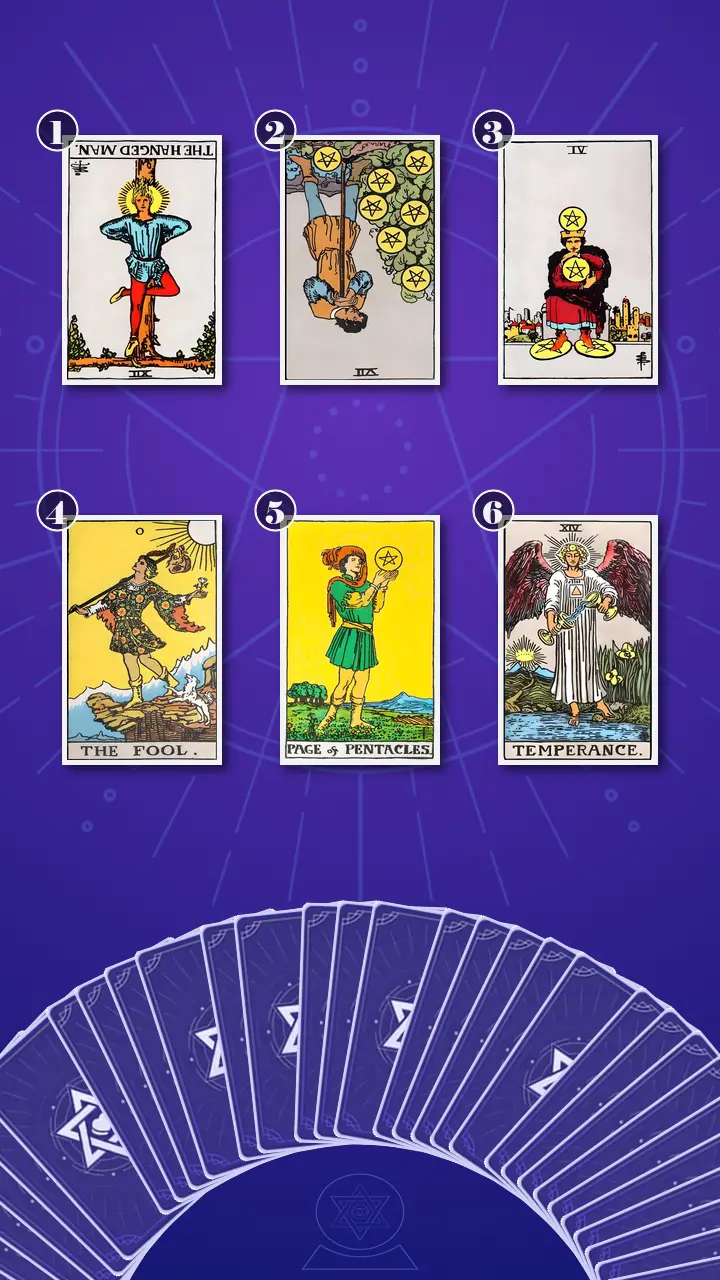
I chose the Transformation Path Grid · Context Edition, a six-card tarot spread arranged in two rows of three. For anyone wondering how tarot works in a practical reading, the structure matters: I was not using the cards to predict when a magical window would open. I was using them as an objective cognitive tool for examining a self-reinforcing system.
The upper row would expose the visible symptom, the immediate blockage, and the fear maintaining it. The lower row would answer those forces with a transformational trigger, a bounded action, and a sustainable method of integration. The vertical pairs were especially useful: movement would answer suspension, one practical task would answer endless payoff calculations, and adjustable balance would answer rigid control.
I told Maya that card meanings in context are more useful than generic definitions. “The first card will show what the delay looks like in your actual week. The third will ask what you’re protecting beneath it. The fourth is our leverage point, and the final two will turn insight into something you can test without betting your whole future.”
The Upper Row of the Bad-Timing Loop
Position 1: The Appointment That Never Becomes Real
“The card I’m turning over now represents the observable symptom,” I said, “the first concrete step being rescheduled whenever present conditions feel imperfect.” I revealed The Hanged Man, in the reversed position.
Upright, the suspended figure can represent a purposeful pause that creates a different perspective. Reversed here, that energy had become a blockage: Maya had already reflected, researched, and identified possible directions, but her body remained motionless while her mind kept finding new reasons to extend the pause.
The card showed the exact Sunday-night scenario I had just witnessed. It was 10:40 p.m.; Maya was still sitting with the same meaningful goal after weeks of thought. She moved the first action three weeks forward, opened another planning document, and called the pause responsible because postponement felt safer than allowing an imperfect beginning to produce real consequences. The reversed Hanged Man was like leaving a calendar event in draft mode forever: the title and time kept improving, but the appointment never became real.
“A useful pause has a purpose and an end point,” I said. “What new information did moving tonight’s block actually give you?”
Maya let out a short laugh with a bitter edge. “That is painfully accurate. Almost a little brutal.” Her fingers tightened around her pen, then released it. “The honest answer is none. It just made tonight feel easier.”
I nodded. “Then we don’t need to shame the pause. We need to notice that it has stopped doing the job you hired it to do.”
Position 2: Auditing a Harvest Before Anything Is Planted
“The card I’m turning over now represents the immediate blockage,” I continued, “the way delayed gratification turns every beginning into another calculation about future readiness and payoff.” I revealed the Seven of Pentacles, in the reversed position.
I pointed to the worker leaning on the tool and evaluating the pentacles. Reversed, the card showed an excess of assessment producing a blockage in investment. Maya had already researched courses, possible roles, and creative routes, but before taking one visible step she recalculated the time, money, energy, and probable return. Because no small experiment could guarantee the value of an entire career change, the benchmark changed and the investment never began.
Seeing that card took me briefly back to Wall Street, where I watched teams build immaculate forecasts around assumptions that had never touched the market. A model can look rigorous and still be a sophisticated shelter from reality. I use a diagnostic lens I call Pseudo-Growth Eradication for moments like this: I strip away the self-help language and audit the actual return on effort and the execution rate.
Maya had a finished Notion dashboard, twelve saved career videos, five compared courses, and several versions of a savings target. The planning had consumed hours. Its execution rate was zero externally visible tests, and its actual learning return had flattened weeks ago. I made clear that the point was not to mock her preparation. It was to stop charging real time and energy to an activity that was no longer producing new evidence.
“Instead of asking whether the whole change will pay off,” I said, “what limited investment could teach you something this week?”
She looked toward the untouched notebook. “I could draft the opening section of the portfolio page. I keep researching what it should contain, but I haven’t written three lines.”
Position 3: When Protection Pins Both Feet Down
“The card I’m turning over now represents the root fear,” I said, “the belief that an imperfect beginning could threaten your security, control, or confidence in your own judgment.” I revealed the Four of Pentacles, upright.
The conservation energy of this card was not inherently unhealthy. Toronto rent was real. Fatigue after a difficult client week was real. A financial buffer and professional reliability were legitimate forms of care. In this position, however, useful protection had expanded into an excess: movement was permitted only if Maya’s income, calendar, energy, routine, and reputation could all remain untouched.
I traced the imagery for her. One pentacle was pressed to the figure’s chest. Two more sat beneath immobile feet. In Maya’s life, her work calendar was protected, her savings buffer was protected, and her identity as the capable person who always delivered was protected. I could almost hear the two internal statements colliding: I want room for a different life, followed immediately by I cannot let anything important become unstable while I test it.
“Protecting every resource can leave no resource available for the life you meant to build,” I said. “The question isn’t whether you should throw away stability. It’s which stability limits are genuine, and which extra conditions are attempts to avoid being seen as a beginner.”
Her breath stopped for a moment. Her eyes lost focus as though she were replaying rent calculations, late-night Slack replies, and all the times she had raised a savings target after reaching the previous one. Then she checked the budget app on her phone almost automatically, noticed what she was doing, and set the phone facedown. Her shoulders lowered by a fraction.
“I called all of it being responsible,” she said quietly. “Some of it is responsible. But some of it is me trying to make sure I can’t be wrong.”
“Exactly,” I said. “We can respect the part protecting you without giving it unlimited authority over the calendar.”
When The Fool Carried Less
Position 4: The Reversible Beginning
The radiator hiss faded, and the room seemed to acquire a cleaner silence. “The card I’m turning over now represents the leverage point,” I said, “the permission to interrupt the bad-timing loop through one small, reversible encounter with uncertainty.” I revealed The Fool, upright.
I returned us to Sunday at 10:40: the work calendar open, the notebook untouched, and the personal task dragged three weeks forward. Maya was not refusing the life she wanted. She was trying to engineer a version of beginning that could not go badly.
I showed her the Fool’s raised face, white rose, lightly carried bundle, and foot approaching the edge. This was not a command to quit her job, drain her savings, or make an irreversible leap. In Maya’s modern life, the edge could be one introductory session with a cancellation option, one imperfect portfolio draft, one informational message, or one protected 30-minute block. Like Dorothy stepping onto the road in The Wizard of Oz, she could learn the path through contact with the next part of it rather than demanding a complete map before leaving the starting point.
The energy here addressed a deficiency, not an excess of caution: Maya had not been giving herself enough permission to learn through direct experience. The timing did not feel right because certainty had quietly become the entry fee.
You do not need a perfect forecast before you move; choose one alert, reversible step now, like the Fool approaching the cliff with a light bundle rather than carrying the whole future.
For one beat, Maya stopped breathing. Her fingers, which had been circling the notebook’s elastic, hung still above it. Her pupils widened; then her gaze slipped away from the card and settled on the calendar block she had just moved. I watched recognition travel through her in stages: first the physical freeze, then the inward replay of months renamed as “preparation,” then a sharp flush across her face. Her eyes became bright, but her jaw tightened again before it released.
“But doesn’t that mean I’ve been doing it wrong this whole time?” she asked, with more anger than relief in her voice. “I’ve spent months trying to be sensible. I don’t want all that waiting to have been pointless.” She folded her arms, then slowly unfolded them. A long breath left her chest. Her shoulders dropped, and the release seemed to make her briefly unsteady, as though clarity had removed a weight before she had decided where to set her hands.
“No,” I said. “It means waiting protected something important until it stopped generating useful information. You weren’t foolish. You were using a strategy beyond the point where its return declined. Seeing that now does not erase what the strategy once did for you.”
I gave the sentence a moment to settle before asking, “Now, with this new perspective, think back to last week. Was there a moment when this insight could have changed how the situation felt?”
Maya remembered riding the Line 1 subway home after seeing a former coworker announce a new role. She had opened several job listings, bookmarked them, and closed the app because she could not yet present a polished new professional identity. “I could have sent her one message,” Maya said. “Not asking for a job. Just asking what surprised her about the move.”
“That’s the operating-system update,” I said. “I want proof before I begin becomes What could I learn by beginning small enough to change my mind? You do not need proof before the first experiment; the experiment is how proof begins.”
I then ran the idea through my Potential Actionability Assessment, the lens I use to stop a powerful realization from evaporating into inspiration. I tested the proposed message against four requirements: it had to be reversible, schedulable inside the current week, observable once completed, and capable of producing information. Maya’s message passed all four. It did not settle her career crossroads, but it crossed the exact boundary between forecasting and contact with reality. I am ruthless about vagueness in this assessment and deliberately gentle about scale; the milestone should create evidence, not demand a personality transplant.
One Coin, Two Cups
Position 5: The Beginner’s Assignment
“The card I’m turning over now represents the practical response,” I said, “one bounded, observable action that can generate evidence without requiring a total life overhaul.” I revealed the Page of Pentacles, upright.
The Page held one pentacle at eye level. That narrowing mattered. The Seven had stared at an entire harvest and tried to calculate its ultimate return; the Page studied one workable unit. The upright energy brought balance to Maya’s scattered attention by giving curiosity a container.
In ordinary terms, Maya could give one task a modest time or money budget, complete it carefully, and review what it taught her without treating the result as a verdict on her talent or future. I asked her to imagine opening twelve tabs about changing direction, closing eleven, and spending 30 minutes on three imperfect portfolio bullets. The laptop clock would reach the end of the block, the task would be finishable, and her brain would finally have evidence that had not come from somebody else’s TikTok, podcast, or career-pivot announcement.
“Will this work for my whole future?” I said, naming the old question. Then I replaced it: “What will this 30-minute trial show me?”
Maya picked up the pen and wrote that second question in her notebook. I saw her mouth soften into a small, uncertain smile. “That feels almost suspiciously manageable,” she said.
“Good,” I replied. “A small start can be real without being irreversible.”
Position 6: A Rhythm That Survives a Busy Week
“The final card represents sustainable integration,” I said, “the way the life you want can coexist with current responsibilities through pacing and recalibration rather than renewed postponement.” I revealed Temperance, upright.
I pointed to the water moving continuously between two cups and the figure standing with one foot on land and one in water. Temperance carried the energy of balance in its most practical form: not a perfect split and not an interruption-free schedule, but an adjustable exchange between stability and exploration.
For Maya, this looked like protecting a small recurring block for the direction she wanted while adjusting its size around client deadlines, actual cost, and available energy. A difficult week would not erase the experiment. She could shorten the block, move it once within the same week, or use a ten-minute minimum version. Timing would become a practice of calibration rather than a door that had to open perfectly.
The card also answered the Four of Pentacles directly. Four had pinned both feet to protected resources; Temperance distributed its footing between solid ground and moving water. I noticed the snow-bright light from the Toronto street outside her window settle across the two rows of cards, making that progression visible: suspended foot, fixed feet, approaching foot, adaptable footing.
“So I don’t have to choose between being responsible and having a life that feels like mine,” Maya said.
“No,” I answered. “But you do have to stop defining responsibility as keeping every resource untouched. The workable version is to decide what you can use, protect the genuine boundary, and let the experiment teach you how to adjust.”
The 30-Day Evidence Ledger
I laid the cards back into their two-row grid and connected the story. Prudence had helped Maya build a savings buffer and a reputation for competence, but that useful history had hardened into an entry rule. In the present, the reversed Hanged Man kept the first action suspended. The reversed Seven of Pentacles repeatedly audited a harvest before anything could grow. Beneath both, the Four of Pentacles tried to preserve every dollar, hour, and sign of control. The Fool restored permission to encounter reality, the Page reduced the future to one finishable assignment, and Temperance made continuation adjustable.
The spread looked like the departure board Maya had been living under. Every deadline, expense, or low-energy week changed the announced time, and she treated each update as evidence that boarding would be irresponsible. The cards did not promise that the next train would be perfect. They revealed that she could stop waiting for the board to become permanent and choose a short journey with a return option.
I named the cognitive blind spot directly: Maya had been treating confidence as an input required before action, when confidence could also be an output created by evidence. She had also confused a real safety boundary with a guarantee that nothing important would be disrupted. The transformation was therefore precise: replace I start when conditions are right with one 30-minute, reversible step scheduled inside the current week.
“This is where finding clarity becomes measurable,” I said. “Not because every uncertainty disappears, but because your next steps stop depending on a fictional month with no deadlines, expenses, or fatigue.”
The Evolution KPI Framework: Thirty Days of Contact With Reality
I adapted my Evolution KPI Framework into a 30-day evidence challenge. Its strictness would apply to the execution rule, not to a heroic outcome: Maya would measure contact with reality rather than career success, confidence, or productivity. That distinction protected the philosophical realization from becoming either self-help fluff or another punishing routine.
“But I know what happens,” Maya said. “A client deadline moves, Slack follows me into the evening, and even 30 minutes feels impossible.”
“Then we design for that now,” I replied. “Your KPI is not perfect attendance at full scale. It is keeping the experiment alive through one pre-agreed adjustment. You may shorten it, or reschedule it once inside the same week. What you may not do is silently move the entire life goal into next month.”
- Book one reversible beginning. On Tuesday, place one exact 30-minute action in the calendar before Sunday: draft three portfolio bullets, send one informational message, or book one introductory session with a cancellation option. Write before starting: “This is a test for information, not a verdict on my future.” If 30 minutes feels too costly when the block arrives, complete a ten-minute minimum version. The action may end with the timer; no further commitment is implied.
- Cap preparation and resource exposure. Before each weekly experiment, set a preparation limit of 30 minutes and a spending ceiling of C$25 or C$0. When preparation ends, move directly into the visible task. Afterward, record only three observations: what held your attention, what felt costly, and what you would adjust. Do not score whether the whole life change will succeed. Score whether the experiment produced useful evidence within the boundary you chose.
- Track the Evolution KPI for 30 days. Give yourself one “contact with reality” point for each weekly experiment completed. If work genuinely takes over, move the block once within the same week and reduce its size instead of cancelling the practice. Review the four points at day 30 and choose whether to continue, revise, pause, or test another direction. The KPI measures disciplined contact, not certainty. A result that tells you to stop or shrink the experiment still counts as valuable evidence.
I reminded Maya that these were options, not instructions issued by the deck. Tarot had helped us expose the system and compare its moving parts. She retained the authority to decide which resource limits were real, which experiment felt appropriate, and whether the evidence justified another step.

A Week Later: The Quiet Proof
Six days later, Maya sent me a screenshot of a completed calendar block labeled “Draft three portfolio bullets.” She had closed the other research tabs, written for 30 minutes, and sent one low-stakes message to her former coworker. She had not resigned, enrolled in a costly program, or solved her entire career. She had created her first piece of direct evidence.
Her message read: “I still wanted to open Notion and build a six-month plan. But I wrote, ‘experiment, not verdict,’ and finished the three bullets. They aren’t amazing. They exist.”
She slept through that night. Her first thought the next morning was still, What if I’m wrong? She told me she smiled, then left the next calendar block where it was.
I understood that as the first grounded movement from certainty-dependent postponement toward self-trust. Not triumph, not permanent confidence, and not proof that every risk would pay off. Just cautious curiosity supported by something real. The cards had not begun Maya’s desired life for her. Maya had chosen the boundary, kept the appointment, gathered the evidence, and won one sentence of her narrative back.
If you also keep your jaw tight around every deadline, dollar, and possible mistake, I hope you remember what I watched Maya discover: noticing when protection has become postponement already places one foot back on the ground.
If your first step could be a light-bundle experiment rather than a promise to carry the whole future, what one reversible appointment would you place inside this week?