From a Life That Works on Paper to Grounded Self-Trust: One Small Test

When Achievement Autopilot Owns the Calendar
If your calendar is full of things that once looked like progress but now feel like a life you forgot to re-choose, I want to begin where this reading began: at 10:45 p.m. on a Thursday in Toronto.
Jordan (name changed for privacy), a 29-year-old non-binary product operations manager, sat in my video window at the kitchen counter of their condo near Queen Street West. They turned the laptop just enough for me to see a career-change article beside a colour-coded promotion roadmap. Blue screen light caught the rim of a half-finished mug of tea, the radiator clicked behind them, and their eyes looked sore from moving between tabs. I watched them add another possible direction to a spreadsheet, close the article, and confirm enrolment in a certification module for the job they already had.
Their shoulders had crept almost to their ears. Their jaw stayed braced even after they stopped typing. The alienation felt less like ordinary boredom and more like watching a highly competent stand-in perform their week from behind soundproof glass.
"I know this path works on paper," Jordan said, "but I no longer know who it is working for. I keep calling it discipline when it is really repetition. Why do I keep following a life script that no longer fits?"
I heard the central conflict immediately: Jordan wanted a life shaped around who they were now, but the outdated script still offered order, status, and continuity. Every emerging desire was being asked to produce a salary range, respectable title, risk assessment, and five-year forecast before it was allowed to enter the real world.
"A life can work on paper and still stop working for you," I told them. "I am not going to use tarot to predict whether you should quit, stay, or reinvent yourself. I want us to see the pattern clearly, separate actual constraints from untested assumptions, and find one choice that still belongs to you. Let us make a map of the fog without pretending the map owns the road."

Choosing the Switchback Map
I invited Jordan to put both feet on the floor, unclench their jaw if it felt comfortable, and take one slow breath while holding the question in mind. I shuffled steadily. The small ritual was not about creating mystery. It gave their attention a clean transition from managing the week to observing it.
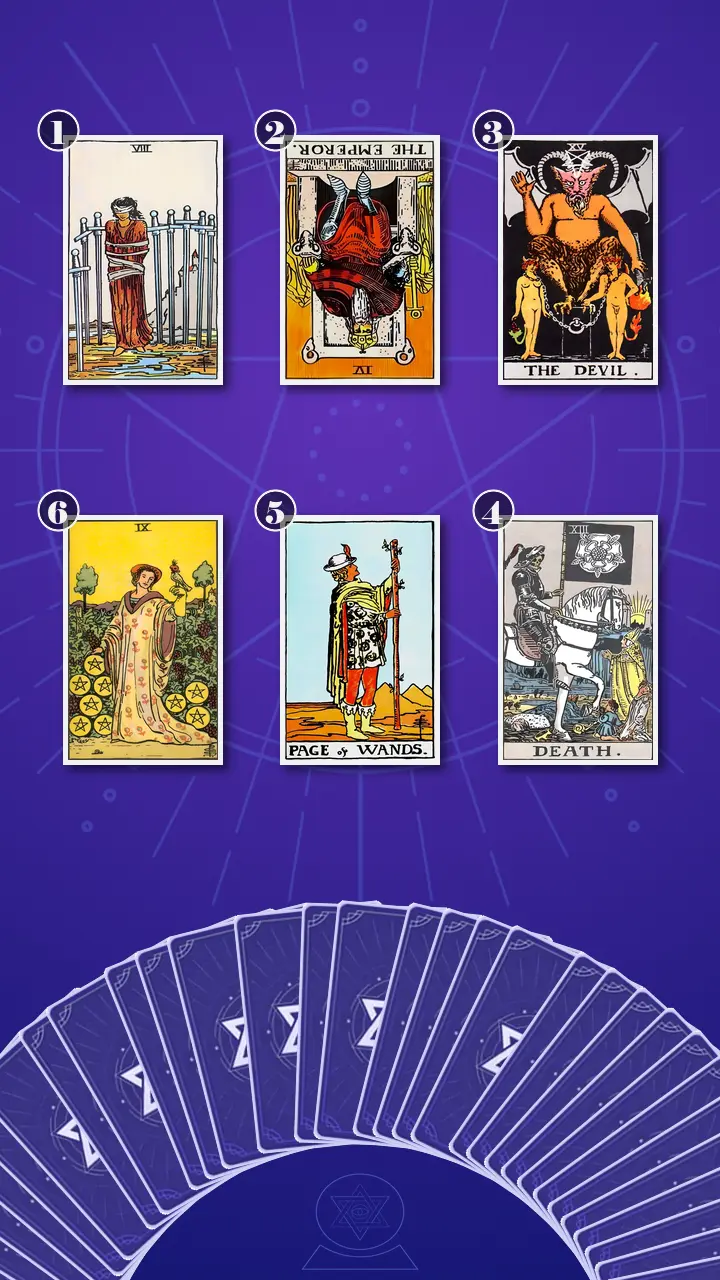
I chose the Transformation Path Grid · Context Edition, a six-card Transformation Path Grid tarot spread designed to trace an outdated life script. A standard decision spread would have assumed Jordan already had two clear alternatives. The Celtic Cross could have offered broad context, but its ten positions would have blurred the precise loop we needed to examine. This grid was more exact: visible repetition, active blockage, underlying attachment, conscious interruption, low-risk experiment, and sustainable integration.
I arranged the cards in two rows of three. I would read the upper row from left to right as the lock-in sequence, then drop beneath the root card and travel back across the lower row like a switchback path. The first position would show how Jordan repeated the script in ordinary behaviour. The second would identify the rigid rule blocking movement. The third would expose what the repetition provided emotionally. Below that, the catalyst would show what could end, the action card would create lived evidence, and the final card would show structure becoming chosen again.
I also explained how tarot works in this kind of consultation. The cards do not issue a supernatural verdict. Their images place an internal system on the table where both of us can inspect it. Card meanings in context become prompts for recognition, testing, and choice. Jordan remained the authority on every boundary and every next step.
Reading the Lock-In Sequence
Position 1: The Gap in a Full Calendar
I began with the card representing the diagnosis-level behaviour through which Jordan kept following the outdated script: repeated commitments, extensive research, and no real-world test. I turned over the Eight of Swords, upright.
I pointed to the blindfold, the loose cloth bindings, and the visible gap in the ring of swords. The card did not tell me that Jordan's financial responsibilities or career risks were imaginary. It showed me that every opening was being judged through inherited assumptions before it could be tested.
In Jordan's actual week, the image was painfully literal. On Thursday night they could protect two hours for researching creative or community-facing work, yet protect zero minutes for attending a workshop, messaging someone in the field, or changing one recurring commitment. On Sunday, they filled every open block in Notion with errands, exercise, admin, and professional development. The calendar looked full enough to be a wall, although Jordan still had permission to remove one recurring event.
"The sentence behind this card sounds like, 'I just need more information before I can try anything,'" I said. "But more information keeps arriving, while real-world contact never begins."
The Eight of Swords showed an excess of mental modelling and a corresponding blockage in experimental movement. Thought was performing the job of experience. Jordan could describe every danger around the promotion track, but the nearby opening remained untested.
Jordan gave one short, bitter laugh. "That is too accurate. Kind of brutal, honestly."
I let the laugh settle before answering. "Accurate does not mean accusatory. This pattern developed because planning has genuinely kept you stable. We are only asking whether one assumption is still earning the authority you give it. Which commitment did you accept automatically this week, and what small encounter did you postpone instead?"
Their eyes moved toward a calendar outside my view. Their thumb rubbed the edge of the cold mug. "I volunteered for another launch-readiness project on Monday," they said. "I did not even check whether I wanted it."
Position 2: When the Promotion Rubric Becomes an Internal Boss
I turned to the position representing the immediate mechanism blocking change: the internal rule that demanded certainty, status, and continuity before a choice could count. The card was The Emperor, reversed.
I described the stone throne as a structure originally built to protect. Upright, the Emperor can provide boundaries, organization, and durable leadership. Reversed here, that energy had moved into excess. Useful discipline had hardened into an internal warden, while flexibility and curiosity had become deficient.
Jordan's promotion plan had begun as infrastructure. Now it acted like a manager inside their head. When a community-facing role or creative workshop appeared, the first question was not, "Do I want to meet this possibility?" It was, "Can I defend this as an adult decision with a salary path and five-year forecast?"
I brought them back to a glass-walled meeting room and a recent performance review. Jordan had told me about the cold air conditioning, Slack notifications flashing on the laptop, and the whiteboard marker smell as their manager asked where they saw themselves in five years. Jordan gave the polished leadership-track answer. It sounded competent, but their stomach dropped because the answer belonged to a version of them who had not been consulted lately.
"The Emperor is behaving like a promotion rubric used as a total definition of a good life," I said. "A spreadsheet can calculate salary and risk. It cannot tell you how an ordinary Tuesday feels in your body. You are not indecisive. You are trying to get lived evidence from a spreadsheet."
Their fingers tightened around the mug, then loosened. Their chest rose in a shallow breath before they looked directly at the reversed card.
"So the problem is not that I like structure?" they asked.
"No. Your capacity for structure is a strength. The blockage appears when structure refuses to bend. The relevant distinction is not responsible versus reckless. It is chosen structure versus an unreviewed rule."
Position 3: The Course That Bought One Hour of Control
I moved to the card representing the root of the repetition cycle: the fear of losing control and the desires pushed outside Jordan's official life story. I turned over The Devil, upright.
I immediately clarified that I did not read this card as an evil force, punishment, or external destiny. I focused on the loose chains around the two figures. The attachment was real, but participation and awareness still mattered. Jordan was not powerless inside the pattern.
The modern scene came from a rainy Tuesday on the Line 1 train. Jordan had scrolled past a former classmate's promotion announcement under buzzing fluorescent lights, surrounded by the smell of damp wool coats. Their phone felt warm in their hand. Their chest went hollow, their thumbs moved faster, and within minutes they had opened a course catalogue.
"The sequence is comparison, body alarm, familiar achievement task, then temporary relief," I said. "The honest sentence may be, 'I do not actually want this course right now; I want the feeling that I have not lost control.'"
The Devil showed an excess of compulsive productivity and a blockage around consciously naming boredom, envy, anger, and longing. Another credential restored order for an evening, but it reinforced the identity contract producing the flatness. Calling it discipline did not make repetition a choice.
Jordan's breathing paused. Their hand froze halfway to the tea, and their gaze shifted past the screen as though the Line 1 carriage were replaying behind my shoulder. Then they released a low, embarrassed sound from deep in their chest and let the mug rest on the counter.
"I bought that course on Tuesday," they said. "I felt better for maybe an hour. Then I was annoyed that I had given myself more work."
"That hour of relief is important data," I replied. "It explains why the loop repeats without turning the explanation into shame. The old script still provides something: immediate orientation. Our task is to find another way to create orientation without forcing the neglected desire back underground."
When Death Raised the White Rose
Position 4: A Conscious Ending at the Edge of the Set
The room seemed to become quieter before I touched the next card. Even the radiator behind Jordan stopped clicking. I turned to the transformational-trigger position, the point where one outdated identity or commitment could end without a complete replacement plan. The card was Death, upright.
I told Jordan plainly that Death did not predict literal death, disaster, or an impulsive resignation. Upright, its transformative energy was available in balance, but Jordan had kept conscious ending deficient. They had tried to preserve every old role while asking where a new life could fit.
Jordan was still solving the late-night equation: make the creative or community-facing interest respectable before letting it touch the calendar, secure a complete route before testing the edge of the set, and protect every old commitment while somehow creating room for another act.
I pointed to the fallen crown, the white rose on the black banner, and the sun rising between the distant towers. A status identity could complete its purpose without making the years invested in it meaningless. The next horizon did not have to become fully visible before one expired responsibility was released.
As an artist, I pictured an editing timeline crowded with footage kept only because it had been difficult to make. A scene can be beautifully executed and still no longer belong in the next act. Cutting it does not declare the earlier work worthless. It allows the film to become honest about where the character is now.
I use a lens called Hero's Journey Alignment for moments like this. Jordan's stagnation resembled the classic Refusal of the Call, but not because they lacked courage. The old protagonist was demanding a complete map, guaranteed reviews, and an approved sequel before crossing the threshold. The refusal was not a moral failure. It was the final defensive move of an identity that had once kept them safe.
The old script is not proof of safety; choose one conscious ending that makes room for a life that fits, just as Death's white rose rises above the fallen crown.
I left a pause around the sentence, then translated the card into the language of Jordan's actual week.
You do not need a finished future to stop renewing a role that belongs to an earlier version of you.
Jordan's breath stopped. Their fingers hovered above the counter, completely still. Their eyes lost focus for several seconds, as though the performance-review answer were running again in a private screening. Then their pupils widened and the line of their mouth hardened.
"But does that not mean I got it wrong?" they asked. The words came out sharper than anything they had said that night. "I spent years building this."
"No," I said. "It means the role may have been right for an earlier chapter and expired in this one. Revision is not proof that the first draft failed."
The anger did not disappear at once. I watched it soften into grief. Their eyes reddened, their tightly held shoulders descended, and both hands opened against the counter. An audible exhale followed, unsteady but relieved. Then came a brief, almost dizzy blankness: the weight had shifted, but the responsibility for choosing was now visible. Jordan gave a small nod that held both recognition and fear.
"Now, using this new perspective, think back to last week," I invited. "Was there a moment when this insight could have made the experience feel different?"
"The performance review," Jordan said quietly. "I could have said I was still considering what kind of leadership I wanted. I did not have to repeat the whole speech."
I asked them to take no drastic action that night. Within ten minutes, they could write down one commitment they maintained mainly for continuity and one proportionate way to pause, decline, or renegotiate it for seven days. They could keep the exercise private. If even naming the commitment felt too charged, they could stop there. No decision was required that night.
This was the reading's key crossing: from achievement autopilot, alienation, and fear of losing control toward grounded self-trust through one conscious ending. It was not certainty. It was the first willingness to trust that present experience deserved a vote.
Where the Page Leaves the Browser
Position 5: One Honest Data Point
I moved to the position representing practical action: a low-risk experiment capable of giving Jordan lived evidence about a neglected desire. I turned over the Page of Wands, upright.
The Page stood in an open landscape, studying a budding wand without pretending to possess a finished map. After the grey enclosure of the Eight of Swords and the black backdrop of the Devil, the Page's yellow tunic changed the visual temperature of the spread. Curiosity had entered the room as usable fire.
In Jordan's life, this did not mean announcing a career pivot. It meant booking one thirty-minute conversation with someone in a community-facing role, attending one introductory Toronto workshop, or taking one bounded volunteer shift. Immediately afterward, Jordan could record whether their energy expanded, contracted, or stayed neutral.
"I am not announcing a new career," I suggested as a line they could borrow. "I am collecting one honest data point."
The Page brought a balanced spark to a system where direct exploration had been deficient. Fire did not need to burn down Jordan's existing life. It only needed enough oxygen to move one interest out of a saved Eventbrite tab and into an actual encounter.
"Curiosity is allowed to be small before it becomes useful," I told them. "What could you do once, for thirty minutes or less, that would answer a question no spreadsheet can answer?"
Jordan reached for their phone, stopped, and smiled with a trace of self-consciousness. "There is a Toronto Public Library program on community facilitation I have saved three times," they said. "I could just go. I do not have to make it mean anything yet."
Position 6: A Calendar That Serves the Person
I turned to the final position, representing integration: the state in which Jordan could use structure selectively, evaluate commitments by lived fit, and build stability around chosen values. The card was the Nine of Pentacles, upright.
I drew their attention to the carefully cultivated vineyard and the hooded falcon resting on a gloved hand. The scene did not depict freedom as chaos. It depicted discernment. The vines had been tended, the resources were real, and discipline remained present, but the figure inhabited the life according to their own standards.
For Jordan, that modern life might still include a salary, budget, commute, routines, and professional responsibility. The change was in what those structures served. Their weekly schedule, work pace, and commitments could be reviewed according to autonomy and the quality of an ordinary weekday, not only according to whether they signalled uninterrupted advancement.
The Nine of Pentacles showed balance between freedom and structure. It answered the opening Eight of Swords directly. Jordan did not need to escape every boundary. They needed to regain editorial control over which boundaries stayed.
"At the end of next week," I said, "notice which commitment made your actual days more livable, even if it made your timeline look no more impressive. That is evidence too."
Jordan looked across the full grid, from the blindfold to the loose chains, then to the Page's uncovered gaze and the cultivated vineyard. Their posture was not suddenly carefree. One shoulder remained slightly raised. But their hands had stopped gripping the mug.
I also named what the spread did not contain: there were no Cups. I did not treat that absence as ominous. It showed me that emotional information had been excluded from Jordan's decision system. Air had analysed, rigid structure had controlled, fire was finally experimenting, and earth could build what worked. The missing bridge was a simple feelings check: one emotion, one body sensation, and one detail worth remembering before opening another comparison tab.
The Expired Role Release
I laid the six cards into one coherent story. The Eight of Swords showed Jordan treating inherited assumptions as a closed system. The Emperor reversed identified the internal promotion rubric enforcing that system. The Devil explained why obedience persisted: familiar achievement provided short-term control whenever comparison or longing surfaced. Death interrupted the loop through one conscious ending. The Page of Wands replaced forecasting with lived evidence. The Nine of Pentacles showed where that evidence could lead, not to a perfect replacement identity, but to self-authored stability.
The blind spot was not simply overplanning. Jordan had been treating certainty as a prerequisite for curiosity and emotional information as inadmissible data. They also assumed the alternatives were total compliance or dramatic escape, much like standing inside The Truman Show and believing the only meaningful move was to destroy the set. The cards offered a third option: test one edge, release one expired line, and observe what becomes possible.
I framed the transformation direction in film language because it belonged naturally to the moment. Jordan did not need to write an entirely new screenplay before revising the scene currently in production. They needed to move from demanding a complete replacement life plan to running one low-risk experiment that tested a present value before recommitting to the next milestone.
For the next steps, I used my Character Bible Directive. Instead of asking Jordan to invent a shiny future job title, I asked them to describe the psychological and behavioural specifications of the person they wanted to practise being now: someone who pauses before accepting status work, protects one unscripted hour, and treats guilt as a feeling to examine rather than an instruction to obey.
- The One-Commitment PauseBy Wednesday, open a note titled "One thing I am no longer automatically available for." Name one promotion-track task, committee, course, or recurring obligation maintained mainly for continuity. Before Friday, send the relevant person a narrow script: "I am not able to take this on in the current cycle, so I need to step back from it." Leave the released calendar time unassigned for seven days.Keep the boundary proportionate. This is not a resignation or a permanent identity announcement. If saying it live feels too exposed, send a concise written message or pause a self-assigned task. Jordan alone decides whether the change continues after seven days.
- The 30-Minute Lived-Evidence ExperimentThis week, book one thirty-minute conversation with someone doing creative or community-facing work, or attend one introductory workshop, open studio, volunteer orientation, or public program in Toronto. Ask one concrete question: "What does a normal Wednesday actually look like in this work?" Immediately afterward, record three lines in Notes: "My energy before," "my energy during," and "what I wanted more or less of."Do not turn the notes into a decision matrix yet. One RSVP, message, or call is enough. Keep the experiment private if that protects it from comparison, and leave early if the experience is not a fit.
I reminded Jordan that actionable advice is only useful when it preserves autonomy. They did not owe the cards a pivot, a promotion, or a brave performance. The experiment could confirm interest, reveal indifference, or produce a more nuanced question. Every result would still be lived evidence.

A Week Later, the Quiet Proof
Six days later, I received a message from Jordan. They had paused the extra certification module and declined the launch-readiness committee for the current cycle. The email took four drafts, but the final version was three sentences long. Their manager replied, "Understood. Thanks for letting me know." No professional catastrophe followed.
Jordan kept Thursday evening unassigned. On Saturday, they attended the Toronto Public Library facilitation program they had repeatedly saved. Their post-event note read: "Before: exposed. During: alert. After: I wanted another conversation." It was not a new career plan. It was one clean piece of evidence that had come from living rather than forecasting.
They slept through the night after sending the boundary message. The next morning, their first thought was, "What if I am wrong?" They told me they smiled anyway and made coffee before opening LinkedIn.
I did not see that week as proof that tarot had changed Jordan's fate. The cards had helped us externalize the pattern, but Jordan made the pause, sent the message, attended the program, and noticed their own response. Their Journey to Clarity ended where genuine self-authorship often begins: not with certainty, but with a small decision that could be felt in the body and revised in the real world.
When your jaw tightens around another polished answer and your shoulders remain braced over a plan that no longer feels like yours, it can hurt to wonder whether control has become the thing keeping you from your own life. I hope Jordan's white rose offers a gentler possibility: noticing that conflict means you are already beginning to see the opening.
If you gave the Page of Wands one blank square in next week's calendar, using it for lived evidence rather than future-proofing, what would you be curious enough to place there: one message, one workshop, or thirty honest minutes at the edge of the old set?