Golden-Handcuff Paralysis: Closing One Listing, Testing One Need

Golden-Handcuff Paralysis at 10:47 p.m.
I have learned that you can be trusted, well-paid, and visibly successful and still spend Sunday night looking for an exit.
At 10:47 on a Tuesday night, Alex joined my video call from a small Toronto condo and shared the screen they had been staring at before our session. A LinkedIn listing for a senior product designer sat beside a colour-coded spreadsheet titled Exit Options. The laptop fan whirred under our voices. Cold coffee had left a bitter film on their tongue, and their phone was still warm from an hour of salary searches, Glassdoor reviews, and Reddit threads.
Three new columns had appeared in the sheet: Probation Risk, Team Stability, and Possible Regret. The application itself remained untouched. Alex closed it while I watched, noticed a non-urgent Slack message, and replied almost automatically. Familiar competence gave their hands something safe to do.
“I know the job drains me,” they said. “But at least I know how to survive it. Every option sounds reasonable until I imagine what it could cost me.”
Then they asked the question that had brought us together: “What am I afraid to lose if I leave the job that traps me?”
I watched their shoulders stay lifted as if they were carrying a backpack they had forgotten was there. When resignation became concrete, the feeling beneath their ribs seemed to behave like an elevator cable pulled tight between two floors: one marked freedom, the other stability, with neither door opening.
“I am not going to use tarot to tell you to quit,” I said. “Your salary, Toronto rent, benefits, and professional identity are real considerations. I want us to find out where confirmed constraints end and untested forecasts begin. Let’s make a map of the fog, then look for one step that does not require you to pretend uncertainty is gone.”
Choosing a Compass for the Career Crossroads
I asked Alex to place both feet on the floor, take one ordinary breath, and hold the question without trying to solve it. I shuffled slowly. The point was not ceremony for ceremony’s sake. It was a short psychological transition from compulsive calculation to deliberate attention.
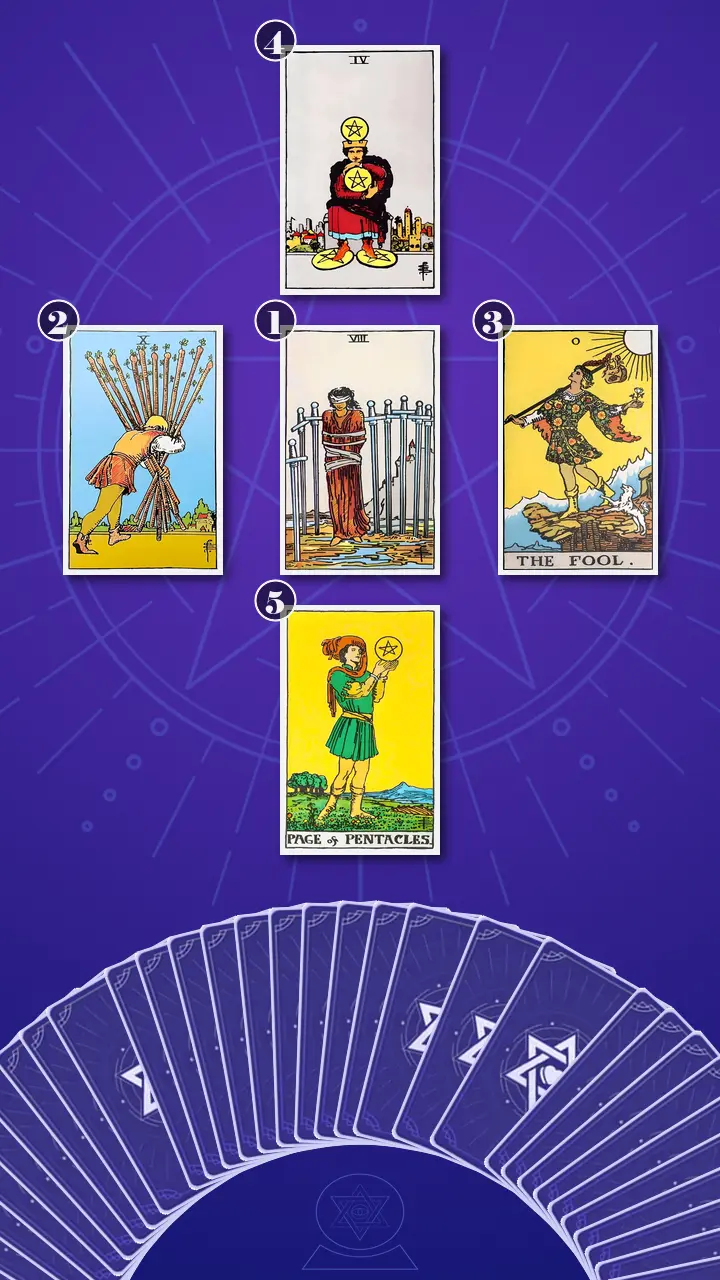
I chose the Decision Cross · Context Edition, a five-card Decision Cross tarot spread designed for decisions in which both visible options are being shaped by a less visible attachment. I use this spread when someone is asking whether to stay or leave but the deeper issue is what either choice seems to prove about safety, identity, or control.
For anyone wondering how tarot works in a career decision like this, I do not treat the cards as a forecast of which employer will succeed or whether resignation will end well. I use each position as a distinct analytical question. Card meanings in context can separate what is happening now, what each path actually asks, what fear is influencing the comparison, and what evidence could be gathered before a final decision.
The centre position would reveal the observable career-change paralysis. The left and right arms would compare what staying preserves with what leaving invites. The card above would name the exact feared loss beneath the analysis. The final card below would anchor the whole reading in one reversible experiment, creating a compass-shaped movement from pressure to practical ground.
When the Forecast Became a Fence
Position One: The Exit Routes Hidden Behind Open Tabs
“The card I am turning over now represents the observable decision paralysis and contracted mental state that make the current job feel inescapable,” I said.
It was the Eight of Swords, upright.
I pointed to the blindfold, the loose bindings, and the incomplete ring of blades. “This image does not deny that the job has real constraints. The salary matters. Benefits matter. A volatile hiring market matters. But the figure’s field of vision is narrower than the actual space around them.”
I connected the swords to the wall of job-board tabs Alex had shown me: LinkedIn, Indeed, Glassdoor salary estimates, Reddit career threads, a transition budget, and three new spreadsheet columns. The collection looked comprehensive, yet it contained almost no observed evidence from an application, recruiter, or exploratory conversation. Every imagined downside had been promoted into an outcome that had already happened.
“The inner rule sounds like this,” I said. “If I can model every downside, I will not have to risk being wrong today.”
I read the upright energy here as Blockage. The mind’s capacity to anticipate risk was functioning, but it had become so loss-focused that it prevented the experiences capable of correcting the forecast. Closing the application created immediate relief. It also ensured that no new information could enter the decision.
“Research reduces risk until it starts replacing evidence,” I said.
Alex gave one short laugh, but the sound caught in their throat. Their hand left the trackpad, hovered for a moment, then folded into the sleeve of their sweatshirt. “That is so accurate it feels a little cruel,” they said. “I keep calling it preparation, but I always end up back in Slack.”
“The recognition may sting,” I replied, “but I am not calling your caution irrational. I am separating the caution that protects you from the loop that keeps you from learning. Which feared outcome did you treat as settled when you closed that listing tonight?”
Alex looked at the spreadsheet rather than at me. “That I would take a pay cut, hate the new place, and realise I had been dramatic about this job.”
I nodded. “Those are possible outcomes. They are not observed outcomes. That distinction is our first opening.”
Position Two: The Workload That Mistook Competence for Capacity
“The card I am turning over now represents what staying preserves and the ongoing burden you accept in exchange for that familiarity,” I said.
It was the Ten of Wands, upright.
The figure was bent beneath ten staves, with the destination ahead partly blocked by the load. I asked Alex about the previous Friday. They described receiving a positive comment on a Figma handoff at 4:36 p.m. Two minutes later, Slack pinged with another urgent flow, and a Jira ticket was reassigned because everyone knew Alex could get it over the line.
They had typed, “Sure, I can take it.” Dinner went cold. A friend received a cancellation text. The personal design project Alex had intended to touch that weekend remained an unopened Figma file.
“The rule here sounds like, I can carry it, so maybe I have no right to call it too much,” I said. “But competence and capacity are not the same metric.”
I read the card’s fire as Excess: effort, responsibility, and reliability had accumulated without enough recovery or renegotiation. Alex’s ability to survive the workload had become the mechanism through which more workload was assigned. The job preserved a predictable salary, routine, reputation, and role. It also repeatedly consumed evenings, friendship, rest, and creative attention.
“Staying is not free just because its cost arrives as exhaustion instead of an invoice.”
Alex’s shoulders rose another fraction before dropping on a slow exhale. Their eyes moved to the corner of the room, where a sketchbook rested beneath a stack of unopened mail. “I keep leaving my life outside the spreadsheet,” they said. “The salary is in there. The benefits are in there. Cancelling dinner for the third time is not.”
“Then the sheet is not neutral yet,” I said. “It measures what staying pays you, but not everything staying charges you.”
Position Three: A Threshold Without a Resignation Letter
“The card I am turning over now represents what leaving invites you to experience, including openness, uncertainty, and the possibility of beginning as a learner,” I said.
It was The Fool, upright.
I placed it beside the Ten of Wands. The contrast was immediate. One figure carried a bundle so large that it blocked the road. The other carried a small pack and stood at a genuine edge. I did not describe that edge as harmless. The Fool does not promise a soft landing, and I would not romanticise uncertainty when Alex had rent, groceries, TTC costs, and essential benefits to consider.
Instead, I translated the card into a 25-minute informational conversation placed on a calendar under the title Exploratory only; no decision attached. Alex could ask a designer who had moved industries what became less stable, what remained portable, and what had to be rebuilt. The call would not be a contract, an application, or a secret promise to resign.
“This is not your Truman Show staircase moment,” I said. “You are not required to walk through a dramatic exit door while the soundtrack swells. This is permission to approach the threshold, look through it, and return home with information.”
I read The Fool as a corrective Balance: enough openness to contact uncertainty, paired with enough awareness to keep the experiment bounded. Alex had been treating exploration and departure as the same action. The card separated them.
“The current inner monologue is, If I explore this, I must be ready to leave,” I said. “The more useful version is, This conversation can be information, not a contract.”
Alex’s jaw loosened. Their hand came out of the sweatshirt sleeve and rested flat beside the keyboard. “A call feels almost embarrassingly small compared with the decision,” they said.
“That is exactly why it may work,” I replied. “It can create movement without pretending the material risk has disappeared.”
Position Four: The Security Package Held Against the Chest
“The card I am turning over now represents the exact feared loss beneath the analysis: the stability, professional identity, and control you associate with this job,” I said.
It was the Four of Pentacles, upright.
The central coin was pressed against the figure’s chest. Two more pinned both feet to the ground. I asked Alex to recall the last payroll notification that arrived after a punishing week. They remembered standing in a grocery queue while scanners beeped and cold air leaked from the freezer aisle. The deposit appeared, their stomach released for a moment, and salary, benefits, title, hybrid routine, and known expectations collapsed into one thought: I cannot lose this.
I read the earth energy as Blockage. Earth is meant to provide form, resources, and reliable ground. Here, it had hardened into immobility. Alex was treating the job like an expensive software bundle with one essential feature buried inside it. Cancelling any part felt equivalent to losing the entire account.
“Security becomes restrictive when every benefit has to be protected as one unbreakable package,” I said. “The job may provide security; it does not automatically own every possible source of it.”
As I looked at the card, my mind flashed back to late nights on Wall Street, when a position could feel untouchable simply because so much money, time, or reputation had already been invested in it. That reflex shaped one of the tools I now call Sunk Cost Neutralization: I objectively separate past investment from future opportunity cost before asking what deserves the next unit of time, money, or emotional energy.
“Your years in this role are real,” I told Alex. “They produced skills, relationships, pattern recognition, and proof of delivery. Leaving would not erase those assets. Past effort may explain why the role matters to you, but it cannot by itself prove that the role deserves the next two years. Staying may still be your best decision. If so, it should win on future value and acceptable trade-offs, not because leaving would make the past feel wasted.”
Alex’s lips pressed into a thin line. Their fingertips touched the base of their throat, almost mirroring the coin held against the figure’s chest. “I think I am scared that the title is the receipt,” they said. “Like it proves all that work turned me into someone legitimate.”
I drew four small rows in my notebook and labelled them income, title, routine, and control. “What if this is not one object?” I asked. “What if you do not have to replace the entire job at once to learn whether one need is portable?”
Their gaze moved down the list. Income remained difficult. Title looked less solid. Routine, they admitted, could be designed again. Control was the most complicated because the current role offered predictability but very little control over workload.
The card had not told Alex to release their grip. It had made the grip specific enough to examine.
When the Page Put One Fact in Focus
Position Five: The Practical Bridge Beneath the Cross
The rain against Alex’s window had stopped. In the pause, the radiator clicked once, and the room seemed to become wider around the small spread.
“The card I am turning over now represents one reversible experiment that can gather evidence without forcing an immediate resignation,” I said.
It was the Page of Pentacles, upright, the key card and bridge of the reading.
The Page held one pentacle at eye level. The card did not show ten variables, six comparison tabs, or a fully predicted career path. It showed one material question receiving sustained attention. I translated it into Alex’s own professional language: a UX researcher runs one focused usability test rather than trying to predict an entire product launch from a meeting-room debate.
I read this earth energy as Balance: practical curiosity, focused learning, and respect for real constraints without using those constraints to freeze the whole system. Alex might choose one question such as, Is my current salary floor genuinely unavailable elsewhere? They could then ask a recruiter two factual questions, complete one suitable application, or speak with one person who had already changed roles. The point would be to record what actually happened.
I brought Alex back to 10:47 p.m. The listing was open. The Exit Options sheet had gained another risk column. Their chest tightened, and they answered a routine work email because competence felt safer than uncertainty. They had been trying to obtain a final verdict from a system containing no new evidence.
You do not need an airtight forecast before moving; build grounded self-trust through one concrete experiment, like the Page studying the pentacle already in their hands.
I let the sentence sit between us.
Alex’s breathing stopped first. Their fingers remained suspended above the notebook, and their pupils widened slightly as if they were replaying each night they had closed an application. Then their eyes lost focus and their mouth tightened. “But doesn’t that mean I have been doing this wrong for months?” they asked, their voice suddenly sharper. “I have spent so much time trying to be responsible.” The anger lasted only a few seconds, but I did not hurry it away. “No,” I said. “It means the strategy protected you from an immediate choice until it reached the limit of what it could teach you. You were not foolish. The method became incomplete.” Their fist slowly opened. Their shoulders lowered, followed by a breath that shook on its way out. Relief appeared, but so did a brief blankness, the light-headed pause that arrives when clarity returns responsibility to your own hands. “Oh,” they said quietly. “So I still have to choose. I just don’t have to choose tonight.”
“Now, using this new perspective, think back to last week,” I said. “Was there a moment when this insight might have made you feel different?”
Alex returned to the Friday handoff. “When the extra ticket came in, I went straight from wanting out to searching salary ranges,” they said. “I could have messaged my former colleague instead. I have been watching their LinkedIn updates for months, but I have never asked what the move was actually like.”
I used my Asymmetric Risk-Benefit Analysis to frame that possibility. In a well-structured experiment, the downside is deliberately capped while the useful upside remains open. A 20-minute conversation might cost Alex a small amount of time and some social discomfort. It could produce current salary context, a realistic account of transition risk, evidence that skills were portable, or simply confirmation that one path did not fit. None of those outcomes would require resignation.
“That is a structurally asymmetric test,” I explained. “The commitment is small and reversible. The information can keep paying you back across several future choices. You are not betting your career on the call. You are buying one piece of reality at a controlled price.”
This was the first visible step from loss-focused analysis paralysis toward grounded self-trust. Alex did not suddenly feel certain. Their chest still tightened around the money question. But cautious curiosity had entered a place previously occupied only by forecasts.
“You do not need a resignation verdict tonight,” I said. “You need one fact your spreadsheet cannot generate.”
Unbundling the Job’s Security Package
I drew the five cards together as one coherent story. The Eight of Swords showed why the job felt inescapable: real constraints had become entangled with untested worst-case predictions. The Ten of Wands showed what the familiar option was continually consuming: Alex’s competence kept the workload functioning while hiding its effect on recovery, friendship, and creative identity. The Fool reopened exploration without demanding a leap. The Four of Pentacles named the protective grip beneath the whole comparison. The Page of Pentacles turned the question into focused evidence-gathering.
The spread’s elemental movement mattered. Constricted air in the Eight of Swords could not be solved by adding more analysis. Overloaded fire in the Ten of Wands could not be solved by working harder. The Fool created breathing room, but the two Pentacles cards brought the issue back to material reality. Earth first appeared as a rigid grip on security, then became flexible enough to study and cultivate.
I also noticed what was absent: there were no Cups. Alex’s grief, frustration, relief, and longing had not disappeared. They had been routed through salary calculations, workload, and career research. I invited those experiences back into the record. A decision sheet that includes income but excludes the physical cost of Sunday night is not yet a complete decision sheet.
The cognitive blind spot was not caution itself. It was treating the absence of tested evidence as evidence that the current job was the only safe option, while excluding the hidden costs of staying from the safety calculation. The transformation direction was equally specific: stop evaluating the job as one indivisible source of salary, identity, routine, and control. Separate those functions, identify what is genuinely non-negotiable, and test whether one part can travel, change, or be rebuilt.
Two Bounded Tests for the Next 72 Hours
I gave Alex two next steps. Neither required a resignation date, disclosure to their manager, or a belief that everything would work out.
- The 10-Minute Security Unbundling CheckOn one private evening this week, Alex would set a 10-minute timer and create three columns in a phone note: Feared Loss, What the Job Currently Provides, and One Reversible Test. They would add one row only, choosing predictable income, professional identity, routine, or control. They would mark any genuinely non-negotiable need, then name the smallest test capable of producing real information, such as checking the minimum monthly budget or drafting one question for a recruiter.Stop when the timer ends, even if the note feels unfinished. If 10 minutes feels too activating, use the two-minute version: “The specific thing I fear losing is ____.”
- The 3rd-Option Leverage TestFor 72 hours, Alex would refuse the false binary between Option A, staying unchanged forever, and Option B, resigning before enough evidence existed. They would map Option C: explore while still employed. Within that window, they would send one trusted former colleague a bounded message asking for a 20-minute call and three facts: what became less stable after moving, what remained portable, and what they had to rebuild. The calendar title would read, “Exploratory only; no decision attached.”The message creates no obligation to apply or leave. If a live call feels too large, the minimum version is drafting the three questions and saving them privately.
I made one boundary explicit: these exercises were not covert instructions to quit. They were ways to improve the quality of the eventual decision. Alex remained free to stay, negotiate their workload, search elsewhere, pause, or combine those paths. Tarot had organised the questions. It did not own the answer.
A Week Later, One Fact Entered the Room
Six days later, I received a message from Alex. It contained no resignation announcement and no cinematic reinvention. They had completed one row of the security note, identified predictable income as the first pentacle, and sent the former colleague a message before they could add another spreadsheet column.
The reply included a salary range, a candid description of a difficult first month, and one detail Alex had not expected: the colleague’s confidence had not arrived before the move. It had grown through interviews, conversations, and early work in the new role. Professional identity had proved less like a badge issued by one company and more like a record of capacities that travelled imperfectly but genuinely.
Alex told me they slept through the night after booking the call. On Monday morning, their first thought was still, What if I am wrong? They looked at the calendar, smiled once, and left the question unanswered long enough to make breakfast.
I considered that the quiet proof of our Journey to Clarity. Alex had not solved their entire career. They had moved from trying to calculate away uncertainty to building self-trust from one observed result. The final trade-off remained real, but it no longer had to be decided inside a locked room made entirely of forecasts.
When Sunday night tightens your chest and Monday’s calendar is still open, I want you to remember what I watched Alex discover: the hardest part may not be staying or leaving. It may be fearing that the role is the only container sturdy enough to hold your salary, identity, routine, and control. Naming that fear means you are already looking at the container rather than living invisibly inside it.
When your own browser fills with forecasts, which single pentacle could you place in front of you this week, and what one reversible test might show whether you can carry, replace, or rebuild it somewhere else?