The Unsent Career Message: Turning Familiar Success Into Runway

The Line 1 Commute Where a Good Job Felt Like a Contract
I met Casey, a 29-year-old Toronto product marketing manager whose role kept earning praise while she spent lunch breaks researching career pivots and closed every tab when the question reached salary, status, or credibility. The first thing she showed me was not her résumé. It was an unsent message.
As I listened, I could picture the Tuesday commute she described. At 8:47 p.m., she had been riding Line 1 north from downtown while the fluorescent lights buzzed overhead and her phone warmed her palm. A former colleague’s promotion filled the LinkedIn screen; Casey opened a message to someone working in a field she wanted to understand, switched to a salary-comparison tab, and let the unfinished message disappear behind it.
“If this is working,” she said at my table later that week, “why am I the one trying to break it?”
The fear of loss sat across her chest like a transit seat belt locked during a sudden stop: protective in theory, painfully restrictive the moment she tried to move. Her shoulders remained lifted even after she set down her phone. Outside, rain made the streetlights look slightly blurred, as if the city itself had been reduced to options she could see but not quite approach.
Casey’s problem was not failure. Her manager trusted her. Her campaigns performed well. She had stable income, benefits, and a professional identity she knew how to explain. The contradiction was that every new piece of evidence confirming her success also made her desire for change feel less defensible.
“I can explain every risk,” she told me, pressing one thumb into the opposite palm, “but I can’t explain what I’m waiting for.”
“Then I’m not going to tell you whether to leave,” I said. “Financial caution is real, and wanting something different is real. A good situation can still be the wrong place to stop asking questions. Let’s use the cards to separate practical risk from the fear that exploring would cancel everything you’ve already proved.”
I wanted our Journey to Clarity to give Casey a map, not a verdict. Tarot, as I practice it, does not replace judgment or predict one compulsory future. It places patterns where we can examine them together, so the person asking the question can recover enough room to choose.

Choosing a Compass for a Career Crossroads
I invited Casey to take one slow breath while noticing her chest, shoulders, and jaw. I shuffled as she held a single question in mind: Why does familiar success make leaving feel unnecessarily risky? The pause was not a mystical test. It was a way to move her attention from ten open browser tabs to one honest inquiry.
I chose the Decision Cross · Context Edition, a six-card spread designed for career indecision and trade-offs. For anyone wondering how tarot works in a focused career-change reading, the choice of spread matters: a broad ten-card Celtic Cross could have added history and atmosphere, but Casey did not need more context to analyze. She needed the smallest useful structure capable of exposing the mechanism that kept reopening her decision.
I placed the first card at the center for the present decision tension and laid the second horizontally across it for the protective obstacle. I placed the third above the center to reveal the underlying fear, then the fourth below it to show the cost of maintaining the current pattern. The fifth waited to the left as the key transformation; the sixth rested to the right as grounded integration.
The layout looked like a compass at a crossroads. Its vertical axis would uncover the hidden structure beneath Casey’s career-pivot anxiety. Its horizontal axis would move from a new attitude into a practical, reversible experiment. Nothing in that design presumed that leaving was braver than staying. It was built to reveal what each choice was currently serving.
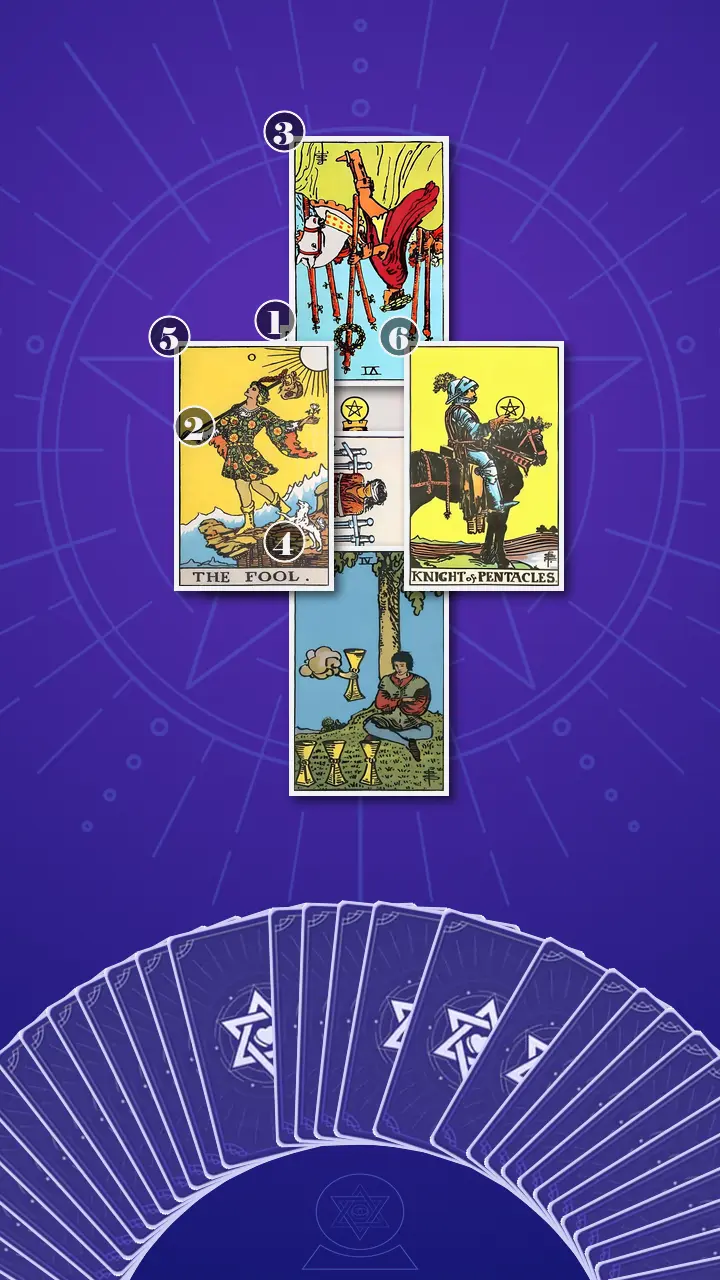
The Closed Hands at the Center of the Decision
Position One: Four of Pentacles and the Success Being Guarded
Now I turned over the card representing the present decision tension: the concrete behavior of protecting familiar success while wanting to leave it. It was the Four of Pentacles, upright.
I pointed to the figure pressing one pentacle against the chest, pinning two beneath the feet, and balancing another on the crown. The town stood behind the figure like an established professional identity: recognizable, orderly, and already built. Yet the closed posture left no free hand with which to receive anything new.
In Casey’s daily life, the card was almost literal. She kept a draft application open beside her campaign dashboard, checked the prospective salary and benefits against her current package, and closed the tab before anyone could respond. Her income, title, reputation, and proof of competence were held against her body as resources that must not be disturbed.
The card was not claiming that stability was false or unimportant. In context, it showed protective Earth operating in excess. The instinct to safeguard what she had earned was useful; the excess appeared when protection became immobility and every resource could function only as a reason not to investigate. An emergency fund can create options, but not if it becomes a locked box that must never be opened because opening it would acknowledge an uncontrolled future.
“Which resource are you most afraid of disturbing?” I asked. “Income, benefits, title, approval—or the proof that you know how to succeed?”
Casey gave a short laugh with a bitter edge. Her chin dipped, her fingers tightened around the sleeve of her mug, and then she looked directly at the pentacle over the figure’s heart. “That’s so accurate it feels a little cruel,” she said. “The salary matters. But the title says I didn’t waste the last six years.”
“I’m not calling your salary a prison,” I replied. “I’m asking whether the stability you built is allowed to support learning, or whether its only permitted job is to keep the current identity untouched.”
Her grip on the mug loosened by a fraction. I saw the first distinction take shape: appreciating what she had built did not require treating it as the final form of her life.
Position Two: Eight of Swords and the Research That Became a Wall
Now I turned over the card representing the protective obstacle: the risk-based thought pattern that turns uncertainty into a reason to postpone action. It was the Eight of Swords, upright.
The figure was blindfolded and loosely bound, surrounded by swords while an open landscape remained visible between them. I drew Casey’s attention to the gap. The image did not show an absence of intelligence or options. It showed limited visibility being interpreted as proof that responsible movement was impossible.
Casey recognized the modern version immediately. She would write eight reasons a career change could fail, read salary reports, compare job requirements, and treat the completed list as a closed case. Each browser tab added another sword. The alternative remained as distant as the castle in the card because she required herself to know its outcome before she was allowed to approach anyone who could provide firsthand information.
Here, Air—the energy of thought, comparison, and analysis—had become excessive until it produced a blockage. Her mind was like a navigation app repeatedly recalculating before the car had moved. The incomplete route was not evidence that the destination was unreachable, but the repeated recalculation made stillness feel like responsible preparation.
“What appears just before you decide not to send the message?” I asked. “And which part of that thought is factual?”
Casey looked toward the rain-darkened window. “I could earn less,” she said. After a pause, she corrected herself. “Actually, the fact is that I know what I earn now. The amount I’d earn somewhere else is a range. The rest is me imagining everyone watching me make a worse choice.”
Her eyes returned to the card, but her shoulders stayed high. The distinction had reached her logic before it reached her body.
“Exactly,” I said. “A salary range is useful planning information. It is not a prophecy, and an imagined audience is not a financial fact. Uncertainty is not a verdict; it is the information your first experiment is meant to find.”
Position Three: Six of Wands Reversed and the Audience Inside the Decision
Now I turned over the card representing the underlying fear: the hidden dependence on recognition and the self-worth concern beneath the decision. It was the Six of Wands, reversed.
The rider still carried the raised wand and laurel wreath, and the surrounding crowd still witnessed the achievement. Reversal did not erase Casey’s success. It showed recognition turning inward as status vigilance: public proof becoming a private scoreboard.
I returned to the performance review she had described. In a cold glass meeting room near King Street West, her manager had called her reliable, strategic, and ready for more. She had thanked him, returned to her desk, and searched for people who had changed careers after reaching a similar level. On the TTC, every LinkedIn promotion became another vote on whether her own path looked impressive enough to keep.
It reminded me of a quieter, everyday version of Severance: not two literally divided selves, but one polished work-self receiving praise while the private self kept asking whether the role still fit. The surrounding crowd in the card had become colleagues, managers, professional peers, and the live leaderboard of LinkedIn.
The Fire of achievement was not deficient. It was blocked and redirected. Instead of warming curiosity, it was being spent maintaining a convincing narrative. The underlying loop sounded like this: If I leave, people may think I misjudged my life; if they think that, I may believe them.
“Being good at a role is evidence of a skill, not a lifetime contract with the role,” I said. “Recognition can tell you that you performed well in one environment. It cannot decide what direction feels meaningful when no audience has voted.”
Casey’s breath stopped just above a full inhale. Her thumb went still against the mug; her gaze drifted past me as though replaying the performance review without its polished script. Then her jaw shifted, and the air left her chest in a low, uneven sound.
“I thought I was afraid my old coworkers would judge me,” she said. “But I think I’m afraid I’d agree with them. If the next thing looked smaller, I might decide this success was a fluke.”
I let the silence hold without rushing to reassure her. This reversed Six of Wands was the spread’s deepest blockage, but it was not a diagnosis of weakness. It showed where an intelligent risk analysis had become entangled with a question no compensation spreadsheet could answer: Am I still capable if my capability is not immediately visible?
Position Four: Four of Cups and the Cost of Another Planning Cycle
Now I turned over the card representing the cost of maintaining the current pattern: the emotional stagnation and missed possibilities created by staying only because the path is familiar. It was the Four of Cups, upright.
The figure sat beneath a tree with arms crossed and gaze lowered toward three familiar cups. A fourth cup arrived from the edge of awareness, but the figure did not look up. I emphasized that the offered cup was not automatically “the right career.” It represented information that might never receive an honest hearing because it arrived without a guaranteed title, salary, or status equivalent.
Casey had lived this card on rainy Sunday evenings. She would scan unfamiliar roles, dismiss each one because it did not resemble her current definition of success, and later conclude that no real option had appeared. An invitation to an informal conversation might wait in her inbox while she returned to the three known paths in her notes app. The relief of not choosing would last for the evening; the room would still feel flat when the radiator clicked on.
Water, the energy of emotional contact and receptivity, was in blockage. The problem was not that Casey lacked options. It was that prolonged evaluation had trained her attention to filter out anything that could not pass the old success algorithm within seconds. Like a feed that keeps serving familiar content because every unfamiliar post is dismissed before it receives a full view, her career search was learning to show her more of what she already knew.
“If you stay through another annual planning cycle without testing anything new,” I asked, “what changes first—your energy, your curiosity, your Sunday evenings, or your sense that other possibilities are real?”
Rain tapped three quick beats against the window and then softened. Casey uncrossed her arms. “I don’t think I’d have a dramatic breakdown,” she said. “I think I’d get very efficient at not noticing. I’d keep delivering, but I’d stop believing myself when I said I wanted something else.”
The repeated Fours now looked less like stability and more like a room with fixed walls: one card guarding material structure, the other settling into emotional stasis. I could see that Casey did not need a dramatic escape from that room. She needed a door small enough to open without pretending she already knew what stood beyond it.
When The Fool Held Out a White Rose
Position Five: The Beginner’s Question at the Edge of Certainty
Now I turned toward the card representing the key transformation: the attitude that can challenge the demand for certainty and reopen curiosity about leaving.
Before I revealed it, I returned to another scene Casey had described: 12:18 p.m., her work dashboard bright with praise, an unsent message waiting in a second tab, the kettle clicking off behind her, and the phone warming in her hand. Protect the proof, or learn what might exist beyond it?
The card was The Fool, upright.
I showed her the figure at the cliff’s edge, the white rose held openly in one hand, the small bundle carried over one shoulder, and the alert dog at the figure’s side. I did not interpret the cliff as a command to resign, gamble her savings, or leap without checking the ground. The dog preserved risk awareness. The bundle showed that Casey would not enter a new field empty-handed. The rose represented one open question held without a guarantee.
In modern life, The Fool looked like a fifteen-minute informational conversation, a small skills exercise, or one question about what an ordinary Tuesday actually feels like in the possible field. Casey could close the call without announcing a pivot, changing her LinkedIn headline, or rewriting her identity. The movement was from abstract research into direct experience.
This was where I used a diagnostic lens I call Career Cycle Phase Identification. After a decade of guiding people through changing seasons of work, I have learned to separate three conditions that can feel identical from inside a tense body: a personal skill gap, an industry-wide macro contraction, and a role-fit cycle that has naturally reached low tide.
Casey’s strong performance review gave us no reason to frame her restlessness as evidence that she lacked competence. Real market conditions still mattered; hiring freezes, compressed budgets, and salary ranges deserved objective attention. But those conditions could not explain why her strongest lift in attention occurred whenever she imagined learning outside her established role. A spreadsheet could measure the weather around her career. It could not tell her whether she still wanted to live in the same house.
For an instant, I remembered the first ephemeris I learned to read. A planet can appear to move backward without having failed or lost its path; apparent motion must be placed in context. In the same way, a career slowdown is not automatically personal inadequacy, and a desire to change direction is not automatically proof of poor judgment.
I framed The Fool as a bridge between the two possibilities. One bounded experiment could help Casey distinguish a temporary industry low tide from a deeper change in role fit, while keeping her income, privacy, and right to stop intact. Open Air and exploratory Fire were returning to the spread, not as recklessness but as restored movement.
I said, “You do not need to abandon practicality to explore change. Let curiosity produce one honest piece of evidence before you ask it to produce certainty.”
Do not keep protecting a successful identity as if it were a final verdict; take one curious, grounded step beyond its edge and let The Fool's white rose mark the beginning of learning.
The room became so quiet that I heard the radiator tick once behind us. Casey’s inhale stopped midway, and her fingers hovered above the phone as if the unsent message were physically present between us. Her pupils widened; then her gaze lost focus, moving through a sequence of remembered screens—the performance-review praise, the salary tabs, the LinkedIn promotions, the message she had edited until it sounded like a business case rather than a human question.
Her mouth tightened before her voice came out sharper than it had all evening. “But doesn’t that mean I’ve been doing this wrong for a year?”
“No,” I said. “It means protection did its job until it started blocking the information you needed. You were not foolish for wanting safety. You’re allowed to update the method now.”
Her fist loosened one finger at a time. Colour rose around her eyes, and she blinked quickly before letting out a breath that trembled on the way down. Her shoulders dropped, but she did not look instantly triumphant. For a moment she looked almost unsteady, as if putting down a heavy box had left her arms unsure what to do next.
“Oh,” she said softly. “I wasn’t only protecting the job. I was protecting the version of me the job proves.”
The sentence brought release, but it also returned responsibility to her hands. If the spreadsheet was no longer allowed to make a self-worth decision, she would have to learn through contact with reality. Clarity had not removed all risk. It had revealed where useful evidence could come from.
I asked, “Now, using this new perspective, think back to last week. Was there a moment when this insight might have made you feel different?”
Casey looked down at her phone. “On the train,” she said. “I might have treated that message like a question instead of a resignation letter. I wasn’t being asked to prove the next path was better. I was being invited to learn whether anything about it was true.”
“Exactly. You do not need a resignation plan to ask a better question.”
I scaled the card’s invitation before it could become another performance target. I suggested a ten-minute timer: write one factual constraint, one untested prediction, and one question for someone with firsthand experience. She could stop at the written question; sending it would remain her choice. She would make no resignation decision during the exercise, keep the experiment private if visibility turned it into a performance, and pause if the sensation in her chest became too intense.
The smallest version of The Fool was simply noticing which question she kept avoiding. The larger transformation had begun: a move from fear-driven protection of a successful identity toward grounded curiosity and self-trust built through direct experience. It was not yet a career decision. It was the first moment in which uncertainty became a live question instead of a character verdict.
Position Six: Knight of Pentacles and the Evidence That Can Be Repeated
Now I turned over the card representing grounded integration: a small, practical experiment that protects Casey’s agency without making the decision for her. It was the Knight of Pentacles, upright.
The Knight sat on a still horse, holding one pentacle at eye level while cultivated fields stretched behind him. The stillness mattered. Unlike the Four of Pentacles, this figure was not gripping every resource against the body. The Knight was examining one useful unit of reality with patience and intention.
In Casey’s life, that meant setting aside one short appointment each week for a specific career experiment: one conversation, one portfolio test, one observation of a real task, or one review of what she had already learned. The single pentacle replaced the demand for a complete five-year plan with one manageable piece of evidence.
Earth had returned in balance. The Fool’s openness would not evaporate into impulsiveness, and the Knight’s practicality would not harden into paralysis. Casey could use her current job as runway, preserve her financial boundaries, and let consistency build trust at the pace she chose.
“Let one honest piece of evidence be enough for today,” I said.
Casey turned her phone face down. This time the gesture did not look like avoidance. It looked like a boundary around the next task.
Turning Familiar Success into Runway
I drew the six cards into one coherent story. Years of visible achievement had taught Casey that success was both a resource and proof of belonging. In the present, the Four of Pentacles showed her guarding that proof so tightly that it could not support exploration. The Eight of Swords revealed the mental rule that demanded an answer before allowing information-gathering. Beneath it, the reversed Six of Wands exposed the fear that a less impressive next step might revoke her right to trust herself. If the pattern continued untouched, the Four of Cups suggested no dramatic catastrophe—only a quieter loss of contact with curiosity.
The Fool and Knight of Pentacles offered the unused resources. Casey already had skills, professional experience, income, and an ability to learn. The Fool could open one question; the Knight could test it within boundaries. The cards did not ask her to reject success. They showed her how familiar success could become runway instead of a locked box.
I named the cognitive blind spot directly: Casey had been using tools designed for logistics to answer a question about identity. A compensation sheet could help establish a minimum-income boundary. It could not tell her what unfamiliar work felt like on an ordinary Tuesday. LinkedIn could display titles. It could not measure private direction. More comparison was not solving the problem because the missing ingredient was not generalized data; it was bounded contact with reality.
Her old decision algorithm contained a hidden rule: if a possible move reduced visible status or introduced uncertainty, it must be dangerous. The update was smaller and more practical than “be fearless.” She would replace the demand for certainty with one reversible experiment that produced new information without requiring an immediate exit.
When I suggested starting with ten minutes, Casey raised one eyebrow. “I know myself,” she said. “I can turn a ten-minute exercise into a three-hour, colour-coded Notion project.”
“Then the stop rule is part of the experiment,” I replied. “Ten minutes means ten minutes. No new dashboard, no productivity theatre, and no decision at the end.”
- The Ten-Minute Facts & Untested Predictions Note The next time the salary spreadsheet or comparison tabs open, set a ten-minute timer in Apple Notes or Notion. Write one fact about the current role, one feared outcome that has not been tested, and one question that could produce firsthand information. For example: “My current salary is X” is a fact; “A different role will permanently damage my credibility” is an untested prediction; “What does progression actually look like in that field?” is a testable question. Tip: Stop when the timer ends, even if the note feels incomplete. If three lines feel like too much, write one fact and one prediction only. The exercise is for separation, not forced resolution.
- The One-Question Career Test On Tuesday, block twenty minutes after lunch and message one person whose current role resembles the direction being considered. Ask about one ordinary workday, one skill that matters, and one surprise they encountered. Request information, not permission, a referral, or reassurance. If sending feels too exposed, draft the questions first or listen to one detailed firsthand interview as the minimum version. Tip: Keep the test private and stop after the agreed twenty minutes. Do not evaluate whether to quit during the conversation. Record three observations afterward, including anything that contradicted an assumption.
- The 30-Day Micro-Orbit Observation For thirty days, reserve ten minutes every Friday for the Micro-Orbit Observation, my method for tracking subtle organizational movement without turning every workday into surveillance. Record one observable blueshift, such as new budget, sponsorship, an adjacent opening, or growing demand for a skill; one observable redshift, such as a verified hiring freeze, shrinking scope, or a concrete layoff-risk signal rather than a rumour; and one attention signal from Casey’s actual work. At day thirty, use the pattern for Promotion Window Calibration: compare an internal move, an external experiment, another month of observation, or deliberate rest to identify the path of least resistance. Tip: No daily refreshing and no anonymous-rumour spirals. Use a maximum of three lines each Friday. If nothing changed, write “no new signal.” Current stability remains in place while the evidence is gathered.
I reminded Casey that none of these actions was secretly a vote for leaving. If a conversation made her current role feel newly valuable, that would be evidence. If a skills test created a noticeable lift in attention, that would be evidence. If she discovered that her available energy was too low for exploration, protecting recovery time would also be an informed choice.
The cards had organized the question, but they did not own the answer. Casey remained the author of her pace, her privacy, her financial boundaries, and whatever she chose after learning more.

A Week Later, the Quiet Proof
The following Tuesday, I received a short message from Casey. At 12:18 p.m., with her work dashboard still open and the kettle clicking off behind her, she had set the timer and written three lines. Then she sent the exploratory message she had kept saving as a draft.
The former colleague replied. They scheduled fifteen minutes, and Casey asked what the work looked like on a normal Tuesday, which skill mattered more than the job descriptions suggested, and what had surprised him after changing fields. She ended the call without asking for a referral or making a promise about what came next.
In her evidence note, she wrote: “I know more about the question because I learned that one task I assumed would dominate the role is actually minor, and one skill I thought I lacked can be tested in a small project.” It was not a solved life. It was reality where a wall of imagined outcomes had been.
That night she slept through. Her first thought on waking was still, What if I’m wrong? She told me she smiled; the thought had lost its admin access.
I did not read her message as proof that she should leave a good job. I read it as proof that she could create information instead of waiting for certainty to arrive. Her Journey to Clarity had moved from fear-driven protection to grounded curiosity—not perfectly, and not permanently, but through one action she had chosen for herself.
The Decision Cross had helped distinguish genuine caution from the fear of losing a successful identity. Casey’s title remained valuable. Her stability remained real. Neither had to function as a final verdict.
If a job keeps rewarding you, your shoulders can still tighten at every thank-you, because wanting something else can start to feel like proof that you cannot be trusted with a good life. I do not take that tightening as a command to leave; I take it as permission to ask a more honest question.
If your current stability could be a base rather than a verdict, what one ten-minute “white rose” question could you place into your own micro-orbit this week—without promising anyone, including yourself, a final answer?