Choosing Their Life Script Over What You Want, One Test at a Time

The Sunday Draft That Kept Becoming a Checklist
I told Jordan, a 29-year-old Toronto project coordinator, that if Sunday Scaries had her opening a private Notes draft and ending up reorganizing her practical checklist, she might be choosing the life that was easiest to explain rather than the one she was curious to practice.
At 8:47 p.m. on Sunday, she had been sitting on the edge of her bed in a rented room near Bloor Street, typing a personal plan into her phone. The screen cast a pale rectangle across her hands, the phone felt warm against her palm, and the radiator clicked while traffic hissed below the window. She switched to Instagram, watched polished stories about promotions, new flats, engagements, and rooftop dinners, then replaced the draft with a practical career checklist.
When Jordan arrived at my studio, she said, 'Why do I keep choosing their life script over what I want?' She was at a career crossroads inside a stable job, but the question was larger than a promotion or a course. She wanted to live according to what she wanted and kept choosing the version of life that other people would recognize first.
She gave me the sentence she had been carrying around: 'I know how to make a life look right, but I do not know how to tell if it feels like mine.' The feeling she called self-doubt moved through her like a phone vibrating under a pillow: impossible to ignore, difficult to locate, and always warning her that someone might be disappointed. Her shoulders stayed lifted as she spoke. Guilt sat beside longing, and a thin line of resentment appeared whenever she described another sensible decision.
I told her, 'You can be grateful for a recognizable path and still notice that it is not the same as a chosen one. We do not need to force a dramatic answer today. We can look at the mechanism, name what is yours, and let the next small piece of evidence come from your life instead of from an imagined audience. Our work is to draw a map through the fog, so you can find clarity without handing me the steering wheel.'

The Four-Layer Insight Ladder at a Career Crossroads
I asked Jordan to put both feet on the floor, take one slow breath, and hold the question in plain language: what happens between wanting something and explaining it to someone else? I shuffled slowly while she focused on that sequence. The preparation was not a supernatural test. It was a clean transition from the noise of messages, feeds, and imagined conversations into an honest examination of how she was making decisions.
For anyone wondering how tarot works in a question like this, I chose a Four-Layer Insight Ladder - Context Edition. It is a compact tarot spread for personal values and life direction. A full Celtic Cross would introduce more positions than this inner question needs, while a conventional decision spread could make their life script and her personal desire look like two external options. This issue needed a smaller structure that examined the authority making the choice.
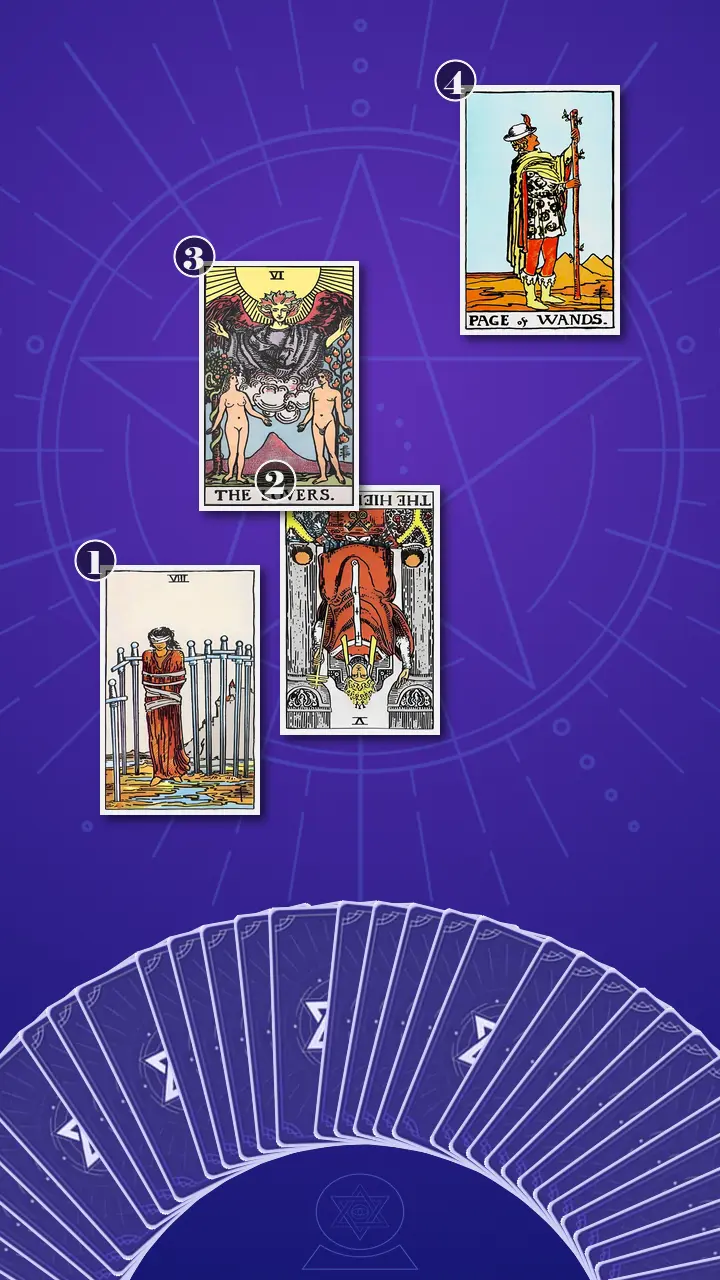
I explained that the four positions would move in a rising diagonal. The first would show the present condition and conscious experience: the observable habit before she explained it. The second would reveal the underlying cause or hidden belief: the rule that made belonging feel conditional. The third would offer the transformative insight and way through. The fourth would turn that insight into a practical next step and a grounded experiment.
I placed the first two cards close together, then set the third above the gap between them and the fourth farther along the table. The arrangement looked like a short ladder out of a narrow corridor. It could not predict which life path would produce a fixed outcome. It could show where approval had entered the decision sequence, where a value could be named, and how Jordan might test a preference without announcing a permanent life change.
Reading the Map from Restriction to Choice
The Blindfold Around the Notes App
Now I am turning over the card that represents the present condition and conscious experience. It is the Eight of Swords, in upright position.
The upright Eight of Swords shows Jordan opening her Notes app to write what she wants, then filling the screen with reasons the choice would be difficult to defend. The blindfold becomes imagined judgment. The loose bindings around the wrists become rules that have never been tested. The eight swords form a perimeter from every practical objection she gathers before a preference is allowed to speak.
In city life, this is the moment after a personal desire appears and before it gets handed to comparison, productivity, or an imagined panel. I connected it to the TTC ride she described: standing on the platform after work, scrolling through other people's milestones, and choosing the recognizable option because it offers immediate relief from having to explain herself. The energy here is excessive in the mind and deficient in direct perception. Thought is working hard, but it is working around the preference instead of listening to it.
I asked, 'Which part of this choice is an actual constraint, and which part is a rule you have never tested?' I was not suggesting that money, work, rent, or other people's responses were imaginary. I was separating real conditions from the extra sentence that says she must obtain approval before she is allowed to investigate what she wants.
Jordan gave a short laugh with a bitter edge. 'That is almost rude,' she said. Her thumb rubbed the edge of her phone, then stopped. I did not treat her reaction as resistance to be overcome. I told her that the card was not calling her trapped; it was showing how a decision can feel externally locked when the first restriction is an unexamined rule. She looked back at the card and said, 'I can see what I want, but I need to know whether I am allowed to want it.' Her shoulders lowered by a fraction.
The Approval Panel Behind the Door
Now I am turning over the card that represents the underlying cause or hidden belief. It is The Hierophant, in reversed position.
The reversed Hierophant appeared as the imagined approval panel behind Jordan's choices. A rule about what counts as sensible, adult, stable, or successful had been repeated so often that it felt like a condition of belonging, even though she had not consciously chosen all of its values. She might ask several people whether a personal plan made sense, collect the most conventional answer, and follow it while privately resenting the version of herself that kept disappearing.
The seated teacher, the kneeling acolytes, and the crossed keys made the pattern easy to see. The keys became the approval codes Jordan believed she needed before entering her own preference. The acolytes echoed the way she treated outside opinions as authorities rather than information. I thought of the split in Severance, not as a literal comparison but as a useful image: the competent public self performs the approved role while the private self keeps asking what the work and life are actually for.
Reversed energy here is a blockage in the relationship with tradition and authority. It does not mean that every familiar option is false or that independence requires rejecting advice, stability, partnership, or conventional work. It means Jordan has been following a workplace handbook, a social timetable, or an inherited definition of success without checking whether she ever agreed to its terms. Belonging and authorship have been treated as opposites when they could be negotiated separately.
I asked her, 'Which rule about work, money, adulthood, relationships, or success are you following because it feels necessary for belonging, even though you cannot remember choosing it?' Her breathing paused. Her eyes shifted toward the window, then back to the crossed keys. She remembered a sentence she had used for years: 'If I choose differently, I will have to explain myself forever.' The fear was not a command from anyone in the room. It was an internal gatekeeper speaking in familiar voices.
I told her, 'Approval can explain why a choice feels safe; it cannot prove that the choice is yours.' Jordan pressed her lips together, looked down at her hands, and then released a long breath. The resentment did not disappear, but it became more useful. It pointed toward something personal that had been edited out, rather than proving that everyone around her was wrong.
When The Lovers Returned the Choice
The Card Between the Scripts
The room became quieter when I reached for the third card. Outside, a streetcar bell sounded once and faded, leaving the table, the cards, and Jordan's breathing unusually distinct. We had reached the visual hinge of the ladder.
Now I am turning over the card that represents the transformative insight and way through. It is The Lovers, in upright position. In this reading, The Lovers is not a prediction about romance and not an instruction to choose for someone else. It is the Conscious Chooser: the moment when desire and responsibility meet in an explicit values-based commitment.
The two figures facing one another contrast directly with the blindfold of the Eight of Swords. Jordan's question can move from 'Will they approve?' to 'What am I willing to practice on an ordinary Tuesday?' The mountain between the figures remains. The choice may still involve uncertainty, money, awkward conversations, or a different pace. What changes is the source of the first evidence. She can write, 'I want this because it expresses creativity, autonomy, rest, or community,' before asking how the sentence will be received.
The Sunk Cost Neutralization Check
This was where I brought in one of my signature tools from my Wall Street years: Sunk Cost Neutralization. I use it when past time, money, emotional effort, or reputation starts pretending to be a binding contract with the future. I asked Jordan to respect everything she had learned from the current path without letting the years spent making it look sensible decide what the next year had to be.
I said, 'The fact that you have invested in becoming excellent at a recognizable life is information, not a verdict. For a moment, remove the investment from the decision matrix. If you encountered this path today, with the same benefits and the same daily feeling, what would you choose? What would a ten-minute test of the other value teach you?'
The risk-benefit structure did not require a reckless leap. A private ten-minute experiment had a limited downside and a potentially valuable return: direct contact with her own response. That asymmetric view protected her from both extremes, from staying only because she had already stayed and from rejecting every familiar option merely to prove that she could.
The Sentence That Changed the Question
At 8:47 p.m. on Sunday, the private plan was open in Notes, the comparison feed was one tap away, and the practical checklist was ready to make the familiar path look real. Nothing external had forced the switch. Imagined judgment arrived first, and relief followed when the desire went quiet.
You are not required to make the inherited script your proof of worth; like the two figures meeting beneath the angel, name your values and choose the next step that honestly aligns with them.
Jordan's breath stopped first. Her thumb hovered over the edge of the card; her pupils widened, and for a second she looked as if I had turned off a light. Then her gaze lost focus. I watched the office kitchen return in fragments: fluorescent hum, instant coffee, the sensible answer leaving her mouth while the personal one stayed behind her teeth. Her fingers curled against her palm. 'But doesn't that mean I was wrong?' she asked, with a flash of anger that sounded almost safer than grief. I let the question stand. 'It means you were protecting belonging with the information you had. Now you have another question.' The radiator clicked from the other room. Her clenched hand opened one finger at a time; her shoulders dropped, then rose in a shaky breath. Moisture gathered at her lower lids, not as proof that the card had predicted anything, but because a sentence she had been using as a verdict had become something she could examine. She looked at the angel, swallowed, and said, 'I can let this be a choice before I know what it becomes.' The relief was real, but it carried a brief, dizzying blankness: no borrowed answer was rushing in to fill the space.
I asked, 'Now, use this new perspective to look back at last week. Was there a moment when it could have made you feel different?' She remembered the office kitchen near King Street West, the microwave humming while a coworker asked what she planned to do next. She had given the sensible answer first. For ten minutes, I asked her to keep the group chat closed, write one decision in first-person language beginning with 'I want...', and name the value beneath it. If her chest tightened, she could look around the room, feel her feet on the floor, pause, revise, or return later. Privacy and no action were both valid choices.
This was the first real crossing from borrowed approval, contracted self-doubt, and postponed desire toward values-based discernment, steadier self-trust, and a consciously chosen sense of belonging. It was not certainty. It was honest self-contact before interpretation by other people.
The Wand at Eye Level
Now I am turning over the card that represents the practical next step and integration. It is the Page of Wands, in upright position.
The Page of Wands offered curiosity, initiative, and a beginner's willingness to explore. The sprouting wand held at eye level became a small test held close enough to inspect. The open landscape behind the Page suggested room to discover rather than perform certainty. Jordan did not need to announce a career reinvention, register for a costly program, or prove that a desire was her permanent identity.
Upright fire here brings a little warmth back into a spread that began in constricted air. The mental analysis does not have to disappear; it can become a tool that serves direct experience. The Page asks for one personally meaningful action, a clear time limit, and an open result. It turns The Lovers' values alignment into lived evidence.
I told her, 'You do not need a five-year plan to collect one honest piece of evidence. Try the direction for a week. Notice what gives you energy, what feels difficult, and what you would change. You are allowed to stop, revise, or decide it is not for you. Learning is the outcome, not performance.'
Jordan looked at the Page's raised gaze and smiled without looking fully convinced. That mattered. Her curiosity was not replacing uncertainty; it was becoming available beside it. She wrote down the phrase 'a seven-day test' instead of 'my new life,' and for the first time that evening, the practical part of her mind seemed to be working for her rather than against her.
Finding Clarity in the Ten-Minute Choice
I laid the four cards in a line and told Jordan the story they made together. The Eight of Swords showed the visible loop: a personal desire appeared, then comparison and imagined judgment turned the surrounding swords into a perimeter. The reversed Hierophant showed why the loop held: an inherited rule had been promoted to an unquestionable authority, and approval had been confused with belonging. The Lovers supplied the bridge by returning the decision to named values. The Page of Wands supplied the practical outlet: a beginner-sized experiment that could create direct evidence before anyone else interpreted the meaning.
The cognitive blind spot was not that Jordan lacked information. It was that she had mistaken immediate relief for proof of fit. Choosing the recognizable path quieted the fear of disapproval for a moment, and that quiet felt like safety. The hours she spent researching, updating her resume, and making the inherited path look responsible then became another reason to keep going. Sunk costs were being used as evidence about the future.
I told her that the key shift was to stop using their life script as the test of whether a desire was legitimate. Her own values and lived response could become the first evidence. This did not require rejecting every familiar path. It required choosing consciously, keeping the result open, and allowing belonging to be something she participated in rather than something she purchased through conformity.
These were the next steps I gave her as actionable advice:
- Borrowed-Script AuditOn Tuesday evening, open a phone note titled Borrowed-Script Audit and choose one current decision, such as the course, role, move, or weekend plan. For ten minutes, write two columns: inherited rule, meaning what would make the option easy for other people to recognize; and chosen value, meaning the quality you would actually practice, such as creativity, autonomy, rest, curiosity, or community. Before asking anyone for an opinion, take one low-stakes action that reflects the chosen value.If the imagined panel calls the value impractical, write that rule in the panel's voice and answer it in first-person language. Keep the experiment private if sharing would make you perform certainty.
- I Want, Then the Third OptionFor one decision you have been researching, write the sentence I want... before writing pros, cons, or explanations, and underline the value inside it. If Option A is the recognizable script and Option B feels like an all-or-nothing escape, use my 3rd-Option Leverage Test over the next 72 hours: define Option C as a bounded trial that keeps practical safeguards while giving the personal value one real hour, one email, or one small application step.The third option does not need to solve the whole decision. Set a ten-minute minimum, leave the maximum open, and evaluate what you learned rather than whether you have proved your identity.
- Seven-Day Curiosity TestChoose one personally meaningful direction and test it privately for seven days. Spend twenty minutes on a course idea, attend one free information session, outline a side project, or walk through a neighbourhood you are considering. Do the action once before requesting reassurance or posting about it online, then record what gave you energy, what felt difficult, and what you would change next time.If twenty minutes feels too exposed, use the ten-minute version. A short trial is not a promise, and stopping or revising is still useful information.
I reminded Jordan that none of these steps required her to make a major career or life decision immediately. They were ways to collect information in her own language. A life could be understandable to other people without being authored by them, and a personally chosen path could begin as quietly as a protected calendar block.

A Week Later, the First Unsent Draft Became Evidence
Four days later, I received a message from Jordan while I was making coffee. She had completed the Borrowed-Script Audit, kept the group chat closed, and spent twenty minutes reviewing a creative course she had been researching for months. She did not enrol or announce a new direction. She emailed one question to the course coordinator and noticed that her attention felt steadier after sending it.
That night, she slept a full night; in the morning, her first thought was still, 'What if I am wrong?' This time, she smiled, made coffee, and opened the course page before opening Instagram.
I saw that as the first small proof of the Journey to Clarity. Tarot had not chosen for her. The cards had helped us make the decision sequence visible, separate an inherited rule from a chosen value, and give desire a manageable place to speak. She had moved from automatic compliance toward curious authorship, one private action at a time.
When saying what you want makes your chest tighten and your shoulders prepare for a defense, it can be because part of you is trying to keep belonging by living the life they recognize while another part is still waiting to find out what feels like yours.
A life can be understandable to other people without being authored by them. If you let one small choice be guided first by a value you can name, rather than by how easily you could explain it, what would you be curious to try privately this week?