Finding Clarity in the Sunday Night LinkedIn Spiral
If you’re a late-20s/early-30s Toronto tech ops person who keeps a “Resume_FINAL_final” file and still refreshes LinkedIn after a normal Monday meeting, this is for you.
When Alex showed up for our session, they didn’t look dramatic. They looked… operational. Tidy. Controlled. The kind of person who can run a rollout, herd stakeholders, and still remember to thumbs-up a Slack message at the right time.
But when they described Sunday night, the control got thin.
“It’s like… I’m half-watching Netflix,” they said, rubbing a thumb along the edge of their phone case, “and then I see one of those ‘I’m excited to announce…’ posts. Promotions. New titles. Big shiny logos. And my body just… reacts.”
I could picture it with the precision of a scene I’ve heard a hundred times in different cities: Sunday, 10:23 p.m., condo living room. Dishwasher humming like a low-grade threat. The cold blue light of a phone making your eyes sting. Your phone slightly hot from refresh. Shoulders inching upward until they nearly touch your ears.
Alex’s voice went flatter on the last part. “I want stability. I want meaning. But the second a job stops feeling clean, I’m like—maybe this is the sign.”
Restlessness, in their case, wasn’t a vibe. It was a wired-but-tired buzz under the skin, like their nervous system had three tabs open that wouldn’t close: Slack, a calendar invite, and a silent loop of What if I’m wasting my time?
They looked at me and said the question that had brought them here: “After three job hops in two years… what pattern is actually guiding my next move?”
I nodded slowly. “We can work with that. Not to judge the hops—Toronto rent doesn’t exactly reward patience—but to understand what the hops are doing for you. And then to find a next step that’s chosen, not reactive. Let’s try to draw a map through the fog—something that gives you clarity without demanding a perfect answer tonight.”

Choosing the Compass: The Celtic Cross · Context Edition
I asked Alex to take one slow breath and notice their shoulders. Not as a mystical ritual—more like the way you’d pause before replying to a message you might regret. A small transition. A signal to the body: We’re not sprinting right now.
As I shuffled, I explained what I’d use. “Today, we’ll work with a spread called the Celtic Cross · Context Edition.”
For readers who are curious about how tarot works in a practical way: I like this spread when someone is at a career crossroads and the real question isn’t ‘Which job should I take?’ but ‘Why does this keep happening?’ The Celtic Cross is built for patterns. It tracks a full chain—present behavior, the immediate block, the deeper driver underneath, the most recent trigger, and then an integration path. It’s less fortune-telling and more like pattern recognition with symbols.
This version stays anchored in the specifics of job hopping: position 4 focuses on the most recent “last straw,” and position 9 names the hopes and fears about repeating the cycle—so we don’t drift into vague career advice.
“Here’s what to watch,” I told Alex. “The first card shows your current pattern in motion. The crossing card shows what blocks you from stability even when you want it. And the last card—position 10—doesn’t ‘predict’ your future. It shows the direction you move toward when you work the pattern consciously.”
Alex exhaled, and I watched their hands unclench around their coffee cup—just slightly, like a system lowering its alert level by one notch.
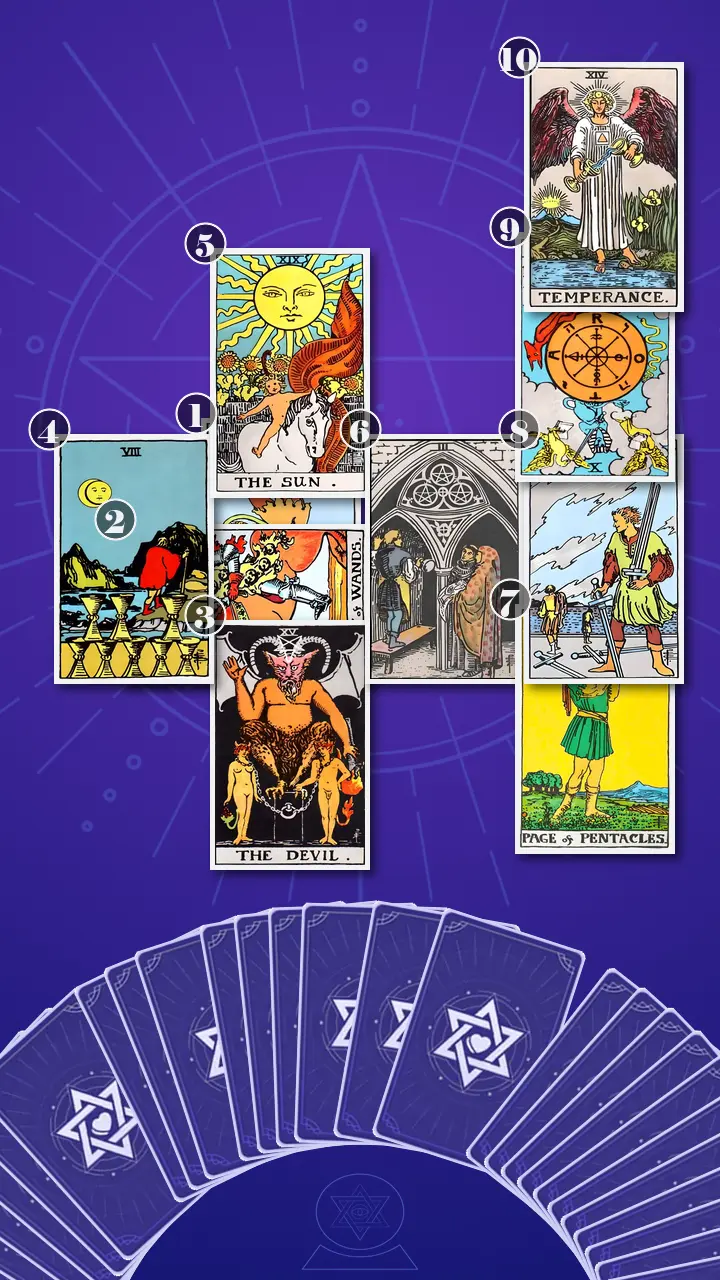
Reading the Map: From Looping to Flowing
Position 1: Current pattern in motion
“Now we turn over the card that represents your current pattern in motion: what your job-hopping cycle looks like day-to-day right now.”
Two of Pentacles, reversed.
“This is painfully specific,” I said, keeping my tone steady. “It’s 2:06 p.m. and you’re ‘working,’ but you’ve got Slack, a spreadsheet called ‘Career Options,’ and three LinkedIn tabs open. You answer messages fast enough to look competent, while quietly imagining your next title and how you’ll explain leaving again.”
Alex let out a short laugh—bitter, almost impressed. “That’s… kind of brutal.”
“I know,” I said. “And I’m not saying it to shame you. I’m saying it because it’s accurate data.” I tapped the card lightly. “Reversed, the Two of Pentacles isn’t healthy flexibility. It’s overwhelm. Split attention. Two identities running at once: committed employee and secret exit-planner.”
“Refreshing job boards isn’t always ambition—sometimes it’s nervous-system first aid.”
Alex’s eyes dropped to the table. Their jaw tightened for a moment, then softened—like they’d been caught, but also relieved to be named correctly.
Position 2: Primary block
“Now we turn over the card that represents your primary block: what keeps you repeating the cycle even when you want stability.”
Knight of Wands, reversed.
“This is the accelerant,” I said. “Right after one ambiguous comment or awkward power dynamic, your body goes into ‘go’ mode. You fire off applications, book informational calls, draft a resignation. You tell yourself you’re being strategic.”
I paused. “But the card is showing that speed is doing emotional work. It gives relief before you’ve even clarified what happened.”
Reversed, the Knight’s energy is blocked and dysregulated—fire without a hearth. Not passion as purpose, but urgency as anesthesia.
I leaned back a fraction, letting the image land. Alex stared at the Knight like it was a security camera still from their own Thursday afternoons.
In my mind—an involuntary professional flashback—I saw a different kind of urgency: graduate students on a dig site, desperate to uncover something spectacular in a single afternoon, brushing too hard and snapping an edge they couldn’t replace. In archaeology, impatience costs evidence. In careers, it costs learning.
Alex nodded tightly. “It’s like… the moment it gets complicated, I start thinking about leaving.”
“Exactly,” I said. “And notice the loop: if you slow down, you fear you’ll lose control. If you speed up, you lose roots.”
Position 3: Root driver
“Now we turn over the card that represents the root driver: the deeper need or fear your career choices are trying to manage.”
The Devil, upright.
Alex went still. That particular stillness—the kind that isn’t calm, but braced.
“People get spooked by this card,” I said, “but I read it in a grounded way. In career readings, The Devil often shows attachment to proof. Outsourcing self-trust to external signals: a recruiter DM, an interview request, a shiny title, a compensation band.”
“That’s… yep,” Alex said quietly. “When someone wants me, I’m okay. When it’s quiet, I feel like I’m free-falling.”
“Look at the detail,” I said, pointing gently. “The chains are loose. The bind is real, but not absolute. The trap isn’t your job. It’s the idea that a job has to certify your worth.”
In terms of energy, this is a sticky, magnetic attachment. It keeps your attention glued to outcomes that can’t actually hold you the way you need to be held.
Position 4: Most recent trigger
“Now we turn over the card that represents your most recent trigger: what pushed the latest job hop—the ‘last straw’ pattern.”
Eight of Cups, upright.
“This matters,” I told Alex. “Because this card says your last hop wasn’t random. It wasn’t laziness. It was emotional truth.”
“You left after you’d already built something—relationships, processes, wins—but the work stopped feeling meaningful. And under that moon—the uncertainty—you chose walking away over renegotiating what you needed.”
Alex’s face flickered with something like grief, fast and almost hidden. “I did build things,” they said. “That’s the messed up part. I leave right when I finally understand the place.”
“And that’s the pattern we’re mapping,” I replied. “Not to force you to stay anywhere harmful—but to see the exact moment your system decides: ‘Better to reset than to risk struggling.’”
Position 5: Conscious aim
“Now we turn over the card that represents your conscious aim: what you think you’re trying to get by making a change.”
The Sun, upright.
“You’re not chasing chaos,” I said. “You’re chasing daylight.”
“A career that feels obvious in your body: clear expectations, visible progress, confidence that doesn’t require constant self-defense. After a few fast pivots, it makes total sense you’d crave something uncomplicated.”
I watched Alex’s shoulders drop a millimeter. The Sun has that effect—just seeing your true aim named can reduce the mental noise.
“And here’s a practical reframing,” I added. “Clarity isn’t only a feeling. It’s often a structure: boundaries, feedback cadence, skill milestones. Sunlight you can measure.”
Position 6: Next stabilizer
“Now we turn over the card that represents your next stabilizer: what becomes possible if you stay with the learning curve long enough to collect real data.”
Three of Pentacles, upright.
The energy in the room shifted—less buzzing, more grounded. If the earlier cards felt like browser tabs multiplying, this one felt like a shared doc with headings and dates.
“This is apprenticeship,” I said. “A calendar invite titled ‘Feedback & Growth Plan.’ A manager who can define ‘good.’ A team that reviews work without gotchas. A 90-day plan with metrics—so you’re collecting real data instead of vibes.”
“Discomfort isn’t a sign to leave; it’s data you haven’t collected yet.”
Alex’s eyes brightened with something that wasn’t excitement, exactly—more like curiosity with relief. “I want that,” they said. “I want to stop guessing.”
“And notice,” I replied, “this card doesn’t say ‘find the perfect company.’ It says ‘find—or build—the conditions where skill can actually form.’”
Position 7: Self-positioning
“Now we turn over the card that represents self-positioning: how you’re showing up internally and what you’re ready to practice.”
Page of Pentacles, upright.
“You’re ready for a different identity,” I said, and I meant it. “Not ‘the person who reinvents fast,’ but ‘the person who learns steadily.’ One coin. One lesson. One season.”
Upright, the Page’s energy is balanced: practical, curious, willing to do reps without needing the rep to be impressive on LinkedIn.
Alex smiled, small and surprised. “That sounds… calmer.”
“It is,” I said. “And it’s not less ambitious. It’s just ambition with roots.”
Position 8: External context
“Now we turn over the card that represents external context: workplace dynamics and pressures that amplify the urge to leave.”
Five of Swords, upright.
“This is the air you’ve been breathing,” I said. “Meetings where credit feels contested. Feedback that lands like a trap. Sharpness as a culture.”
It isn’t always overt bullying. Sometimes it’s a subtle, constant ambiguity—enough to make your nervous system interpret normal friction as threat.
Alex’s fingers tightened around their cup again. “My last team was like that,” they said. “And parts of this one too.”
“Then it makes sense that leaving starts to feel like self-protection,” I replied. “But this card also asks: what boundary, what conversation, what request could protect your energy before you assume the only solution is to exit?”
Position 9: Hopes and fears
“Now we turn over the card that represents your hopes and fears about repeating the pattern: what you want to believe vs what you dread will happen again.”
Wheel of Fortune, reversed.
“There it is,” I said softly. “The loop fear.”
“You look at the last three exits and think, ‘It always ends up like this.’ Part of you hopes the next job will magically break the cycle. Part of you fears you’ll re-live the same arc: excitement → ambiguity → bolt.”
I held Alex’s gaze. “Three hops in two years is information—not destiny.”
Reversed, the Wheel’s energy is stuck—repetition without learning. And that’s the invitation: change one lever you control. Not every variable. Just one.
Alex swallowed. “I’m scared it’s me,” they said. “Like, if I stay and it still doesn’t work… then I’m the problem.”
“That’s the heart of it,” I answered. “And it’s exactly why the last card matters.”
When Temperance Spoke: Turning Separate Cups into One Steady Flow
I let the room get quiet on purpose, the way you pause before opening an email you’ve been avoiding. Outside my window, street noise in Toronto came and went in soft swells—cars, a distant streetcar bell—like a reminder that the city keeps moving even when you stop sprinting.
“Now we turn over the card that represents the integration outcome: the direction you move toward when you work the pattern consciously,” I said. “This is the core of your ‘next move’ question.”
Temperance, upright.
Alex blinked, once, slowly. Like their eyes were trying to focus on a different kind of answer than the one LinkedIn offers.
Setup: They were stuck in the familiar logic of decision fatigue—if they didn’t choose the right job next, everything would collapse into a story of failure. Uncertainty felt like danger. Struggling through a learning curve felt like exposure.
Delivery:
Stop treating every discomfort as a sign to leave; start mixing what works and what matters, like Temperance turning separate cups into one steady flow.
I didn’t rush to explain. I let it sit between us.
Reinforcement: Alex’s reaction came in three waves. First, a physical freeze—breath paused, shoulders held high as if bracing for impact. Then the mind catching up—their gaze unfocused for a moment, as though replaying every “vague feedback → job board” pivot like a highlight reel they’d never asked to watch. Finally, the emotional release: a long exhale that sounded almost like a laugh, but softer, and their shoulders dropped with it.
Then—unexpectedly—anger flashed across their face. Not at me. At the idea itself.
“But if that’s true,” they said, voice tight, “doesn’t that mean I’ve been… wrong? Like I made all those moves for nothing?”
I shook my head, firm but kind. “No. It means you’ve been surviving. And you’re ready to do something more sophisticated than survive.”
This is where my own work—my odd, academic sort of intuition—kicks in. In archaeology we don’t call a collapsed layer ‘a mistake.’ We call it a record. A signal. We study it.
“Let me use what I call Historical Case Matching,” I said. “In the ancient world, civilizations hit crossroads all the time. Some reacted to the first friction by relocating—again and again—chasing an easier soil, a cleaner river, a less complicated neighbor. Others stayed long enough to build irrigation, laws, apprenticeships—systems that made life workable even when it wasn’t easy.”
I pointed to Temperance’s flowing motion. “Your pattern has been relocation energy. Temperance is systems energy. Integration. Not intensity.”
“Your next move doesn’t need more intensity. It needs more integration.”
I watched Alex absorb that, and I asked the question that turns insight into something lived: “Now, with this new lens—think back to last week. Was there a moment when you opened LinkedIn after a slightly uncomfortable meeting, and this perspective could’ve changed what you did next?”
Alex’s eyes watered, but they didn’t cry. They just nodded, once, like someone accepting a hard truth that also happens to be freeing.
“Wednesday,” they said. “Glass meeting room. Someone said I should be ‘more strategic’ and no one defined it. I smiled. I nodded. And I went straight to Easy Apply in the bathroom like it was… an inhaler.”
“That’s the moment,” I said gently. “Temperance doesn’t tell you to tolerate nonsense. It tells you to mix: your values and your boundaries, your ambition and your pace, your emotional truth and your practical plan.”
“This is you moving from restless urgency toward steadier self-trust,” I added, making it explicit. “From treating career as a verdict on your worth to treating it as a craft you can build.”
The 90-Day Craft-Building Voyage: Actionable Next Steps
I gathered the spread into a single story, the way I’d summarize a site report after a long dig.
“Here’s what I see,” I told Alex. “You’ve been juggling two lives at once—present job and future escape—so you never get clean evidence. When friction hits, you sprint for relief. Underneath that sprint is an attachment to proof: titles, offers, external signals that momentarily settle your nervous system. And because some environments really are sharp and political, the sprint feels justified. But the Wheel shows the fear: ‘It will always end up like this.’ Temperance offers the exit ramp: a sustainable rhythm where you blend what you’ve learned, set boundaries, and build skill through a 90-day experiment.”
“Your cognitive blind spot,” I said, “is this: you’ve been treating early discomfort as a final verdict on fit. But in reality, that discomfort is often the first layer of data.”
“In my work, I call the fix Time Stratigraphy,” I added. “We separate layers. The top layer is impulse—what your nervous system wants in the first hour after a trigger. The deeper layer is lasting value—what actually helps you build a career you can inhabit.”
Then Alex did the thing I’ve come to respect: they named the real constraint.
“Okay,” they said, “but I barely have time. My days are wall-to-wall meetings. I don’t know where I’m supposed to find even five minutes for ‘experiments.’”
“Good,” I replied. “That’s real. So we go small. Ancient navigators didn’t plan the whole ocean in a day. They kept a log, checked the stars, made the next safe adjustment.”
“Here are your next steps,” I said. “Pick the smallest version that you can actually do.”
- Build a 20-minute Career Container (7 days)Choose one consistent time (example: 7:40–8:00 p.m. after dinner). Only in that window: job boards, recruiter replies, resume edits. Outside that window: no LinkedIn tab, no “just checking”—especially not during work tasks.Expect resistance like “I’ll miss my chance.” You’re not banning job searching—you’re scheduling it. If 20 minutes feels impossible, do the 10-minute version and still count it.
- Use the 48-Hour Rule + a 6-Line Friction LogAfter your next trigger meeting, pause all “escape actions” for 48 hours (no applications, no recruiter messages, no resignation drafts). Instead, write 6 lines: 1) what happened, 2) what I assumed it meant, 3) what I need, 4) what boundary might help, 5) one clarifying question, 6) what action can wait 48 hours.Hour 6–12 is when the craving for momentum spikes. That’s normal. If 48 hours is too big, start with “sleep on it once.”
- Start a 90-Day “Voyage Log” Craft ExperimentPick ONE skill to deepen for 12 weeks (stakeholder management, analytics, ops tooling, process design). Define what evidence counts by Day 30/60/90. Then every Friday, update a 2-minute log: one thing I built, one friction I handled without bolting, one ask I made, one skill rep I completed.When your brain says “But what if I pick the wrong skill?” remind yourself: this is an experiment, not a forever identity. You’re allowed to revise after 90 days—with data.
I added one line, because Alex’s spread demanded it: “Make one request before you make an exit.”
And because Temperance is about mixing, not denying: “If a workplace is truly harmful, we don’t talk you into endurance. We talk you into clarity—so leaving is a decision, not a reflex.”

A Week Later: Ownership, Not Certainty
Seven days later, Alex texted me a screenshot: a Notes app entry titled “Friction Log (Wed).” Six lines. Clean. Honest.
Under it: “Also… I did the Career Container. I hated it the first two days. Then it got weirdly calming. Like my brain stopped free-running.”
They told me they’d asked their manager one clarifying question—one. Not a dramatic confrontation. Not a resignation. A request for an example of what “strategic” meant by next Friday.
And in a small, bittersweet way, the shift showed up where it always shows up first: sleep. They said they’d slept through the night once. In the morning, the first thought was still, What if I’m wrong?—but this time it came with a half-smile, not a spiral.
That’s what a real Journey to Clarity often looks like: not certainty, but ownership. Not a perfect career narrative, but a new relationship with discomfort—one where it becomes information instead of a fire alarm.
When the job stops feeling clean and certain, it can feel like your chest tightens and your brain hits “escape”—because staying long enough to struggle would risk proving you weren’t in control after all.
If you treated the next 90 days as an experiment in building craft—not a verdict on your worth—what’s one tiny piece of evidence you’d want to collect about yourself this week?
This story is adapted from psychological research, written so that those in a similar struggle can see their own pattern in it — and find their next step clearly.These insights are not a substitute for professional psychological, medical, legal, or financial advice.
Learn more about our Journey to Clarity.
How did this insight land for you?
🫂 This Resonates Deeply
🌀 Living This Story
✨ Now I See Clearly
🌱 Seeing New Possibilities
🧰 Useful Framework
🔮 The Confirmation I Needed
💪 Feeling Empowered
🚀 Ready for My Next Step
Author Profile
 AI
AI“Having spent a lifetime at Cambridge and on archaeological digs, I’ve witnessed the rise and fall of countless civilizations. Please know that your current struggles are not a permanent fate, but merely a necessary fracture before rebuilding. I won't lecture you; instead, I invite you to sit with me in the ruins, using a patient, historical perspective to gently dust off the true, enduring value hidden beneath your temporary doubts.”
In this Choice Tarot Reading :
Core Expertise
- Historical Crossroad Matching: Contextualizing your dilemma by comparing it to macro-historical turning points, providing an objective bird's-eye view.
- Enduring Value Assessment: Evaluating competing options based on what will survive the test of time versus what is merely a short-term impulse.
Service Features
- The Time Stratigraphy Exercise: A mental time-travel protocol evaluating your current dilemma strictly from the perspective of your 10-year future self, instantly dissolving trivial anxieties.
Also specializes in :
Explore Related Patterns:
Avoidance CopingAlex opening LinkedIn after uncomfortable meetings, keeping Slack and job tabs active at the same time, and going to Easy Apply in a bathroom shows a coping loop that converts anxiety into exit planning. You are not simply changing roles; you are using movement to regulate the spike that arrives when work gets ambiguous. Avoidance Coping fits because the escape action provides immediate relief before the actual problem has been clarified. It protects you from the exposed feeling of staying long enough to ask, negotiate, or collect evidence, but it also blocks you from learning whether the friction is a boundary issue, a skill gap, a culture mismatch, or a real signal to leave. The pattern becomes visible at the exact moment Alex says they leave right when they finally understand the place. The next move becomes more chosen when leaving is delayed long enough to become a decision rather than a nervous-system reflex.
Fresh Start FantasyAlex has repeated the arc of excitement, ambiguity, and bolting across three job hops in two years, and the story names the most revealing moment: they leave right when they finally understand the place. The reset arrives just when deeper learning, negotiation, or boundary-setting would have to begin. Fresh Start Fantasy fits because the next role starts to carry the emotional promise of a clean slate. A new company can look like a new nervous system, a new identity, and a new chance to avoid the complicated feeling that the current situation has become real. The fantasy is not that leaving is always wrong. The fantasy is that relocation alone will solve a pattern that also lives in how you interpret discomfort, feedback, status, and uncertainty. The next move becomes more grounded when the question shifts from where can I restart to what system would let me stay long enough to learn.
Urgency BiasAlex's response to one ambiguous comment or awkward power dynamic is not slow assessment; it is applications, informational calls, resignation drafts, and a body that wants to move now. The bathroom Easy Apply moment after undefined feedback shows urgency acting like an inhaler for uncertainty. Urgency Bias names the way speed starts doing emotional work. Action feels strategic because it creates momentum, but the deeper function is relief before reality has been checked. You get the sensation of control without the slower discomfort of asking what happened, what you need, and what can wait. The cost is that speed collapses the learning window. If every unclear signal becomes a launchpad for the next move, you never get clean data about whether staying, setting a boundary, or making a specific request would have changed the situation.
Certainty SeekingAlex wants stability and meaning, but the second a job stops feeling clean, the uncertainty starts to read like a sign. The story keeps returning to the same pressure point: if the next job is not the right one, the whole career narrative could collapse into failure. Certainty Seeking fits because the mind is trying to eliminate ambiguity before it has enough evidence. A vague comment, a messy workplace dynamic, or a learning curve becomes intolerable because it cannot immediately confirm that you are safe, competent, and on the right track. The trap is that certainty gets mistaken for clarity. Clarity can be built through boundaries, feedback cadence, skill milestones, and time-boxed experiments; certainty demands a perfect answer before the next step. Alex's 90-day experiment matters because it replaces the need for a flawless verdict with evidence you can actually collect.
External ValidationAlex's line that being wanted makes them feel okay while silence feels like free-falling is the clearest root signal in the story. Recruiter DMs, interview requests, shiny titles, compensation bands, and LinkedIn announcements become more than career information; they become proof that the self is still valuable. External Validation fits because the job market starts regulating self-trust. When the signal is loud, you feel certified. When the signal goes quiet, your nervous system searches for a new hit of desirability, which can make a job hop feel like reassurance rather than strategy. This pattern does not mean ambition is fake. It means ambition gets contaminated when worth has to be confirmed from the outside before you can feel steady inside. The next move becomes clearer when a role is evaluated as a craft environment, not as a verdict on whether you matter.
Threshold ToleranceAlex's Career Container, 48-hour pause, friction log, and one clarifying manager question show a different relationship with discomfort starting to form. Instead of letting job searching free-run through the workday and evening, you create a holding structure where urgency can be noticed without immediately obeyed. Threshold Tolerance fits because the new pattern is not passive endurance. It is the capacity to stay at the edge of uncertainty long enough to collect data, ask for definition, test a boundary, and watch what actually happens. Discomfort becomes information instead of a fire alarm. This is the adaptive direction of the next move. You are not asked to tolerate a harmful workplace or deny ambition; you are learning to separate impulse from evidence so that staying, negotiating, or leaving can each become a conscious choice.
Explore Related Struggles:
Urgency-Compass FusionAlex does not simply dislike jobs when they get difficult; their whole decision system accelerates after one ambiguous comment, one awkward power dynamic, or one meeting where the rules are not clear. The body moves before the evidence does: applications, informational calls, resignation drafts, and Easy Apply become ways to create motion when staying still feels exposed. That is why Urgency-Compass Fusion fits the pattern. You are watching speed take over the role of discernment. The next move starts to feel guided by momentum, but underneath that momentum is a need to escape uncertainty before it can ask anything harder of you. The struggle is not ambition itself. It is the moment ambition gets fused with immediate relief, so the fastest option feels like the truest one. Once you can separate urgency from direction, a career move can become a chosen experiment instead of a reflex against discomfort.
System Reset OverloadAlex has already built things before leaving: relationships, processes, wins, and enough understanding to finally know how the place works. The painful detail is timing. They leave right when the role stops being new and starts asking for a more mature kind of negotiation. System Reset Overload names the strain of starting over so often that the reset itself becomes expensive. You get the relief of a clean slate, but you also lose the continuity that lets craft, trust, and discernment accumulate. Each new role promises simpler soil, yet the same weather eventually arrives. The pattern is not proof that every move was meaningless. It shows that relocation energy has been doing work that integration energy now needs to take over. A 90-day experiment, a friction log, or one clarifying request gives you a way to test whether staying can become data collection instead of self-betrayal.
Clarity-Exposure SplitA manager says Alex should be "more strategic" without defining what that means, and Alex smiles, nods, then goes straight to Easy Apply in the bathroom. The missing definition is not just annoying; it becomes a doorway into exposure, because asking for clarity might reveal what is wrong with the role, the manager, the culture, or Alex's own next learning edge. Clarity-Exposure Split sits in that exact doorway. You want clean expectations, visible progress, and a role that feels obvious in your body, but the act of seeking clarity can feel like stepping under a brighter light. If the answer still hurts, you might have to stay with a more complicated truth than "this job is wrong." This struggle makes ambiguity feel more dangerous than it actually is. Once discomfort is treated as data instead of a verdict, clarity no longer has to arrive as a perfect answer; it can arrive through one grounded question, one boundary, one request, and one piece of evidence collected before the exit impulse takes over.
Partial Exit LockAlex can still run the rollout, answer Slack, manage stakeholders, and look operational from the outside, while another version of them is already drafting the escape route. The Career Options spreadsheet and LinkedIn tabs are not separate from the workday; they sit beside it, quietly splitting attention between the role they have and the role they might need next. Partial Exit Lock names that in-between state. You are not fully choosing the current job, but you are not fully leaving either. That half-exit creates a strange form of safety because there is always a door in view, yet it also blocks the clean data that only arrives when your attention is actually inside the experiment. The cost is subtle but heavy: every friction point gets filtered through the possibility of departure. When the escape route is always open in the background, staying long enough to learn, ask, repair, or renegotiate starts to feel less like agency and more like risk.
Performance-Worth FusionAlex's body reacts to promotion posts, shiny logos, recruiter attention, and compensation bands as if those signals carry more than career information. When someone wants them, they feel okay; when the market goes quiet, they describe the sensation as free-falling. Performance-Worth Fusion captures the deeper bind underneath the job hopping. You are not only evaluating roles; you are asking the career field to certify whether you are solid, wanted, and on track. That makes every external signal feel oversized, because the signal is being asked to hold a kind of self-trust it was never built to hold. The job then stops being a workplace and starts acting like a verdict. A title, offer, or interview request can briefly calm the system, but it cannot build the inner reference point that tells you what matters when no one is clapping, hiring, or announcing anything.
Explore Related Emotions:
Ambiguity DreadYou notice that the moment a job stops feeling clean, the mind starts scanning for a sign to leave. Ambiguous comments, unclear power dynamics, and undefined expectations all become heavier than the facts available in the moment. Ambiguity Dread names the emotional charge around not knowing what friction means yet. The discomfort is not merely inconvenient; it feels like standing in fog while being asked to prove you are safe, competent, and on the right path. The story shows why this feeling guides the next move so powerfully. If uncertainty itself feels dangerous, then leaving can start to feel like clarity, even before you have tested whether the situation could be clarified from inside it.
Feedback DreadYou hear that you should be more strategic, no one defines what that means, and you smile through it before retreating into a bathroom application scroll. The feedback does not land as useful information; it lands as exposure without a map. Feedback Dread grows in the gap between being evaluated and being guided. When the workplace atmosphere already feels sharp or political, even a vague comment can feel like a trap rather than an opening for skill-building. This matters because the job-hop loop often begins right there, in the seconds after unclear feedback. Before you can ask what would help, the body tries to protect you by finding an exit.
Cautious MomentumYou complete a small friction log, keep the Career Container, and ask for one example of what 'strategic' means. The movement is modest, but it is real enough to change the texture of the week. Cautious Momentum names the feeling of moving forward without pretending the fear is gone. The first morning thought is still, 'What if I'm wrong?' but it arrives with a half-smile rather than a spiral. This emotion belongs in the final arc because it shows ownership replacing the demand for certainty. You are not trying to solve your whole career at once; you are gathering evidence that you can stay present long enough to learn.
Decision FatigueYou are not only choosing a next job; you are trying to choose a version of yourself that will make the past two years make sense. That loads every option with too much symbolic weight. Decision Fatigue emerges because the mind is trying to solve stability, meaning, self-worth, workplace fit, and future confidence through one career move. No single option can carry all of that cleanly, so the decision field becomes crowded and exhausting. The story's 90-day experiment matters because it reduces the emotional burden on the choice. Instead of demanding a perfect answer, it asks for evidence, which gives your mind a smaller and more honest task.
Directionless UrgencyYou open LinkedIn after a slightly uncomfortable meeting, then move toward Easy Apply before the workplace moment has been understood. The speed gives the body something to do, and that action can feel like control even when the direction has not been chosen. Directionless Urgency sits underneath the job-hop pattern because the movement arrives before the meaning. Applications, informational calls, and resignation drafts become a pressure valve, not necessarily a strategy. The story keeps returning to the same emotional physics: when discomfort spikes, motion promises relief. Naming this feeling helps separate the valid need for change from the reflex to sprint before you have clean data.
Grounded AgencyYou build a 20-minute Career Container, ask one clarifying question, and notice that your brain stops free-running after the first resistance passes. None of this is dramatic, but it changes the emotional center of gravity. Grounded Agency fits because the story shifts from reflexive motion to chosen structure. You are not forcing certainty; you are creating one controllable lever between discomfort and action. That small boundary matters. It lets you respond to friction with evidence-gathering instead of immediate escape, which makes the next move feel less like a panic response and more like something you can author.
Integration ReliefYou hear the invitation to mix values, boundaries, ambition, pace, emotional truth, and a practical plan, and the answer stops needing to be one extreme. The career question becomes less about staying or leaving and more about building a rhythm that can hold complexity. Integration Relief is the softening that comes when separate pressures no longer have to fight for control. You can want meaning and stability, protect your energy and keep learning, question a workplace and still collect real data. The relief is practical, not abstract. A 90-day log, one clarifying request, and a defined career-search window make integration something lived in time rather than a nice idea.
Meaning HungerYou say you want stability and meaning, yet the moment work feels murky, the question underneath becomes whether you are wasting your time. That question is not small; it turns ordinary career friction into a referendum on whether the whole path is worth inhabiting. Meaning Hunger fits because the exits are not framed as thrill-seeking or chaos. The story shows a person trying to find work that feels clear in the body, aligned enough to stay with, and substantial enough to make the learning curve feel worth it. The ache becomes especially sharp because external signals can soothe it briefly but cannot feed it for long. A new title may create relief, but the deeper need is for work that can hold attention, values, and growth without requiring constant escape planning.
Pattern Recognition CalmYou exhale after the pattern is named with precision, and your shoulders drop as if the body has been waiting for a map that does not shame it. The same history is still there, but it starts to look readable instead of condemning. Pattern Recognition Calm is the quiet that arrives when the loop becomes observable. You can see the chain from vague feedback to threat response to job-board relief, and that visibility creates a small pocket of choice. The feeling is grounded rather than euphoric. It does not erase uncertainty, but it gives you enough distance from the spiral to ask one clarifying question before making an exit.
Quiet ShameYou say, 'I'm scared it's me,' and the room tightens around a fear that has been sitting underneath the career analysis. The three exits are no longer just decisions; they threaten to become evidence in a private case against yourself. Quiet Shame fits because the feeling is not loud or theatrical. It appears as bracing, a flattened voice, a tightened jaw, and the fear that staying long enough to struggle might prove something painful about who you are. The story gives this shame a way to be witnessed without letting it run the whole pattern. The job history can become information to study, which gives you room to separate accountability from self-erasure.
Scattered OverwhelmYou are half-working while Slack, a career spreadsheet, and LinkedIn tabs stay open in the background, and the body keeps acting as if every small signal needs immediate processing. The competent surface remains intact, but underneath it the attention field is fragmented into present performance, future escape, and public comparison. That fragmentation creates Scattered Overwhelm because no single part of the day gets to be fully inhabited. Even ordinary meetings become emotionally crowded when part of you is already preparing the next explanation, the next application, or the next possible exit. The label fits because the story repeatedly shows pressure moving through split focus rather than one clear crisis. You are not lacking discipline; you are carrying too many unresolved inputs at once, and the nervous system starts treating multitasking as emotional survival.
Status AnxietyYou see promotion posts, shiny logos, and public career updates, and your body reacts before your mind has sorted out the comparison. The screen becomes a scoreboard, even when you never agreed to play by its rules. Status Anxiety fits because the pressure is not only about employment. It is about whether your progress is visible enough, impressive enough, and legible enough to quiet the fear that you are falling behind. In the story, LinkedIn is not just a platform; it becomes an emotional measuring device. The next move starts to carry the burden of restoring public proof, which makes the choice feel sharper and less internally guided.
Explore Related Contexts:
Career Transition FogAlex arrives with a practical question about three job hops, but the wider career scene is a crossroads where stability and meaning are both desired and neither is clearly mapped. The next role is supposed to solve the pattern, yet the old uncertainty keeps returning after the first complicated meeting. The fog thickens because each new role promises a clean reset while the same evaluation problem follows. You are not only choosing a job; you are trying to locate a professional position that can survive uncertainty without needing the next title to settle the whole story.
LinkedIn Performance LoopSunday night begins with Netflix and a promotion post, then the phone gets hot from refreshes and the blue light becomes part of the room. During work, Slack, the Career Options spreadsheet, and LinkedIn tabs sit side by side, turning the current job into a stage watched by the next possible job. The external platform is not neutral here. Each title announcement, recruiter signal, shiny logo, or compensation band becomes a public scoreboard. You are not only comparing jobs; you are being pulled into an always-on market where proof appears to arrive faster than grounded self-assessment.
Performance Criteria Black BoxWednesday, in a glass meeting room, someone tells Alex to be "more strategic" and gives no usable definition. They smile, nod, and go straight to Easy Apply in the bathroom. A black-box criterion turns feedback from guidance into surveillance. You cannot build skill against a standard nobody will define, so the workplace starts producing ambiguity instead of evidence. The leverage point is a specific request for examples, metrics, or a feedback cadence that lets you test whether the role can become legible.
Premature Career Pivot PressureAlex has made three job hops in two years, and the pattern sharpens after vague feedback or an awkward power dynamic. Applications, informational calls, resignation drafts, and Easy Apply arrive before the situation has been clarified. The pressure is not simply job hopping. It is an external career market that rewards fast reinvention while workplace ambiguity stays unresolved. You get temporary relief from movement, but the move happens before the role has had enough time to show whether it can be shaped, negotiated, or outgrown with evidence.
Reflection Structure TrialSeven days later, Alex has a six-line Friction Log, a scheduled Career Container, and one clarifying question sent to a manager about what "strategic" means by next Friday. The shift is small, but it changes the social mechanics of the next move. The trial works because it turns career movement from a reflex into a measured experiment. You are not being asked to stay indefinitely or tolerate unclear conditions; you are building a short external structure that separates the first-hour impulse from the data that can actually guide a cleaner decision.