Cold Coffee, Nine Job Tabs, and the Call That Became Evidence

Finding Clarity in the 11:45 p.m. Spreadsheet
I know the particular form career pivot anxiety can take when a stable job feels empty but Toronto rent, debt payments, and Monday's Teams calendar all remain painfully real. It does not always look like panic. Sometimes it looks like competence stretched over a life that no longer feels chosen.
Alex (name changed for privacy), a 29-year-old product operations coordinator, described the previous Tuesday night to me. At 11:45 p.m., they had nine LinkedIn job tabs open beside a salary spreadsheet in their condo kitchen. The fridge hummed. Cold coffee left a bitter film on their tongue, and the laptop warmed their wrists while they adjusted the same rent and debt figures for the third time.
Each role description produced a brief lift in their chest. Then the application button made the possibility real, their jaw locked, and they returned to the spreadsheet. One by one, they closed the listings.
“I keep saying the job is fine,” Alex told me. “Which isn't the same as wanting it. I want proof before I take a step that could produce proof.”
I could hear the central conflict immediately: Alex wanted to move away from an option that felt empty, but they feared losing whatever protection staying appeared to provide. Their dissatisfaction felt less like a fire and more like carrying an empty suitcase strapped inside the rib cage: no visible emergency, just a hollow weight pulling the shoulders forward every Sunday evening.
“I'm not here to tell you to quit,” I said. “And I won't pretend rent, benefits, and continuity are imaginary concerns. I want us to separate the protection you genuinely need from the grip that keeps every alternative theoretical. Let's make a map of the fog before we discuss a direction.”

Choosing the Compass: The Decision Cross
I asked Alex to place both feet on the floor, take one slow breath, and hold the question without trying to solve it: “What am I protecting by staying with an option that feels empty?” I shuffled while they breathed. I use that pause as a transition from mental rehearsal to focused observation, not as a performance of mystery.
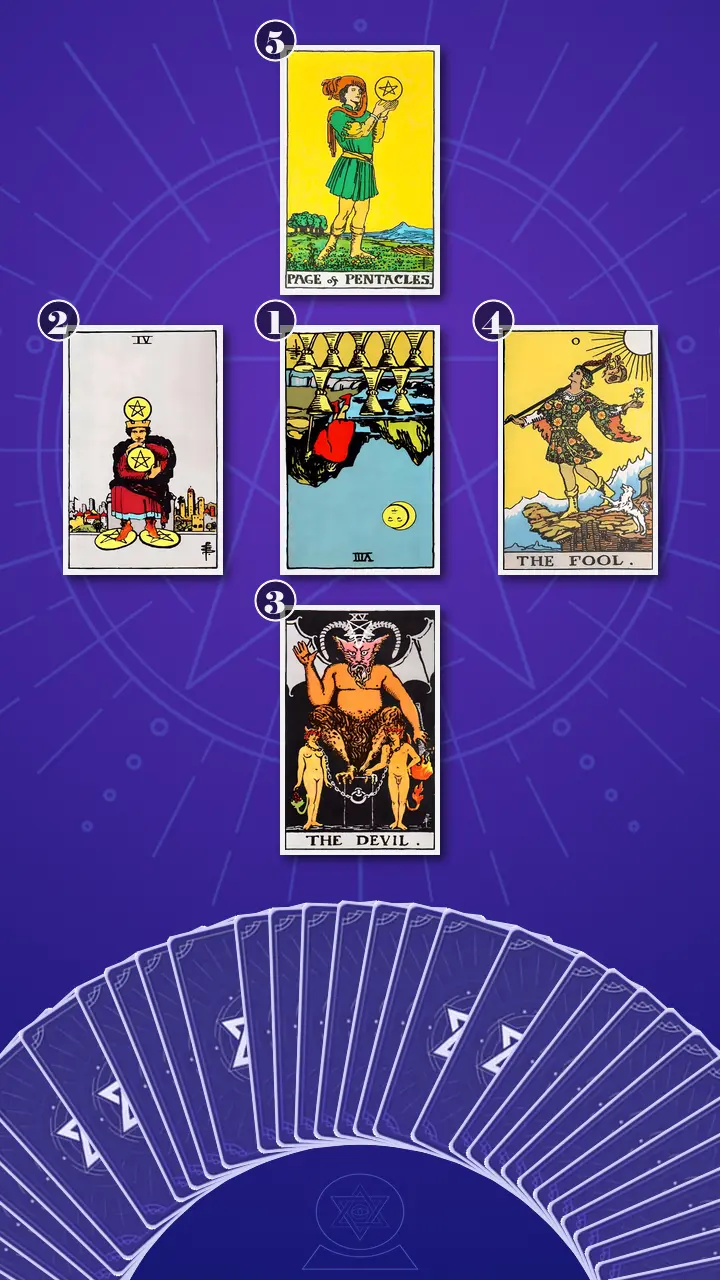
I chose a five-card Decision Cross. For this kind of stay-or-release question, I find it more useful than a broad spread because it isolates the actual trade-offs. It distinguishes the visible bind from the benefit of staying, the hidden attachment beneath it, the inner value of exploring, and the practical principle that can integrate all four.
I placed the first card at the centre for the pattern Alex could already see. The card on the left would show what the current role appeared to protect. The card below would expose the bargain operating beneath conscious reasoning. On the right, I would look for what movement might restore. The final card above the centre would translate the reading into a grounded next step.
The layout resembled a compass whose needle had stopped moving. My task was not to choose north for Alex. It was to identify what had been weighing down the needle.
The Traveller Who Kept Turning Back
Position 1: The Current Bind
I turned over the card representing the observable pattern of returning to an option Alex had already experienced as emotionally incomplete. It was the Eight of Cups, reversed.
In the traditional image, a red-cloaked traveller leaves an arrangement of cups with a visible gap. Reversed, I read the movement as interrupted: the traveller approaches the rough path, turns back, reassesses the same cups, and mistakes the difficulty of leaving for evidence that the arrangement must still be enough.
For Alex, the card was the 11:45 p.m. browser threshold. They opened an application, recognised something alive in the responsibilities, returned to the salary sheet, and closed the application. The immediate tension dropped, but their current role did not regain meaning. The Water energy was blocked, circulating through the same approach-and-retreat loop without completing either departure or renewed commitment.
“It's a little like the emotional split in Severance,” I said. “You can function well inside a work system without feeling personally connected to the life being spent there. Competence does not automatically create fulfilment.”
Alex gave a short laugh with a bitter edge. “That's so accurate it feels almost cruel.”
I let the reaction land before answering. “Accuracy does not have to become an accusation. This card is not shaming you for staying. It is showing us that postponement provides a real benefit: for ten minutes, nothing uncertain can happen. We just also have to count what remains heavy the next morning.”
Their thumb stopped rubbing the edge of the table. They looked back at the reversed traveller and nodded once, slowly.
“Staying is still a decision,” I said, “and it still has a cost.”
Position 2: The Package Called Safety
I turned over the card representing what staying appeared to protect: familiarity, continuity, and a sense of control. The Four of Pentacles appeared upright.
The figure holds one coin against the chest, carries another above the head, and pins two beneath the feet. I mapped that pose onto a moment Alex had described in their condo lobby. A rent auto-debit notification had appeared above a recruiter's message. Under buzzing fluorescent lights, with winter air slipping through the doors, they had pressed the phone against their coat and thought, “If I touch the job, I could destabilise everything.”
The card validated part of that response. Income continuity, benefits, debt payments, and predictable hours can be genuine safeguards. I had no interest in romanticising financial exposure. But conservation had moved into excess: salary, professional credibility, identity, routine, and the entire future had become one indivisible software bundle that Alex believed could not be updated component by component.
“A safeguard supports movement; a restraint makes movement impossible,” I said. “Which part of this package actually has to remain unchanged for a twenty-minute conversation to be safe?”
Alex inhaled, held the breath near the top, and then released it through their nose. Their shoulders lowered a fraction.
“The income,” they said. “And the benefits. But I guess an informational interview doesn't touch either of those.”
That distinction mattered. The card was not asking Alex to drop the pentacles. It was asking whether holding every resource against the body was the only way to be supported by it.
The Contract Beneath the Choice
Position 3: The Hidden Bargain
I turned over the card representing the fear and unacknowledged bargain beneath the decision. The Devil appeared upright.
I kept my attention on the loose chains around the two figures. I did not read them as a sentence imposed by an outside power. I read them as a contract that felt compulsory because its terms had gone unexamined.
Alex had seen a former colleague announce a career change on LinkedIn, opened a course page, and felt their stomach drop when the enrolment button turned curiosity into a visible action. They messaged the most cautious friend in their group chat. The friend mentioned the difficult job market. Alex closed the course page and felt immediate relief.
The hidden bargain sounded like this: “If I do not test an alternative, I cannot choose wrongly. If I cannot choose wrongly, I can continue believing I am in control.” It protected Alex from beginner embarrassment, regret, and responsibility for an uncertain choice. Its recurring price was attention, energy, and the evidence that might have strengthened their agency.
I asked, “What becomes temporarily easier when you cancel the experiment?”
Alex's breathing paused. Their fingers hovered over the table as if they had forgotten what they were about to touch. Their gaze shifted beyond the cards, replaying a memory I could not see. Then their hand dropped into their lap.
“I don't have to find out whether I'm bad at it,” they said quietly. “Or whether I spent years getting good at something I don't want.”
During my Wall Street years, I learned that a familiar position can still carry risk. Predictable costs often disappear into the background precisely because they arrive without drama. Looking at The Devil, I thought of contracts whose most expensive clause was not hidden in small print; it was the assumption nobody had challenged.
“The pattern loosens when you stop calling the bargain neutral,” I said. “No card here says your constraints are fake. The question is which constraints are concrete and which have been extended far beyond their actual boundary.”
Alex's eyes returned to the loose chains. Their mouth tightened, then softened. The room's radiator clicked once into the silence, like a latch being tested rather than a door being thrown open.
When The Fool Lifted One Foot
Position 4: The Value of Crossing a Small Threshold
I turned over the card representing what movement toward change could restore internally: curiosity, agency, and the capacity to learn through experience. The Fool appeared upright.
The room seemed to become quieter around it. The figure stood beneath an open sky with one foot raised, carrying a small bundle rather than every possible contingency. I explained that The Fool did not require Alex to resign, announce a pivot, or believe that the next path would succeed. The card offered beginner's openness in balance: enough movement to encounter reality, without confusing exploration with recklessness.
In Alex's life, this could be one twenty-minute informational interview treated as a visit rather than a declaration. They could prepare two questions, keep their current job, sound new, and leave without promising anything. Like Dorothy stepping from sepia Kansas onto the Yellow Brick Road, the point was not to possess the whole map. Understanding could develop through the encounter.
At that moment, Alex was still mentally back in the kitchen with the job tabs and salary sheet. They were trying to make the next half-hour carry the weight of the next ten years, as though one scheduled conversation had to contain a resignation letter, a new identity, and a guaranteed destination.
Stop treating certainty as the price of movement; take one bounded beginner step and let The Fool's light bundle replace the burden of a perfect plan.
I left the sentence alone for a moment, then added:
Keeping the familiar option is not neutral; the question is whether it protects an actual need or protects you from meeting uncertainty. The next step can be data, not destiny.
Alex froze first. Their breath stopped halfway in, and their thumb pressed hard into the side of their index finger. Then their pupils widened slightly and their focus slipped past me, as though several expired applications were replaying at once. Their jaw released before their shoulders did. When the shoulders finally dropped, the movement looked almost disorienting, like setting down luggage they had forgotten they were carrying.
The relief did not arrive cleanly. Their eyes reddened, and frustration sharpened their voice. “But doesn't that mean I've wasted years? If I could have tested this sooner, I've been doing it wrong the whole time.”
I heard grief beneath the anger, but I also heard a new responsibility entering the room. Clearer options can feel exposing because they remove the protection of saying there was never another move available.
“Now, using this new perspective,” I said, “think back to last week. Was there a moment when one bounded step could have felt different?”
Alex swallowed and mentioned the recruiter's message. “I could have asked for a call. I didn't have to apply.”
This was where I used Sunk Cost Neutralization. I separated the time Alex had already invested from the opportunities still available. Their years in product operations were not erased or declared worthless; those years had produced skills, income, relationships, and useful evidence. But past investment did not create a debt that the future had to keep repaying.
I then applied an Asymmetric Risk-Benefit Analysis. The downside of a twenty-minute call was capped: some time, some beginner discomfort, and perhaps confirmation that the adjacent role was not appealing. The upside included new information, a useful contact, language for transferable skills, or a reason to run another small test. Alex could preserve their salary while obtaining evidence their spreadsheet could never manufacture.
“I would not call that a leap,” I said. “I would call it an information-rich position with protected downside.”
I watched cautious curiosity replace the earlier full-body grip. This was not instant certainty. It was the first crossing from numb certainty-seeking toward evidence-based self-trust: permission to learn before knowing where the learning would lead.
One Pentacle, One Piece of Evidence
Position 5: The Integrating Principle
I turned over the final card, representing the practical decision principle that could integrate safety and movement. The Page of Pentacles appeared upright.
The Page studies one pentacle with sustained attention. There is no scattered comparison and no demand for a final verdict. The Earth energy that had been rigid in the Four of Pentacles now became balanced: one real task, inside one real field, observed carefully enough to produce usable knowledge.
I returned to another scene Alex had described. In a Queen West coffee shop, they had opened a two-week course module and a blank notes page, then used the entire session to add criteria to a Notion database. In the Page's version of that afternoon, Alex would complete one exercise and record what happened: attention, bodily tension, curiosity, and desire to continue.
“One task, one thing to learn, one review date,” I said. “You are not asking whether this proves a new career identity. You are asking what this specific contact with the work reveals.”
Alex picked up their phone and opened the calendar. Their knee bounced once beneath the table, stopped, and started again more lightly. The movement had not become comfortable. It had become specific.
Protection Designed Around Movement
Taken together, the Decision Cross told a coherent story. The reversed Eight of Cups showed Alex repeatedly approaching a threshold and retreating. The Four of Pentacles explained why: the current role had become the imagined container for every form of safety. The Devil revealed the deeper bargain, where avoiding a test preserved the appearance of control. The Fool restored voluntary movement, and the Page of Pentacles grounded that movement in evidence rather than fantasy.
The core blind spot was not simply fear of change. It was treating staying as the neutral option while ignoring its ongoing costs, then treating every practical safeguard as inseparable from the current employer. Alex had been guarding an empty waiting room because stepping outside came without a timetable.
The transformation was not from practicality to recklessness. It was from using practical concerns to prevent movement toward using practical design to support movement. Protection is something Alex could design, not something only one job could provide.
I told Alex that the cards did not deliver a verdict about staying or leaving. They showed how tarot works best in a high-stakes decision: as a structured mirror for separating feelings, assumptions, constraints, and available experiments. Alex remained the decision-maker.
They looked at the proposed thirty-minute test and frowned. “Quarterly planning is this week. I genuinely don't know where I'll find half an hour.”
“Then we do not use thirty minutes as another impossible entry requirement,” I said. “Use ten. The goal is not to perform courage. The goal is to create one piece of lived evidence.”
- Run the 3rd-Option Leverage Test within 72 hours.In one note, define Option A as staying unchanged and Option B as making a full career exit. Then design Option C: keep the current role while testing one saved alternative. List the three protections that genuinely matter, such as minimum income, benefits, or predictable hours, and show how Option C preserves them.Use concrete thresholds rather than words like “stability.” Limit the exercise to 15 minutes so it cannot become another permanent research project.
- Schedule one Bounded Beginner Test.Choose one saved role, course, conversation, or portfolio prompt. Put a 10- to 30-minute event on the calendar this week and use the time only to perform the task or speak with one person. Before starting, write: “This experiment does not require me to resign, announce a pivot, or make a permanent commitment.”Ban salary comparisons and long-term planning during the timer. Stop when it ends; completion creates information, not an obligation.
- Create a One-Pentacle Evidence Log.Immediately after the test, open a two-column note titled “What Happened” and “What I Noticed.” Record one observable result, then rate attention, bodily tension, curiosity, and desire to continue from 1 to 5. Review the entry 48 hours later.Do not turn one awkward beginner session into a verdict on an entire field. One sentence and one rating count as a complete minimum version.

A Week Later: The Quiet Proof
Seven days later, Alex messaged me from a Queen West cafe. They had completed a twenty-minute call and saved three notes in a folder named Career Evidence. They slept through the night; at breakfast, “What if I'm wrong?” still appeared, but it no longer closed the tab.
The call had not solved their career. It had revealed that they wanted to ask more questions about the work, and that sounding inexperienced for twenty minutes had not destabilised their income, housing, identity, or future. Alex remained in their job, but they were no longer defending it as the only responsible container for safety.
I saw the real value of the reading in that modest shift. The cards had not predicted a better path or granted permission from outside Alex. They had helped Alex move from passive disengagement to cautious curiosity, then return ownership of the next step to the only person who could take it.
If the familiar option feels empty while your chest tightens at the thought of loosening your grip, you may be carrying the exhausting belief that one uncertain step could expose whether you can trust yourself. Naming that bargain does not force the chain open, but it lets you inspect where the clasp actually sits.
If you let one reversible experience answer what your spreadsheet cannot, what is the smallest piece of real-world evidence you would be curious to place in your own one-pentacle log?