The Scope Opened After Yes: Three Questions Reshaped the Terms

The Yes Sent Before the Scope Opened
If you have ever typed yes from your phone before breakfast and spent the evening negotiating with yourself about what you actually agreed to, I know the particular ache behind that reflex. The first message feels like momentum. The attachment feels like something you can deal with later.
I met Jordan, a 28-year-old freelance digital strategist in Toronto, over a video call. Before I touched the cards, they took me back to 8:47 p.m. on a Line 1 train heading north. A recognizable company’s offer glowed on the warm phone in their hand; the carriage lights buzzed overhead, winter air slipped through the doors, and their shoulders rose as they read, “We loved your approach.”
Then Jordan reached the phrase evening availability as needed. Their throat tightened, but the bright client name was already creating a future in their head: steadier income, a stronger portfolio, a LinkedIn-worthy win. “I didn’t even know the fee yet,” they told me. “But I’d already forwarded it to a friend and said it felt like a big step.”
I heard the central contradiction immediately: the offer seemed right, yet part of Jordan could already feel its conditions drawing tighter. Their ambivalence was like standing in a subway doorway after the warning chime—one foot pulled toward the opportunity, the other trying to protect the life waiting on the platform.
“If it feels this right,” Jordan said, pressing two fingers against their throat, “why am I already negotiating with myself?”
I kept my answer gentle because this was not a failure of intelligence or professionalism. “You are not confused because you cannot recognize a good opportunity; you are trying to evaluate it while afraid of losing it.” I recognized a pattern of premature consent driven by validation and scarcity, wearing the polished face of a career win. The immediate yes stopped uncertainty for a moment, but scope creep, private resentment, and heavy shoulders arrived later.
I told Jordan I would not use tarot to declare the offer good or bad. “Let’s use it to draw a map of what happens between the first rush and the final agreement. The decision will still belong to you. Our journey today is about finding enough clarity for you to choose knowingly.”

Choosing a Crossroads Instead of a Verdict
I invited Jordan to place both feet on the floor, take one unforced breath, and hold one question in mind: Why do I keep accepting offers with strings when they seem right? I shuffled slowly, not as a supernatural performance, but as a deliberate transition from reacting to observing.
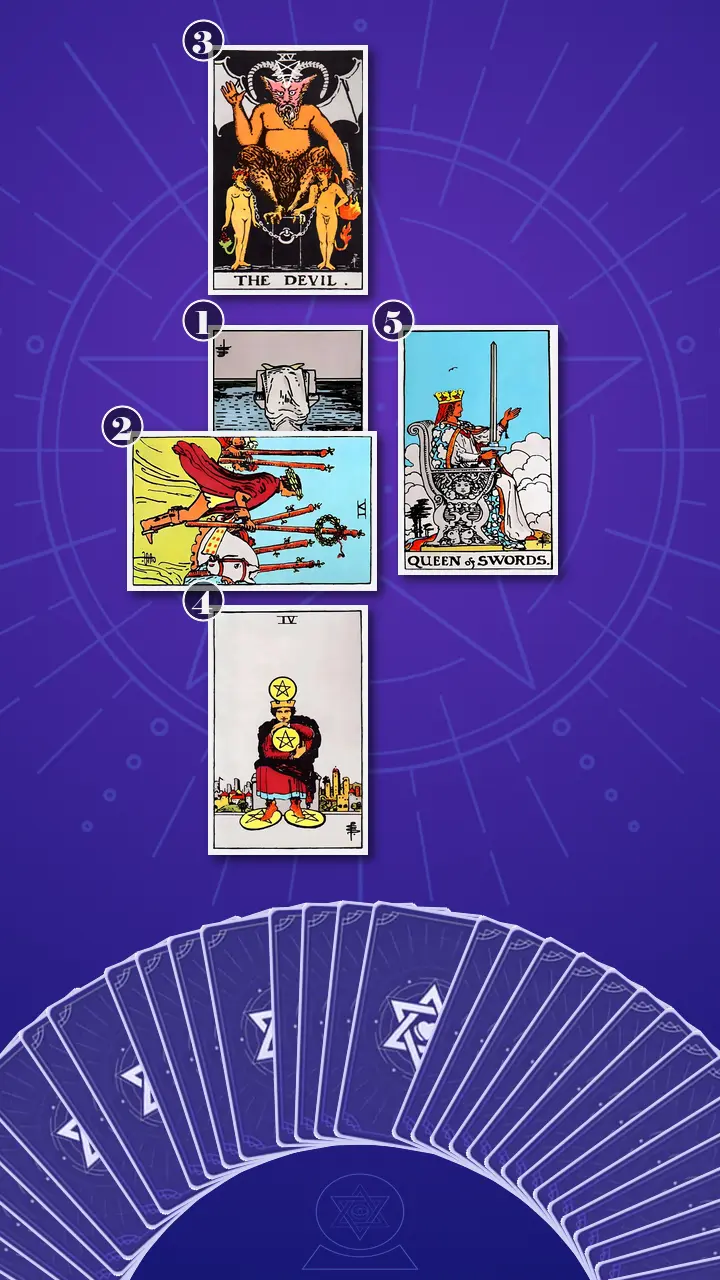
I chose the five-card Decision Cross tarot spread. A ten-card Celtic Cross could have produced a larger life narrative, but Jordan’s question needed a smaller, cleaner structure: one that could isolate the rushed yes, the pressure crossing it, the attraction and tradeoff, the fear underneath, and an actionable point of discernment.
For anyone wondering how tarot works in a career decision, I use the cards as an external thinking surface. They do not reveal a client’s secret intentions or dictate an outcome. They arrange competing variables where I can examine them with the querent. Card meanings in context help transform a vague bodily warning into observable questions about pay, scope, access, availability, revisions, and exit terms.
I placed the first card at the center for Jordan’s observable acceptance pattern. I laid the second across it for the social and emotional pressure complicating the choice. Above the center would sit the offer’s visible attraction and hidden tradeoff; below it, the fear that made holding on feel safer than pausing. The fifth card would open a path to the right: a concrete boundary or question that could restore self-directed choice.
The spread resembled a crossroads. I explained that we were not looking for a cosmic traffic signal. We were looking for the point where Jordan could stop letting urgency drive the car.
Reading the Pressure Inside the Yes
Position 1: The Blindfold Made of an Unopened Attachment
I began at the center. “The card I’m turning over now represents your presenting decision pattern: the observable behavior of accepting an offer before examining its strings.”
I revealed the Two of Swords, reversed.
In the traditional image, a blindfolded figure holds two swords crossed over their chest while still water waits behind them. In Jordan’s working life, the blindfold was an unread scope document. The crossed swords were the two truths they kept from occupying the same screen: I want to secure this opportunity and I need to know what it will cost before I consent.
I brought the card directly into the Tuesday-morning pattern Jordan had described. A flattering voice note arrives at 7:18 a.m. The praise is visible. The attachment containing payment timing, revision limits, expected response hours, and cancellation terms remains unopened. Jordan replies yes from the kitchen counter while the kettle clicks off, then spends the evening rereading the compliment instead of the conditions.
Reversed, the Two of Swords showed blocked Air: not a deficiency of intelligence, but a blockage in how information entered the decision. Jordan’s judgment was available, yet the uncomfortable half of the evidence was being postponed until consent felt embarrassing to revise. The short-term reward was relief. The longer-term cost was that every later question felt like an attempt to undo something rather than a normal part of forming an agreement.
“When the next offer arrives,” I asked, “what do you usually agree to before checking the fee, scope, response hours, or exit?”
Jordan gave a small laugh with no warmth in it. Their fingers tightened around the mug beside the laptop. “That’s so accurate it’s almost cruel. I literally said yes to Monday before checking how many stakeholders could request changes.”
I did not defend the card or push them to agree more enthusiastically. “Then let’s keep the insight and remove the cruelty. The card is not calling you careless. It is showing where your capable judgment gets interrupted. The invitation is not to reject everything—it is to let both swords become visible before you choose.”
Position 2: The LinkedIn-Worthy Win
I laid the next card horizontally across the first. “The card I’m turning over now represents the immediate crossing influence: the emotional or social pressure that makes the offer seem right in the moment.”
I revealed the Six of Wands, upright.
The laurel wreath and watching crowd carried a recognizable modern charge. This was the notification from a known brand saying it loved Jordan’s work. It was the logo that would look good in a portfolio, the group-chat praise, and the LinkedIn announcement that could make a fluctuating freelance career look coherent from the outside. The public signal arrived before any useful information about the actual exchange.
The Six of Wands can represent healthy recognition. In this crossing position, however, its Fire had become excessive because praise was being assigned authority it did not possess. A client’s enthusiasm could confirm that Jordan’s work had value; it could not confirm that the fee, timeline, access expectations, or revision policy respected that value.
“Are you deciding whether you want the work,” I asked, “or trying to secure proof that someone else sees your value?”
Jordan’s gaze dropped. “Sometimes the second one. Especially if I’ve just seen someone else post a huge client win. I start thinking that asking questions means I’m the only person who doesn’t know how to handle success.”
“LinkedIn gives you the client logo,” I said. “It rarely gives you the unpaid prep, the 9 p.m. Slack messages, or the number of revisions hidden behind the announcement. You are comparing your full terms with someone else’s highlight card.”
As I watched the Six of Wands press across the Two of Swords, an image from years of chart work flashed through me: a planet moves fastest when it is closest to the body exerting the strongest pull. Speed can reveal attraction; it cannot certify destination. Jordan’s rapid yes worked the same way.
I let one sentence settle between us: Being chosen is information, not a contract.
Jordan inhaled, held the breath for a moment, and then released it through pursed lips. Their shoulders did not fully lower, but I saw the first inch of space appear between praise and consent.
Position 3: The Subscription Hidden Inside the Prize
I moved above the central cards. “The card I’m turning over now represents the visible attraction and hidden tradeoff: what the offer promises and what its strings may require.”
I revealed The Devil, upright.
I immediately clarified that this card did not mean the client was evil or that every condition was a warning to flee. In this position, The Devil showed attachment in excess and consent in blockage: desire, financial pressure, and fear of missing out could make an unexamined term feel inevitable.
I directed Jordan’s attention to the loose chains rather than only the horned figure. The modern version was painfully ordinary: a supposedly short strategy project expanding into extra stakeholder calls, unpaid revisions, weekend messages, emotional availability, and access to a personal number. It was like accepting a prize that quietly activated a subscription to Jordan’s evenings.
I asked Jordan to picture the late-night scene they had mentioned: the blue light of a Google Doc at 10:06 p.m., a Slack thread glowing beside it, the laptop fan humming, and a cool bedsheet beneath their wrist. One small edit had become another call, then another round of revisions. Their stomach had clenched while the thought Maybe everyone accepts this turned each addition into something supposedly normal.
“Which loose chain have you been treating as permanent because you haven’t named it?” I asked.
Jordan was silent long enough for a client notification to sound from their laptop. They muted it without opening it. “Evening availability,” they said at last. “Nobody defined it. I just started answering whenever they messaged because I’d already agreed to be flexible.”
I translated the worry into a draft question: “Does evening availability include a response-time expectation, and how is that time priced?”
Jordan’s fingers stopped rubbing the mug’s rim. Their eyes moved back to the card. The offer remained attractive; nothing had been declared toxic or irredeemable. But the string had changed from a shapeless pressure into a term that could be evaluated, negotiated, accepted, or declined.
“That is why the chains are loose,” I said. “Not because leaving is always easy, and not because every client will renegotiate, but because naming the condition returns information to you. Resentment can be evidence of an unspoken exchange. It does not make you ungrateful.”
Position 4: Holding the Offer Like the Last Train Home
I moved below the center. “The card I’m turning over now represents the underlying driver: the fear and protective strategy that make accepting feel safer than pausing.”
I revealed the Four of Pentacles, upright.
The figure on the card presses one pentacle against the chest, pins two beneath the feet, and balances another above the head. I saw Jordan’s first-of-the-month calendar in that posture: rent had cleared, an invoice remained unpaid, and one conditional project was blocked across an entire week even though its fee and start date were not confirmed. Protecting access to the possibility had begun to consume the very time and bargaining power the project was meant to support.
This was Earth energy contracted into excess holding. The need for security was real; Toronto rent and fluctuating income were not mindset problems I could wave away with a card. But the protective strategy had become costly. Keeping the option alive mattered more than asking whether the option also protected Jordan.
“What loss are you trying to prevent when you avoid clarifying an offer?” I asked. “Money, momentum, approval, referrals—or the fear that turning it down would prove you misjudged it?”
Jordan’s chin lifted defensively, then dropped. Their hand closed once around the mug and opened again. “The last one,” they said. “If I let a good-looking offer go and nothing replaces it, I’ll feel like I couldn’t recognize my chance.”
I heard both the practical fear and the older bargain underneath it: If I hold tightly enough, I can stop uncertainty from taking something away. I reminded Jordan that a low tide in income can be real without being a verdict on their talent. A temporary dip may influence timing, but it does not deserve sole authority over a long-term orbit.
“The minimum question here is not ‘Can I force myself to keep this?’” I said. “It is ‘What terms would let me keep the opportunity without surrendering my time or self-respect to hold it?’”
When the Queen of Swords Raised Her Hand
Position 5: The Antidote Was a Plain Question
The room seemed to grow quieter as I reached for the final card. Rain softened against my window, and even Jordan’s radiator went still. “The card I’m turning over now represents discernment and action: the concrete boundary or question that supports self-trust.”
I revealed the Queen of Swords, upright.
Her sword stood vertical rather than crossed. Her gaze was uncovered. One hand held the blade steadily while the other remained raised, open to direct exchange. The butterfly carved into her throne suggested that experience could sharpen judgment without hardening it into automatic suspicion.
Her Air was balanced: facts, feelings, and conditions could all enter the decision without any one of them becoming the verdict. In a modern work-offer reading, I see the Queen of Swords as a contract review in human form—interested in the project, precise about what the project requires.
I asked Jordan to picture Tuesday again: 8:47 p.m. on Line 1, a flattering offer glowing on the warm phone, carriage lights buzzing, stomach tightening at vague evening availability. They wanted the work and protection from what it might quietly require.
“The offer does not have to be declared right or wrong inside that first emotional rush,” I said. “It can remain promising while you ask what it actually requires from your time, access, money, and capacity.”
This was where I used what I call Decision Timing Calibration. I do not use cycles to decide which opportunity fate approves. I ask whether the current cyclical environment is structurally sound for a high-stakes crossroads choice. Rent week, brand-name praise, peer comparison, and a short reply window can create a temporary pressure peak. A decision made at that peak may reflect the weather around the offer more than the offer’s long-term fit.
Then I applied Cyclical Variable Filtering. I stripped away the temporary macro-friction—the LinkedIn glow, the fear of an empty calendar, the relief of being selected—and isolated the variables that could actually alter Jordan’s working orbit: pay, scope, access, and exit terms. The point was not to suppress excitement. It was to prevent excitement from signing on behalf of every other need.
You do not have to call an offer right before you have examined its conditions; raise the Queen of Swords and let plain questions, a steady gaze, and a clearly stated boundary guide your yes.
For one beat, Jordan’s breath stopped. Their thumb hovered above the Notes app as if the screen had become a threshold. Then their eyes moved away from me and lost focus; I could almost see the early-morning replies, the expanding Google Docs, and the unanswered late-night Slack messages replaying behind them. Their jaw tightened. “But doesn’t that mean I’ve been doing this wrong for years?” The words arrived sharper than anything they had said before.
I did not rush to turn their anger into gratitude. “It means your old reflex protected you from uncertainty quickly,” I said. “It also charged you later. Seeing both is not a verdict on who you were; it is the first moment you can price that reflex accurately.”
Their eyes reddened. The fist resting beside the laptop slowly uncurled, and their shoulders dropped with a long breath from deep in the chest. Relief appeared first, followed by a brief, unsteady blankness—the slight dizziness of discovering that clarity also brings responsibility. “Oh,” they said quietly. “Then I’m the one who gets to slow it down.”
I asked, “Now, with this new perspective, think back to last week: was there a moment when this insight could have made you feel different?”
“When they added weekend Slack,” Jordan said. “I thought my only choices were to accept it cheerfully or blow up the whole project. I didn’t realize I could ask what they meant.”
I invited them to open a blank note and begin with: I am interested, and I still need to know… Under that line, I watched them type three questions: What exactly is included in the scope? What availability or response time is expected? How are additional requests priced or approved?
“A question is not a rejection; it is part of the consent,” I said. The sword was now precise language. The raised hand was a professional pause. The final yes, qualified yes, or deliberate no would belong to Jordan after the full exchange became visible.
I heard the emotional shift in the way they read the questions aloud. This was not instant certainty. It was the first movement from validation-driven, scarcity-fueled premature consent toward grounded discernment and boundary-aware informed consent—from needing the offer to prove their value to examining whether the exchange supported it.
The Four-Term Orbit of a Qualified Yes
I gathered the five cards into one coherent story. Earlier rushed yeses had taught Jordan that acceptance could end uncertainty quickly. The reversed Two of Swords showed the current habit of keeping conflicting information outside the decision. The Six of Wands supplied the emotional lift of recognition. The Devil revealed how unnamed conditions gained power, while the Four of Pentacles exposed the fear that releasing one option might mean losing security, momentum, or proof of good judgment. The Queen of Swords restored the resource that had never actually disappeared: Jordan’s capacity to ask precise questions and make an informed choice.
The spread also carried an elemental storyline. Air began blocked, Fire accelerated the attraction, and dense Earth turned desire into attachment and guarded holding. No Cups appeared. I took that absence as a practical clue: Jordan’s feelings were being compressed into the single word right, then converted immediately into action. Excitement, relief, pride, guilt, longing, and fear of missing out needed to be named separately before they could provide useful information.
I named the cognitive blind spot plainly. Jordan had assumed that the discomfort of asking a question was more dangerous than the cost of premature consent. They had also confused the first key that fit a lock with a key worth carrying, even when a chain hung from it.
The transformation direction was equally plain: let immediate resonance begin the review, not complete it. The next step was not to reject every complicated offer. It was to pause, translate each string into observable language, and decide whether the complete exchange still supported the value promised by the opening message.
Two Actionable Next Steps for the Next Offer
- Run the 72-Hour Orbital Pause and Four-Term Offer Check. For the next freelance offer without a genuine contractual deadline, reply with interest but ask to confirm within 72 hours. During that pause, copy the offer into Notes or Notion and make four lines: pay, scope, access, and exit. Translate every vague phrase into calendar language—for example, flexible availability becomes available until 6 p.m. on weekdays. Finish by labeling the decision yes as written, yes if specific terms change, or no for now. The Orbital Pause Strategy is not ghosting or indecision; it is a communicated delay that lets temporary pressure pass before consent becomes structural. Tip: If 72 hours is genuinely unavailable, use an overnight pause. If even that feels impossible, do the ten-minute version and identify only the one condition most likely to change your answer. Ask for an extension in writing rather than inventing certainty.
- Send the Queen’s Three Questions with a Qualified Yes. In the same email or message, write: I’m interested, and I want to confirm the working terms before I commit. Then ask: What exactly is included in the scope? What availability or response time is expected? Which parts are flexible, and how are additional requests priced or approved? Compare the reply with one real week in your calendar. If the opportunity still fits after the terms are visible, use: I’d be interested in moving forward if we can confirm the fee, revision limit, and response hours. Tip: Save the questions as a reusable template so the process takes under five minutes. Keep the wording factual rather than apologetic. If someone reacts badly to ordinary scope questions, treat that response as information about the arrangement—not as a verdict on your ambition, gratitude, or character.
I reminded Jordan that neither practice demanded a particular outcome. They remained free to accept risk, negotiate, revise, or walk away. Small-step pragmatism meant gathering enough information to choose, not waiting for a state of perfect emotional certainty.
“You do not need certainty before you pause,” I said. “You need enough clarity to choose knowingly.”

One Week Later, the Offer Was Still Allowed to Be Promising
Five days later, at 2:24 p.m., my phone lit with a message from Jordan at the Toronto Reference Library. They described the quiet corner as smelling faintly of paper and wet coats, with each keyboard tap sounding sharper than usual. A photo showed the client offer on one side of the screen and three questions on the other.
Jordan had sent the pause statement and the Queen of Swords questions. The client clarified that evening access was optional, agreed to a 6 p.m. response boundary, capped the project at two revision rounds, and confirmed that additional work would require separate approval. Jordan replied with a qualified yes—not because the cards had pronounced the offer right, but because the revised exchange worked for their actual calendar.
The message ended with: “I thought asking would turn into a whole confrontation. It was just an email. My breathing slowed after the first sentence.”
Jordan also told me they slept through the night, then woke with the old thought—What if I made myself difficult?—waiting at the edge of the bed. This time, they laughed softly, checked the revised scope, and got up.
I did not see tarot solve Jordan’s freelance career. I saw a five-card Decision Cross give visible structure to a pattern Jordan was already capable of changing. The cards supplied a map; Jordan supplied the pause, the questions, and the boundary. That was the quiet proof of movement from being chosen toward choosing knowingly.
If an offer makes your chest lift and your stomach clench at the same time, you may still feel pulled toward yes because being chosen seems safer than risking the loss of a promising option. But noticing that simultaneous lift and tightening means the old reflex is no longer acting entirely in the dark.
If you let the next promising offer stay unfinished for one orbit—just one night—what is the first plain-language question you would place beneath the Queen’s raised hand before deciding whether the key is worth its chain?